
Life, 1922-10-12 · page 11 of 36
Life — October 12, 1922 — page 11: what you’re looking at
What you’re looking at
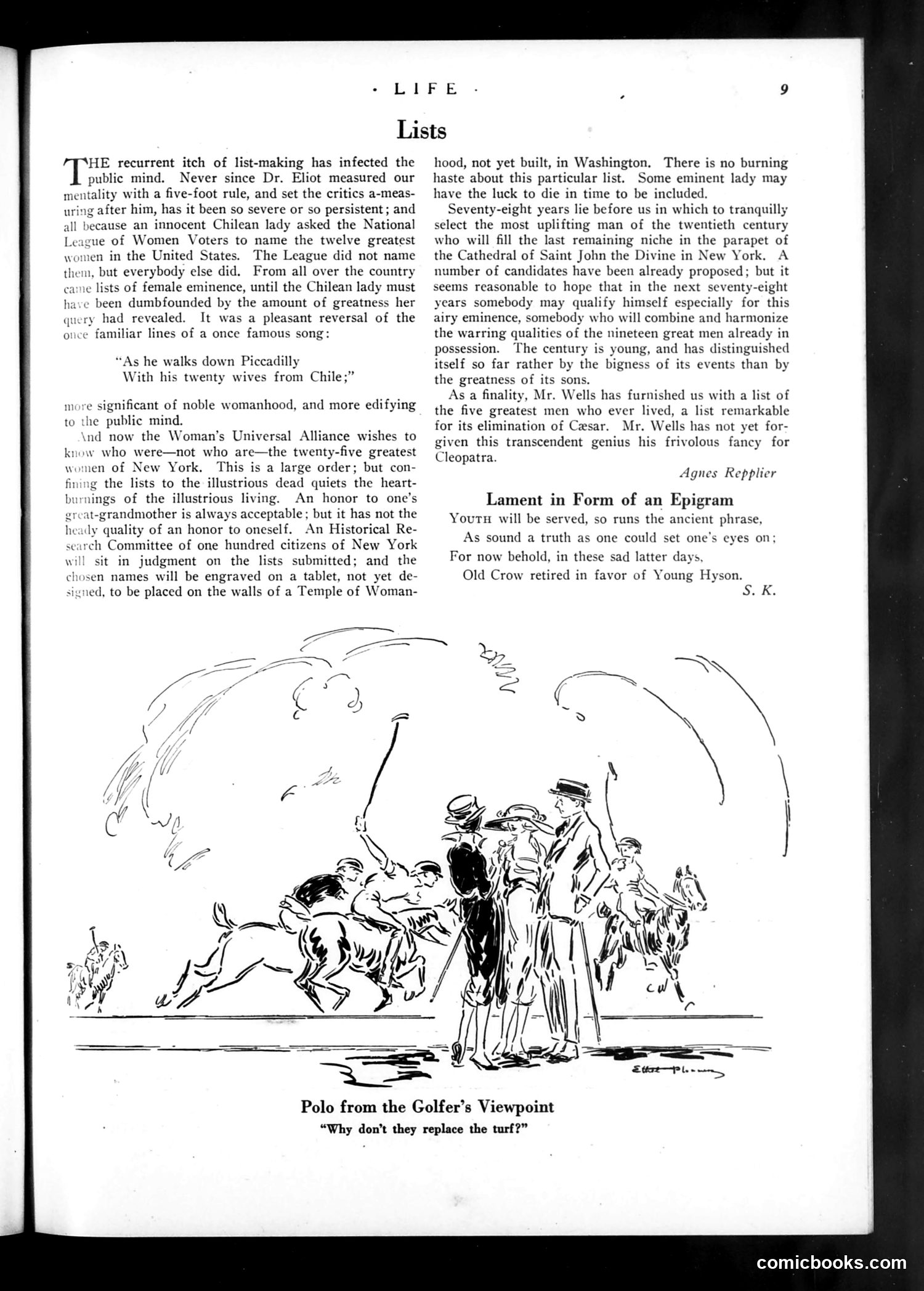
This page contains two distinct pieces: an essay on "Lists" and a cartoon titled "Polo from the Golfer's Viewpoint." **The Essay** discusses the public obsession with list-making, referencing Dr. Eliot's "five-foot rule" for measuring culture. It humorously critiques attempts to rank society's greatest women and men, noting the absurdity of such endeavors. **The Cartoon** shows polo players mid-game while spectators stand nearby. The caption—"Why don't they replace the turf?"—presents a golfer's complaint, satirizing the sporting priorities of wealthy New Yorkers. The joke assumes polo fields and golf courses compete for the same social real estate, mocking how the upper class allocates prime land to fashionable sports rather than practical grounds maintenance.
📄 Transcribed text from this page (OCR, searchable)
Machine-transcribed from the original scan — historical spelling and the odd misread are preserved.
- LIFE Lists HE recurrent itch of list-making has infected the public mind. Never since Dr. Eliot measured our mentality with a five-foot rule, and set the critics a-meas- uring after him, has it been so severe or so persistent; and all ause an innocent Chilean lady asked the National League of Women Voters to name the twelve greatest women in the United States. The League did not name them, but everybody else did. From all over the country cane lists of female eminence, until the Chilean lady must have been dumbfounded by the amount of greatness her query had revealed. It was a pleasant reversal of the once familiar lines of a once famous song: “As he walks down Piccadilly With his twenty wives from Chile;” e significant of noble womanhood, and more edifying the public mind. nd now the Woman's Universal Alliance wishes to v who were—not who are—the twenty-five greatest omen of New York. This is a large order; but con- g the lists to the illustrious dead quiets the heart- rnings of the illustrious living. An honor to one’s at-grandmother is always acceptable ; but it has not the ly quality of an honor to oneself. An Historical Re- ch Committee of one hundred citizens of New York sit in judgment on the lists submitted; and the en names will be engraved on a tablet, not yet de- sned, to be placed on the walls of a Temple of Woman- hood, not yet built, in Washington. There is no burning haste about this particular list. Some eminent lady may have the luck to die in time to be included. Seventy-eight years lie before us in which to tranquilly select the most uplifting man of the twentieth century who will fill the last remaining niche in the parapet of the Cathedral of Saint John the Divine in New York. A number of candidates have been already proposed; but it seems reasonable to hope that in the next seventy-eight years somebody may qualify himself especially for this airy eminence, somebody who will combine and harmonize the warring qualities of the nineteen great men already in possession. The century is young, and has distinguished itself so far rather by the bigness of its events than by the greatness of its sons. As a finality, Mr. Wells has furnished us with a list of the five greatest men who ever lived, a list remarkable for its elimination of Cesar. Mr. Wells has not yet for- given this transcendent genius his frivolous fancy for Cleopatra. Agnes Repplier Lament in Form of an Epigram Youtu will be served, so runs the ancient phrase, As sound a truth as one could set one’s eyes on; For now behold, in these sad latter days, Old Crow retired in favor of Young Hyson. S. K. Polo from the Golfer’s Viewpoint “Why don’t they replace the turf?” comicbooks.com