
A complete issue · 36 pages · 1922
Life — October 5, 1922
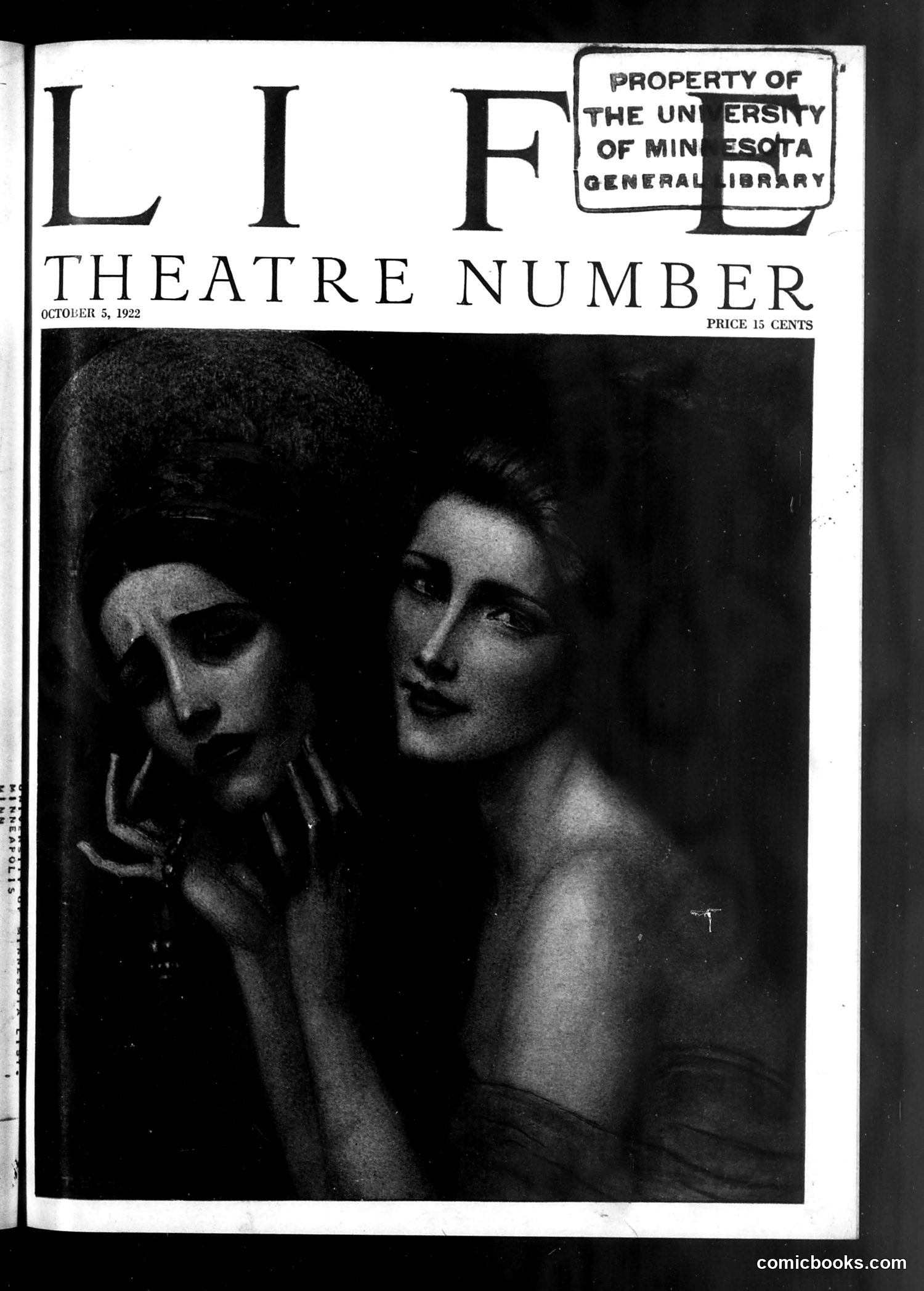
This is the cover of Life magazine's "Theatre Number" special issue from October 5, 1922, priced at 15 cents. The image shows a dramatic theatrical portrait of two figures in profile against a dark background—one wearing an ornate mask or costume piece on the left, the other a woman's face on the right, both rendered in high-contrast black and white photography typical of theatrical promotional imagery from the 1920s. The cover appears to promote theatrical productions of that era rather than containing political satire. The styling and composition suggest this showcases contemporary stage performances, likely drama or classic theatre adaptations popular in early 1920s American theater. Without additional text identifying the specific production or performers, the exact theatrical reference remains unclear.
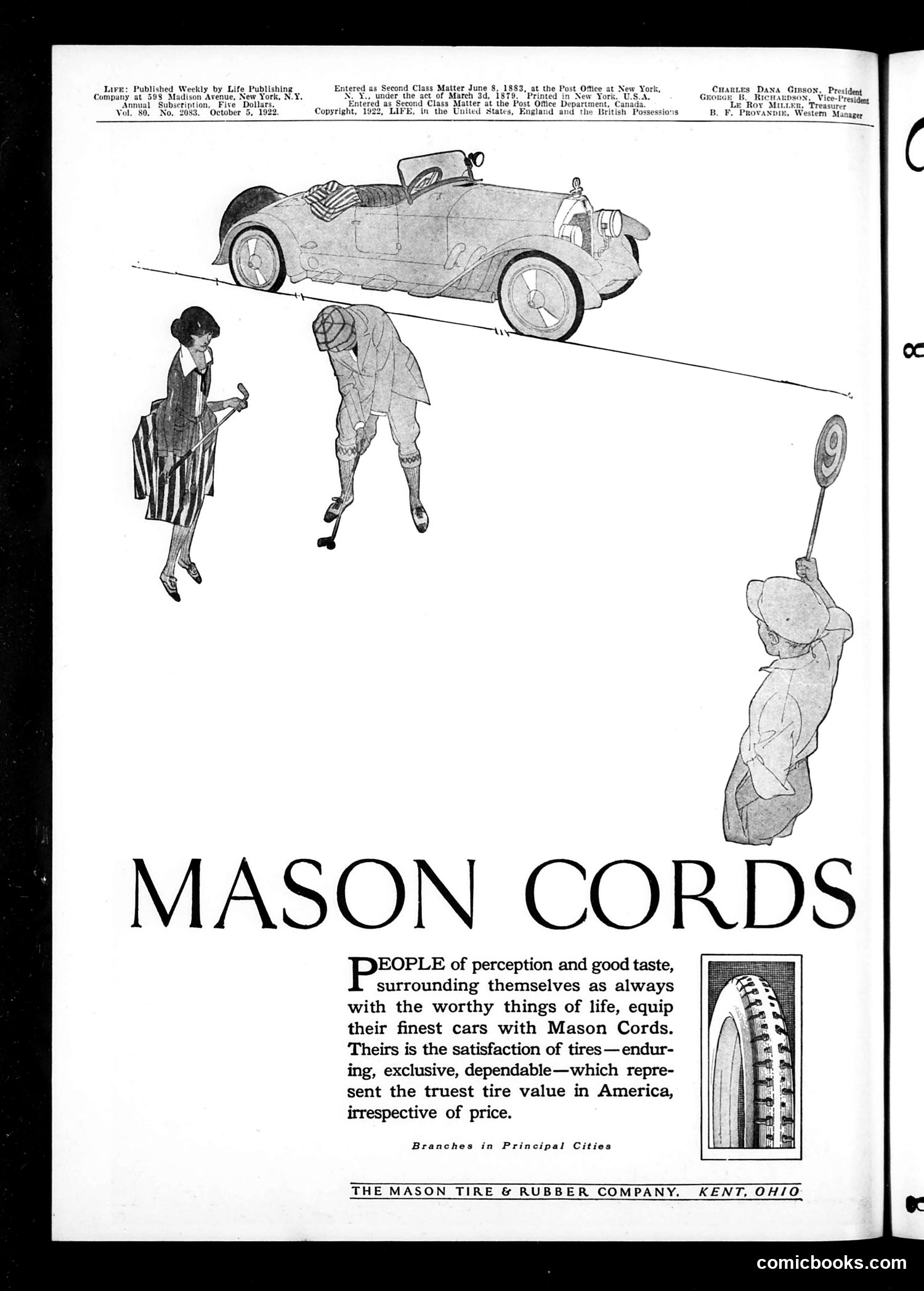
This page is primarily a **Mason Cords tire advertisement** from 1922, not a political cartoon. The image shows a stylized, humorous illustration of a car with two figures appearing to jump or fly alongside it—likely depicting enthusiastic customers or the exhilaration of driving with Mason Cords tires. The advertisement's appeal relies on the **1920s cultural moment**: automobiles were still relatively novel luxury items, and this "people of perception and good taste" messaging suggests aspirational marketing to the middle and upper classes. The flying figures humorously emphasize the tire's quality and performance as a status symbol worth purchasing. The satirical elements are mild—primarily visual humor rather than social commentary. This is commercial advertising rather than editorial satire.
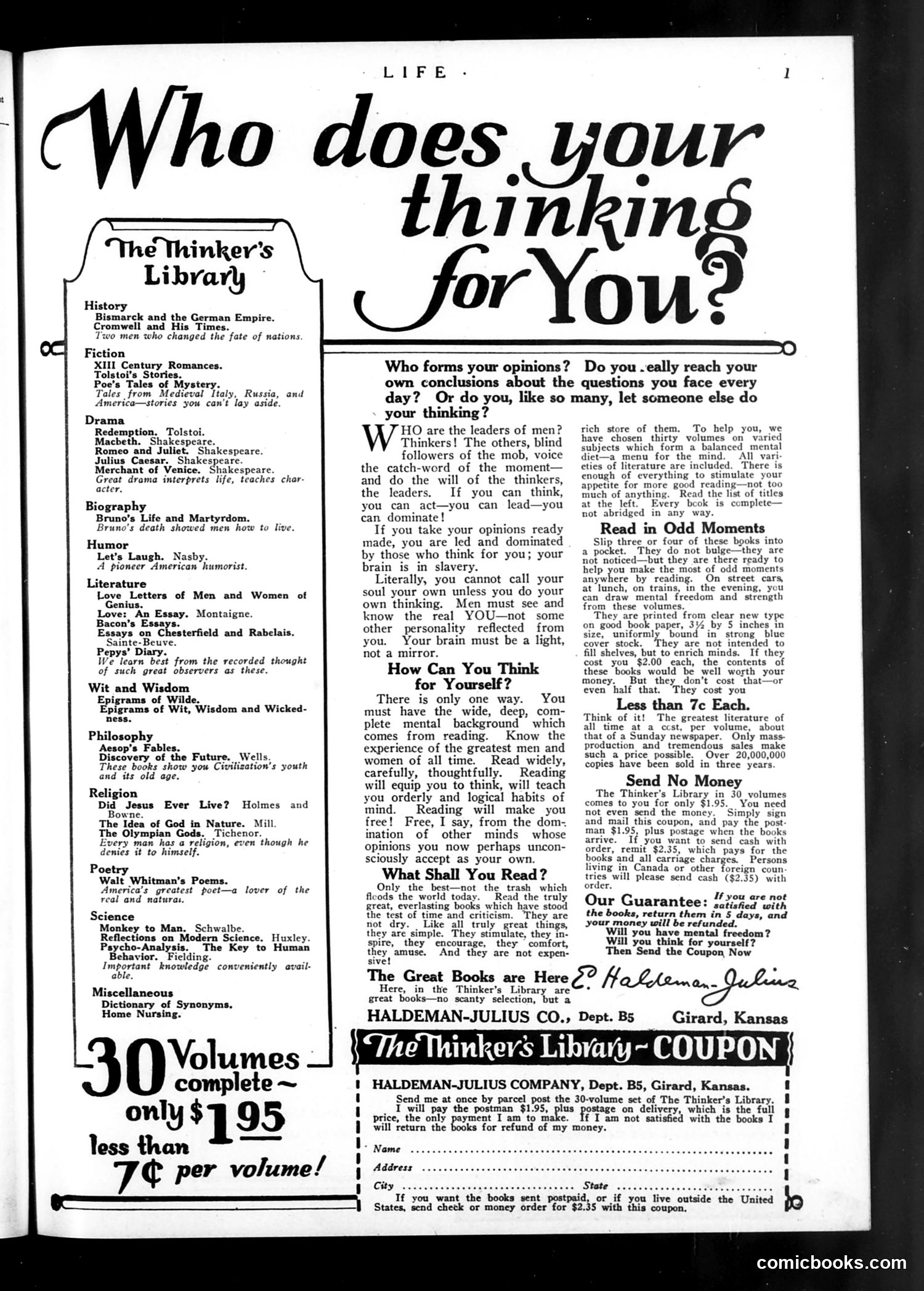
This page is primarily **advertising for "The Thinker's Library,"** a 30-volume book collection sold by Haldeman-Julius Co. for $1.95 (about 7¢ per volume). The main content isn't a political cartoon but rather a sales pitch disguised as advice. The headline "Who does your thinking for you?" challenges readers to think independently rather than blindly following leaders or "the mob." The text argues that independent thinking—achieved through reading great literature, philosophy, and biography—gives people power and freedom from intellectual slavery to others' opinions. This reflects **early 20th-century populist and progressive attitudes** about education democratizing society. The advertisement positions cheap books as tools for intellectual liberation, appealing to aspirational readers who wanted self-improvement and independence from establishment thinking.
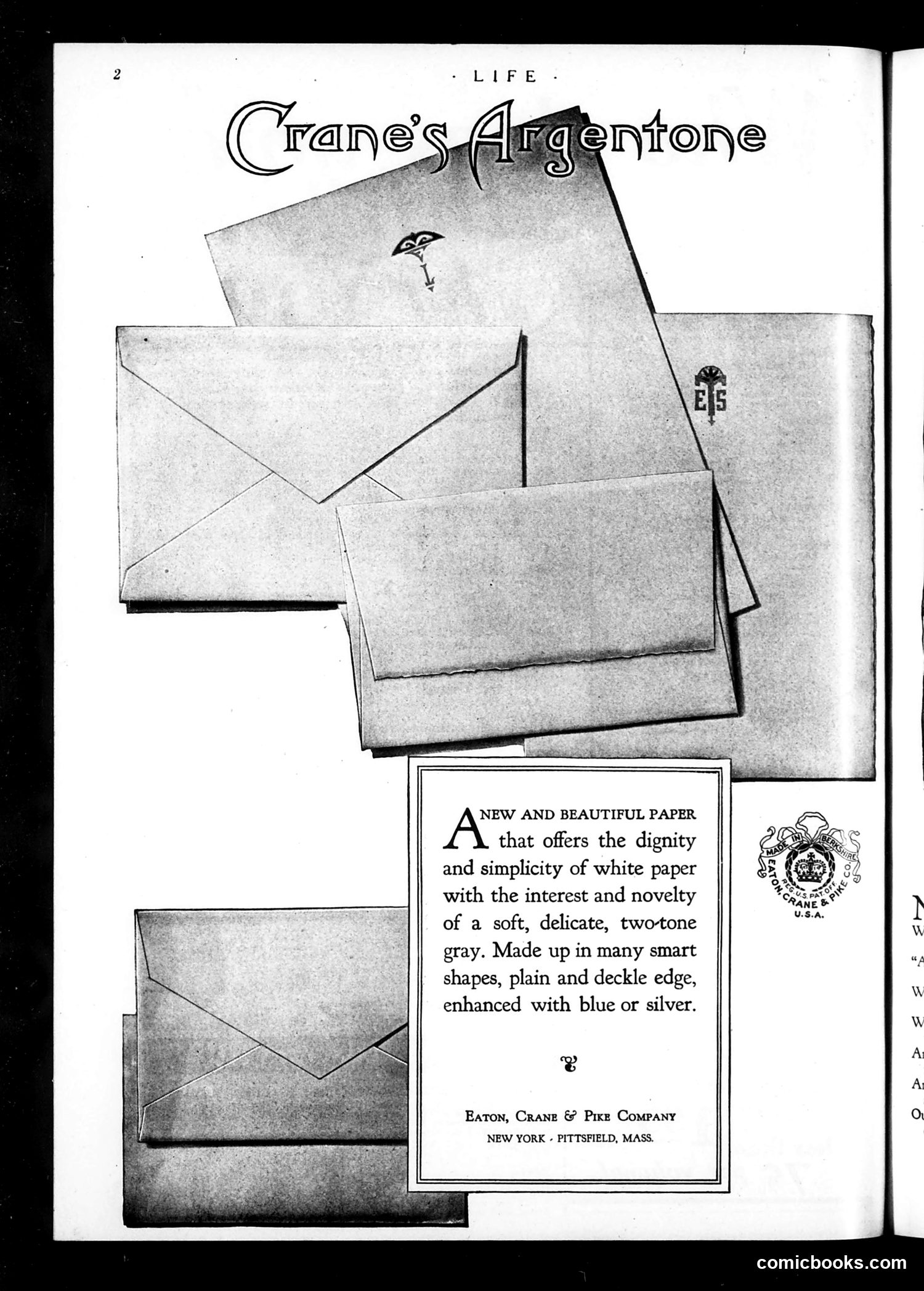
This page is primarily **advertising, not political satire**. The header "Crane's Argentone" advertises a new paper product from Eaton, Crane & Peek Company (New York and Pittsburgh, Mass.). The advertisement describes "Argentone" as a novel stationery combining "the dignity and simplicity of white paper with the interest and novelty of a soft, delicate, two-tone gray." The images show various envelope and letter formats made from this paper, available in plain or deckle-edged styles, enhanced with blue or silver accents. The small crane logo appears to be the company's trademark. There is no political cartoon or satire present on this page—it is straightforward commercial promotion for luxury writing paper popular among the affluent during this era.
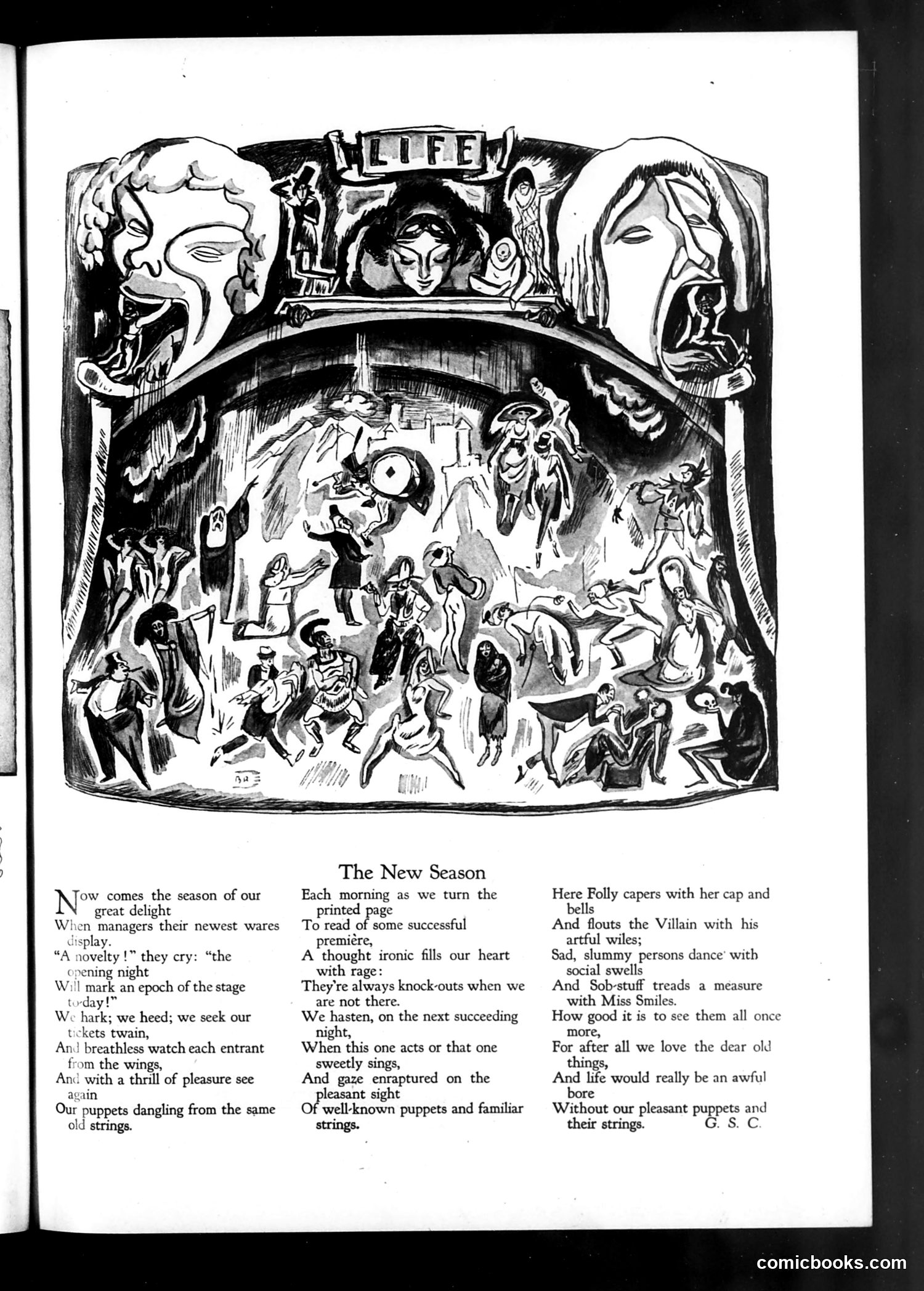
This page satirizes the theatrical season's opening, when new plays debut. The illustration shows a chaotic stage scene with various character types performing—dancers, comedians, and dramatic players—watched by an audience below. The poem by G.S.C. mocks predictable theatrical formulas: producers recycling "knock-outs" that never succeed, audiences knowing exactly what they'll see ("well-known puppets and familiar strings"), yet returning anyway because they love the familiar entertainment despite its staleness. The grotesque masks framing the top represent theatrical drama and comedy. The satire targets both producers for repetitive programming and audiences for accepting mediocrity—the entire theatrical industry perpetuating itself through habit rather than innovation.
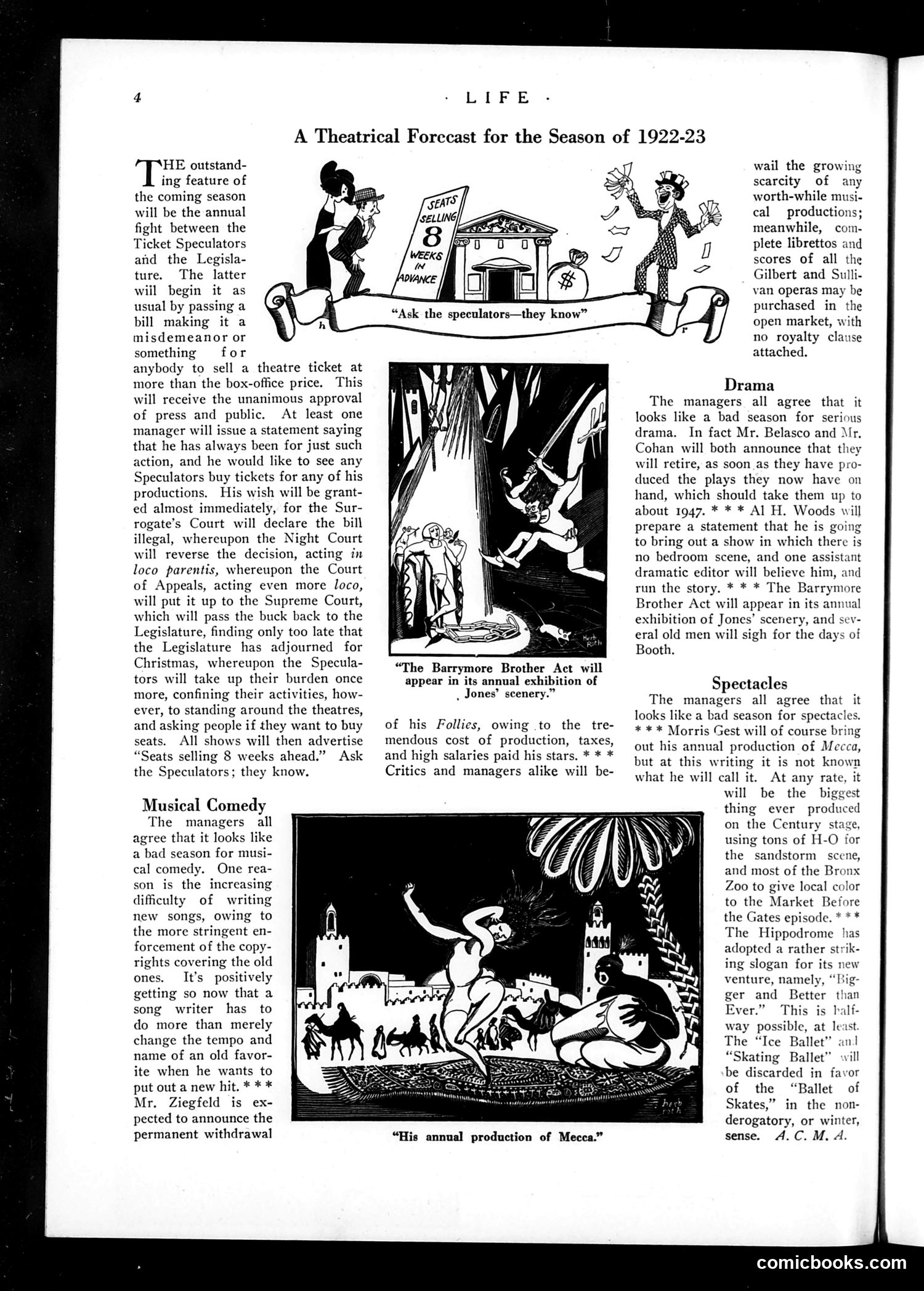
This satirical article uses cartoon illustrations to mock upcoming Broadway productions. The top cartoon shows theatrical speculators ("Ask the speculators—they know") advertising an 8-week advance sale—satirizing ticket scalping and speculation practices. The middle illustration depicts a dramatic scene from what appears to be a serious play, mocking the prevalence of melodrama. The bottom cartoon shows an elaborate production number for "His annual production of Mecca," likely referencing a specific lavish spectacle production. The text criticizes producers for relying on expensive production values, high-paid stars, and recycled material rather than original work. The satire targets both theatrical economics (scalping, royalty disputes) and artistic decline—suggesting Broadway was prioritizing spectacle and profit over dramatic quality during this 1922-23 season.
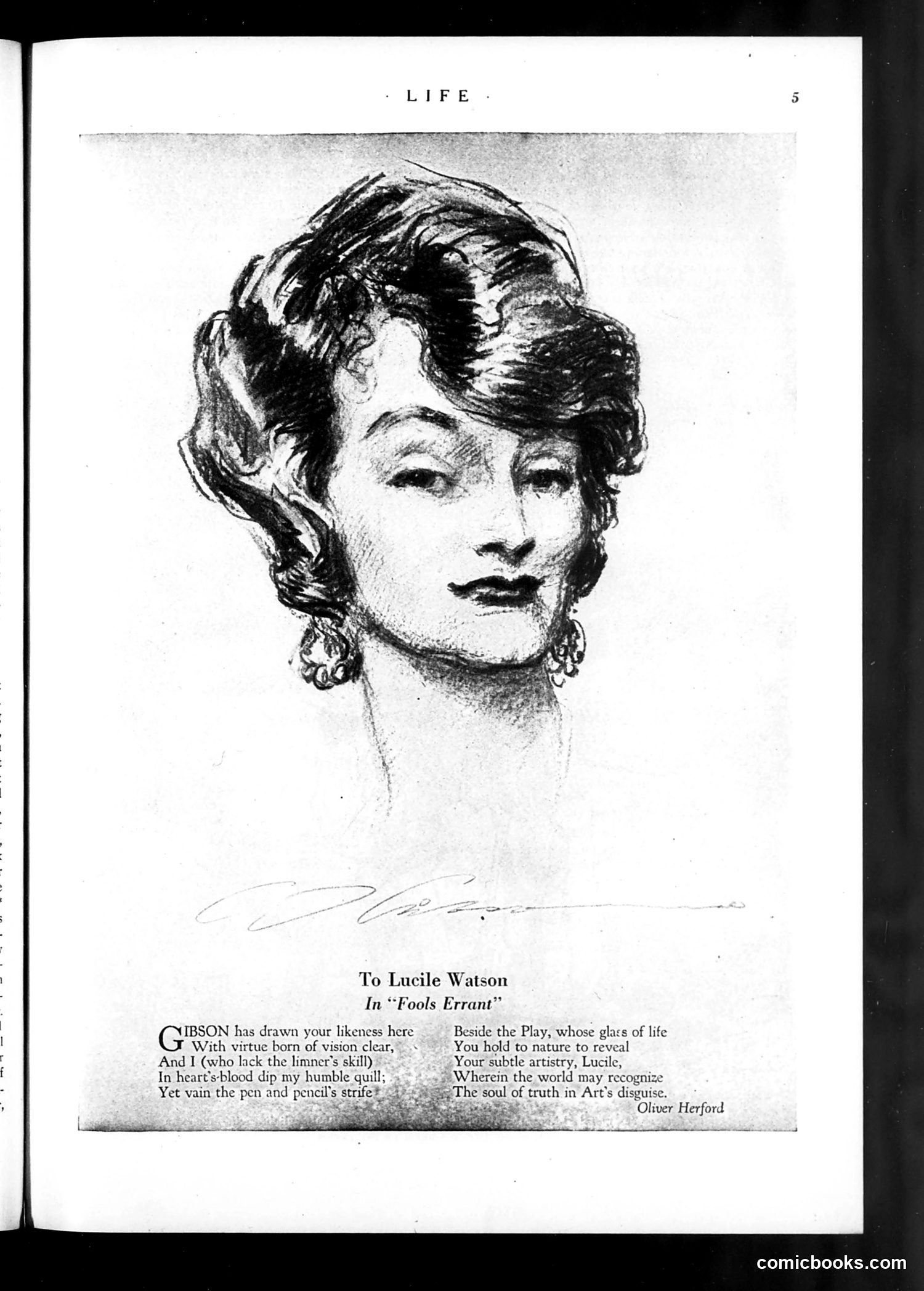
This page features a portrait sketch dedicated to actress **Lucile Watson**, accompanied by a poem titled "In 'Fools Errant'" credited to **Oliver Herford**. The sketch is a classical line drawing showing a woman's head in three-quarter view, rendered in a refined style typical of early 20th-century magazine portraiture. The poem praises Watson's acting abilities, noting that Gibson (the artist) has captured her likeness with "virtue born of vision clear." Herford's verse compliments her skill in revealing "the soul of truth in Art's disguise," suggesting Watson was known for bringing psychological depth and authenticity to her theatrical roles. This appears to be a **celebrity tribute page**—common in *Life* magazine—celebrating a prominent stage actress of the era.
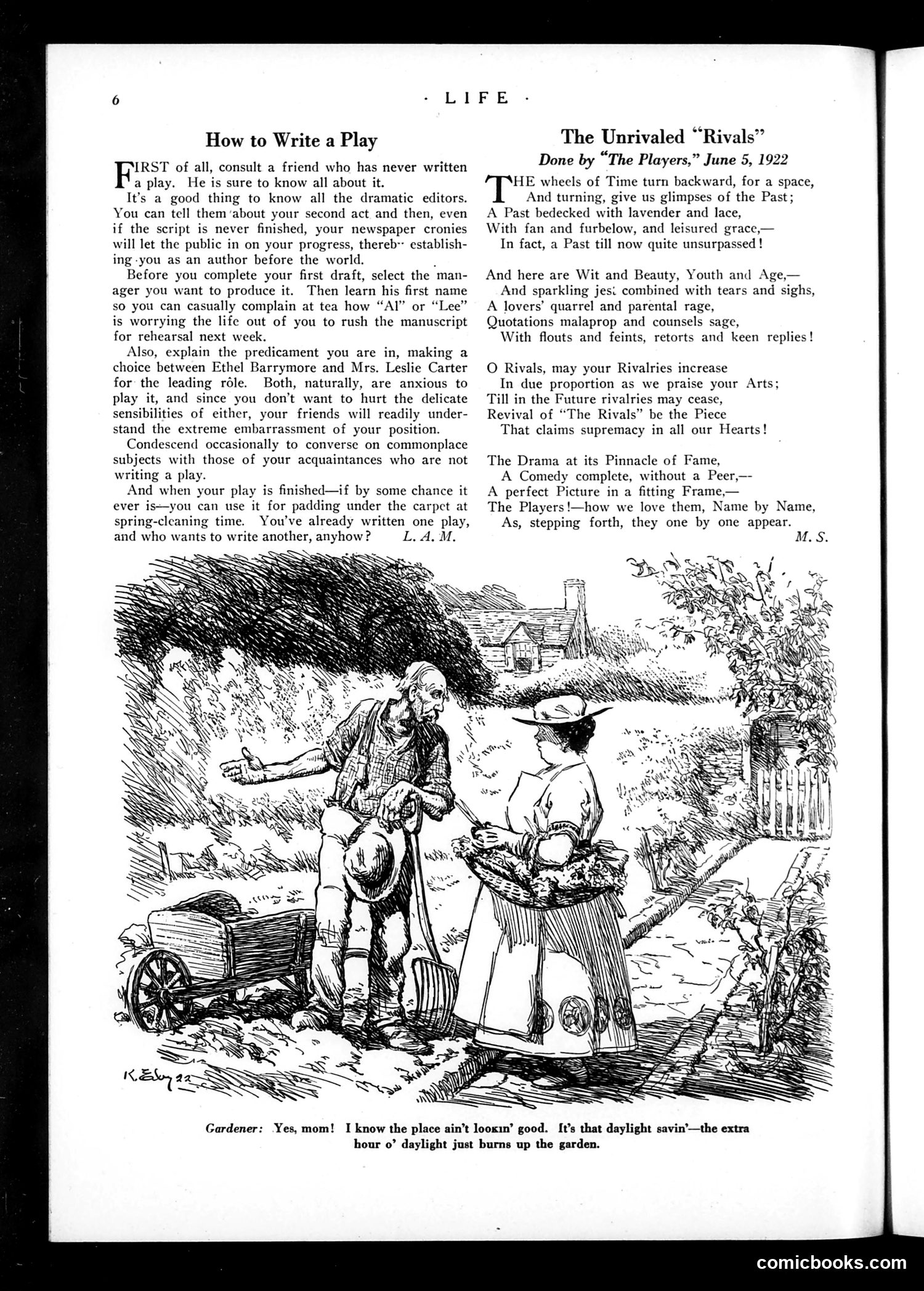
This page contains two separate pieces from *Life* magazine (circa 1922): **"How to Write a Play"** (left column): A humorous advice article signed "L.A.M." mocking aspiring playwrights. It satirizes the pretentiousness of would-be authors by suggesting they consult dramatic editors and network with theater managers—implying most amateur plays are mediocre padding material. **"The Unrivaled 'Rivals'"** (right): A poem by M.S. celebrating *The Flayers* theater company's production of Sheridan's classic play "The Rivals" (1775). It praises the production's wit, romance, and comedic execution. **The cartoon below** depicts a gardener complaining to his employer (a woman) about daylight saving time, claiming the extra daylight hour "burns up the garden." This reflects early 20th-century working-class skepticism about daylight saving time as a productivity measure.
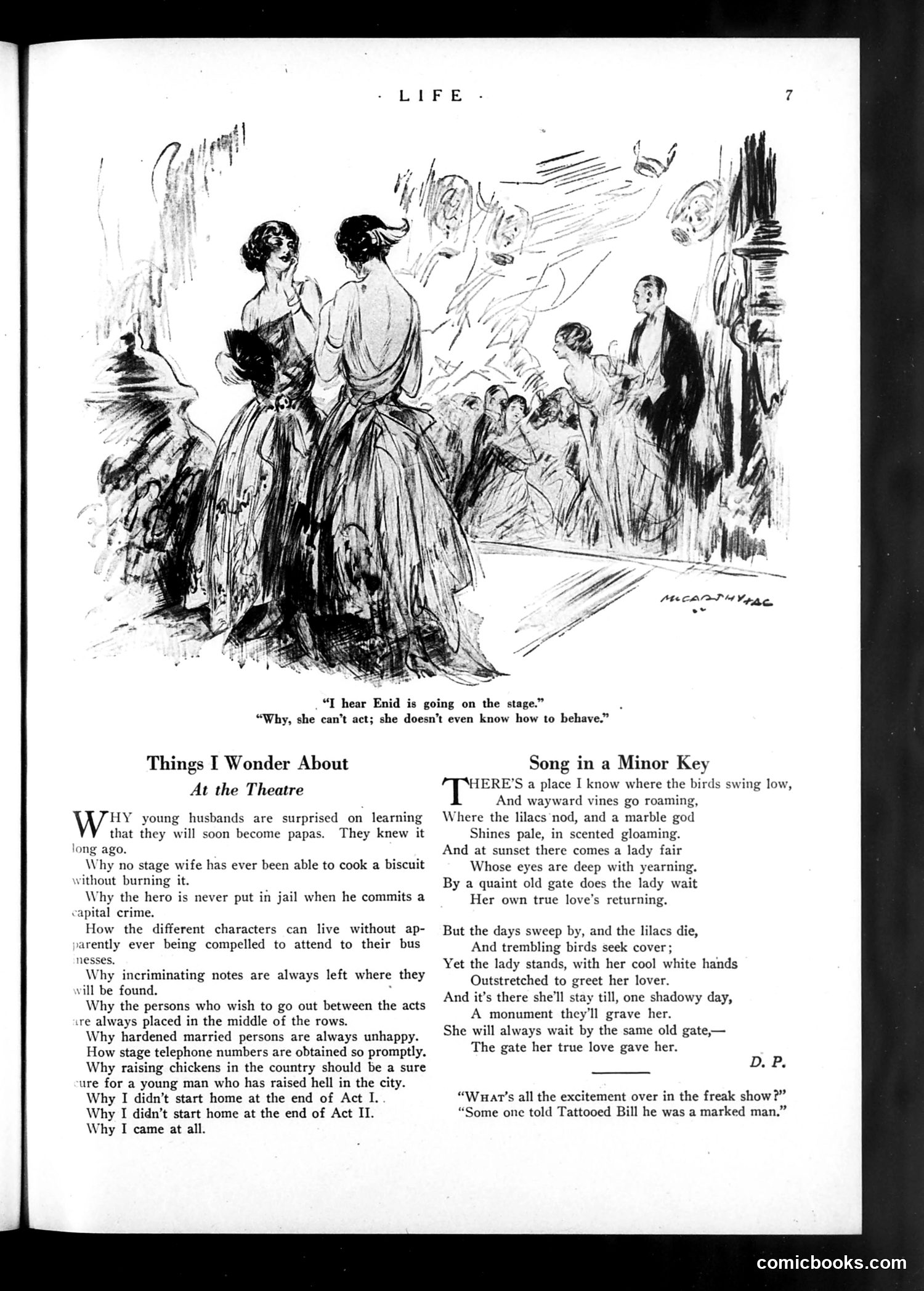
This page contains a theatrical sketch and two literary pieces rather than political commentary. The **illustration** depicts a theater scene where two elegantly dressed women are critiquing an actress. The caption reads: "Why, she can't act; she doesn't even know how to behave." This satirizes the social pretension of theatergoers who judge performers based on comportment and manners rather than genuine acting ability—a common target of satirical humor about upper-class audiences. Below, **"Things I Wonder About At the Theatre"** is a humorous list questioning theatrical absurdities: implausible plot devices (heroes never jailed for crimes), backstage logistics, and audience behavior. The **poem "Song in a Minor Key"** is a romantic narrative about a faithful lady awaiting her lover by a gate—unrelated to the satire above. The page satirizes Victorian theatrical culture and audience pretension.
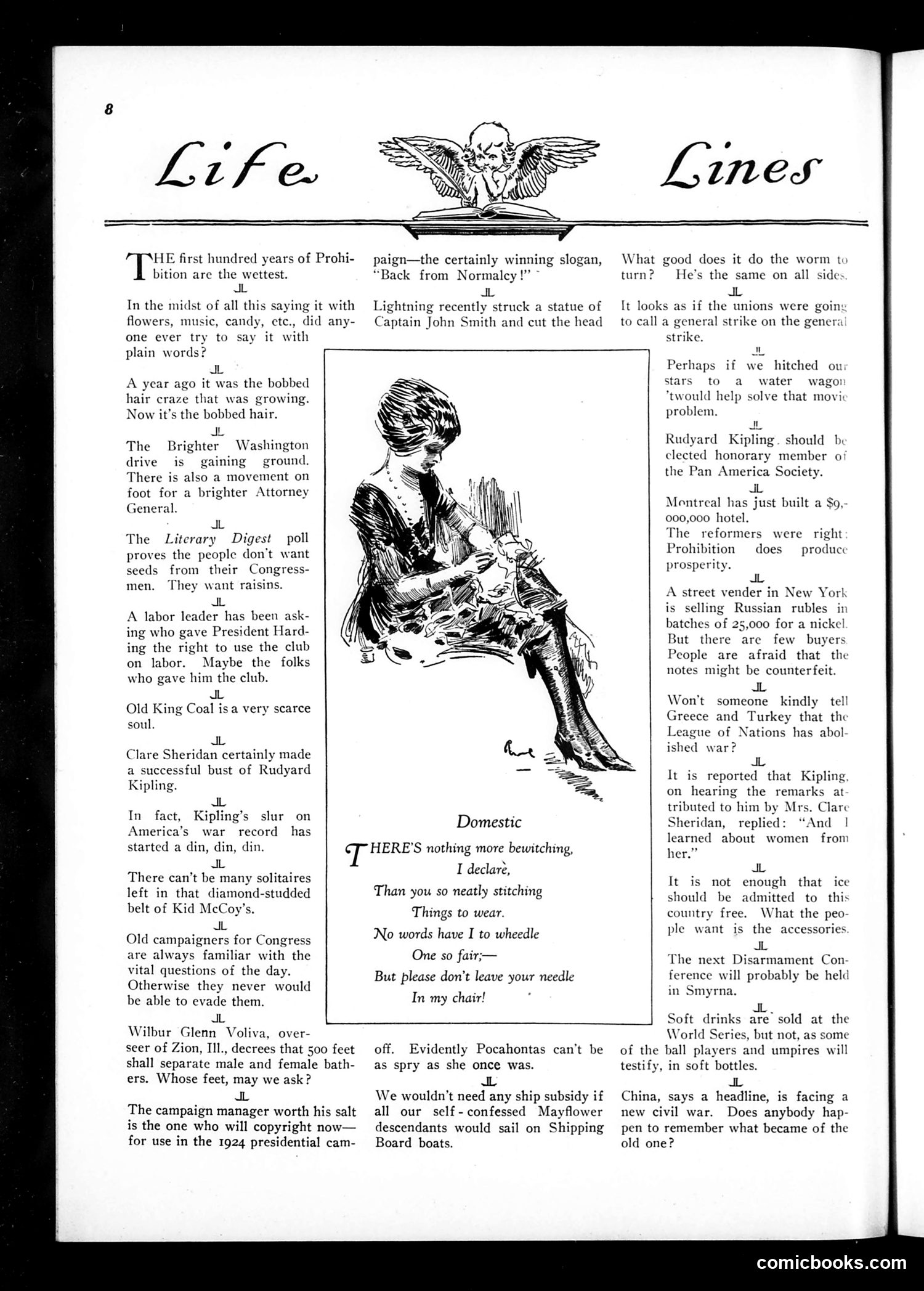
This page from *Life* magazine contains a central illustration titled "Domestic" depicting a woman sewing, accompanied by period verse celebrating domestic needlework. The surrounding "Life Lines" column offers brief satirical commentary on contemporary topics. The visible jokes reference: - Prohibition's first hundred years being "the wettest" - A bobbed hair craze from a year prior - A Literary Digest poll about raisins vs. seeds - Labor disputes over President Harding's club-use policies - Kipling's negative views on America's wartime record - A Pocahontas reference suggesting she's "less spry" now - Mayflower descendants potentially sailing "Shipping Board boats" The domestic verse appears ironic—celebrating traditional women's roles while the surrounding commentary reflects 1920s social upheaval around labor, gender, and politics.
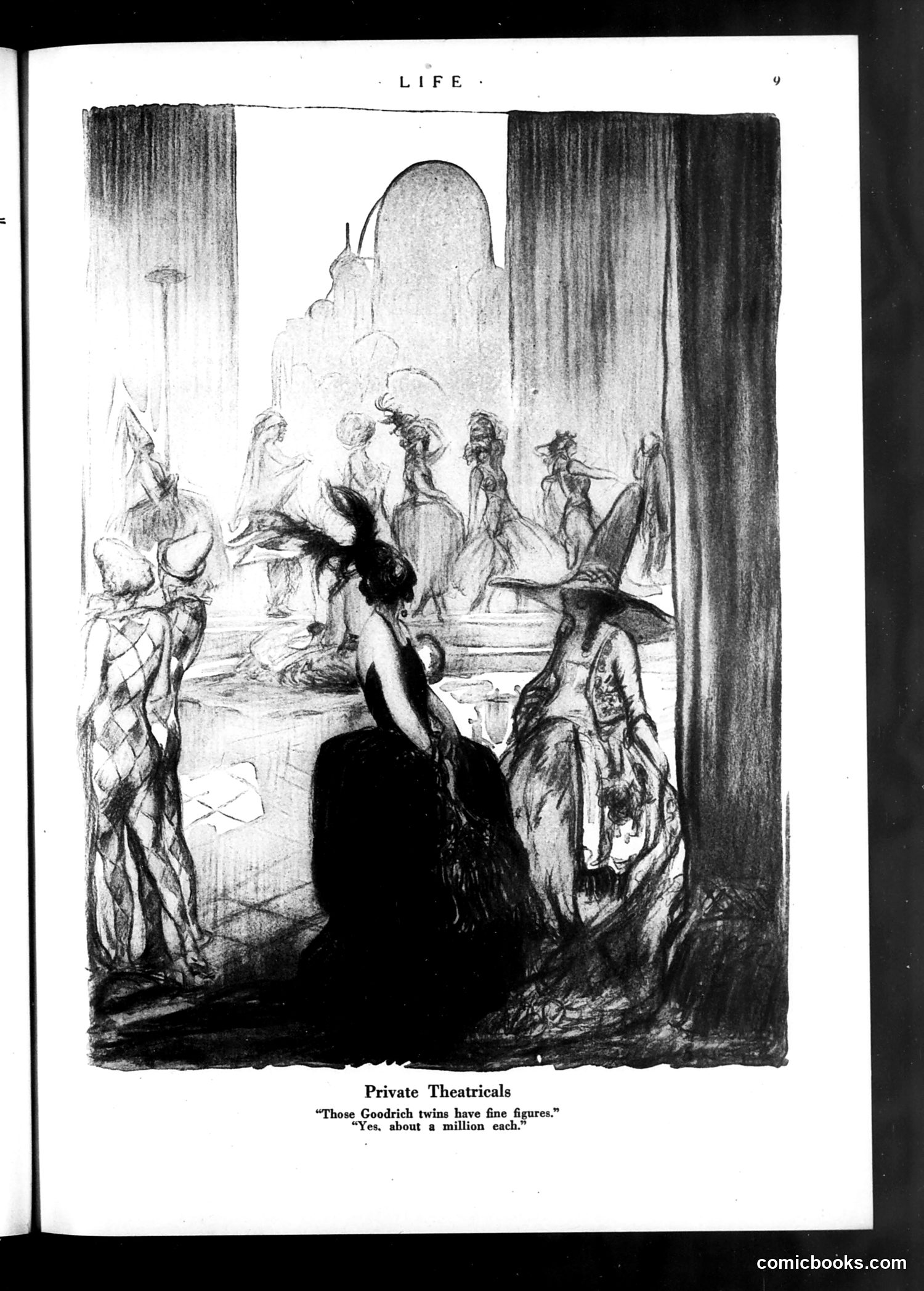
This cartoon satirizes wealthy individuals staging elaborate private theatrical productions. The silhouetted figure in the foreground watches a theatrical performance with costumed performers on stage, while ornate curtains frame the scene. The caption references "the Goodrich twins" and their considerable wealth ("about a million each"), suggesting this depicts wealthy socialites entertaining themselves with expensive private theatrical productions. The joke appears to target the extravagance of the ultra-wealthy who could afford to stage elaborate plays purely for private entertainment—a luxury that would strike ordinary readers as absurdly decadent. The cartoon satirizes both the conspicuous consumption of the wealthy and the frivolous nature of their leisure activities during an era when most Americans could not afford such extravagance.
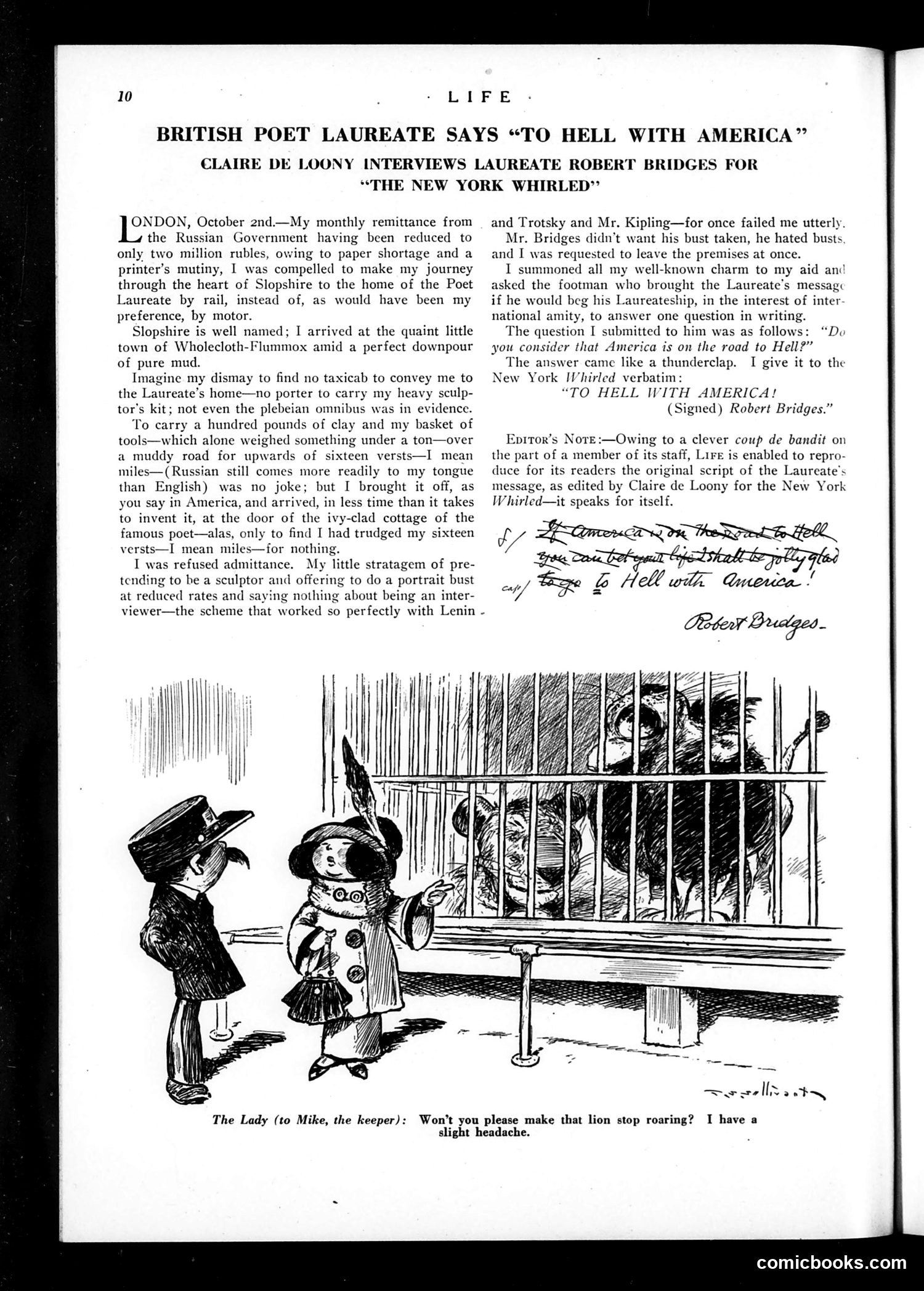
This page features an interview with British Poet Laureate Robert Bridges regarding his critical statement "To Hell with America." The handwritten quote visible in the image confirms Bridges made this inflammatory remark. The accompanying cartoon satirizes the complaint through a domestic scene: a woman asks a zookeeper to silence a roaring lion because she has a headache. The joke draws a parallel—just as the woman finds the lion's noise unbearable, so too do Americans find Bridges' harsh criticism intolerable. The cartoon mocks both Bridges' outburst and America's sensitive reaction to foreign criticism. The "New York Whirled" subtitle suggests Life magazine is presenting this as sensationalized news coverage typical of yellow journalism.
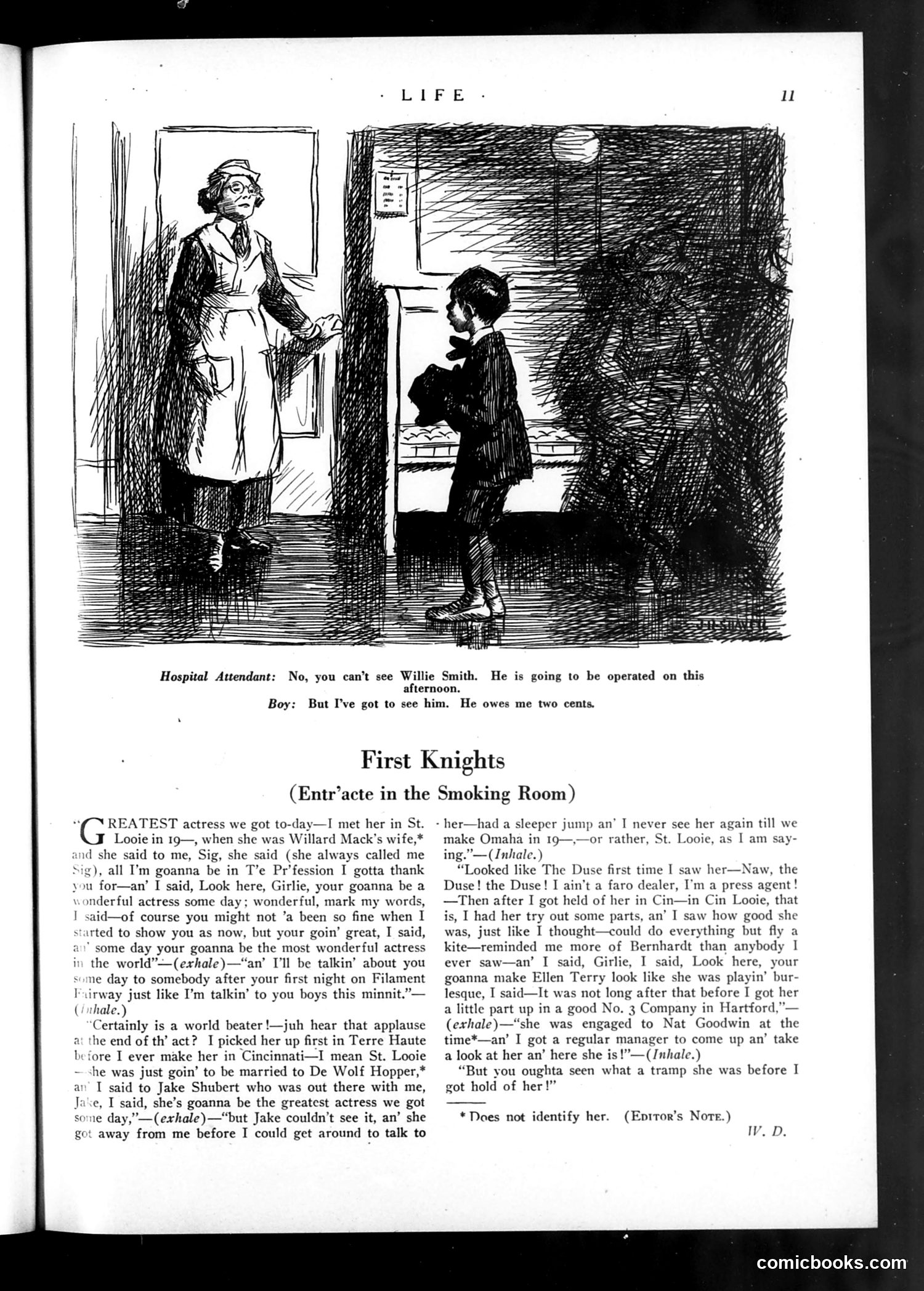
The top cartoon shows a hospital scene where a boy wants to visit Willie Smith before his afternoon operation, claiming Smith owes him two cents. The attendant refuses. The lower section, titled "First Knights (Entr'acte in the Smoking Room)," is a theatrical anecdote. The narrator discusses a great actress he met in St. Louis around 1912—likely referring to Ellen Terry or similar stage performer. The speaker brags about discovering her talent and predicting her stardom, while a skeptical listener (marked as "exhale") interjects doubts. The humor derives from the boastful narrator's inflated memory of his role in an actress's success, a common type of self-aggrandizing bar-room conversation that Life magazine frequently mocked.
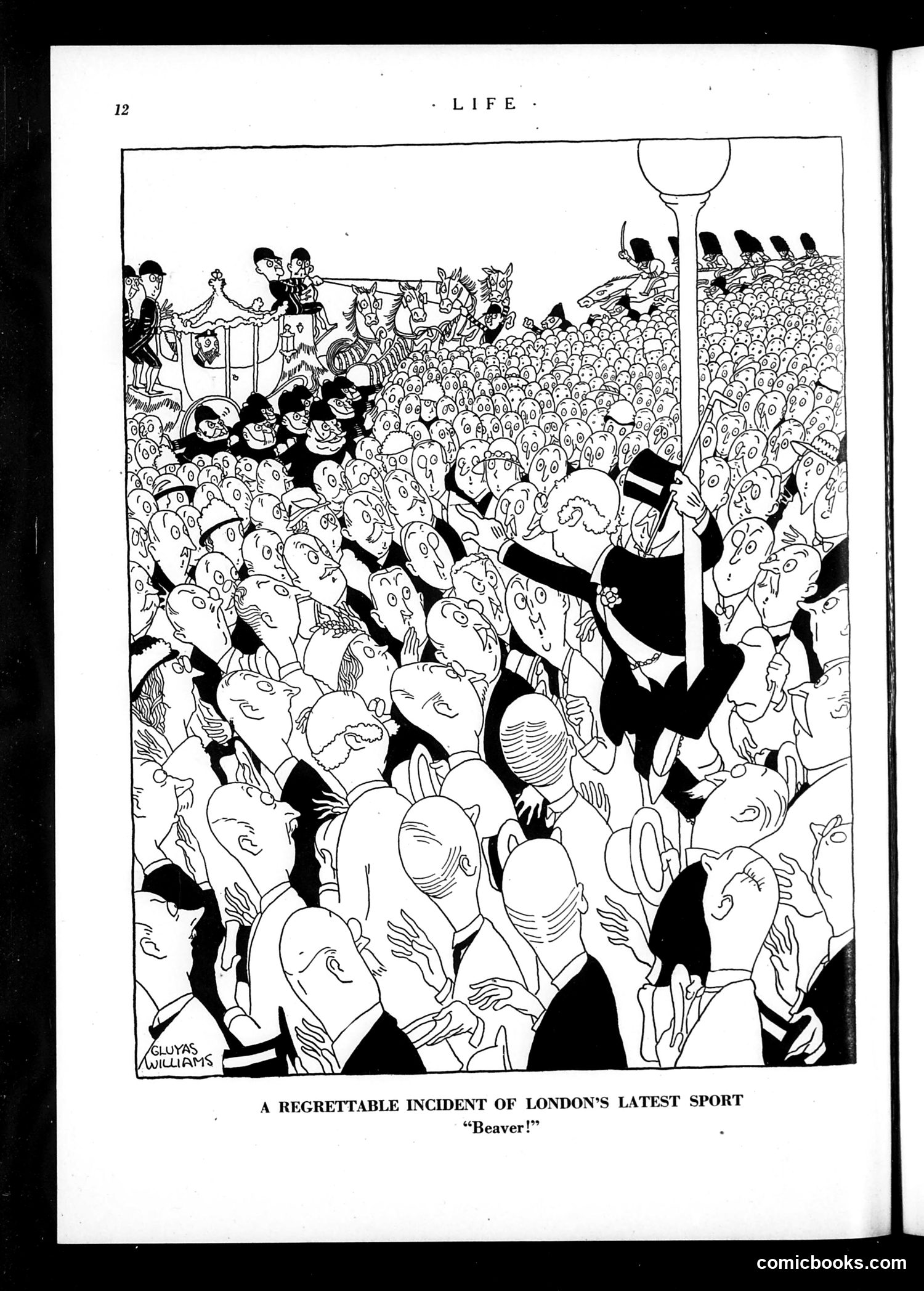
This cartoon satirizes a fad called "Beaver," described as "London's latest sport." The image shows an enormous, densely packed crowd of well-dressed men in formal attire and top hats, with several figures in the center appearing to participate in or demonstrate the sport. The satire targets mob mentality and the arbitrary nature of fashionable trends among the wealthy elite. The "sport" itself remains deliberately unclear—the joke is that Londoners will enthusiastically adopt any fashionable activity, however nonsensical or undignified, simply because it's deemed trendy. The artist (Gluyas Williams, per the signature) mocks how the upper class mindlessly follows fads, creating chaotic crowds around whatever is declared the "latest" thing.
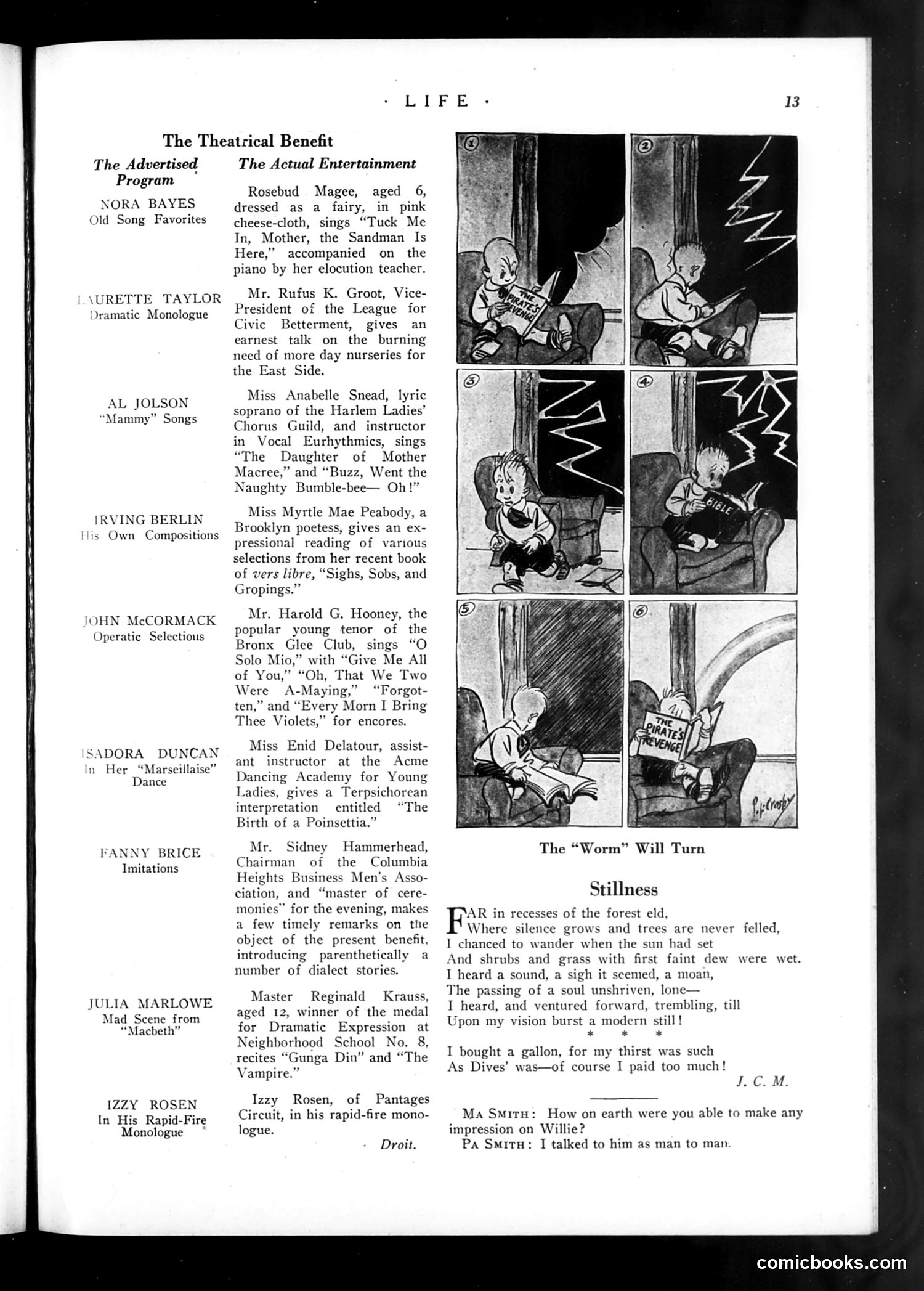
This page documents "The Theatrical Benefit"—a variety show fundraiser for East Side nurseries. The left column lists performers and their acts (singers, monologists, dancers, etc.), while the right side features a six-panel comic strip titled "The 'Worm' Will Turn." The comic depicts a child character who appears to be mischievous or defiant—reading what looks like a forbidden book or material, with lightning bolt symbols suggesting shock or surprise. The panels show escalating chaos or rule-breaking behavior, likely illustrating the saying "even a worm will turn" (meaning even the meek will rebel when pushed too far). This is primarily a program/entertainment listing page rather than political satire. The humor is domestic and child-focused rather than social commentary.
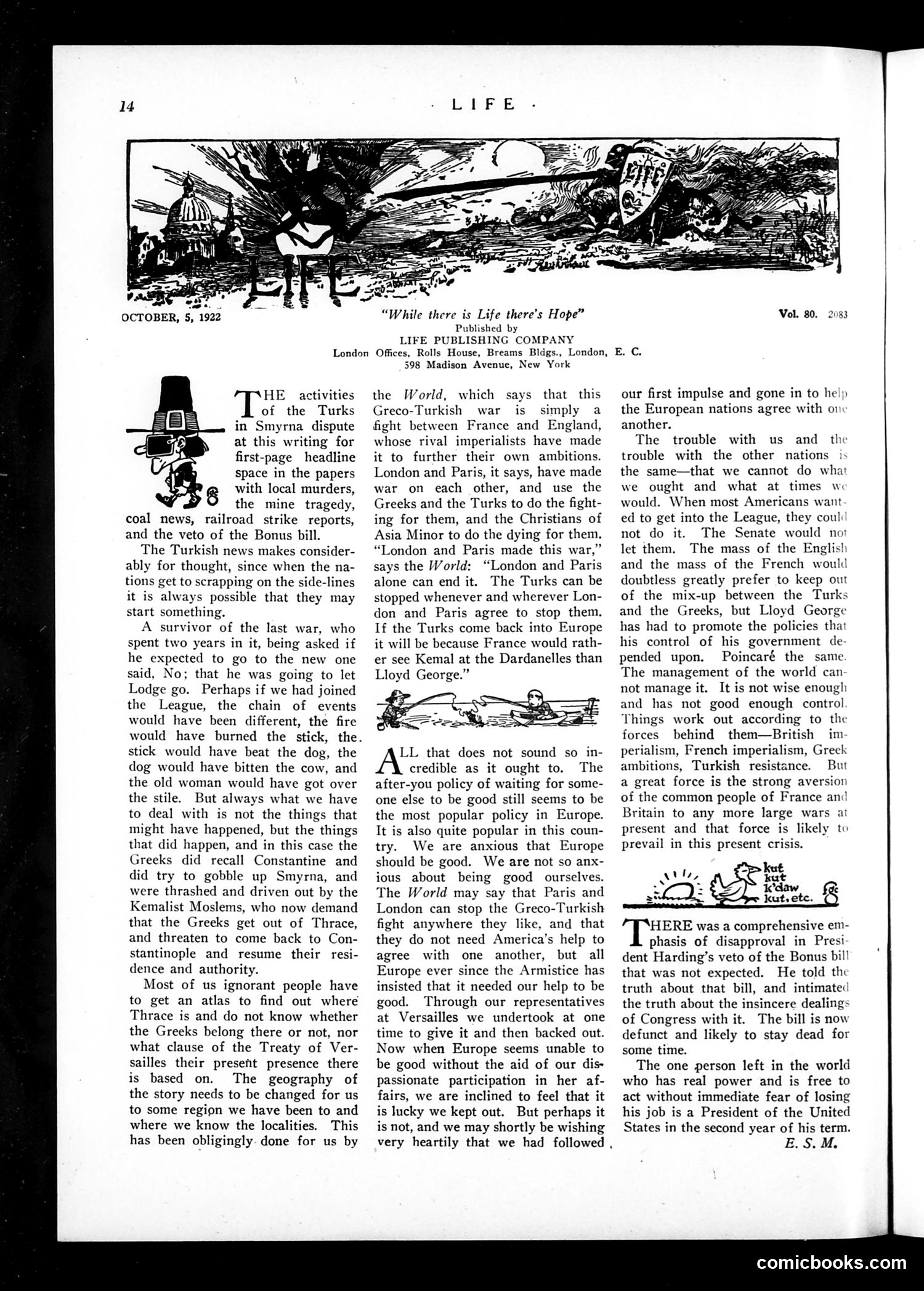
The masthead cartoon depicts a chaotic scene with "LIFE" visible, illustrating the article's theme: European instability following World War I. The main article, "While there is Life there's Hope," discusses the Greco-Turkish conflict and broader European tensions. The author critiques British and French imperialism, arguing their rival ambitions fuel regional conflicts. The piece references Lloyd George's policies and expresses American skepticism about European disputes, suggesting the U.S. should remain uninvolved despite pressure to intervene. A secondary item discusses President Harding's veto of the Bonus Bill for veterans, characterizing it as unpopular but likely to stand. The satirical tone suggests frustration with both European entanglement and domestic political decisions affecting war veterans.
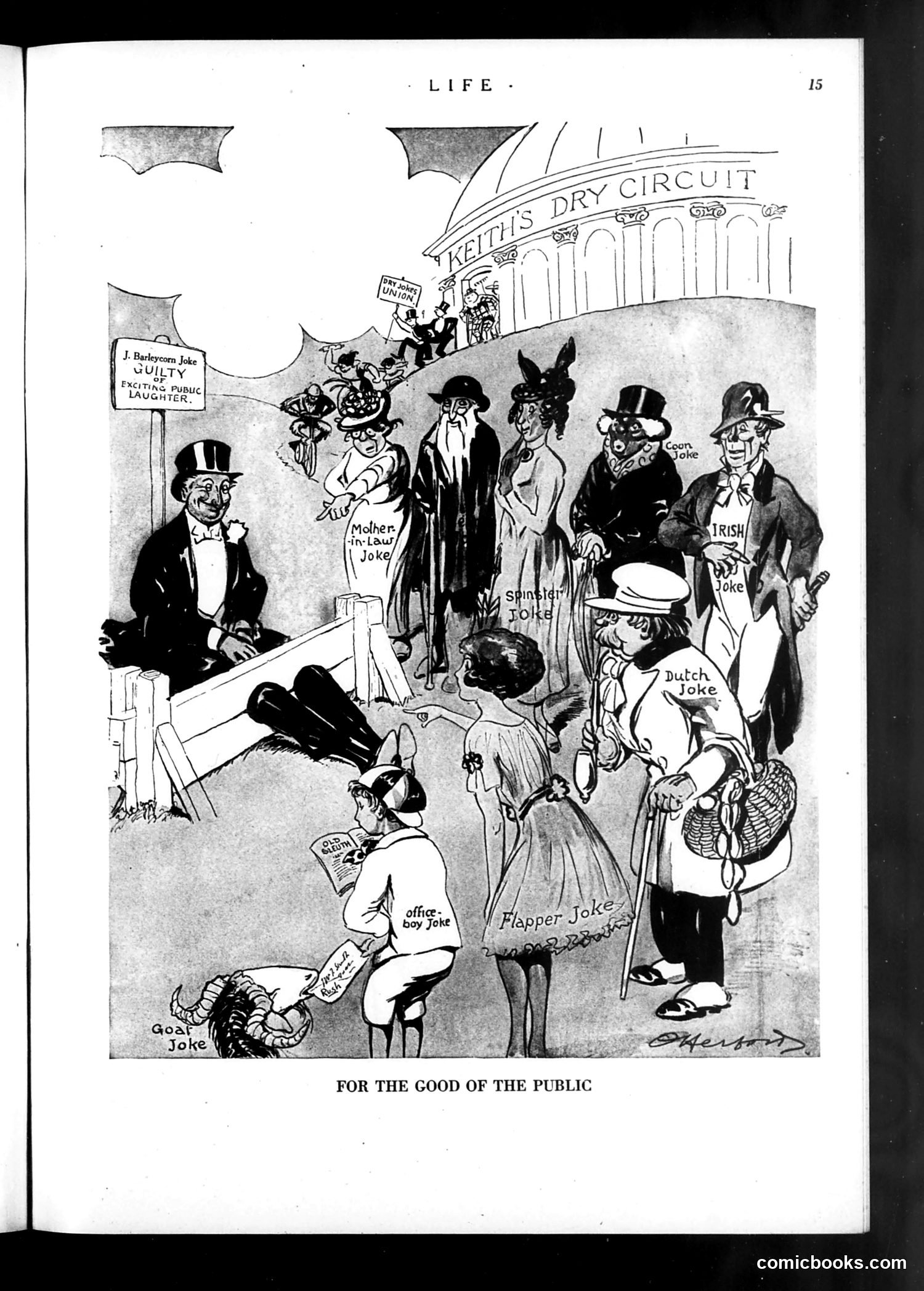
This cartoon satirizes ethnic and national stereotypes through caricatured "joke" figures at what appears to be Keith's Dry Circuit (likely a vaudeville venue). Each character is labeled by stereotype: "Irish Joke," "Dutch Joke," "Scotch Joke," "Springfield Joke," "Flapper Joke," "Office-boy Joke," and "Goat Joke." The setup mocks how entertainment of this era relied on crude ethnic humor and stock character types for laughs. A barker at left advertises "Exciting Laughter," while the crowd gathers to consume these pre-packaged jokes "for the good of the public"—suggesting the satirist is criticizing both the entertainment industry's dependence on stereotypes and the public's appetite for them. The cartoon likely dates to the 1920s, when vaudeville was dominant.
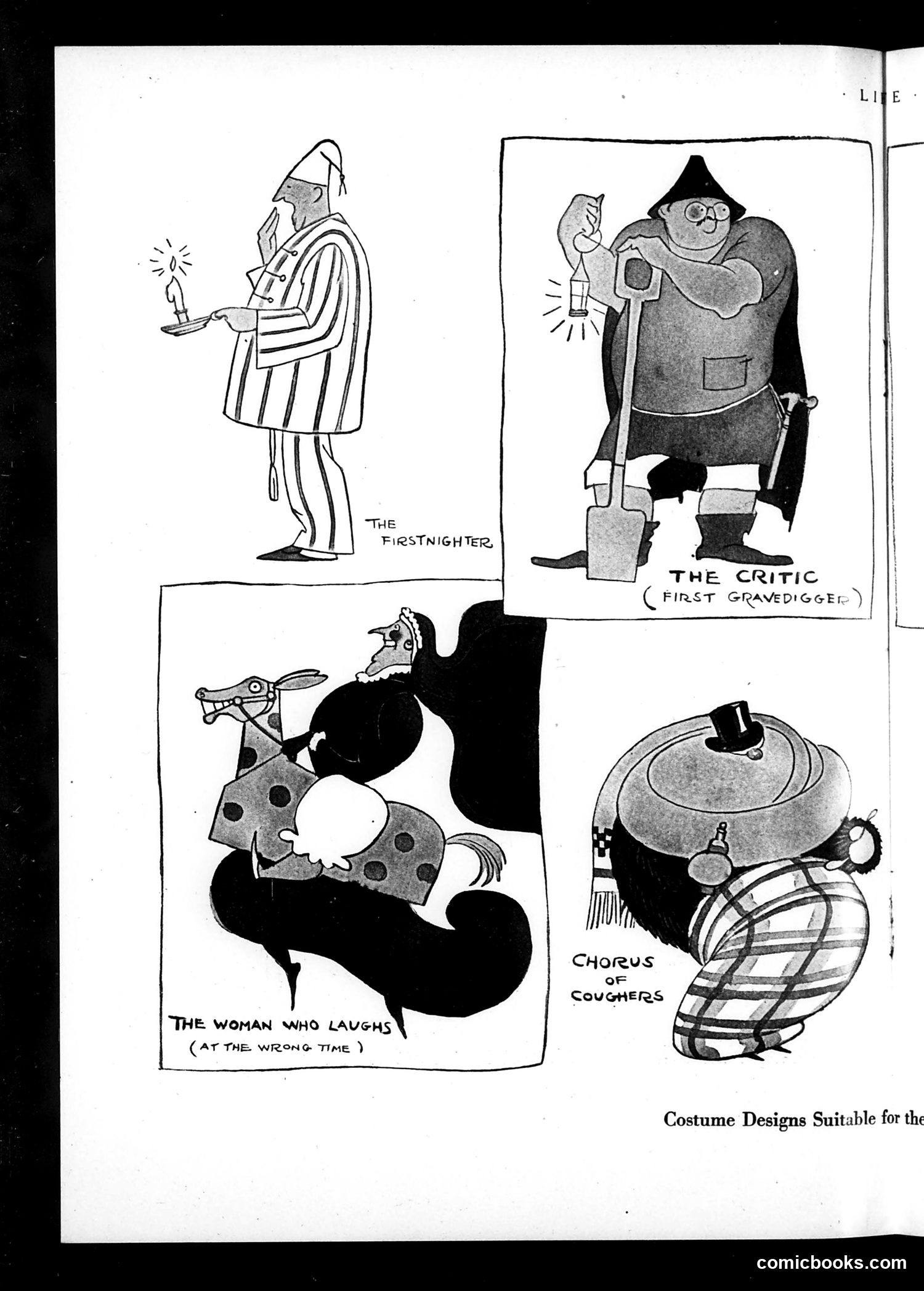
This page presents satirical costume designs for theatrical character types. "The Firstnighter" depicts an enthusiastic theatergoer holding a candle—likely mocking the devoted patron who arrives early and with excessive enthusiasm. "The Critic (First Gravedigger)" shows a rotund, serious figure with tools, suggesting critics as destructive forces in theater. "The Woman Who Laughs (at the Wrong Time)" ridicules female audience members who laugh inappropriately during performances. "Chorus of Coughers" depicts people with cough remedies, mocking disruptive audience behavior during shows. The satire targets common theatrical annoyances—overeager patrons, harsh critics, inattentive women, and sick audience members—presenting them as stock character types worthy of costuming. This reflects early 20th-century attitudes about proper theater decorum and audience etiquette.
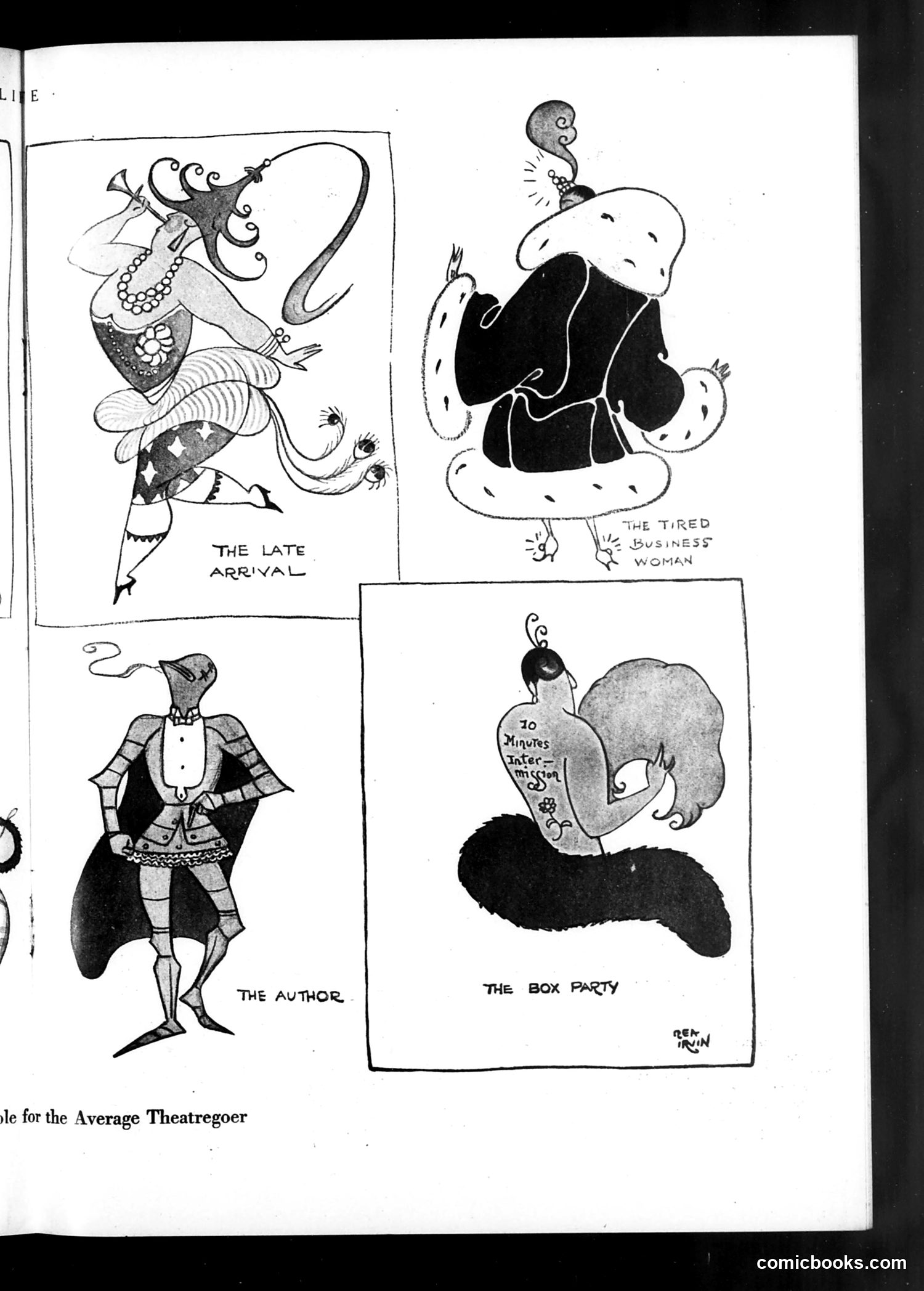
This page presents four satirical character types depicting different theatre attendees circa early 20th century: 1. **"The Late Arrival"** - A flamboyantly dressed woman with elaborate feathers and jewelry, arriving ostentatiously late with dramatic flair. 2. **"The Tired Business Woman"** - A weary figure in business attire, overwhelmed and exhausted, likely satirizing the emerging phenomenon of working women trying to enjoy entertainment. 3. **"The Author"** - A pompous man in formal cape and tails, depicted as self-important and theatrical. 4. **"The Box Party"** - A back view showing fashionably dressed theatre-goers in expensive box seats, with a note reading "Minutes Inter-mission." The satire mocks various theatre-patron stereotypes: social climbers seeking attention, exhausted working women, pretentious creators, and wealthy socialites more focused on socializing than the performance itself. The artist is identified as "Rea Irwin" in the lower right.
This is a theater review column critiquing two Broadway plays: "It's a Boy" and "Dreams For Sale." The critic savagely attacks "It's a Boy" as derivative hackwork—merely a rewrite of McGuire's earlier success "Six-Cylinder Love" stripped of humor. The satire targets the play's reliance on tired formulas: newlyweds, a temptress from New York, infidelity, and melodramatic morality. The reviewer mocks the absurd premise that all New Yorkers live beyond their means in "community sin," contrasting it satirically with wholesome small-town life. The critic also ridicules contemporary theater's moralizing heroes—characters who tediously announce their principles while judging others harshly. The review praises supporting actors (Lawrence, Murphy) who salvage scenes through performance skill rather than script quality. This represents Life magazine's signature role: sophisticated cultural commentary mocking both theatrical mediocrity and the moral hypocrisy of the era's entertainment.
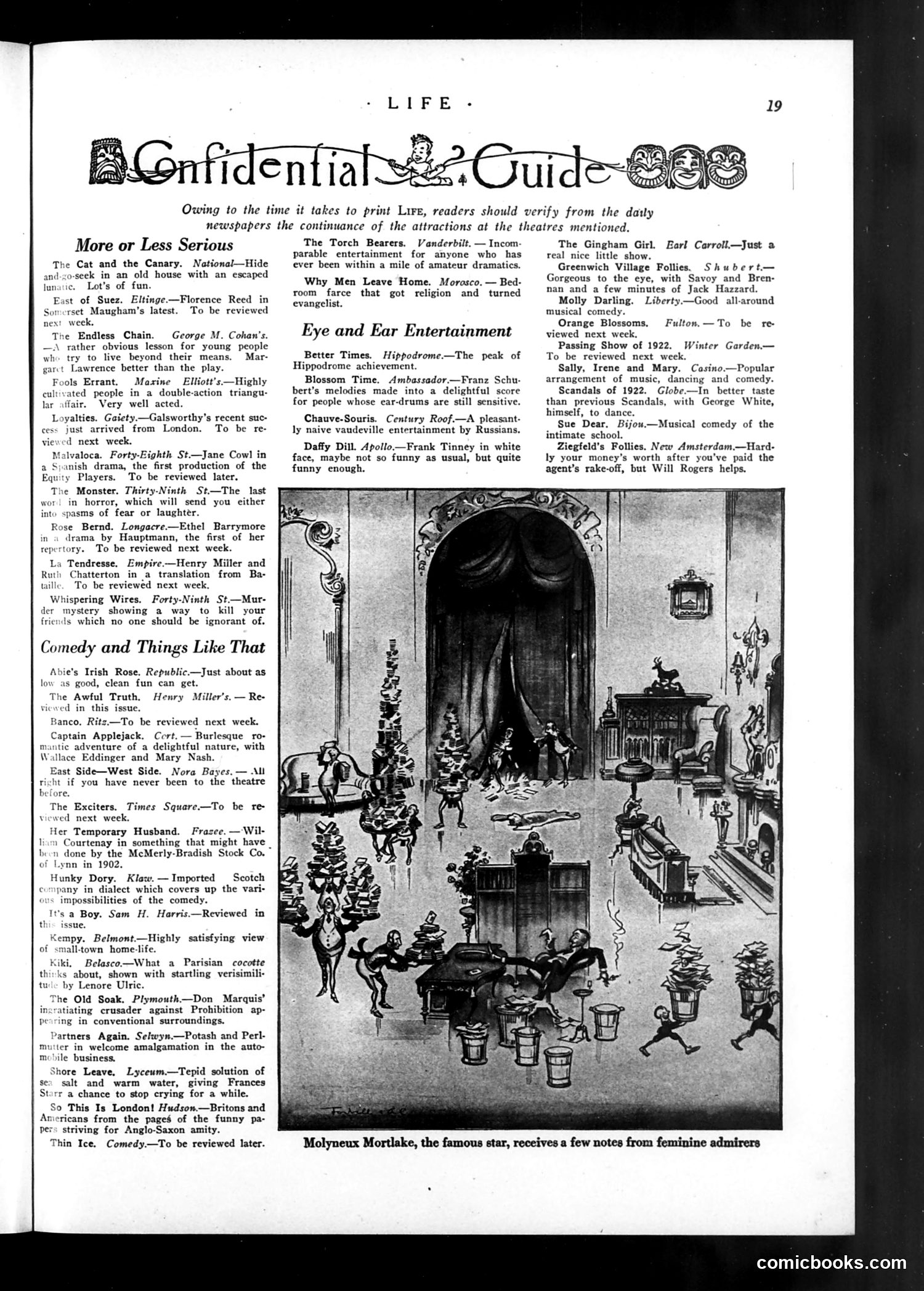
This page is a **theater listings and reviews section** from Life magazine, not primarily a political cartoon. It catalogs Broadway shows currently running, organized by category: "More or Less Serious" dramas, "Comedy and Things Like That," and "Eye and Ear Entertainment" (musicals/vaudeville). The large illustration depicts a **glamorous theater lobby or backstage scene** with well-dressed patrons, performers, and the caption notes "Molyneux Mortlake, the famous star, receives a few notes from feminine admirers"—a satirical joke about celebrity adoration and fan mail. The reviews are witty, brief critiques. For instance, "Abie's Irish Rose" is called "just about as low as good, clean fun can get," while "East Side—West Side" is dismissed as suitable only for theater novices. This reflects Life's role as **cultural commentary for educated urban audiences** in the early 1920s, mixing theater criticism with gentle social satire about entertainment and American tastes.
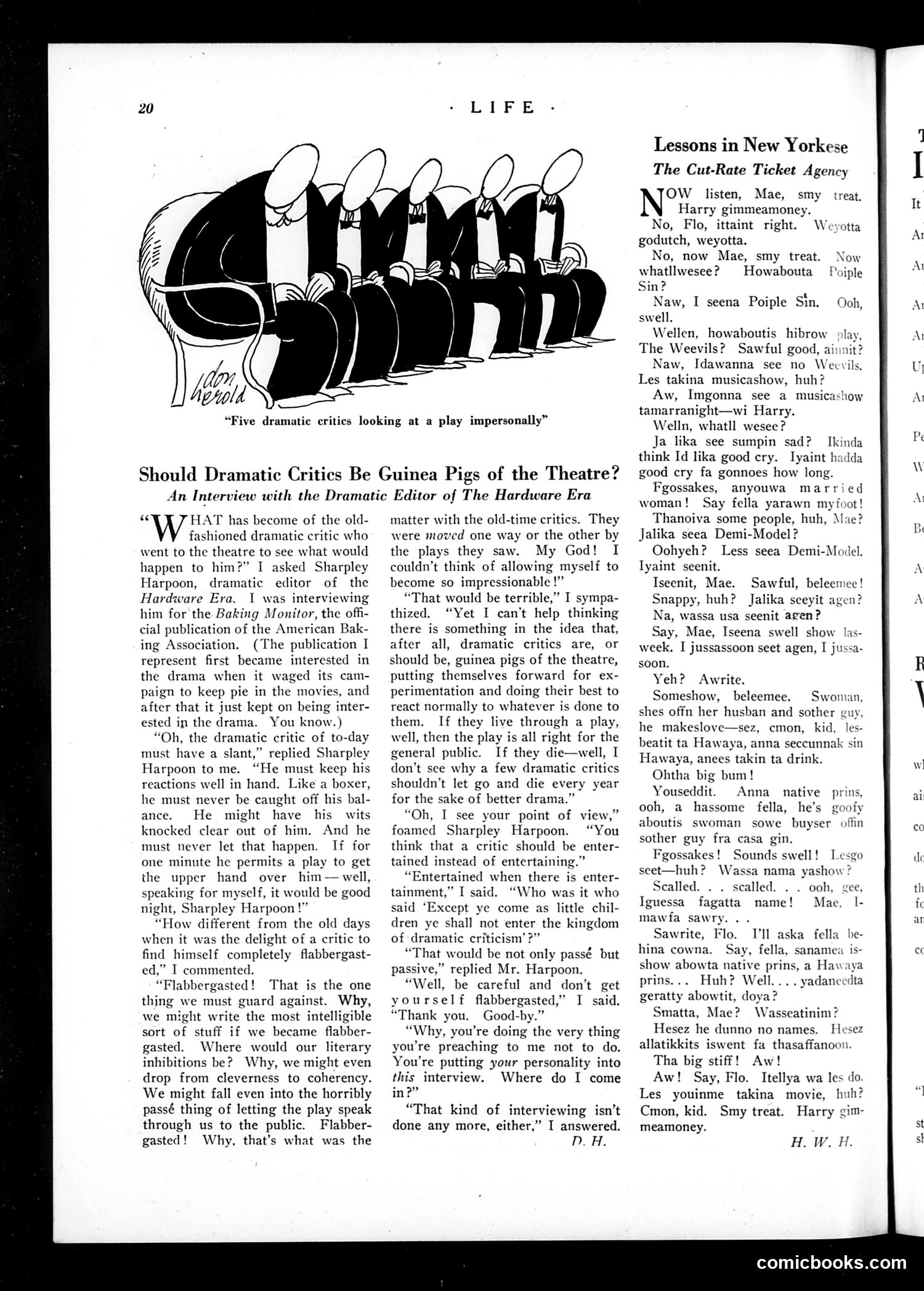
## Main Cartoon The illustration shows five identical dramatic critics sitting in a row, all with blank, expressionless faces. The satire targets modern theater critics who pride themselves on maintaining emotional detachment and "objectivity." ## The Interview Article The text mocks contemporary critics through a fictional interview with "Sharpley Harpoon," dramatic editor of *The Hardware Era*. The satire argues that modern critics are so preoccupied with appearing intellectually superior and maintaining critical distance that they've lost the ability to be genuinely moved by theater. They fear appearing "flabbergasted" (emotionally affected), which might compromise their cleverness and literary credibility. The interviewer humorously suggests critics should be "guinea pigs of the theatre"—willing to react naturally and genuinely. The piece ridicules how critics prioritize maintaining persona over authentic response, even to the point of complaining when interviewed in a natural manner. ## "Lessons in New Yorkese" A comedic sidebar phonetically transcribing working-class New York dialect and speech patterns, showing how ordinary New Yorkers discuss entertainment.
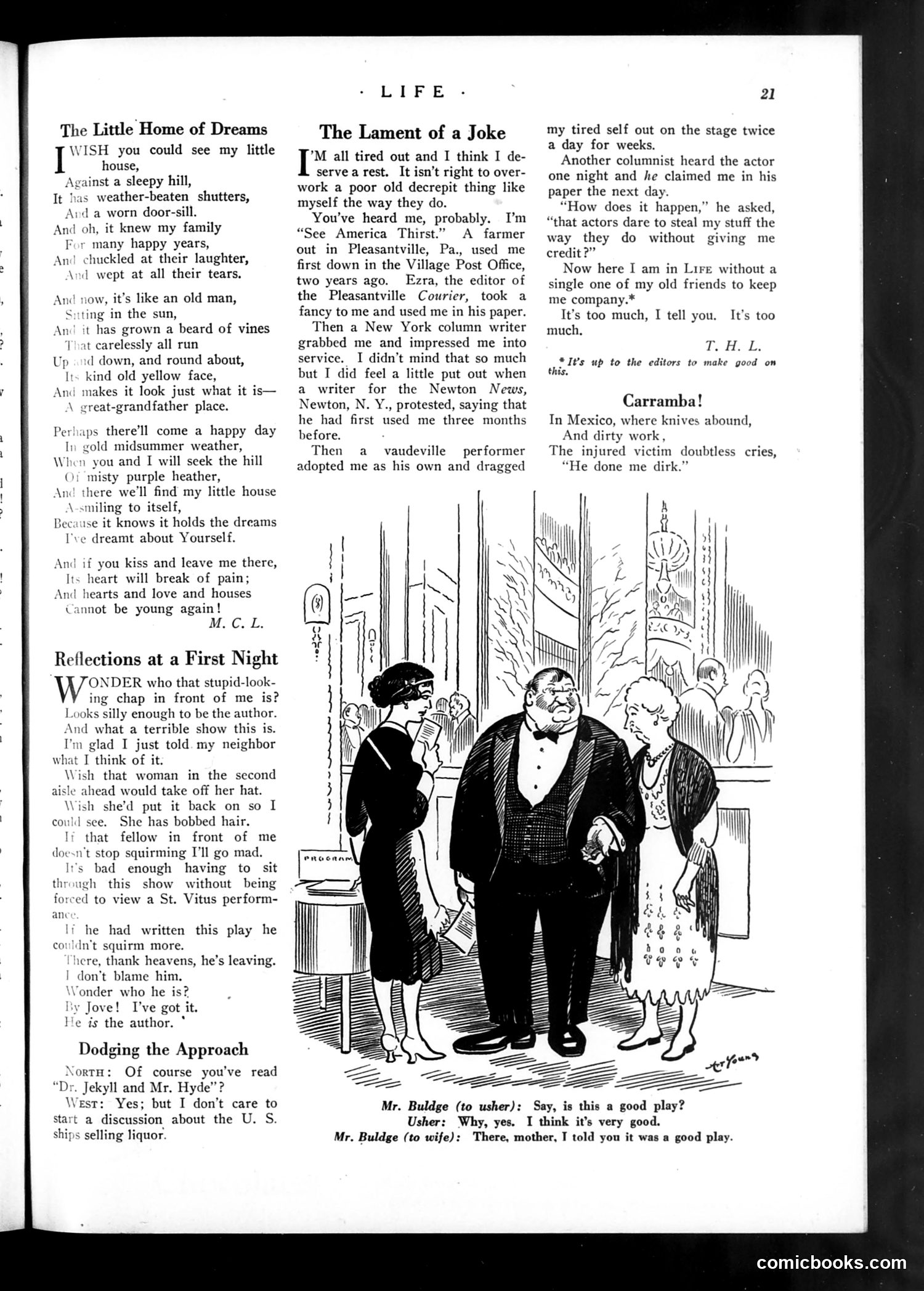
This page contains several satirical pieces typical of 1920s American humor: **"The Lament of a Joke"** mocks the widespread plagiarism and reuse of jokes across media. The joke personified—"See America Thirst"—complains of being stolen repeatedly from a Pennsylvania farmer to newspaper columnists to vaudeville performers, each claiming originality. This satirizes the common practice of comedians and writers lifting material without credit. **"Reflections at a First Night"** humorously depicts a theater-goer's stream of consciousness, complaining about audience members and the play itself, then ironically concluding the "stupid-looking chap" he mocked must be the author—since only the author could write something so bad. **"Dodging the Approach"** references *Dr. Jekyll and Mr. Hyde*, with one character avoiding discussion by pivoting to Prohibition ("U.S. ships selling liquor"), suggesting alcohol and morality were contentious contemporary topics. **The cartoon** shows Mr. Buldge seeking validation about a play's quality from his wife through an usher, satirizing how people manufacture consensus about art. These pieces reflect 1920s concerns: intellectual property theft, theater culture, and Prohibition debates.
This article by Robert E. Sherwood criticizes Hollywood's profit-driven system. An anonymous producer accused the industry of being controlled by "Greed" in *Collier's* magazine, sparking outrage among film executives who reportedly demanded to know his identity. Sherwood argues that moguls like **Adolph Zukor**, **William Fox**, and **Marcus Loew** control distribution and deliberately reject artistically ambitious films, instead demanding only mass-appeal entertainment for small-town theaters like the "Rosebud Theatre, in Gopher Prairie." He contends they ignore "intelligent" audiences who appreciate sophisticated films like "Broken Blossoms" and German expressionist pictures. The piece advocates for a non-commercial theater model—citing the Washington Square Players and Theatre Guild—as proof that serious art can sustain itself without chasing lowest-common-denominator profits. The satire targets Hollywood's equation of financial success with artistic merit.
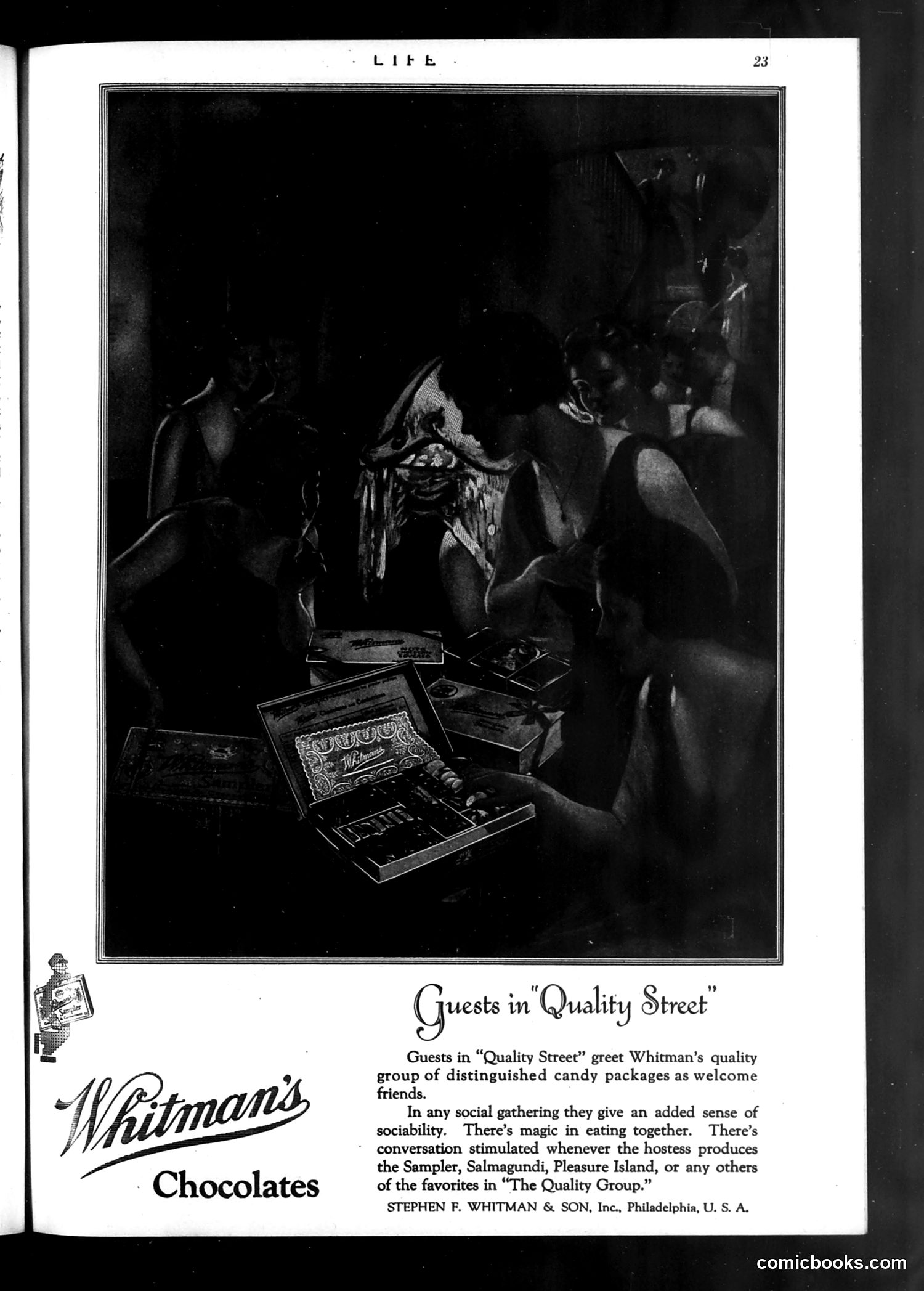
This is a **Whitman's Chocolates advertisement**, not political satire or a cartoon. The image shows a social gathering where a hostess presents elegant candy boxes to guests. The ad's message emphasizes that sharing Whitman's candies—specifically their "Quality Group" products (Sampler, Salmagundi, Pleasure Island)—enhances social occasions by promoting conversation and hospitality. The appeal targets middle-class consumers valuing refinement: branded chocolates signal good taste and gracious entertaining. This was typical early 20th-century advertising strategy, positioning luxury goods as essential to proper social conduct. There is no satire, political commentary, or caricature—merely a straightforward product endorsement using aspirational imagery of genteel society.
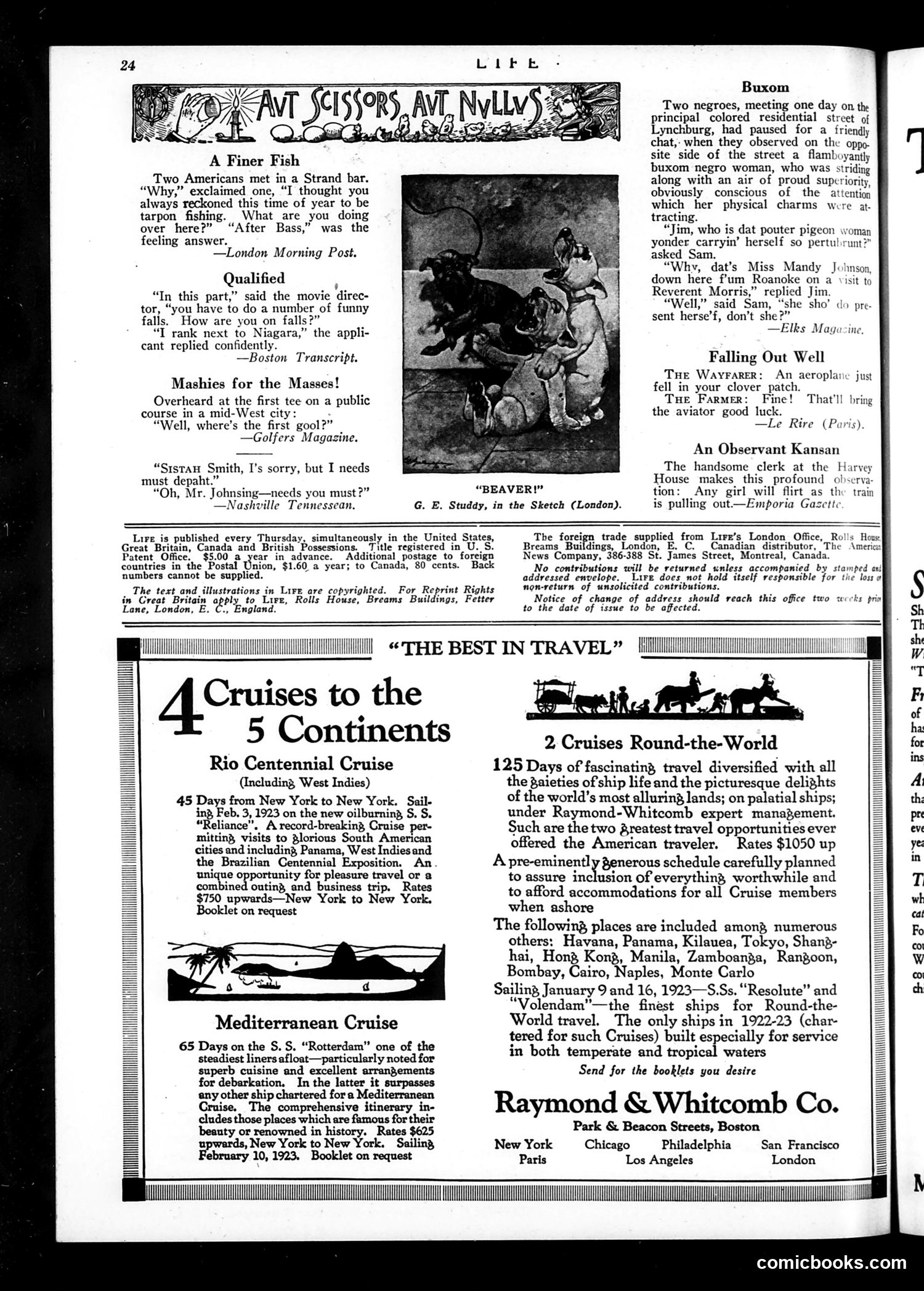
This page contains several brief humor items and a large cruise advertisement. The cartoon titled "BEAVER" by G.E. Studdy depicts a dog, likely illustrating a pun or visual joke about the animal. The text items are brief anecdotes with punchlines. Most notably, the "Buxom" section presents a dialogue between two Black men in Lynchburg using dialect humor—a common (though offensive by modern standards) comedic format of the era. They comment on a woman's appearance and proud demeanor, with the joke relying on stereotypical dialect and casual observation of physical appearance. The other anecdotes ("A Finer Fish," "Qualified," "Mashies for the Masses") are mild observational humor about fishing, movie acting, and golf, sourced from various publications. The page is primarily dominated by Raymond & Whitcomb's cruise advertisements offering trips to five continents, reflecting the 1920s travel industry boom and appeal to affluent readers.
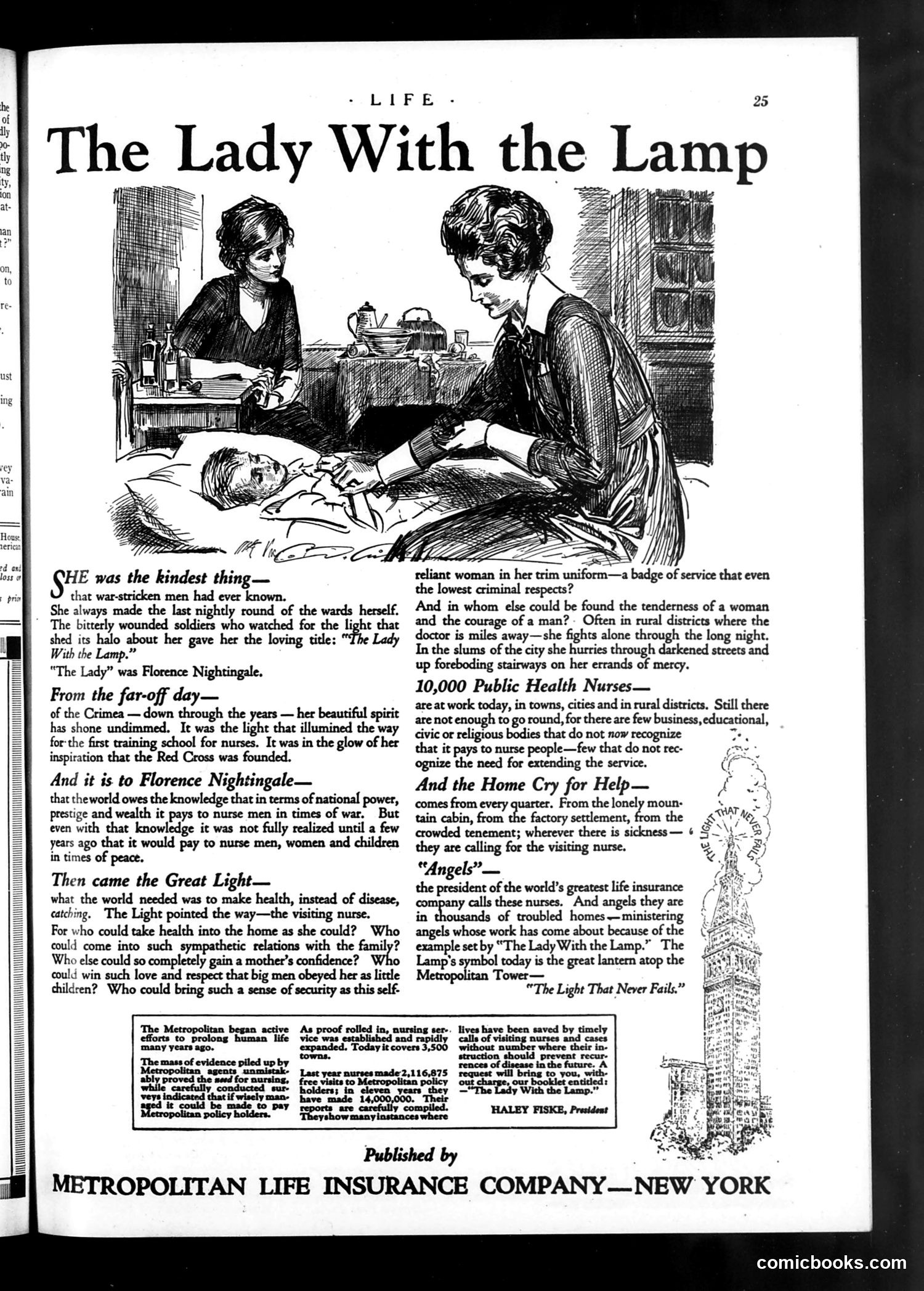
This is primarily a **Metropolitan Life Insurance Company advertisement**, not satire. It uses Florence Nightingale—the famous 19th-century nurse who pioneered modern nursing during the Crimea War—as an inspirational figure to promote visiting nurses and public health services. The illustration shows a nurse attending to a patient while a woman (likely a supervisor or administrator) observes, embodying Nightingale's legacy of professional, compassionate care. The ad argues that nursing—once recognized as vital during wartime—should be equally valued during peacetime for civilian health. It notes 10,000 public health nurses currently work across America but claims more are needed. The "Lady With the Lamp" reference invokes Nightingale's iconic image, positioning the insurance company as supporting modern healthcare infrastructure. This represents early 20th-century corporate messaging linking profit to social welfare, using historical heroism to encourage public acceptance of professional nursing as essential infrastructure rather than charity.
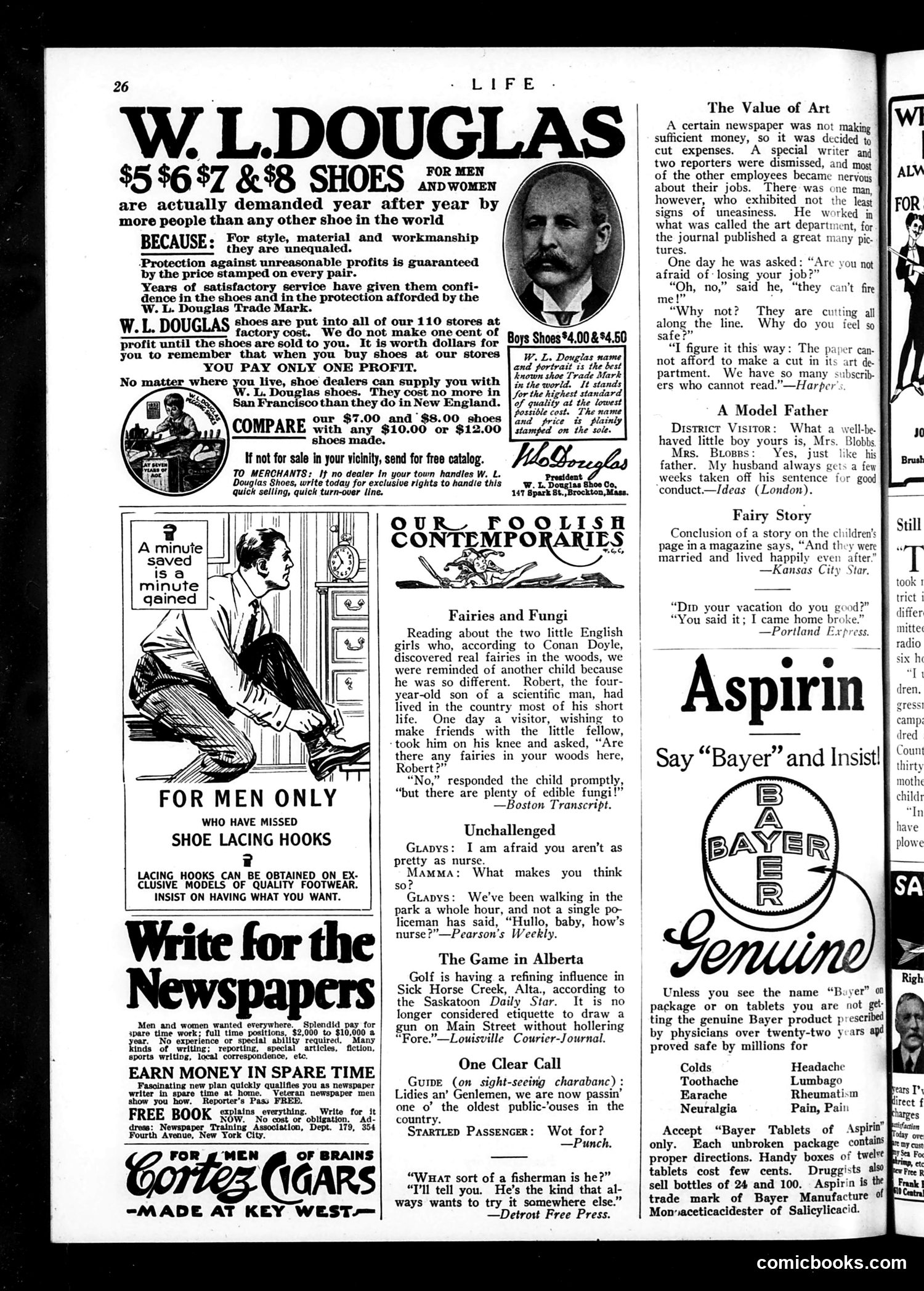
This page is primarily **advertising and humor content** rather than political satire. The main elements: **W.L. Douglas Shoe Ad**: A major commercial advertisement emphasizing that Douglas shoes cost no more in San Francisco than New England—notable because this addresses early 20th-century concerns about regional price variation and fair pricing. **"Our Foolish Contemporaries"**: A humor section featuring brief jokes from other publications, including: - A child choosing "edible fungi" over fairy tales (satirizing scientific rationalism vs. imagination) - A joke about a mother's attractiveness to policemen - A golf etiquette joke about the American frontier (drawing guns without warning) **"For Men Only"** cartoon: Shows a man in a domestic setting, satirizing men who complain about missing shoe-lacing hooks—gentle humor about male fussiness. The page reflects early 20th-century concerns: consumer pricing fairness, advertising dominance, and gender-role humor typical of *Life* magazine's satirical approach.
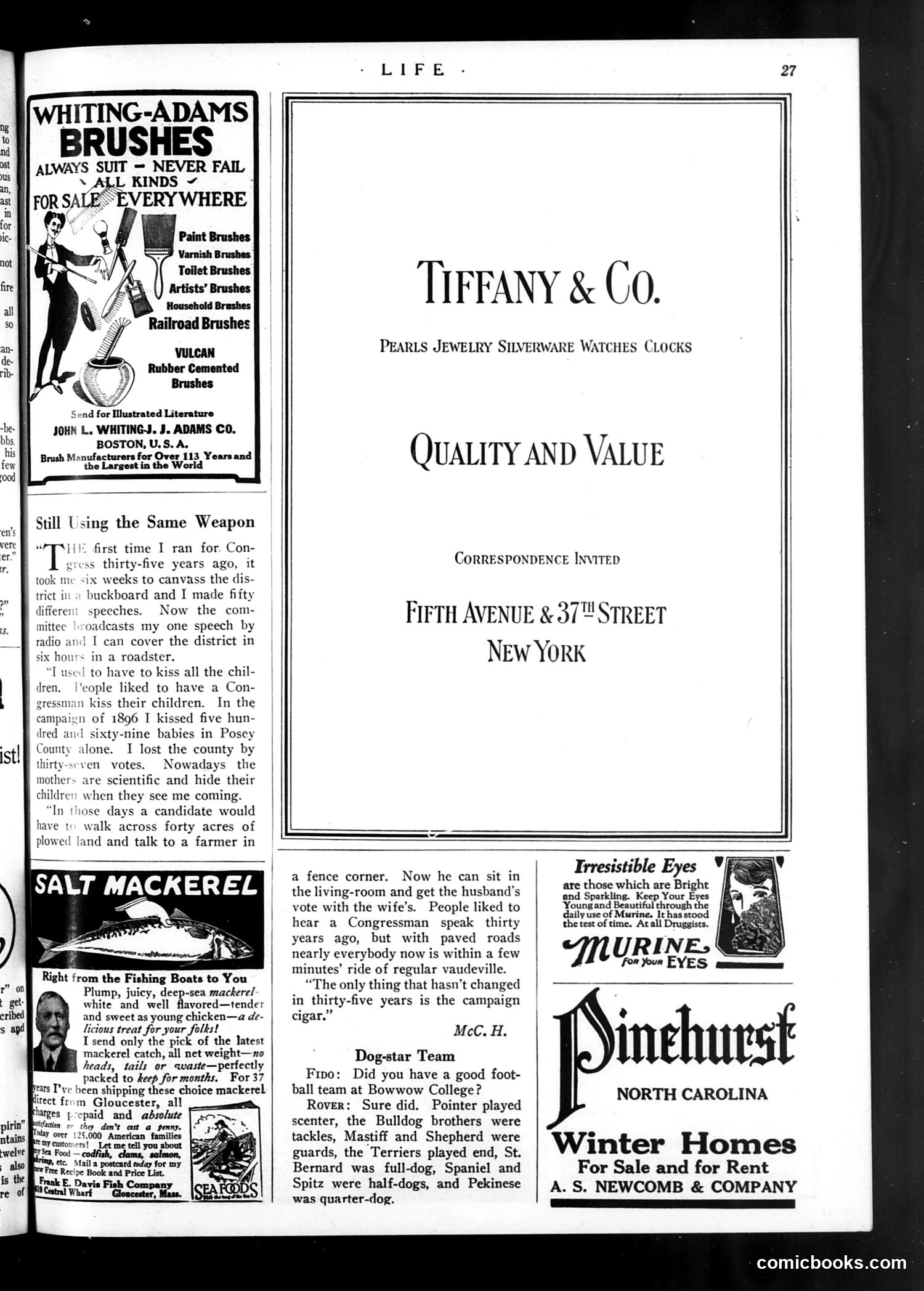
This page is primarily **advertisements and filler content** with one notable satirical piece. ## "Still Using the Same Weapon" The main article features a unnamed Congressman reflecting on how campaigning has changed over 35 years. The satire contrasts old-fashioned retail politics with modern efficiency: **Then (1896):** Candidates personally traveled for weeks, made dozens of speeches, and kissed hundreds of babies to win votes—yet still lost elections. **Now:** Radio broadcasts reach entire districts in hours; candidates can stay home while reaching voters through their wives' influence rather than direct appeal. The joke's point: **Modern technology and paved roads have made politicians more efficient but less effective and less genuine.** Voters now expect entertainment (vaudeville) rather than substantive engagement. The final punchline—that only the "campaign cigar" remains unchanged—suggests cynical continuity: politicians' promises are still cheap. The "Dog-star Team" joke below uses animal puns for college football positions, unrelated to political satire. The page otherwise consists of product advertisements (Tiffany & Co., fish, brushes, real estate).
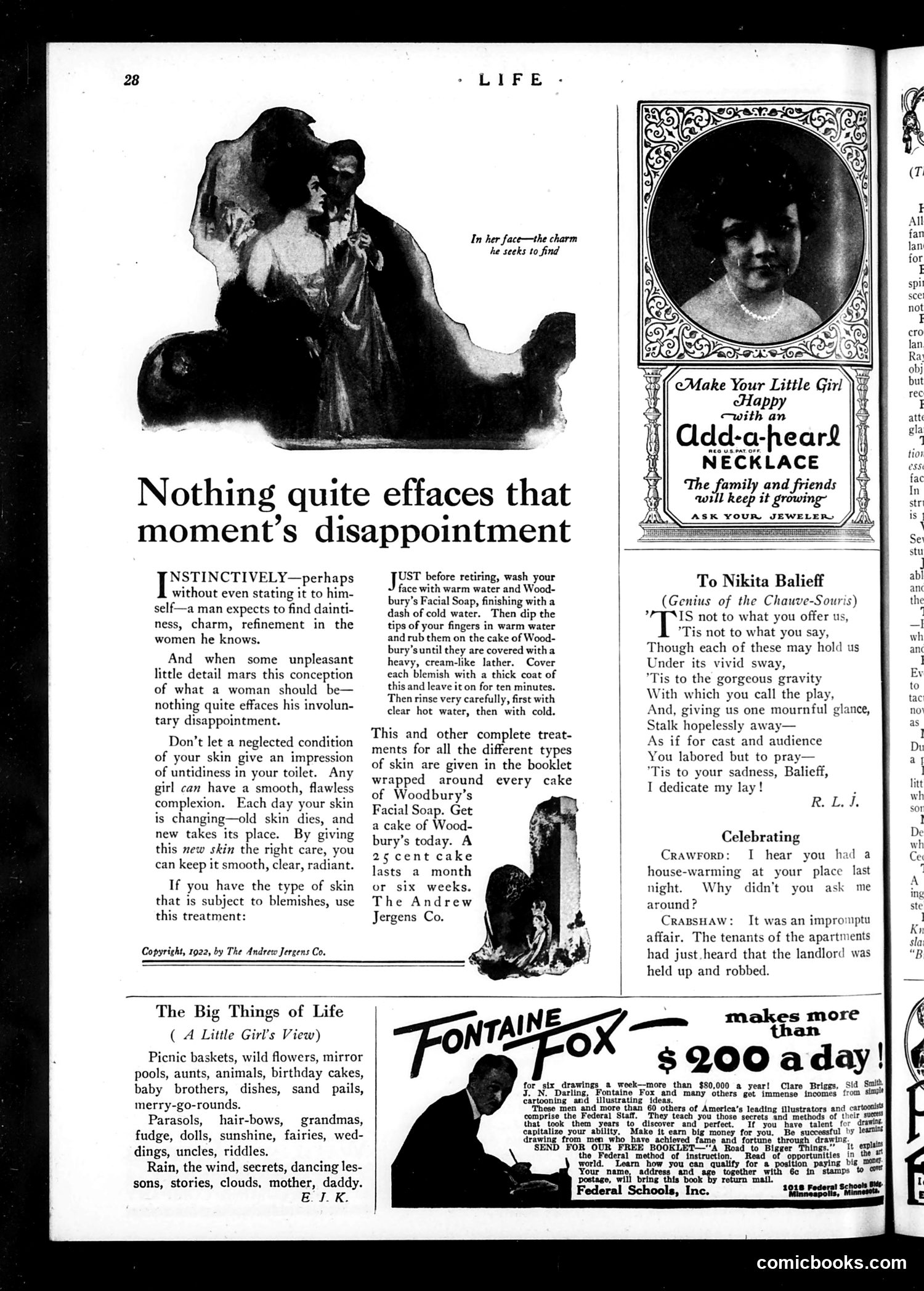
This page features three distinct elements: **Main Advertisement (Woodbury's Facial Soap):** A romantic illustration showing a man admiring a woman's face, captioned "In her face—the charm he seeks to find." The accompanying text warns women that skin blemishes and neglected complexions create "involuntary disappointment" in men—a direct appeal to female insecurity about appearance to drive soap sales. This reflects 1920s advertising's use of romantic anxiety as marketing strategy. **Minor Ads:** An "Add-a-pearl" necklace advertisement and a Fontaine Fox drawing school recruitment ad (Fox was a famous cartoonist of the era). **Editorial Content:** A poem tribute to Nikita Balieff (director of the avant-garde Chauve-Souris theater), a humorous anecdote about a canceled housewarming due to the landlord's robbery, and a whimsical list of childhood pleasures. The page demonstrates how Life mixed satirical commentary with consumer advertising—here, juxtaposing romantic sentiment against the commercial exploitation of women's anxieties about beauty standards.
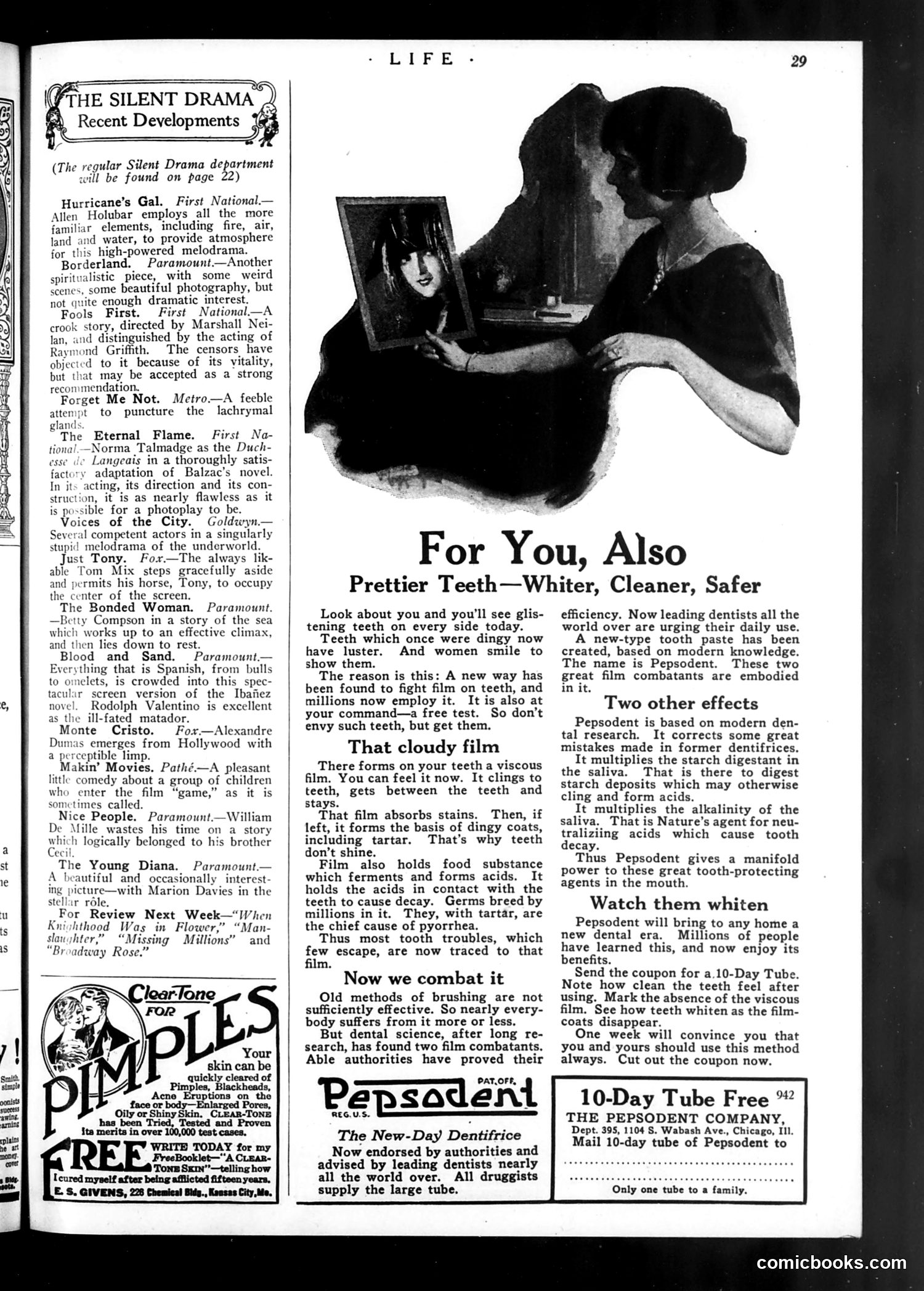
This page combines film criticism with advertising. The top section reviews silent films currently in theaters—titles like "Hurricane's Gal," "Borderland," and "Blood and Sand" (featuring Rudolph Valentino). The reviews are brief, casual critiques typical of 1920s entertainment journalism, noting whether films have dramatic interest, good acting, or censorship issues. The dominant content is a Pepsodent toothpaste advertisement disguised as health advice. It explains tooth decay through "film" (plaque buildup) and promotes Pepsodent as a modern solution endorsed by dentists. The ad includes a photograph of a woman demonstrating teeth-whitening results. Below is a smaller ad for "Clear-Tone," a skin treatment claiming to cure pimples and acne. These advertisements reflect 1920s consumer culture: promoting new personal hygiene products as scientific advances, targeting both appearance and health consciousness in the emerging consumer economy.
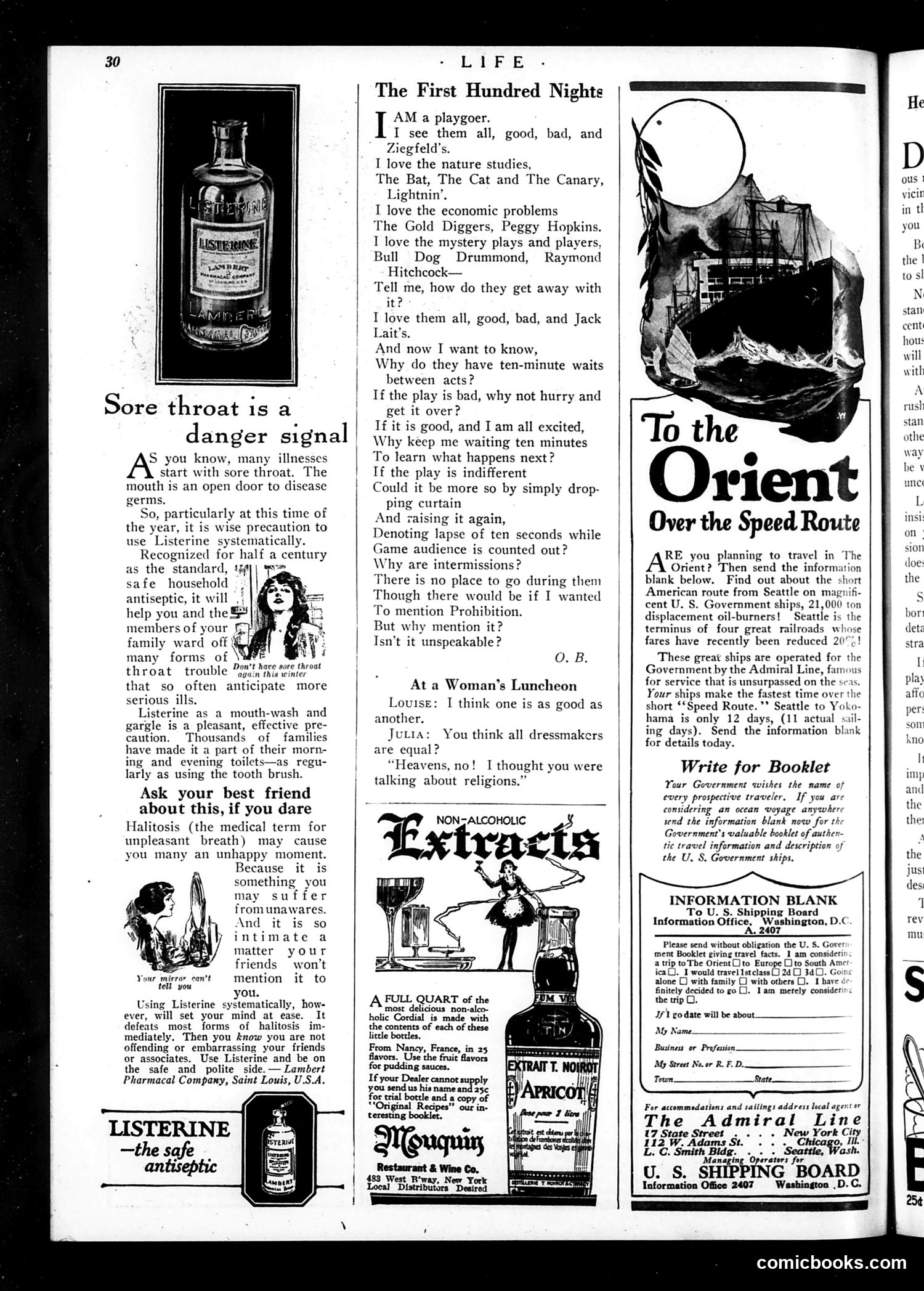
This page mixes theatrical criticism with advertisements and travel promotion, typical of 1920s Life magazine content. **"The First Hundred Nights"** is a humorous essay by O.B. (likely Jack Lait, mentioned in the text) complaining about Broadway theater conventions. The author loves attending plays—referencing contemporary hits like *Ziegfeld's*, *The Bat*, *Lightnin'*, and *Bull Dog Drummond*—but satirizes the arbitrary ten-minute intermissions. His complaint: whether the play is good, bad, or mediocre, the wait serves no purpose except frustrating audiences. The essay mockingly notes the absurdity of mentioning Prohibition (illegal alcohol) as a reason for breaks. **"At a Woman's Luncheon"** presents a brief comic dialogue where Louise and Julia discuss dressmakers and religions, with Julia's punchline exposing Louise's vague thinking. The page is otherwise dominated by **advertisements**: Listerine antiseptic (promoting germ-prevention for sore throats), Extract liqueur, and a U.S. Shipping Board promotion for Orient travel via Seattle. These ads reflect 1920s consumer culture and government shipping interests post-WWI.
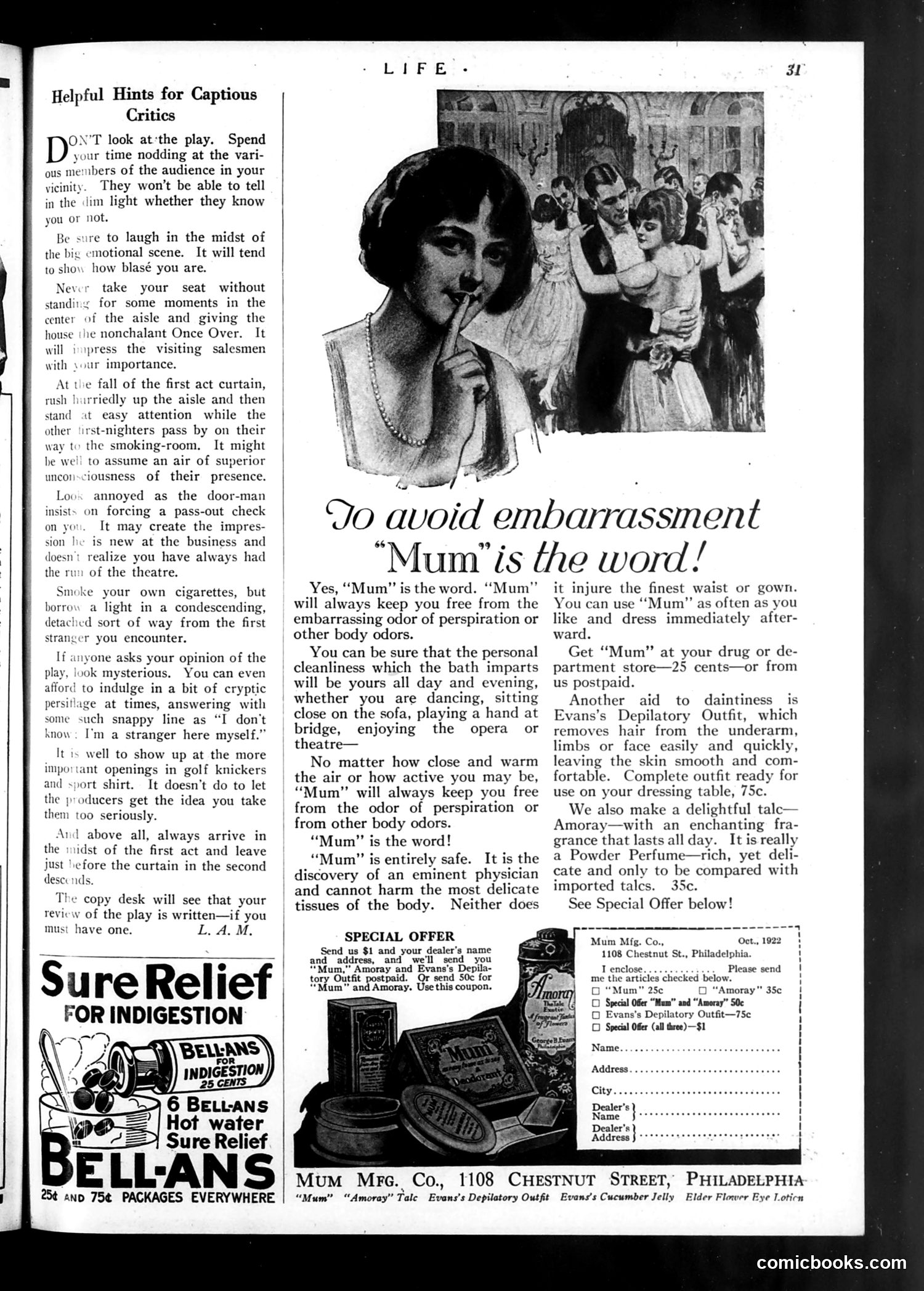
This page combines satirical social commentary with vintage advertising. **"Helpful Hints for Captious Critics"** mocks pretentious theater-goers who attend plays not to enjoy them but to perform sophistication for others. The satire advises behaviors like ignoring the performance, laughing at emotional moments to seem "blasé," arriving late, leaving early, and feigning mystery about the plot. The humor lies in exposing how some audience members prioritize appearing cultured and important over actually engaging with art—a timeless critique of performative elitism. **The advertisements** for "Mum" deodorant and related beauty products reflect 1920s anxieties about body odor and "daintiness." The ad copy promises that "Mum" eliminates embarrassing perspiration odors in social situations (dancing, theater, dating). It also advertises Evans's Depilatory Outfit for hair removal and Amoray talc powder—products addressing women's grooming concerns of that era, particularly underarm hair removal, then considered essential for "respectable" femininity. The page exemplifies how early 20th-century magazines balanced social satire with marketing to female readers' insecurities about appearance and social acceptance.
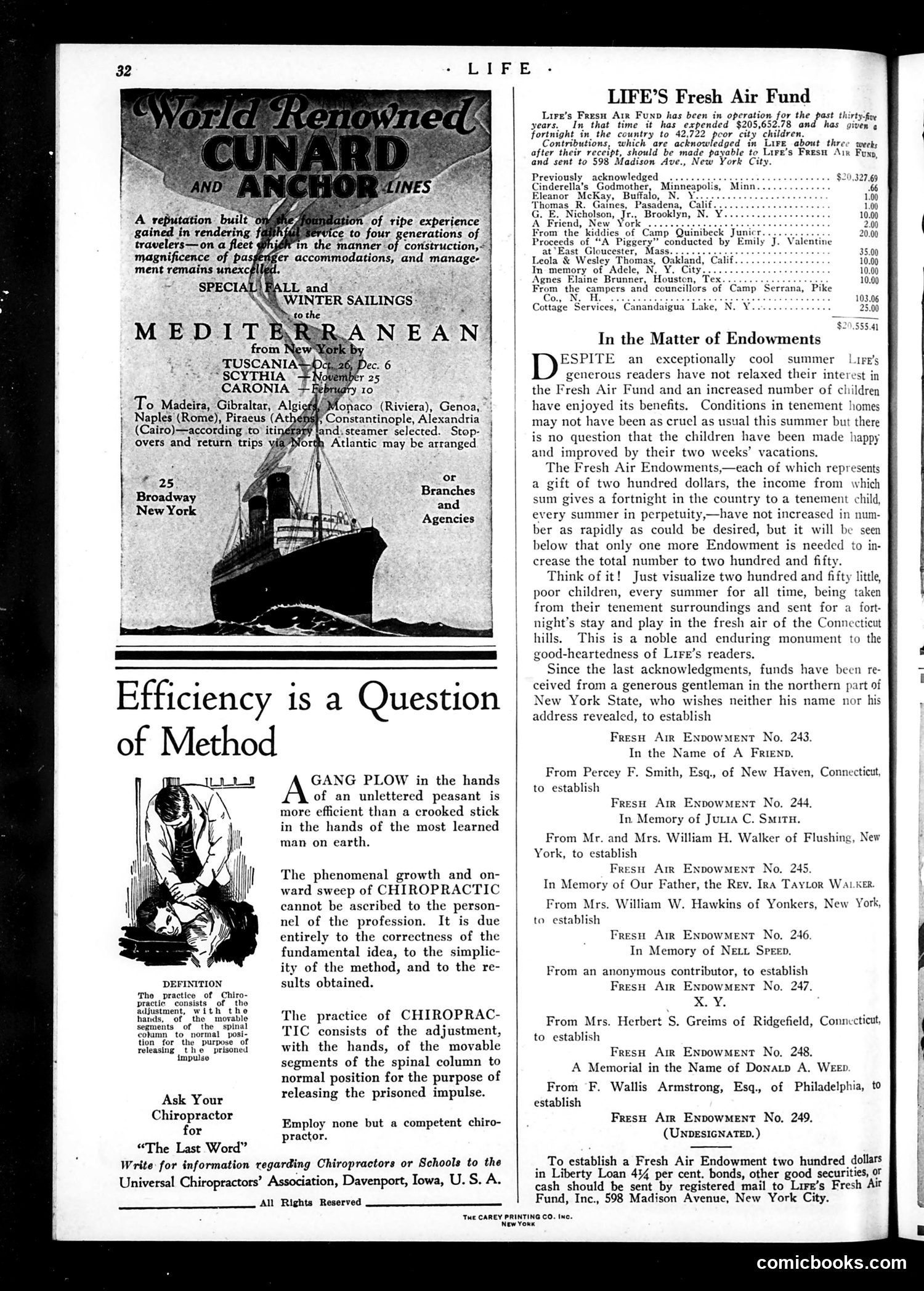
This page mixes two distinct elements: a chiropractic industry advertisement and charitable fundraising. ## The Chiropractic Ad The "Efficiency is a Question of Method" section is industry advocacy disguised as wisdom. It uses an analogy—an untrained peasant with a proper tool outperforms a learned scholar with an inferior one—to argue that chiropractic's success stems not from its practitioners' credentials but from the "correctness" of the method itself. This was a strategic argument during chiropractic's early legitimacy struggles (the profession faced heavy medical establishment opposition). The ad essentially claims: don't worry about chiropractors' lack of formal medical training; the *system* works. ## The Fresh Air Fund The right column documents Life magazine's ongoing charitable campaign providing poor tenement children brief countryside vacations—a Progressive-era social reform effort. It lists donors and solicits more endowments to reach 250 permanent child-beneficiaries. Together, the page reflects 1920s American concerns: skepticism toward professional credentials, faith in systematic solutions, and philanthropic responsibility toward urban poverty.
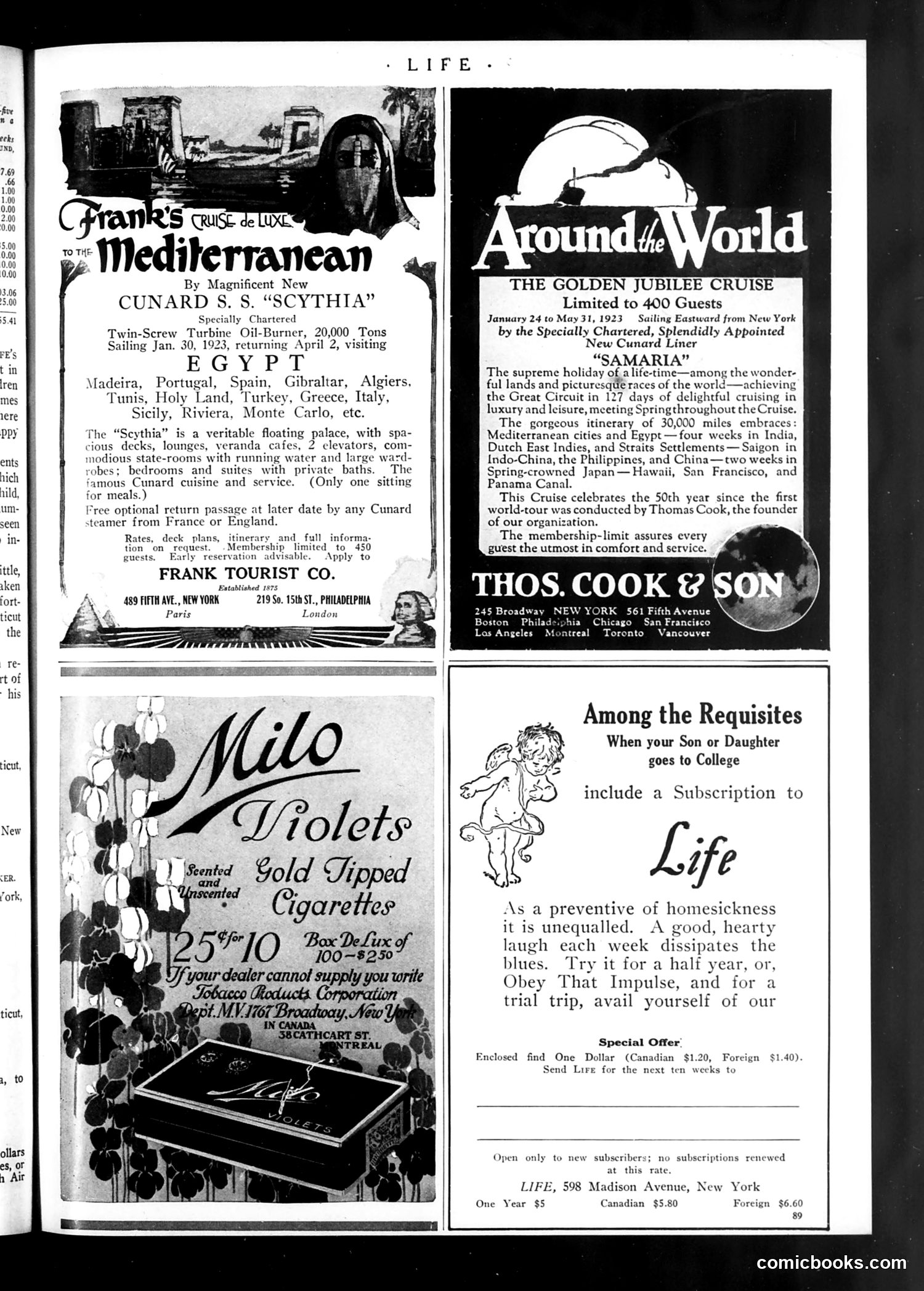
This page consists primarily of **advertisements**, not political cartoons or satire. The content includes luxury travel promotions: Cunard cruise lines advertising Mediterranean and around-the-world voyages (1923), positioned as prestigious leisure experiences for affluent customers. There's also an ad for Milo Violets cigarettes with decorative violet imagery. The notable element is **Life magazine's self-advertisement** promoting subscriptions to college-bound students. The pitch frames the magazine as a remedy for homesickness—claiming its humor ("a good, hearty laugh") prevents the "blues." This reflects 1920s assumptions about the magazine's role: sophisticated, humorous content for educated readers. The overall page reflects **1920s American consumer culture**: luxury travel, cigarettes, and mass-market humor were positioned as aspirational lifestyle markers for middle and upper-class audiences.
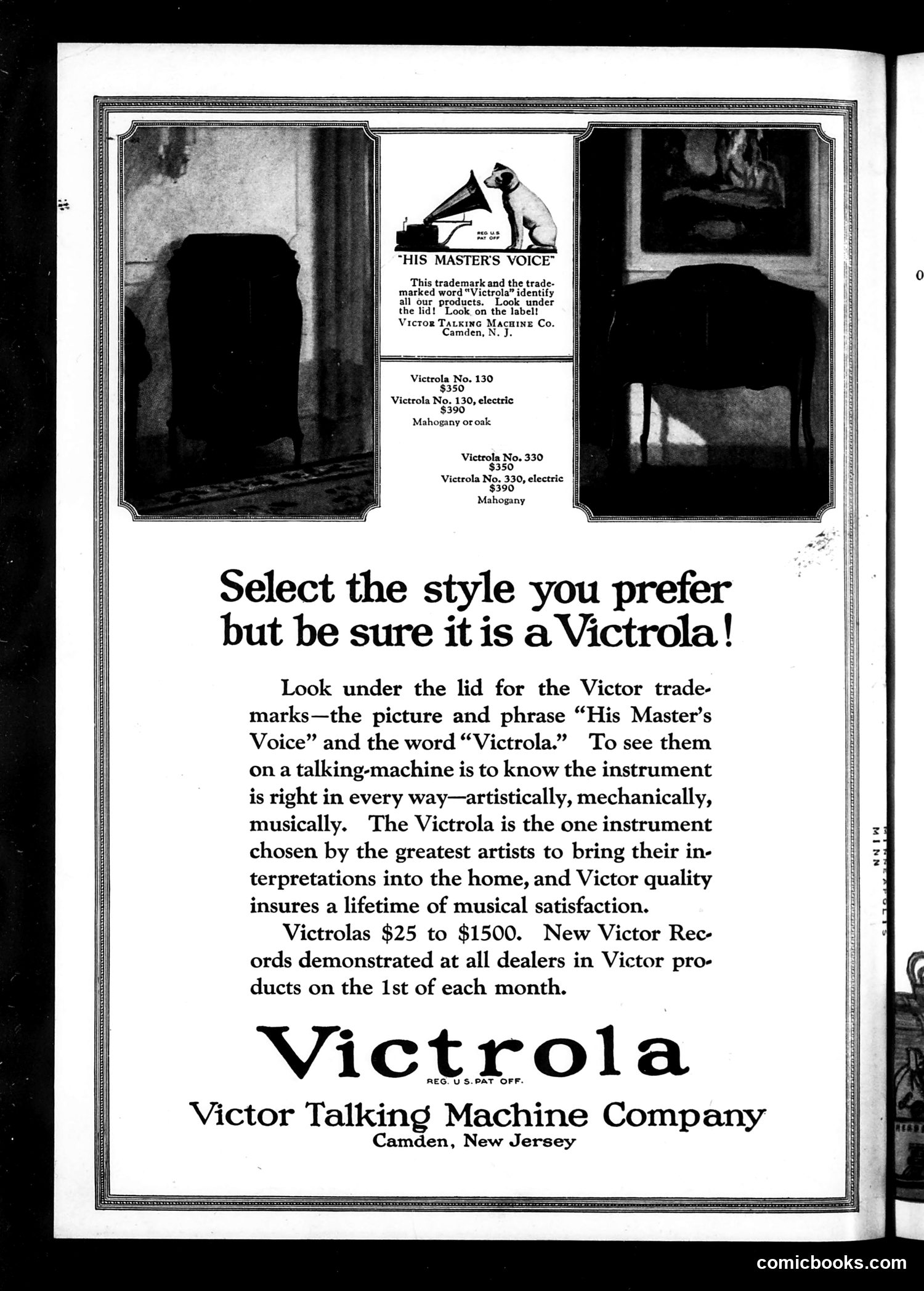
This is a **Victrola phonograph advertisement**, not a political cartoon. It promotes Victor Talking Machine Company's line of record players. The page displays two photographs of elegant Victrola models (No. 130 and No. 330) in mahogany or oak cabinetry, priced from $25 to $1500. The famous "His Master's Voice" trademark—featuring a dog listening to a gramophone—appears centrally, identifying authentic Victor products. The advertisement's core message warns consumers to verify they're purchasing genuine Victrolas by checking for the trademark and word under the lid and on labels. This suggests counterfeit or inferior competing models were circulating in the market. The copy emphasizes Victor's quality and association with "greatest artists," positioning the Victrola as a luxury item ensuring "lifetime of musical satisfaction." This reflects early 20th-century consumer culture when phonographs were prestigious home entertainment technology and brand authentication mattered to discerning buyers.