
Life, 1922-10-05 · page 27 of 36
Life — October 5, 1922 — page 27: what you’re looking at
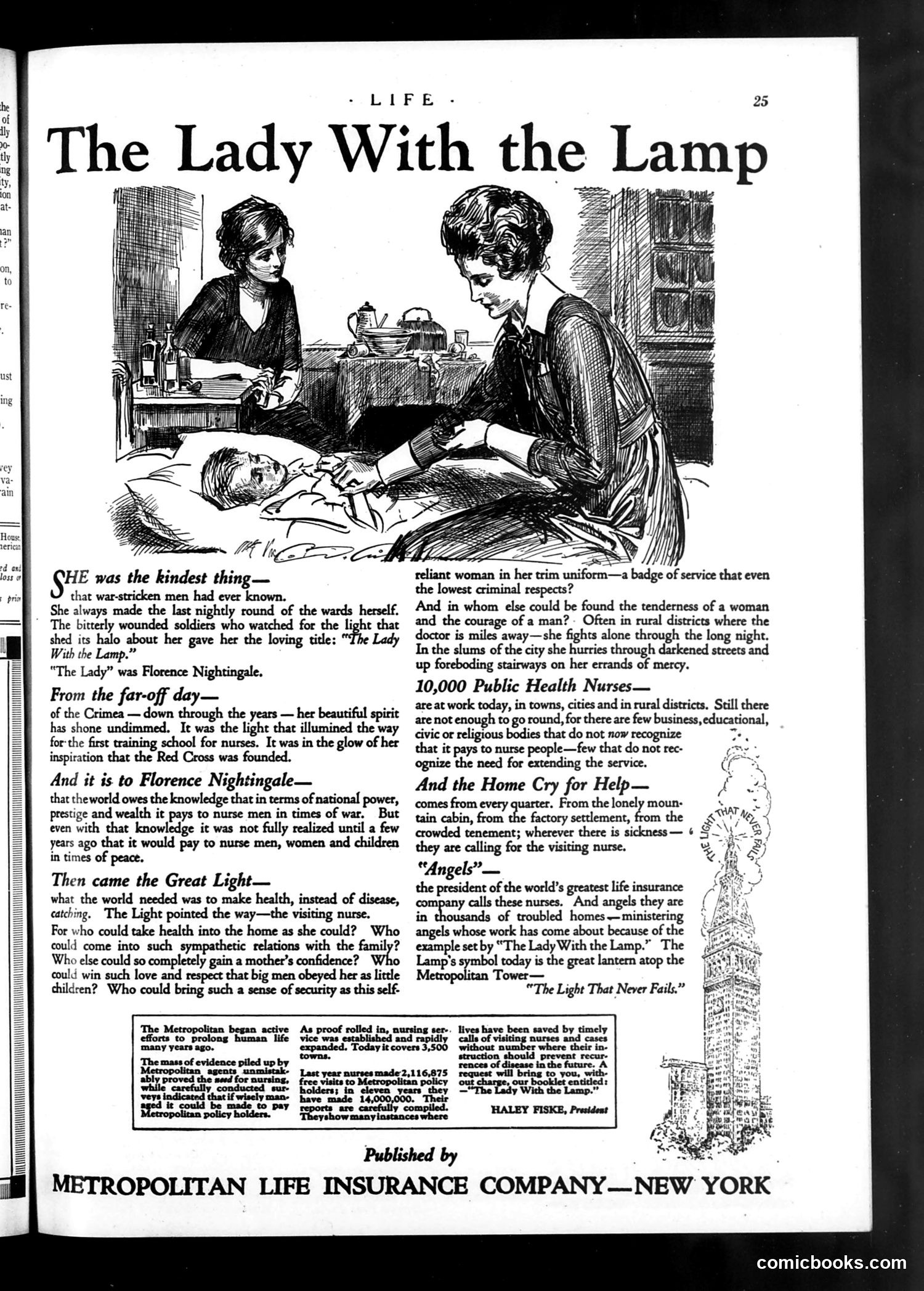
What you’re looking at
This is primarily a **Metropolitan Life Insurance Company advertisement**, not satire. It uses Florence Nightingale—the famous 19th-century nurse who pioneered modern nursing during the Crimea War—as an inspirational figure to promote visiting nurses and public health services. The illustration shows a nurse attending to a patient while a woman (likely a supervisor or administrator) observes, embodying Nightingale's legacy of professional, compassionate care. The ad argues that nursing—once recognized as vital during wartime—should be equally valued during peacetime for civilian health. It notes 10,000 public health nurses currently work across America but claims more are needed. The "Lady With the Lamp" reference invokes Nightingale's iconic image, positioning the insurance company as supporting modern healthcare infrastructure. This represents early 20th-century corporate messaging linking profit to social welfare, using historical heroism to encourage public acceptance of professional nursing as essential infrastructure rather than charity.
📄 Transcribed text from this page (OCR, searchable)
Machine-transcribed from the original scan — historical spelling and the odd misread are preserved.
LIFE - 25 The Lady With the L GuE was the kindest thing— that war-stricken men had ever known. She always made the last nightly round of the wards herself. The bitterly wounded soldiers who watched for the light that shed its halo about her gave her the loving title: With the Lamp.” “The Lady” was Florence Nightingale, From the far-off day— of the Crimea — down through the years — her beautiful spirit has shone undimmed. It was the light that illumined the way forthe first training school for nurses. It was in the glow of her inspiration that the Red Cross was founded. And it is to Florence Nightingale— that theworld owes the knowledge that in terms of national power, prestige and wealth it pays to nurse men in times of war. But even with that knowledge it was not fully realized until a few years ago that it would pay to nurse men, women and children in times of peace. Then came the Great Light— what the world needed was to make health, instead of disease, catching. The Light pointed the way—the visiting nurse. For who could take health into the home as she could? Who could come into such sympathetic relations with the family? Who else could so completely gain a mother’s confidence? Who could win such love and respect that big men obeyed her as little children? Who could bring such a sense of security as this self- reliant woman in her trim uniform—a badge of service that even the lowest criminal respects? And in whom else could be found the tenderness of a woman and the cot of a man? Often in rural districts where the doctor is miles away—she fights alone through the long night. In the slums of the city she hurries through darkened streets and up foreboding stairways on her errands of mercy. 10,000 Public Health Nurses— are at work today, in towns, cities and in rural districts. Still there are not enough to go round, for there are few business, educational, civic or religious bodies that do not now i 7% that it pays to nurse people—few that do not rec- ognize the need for extending the service. And the Home Cry for Help— comes from warter. From the lonely moun- . j tain cabin, Gone he factory settlement, from the <4" crowded tenement; wherever there is sickness— ¢ $\s\. & } they are calling for the visiting nurse. “Angels”— the president of the world’s greatest life insurance 1 calla thats wurses. “And angels they are in ouside of troubled homes —ministering angels whose work has come about because of the example set by “The Lady With the Lamp.” The Lamp's | today is the great lantern atop the itan Tower: “The Light That Never Fails.” . lives have been saved by timely calls of | and comicbooks.com