
Life, 1922-10-05 · page 16 of 36
Life — October 5, 1922 — page 16: what you’re looking at
What you’re looking at
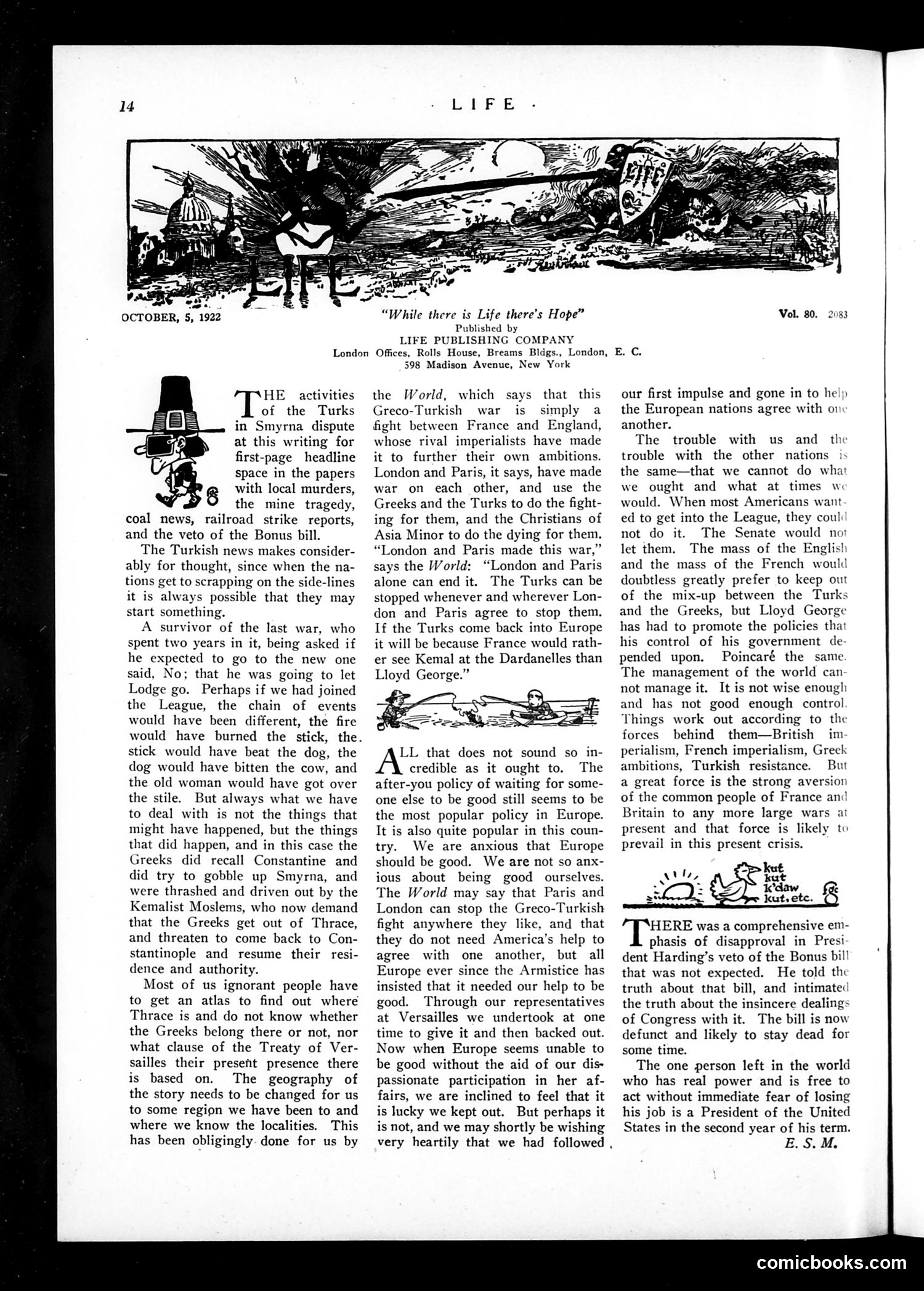
The masthead cartoon depicts a chaotic scene with "LIFE" visible, illustrating the article's theme: European instability following World War I. The main article, "While there is Life there's Hope," discusses the Greco-Turkish conflict and broader European tensions. The author critiques British and French imperialism, arguing their rival ambitions fuel regional conflicts. The piece references Lloyd George's policies and expresses American skepticism about European disputes, suggesting the U.S. should remain uninvolved despite pressure to intervene. A secondary item discusses President Harding's veto of the Bonus Bill for veterans, characterizing it as unpopular but likely to stand. The satirical tone suggests frustration with both European entanglement and domestic political decisions affecting war veterans.
📄 Transcribed text from this page (OCR, searchable)
Machine-transcribed from the original scan — historical spelling and the odd misread are preserved.
OCTOBER, §, 1922 London Offices, Rolls House, Breams Bldgs., London, HE activities of the Turks in Smyrna dispute at this writing for first-page headline space in the papers with local murders, the mine tragedy, coal news, railroad strike reports, and the veto of the Bonus bill. The Turkish news makes consider- ably for thought, since when the na- tions get to scrapping on the side-lines it is always possible that they may start something. A survivor of the last war, who spent two years in it, being asked if he expected to go to the new one said, No; that he was going to let Lodge go. Perhaps if we had joined the League, the chain of events would have been different, the fire would have burned the stick, the. stick would have beat the dog, the dog would have bitten the cow, and the old woman would have got over the stile. But always what we have to deal with is not the things that might have happened, but the things that did happen, and in this case the Greeks did recall Constantine and did try to gobble up Smyrna, and were thrashed and driven out by the Kemalist Moslems, who now demand that the Greeks get out of Thrace, and threaten to come back to Con- stantinople and resume their resi- dence and authority. Most of us ignorant people have to get an atlas to find out where Thrace is and do not know whether the Greeks belong there or not, nor what clause of the Treaty of Ver- sailles their present presence there is based on. The geography of the story needs to be changed for us to some region we have been to and where we know the localities. This has been obligingly. done for us by “While there is Life there’s Hope” Published by LIFE PUBLISHING COMPANY 398 Madison Avenue, New York the World, which says that this Greco-Turkish war is simply a fight between France and England, whose rival imperialists have made it to further their own ambitions. London and Paris, it says, have made war on each other, and use the Greeks and the Turks to do the fight- ing for them, and the Christians of Asia Minor to do the dying for them. “London and Paris made this war,” says the World: “London and Paris alone can end it. The Turks can be stopped whenever and wherever Lon- don and Paris agree to stop them. If the Turks come back into Europe it will be because France would rath- er see Kemal at the Dardanelles than Lloyd George.” LL that does not sound so in- credible as it ought to. The after-you policy of waiting for some- one else to be good still seems to be the most popular policy in Europe. It is also quite popular in this coun- try. We are anxious that Europe should be good. We are not so anx- ious about being good ourselves. The World may say that Paris and London can stop the Greco-Turkish fight anywhere they like, and that they do not need America’s help to agree with one another, but all Europe ever since the Armistice has insisted that it needed our help to be good. Through our representatives at Versailles we undertook at one time to give it and then backed out. Now when Europe seems unable to be good without the aid of our dis- passionate participation in her af- fairs, we are inclined to feel that it is lucky we kept out. But perhaps it is not, and we may shortly be wishing very heartily that we had followed , our first impulse and gone in to help the European nations agree with or another. The trouble with us and th¢ trouble with the other nations the same—that we cannot do what we ought and what at times wi would. When most Americans want ed to get into the League, they coul not do it. The Senate would not let them. The mass of the English and the mass of the French would doubtless greatly prefer to keep out of the mix-up between the Turks and the Greeks, but Lloyd George has had to promote the policies that his control of his government de pended upon. Poincaré the same. The management of the world can not manage it. It is not wise enough and has not good enough control Things work out according to the forces behind them—British —im- perialism, French imperialism, Greek ambitions, Turkish resistance. But a great force is the strong aversion of the common people of France ani Britain to any more large wars at present and that force is likely to prevail in this present crisis. ‘HERE was a comprehensive em- phasis of disapproval in Presi dent Harding’s veto of the Bonus bil! that was not expected. He told the truth about that bill, and intimate: the truth about the insincere dealings of Congress with it. The bill is now defunct and likely to stay dead for some time. The one person left in the world who has real power and is free to act without immediate fear of losing his job is a President of the United States in the second year of his term. E.S.M. comicbooks.com