
Life, 1922-10-05 · page 24 of 36
Life — October 5, 1922 — page 24: what you’re looking at
What you’re looking at
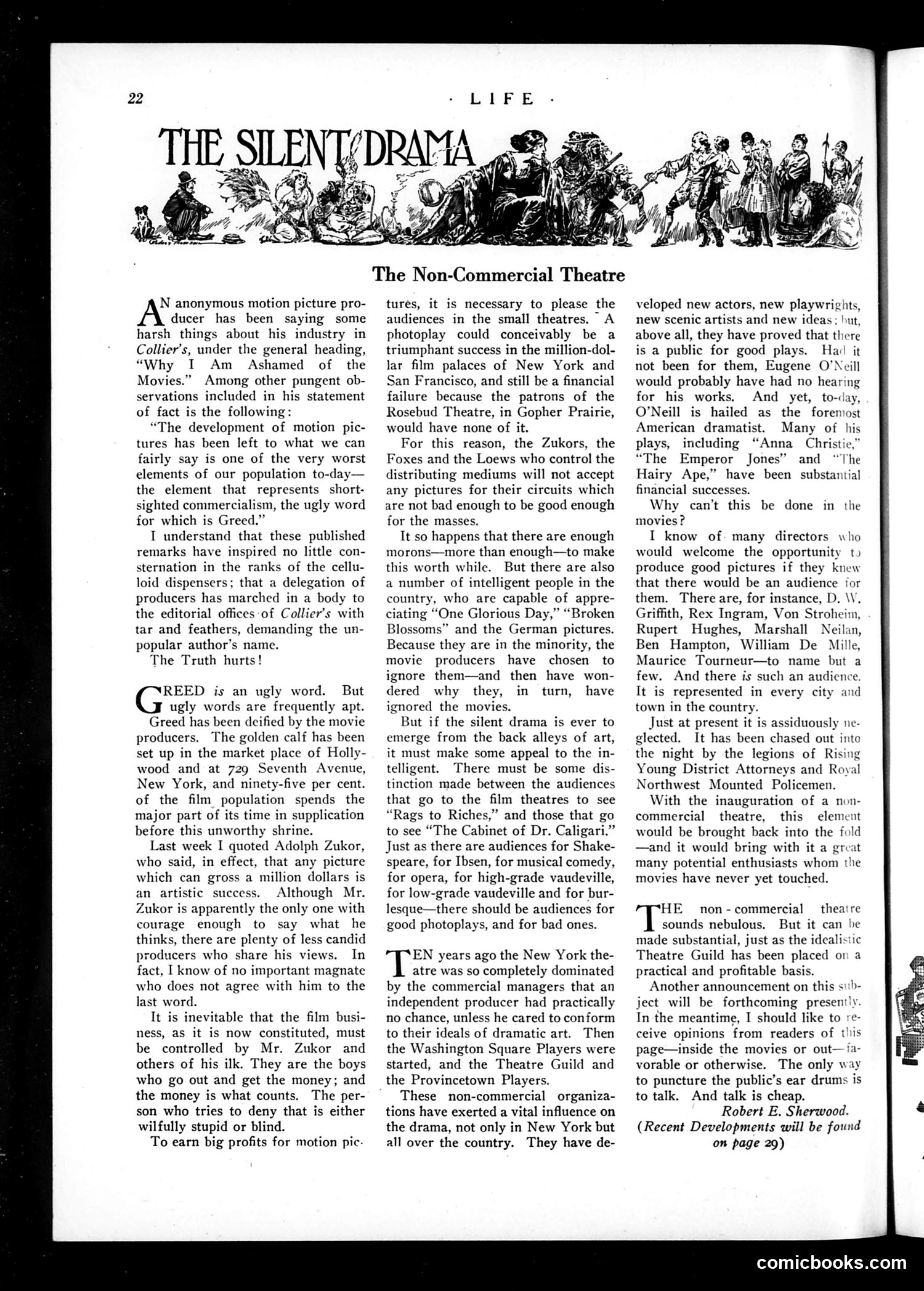
This article by Robert E. Sherwood criticizes Hollywood's profit-driven system. An anonymous producer accused the industry of being controlled by "Greed" in *Collier's* magazine, sparking outrage among film executives who reportedly demanded to know his identity. Sherwood argues that moguls like **Adolph Zukor**, **William Fox**, and **Marcus Loew** control distribution and deliberately reject artistically ambitious films, instead demanding only mass-appeal entertainment for small-town theaters like the "Rosebud Theatre, in Gopher Prairie." He contends they ignore "intelligent" audiences who appreciate sophisticated films like "Broken Blossoms" and German expressionist pictures. The piece advocates for a non-commercial theater model—citing the Washington Square Players and Theatre Guild—as proof that serious art can sustain itself without chasing lowest-common-denominator profits. The satire targets Hollywood's equation of financial success with artistic merit.
📄 Transcribed text from this page (OCR, searchable)
Machine-transcribed from the original scan — historical spelling and the odd misread are preserved.
N anonymous motion picture pro- ducer has been saying some harsh things about his industry in Collier’s, under the general heading, “Why I Am Ashamed of the Movies.” Among other pungent ob- servations included in his statement of fact is the following: “The development of motion pic- tures has been left to what we can fairly say is one of the very worst elements of our population to-day— the element that represents short- sighted commercialism, the ugly word for which is Greed.” I understand that these published remarks have inspired no little con- sternation in the ranks of the cellu- loid dispensers; that a delegation of producers has marched in a body to the editorial offices of Collier’s with tar and feathers, demanding the un- popular author’s name. The Truth hurts! REED is an ugly word. But ugly words are frequently apt. Greed has been deified by the movie producers. The golden calf has been set up in the market place of Holly- wood and at 729 Seventh Avenue, New York, and ninety-five per cent. of the film population spends the major part of its time in supplication before this unworthy shrine. Last week I quoted Adolph Zukor, who said, in effect, that any picture which can gross a million dollars is an artistic success. Although Mr. Zukor is apparently the only one with courage enough to say what he thinks, there are plenty of less candid producers who share his views. In fact, I know of no important magnate who does not agree with him to the last word. It is inevitable that the film busi- ness, as it is now constituted, must be controlled by Mr. Zukor and others of his ilk. They are the boys who go out and get the money; and the money is what counts. The per- son who tries to deny that is either wilfully stupid or blind. To earn big profits for motion pic- LIFE The Non-Commercial Theatre turés, it is necessary to please the audiences in the small theatres. A photoplay could conceivably be a triumphant success in the million-dol- lar film palaces of New York and San Francisco, and still be a financial failure because the patrons of the Rosebud Theatre, in Gopher Prairie, would have none of it. For this reason, the Zukors, the Foxes and the Loews who control the distributing mediums will not accept any pictures for their circuits which are not bad enough to be good enough for the masses. It so happens that there are enough morons—more than enough—to make this worth while. But there are also a number of intelligent people in the country, who are capable of appre- ciating “One Glorious Day,” “Broken Blossoms” and the German pictures. Because they are in the minority, the movie producers have chosen to ignore them—and then have won- dered why they, in turn, have ignored the movies. But if the silent drama is ever to emerge from the back alleys of art, it must make some appeal to the in- telligent. There must be some dis- tinction made between the audiences that go to the film theatres to see “Rags to Riches,” and those that go to see “The Cabinet of Dr. Caligari.” Just as there are audiences for Shake- speare, for Ibsen, for musical comedy, for opera, for high-grade vaudeville, for low-grade vaudeville and for bur- lesque—there should be audiences for good photoplays, and for bad ones. EN years ago the New York the- atre was so completely dominated by the commercial managers that an independent producer had practically no chance, unless he cared to conform to their ideals of dramatic art. Then the Washington Square Players were started, and the Theatre Guild and the Provincetown Players. These non-commercial organiza- tions have exerted a vital influence on the drama, not only in New York but all over the country. They have de- veloped new actors, new playwrights, new Scenic artists and new ideas above all, they have proved that there is a public for good plays. Hai it not been for them, Eugene O'Neill would probably have had no hearing for his works. And yet, to- O'Neill is hailed as the foremos American dramatist. Many of his plays, including “Anna Christ “The Emperor Jones” and “The Hairy Ape,” have been substantial financial successes. Why can’t this be done in movies? I know of. many directors who would welcome the opportunity to produce good pictures if they knew that there would be an audience for them. There are, for instance, D. \\. Griffith, Rex Ingram, Von Stroheim, Rupert Hughes, Marshall Neilan, Ben Hampton, William De Mille, Maurice Tourneur—to name but a few. And there is such an audienc It is represented in every city ai town in the country. Just at present it is assiduously ne- glected. It has been chased out into the night by the legions of Rising Young District Attorneys and Royal Northwest Mounted Policemen. With the inauguration of a non- commercial theatre, this element would be brought back into the fold —and it would bring with it a great many potential enthusiasts whom the movies have never yet touched. the HE non-commercial _ theatre sounds nebulous. But it can be made substantial, just as the idealistic Theatre Guild has been placed on a practical and profitable basis. Another announcement on this si\b- ject will be forthcoming presently. In the meantime, I should like to re- ceive opinions from readers of this page—inside the movies or out—{a- vorable or otherwise. The only way to puncture the public’s ear drums is to talk. And talk is cheap. Robert E. Sherwood. (Recent Developments will be found on page 29) comicbooks.com