
Life, 1922-10-05 · page 22 of 36
Life — October 5, 1922 — page 22: what you’re looking at
What you’re looking at
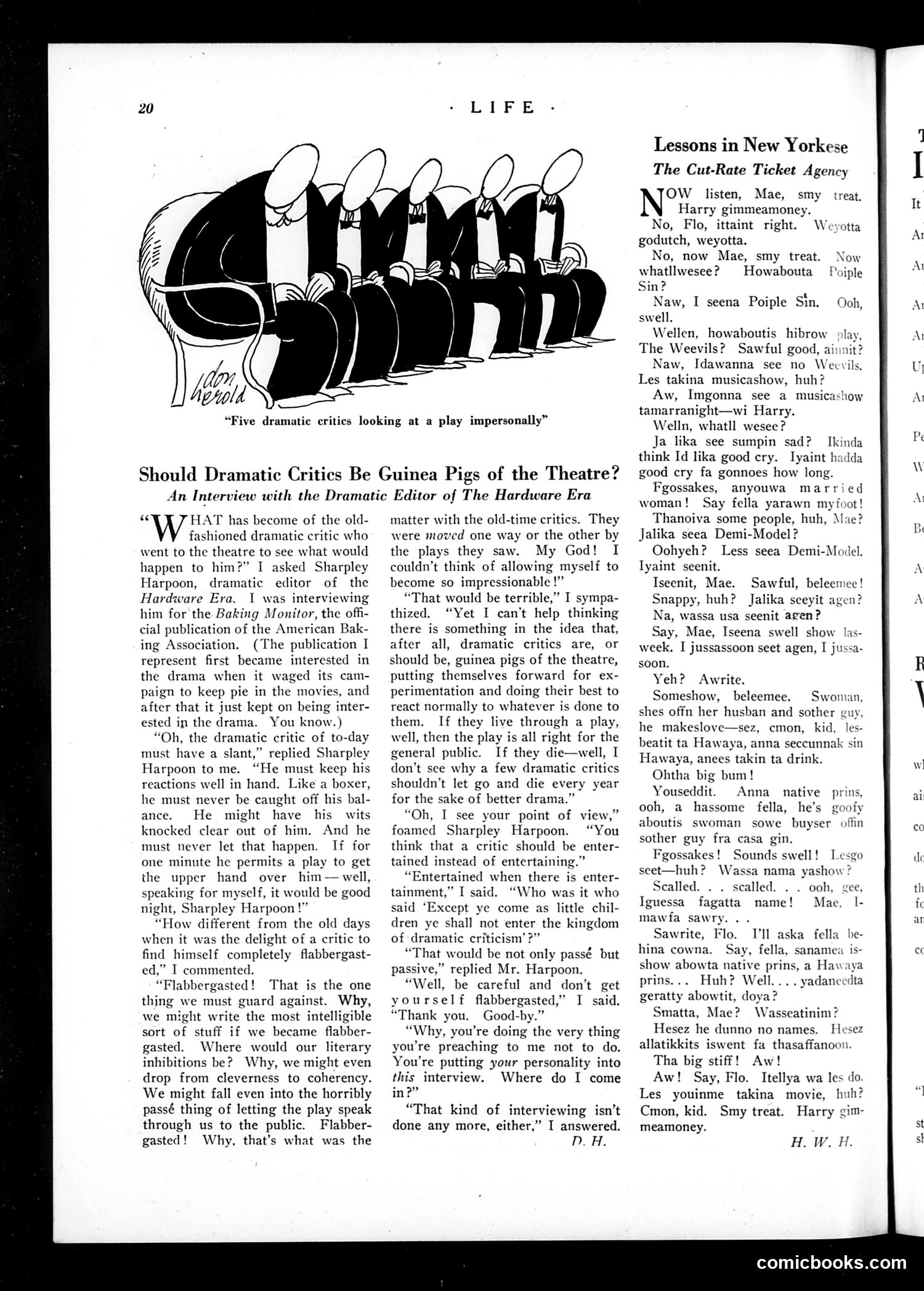
## Main Cartoon The illustration shows five identical dramatic critics sitting in a row, all with blank, expressionless faces. The satire targets modern theater critics who pride themselves on maintaining emotional detachment and "objectivity." ## The Interview Article The text mocks contemporary critics through a fictional interview with "Sharpley Harpoon," dramatic editor of *The Hardware Era*. The satire argues that modern critics are so preoccupied with appearing intellectually superior and maintaining critical distance that they've lost the ability to be genuinely moved by theater. They fear appearing "flabbergasted" (emotionally affected), which might compromise their cleverness and literary credibility. The interviewer humorously suggests critics should be "guinea pigs of the theatre"—willing to react naturally and genuinely. The piece ridicules how critics prioritize maintaining persona over authentic response, even to the point of complaining when interviewed in a natural manner. ## "Lessons in New Yorkese" A comedic sidebar phonetically transcribing working-class New York dialect and speech patterns, showing how ordinary New Yorkers discuss entertainment.
📄 Transcribed text from this page (OCR, searchable)
Machine-transcribed from the original scan — historical spelling and the odd misread are preserved.
“Five dramatic critics looking at a play impersonally” Should Dramatic Critics Be Guinea Pigs of the Theatre? An Interview with the Dramatic Editor of The Hardware Era HAT has become of the old- fashioned dramatic critic who went to the theatre to see what would happen to him?” I asked Sharpley Harpoon, dramatic editor of the Hardware Era. 1 was interviewing him for the Baking Monitor, the offi- cial publication of the American Bak- ing Association. (The publication I represent first became interested in the drama when it waged its cam- paign to keep pie in the movies, and after that it just kept on being inter- ested in the drama. You know.) “Oh, the dramatic critic of to-day must have a slant,” replied Sharpley Harpoon to me. “He must keep his reactions well in hand. Like a boxer, he must never be caught off his bal- ance. He might have his wits knocked clear out of him. And he must never let that happen. If for one minute he permits a play to get the upper hand over him— well, speaking for myself, it would be good night, Sharpley Harpoon !” “How different from the old days when it was the delight of a critic to find himself completely flabbergast- ed,” I commented. “Flabbergasted! That is the one thing we must guard against. Why, we might write the most intelligible sort of stuff if we became flabber- gasted. Where would our literary inhibitions be? Why, we might even drop from cleverness to coherency. We might fall even into the horribly passé thing of letting the play speak through us to the public. Flabber- gasted! Why, that’s what was the matter with the old-time critics. They were moved one way or the other by the plays they saw. My God! I couldn’t think of allowing myself to become so impressionable !” “That would be terrible,” I sympa- thized. “Yet I can’t help thinking there is something in the idea that, after all, dramatic critics are, or should be, guinea pigs of the theatre, putting themselves forward for ex- perimentation and doing their best to react normally to whatever is done to them. If they live through a play, well, then the play is all right for the general public. If they die—well, I don’t see why a few dramatic critics shouldn't let go and die every year for the sake of better drama.” “Oh, I see your point of view,” foamed Sharpley Harpoon. “You think that a critic should be enter- tained instead of entertaining.” “Entertained when there is enter- tainment,” I said. “Who was it who said ‘Except ye come as little chil- dren ye shall not enter the kingdom of dramatic criticism’ ?” “That would be not only passé but passive,” replied Mr. Harpoon. “Well, be careful and don’t get yourself flabbergasted,” I said. “Thank you. Good-by.” “Why, you're doing the very thing you're preaching to me not to do. You're putting your personality into this interview. Where do I come in?” “That kind of interviewing isn’t done any more, either,” I answered. dD. #H. Lessons in New Yorkese The Cut-Rate Ticket Agency OW listen, Mae, smy treat, Harry gimmeamoney. No, Flo, ittaint right. Weyotta godutch, weyotta. No, now Mae, smy treat. Now whatllwesee? | Howabouta Poiple Sin? Naw, I seena Poiple Sin, Ooh, swell. Wellen, howaboutis hibrow play, The Weevils? Sawful good, ainnit? Naw, Idawanna see no Weevils, Les takina musicashow, huh? Aw, Imgonna see a musicashow tamarranight—wi Harry. Welln, whatll wesee? Ja lika see sumpin sad? Ikinda think Id lika good cry. Iyaint hadda good cry fa gonnoes how long. Fgossakes, anyouwa married woman! Say fella yarawn myfoot! Thanoiva some people, huh, Mae? Jalika seea Demi-Model? Oohyeh? Less seea Demi-Model. lyaint seenit. Iseenit, Mae. Sawful, beleemee! Snappy, huh? Jalika seeyit agen? Na, wassa usa seenit agen? Say, Mae, Iseena swell show las- week. I jussassoon seet agen, I jussa- soon. Yeh? Awrite. Someshow, beleemee. Swomian, shes offn her husban and sother guy, he makeslove—sez, cmon, kid, les- beatit ta Hawaya, anna seccunnak sin Hawaya, anees takin ta drink. Ohtha big bum! Youseddit. Anna native prins, ooh, a hassome fella, he’s goofy aboutis swoman sowe buyser offin sother guy fra casa gin. Fgossakes! Sounds swell! seet—huh? Wassa nama yashow? Scalled. . . scalled. . . ooh, gee, Iguessa fagatta name! Mae, I- mawfa sawry. . . Sawrite, Flo. I'll aska fella be- hina cowna. Say, fella, sanamea is- show abowta native prins, a Hawaya prins... Huh? Well... . yadancedta geratty abowtit, doya? Smatta, Mae? Wasseatinim? Hesez he dunno no names. Hesez allatikkits iswent fa thasaffanoon. Tha big stiff! Aw! Aw! Say, Flo. Itellya wa les do. Les youinme takina movie, huh? Cmon, kid. Smy treat. Harry gim- meamoney. Lesgo H. W. H. comicbooks.com It Al Al A A U Al