
Life, 1922-10-05 · page 20 of 36
Life — October 5, 1922 — page 20: what you’re looking at
What you’re looking at
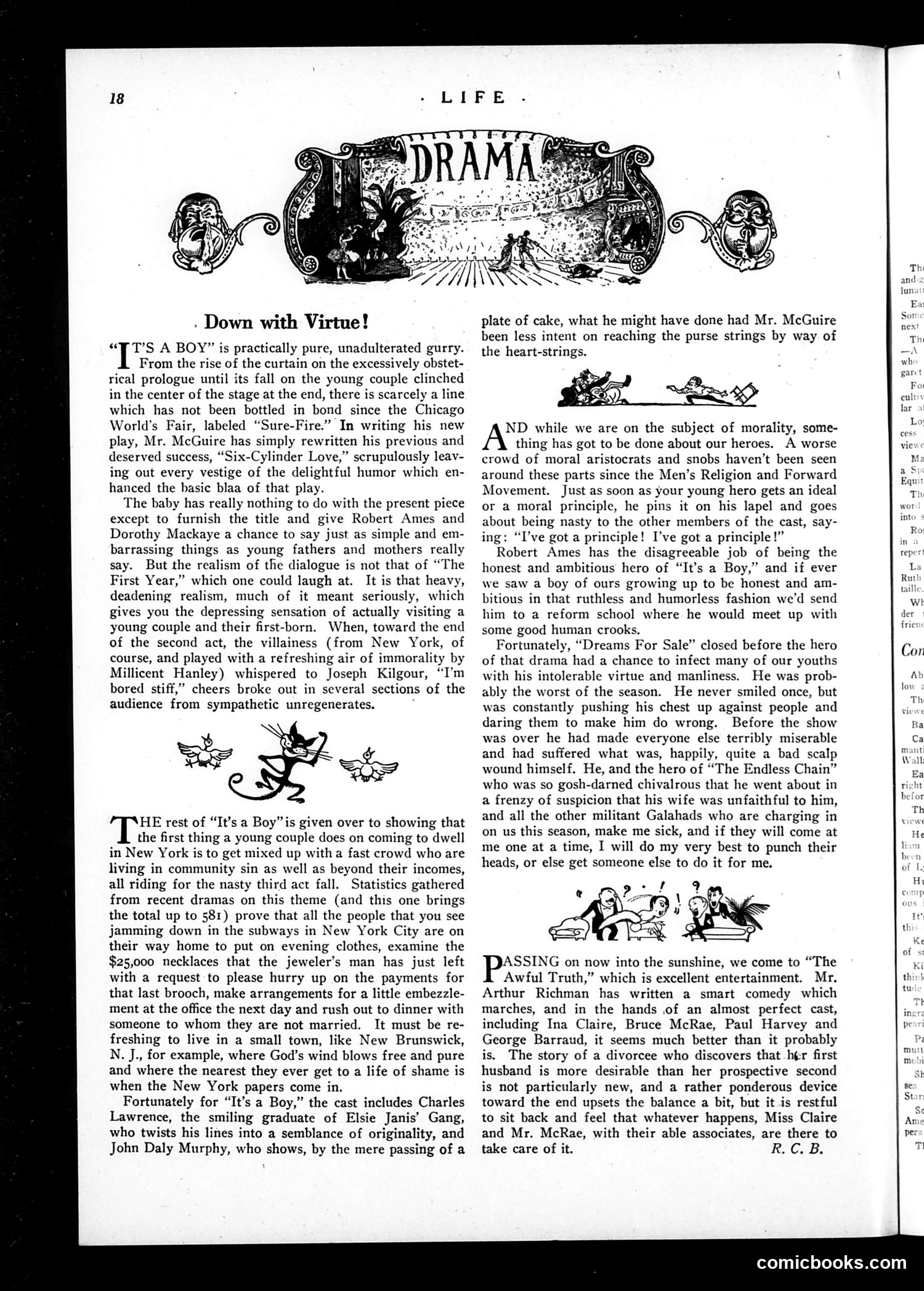
This is a theater review column critiquing two Broadway plays: "It's a Boy" and "Dreams For Sale." The critic savagely attacks "It's a Boy" as derivative hackwork—merely a rewrite of McGuire's earlier success "Six-Cylinder Love" stripped of humor. The satire targets the play's reliance on tired formulas: newlyweds, a temptress from New York, infidelity, and melodramatic morality. The reviewer mocks the absurd premise that all New Yorkers live beyond their means in "community sin," contrasting it satirically with wholesome small-town life. The critic also ridicules contemporary theater's moralizing heroes—characters who tediously announce their principles while judging others harshly. The review praises supporting actors (Lawrence, Murphy) who salvage scenes through performance skill rather than script quality. This represents Life magazine's signature role: sophisticated cultural commentary mocking both theatrical mediocrity and the moral hypocrisy of the era's entertainment.
📄 Transcribed text from this page (OCR, searchable)
Machine-transcribed from the original scan — historical spelling and the odd misread are preserved.
. Down with Virtue! “TT’S A BOY” is practically pure, unadulterated gurry. From the rise of the curtain on the excessively obstet- rical prologue until its fall on the young couple clinched in the center of the stage at the end, there is scarcely a line which has not been bottled in bond since the Chicago World's Fair, labeled “Sure-Fire.” In writing his new play, Mr. McGuire has simply rewritten his previous and deserved success, “Six-Cylinder Love,” scrupulously leav- ing out every vestige of the delightful humor which en- hanced the basic blaa of that play. The baby has really nothing to do with the present piece except to furnish the title and give Robert Ames and Dorothy Mackaye a chance to say just as simple and em- barrassing things as young fathers and mothers really say. But the realism of the dialogue is not that of “The First Year,” which one could laugh at. It is that heavy, deadening realism, much of it meant seriously, which gives you the depressing sensation of actually visiting a young couple and their first-born. When, toward the end of the second act, the villainess (from New York, of course, and played with a refreshing air of immorality by Millicent Hanley) whispered to Joseph Kilgour, “I’m bored stiff,” cheers broke out in several sections of the audience from sympathetic unregenerates. Sr, yh & HE rest of “It’s a Boy” is given over to showing that the first thing a young couple does on coming to dwell in New York is to get mixed up with a fast crowd who are living in community sin as well as beyond their incomes, all riding for the nasty third act fall. Statistics gathered from recent dramas on this theme (and this one brings the total up to 581) prove that all the people that you see jamming down in the subways in New York City are on their way home to put on evening clothes, examine the $25,000 necklaces that the jeweler’s man has just left with a request to please hurry up on the payments for that last brooch, make arrangements for a little embezzle- ment at the office the next day and rush out to dinner with someone to whom they are not married. It must be re- freshing to live in a small town, like New Brunswick, N. J., for example, where God’s wind blows free and pure and where the nearest they ever get to a life of shame is when the New York papers come in. Fortunately for “It’s a Boy,” the cast includes Charles Lawrence, the smiling graduate of Elsie Janis’ Gang, who twists his lines into a semblance of originality, and John Daly Murphy, who shows, by the mere passing of a plate of cake, what he might have done had Mr. McGuire been less intent on reaching the purse strings by way of the heart-strings. ND while we are on the subject of morality, some- A thing has got to be done about our heroes. A worse crowd of moral aristocrats and snobs haven’t been seen around these parts since the Men’s Religion and Forward Movement. Just as soon as your young hero gets an ideal or a moral principle, he pins it on his lapel and goes about being nasty to the other members of the cast, say- ing: “I’ve got a principle! I’ve got a principle!” Robert Ames has the disagreeable job of being the honest and ambitious hero of “It’s a Boy,” and if ever we saw a boy of ours growing up to be honest and am- bitious in that ruthless and humorless fashion we'd send him to a reform school where he would meet up with some good human crooks. Fortunately, “Dreams For Sale” closed before the hero of that drama had a chance to infect many of our youths with his intolerable virtue and manliness. He was prob- ably the worst of the season. He never smiled once, but was constantly pushing his chest up against people and daring them to make him do wrong. Before the show was over he had made everyone else terribly miserable and had suffered what was, happily, quite a bad scalp wound himself. He, and the hero of “The Endless Chain” who was so gosh-darned chivalrous that he went about in a frenzy of suspicion that his wife was unfaithful to him, and all the other militant Galahads who are charging in on us this season, make me sick, and if they will come at me one at a time, I will do my very best to punch their heads, or else get someone else to do it for me. ASSING on now into the sunshine, we come to “The Awful Truth,” which is excellent entertainment. Mr. Arthur Richman has written a smart comedy which marches, and in the hands of an almost perfect cast, including Ina Claire, Bruce McRae, Paul Harvey and George Barraud, it seems much better than it probably is. The story of a divorcee who discovers that h¢r first husband is more desirable than her prospective second is not particularly new, and a rather ponderous device toward the end upsets the balance a bit, but it is restful to sit back and feel that whatever happens, Miss Claire and Mr. McRae, with their able associates, are there to take care of it. R.C. B. comicbooks.com