
A complete issue · 34 pages · 1922
Life — April 13, 1922
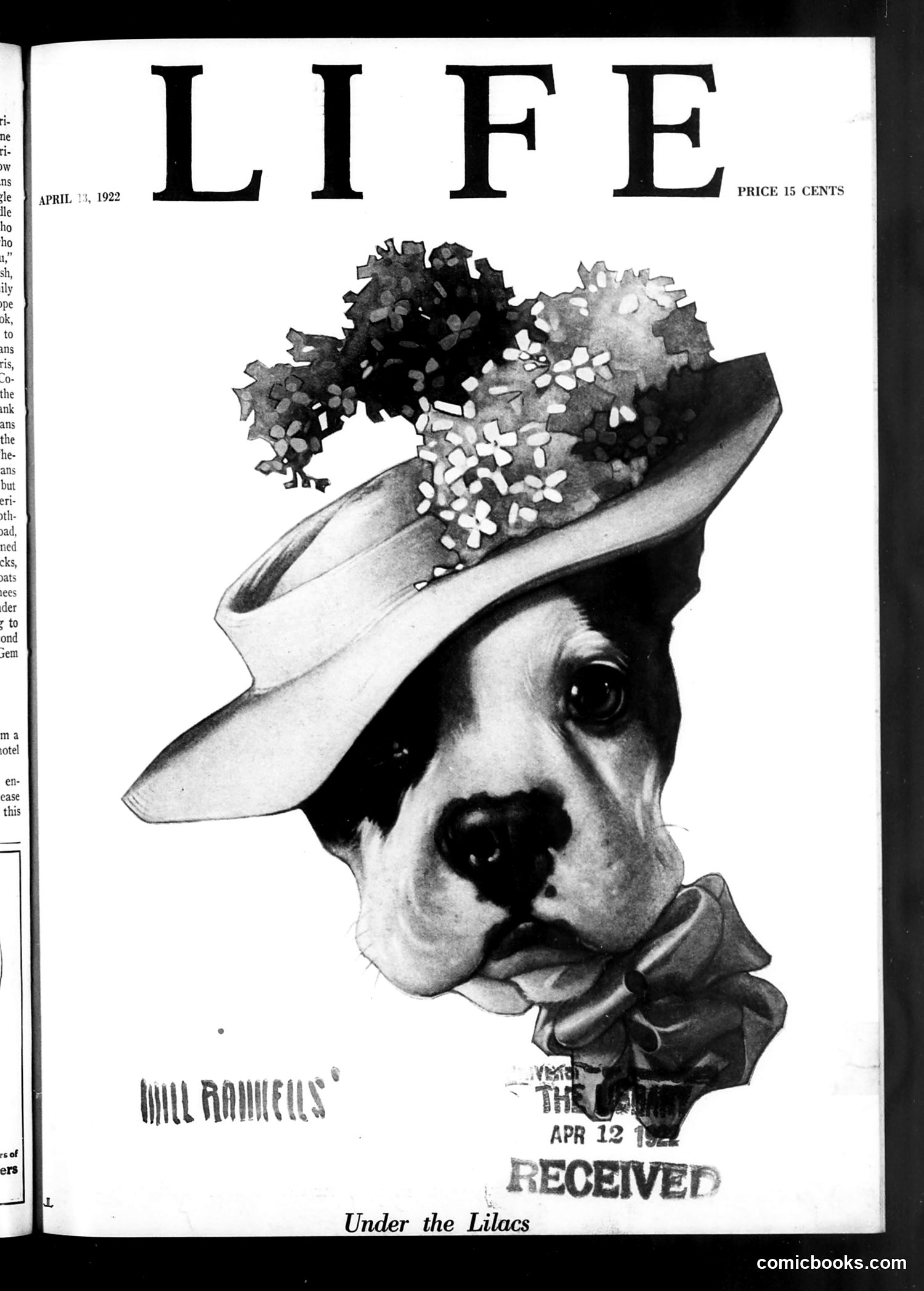
This is a humorous illustration by Will Ranwell featuring a Boston Terrier wearing an elaborate, flower-decorated hat with a large bow tie. The dog's expression is somewhat bemused or dignified. The caption "Under the Lilacs" likely references the sentimental 1878 Louisa May Alcott novel of the same name. The satire appears to mock high-fashion women's hats of the 1920s era—absurdly overdecorated with flowers and ribbons—by placing such a ridiculous confection on a dog's head. The joke suggests these elaborate hats were so ornate and impractical that even a dog wearing one looks equally foolish. This reflects period humor about women's fashion excess and the Jazz Age's sometimes over-the-top aesthetic conventions.
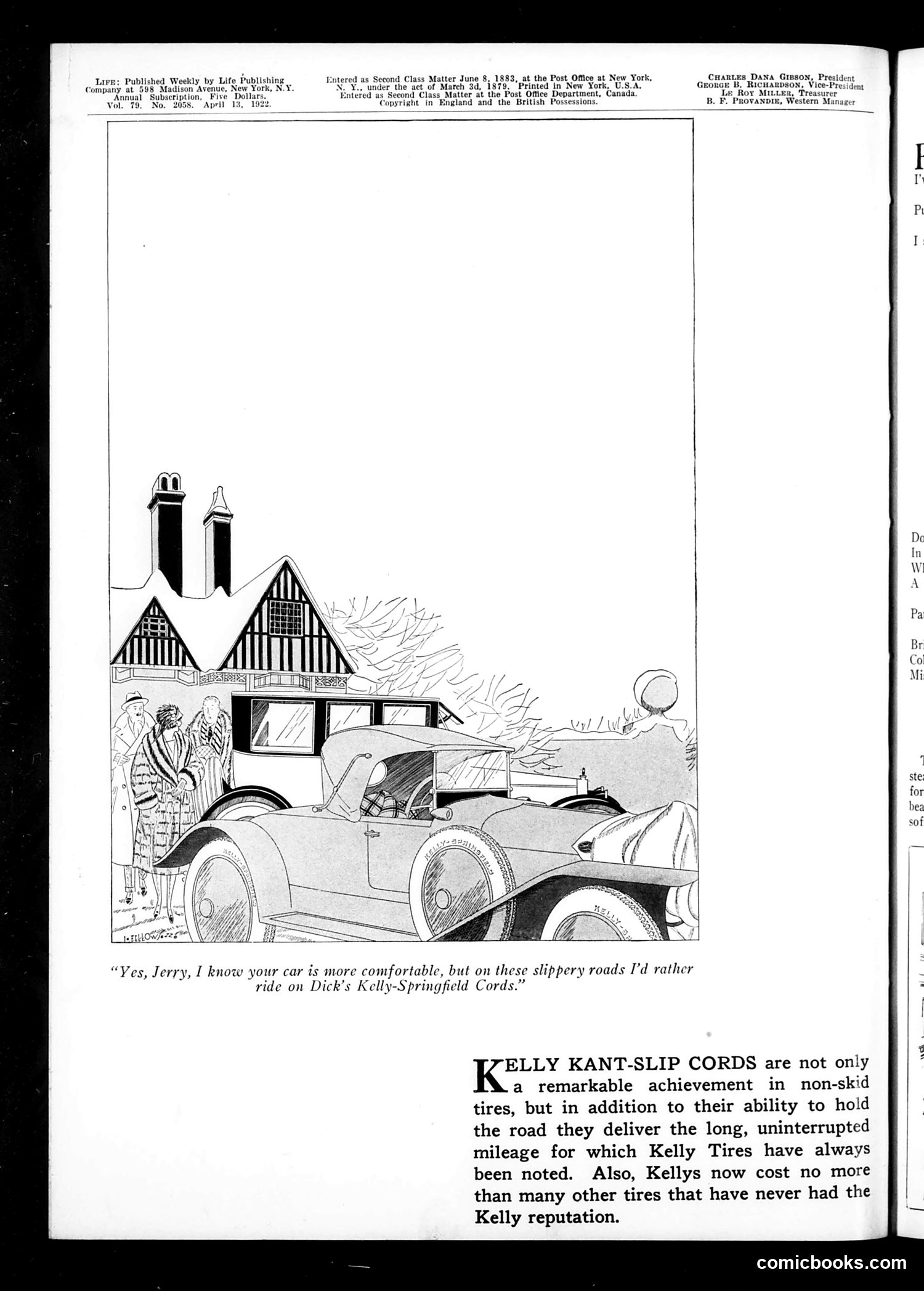
This page is primarily **advertising content** for Kelly Kant-Slip Cords (automobile tires), not political satire or editorial cartoon. The illustration shows a 1920s-era car on a snowy road near a cottage. Two figures outside the car discuss tire safety—one recommends Kelly tires for traction on slippery roads, implying superior performance over competitors. The advertisement's message exploits contemporary concerns about **winter driving safety** on unpaved or icy roads, a genuine practical issue in the 1920s automotive era. The copytext emphasizes that Kelly Kant-Slip Cords provide both non-skid reliability and long mileage at competitive prices—standard advertising claims positioning them against unnamed rival tire manufacturers. This reflects early automotive consumer culture rather than political commentary.
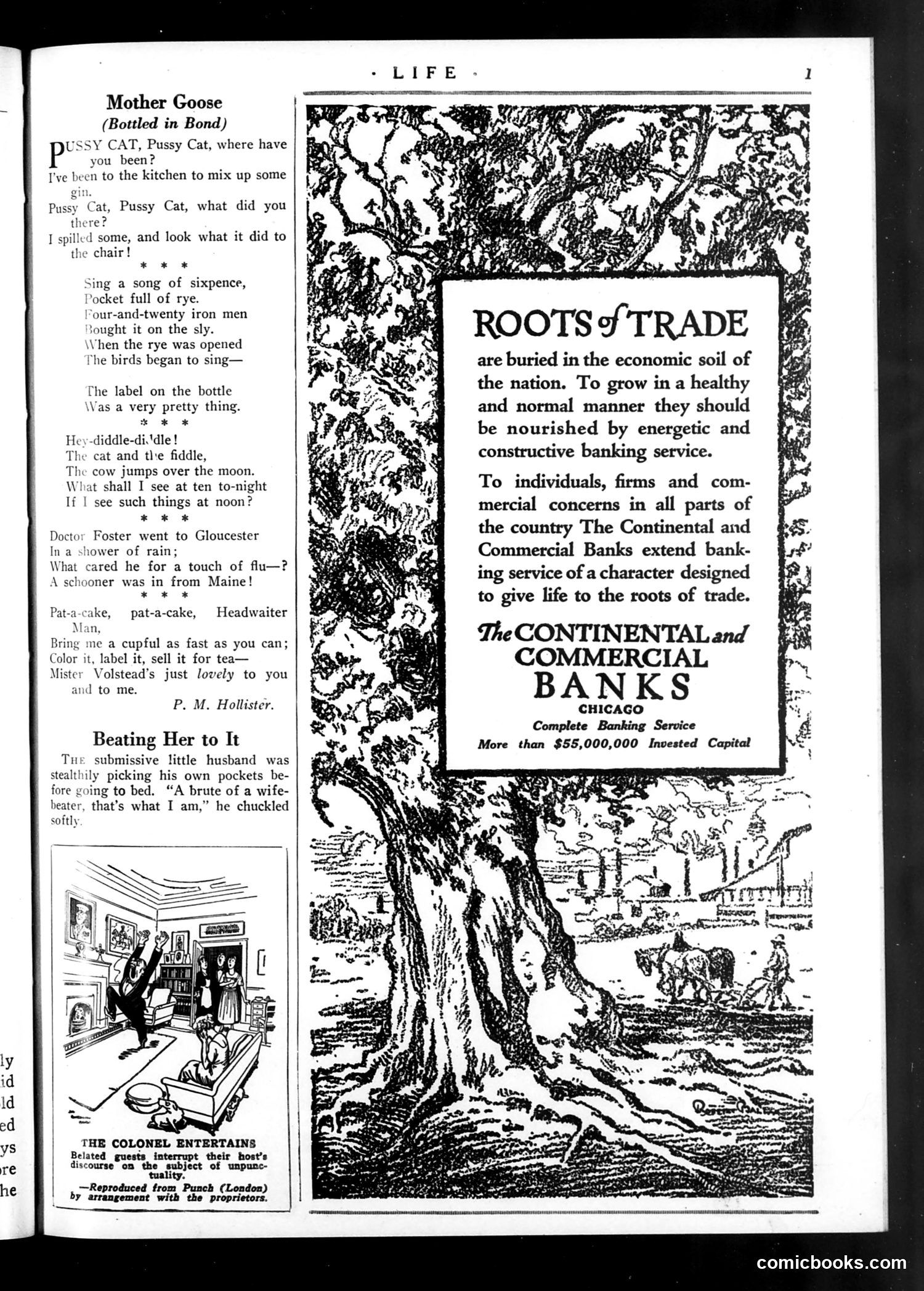
This page contains **mostly advertising** alongside light humor content. The left side features "Mother Goose (Bottled in Bond)" — nursery rhyme verses, likely satirizing prohibition-era rhetoric about "bottled" goods. Below is a brief joke titled "Beating Her to It" about a submissive husband claiming he's "a shirt of a wife-beater" before his wife can say so — domestic humor typical of the 1920s. The main content is a full-page ad for **The Continental and Commercial Banks of Chicago**, using an illustrated tree metaphor: "roots of trade" need banking service to grow. The marketing pitch emphasizes financial services for businesses nationwide. The cartoon labeled "The Colonel Entertains" (bottom left) shows a social scene where guests interrupt the host's discourse—light satirical commentary on social interruptions, reprinted from *Punch* (London).
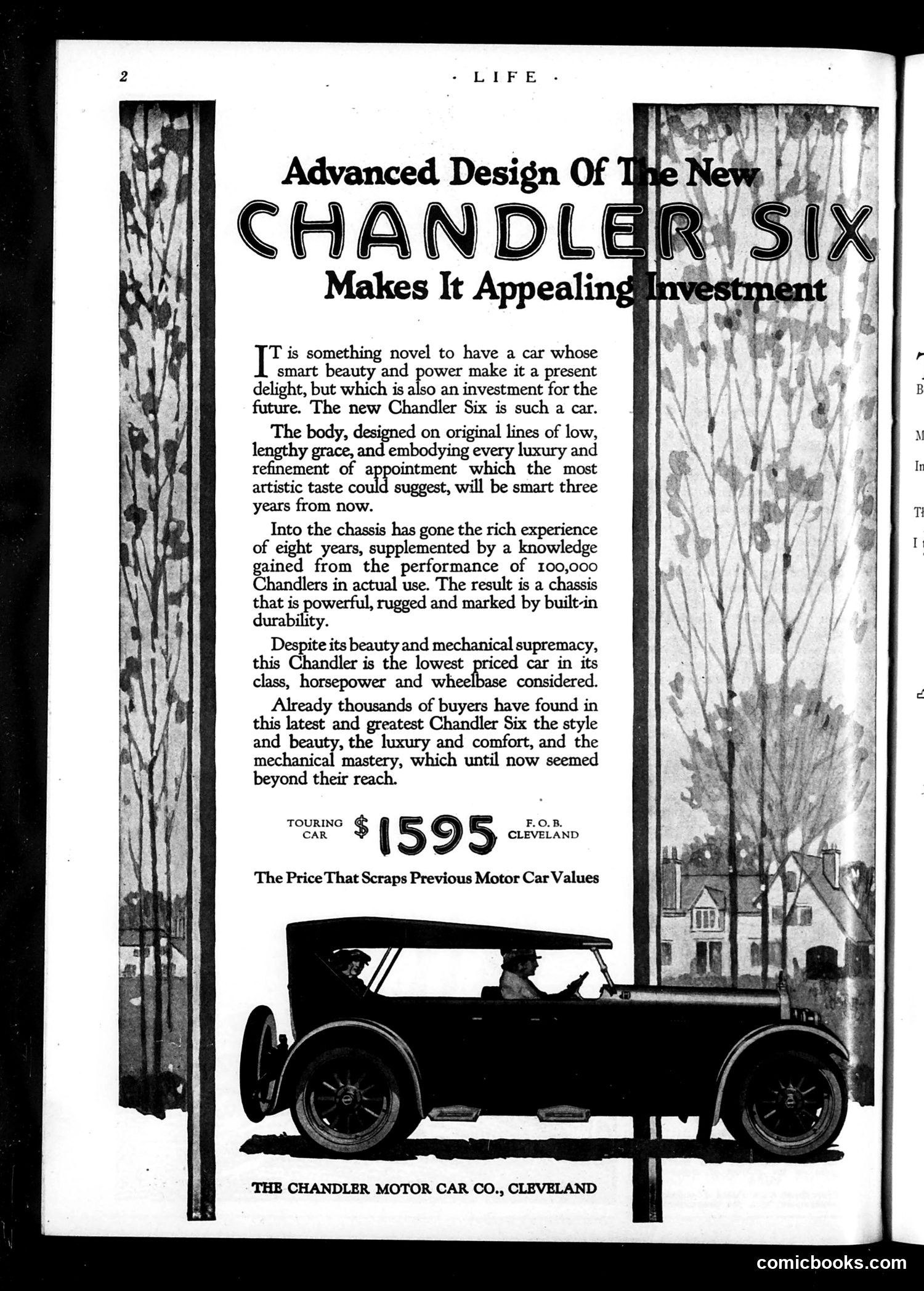
This page is **not a cartoon or satirical content**—it's a straightforward automobile advertisement for the Chandler Six, published in *Life* magazine. The ad promotes the 1920s Chandler Six touring car, priced at $1,595 (F.O.B. Cleveland). The marketing pitch emphasizes the car as both a luxury item and a sound financial investment. Key claims include its low price relative to competitors, reliability from 100,000 cars in use, and advanced design features. The decorative border illustrations (left and right) appear to be generic period scenery—urban landscapes and buildings—typical of 1920s advertisement design, not satirical commentary. This represents how *Life*'s pages mixed humor with commercial advertising during this era.
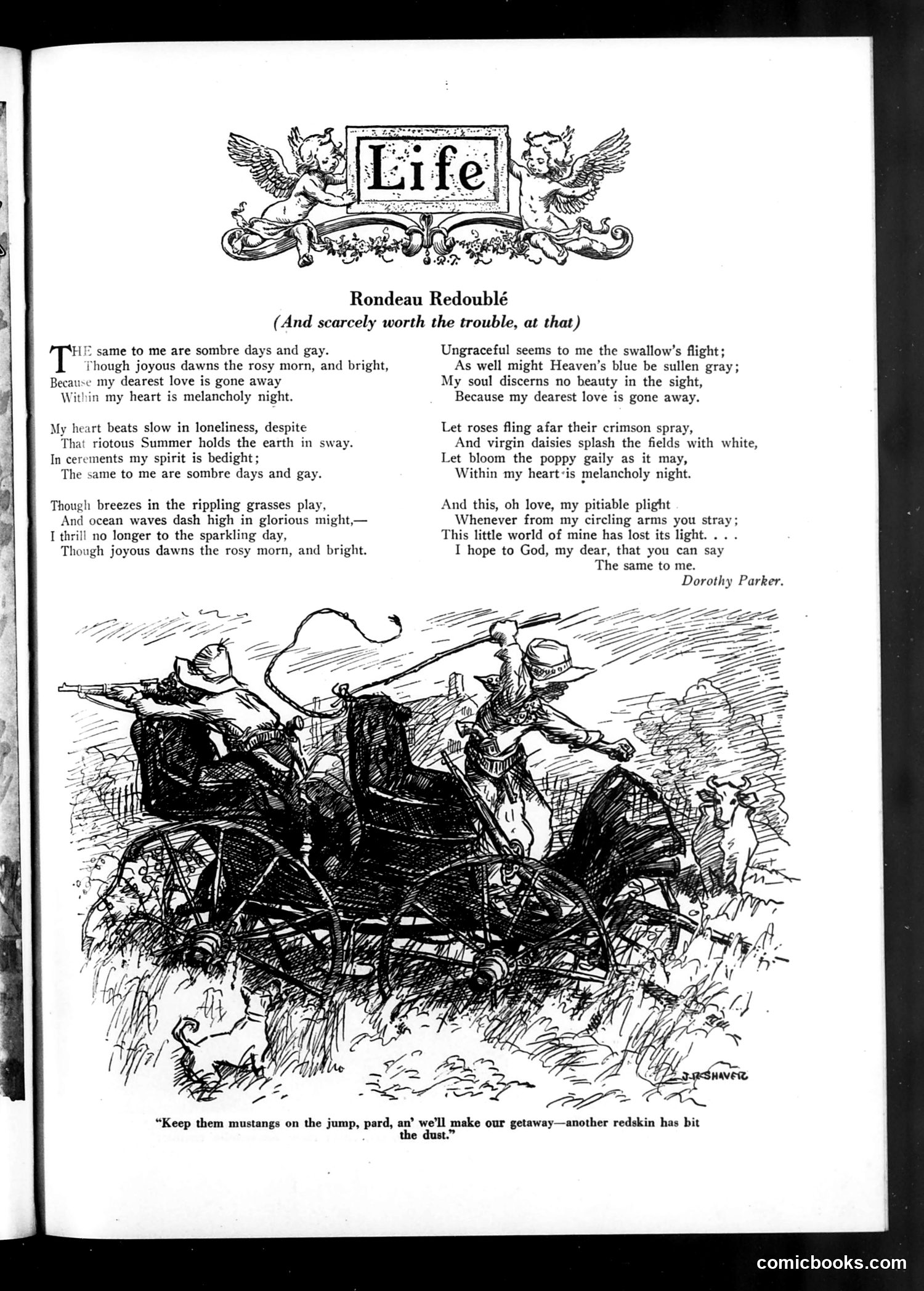
This page features a poem titled "Rondeau Redoublé" by Dorothy Parker, expressing melancholy over a lost love. The accompanying illustration by F. R. Shaver depicts a chaotic scene of people in a horse-drawn carriage fleeing hastily across grassland. The cartoon's caption reads: "Keep them mustangs on the jump, pard, an' we'll make our getaway—another redskin has bit the dust." This reflects early 20th-century Wild West stereotypes, depicting a dramatic escape scene. The illustration appears designed to humorously contrast with Parker's romantic poem about heartbreak—juxtaposing sentimental verse with comedic action imagery typical of Life magazine's satirical approach to pairing art with literature.
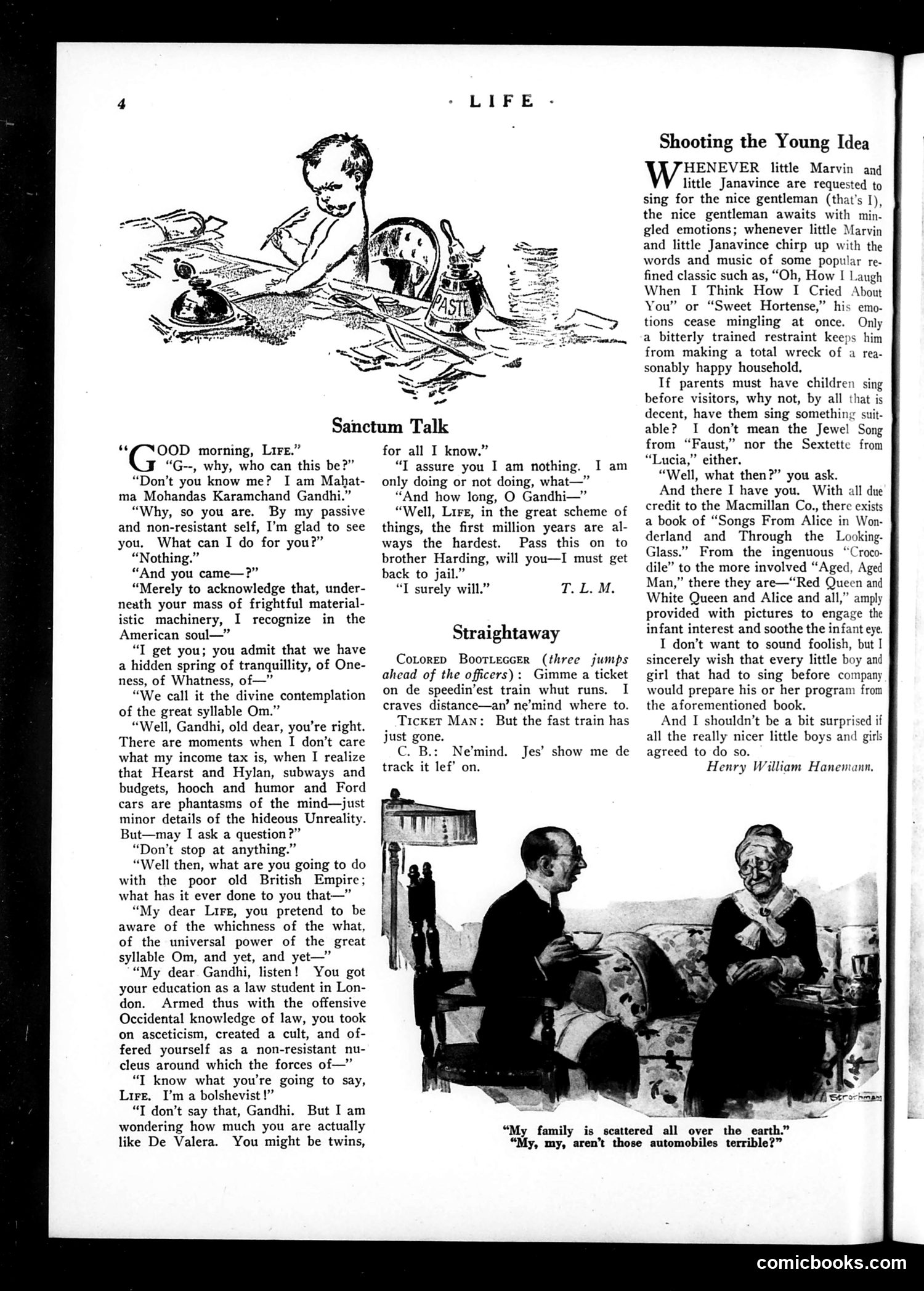
This page contains three distinct sections: **"Sanctum Talk"** presents a satirical dialogue between "Life" (the magazine) and Mahatma Gandhi, mocking Gandhi's philosophy and asceticism. Life criticizes Gandhi's non-resistance and questions his actual influence, suggesting his ideas are impractical luxuries compared to harsh realities (mentioning Hearst, Hylton, Ford cars as symbols of American materialism). **"Straightaway"** is a brief, obscure joke about a colored bootlegger and a train, likely referencing Prohibition-era smuggling. **"Shooting the Young Idea"** discusses whether children should sing sentimental popular songs before visitors, arguing against it. The author (Henry William Hanemann) suggests children instead perform from established children's literature like Alice in Wonderland. The page reflects early 20th-century satirical humor and social commentary typical of Life magazine's editorial stance.
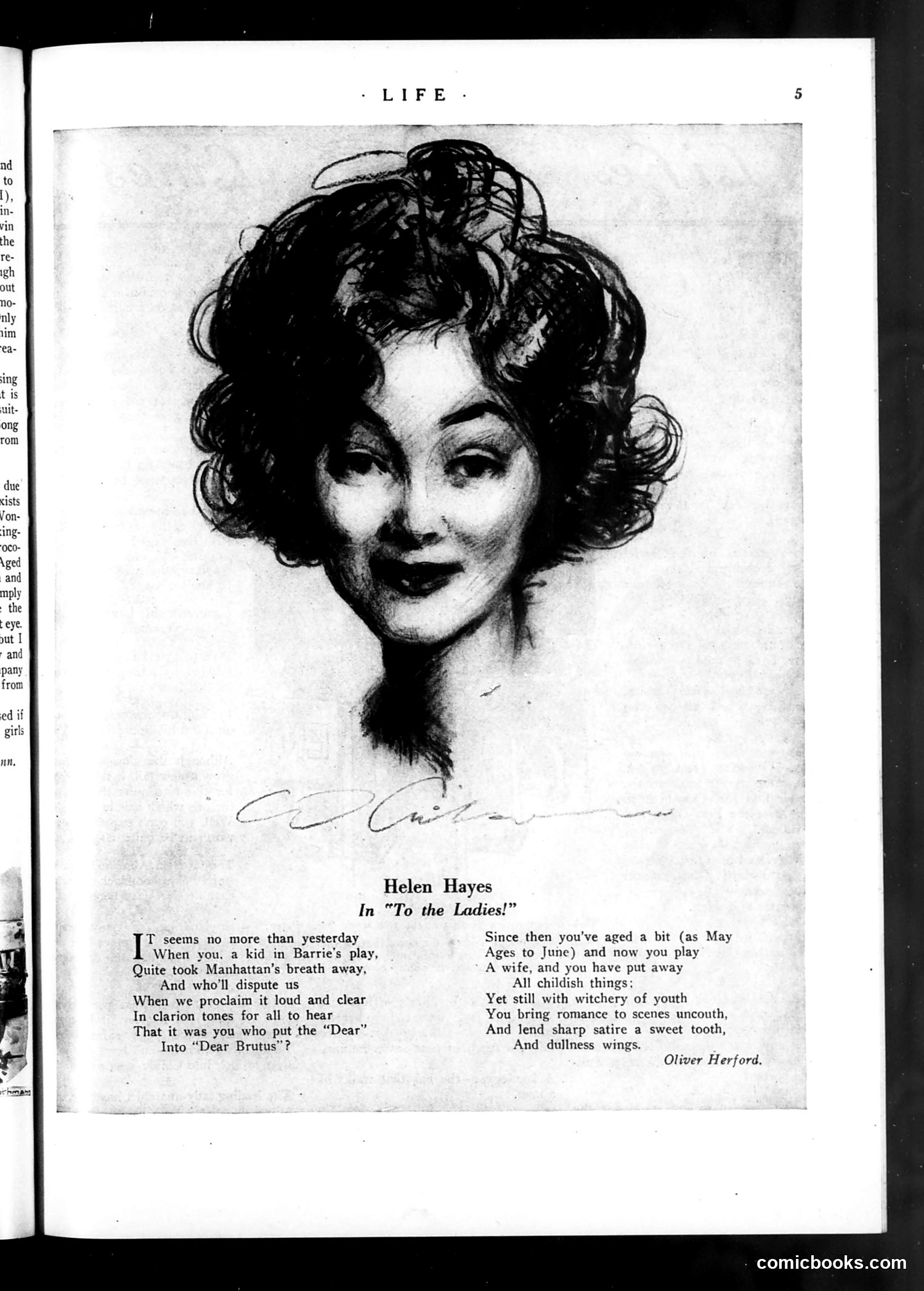
This is a tribute page to actress Helen Hayes, featuring her portrait and a poem by Oliver Herford. The piece celebrates Hayes's career progression from child actress in Barrie's play (likely *Peter Pan*) to adult roles, specifically referencing her performance in "To the Ladies!" Herford's verse marks the passage of time—Hayes has "aged a bit" from her May-to-June youth into a mature performer who has "put away / All childish things." The satire gently mocks the transition while praising her retained qualities: romantic charm, witty satire, and refined artistry ("sweet tooth / And dullness wings"). This appears to be a celebratory feature rather than political satire, typical of *Life* magazine's theatrical coverage during the early 20th century.
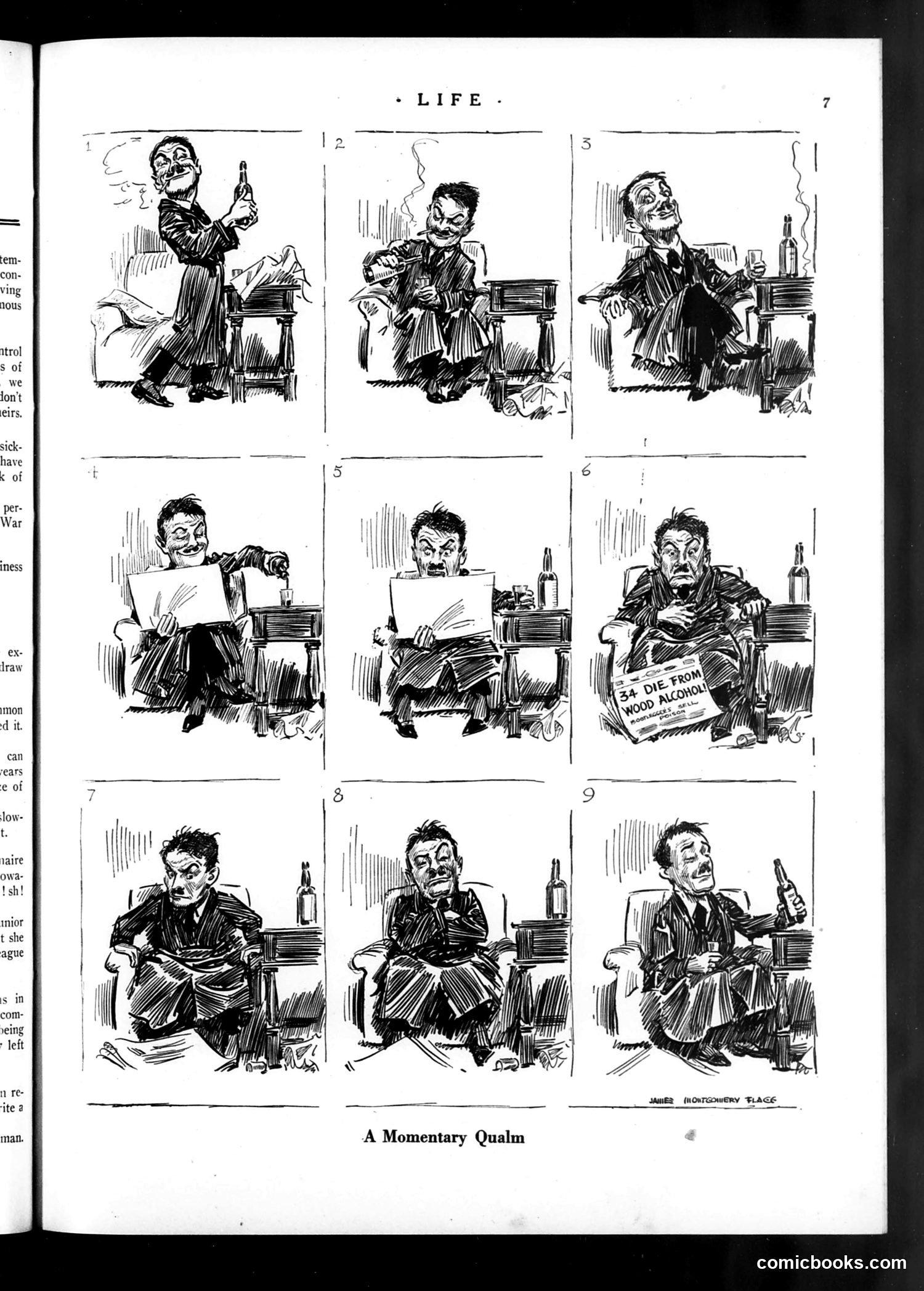
This nine-panel comic strip depicts a man alone with a bottle of alcohol, showing his internal conflict about drinking. The title "A Momentary Qualm" suggests he experiences brief hesitation before succumbing to temptation. The sequence shows the man's escalating intoxication and emotional states—from initial resolve to drink, through moments of doubt (panel 6 shows what appears to be a newspaper about "Die from Wood Alcohol"), to eventual drunkenness. His facial expressions shift from determination to distress to resigned acceptance. This appears to be satirical commentary on alcohol consumption and addiction, possibly referencing Prohibition-era concerns about wood alcohol poisoning (a dangerous bootleg substitute). The comic critiques both the dangers of drinking and the weakness of human resolve against temptation.
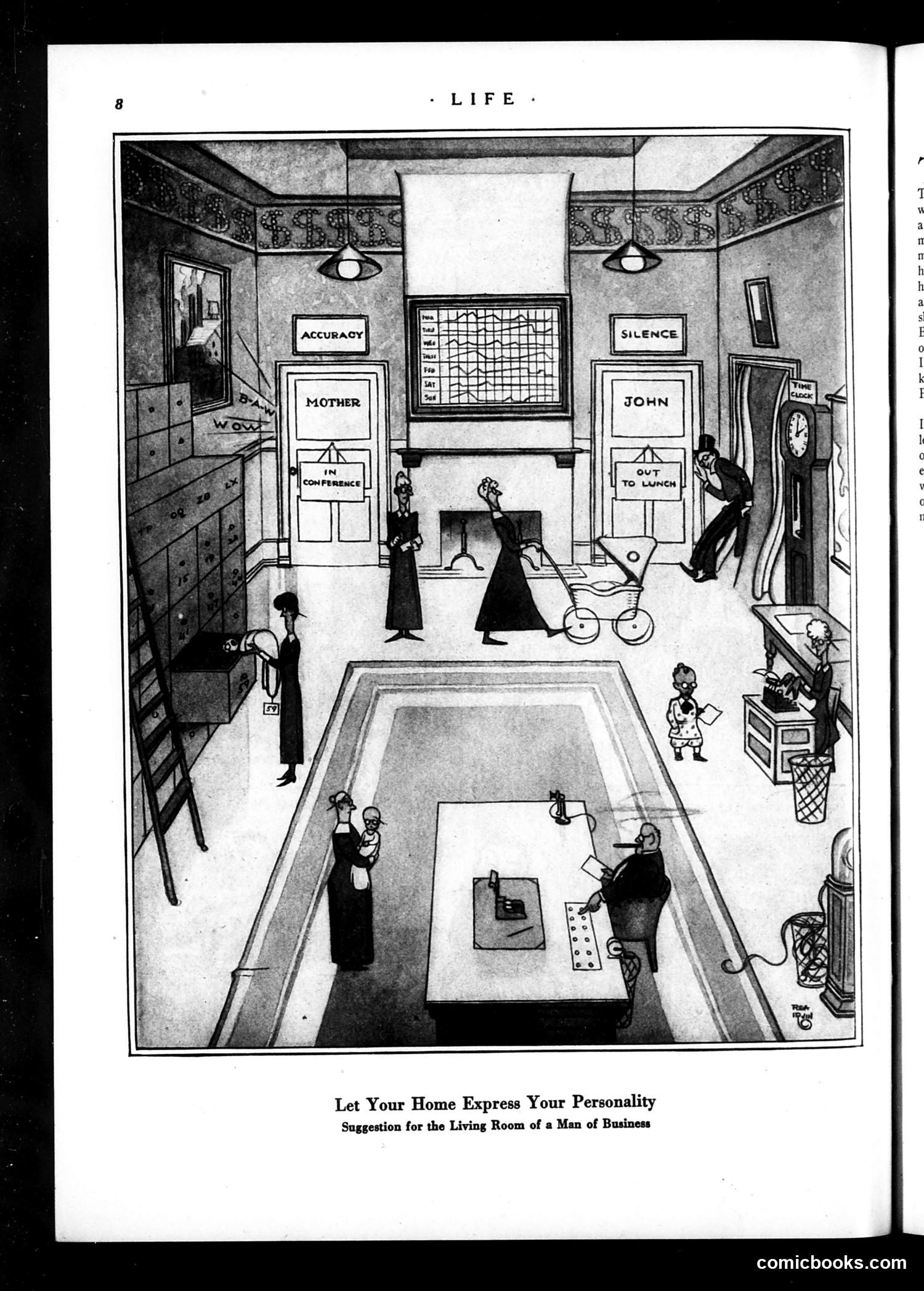
This is an architectural/interior design illustration rather than political satire. The image shows a cross-section of a living room labeled "Suggestion for the Living Room of a Man of Business." The cartoon depicts a modernist domestic space with labeled areas emphasizing desirable qualities: "Accuracy," "Silence," "Mother" (domestic care), and "John" (presumably the businessman owner). A central fireplace anchors the room, with various family members and staff engaged in different activities. The satire appears gentle and aspirational rather than biting—it's suggesting that a businessman's home should embody orderly, efficient values ("Accuracy," "Silence") while maintaining traditional domestic comfort and maternal care. This reflects early-20th-century ideals about how domestic space should support and express a professional man's personality and status.
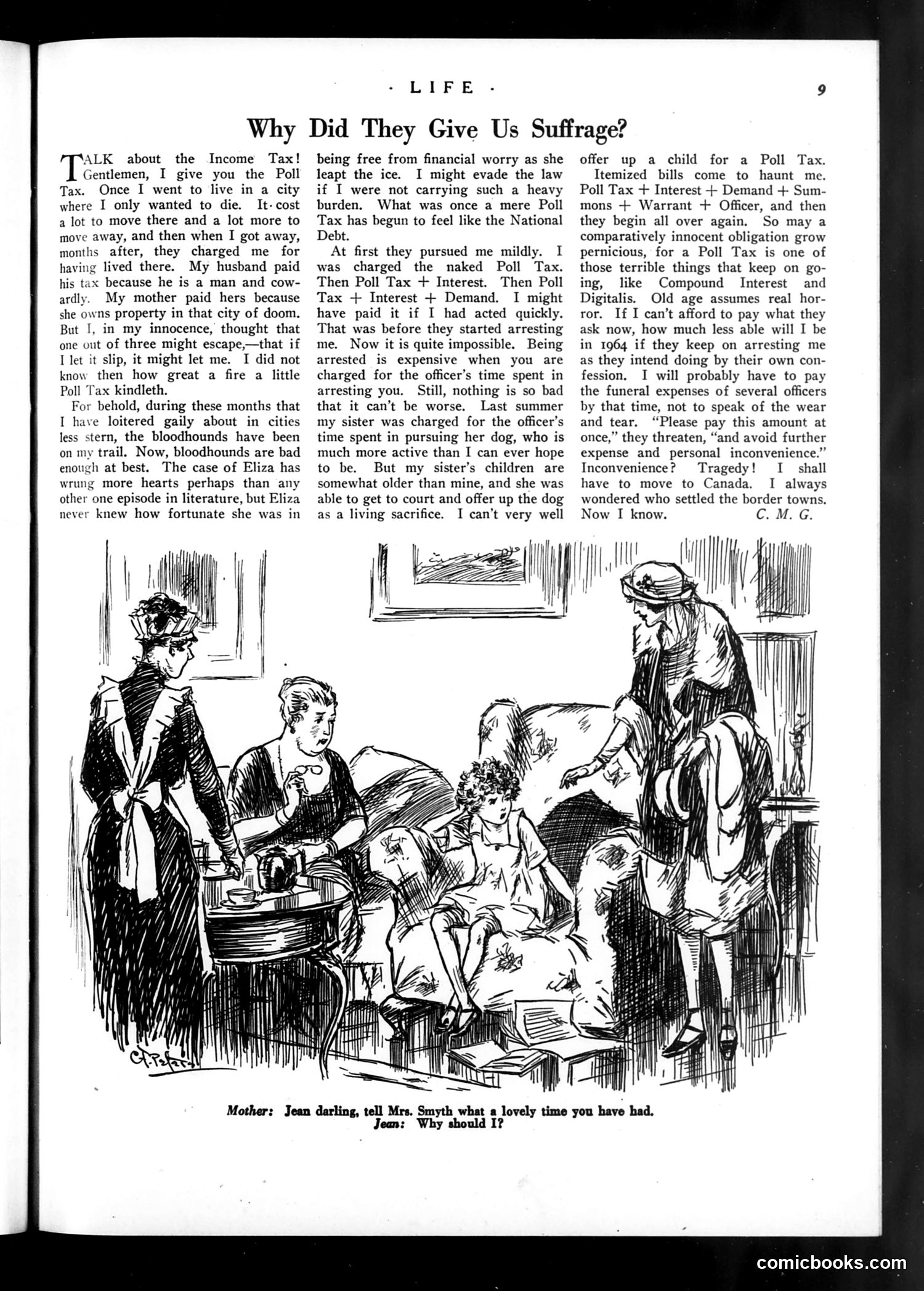
This satirical article titled "Why Did They Give Us Suffrage?" is a first-person account—likely by a woman—describing the burdensome consequences of gaining voting rights. The narrator explains that along with suffrage came a "Poll Tax," a financial requirement to vote that created cascading debts (Poll Tax + Interest + Demand) she couldn't afford to pay. The satire's point: granting women the vote was hollow when accompanied by a Poll Tax that effectively prevented poor women from exercising that right. The cartoon below depicts women in a social gathering, with a child asking why she should tell a guest about "a lovely time"—implying women's actual circumstances contradict any celebration of their newfound "freedom." This critiques how suffrage, though nominally progressive, was undermined by financial barriers.
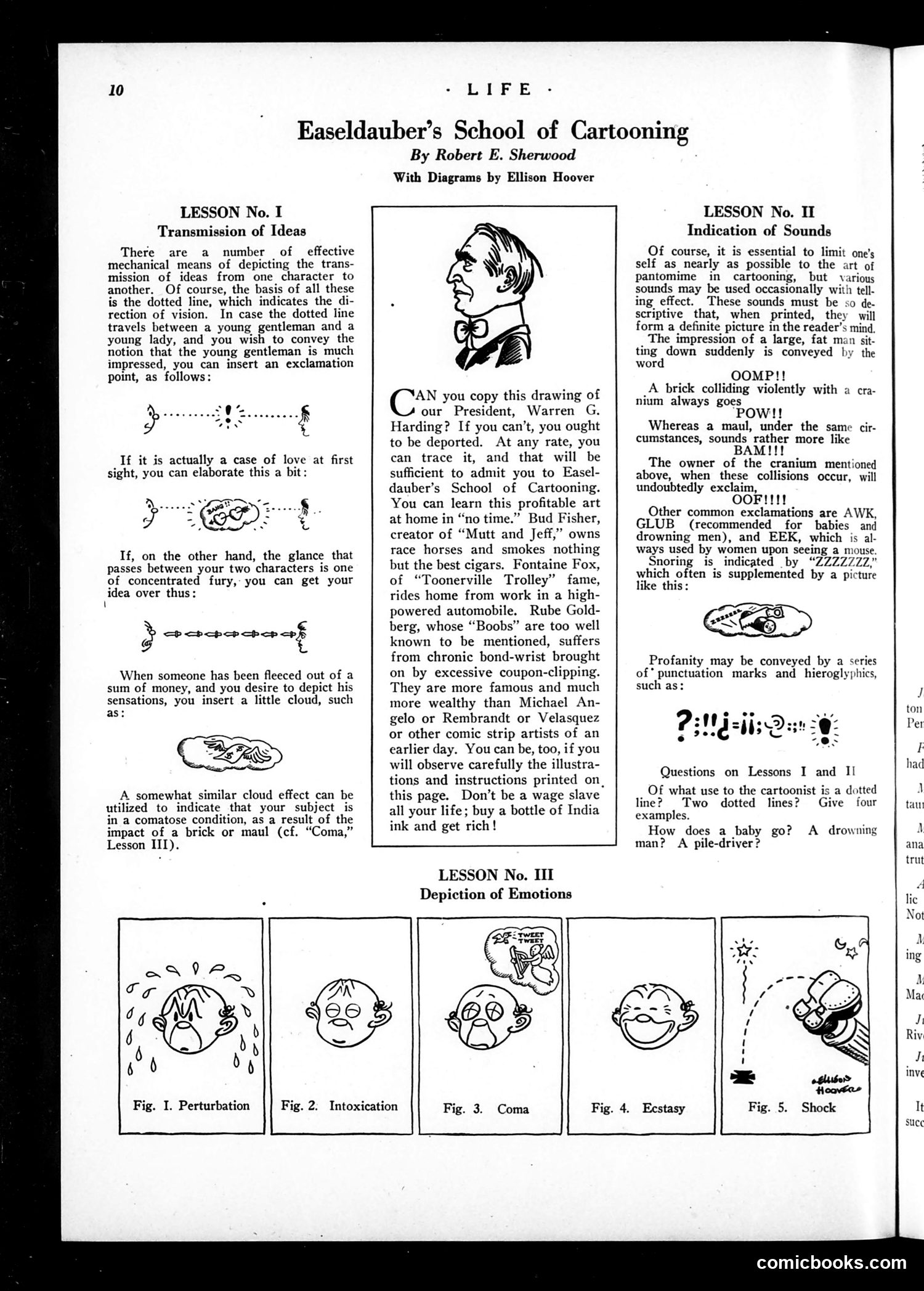
This instructional page teaches cartooning techniques through three lessons: **Lesson I** demonstrates how dotted lines convey direction and emotion between characters—a visual shorthand for transmitting ideas. **Lesson II** covers sound effects in comics. It illustrates onomatopoeia like "OOMPH," "POW," and "BAM!!!" for collisions, and "ZZZZZZZ" for snoring. The text references actual cartoonists of the era (Bud Fisher, Fontaine Fox, Rube Goldberg) as examples of professionals who mastered these techniques. **Lesson III** provides five simple face diagrams showing how to draw basic emotions: perturbation (distress), intoxication, coma, ecstasy, and shock. The page is practical instruction for aspiring cartoonists, encouraging them to study professional work and use India ink while learning these foundational skills.
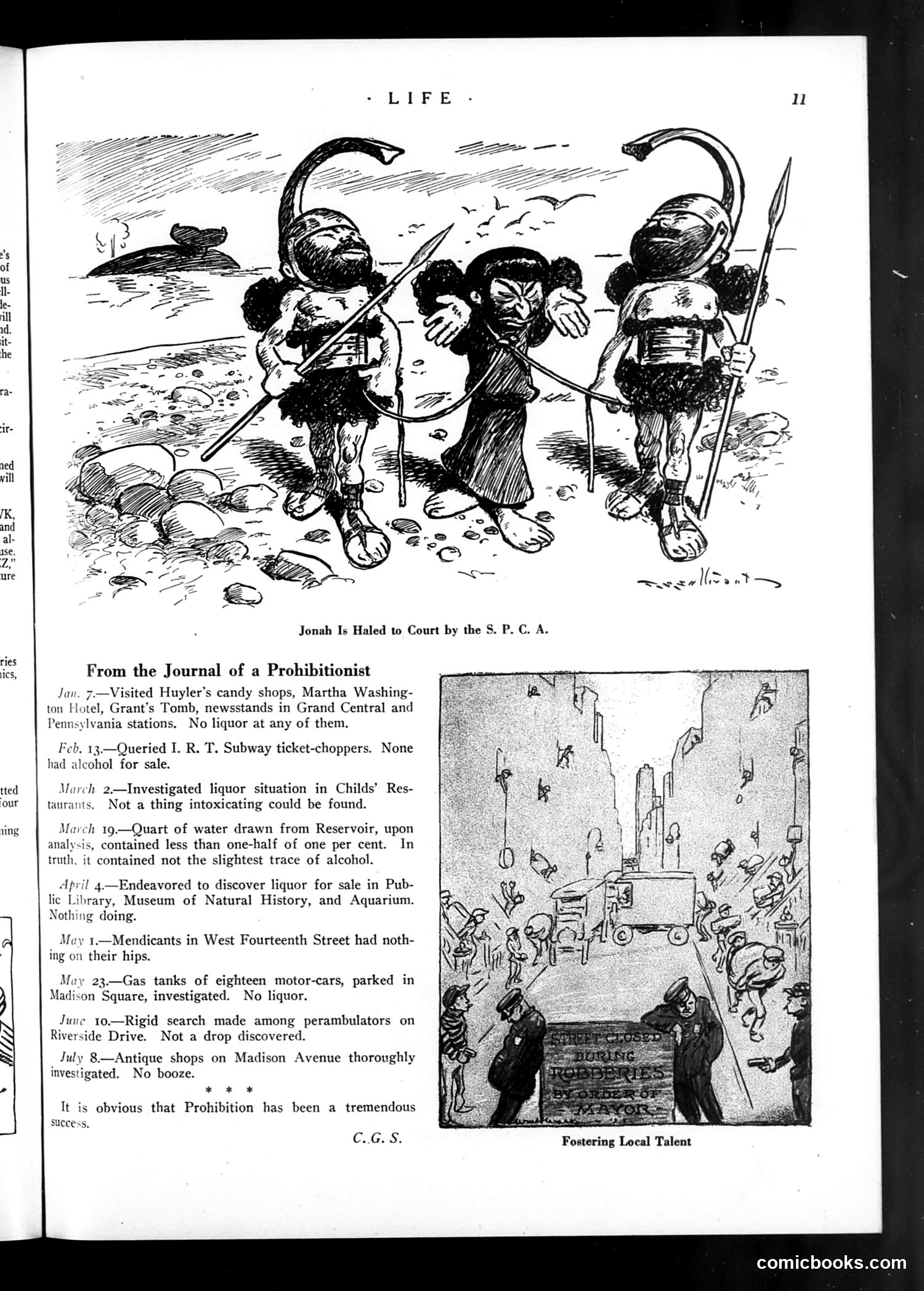
**Top Cartoon: "Jonah Is Haled to Court by the S.P.C.A."** This depicts anthropomorphic animals (appearing to be monkeys or apes) in helmets and armor, hauling a small figure before what seems to be court proceedings. The joke references the biblical story of Jonah and the whale, combined with S.P.C.A. (Society for the Prevention of Cruelty to Animals) concerns. The cartoon satirizes animal welfare advocacy by suggesting Jonah faces prosecution for his treatment by—or of—the whale. **"From the Journal of a Prohibitionist"** This section mocks Prohibition-era enforcement efforts through dated diary entries documenting searches for alcohol across New York locations (hotels, subways, restaurants, libraries). The tone is self-congratulatory despite finding nothing, satirizing prohibitionists' zealousness and claimed "tremendous success" despite apparent ineffectiveness.
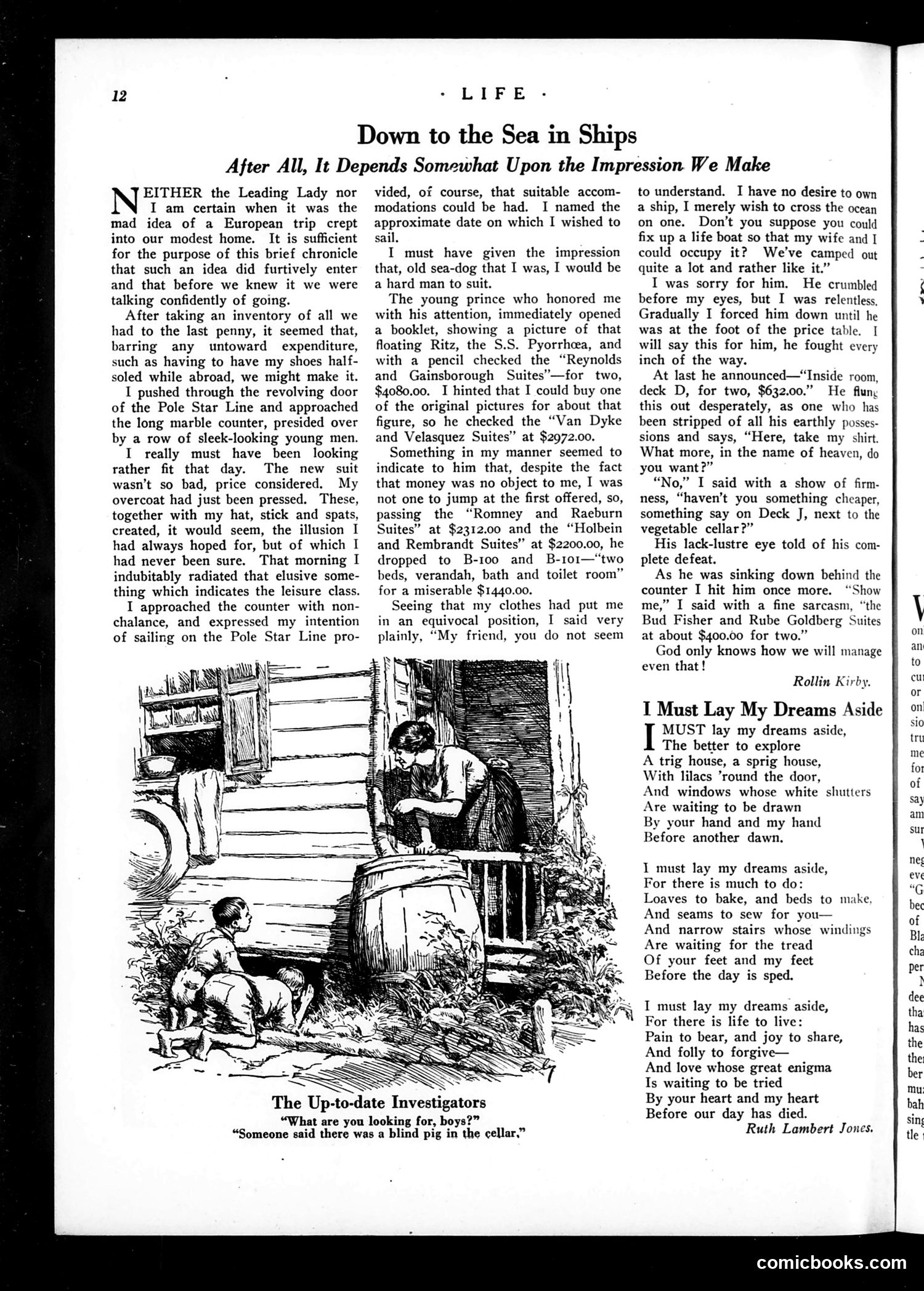
This cartoon depicts two children playing detective or explorer in a rustic rural setting. One child asks, "What are you looking for, boys?" with another responding, "Someone said there was a blind pig in the cellar." The humor relies on the double meaning of "blind pig"—a term for illegal bars or speakeasies that operated during Prohibition (the ban on alcohol sales, 1920-1933). The children's innocence in searching for an actual blind pig, while adults would recognize the reference to illegal liquor establishments, creates ironic comedy. The sketch satirizes how Prohibition-era slang had permeated American culture so thoroughly that even children's games reflected underground drinking culture. The "up-to-date" title emphasizes how modern youth have absorbed contemporary criminal references.
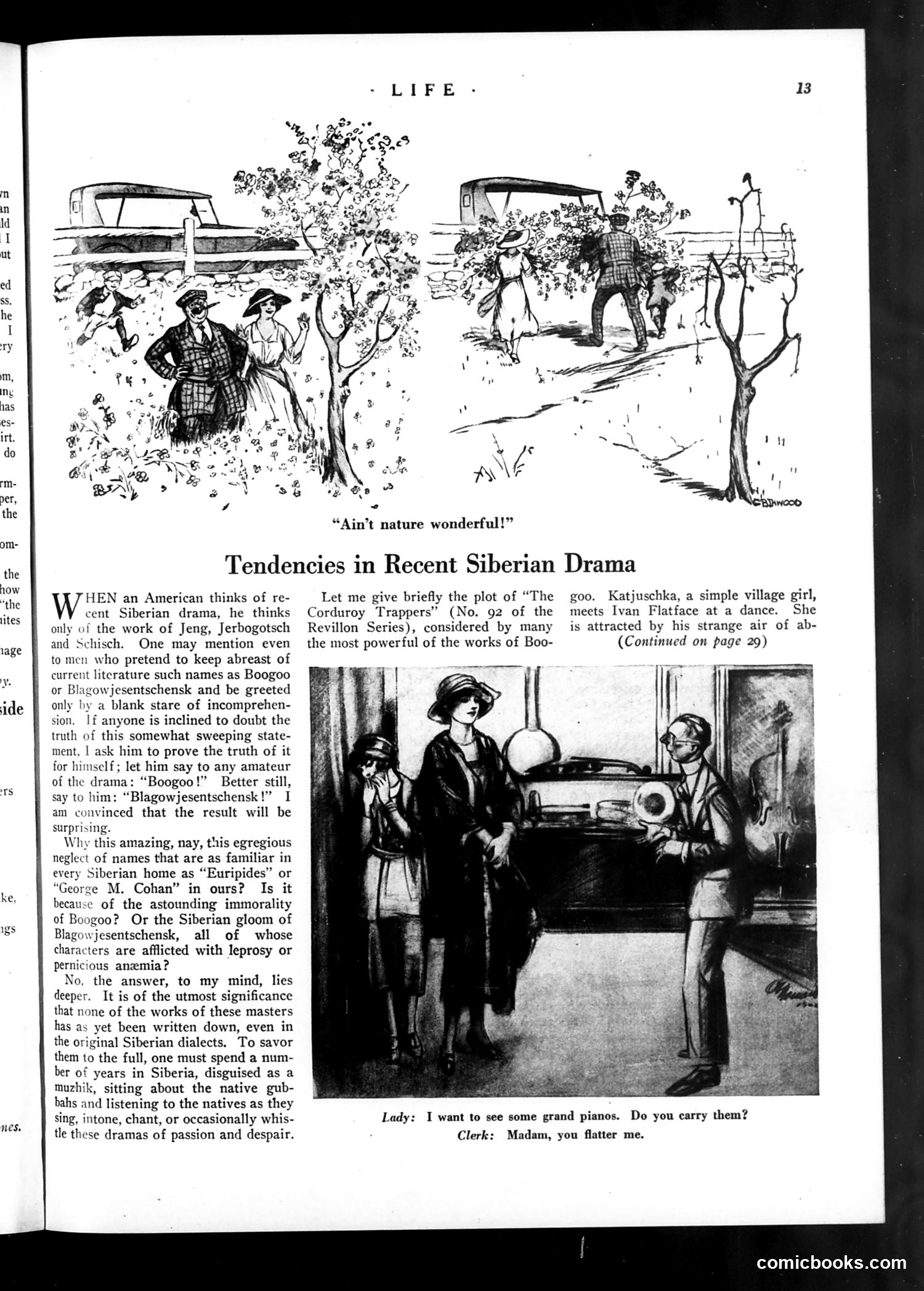
This satirical article critiques Americans' vague familiarity with Russian/Siberian culture. The author humorously challenges readers to name actual Siberian dramatists (mentioning "Boogoo" and "Blagowysentschensk" as absurd examples), suggesting Western audiences confuse these with famous European playwrights like Euripides or George M. Cohan. The illustration shows a woman asking a clerk about grand pianos, with the caption "Madam, you flatter me"—likely satirizing pretentious cultural aspirations or the incongruity of seeking luxury goods in remote regions. The page mocks American ignorance of actual Siberian drama while poking fun at those who adopt fashionable interest in exotic, unfamiliar cultures without genuine knowledge.
This page discusses the "Bonus bill" passed by the House regarding veterans' hospital benefits. The editorial criticizes William Jennings Bryan (identified in text) for opposing Darwinism while being hypocritical about evolutionary theory's implications. The main satire targets Bryan's contradictory stance: he rejects Darwin's natural selection but opposes the logical social consequences of abandoning it. The writer argues Bryan's "neo-Darwinism" opposition ignores that people naturally want to escape difficult situations—suggesting Bryan himself would benefit from progress rather than stagnation. The piece also mentions a Patagonian expedition, likely referencing contemporary exploration news. Decorative illustrations of monkeys frame the text, humorously reinforcing the Darwinian subject matter. The overall tone mocks Bryan's selective application of evolutionary theory to political positions.
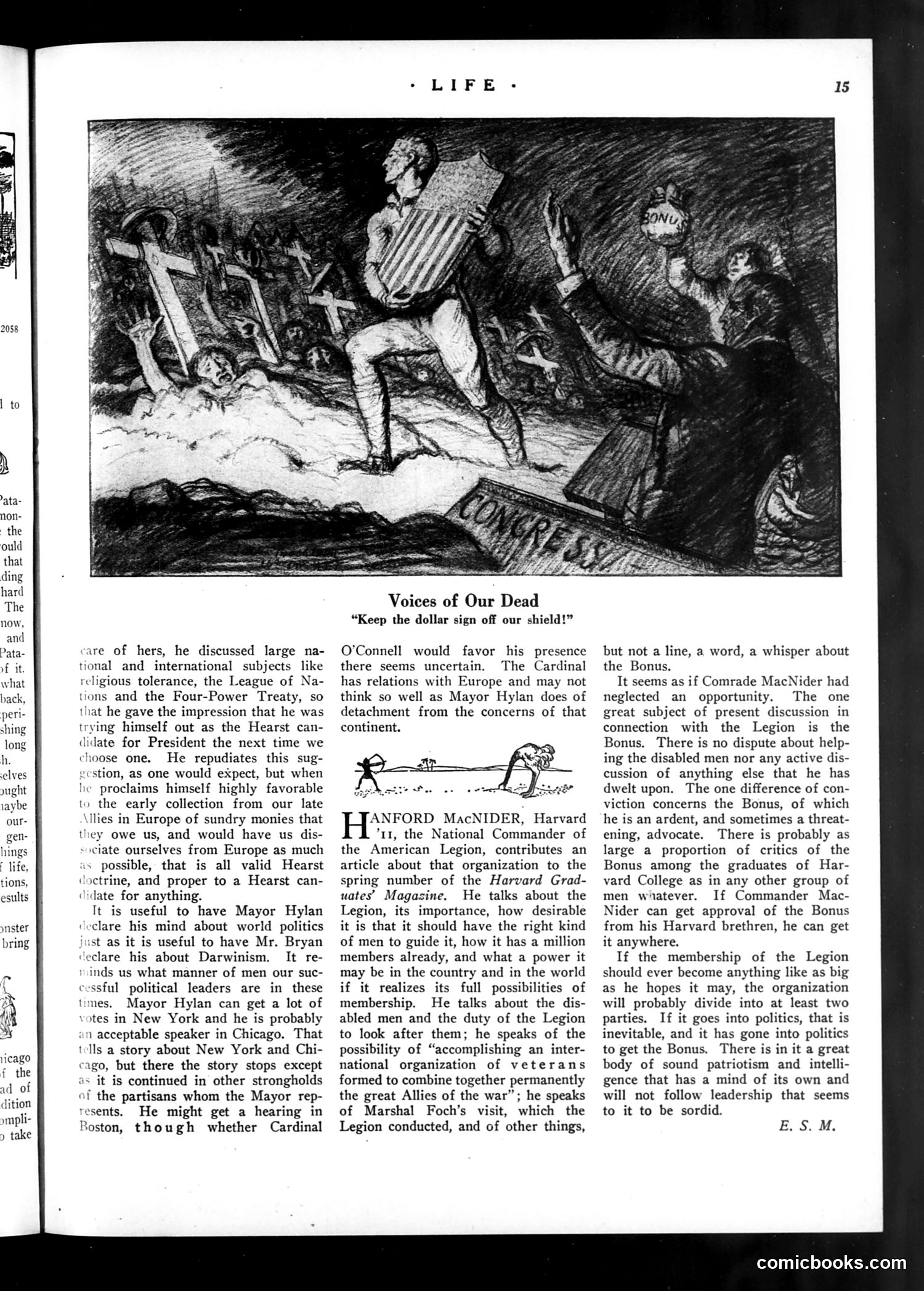
The page contains two distinct pieces of political commentary: **"Voices of Our Dead" cartoon**: The illustration depicts skeletal soldiers rising from graves, confronting a living figure wearing a striped shield (representing American patriotism). The caption "Keep the dollar sign off our shield!" is the key: it's satirizing how WWI veterans' sacrifice is being commercialized or exploited for political gain. **MacNider article critique**: The text criticizes Hanford MacNider, National Commander of the American Legion, for avoiding discussion of the "Bonus"—compensation owed to WWI veterans. The author suggests MacNider focused on broader Legion goals while sidestepping this central veteran concern. The piece implies MacNider is being evasive about a politically divisive issue affecting his own constituency, and warns that the Legion risks splitting into factions if it enters politics over bonus disputes. Both pieces reflect 1920s debate over veteran benefits and warnings against politicizing soldiers' sacrifices.
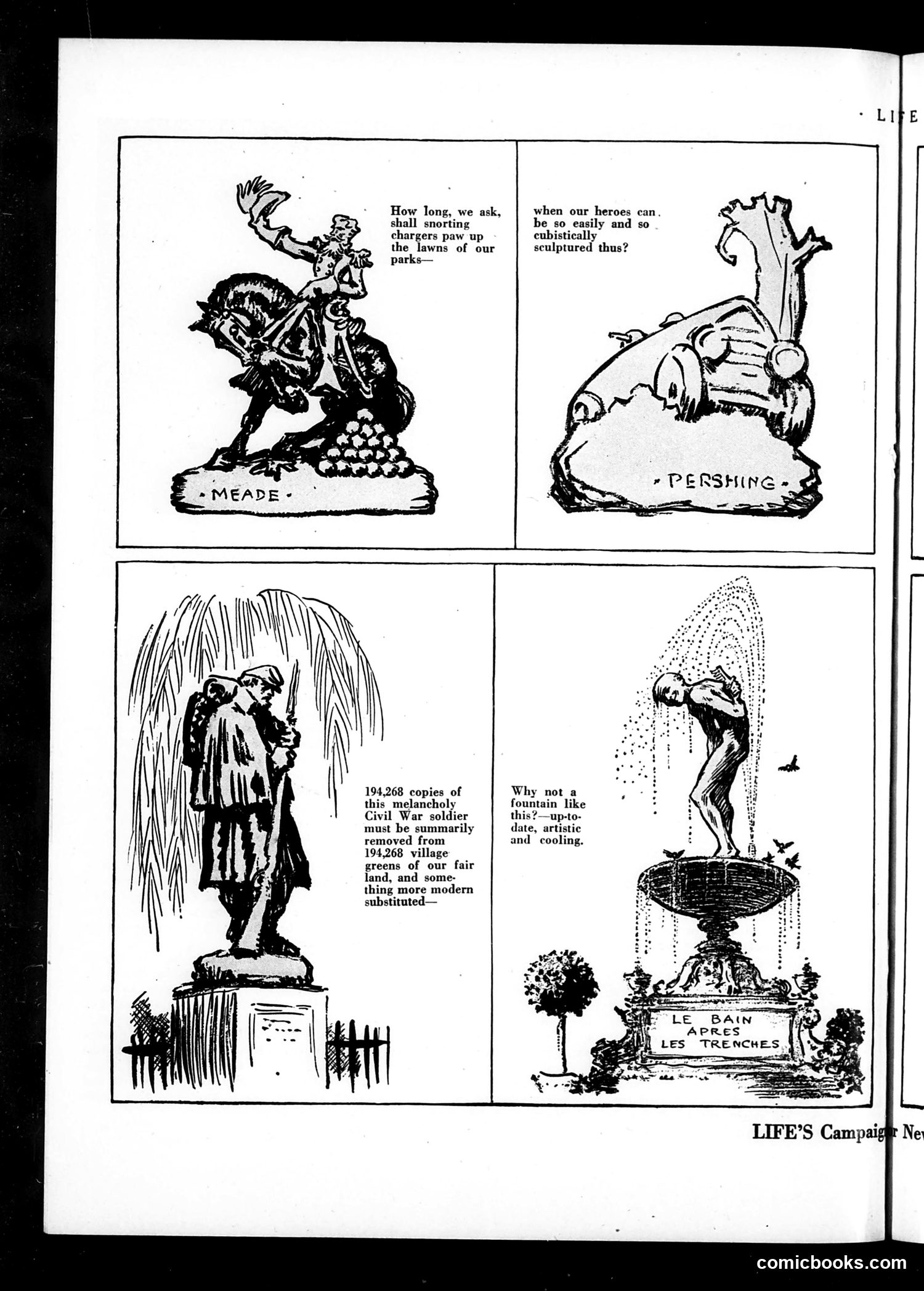
This Life magazine cartoon mocks the proliferation of identical Civil War soldier statues cluttering American town squares. The four panels contrast outdated Civil War monuments with modernist alternatives. **The satire:** Life argues that 194,268 nearly-identical melancholy soldier statues (labeled "MEADE" and "PERSHING") disfigure village greens. Rather than removing these redundant monuments, why not replace them with modern, artistic sculptures—shown here as stylized fountains and abstract forms ("cubistically sculptured"). **The targets:** The cartoonist criticizes both the aesthetic monotony of mass-produced 19th-century public art and the conservative impulse to preserve them. The French caption "Le Bain Après les Tranchées" (The Bath After the Trenches) suggests even WWI-era modernism surpasses Victorian sentimentality. **The joke:** By proposing increasingly whimsical replacements (fountains, abstract sculptures), Life ridicules the assumption that removing old monuments requires leaving ugly gaps—modern art could honor heroes while improving public spaces aesthetically.
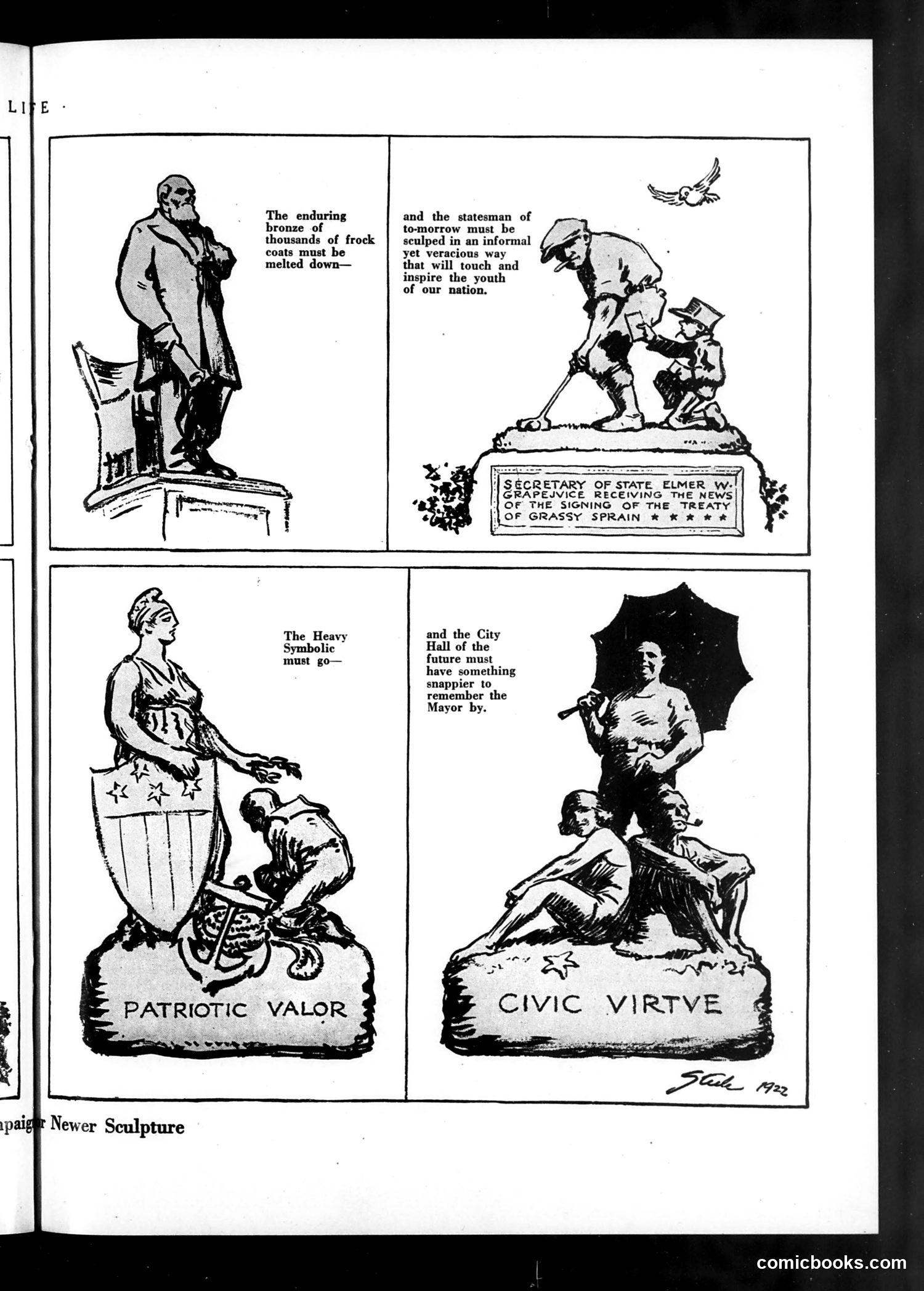
This 1922 Life magazine page satirizes post-WWI American monument-building aspirations. The top panels mock the idea of melting down old bronze statues of dignified statesmen to create new, informal sculptures celebrating contemporary figures—including "Secretary of State Elmer W. Grapejuice" (a fictional name mocking someone, likely Secretary of State Elmer Root or similar). The bottom panels present idealized allegorical sculptures: "Patriotic Valor" (Liberty with a child) and "Civic Virtue" (figures under an umbrella). The satire suggests America's need to replace stuffy 19th-century monuments with modern, relatable public art that could "inspire youth." The joke critiques both the impulse to constantly commemorate current events and the vagueness of what "modern" public monuments should actually represent.
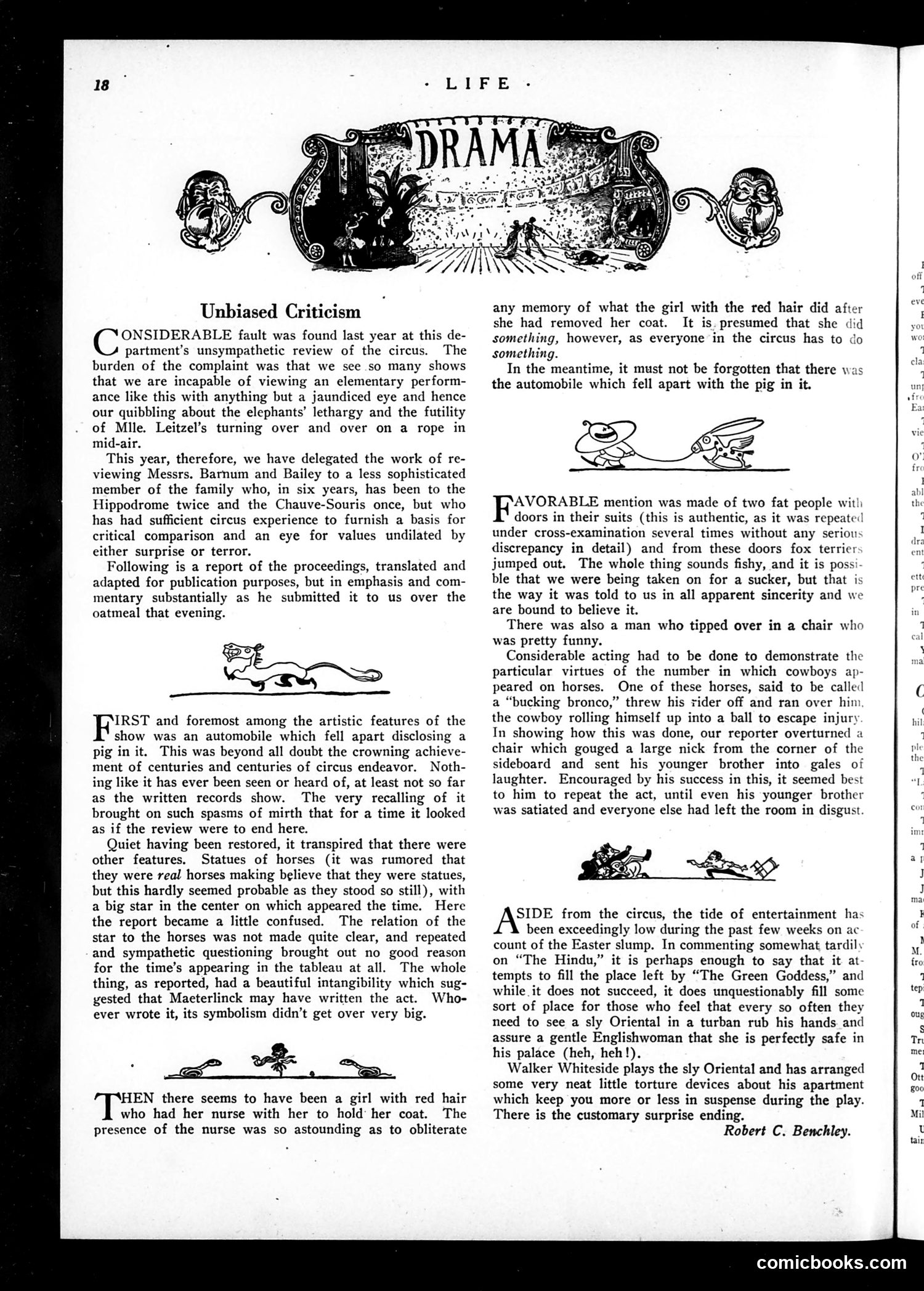
This is a satirical theater review of the Barnum and Bailey circus, written as if by a naive, unsophisticated child rather than Life's usual jaded critic. The humor lies in the deliberately deadpan, literalist descriptions of circus acts that miss the point entirely. The child narrator focuses on absurdities: an automobile containing a pig, statues of horses with inexplicable time displays, a girl whose nurse holding her coat is more memorable than her actual performance, and fat performers with doors in their suits releasing fox terriers. The review's apparent sincerity—"it is presumed that she did something"—while describing increasingly ridiculous acts creates the satire. The joke mocks both oversophisticated critics and the circus itself. By pretending fresh wonder at genuinely strange spectacles, the reviewer suggests circus acts are inherently absurd; only jaded reviewing conventions made them seem normal.
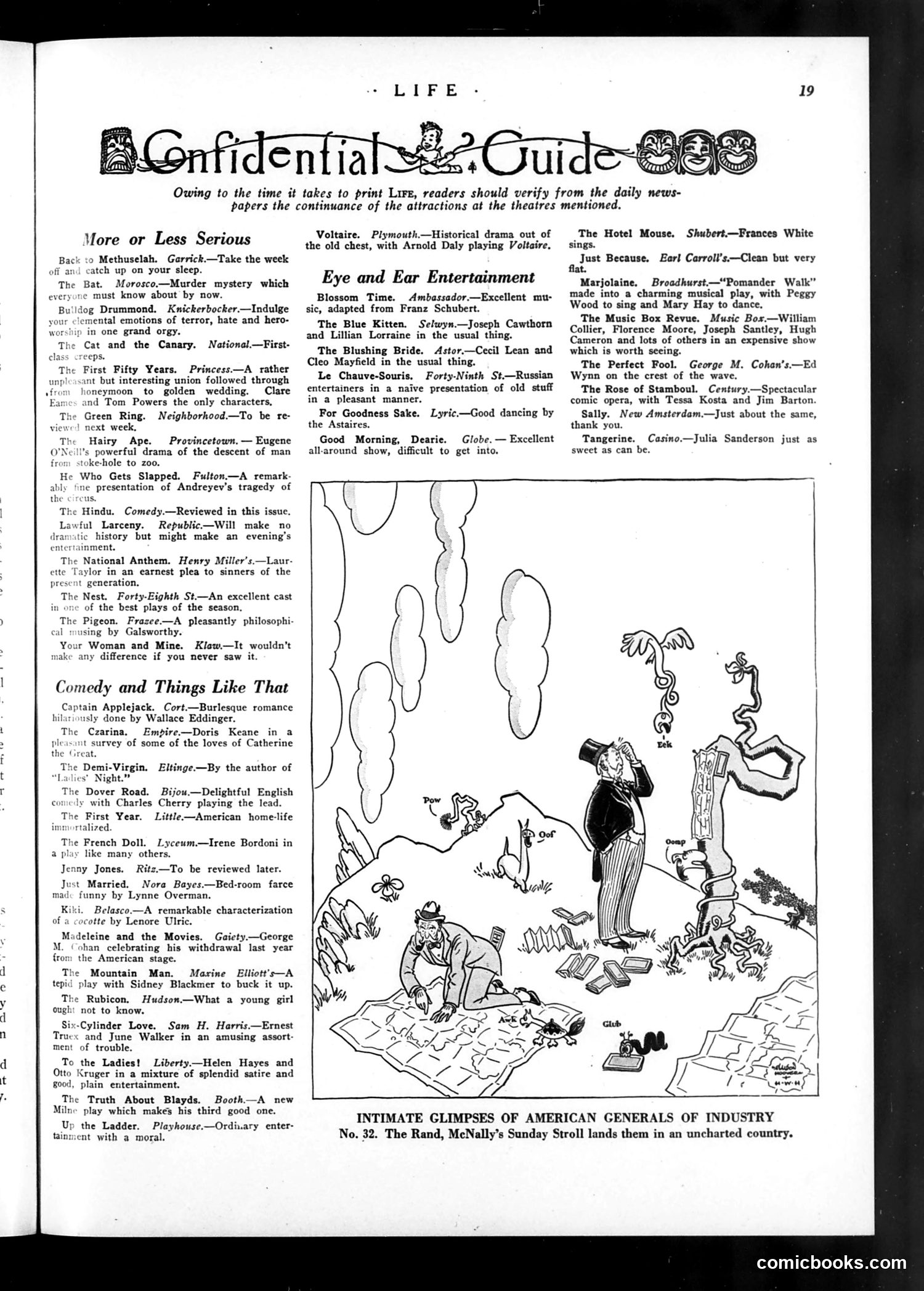
This cartoon satirizes wealthy American industrialists ("generals of industry") by depicting them as tourists exploring uncharted territory from a map. The central figure, dressed formally, studies a large map while surrounded by surveying equipment, suggesting these business leaders treat the landscape of commerce and society as unexplored terrain requiring mapping and conquest. The satirical point appears to be that despite their power and prominence, these industrialists approach their domains with the attitude of colonial explorers—detached, analytical, treating their enterprises as distant lands rather than integrated parts of society they inhabit. The "uncharted country" reference mocks their disconnect from ordinary life. This reflects early-20th-century American skepticism toward industrial magnates' social awareness and responsibility during the Gilded Age debates.
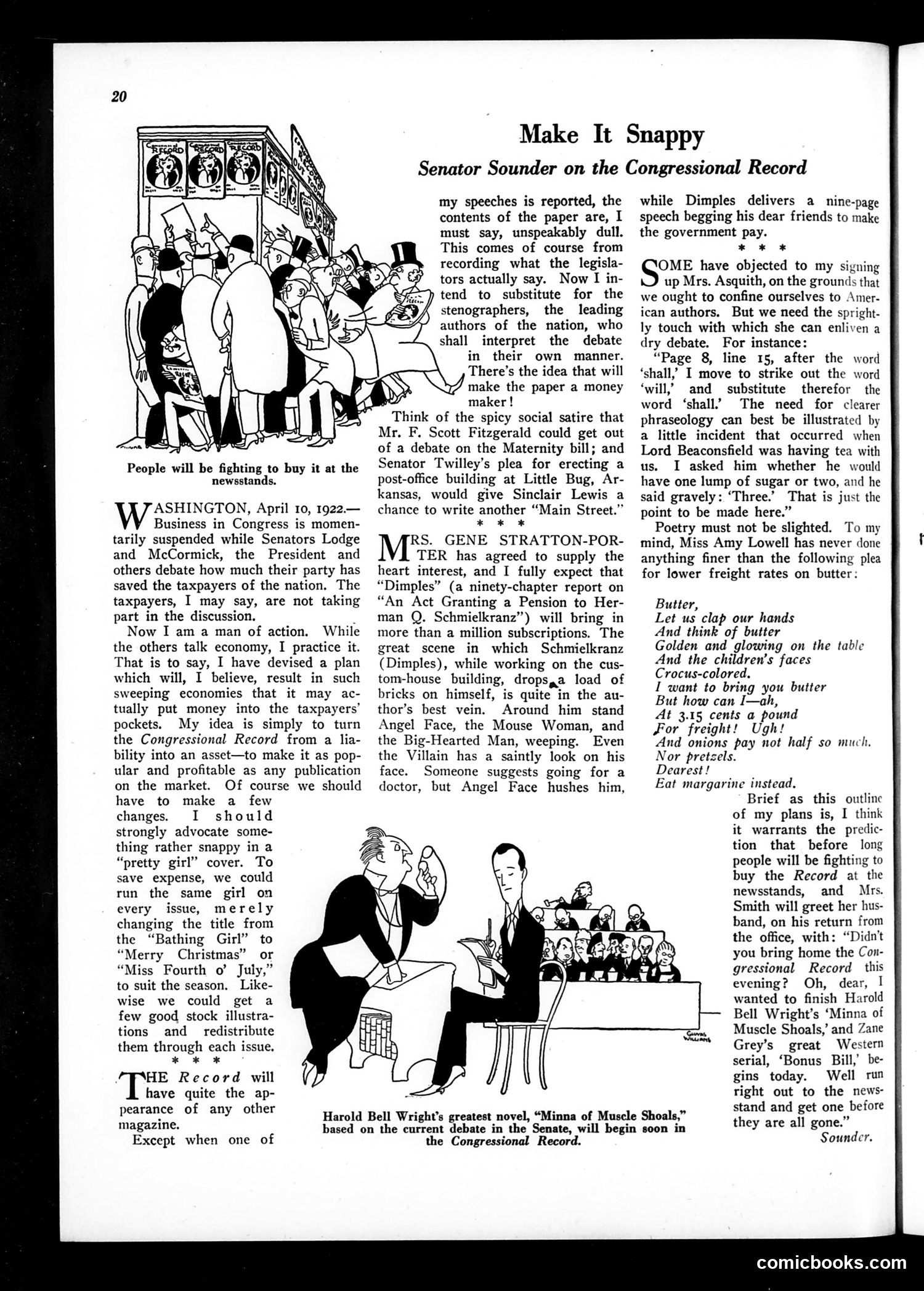
This satirical piece by "Senator Sounder" (a fictional character) mocks the tedium of Congressional Record proceedings. The author proposes sensationalizing the Record—treating it like a commercial magazine—by hiring famous authors (F. Scott Fitzgerald, Sinclair Lewis, Gene Stratton-Porter, Harold Bell Wright, Amy Lowell) to dramatize legislative debates into entertaining fiction. The joke targets Congressional tedium: actual legislative language is "unspeakably dull," so why not have celebrated novelists transform mundane bills (a maternity act, a post-office building proposal) into serialized melodramas with stock characters ("Angel Face," "The Mouse Woman"). The cartoon shows Congress debating economy while ignoring taxpayers' actual concerns. The satire suggests selling the Record as a profitable publication with "pretty girl" covers—implying Congress values entertainment over substance. References to specific contemporary authors and their signature styles (Fitzgerald's social satire, Lewis's small-town critique) enhance the absurdist humor.
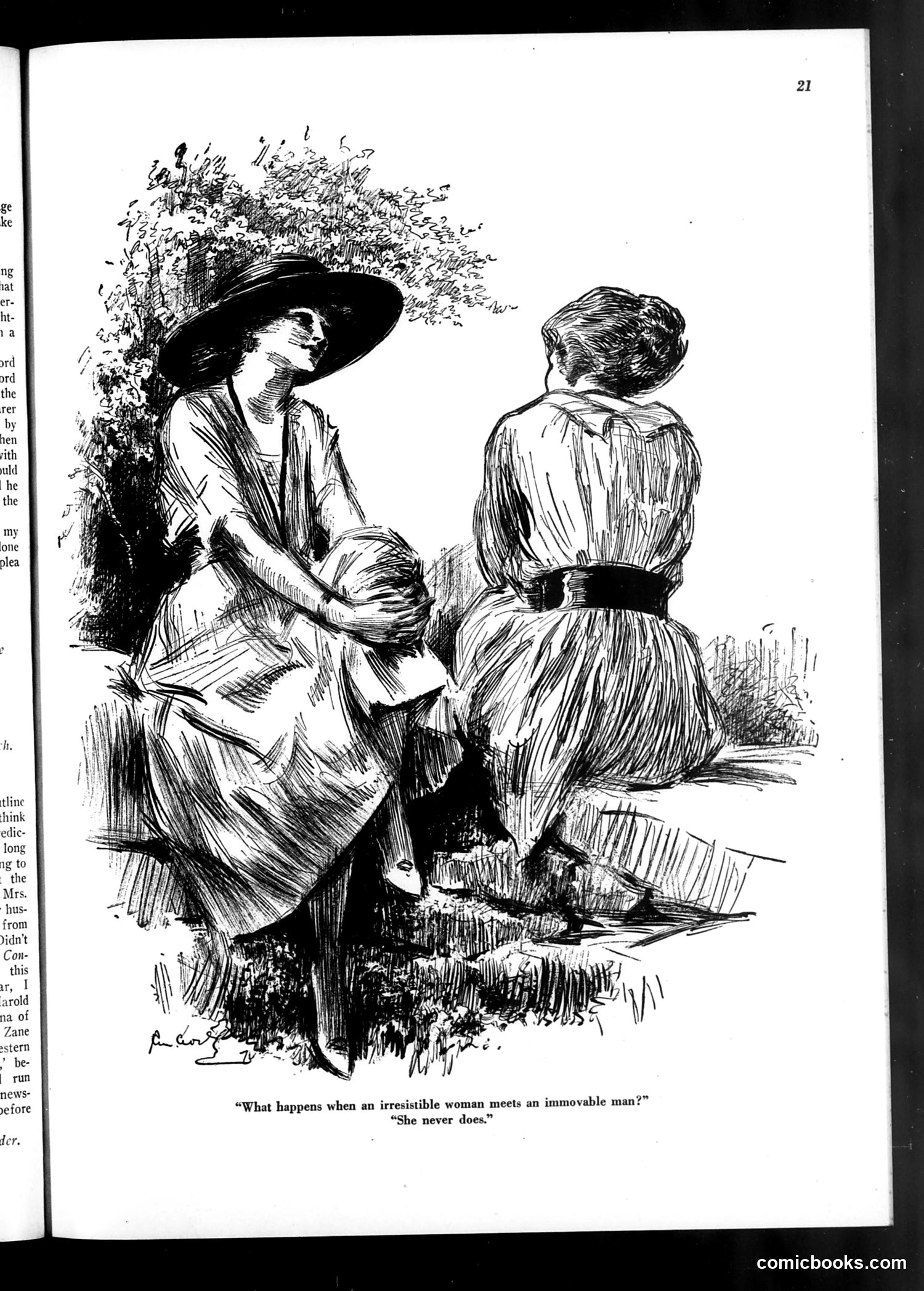
This is a satirical cartoon playing on a classic paradox. The caption poses an old philosophical riddle, then answers it with a punchline about gender dynamics: "She never does." The illustration shows two women in Edwardian-era dress seated outdoors. The joke's cynical implication is that women stereotyped as "irresistible" never actually encounter truly immovable men—suggesting either that no such immovable men exist, or more likely, that women's supposed irresistibility is itself a myth. The satire critiques romantic/gender stereotypes popular in early 20th-century culture. It's simultaneously mocking both the "irresistible woman" trope and suggesting women lack real power in encounters with determined men. The joke reflects the magazine's era's particular brand of sardonic social commentary about gender relations.
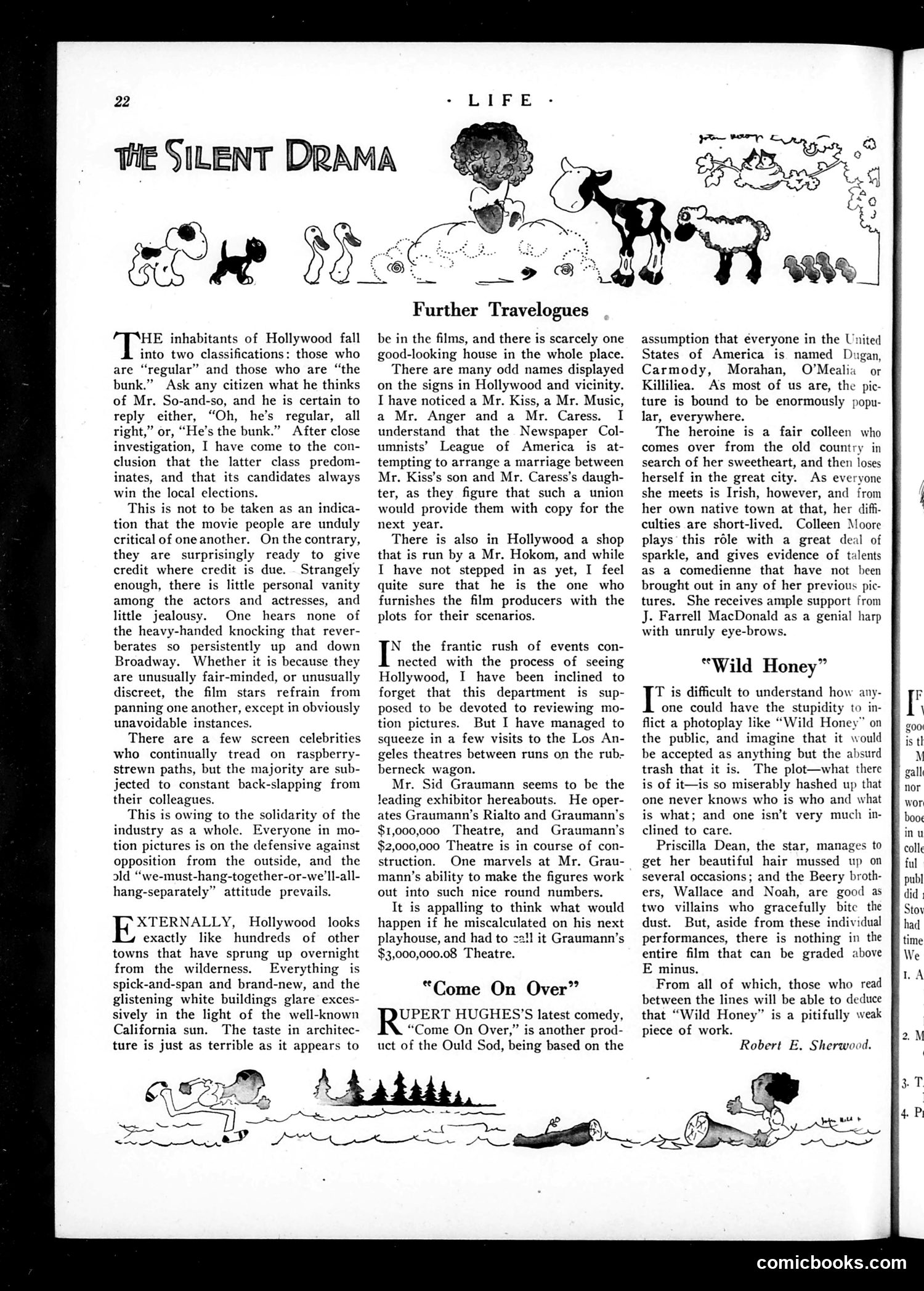
This page satirizes Hollywood's social dynamics and early cinema through three lenses: **Main Article ("Further Travelogues"):** The author mocks Hollywood's peculiar culture—actors' surprising lack of vanity and mutual support (attributed to industry solidarity against outside criticism). The humor lies in contrasting Hollywood's reputed cattiness with observed collegiality. **Name Jokes:** The satire ridicules coincidental surnames of Hollywood residents (Mr. Kiss, Mr. Caress, Mr. Anger, Mr. Hokom), with the columnist suggesting newspapers could manufacture gossip from a fictional marriage between "Kiss" and "Caress" families. **Film Reviews:** The piece critiques: - Sid Graumann's ever-expanding theater empire (with absurdist humor about miscalculating costs) - "Come On Over," a Rupert Hughes comedy that stereotypes Irish-Americans with names like Dugan and Carmody, relying on ethnic caricature for broad appeal The cartoons at top and bottom depict silent-film style slapstick physical comedy. **Context:** This reflects 1920s attitudes toward both nascent Hollywood culture and casual ethnic stereotyping in entertainment.
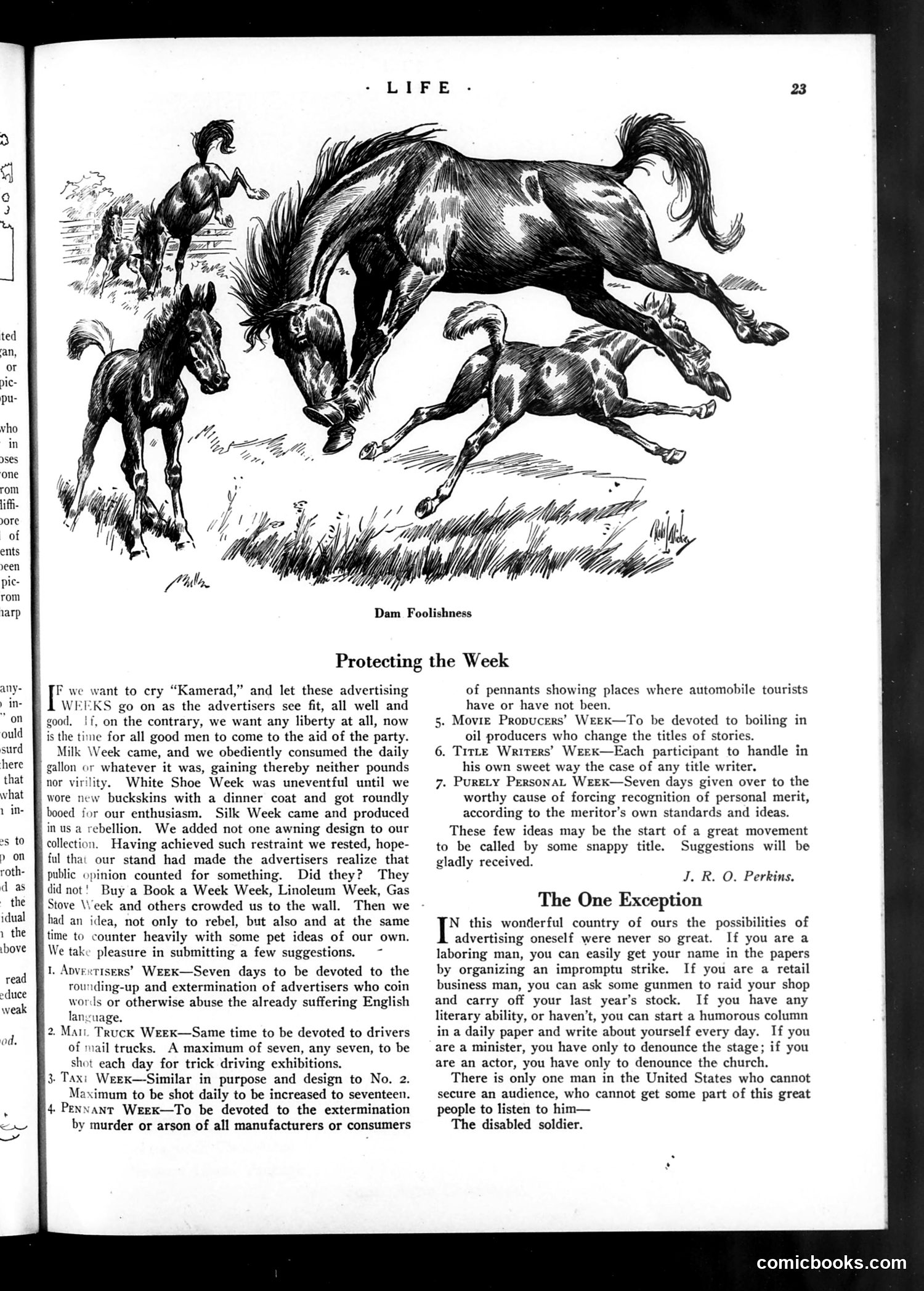
This page satirizes aggressive advertising campaigns and American culture's tendency to sensationalize. The cartoon (top) shows a mare kicking at smaller horses—a visual pun on "Dam Foolishness" (a female horse is a "dam"). The main text mocks the proliferation of themed marketing weeks ("Milk Week," "White Shoe Week," "Silk Week," etc.) that bombard consumers. The author proposes satirical counter-weeks targeting advertisers, mail truck drivers, and title writers—suggesting public frustration with manipulation and commercial excess. The final section, "The One Exception," takes a darker turn: it argues that in this publicity-obsessed America, virtually everyone can gain attention through strikes, crime, stunts, or controversy—except disabled soldiers, who are ignored despite their sacrifice. This appears to be social commentary on post-WWI America's failure to adequately recognize or care for veterans.
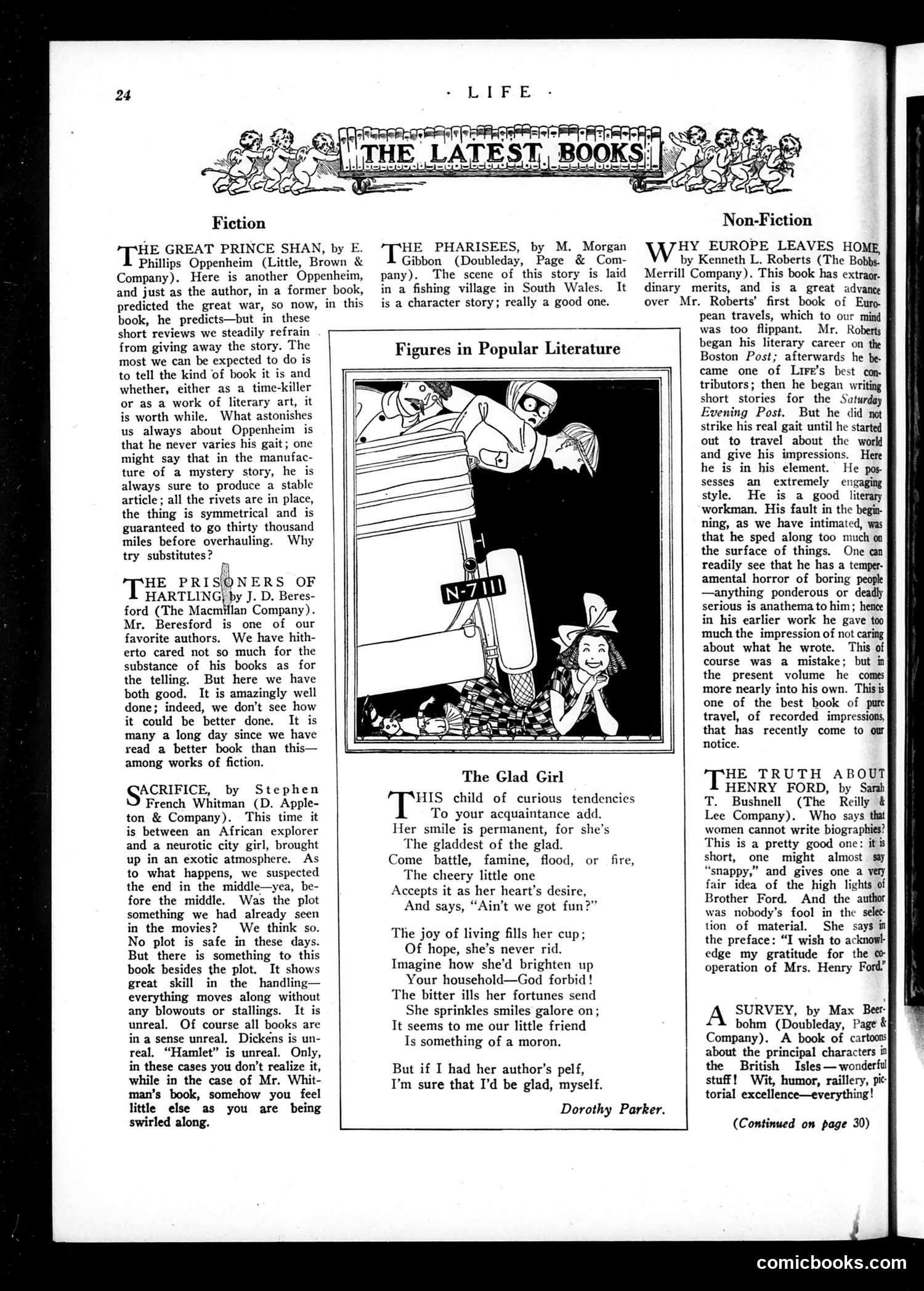
This page from *Life* magazine features a book review section and a satirical poem titled "The Glad Girl," accompanied by a cartoon illustration showing a cheerful young woman amid chaos—notably an airplane crash (marked "N-71"). The poem mockingly portrays a girl of "curious tendencies" who maintains permanent, unwavering cheerfulness regardless of circumstances: "Come battle, famine, flood, or fire, / The cheery little one / Accepts it as her heart's desire." The satire targets what appears to be a cultural archetype of the excessively optimistic woman—the kind who remains relentlessly glad despite real hardship or danger. The cartoon's juxtaposition of her beaming face against an aviation disaster underscores the absurdity of such unconditional cheerfulness. The poem suggests this relentless positivity is almost moronic ("something of a moron"), mocking the era's cultural pressure on women to maintain cheerfulness regardless of actual circumstances. This reflects early 20th-century satire of toxic positivity and gender expectations.
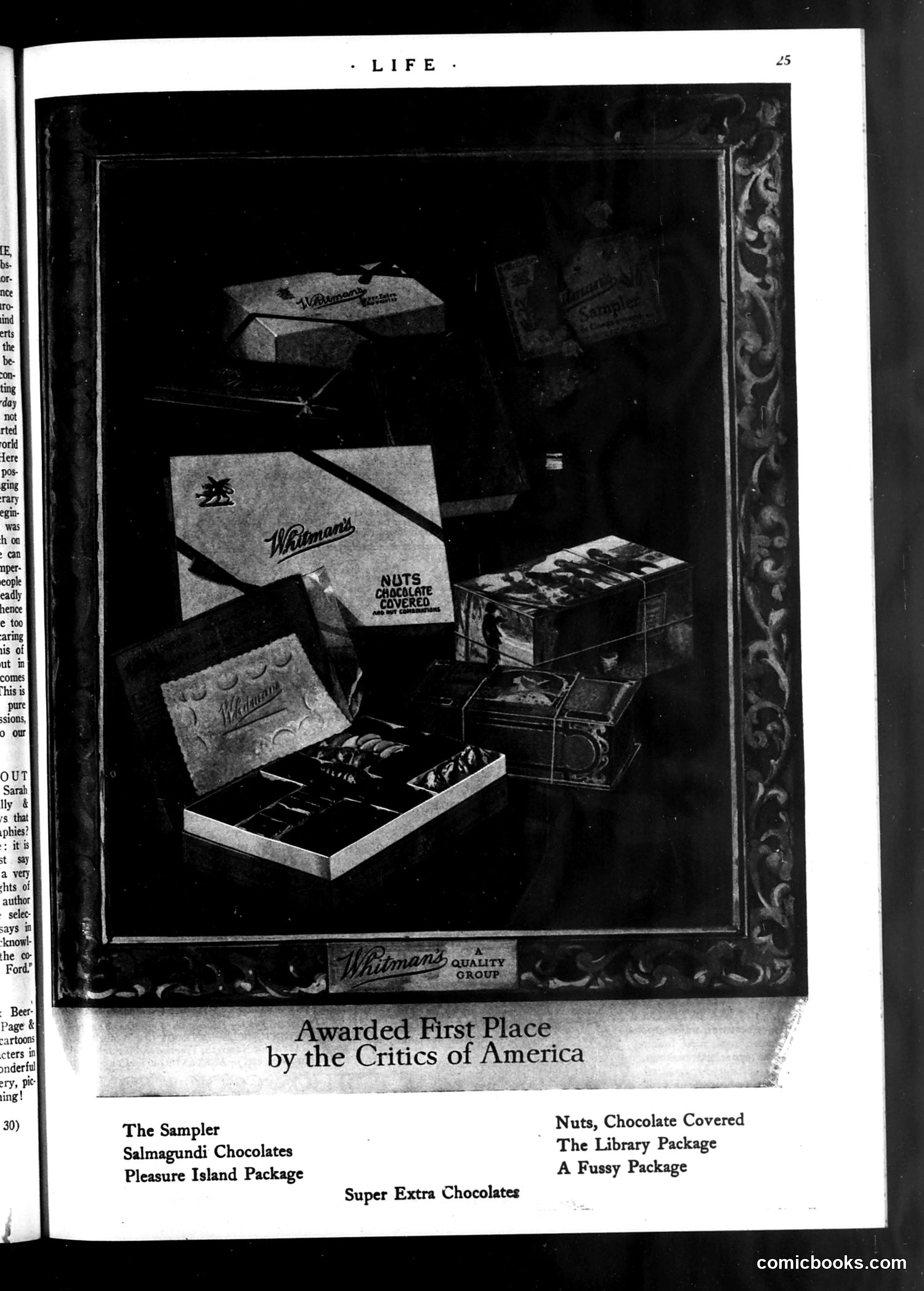
This is a **Whitman's chocolate advertisement**, not political satire. The page displays various Whitman's candy boxes and packages arranged in an artistic still-life photograph. The text identifies specific product lines: "The Sampler," "Salmagundi Chocolates," "Pleasure Island Package," "Nuts, Chocolate Covered," "The Library Package," "A Fussy Package," and "Super Extra Chocolates." The headline claims these products were "Awarded First Place by the Critics of America"—a marketing claim typical of early 20th-century advertising that uses prestige language to promote consumer goods. The ornate border frames the products like fine art, elevating candy boxes to luxury status. This is purely commercial content, not editorial cartooning or political commentary.
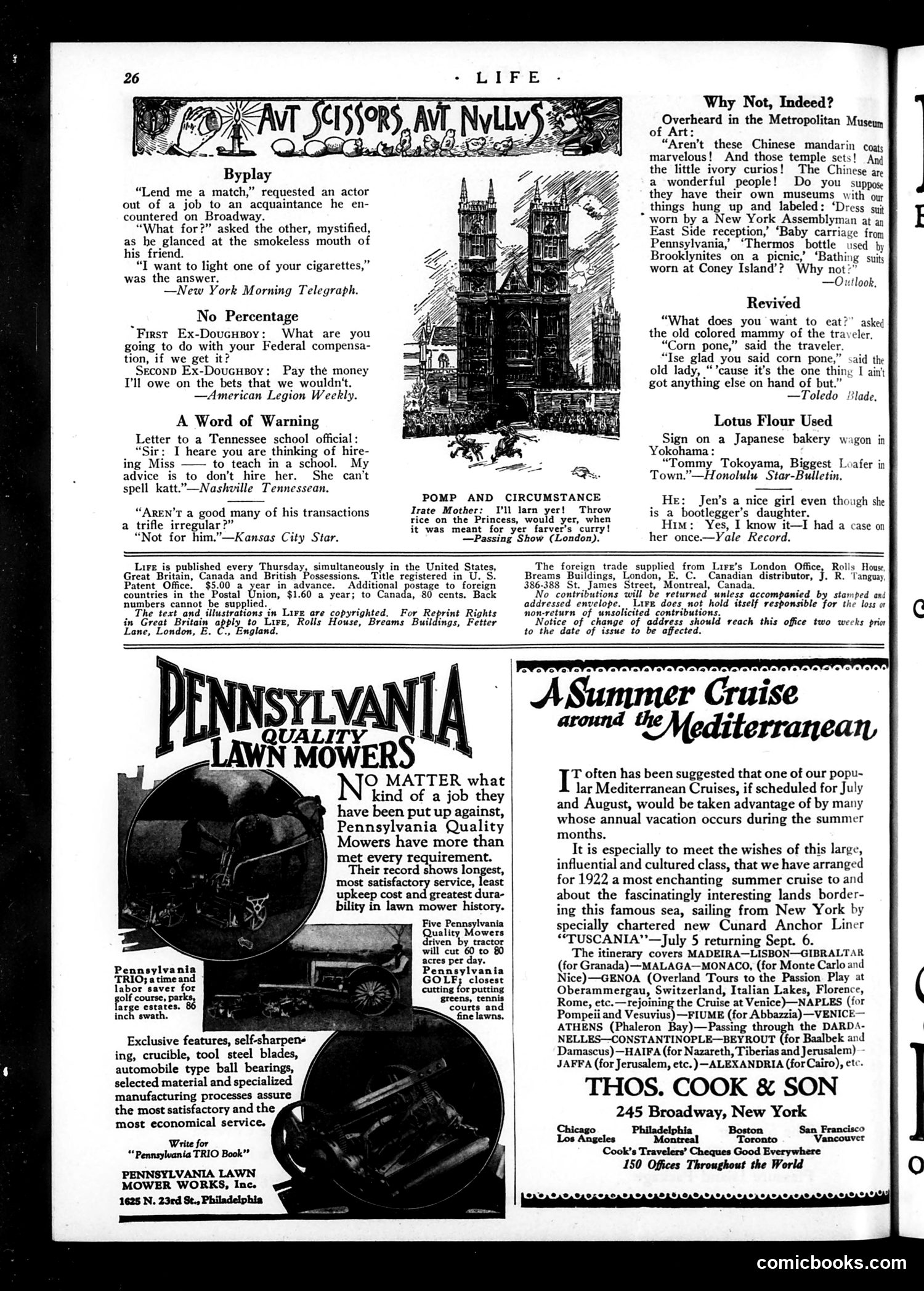
This page contains brief satirical anecdotes rather than visual cartoons. The humor targets various social absurdities: **"Why Not, Indeed?"** mocks American cultural pretension by imagining a Chinese museum displaying mundane American artifacts (a douchebag's dress suit, a Thermos bottle from Brooklyn) with the same reverence Americans show Chinese antiquities—suggesting Western admiration of "exotic" cultures while dismissing our own ordinary objects. **"No Percentage"** jokes about unemployed vaudeville performers and war veterans, with dark humor about betting against receiving federal compensation. **"A Word of Warning"** ridicules a poorly educated teacher who misspells "cat." **"Revived"** features dialect humor about an African American woman serving cornmeal—stereotypical "plantation" speech comedy common to the era. **"Pomp and Circumstance"** presents a slapstick scene of someone throwing rice at the wrong person during a curry dinner. The advertisements for Pennsylvania lawn mowers and Mediterranean cruises occupy significant space, typical of Life's revenue model.
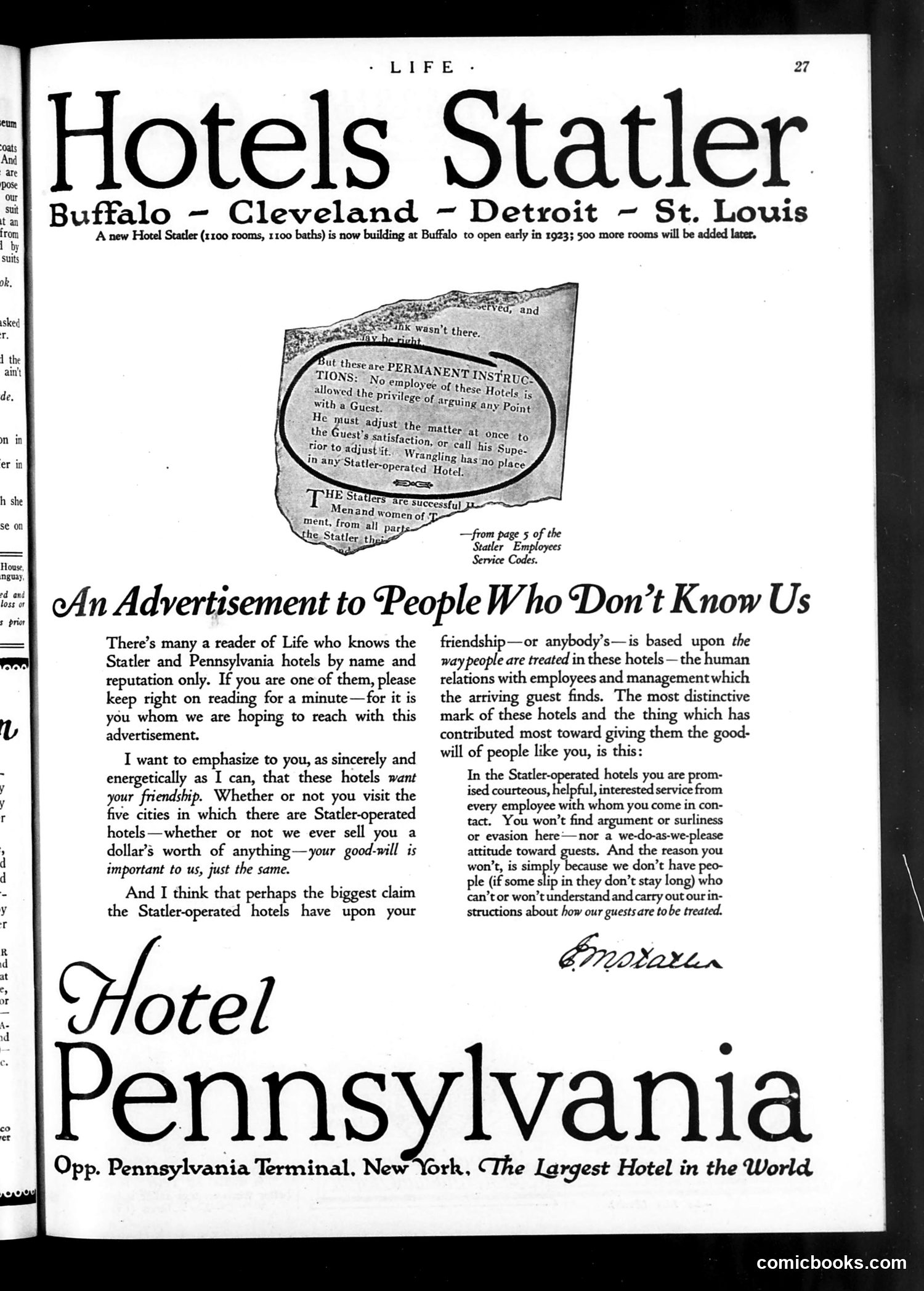
This page is primarily a **hotel chain advertisement** rather than satire or political commentary. It promotes the Statler hotel chain operating in Buffalo, Cleveland, Detroit, and St. Louis, plus the Hotel Pennsylvania in New York. The small boxed excerpt at top quotes the "Statler Employees Service Codes," establishing the brand's philosophy: employees cannot argue with guests or refuse service—management must resolve complaints immediately. The main text below is a direct appeal from Statler management emphasizing that their hotels want customers' "friendship" and "good-will" regardless of whether guests actually book rooms. The pitch emphasizes **courteous service and positive employee-guest relations** as their distinguishing feature. This reflects early-20th-century hotel industry competition based on service quality and hospitality culture rather than amenities alone. The tone is earnest corporate messaging, not humor or satire.
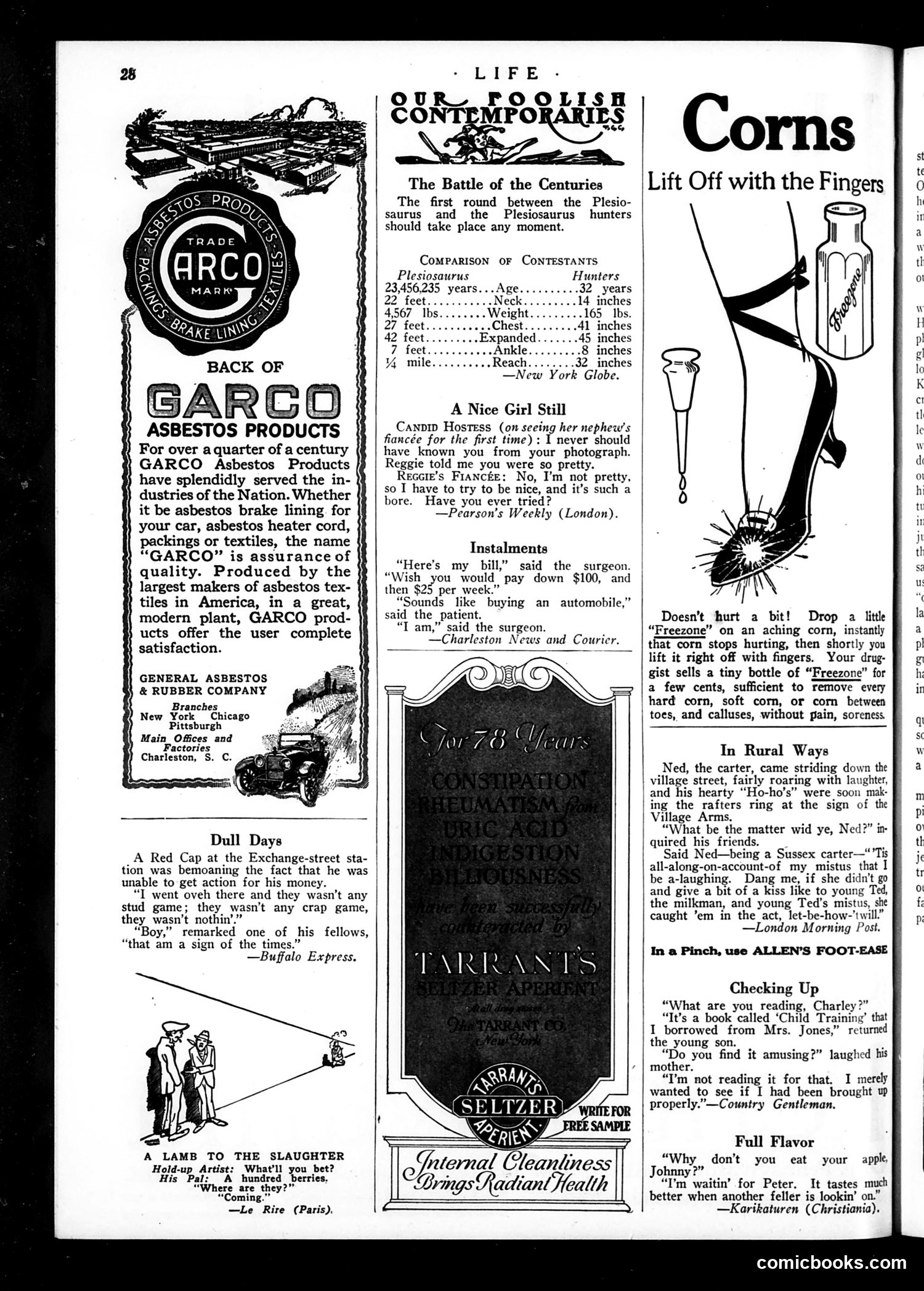
This page contains primarily **humorous anecdotes and advertisements** rather than political cartoons. ## Key Humor Pieces: **"Dull Days"** (Buffalo Express): A porter laments that gambling games aren't running—interpreted as a sign of economic depression or social decline. **"A Lamb to the Slaughter"** (Le Rire): A hold-up robbery joke about a criminal betting his stolen money ("berries"). **"In Rural Ways"** (London Morning Post): A slapstick story about a Sussex carter amused that his wife kissed a young milkman, whose own wife caught them—playing on rural dialect and extramarital confusion for comedic effect. ## Notable Advertisements: The page includes substantial ads for **Garco Asbestos Products** (brake linings, heater cords), **Freezone corn remover**, and **Allen's Foot-Ease**—typical early 20th-century patent medicines and industrial products. A "Tarrants Seltzer Aperient" ad suggests digestive ailments were common concerns. **No clear political satire is evident.** The humor is light, domestic, and reflects period concerns about gambling, rural life, and minor physical ailments.
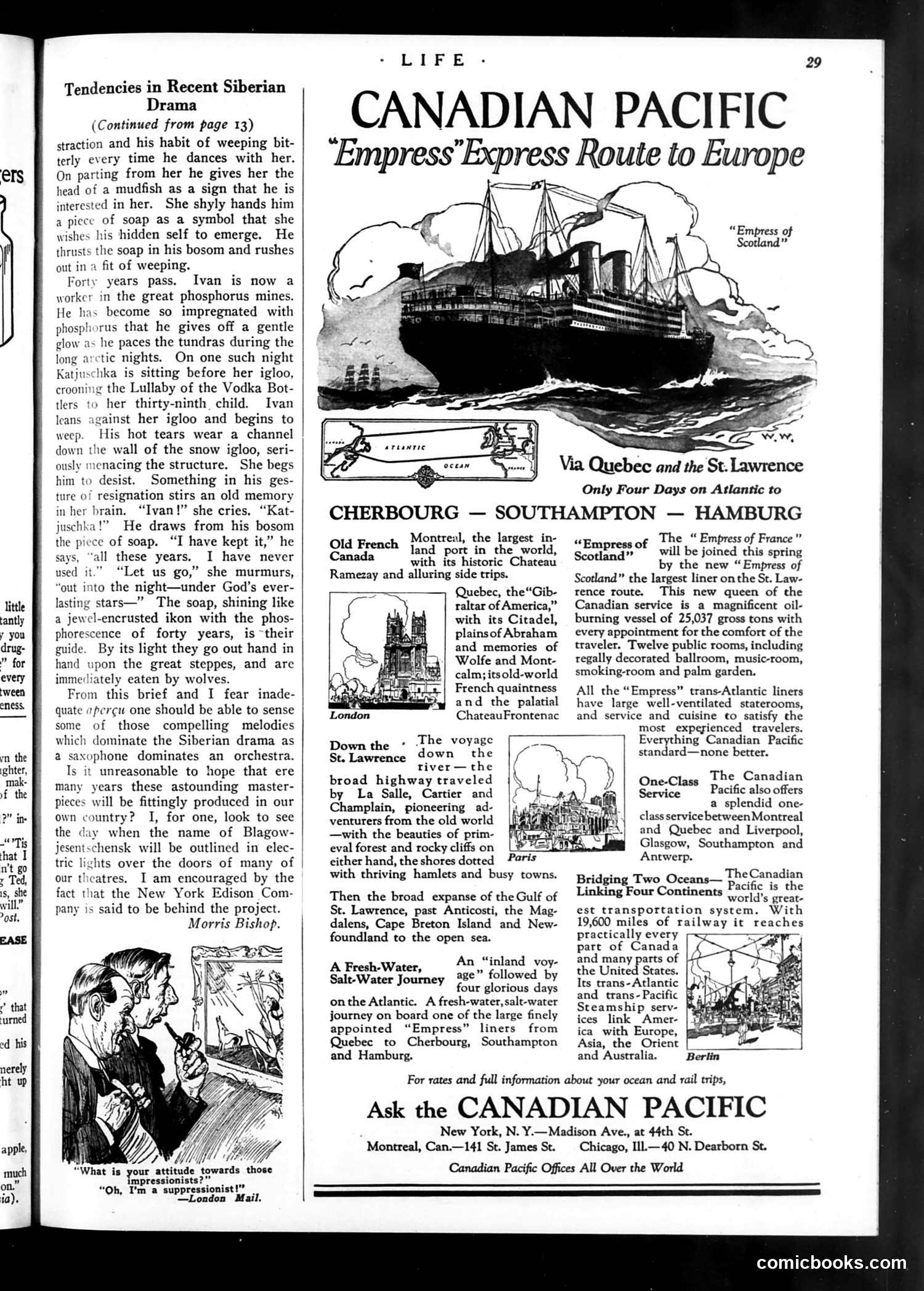
This page is primarily **advertising**, not political satire. It contains two distinct elements: **Left side:** A literary parody titled "Tendencies in Recent Siberian Drama" by Morris Bishop. This mocks pretentious avant-garde theater by describing an absurdly melodramatic Russian play involving phosphorescent miners, tears freezing igloos, and characters being eaten by wolves—clearly ridiculous on its face. The satire targets experimental theater's overwrought emotionalism and obscure continental influences then fashionable among intellectuals. The small cartoon below shows someone defending "impressionists," likely referencing this same cultural pretension. **Right side:** Straightforward **advertising** for Canadian Pacific Railway's ocean liner service, the "Empress of Scotland," promoting luxury transatlantic travel from Quebec to European ports. This is not satirical content. The page juxtaposes literary mockery with commercial promotion—typical of Life magazine's mix of humor and paid content.
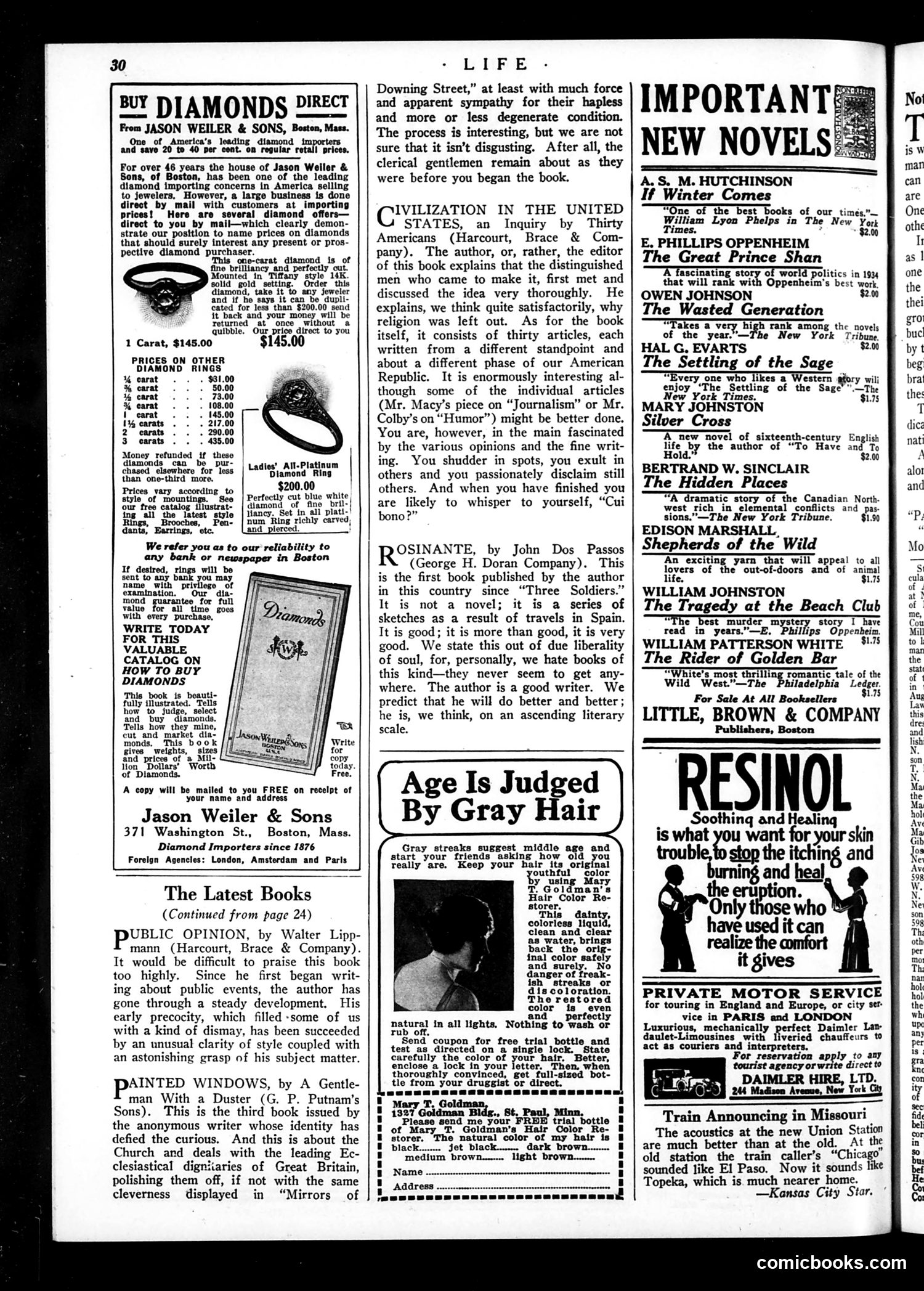
This page is primarily **advertising and book reviews**, not political cartoons. The dominant content includes: **Advertisements:** Jason Weiler & Sons diamond importers dominate the left side, offering direct-mail diamonds at claimed discounts. Below is a Resinol salve ad featuring silhouettes of children, promoting treatment for skin irritation. A "Private Motor Service" ad and train announcement round out commercial content. **Book Reviews:** The right column reviews contemporary literature including works by Walter Lippmann (*Public Opinion*) and an anonymous author called "A Gentleman With a Duster" (*Painted Windows*), which satirizes British ecclesiastical figures. **Hair Dye Advertisement:** A prominent middle section features Mary T. Goldman's Hair Color Restorer, using the headline "Age Is Judged By Gray Hair"—a period beauty product marketed to combat perceived aging. No political cartoons appear on this page. The "satire" mentioned relates to book content, not visual humor.
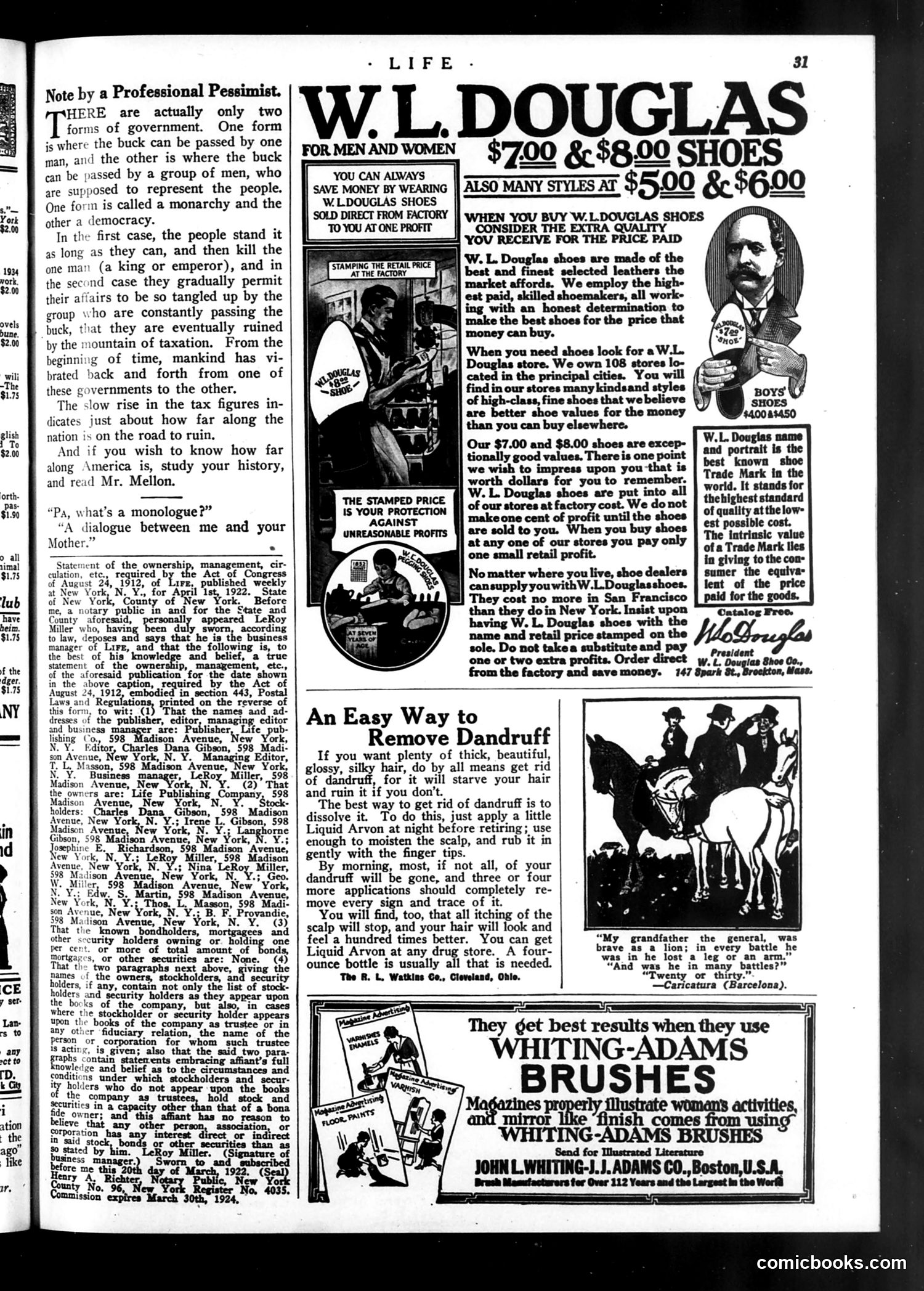
This page from Life (April 1, 1922) contains a political commentary and advertisements. **The "Professional Pessimist" Column:** The opening essay satirizes both monarchy and democracy as equally flawed systems. It argues that in monarchies, people eventually revolt and kill the ruler, while in democracies, corrupt officials gradually "pass the buck" until the nation collapses under taxation. The piece references **Andrew Mellon**, Treasury Secretary under Presidents Harding and Coolidge, implying his tax policies are ruining America. This reflects 1920s progressive criticism of conservative economic management post-WWI. **The Monologue Joke:** A brief, cynical quip defining "monologue" as one person talking while another (the wife) listens—standard domestic humor of the era. **Advertisements:** The page is dominated by W.L. Douglas shoe advertisements featuring the company founder's portrait, emphasizing factory-direct sales at competitive prices ($7-8 and $5-6). The content reflects post-war American skepticism about government competence and concerns about fiscal policy, wrapped in satirical humor typical of Life's editorial voice.
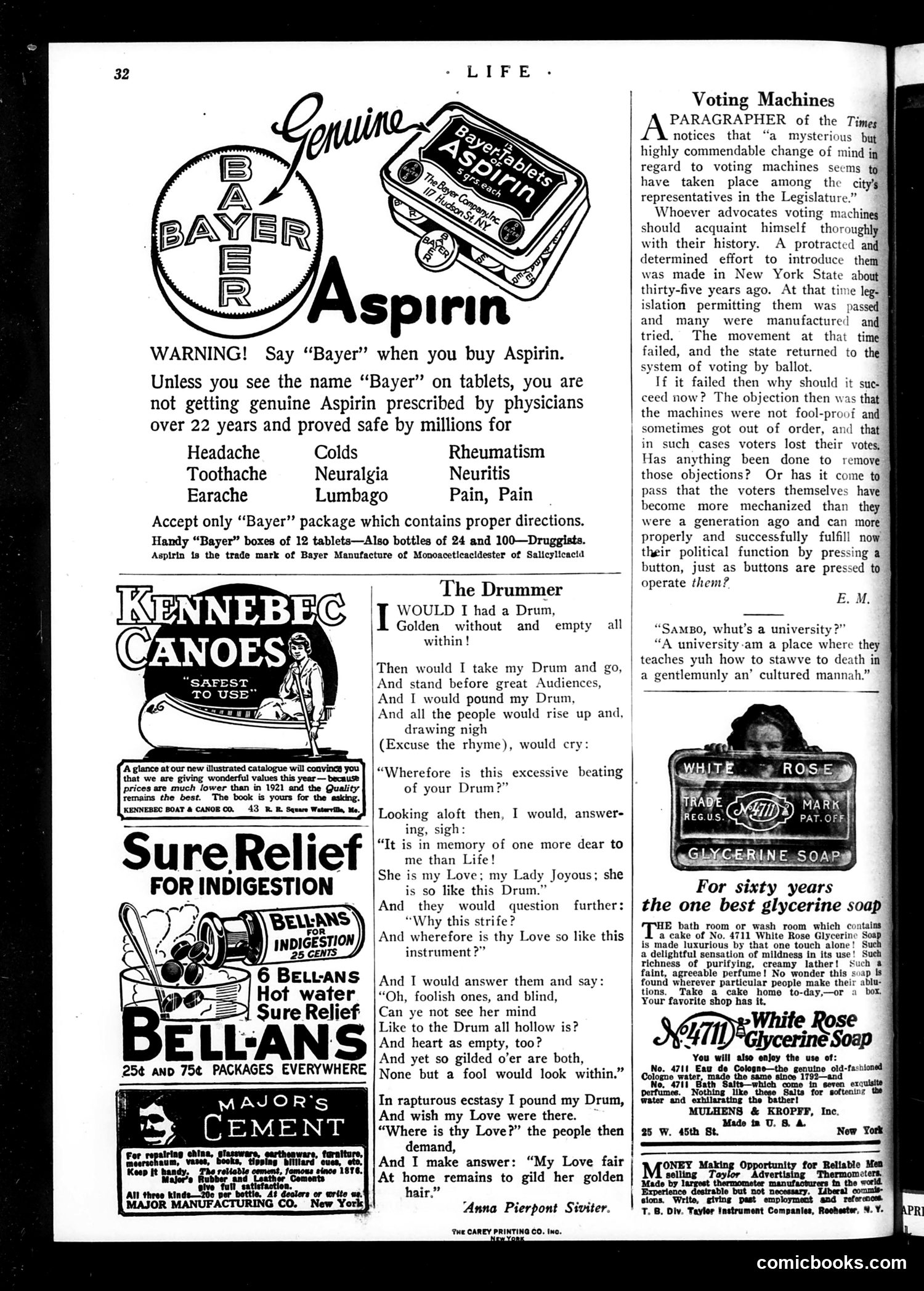
This page is primarily **advertisements** interspersed with two literary pieces. The ads include Bayer Aspirin (asserting trademark exclusivity), Kennebec canoes, Bell-Ans indigestion relief, and White Rose Glycerine Soap. The notable non-ad content includes: **"The Drummer"** by Anna Pierpont Sixiter — a sentimental poem about a man who drums in memory of his beloved, whom he describes (cruelly) as hollow-minded and empty-hearted, merely "gilded o'er" with beauty. **"Voting Machines"** — a commentary questioning why New York legislators advocate for voting machines when they failed thirty-five years prior due to mechanical unreliability and lost votes. The author skeptically asks whether voters have become so "mechanized" they can now responsibly operate machines, or whether the machines' problems have actually been solved. This reflects early-20th-century debate over mechanization versus traditional ballot voting. The page reflects concerns about technological adoption and romantic disillusionment typical of the 1920s era.