
Life, 1922-04-13 · page 16 of 34
Life — April 13, 1922 — page 16: what you’re looking at
What you’re looking at
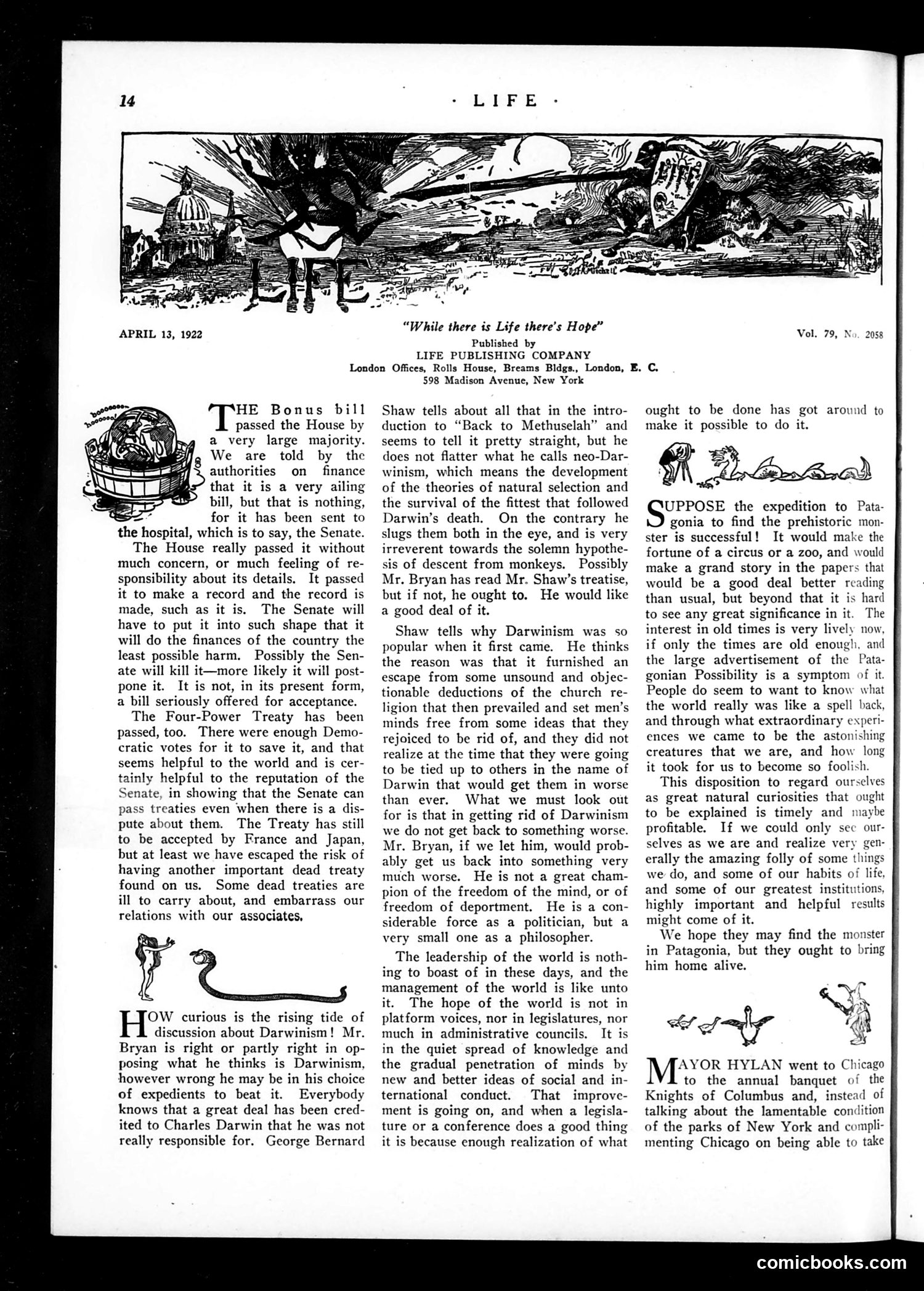
This page discusses the "Bonus bill" passed by the House regarding veterans' hospital benefits. The editorial criticizes William Jennings Bryan (identified in text) for opposing Darwinism while being hypocritical about evolutionary theory's implications. The main satire targets Bryan's contradictory stance: he rejects Darwin's natural selection but opposes the logical social consequences of abandoning it. The writer argues Bryan's "neo-Darwinism" opposition ignores that people naturally want to escape difficult situations—suggesting Bryan himself would benefit from progress rather than stagnation. The piece also mentions a Patagonian expedition, likely referencing contemporary exploration news. Decorative illustrations of monkeys frame the text, humorously reinforcing the Darwinian subject matter. The overall tone mocks Bryan's selective application of evolutionary theory to political positions.
📄 Transcribed text from this page (OCR, searchable)
Machine-transcribed from the original scan — historical spelling and the odd misread are preserved.
APRIL 13, 1922 “While there is Life there’s Hope” Published by LIFE PUBLISHING COMPANY Vol. 79, No. 2058 London Offices, Rolls House, Breams Bldgs., London, E. C. HE Bonus bill passed the House by a very large majority. We are told by the authorities on finance that it is a very ailing bill, but that is nothing, 4 for it has been sent to the hospital, which is to say, the Senate. The House really passed it without much concern, or much feeling of re- sponsibility about its details. It passed it to make a record and the record is made, such as it is. The Senate will have to put it into such shape that it will do the finances of the country the least possible harm. Possibly the Sen- ate will kill it—more likely it will post- pone it. It is not, in its present form, a bill seriously offered for acceptance. The Four-Power Treaty has been passed, too. There were enough Demo- cratic votes for it to save it, and that seems helpful to the world and is cer- tainly helpful to the reputation of the Senate, in showing that the Senate can pass treaties even when there is a dis- pute about them. The Treaty has still to be accepted by France and Japan, but at least we have escaped the risk of having another important dead treaty found on us. Some dead treaties are ill to carry about, and embarrass our relations with our associates, ‘OW curious is the rising tide of discussion about Darwinism! Mr. Bryan is right or partly right in op- posing what he thinks is Darwinism, however wrong he may be in his choice of expedients to beat it. Everybody knows that a great deal has been cred- ited to Charles Darwin that he was not really responsible for. George Bernard 598 Madison Avenue, New York Shaw tells about all that in the intro- duction to “Back to Methuselah” and seems to tell it pretty straight, but he does not flatter what he calls neo-Dar- winism, which means the development of the theories of natural selection and the survival of the fittest that followed Darwin’s death. On the contrary he slugs them both in the eye, and is very irreverent towards the solemn hypothe- sis of descent from monkeys. Possibly Mr. Bryan has read Mr. Shaw’s treatise, but if not, he ought to. He would like a good deal of it. Shaw tells why Darwinism was so popular when it first came. He thinks the reason was that it furnished an escape from some unsound and objec- tionable deductions of the church re- ligion that then prevailed and set men’s minds free from some ideas that they rejoiced to be rid of, and they did not realize at the time that they were going to be tied up to others in the name of Darwin that would get them in worse than ever. What we must look out for is that in getting rid of Darwinism we do not get back to something worse. Mr. Bryan, if we let him, would prob- ably get us back into something very much worse. He is not a great cham- pion of the freedom of the mind, or of freedom of deportment. He is a con- siderable force as a politician, but a very small one as a philosopher. The leadership of the world is noth- ing to boast of in these days, and the management of the world is like unto it. The hope of the world is not in platform voices, nor in legislatures, nor much in administrative councils. It is in the quiet spread of knowledge and the gradual penetration of minds by new and better ideas of social and in- ternational conduct. That improve- ment is going on, and when a legisla- ture or a conference does a good thing it is because enough realization of what ought to be done has got around to make it possible to do it. UPPOSE the expedition to Pata- gonia to find the prehistoric mon- ster is successful! It would make the fortune of a circus or a zoo, and would make a grand story in the papers that would be a good deal better reading than usual, but beyond that it is hard to see any great significance in it. The interest in old times is very lively now, if only the times are old enough, and the large advertisement of the Pata- gonian Possibility is a symptom of it People do seem to want to know what the world really was like a spell back, and through what extraordinary experi- ences we came to be the astonishing creatures that we are, and how long it took for us to become so foolish. This disposition to regard ourselves as great natural curiosities that ought to be explained is timely and maybe profitable. If we could only sec our- selves as we are and realize very gen- erally the amazing folly of some things we do, and some of our habits of life, and some of our greatest institutions, highly important and helpful results might come of it. We hope they may find the monster in Patagonia, but they ought to bring him home alive. wir = ¢ AYOR HYLAN went to Chicago to the annual banquet of the Knights of Columbus and, instead of talking about the lamentable condition of the parks of New York and compli- menting Chicago on being able to take comicbooks.com