
Life, 1922-04-13 · page 20 of 34
Life — April 13, 1922 — page 20: what you’re looking at
What you’re looking at
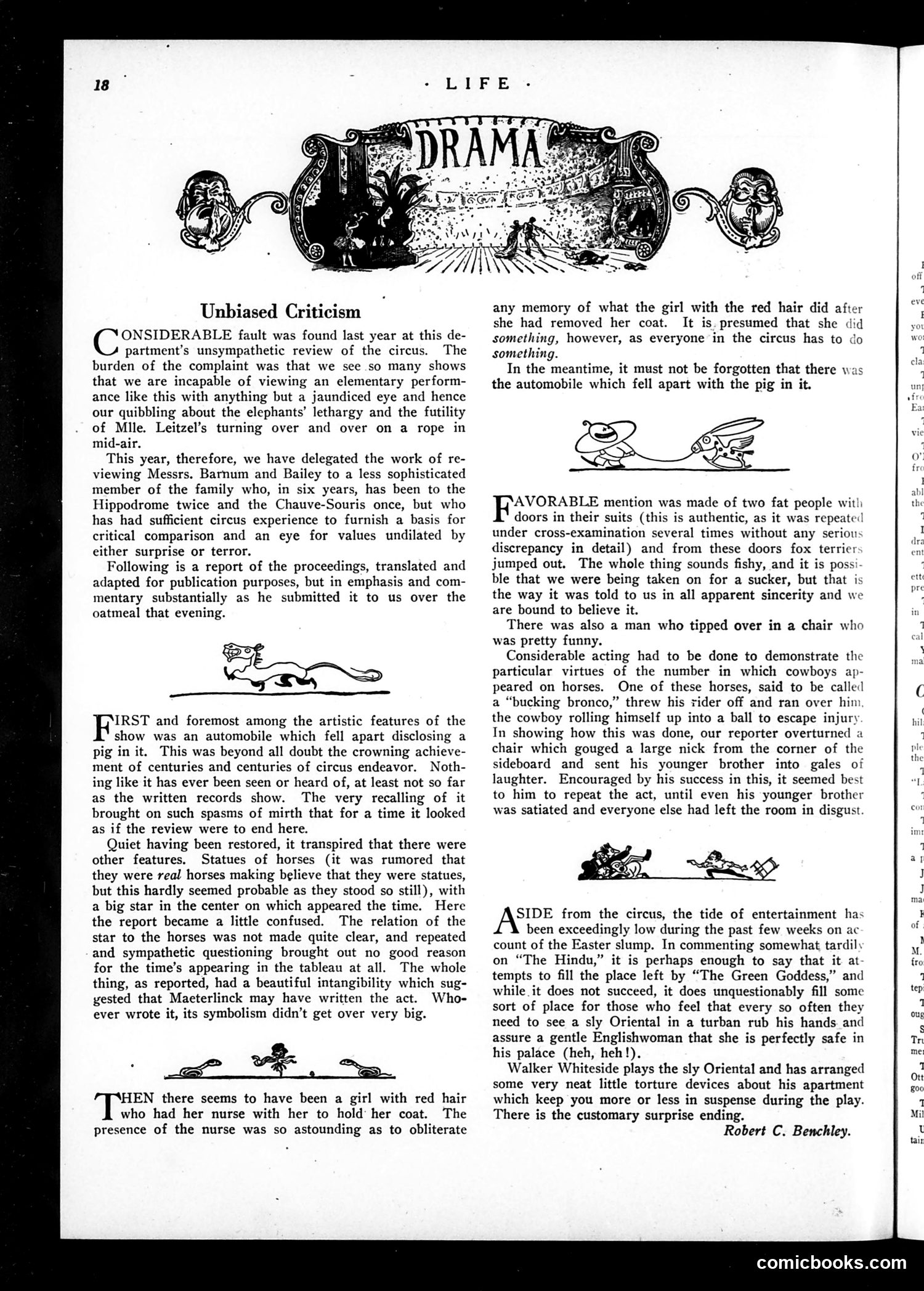
This is a satirical theater review of the Barnum and Bailey circus, written as if by a naive, unsophisticated child rather than Life's usual jaded critic. The humor lies in the deliberately deadpan, literalist descriptions of circus acts that miss the point entirely. The child narrator focuses on absurdities: an automobile containing a pig, statues of horses with inexplicable time displays, a girl whose nurse holding her coat is more memorable than her actual performance, and fat performers with doors in their suits releasing fox terriers. The review's apparent sincerity—"it is presumed that she did something"—while describing increasingly ridiculous acts creates the satire. The joke mocks both oversophisticated critics and the circus itself. By pretending fresh wonder at genuinely strange spectacles, the reviewer suggests circus acts are inherently absurd; only jaded reviewing conventions made them seem normal.
📄 Transcribed text from this page (OCR, searchable)
Machine-transcribed from the original scan — historical spelling and the odd misread are preserved.
Unbiased Criticism ONSIDERABLE fault was found last year at this de- partment’s unsympathetic review of the circus. The burden of the complaint was that we see so many shows that we are incapable of viewing an elementary perform- ance like this with anything but a jaundiced eye and hence our quibbling about the elephants’ lethargy and the futility of Mlle. Leitzel’s turning over and over on a rope in mid-air. This year, therefore, we have delegated the work of re- viewing Messrs. Barnum and Bailey to a less sophisticated member of the family who, in six years, has been to the Hippodrome twice and the Chauve-Souris once, but who has had sufficient circus experience to furnish a basis for critical comparison and an eye for values undilated by either surprise or terror. Following is a report of the proceedings, translated and adapted for publication purposes, but in emphasis and com- mentary substantially as he submitted it to us over the oatmeal that evening. IRST and foremost among the artistic features of the show was an automobile which fell apart disclosing a pig in it. This was beyond all doubt the crowning achieve- ment of centuries and centuries of circus endeavor. Noth- ing like it has ever been seen or heard of, at least not so far as the written records show. The very recalling of it brought on such spasms of mirth that for a time it looked as if the review were to end here. Quiet having been restored, it transpired that there were other features, Statues of horses (it was rumored that they were real horses making believe that they were statues, but this hardly seemed probable as they stood so still), with a big star in the center on which appeared the time. Here the report became a little confused. The relation of the star to the horses was not made quite clear, and repeated and sympathetic questioning brought out no good reason for the time’s appearing in the tableau at all. The whole thing, as reported, had a beautiful intangibility which sug- gested that Maeterlinck may have written the act. Who- ever wrote it, its symbolism didn’t get over very big. a ae ‘HEN there seems to have been a girl with red hair who had her nurse with her to hold her coat. The presence of the nurse was so astounding as to obliterate any memory of what the girl with the red hair did after she had removed her coat. It is. presumed that she did something, however, as everyone in the circus has to do something. In the meantime, it must not be forgotten that there was the automobile which fell apart with the pig in it. AVORABLE mention was made of two fat people wit! doors in their suits (this is authentic, as it was repeated under cross-examination several times without any serious discrepancy in detail) and from these doors fox terrier jumped out. The whole thing sounds fishy, and it is possi ble that we were being taken on for a sucker, but that is the way it was told to us in all apparent sincerity and we are bound to believe it. There was also a man who tipped over in a chair who was pretty funny. Considerable acting had to be done to demonstrate the particular virtues of the number in which cowboys ap- peared on horses. One of these horses, said to be called a “bucking bronco,” threw his rider off and ran over him the cowboy rolling himself up into a ball to escape injury In showing how this was done, our reporter overturned a chair which gouged a large nick from the corner of the sideboard and sent his younger brother into gales of laughter. Encouraged by his success in this, it seemed best to him to repeat the act, until even his younger brother was satiated and everyone else had left the room in disgust. BE! ~w SIDE from the circus, the tide of entertainment has been exceedingly low during the past few weeks on ac count of the Easter slump. In commenting somewhat tardily on “The Hindu,” it is perhaps enough to say that it at tempts to fill the place left by “The Green Goddess,” and while it does not succeed, it does unquestionably fill some sort of place for those who feel that every so often they need to see a sly Oriental in a turban rub his hands and assure a gentle Englishwoman that she is perfectly safe in his palace (heh, heh!). Walker Whiteside plays the sly Oriental and has arranged some very neat little torture devices about his apartment which keep you more or less in suspense during the play. There is the customary surprise ending. Robert C. Benchley. comicbooks.com