
Life, 1922-04-13 · page 11 of 34
Life — April 13, 1922 — page 11: what you’re looking at
What you’re looking at
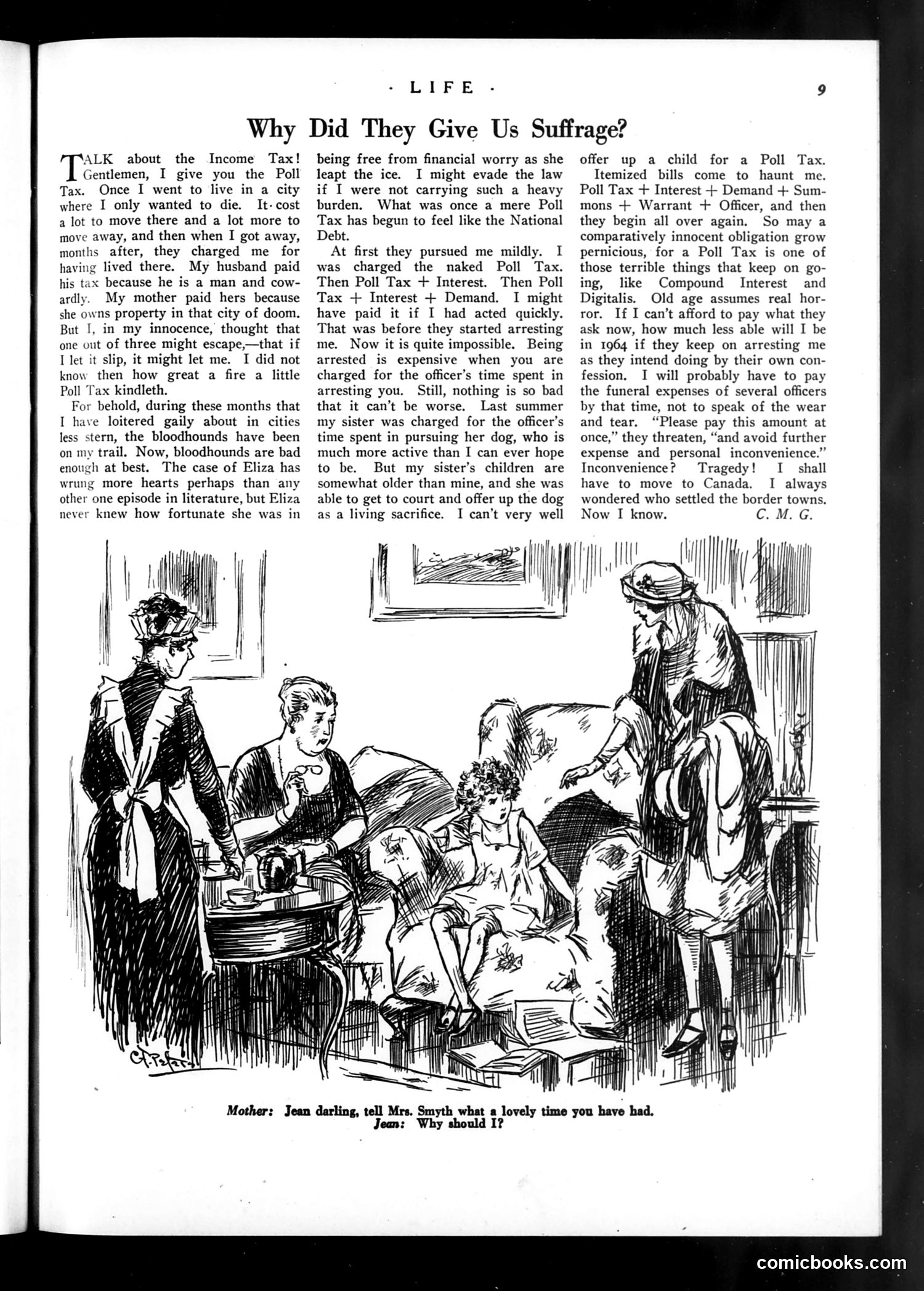
This satirical article titled "Why Did They Give Us Suffrage?" is a first-person account—likely by a woman—describing the burdensome consequences of gaining voting rights. The narrator explains that along with suffrage came a "Poll Tax," a financial requirement to vote that created cascading debts (Poll Tax + Interest + Demand) she couldn't afford to pay. The satire's point: granting women the vote was hollow when accompanied by a Poll Tax that effectively prevented poor women from exercising that right. The cartoon below depicts women in a social gathering, with a child asking why she should tell a guest about "a lovely time"—implying women's actual circumstances contradict any celebration of their newfound "freedom." This critiques how suffrage, though nominally progressive, was undermined by financial barriers.
📄 Transcribed text from this page (OCR, searchable)
Machine-transcribed from the original scan — historical spelling and the odd misread are preserved.
- LIFE .- Why Did They Give Us Suffrage? ‘ALK about the Income Tax! To I give you the Poll Tax. Once I went to live in a city where I only wanted to die. It- cost a lot to move there and a lot more to move away, and then when I got away, months after, they charged me for having lived there. My husband paid his tax because he is a man and cow- ardly. My mother paid hers because she owns property in that city of doom. But I, in my innocence, thought that one out of three might escape,—that if I let it slip, it might let me. I did not know then how great a fire a little Poll Tax kindleth. For behold, during these months that I have loitered gaily about in cities less stern, the bloodhounds have been on my trail. Now, bloodhounds are bad enough at best. The case of Eliza has wrung more hearts perhaps than any other one episode in literature, but Eliza never knew how fortunate she was in being free from financial worry as she leapt the ice. I might evade the law if I were not carrying such a heavy burden. What was once a mere Poll Tax has begun to feel like the National Debt. At first they pursued me mildly. I was charged the naked Poll Tax. Then Poll Tax + Interest. Then Poll Tax + Interest + Demand. I might have paid it if I had acted quickly. That was before they started arresting me. Now it is quite impossible. Being arrested is expensive when you are charged for the officer’s time spent in arresting you. Still, nothing is so bad that it can’t be worse. Last summer my sister was charged for the officer’s time spent in pursuing her dog, who is much more active than I can ever hope to be. But my sister’s children are somewhat older than mine, and she was able to get to court and offer up the dog as a living sacrifice. I can’t very well | bce offer up a child for a Poll Tax. Itemized bills come to haunt me. Poll Tax + Interest + Demand + Sum- mons + Warrant + Officer, and then they begin all over again. So may a comparatively innocent obligation grow pernicious, for a Poll Tax is one of those terrible things that keep on go- ing, like Compound Interest and Digitalis. Old age assumes real hor- ror. If I can’t afford to pay what they ask now, how much less able will I be in 1964 if they keep on arresting me as they intend doing by their own con- fession. I will probably have to pay the funeral expenses of several officers by that time, not to speak of the wear and tear. “Please pay this amount at once,” they threaten, “and avoid further expense and personal inconvenience.” Inconvenience? Tragedy! I shall have to move to Canada. I always wondered who settled the border towns. Now I know. C.M.G. | Se Mother: Jean darling, tell Mrs. Smyth what a lovely time you have had. Jean: Why should I? comicbooks.com