
Life, 1922-04-13 · page 6 of 34
Life — April 13, 1922 — page 6: what you’re looking at
What you’re looking at
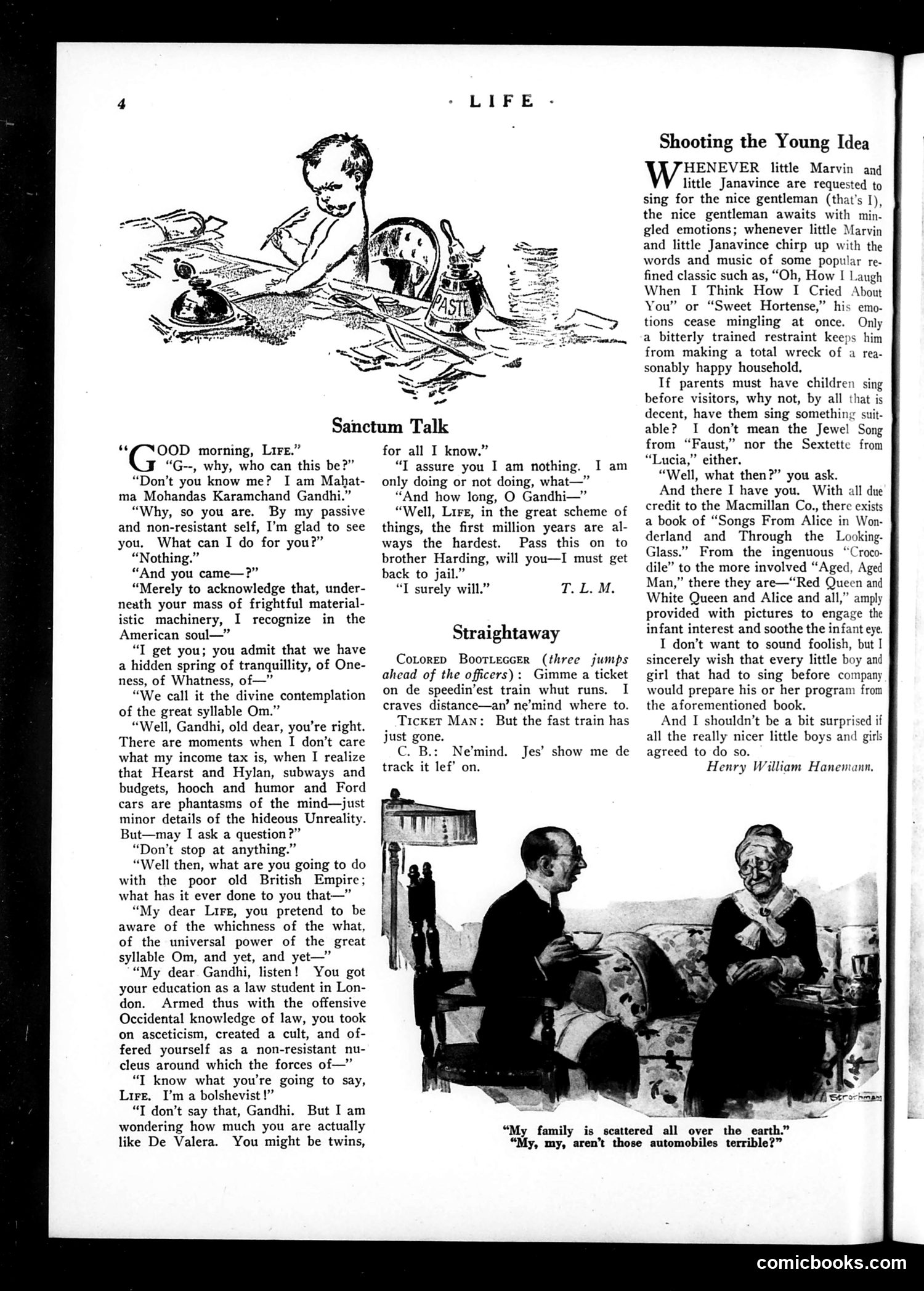
This page contains three distinct sections: **"Sanctum Talk"** presents a satirical dialogue between "Life" (the magazine) and Mahatma Gandhi, mocking Gandhi's philosophy and asceticism. Life criticizes Gandhi's non-resistance and questions his actual influence, suggesting his ideas are impractical luxuries compared to harsh realities (mentioning Hearst, Hylton, Ford cars as symbols of American materialism). **"Straightaway"** is a brief, obscure joke about a colored bootlegger and a train, likely referencing Prohibition-era smuggling. **"Shooting the Young Idea"** discusses whether children should sing sentimental popular songs before visitors, arguing against it. The author (Henry William Hanemann) suggests children instead perform from established children's literature like Alice in Wonderland. The page reflects early 20th-century satirical humor and social commentary typical of Life magazine's editorial stance.
📄 Transcribed text from this page (OCR, searchable)
Machine-transcribed from the original scan — historical spelling and the odd misread are preserved.
s§ OOD morning, Lire.” “G--, why, who can this be?” “Don’t you know me? I am Mahat- ma Mohandas Karamchand Gandhi.” “Why, so you are. By my passive and non-resistant self, I’m glad to see you. What can I do for you?” “Nothing.” “And you came—?” “Merely to acknowledge that, under- neath your mass of frightful material- istic machinery, I recognize in the American soul—” “I get you; you admit that we have a hidden spring of tranquillity, of One- ness, of Whatness, of—” “We call it the divine contemplation of the great syllable Om.” “Well, Gandhi, old dear, you’re right. There are moments when I don’t care what my income tax is, when I realize that Hearst and Hylan, subways and budgets, hooch and humor and Ford cars are phantasms of the mind—just minor details of the hideous Unreality. But—may I ask a question?” “Don’t stop at anything.” “Well then, what are you going to do with the poor old British Empire; what has it ever done to you that—” “My dear Lire, you pretend to be aware of the whichness of the what, of the universal power of the great syllable Om, and yet, and yet—” “My dear Gandhi, listen! You got your education as a law student in Lon- don. Armed thus with the offensive Occidental knowledge of law, you took on asceticism, created a cult, and of- fered yourself as a non-resistant nu- cleus around which the forces of—” “I know what you're going to say, Lire. I’m a bolshevist !” “I don’t say that, Gandhi. But I am wondering how much you are actually like De Valera. You might be twins, for all I know.” “T assure you I am nothing. only doing or not doing, what—” “And how long, O Gandhi—” “Well, Lire, in the great scheme of things, the first million years are al- ways the hardest. Pass this on to brother Harding, will you—I must get back to jail.” “T surely will.” I am T.L.M. Straightaway CoLorep BoorLeccEer (three jumps ahead of the officers): Gimme a ticket on de speedin’est train whut runs. I craves distance—an’ ne’mind where to. Ticket Man: But the fast train has just gone. C. B.: Ne’mind. Jes’ show me de track it lef’ on. Shooting the Young Idea HENEVER little Marvin and little Janavince are requested to sing for the nice gentleman (that’s I), the nice gentleman awaits with min- gled emotions; whenever little Marvin and little Janavince chirp up with the words and music of some popular re- fined classic such as, “Oh, How I Laugh When I Think How I Cried About You” or “Sweet Hortense,” his emo- tions cease mingling at once. Only a bitterly trained restraint keeps him from making a total wreck of a rea- sonably happy household, If parents must have children sing before visitors, why not, by all that is decent, have them sing something suit- able? I don’t mean the Jewel Song from “Faust,” nor the Sextette from “Lucia,” either. “Well, what then?” you ask. And there I have you. With all due credit to the Macmillan Co., there exists a book of “Songs From Alice in Won- derland and Through the Looking. Glass.” From the ingenuous “Croco- dile” to the more involved “Aged, Aged Man,” there they are—“Red Queen and White Queen and Alice and all,” amply provided with pictures to engage the infant interest and soothe the infant eye. I don’t want to sound foolish, but I sincerely wish that every little boy and girl that had to sing before company would prepare his or her program from the aforementioned book. And I shouldn’t be a bit surprised if all the really nicer little boys and girls agreed to do so. Henry William Hanemann, “My family is scattered all over the earth.” “My, my, aren’t those automobiles terrible?” comicbooks.com