
Life, 1922-04-13 · page 17 of 34
Life — April 13, 1922 — page 17: what you’re looking at
What you’re looking at
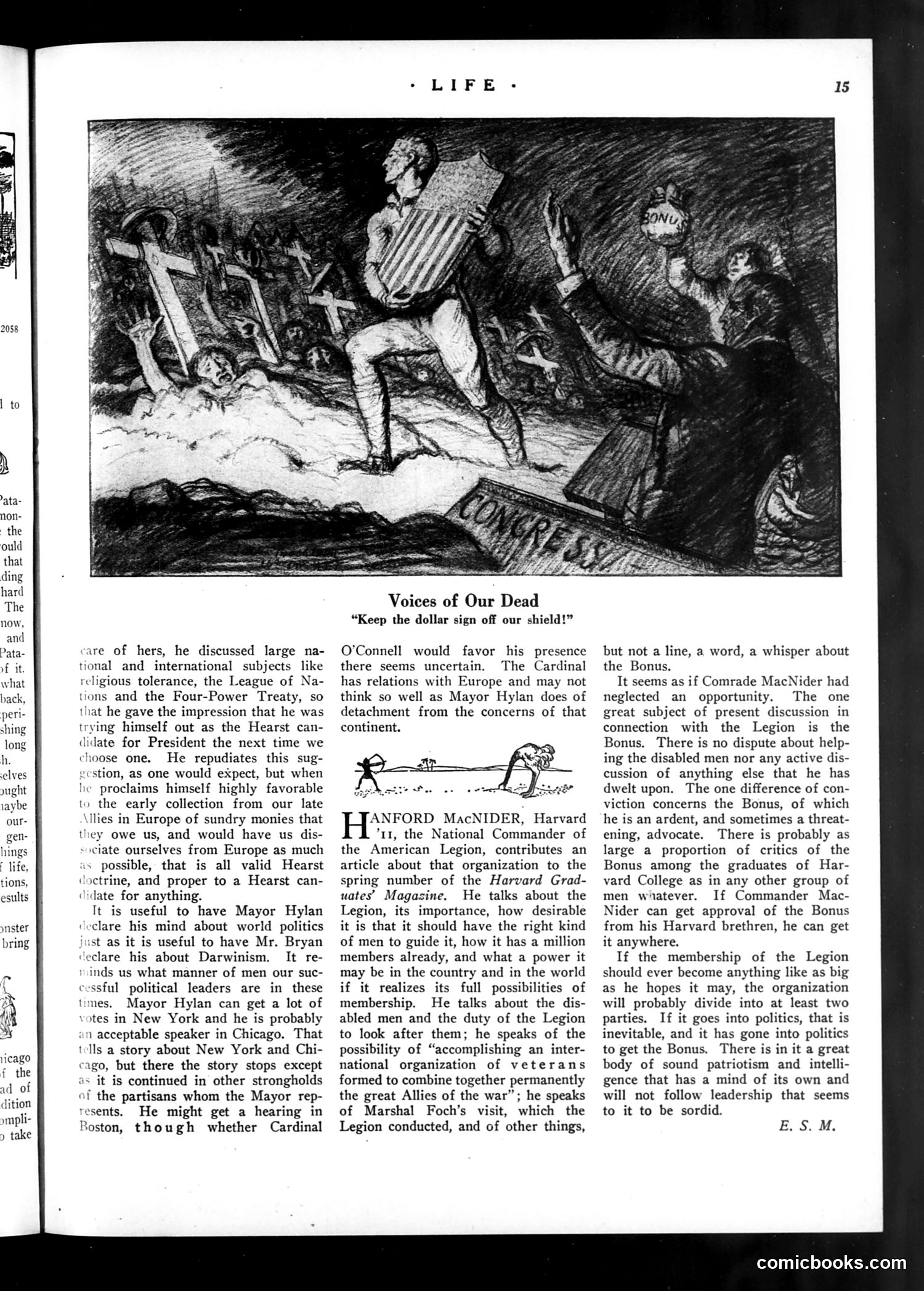
The page contains two distinct pieces of political commentary: **"Voices of Our Dead" cartoon**: The illustration depicts skeletal soldiers rising from graves, confronting a living figure wearing a striped shield (representing American patriotism). The caption "Keep the dollar sign off our shield!" is the key: it's satirizing how WWI veterans' sacrifice is being commercialized or exploited for political gain. **MacNider article critique**: The text criticizes Hanford MacNider, National Commander of the American Legion, for avoiding discussion of the "Bonus"—compensation owed to WWI veterans. The author suggests MacNider focused on broader Legion goals while sidestepping this central veteran concern. The piece implies MacNider is being evasive about a politically divisive issue affecting his own constituency, and warns that the Legion risks splitting into factions if it enters politics over bonus disputes. Both pieces reflect 1920s debate over veteran benefits and warnings against politicizing soldiers' sacrifices.
📄 Transcribed text from this page (OCR, searchable)
Machine-transcribed from the original scan — historical spelling and the odd misread are preserved.
) ata- non- - the ould that ding hard The now, and Pata- of it. what back, peri- shing long h. elves ought vaybe tions, esults ynster bring care of hers, he discussed large na- tional and international subjects like religious tolerance, the League of Na- tions and the Four-Power Treaty, so that he gave the impression that he was trying himself out as the Hearst can- didate for President the next time we choose one. He repudiates this sug- gestion, as one would expect, but when proclaims himself highly favorable to the early collection from our late \llies in Europe of sundry monies that ey owe us, and would have us dis- svciate ourselves from Europe as much s possible, that is all valid Hearst loctrine, and proper to a Hearst can- date for anything. It is useful to have Mayor Hylan clare his mind about world politics just as it is useful to have Mr. Bryan eclare his about Darwinism. It re- »inds us what manner of men our suc- ssful political leaders are in these times. Mayor Hylan can get a lot of votes in New York and he is probably an acceptable speaker in Chicago. That tells a story about New York and Chi- ago, but there the story stops except it is continued in other strongholds of the partisans whom the Mayor rep- resents. He might get a hearing in Boston, though whether Cardinal Voices of Our Dead “Keep the dollar sign off our shield!” O'Connell would favor his presence there seems uncertain. The Cardinal has relations with Europe and may not think so well as Mayor Hylan does of detachment from the concerns of that continent. ANFORD MacNIDER, Harvard ‘11, the National Commander of the American Legion, contributes an article about that organization to the spring number of the Harvard Grad- uates’ Magazine. He talks about the Legion, its importance, how desirable it is that it should have the right kind of men to guide it, how it has a million members already, and what a power it may be in the country and in the world if it realizes its full possibilities of membership. He talks about the dis- abled men and the duty of the Legion to look after them; he speaks of the possibility of “accomplishing an inter- national organization of veterans formed to combine together permanently the great Allies of the war”; he speaks of Marshal Foch’s visit, which the Legion conducted, and of other things, but not a line, a word, a whisper about the Bonus. It seems as if Comrade MacNider had neglected an opportunity. The one great subject of present discussion in connection with the Legion is the Bonus. There is no dispute about help- ing the disabled men nor any active dis- cussion of anything else that he has dwelt upon. The one difference of con- viction concerns the Bonus, of which he is an ardent, and sometimes a threat- ening, advocate. There is probably as large a proportion of critics of the Bonus among the graduates of Har- vard College as in any other group of men whatever. If Commander Mac- Nider can get approval of the Bonus from his Harvard brethren, he can get it anywhere. If the membership of the Legion should ever become anything like as big as he hopes it may, the organization will probably divide into at least two parties. If it goes into politics, that is inevitable, and it has gone into politics to get the Bonus. There is in it a great body of sound patriotism and intelli- gence that has a mind of its own and will not follow leadership that seems to it to be sordid. E. S. M. comicbooks.com