
Life, 1922-04-13 · page 24 of 34
Life — April 13, 1922 — page 24: what you’re looking at
What you’re looking at
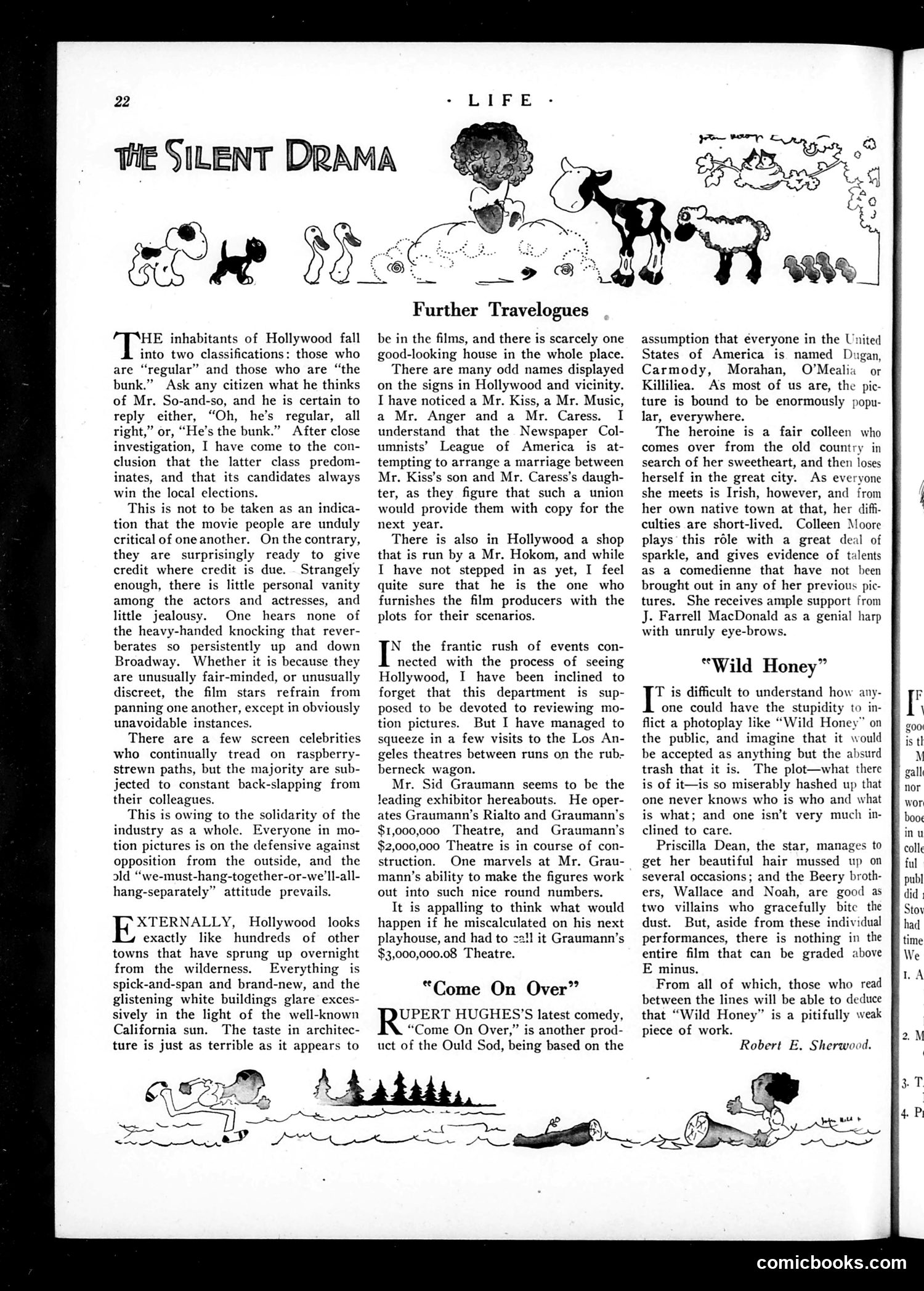
This page satirizes Hollywood's social dynamics and early cinema through three lenses: **Main Article ("Further Travelogues"):** The author mocks Hollywood's peculiar culture—actors' surprising lack of vanity and mutual support (attributed to industry solidarity against outside criticism). The humor lies in contrasting Hollywood's reputed cattiness with observed collegiality. **Name Jokes:** The satire ridicules coincidental surnames of Hollywood residents (Mr. Kiss, Mr. Caress, Mr. Anger, Mr. Hokom), with the columnist suggesting newspapers could manufacture gossip from a fictional marriage between "Kiss" and "Caress" families. **Film Reviews:** The piece critiques: - Sid Graumann's ever-expanding theater empire (with absurdist humor about miscalculating costs) - "Come On Over," a Rupert Hughes comedy that stereotypes Irish-Americans with names like Dugan and Carmody, relying on ethnic caricature for broad appeal The cartoons at top and bottom depict silent-film style slapstick physical comedy. **Context:** This reflects 1920s attitudes toward both nascent Hollywood culture and casual ethnic stereotyping in entertainment.
📄 Transcribed text from this page (OCR, searchable)
Machine-transcribed from the original scan — historical spelling and the odd misread are preserved.
22 HE inhabitants of Hollywood fall into two classifications: those who are “regular” and those who are “the bunk.” Ask any citizen what he thinks of Mr. So-and-so, and he is certain to reply either, “Oh, he’s regular, all right,” or, “He's the bunk.” After close investigation, I have come to the con- clusion that the latter class predom- inates, and that its candidates always win the local elections. This is not to be taken as an indica- tion that the movie people are unduly critical of oneanother. On the contrary, they are surprisingly ready to give credit where credit is due. Strangely enough, there is little personal vanity among the actors and actresses, and little jealousy. One hears none of the heavy-handed knocking that rever- berates so persistently up and down Broadway. Whether it is because they are unusually fair-minded, or unusually discreet, the film stars refrain from panning one another, except in obviously unavoidable instances. There are a few screen celebrities who continually tread on raspberry- strewn paths, but the majority are sub- jected to constant back-slapping from their colleagues. This is owing to the solidarity of the industry as a whole. Everyone in mo- tion pictures is on the defensive against opposition from the outside, and the ald “we-must-hang-together-or-we'll-all- hang-separately” attitude prevails. XTERNALLY, Hollywood looks exactly like hundreds of other towns that have sprung up overnight from the wilderness. Everything is spick-and-span and brand-new, and the glistening white buildings glare exces- sively in the light of the well-known California sun. The taste in architec- ture is just as terrible as it appears to Further Travelogues be in the films, and there is scarcely one good-looking house in the whole place. There are many odd names displayed on the signs in Hollywood and vicinity. I have noticed a Mr. Kiss, a Mr. Music, a Mr. Anger and a Mr. Caress. I understand that the Newspaper Col- umnists’ League of America is at- tempting to arrange a marriage between Mr. Kiss’s son and Mr. Caress’s daugh- ter, as they figure that such a union would provide them with copy for the next year. There is also in Hollywood a shop that is run by a Mr. Hokom, and while I have not stepped in as yet, I feel quite sure that he is the one who furnishes the film producers with the plots for their scenarios. N the frantic rush of events con- nected with the process of seeing Hollywood, I have been inclined to forget that this department is sup- posed to be devoted to reviewing mo- tion pictures. But I have managed to squeeze in a few visits to the Los An- geles theatres between runs on the rub- berneck wagon. Mr. Sid Graumann seems to be the leading exhibitor hereabouts. He oper- ates Graumann’s Rialto and Graumann’s $1,000,000 Theatre, and Graumann’s $2,000,000 Theatre is in course of con- struction. One marvels at Mr. Grau- mann’s ability to make the figures work out into such nice round numbers. It is appalling to think what would happen if he miscalculated on his next playhouse, and had to z2!l it Graumann’s $3,000,000.08 Theatre. “Come On Over” PERT HUGHES'S latest comedy, “Come On Over,” is another prod- uct of the Ould Sod, being based on the assumption that éveryone in the United States of America is named Dugan, Carmody, Morahan, O’Mealia or Killiliea. As most of us are, the pic- ture is bound to be enormously popu- lar, everywhere. The heroine is a fair colleen who comes over from the old country in search of her sweetheart, and then loses herself in the great city. As everyone she meets is Irish, however, and from her own native town at that, her diffi- culties are short-lived. Colleen Moore plays this role with a great deal of sparkle, and gives evidence of talents as a comedienne that have not been brought out in any of her previous pic- tures. She receives ample support from J. Farrell MacDonald as a genial harp with unruly eye-brows. “Wild Honey” T is difficult to understand how any- one could have the stupidity to in- flict a photoplay like “Wild Honey” on the public, and imagine that it would be accepted as anything but the absurd trash that it is. The plot—what there is of it—is so miserably hashed up that one never knows who is who and what is what; and one isn’t very much in- clined to care. Priscilla Dean, the star, manages to get her beautiful hair mussed up on several occasions; and the Beery broth- ers, Wallace and Noah, are good as two villains who gracefully bite the dust. But, aside from these individual performances, there is nothing in the entire film that can be graded above E minus. From all of which, those who read between the lines will be able to deduce that “Wild Honey” is a pitifully weak piece of work. Robert E. Sherwood. eG e comicbooks.com