
Life, 1922-04-13 · page 12 of 34
Life — April 13, 1922 — page 12: what you’re looking at
What you’re looking at
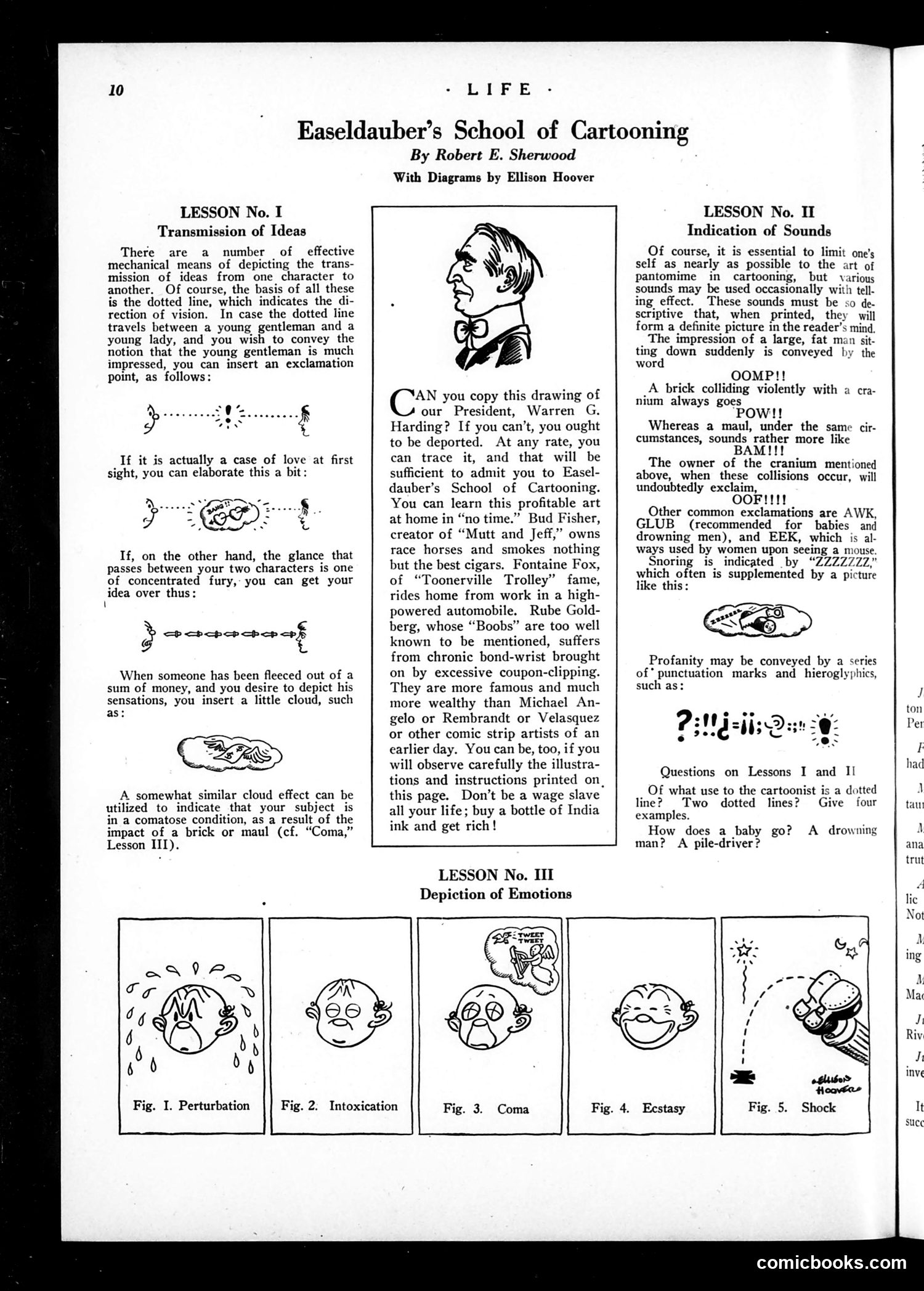
This instructional page teaches cartooning techniques through three lessons: **Lesson I** demonstrates how dotted lines convey direction and emotion between characters—a visual shorthand for transmitting ideas. **Lesson II** covers sound effects in comics. It illustrates onomatopoeia like "OOMPH," "POW," and "BAM!!!" for collisions, and "ZZZZZZZ" for snoring. The text references actual cartoonists of the era (Bud Fisher, Fontaine Fox, Rube Goldberg) as examples of professionals who mastered these techniques. **Lesson III** provides five simple face diagrams showing how to draw basic emotions: perturbation (distress), intoxication, coma, ecstasy, and shock. The page is practical instruction for aspiring cartoonists, encouraging them to study professional work and use India ink while learning these foundational skills.
📄 Transcribed text from this page (OCR, searchable)
Machine-transcribed from the original scan — historical spelling and the odd misread are preserved.
- LYFE : Easeldauber’s School of Cartooning LESSON No. I Transmission of Ideas There are a number of effective mechanical means of depicting the trans- mission of ideas from one character to another. Of course, the basis of all these is the dotted line, which indicates the di- rection of vision. In case the dotted line travels between a young gentleman and a young lady, and you wish to convey the notion that the young gentleman is much impressed, you can insert an exclamation point, as follows: Zz If it is actually a case of love at first sight, you can elaborate this a bit: If, on the other hand, the glance that passes between your two characters is one of concentrated fury, you can get your idea over thus: # ceaecperancn anf When someone has been fleeced out of a sum of money, and you desire to depict his sensations, you insert a little cloud, such A somewhat similar cloud effect can be utilized to indicate that your subject is in a comatose condition, as a result of the impact of a brick or maul (cf. “Coma,” Lesson III). Fig. I. Perturbation Fig. 2. Intoxication By Robert E. Sherwood With Diagrams by Ellison Hoover ‘AN you copy this drawing of our President, Warren G. Harding? If you can’t, you ought to be deported. At any rate, you can trace it, and that will be sufficient to admit you to Easel- dauber’s School of Cartooning. You can learn this profitable art at home in “no time.” Bud Fisher, creator of “Mutt and Jeff,’ owns race horses and smokes nothing but the best cigars. Fontaine Fox, of “Toonerville Trolley” fame, rides home from work in a high- powered automobile. Rube Gold- berg, whose “Boobs” are too well known to be mentioned, suffers from chronic bond-wrist brought on by excessive coupon-clipping. They are more famous and much more wealthy than Michael An- gelo or Rembrandt or Velasquez or other comic strip artists of an earlier day. You can be, too, if you will observe carefully the illustra- tions and instructions printed on, this page. Don’t be a wage slave all your life; buy a bottle of India ink and get rich! LESSON No. III Depiction of Emotions Fig. 3. Coma Fig. 4. Ecstasy LESSON No. II Indication of Sounds Of course, it is essential to limit one’s self as nearly as possible to the art of pantomime in cartooning, but various sounds may be used occasionally with tell- ing effect. These sounds must be so de- scriptive that, when printed, they will form a definite picture in the reader’s mind, _ The impression of a large, fat man sit- ting down suddenly is conveyed by the word . OOMP!! _A brick colliding violently with a cra- nium always goes POW! Whereas a maul, under the same cir- cumstances, sounds rather more like BAM!!! The owner of the cranium mentioned above, when these collisions occur, will undoubtedly exclaim, OOF!!!! Other common exclamations are AWK, GLUB (recommended for babies and drowning men), and EEK, which is al- ways used by women upon seeing a mouse. Snoring is indicated by “ZZZZZZZ," which often is supplemented by a picture like this: Profanity may be conveyed by a series of* punctuation marks and _hieroglyphics, such as: Questions on Lessons I and II _ Of what use to the cartoonist is a dotted line? Two dotted lines? Give four examples. How does a baby go? man? A pile-driver? A drowning Hoavtes Fig. 5. Shock J ton Per F had comicbooks.com