
Life, 1922-04-13 · page 26 of 34
Life — April 13, 1922 — page 26: what you’re looking at
What you’re looking at
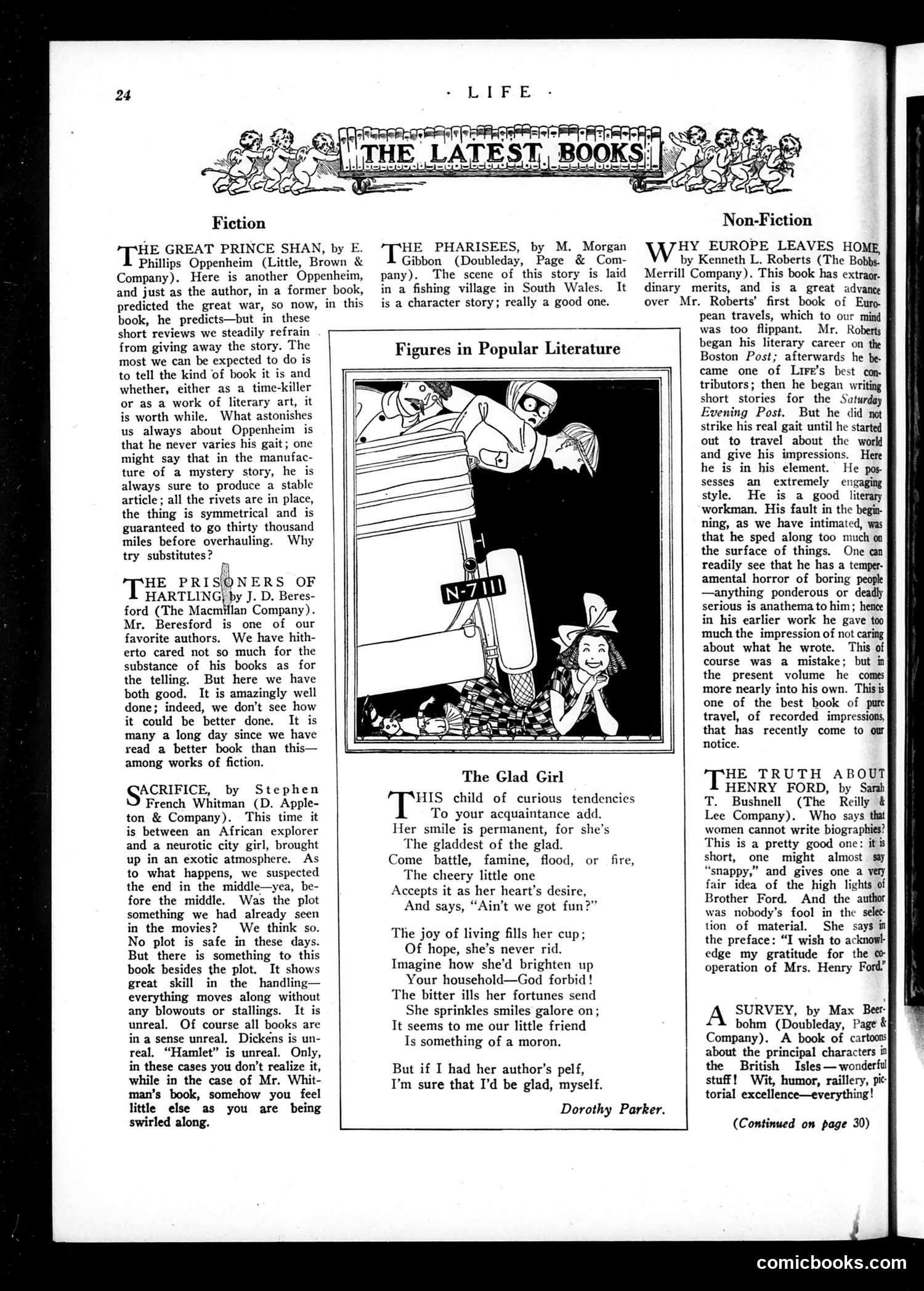
This page from *Life* magazine features a book review section and a satirical poem titled "The Glad Girl," accompanied by a cartoon illustration showing a cheerful young woman amid chaos—notably an airplane crash (marked "N-71"). The poem mockingly portrays a girl of "curious tendencies" who maintains permanent, unwavering cheerfulness regardless of circumstances: "Come battle, famine, flood, or fire, / The cheery little one / Accepts it as her heart's desire." The satire targets what appears to be a cultural archetype of the excessively optimistic woman—the kind who remains relentlessly glad despite real hardship or danger. The cartoon's juxtaposition of her beaming face against an aviation disaster underscores the absurdity of such unconditional cheerfulness. The poem suggests this relentless positivity is almost moronic ("something of a moron"), mocking the era's cultural pressure on women to maintain cheerfulness regardless of actual circumstances. This reflects early 20th-century satire of toxic positivity and gender expectations.
📄 Transcribed text from this page (OCR, searchable)
Machine-transcribed from the original scan — historical spelling and the odd misread are preserved.
Fiction Pe GREAT PRINCE SHAN, by E. Phillips Oppenheim (Little, Brown & Company). Here is another Oppenheim, and just as the author, in a former book, predicted the great war, so now, in this book, he predicts—but in these HE PHARISEES, by M. Morgan Gibbon (Doubleday, Page & Com- pany). The scene of this story is laid in a fishing village in South Wales. It is a character story; really a good one. Non-Fiction w*, EUROPE LEAVES HOME, by Kenneth L. Roberts (The Bobbs- Merrill Company). This book has extraor. dinary merits, and is a great advance over Mr. Roberts’ first book of Euro- pean travels, which to our mind short reviews we steadily refrain from giving away the story. The most we can be expected to do is Figures in Popular Literature was too flippant. Mr. Roberts began his literary career on the Boston Post; afterwards he be to tell the kind of book it is and came one of Lirr’s best con whether, either as a time-killer or as a work of literary art, it is worth while. What astonishes us always about Oppenheim is that he never varies his gait; one might say that in the manufac- ture of a mystery story, he is always sure to produce a stable article; all the rivets are in place, the thing is symmetrical and is guaranteed to go thirty thousand miles before overhauling. Why try substitutes? HE PRIS NERS OF HARTLING} by J. D. Beres- ford (The Macmillan Company). Mr. Beresford is one of our favorite authors. We have hith- erto cared not so much for the substance of his books as for the telling. But here we have both good. It is amazingly well done; indeed, we don’t see how it could be better done. It is many a long day since we have tributors; then he began writing short stories for the Saturday Evening Post. But he did not strike his real gait until he started out to travel about the world and give his impressions. Here he is in his element. He pos- sesses an extremely engaging style. He is a good literary workman. His fault in the begin- ning, as we have intimated, was that he sped along too much on the surface of things. One can readily see that he has a temper- amental horror of boring peopl —anything ponderous or deadly serious is anathema to him; hence in his earlier work he gave too much the impression of not caring about what he wrote. This of course was a mistake; but in the present volume he comes more nearly into his own. Thisis one of the best book of pure travel, of recorded impressions, that has recently come to our read a better book than this— among works of fiction. ACRIFICE, by Stephen French Whitman (D. Apple- ton & Company). This time it is between an African explorer and a neurotic city girl, brought up in an exotic atmosphere. As to what happens, we suspected the end in the middle—yea, be- fore the middle. Was the plot something we had already seen in the movies? We think so. No plot is safe in these days. But there is something to this book besides the plot. It shows great skill in the handling— everything moves along without any blowouts or stallings. It is unreal. Of course all books are in a sense unreal. Dickens is un- real. “Hamlet” is unreal. Only, in these cases you don’t realize it, while in the case of Mr. Whit- man’s book, somehow you feel little else as you are being swirled along. notice. The Glad Girl HIS child of curious tendencies To your acquaintance add. Her smile is permanent, for she’s The gladdest of the glad. Come battle, famine, flood, or The cheery little one Accepts it as her heart's desire, And says, “Ain’t we got fun?” fire, The joy of living fills her cup; Of hope, she’s never rid. Imagine how she’d brighten up Your household—God forbid! The bitter ills her fortunes send She sprinkles smiles galore on; It seems to me our little friend Is something of a moron. But if I had her author’s pelf, I’m sure that I’d be glad, myself. Dorothy Parker. TH TRUTH ABOUT HENRY FORD, by Sarah T. Bushnell (The Reilly & Lee Company). Who says that women cannot write biographies? This is a pretty good one: its short, one might almost say “snappy,” and gives one a very fair idea of the high lights of Brother Ford. And the author was nobody’s fool in the selec tion of material. She says @ the preface: “I wish to acknowl edge my gratitude for the operation of Mrs. Henry Ford.’ A SURVEY, by Max Beer bohm (Doubleday, Page & Company). A book of cartoons about the principal characters i the British Isles — wonderful stuff! Wit, humor, raillery, pic torial excellence—everything! (Continued on page 30) comicbooks.com