
A complete issue · 34 pages · 1922
Life — March 23, 1922
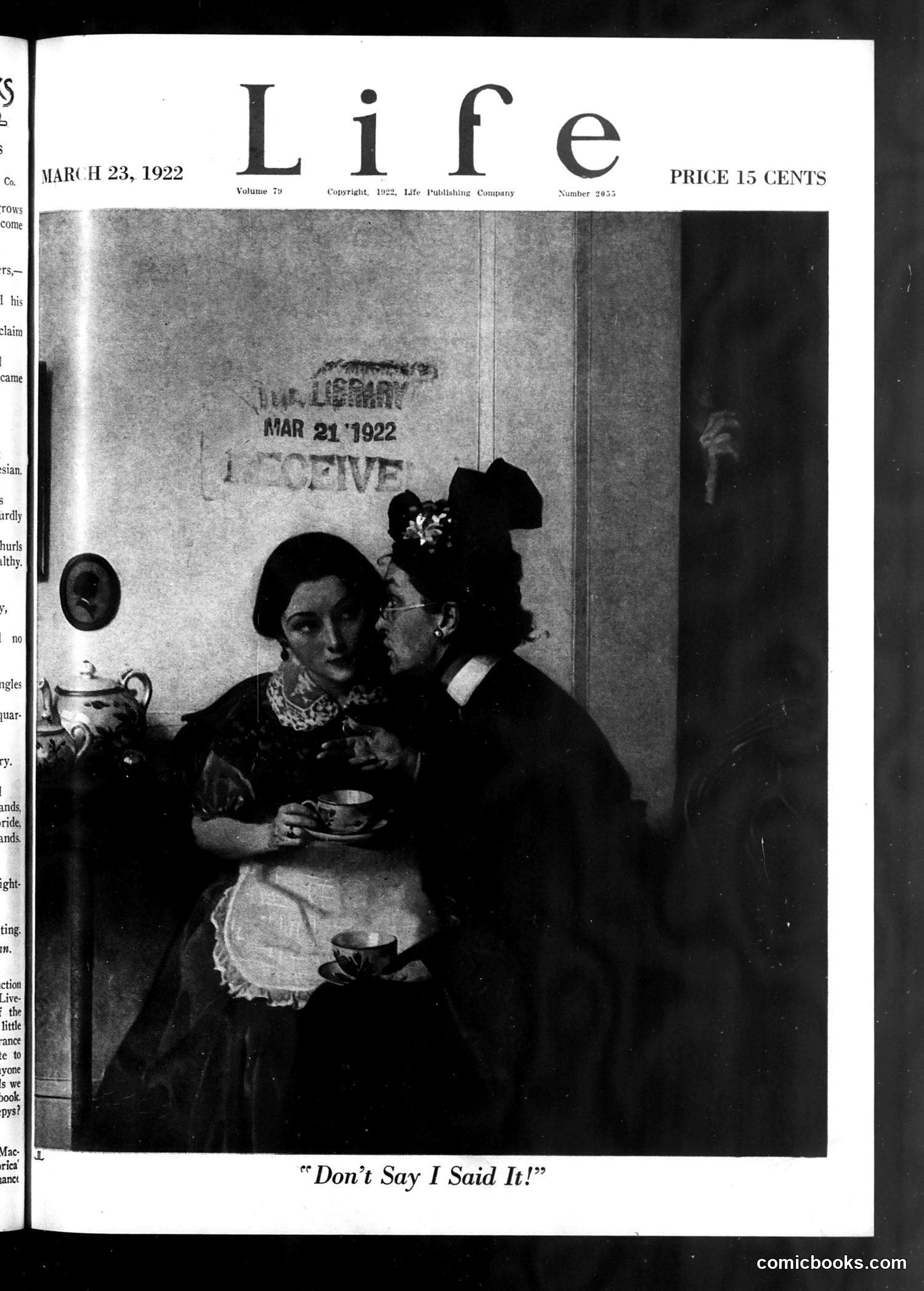
This 1922 *Life* magazine cover depicts a domestic scene satirizing gossip and rumor-spreading. Two women share tea while conversing; the caption "Don't Say I Said It!" suggests one is sharing confidential information while disclaiming responsibility for its spread. The satire targets the social hypocrisy of gossiping—explicitly denying one is gossiping while actively doing so. This was a common theme in early 20th-century humor about women's social gatherings, which were stereotyped as hotbeds of rumor and cattiness. The image plays on anxieties about information control and plausible deniability in social contexts. The formal tea setting emphasizes how such behavior occurred within respectable domestic spaces, making the satire more pointed about the gap between polite society's pretenses and actual behavior.
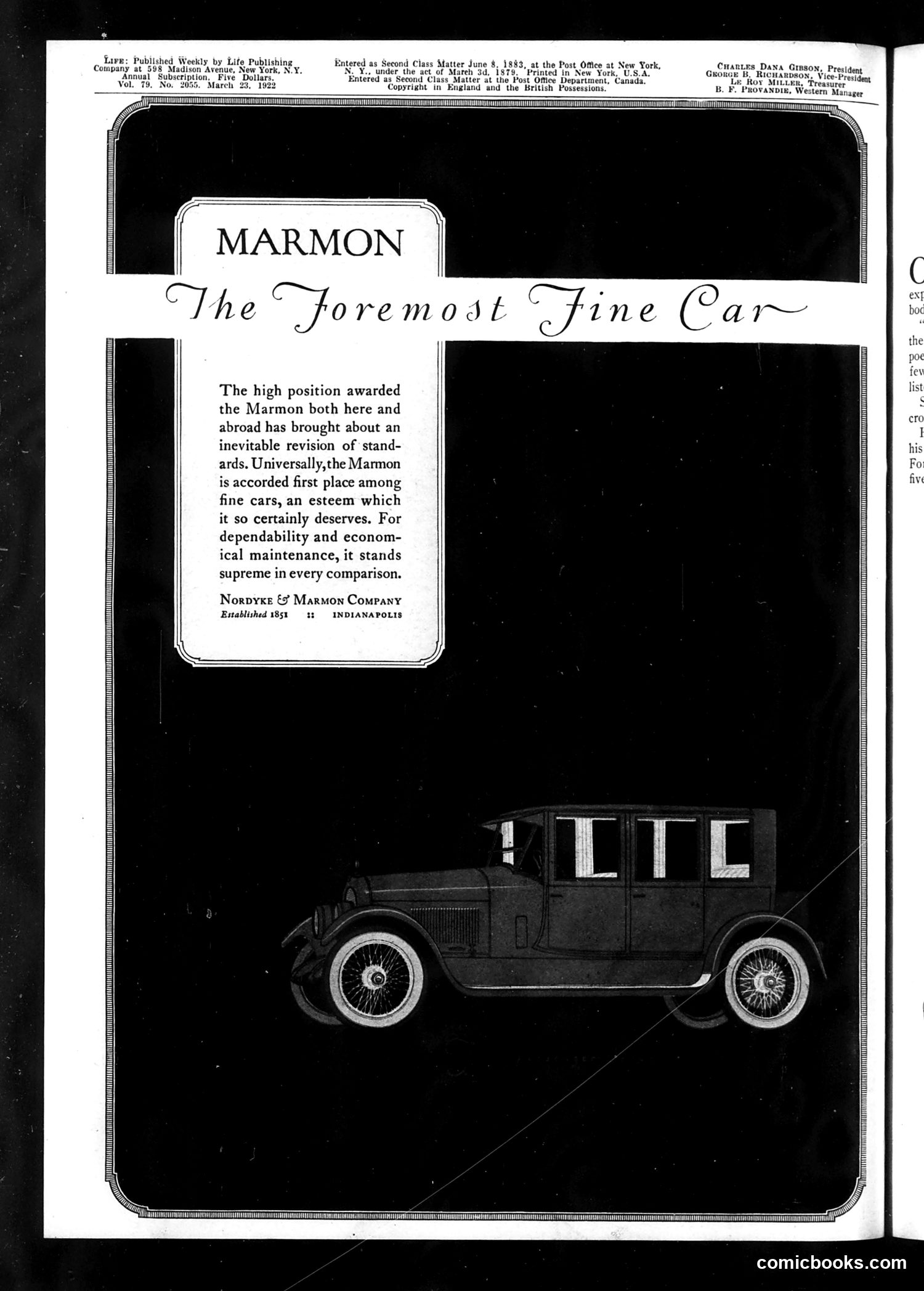
This is primarily a **product advertisement**, not political satire. It promotes the Marmon automobile, manufactured by Nordyke & Marmon Company of Indianapolis (established 1851). The ad claims the Marmon holds "first place among fine cars" due to superior "dependability and economical maintenance." The headline—"The Foremost Fine Car"—emphasizes its market position and prestige. The accompanying vehicle illustration shows a classic sedan-style car typical of early 1920s design, when this Life magazine issue was published (March 20, 1922). This represents straightforward commercial advertising rather than editorial commentary or satire. The "LIFE" text visible on the car appears to be part of the magazine's layout rather than the vehicle's branding.
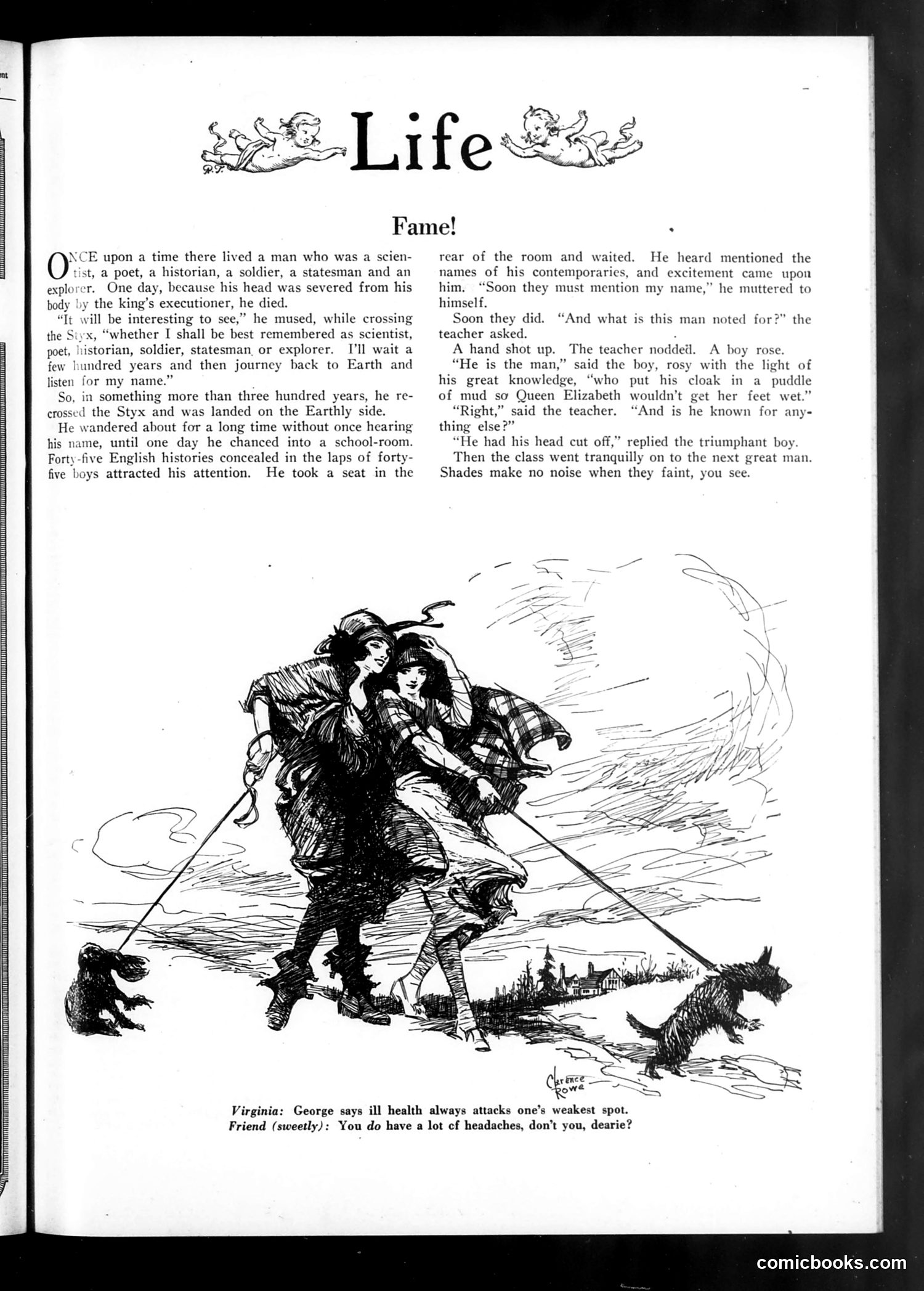
This page combines a humorous short story with a single cartoon. The story mocks a scientist's vanity—he obsesses over historical fame while crossing the Suez Canal, only to be forgotten until accidentally mentioned in a school history book. Students then trivialize his accomplishment: he's remembered only for putting his head in mud during Queen Elizabeth's reign. The cartoon below illustrates a domestic joke unrelated to the story. A couple ice-skates while two dogs run alongside. The woman (Virginia) tells her friend that ill health "attacks one's weakest spot," implying her male companion George suffers headaches. The cartoon humorously suggests marital friction—the woman's sweetly-voiced comment is actually a jab at her partner's afflictions.
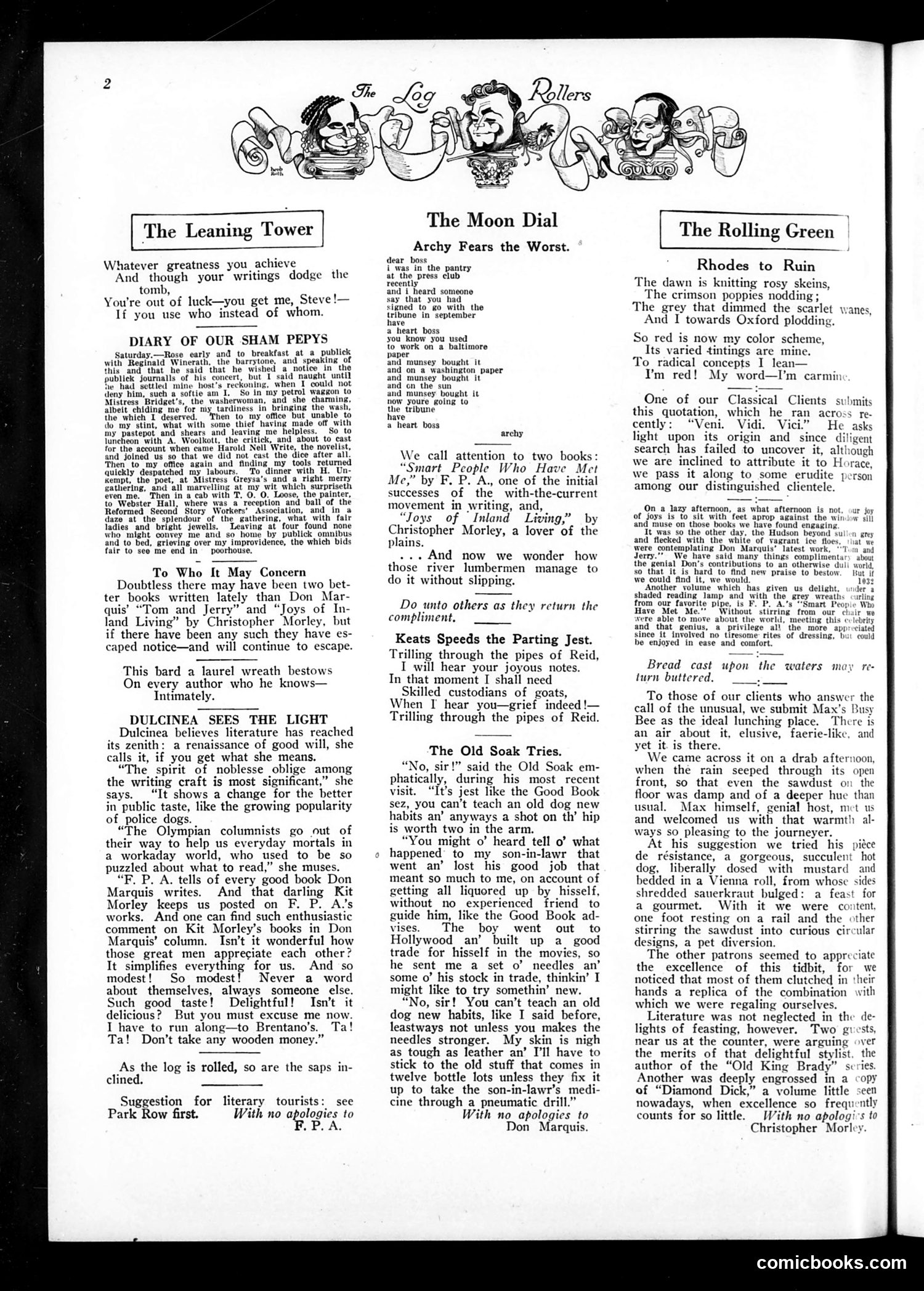
This page from *Life* magazine features three satirical columns with literary and social commentary rather than political cartoons. "The Leaning Tower" mocks pretentious modernist writing that sacrifices clarity for affectation. "The Moon Dial" contains poetry critiquing various public figures and social trends, including references to Baltimore and Washington. "The Rolling Green" discusses classical literature and contemporary writing trends. The header illustration shows caricatured "log rollers"—a period term for writers who promote each other's work through mutual praise rather than merit. The content satirizes literary pretension, self-promotion among authors, and the disconnect between experimental modernism and accessible storytelling. The references suggest this is early-to-mid 20th century literary criticism.
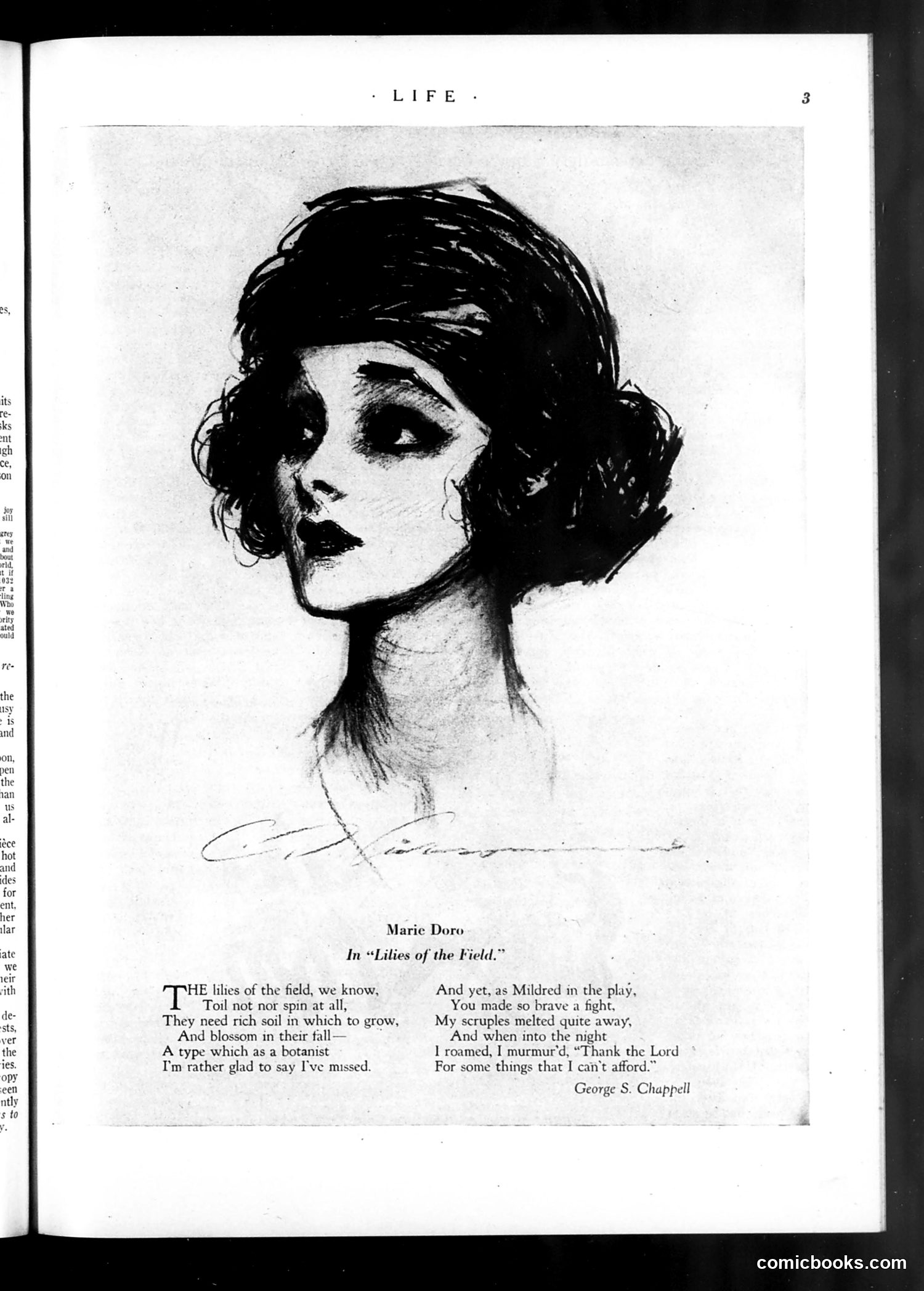
This page features a portrait illustration of **Marie Doro**, an actress, labeled as appearing in *"Lives of the Field."* Below the portrait is a poem by George S. Chappell titled "In 'Lives of the Field.'" The poem references her character "Mildred" in the play, praising her brave performance. Lines like "You made so brave a fight, / My scruples melted quite away" and the closing "Thank the Lord / For some things that I can't afford" suggest the play dealt with moral or social themes—likely romantic or ethical dilemmas—that resonated with audiences. This appears to be **theatrical promotion** rather than political satire, celebrating Doro's acting in a contemporary stage production.
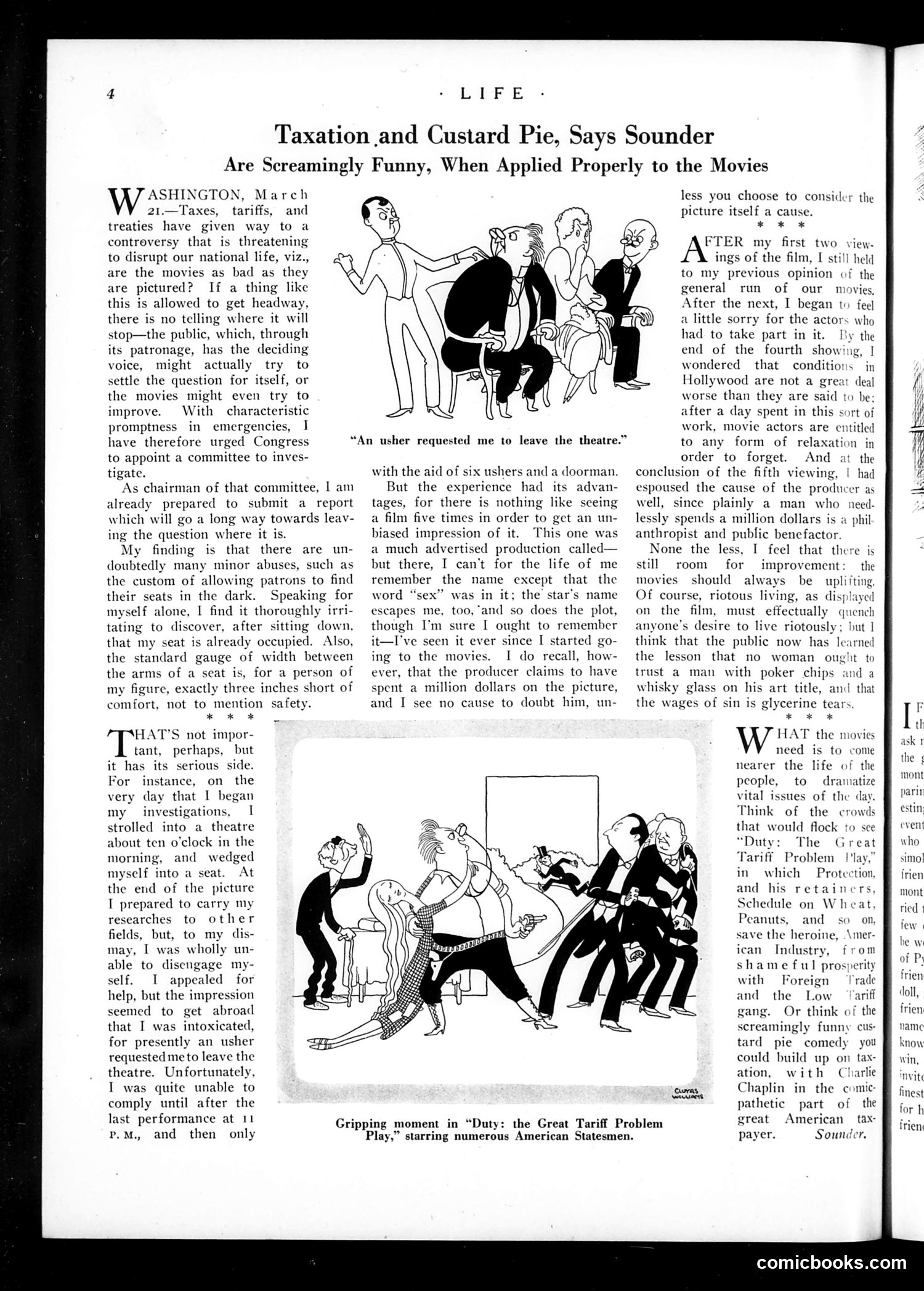
This is a satirical article by Sounder criticizing American cinema's content and production practices. The two cartoons illustrate his complaints: The first cartoon shows an usher forcibly removing a patron from a theater—satirizing the article's complaint that even basic theater comfort and safety are compromised by poor management. The second cartoon depicts what appears to be a chaotic film production scene (labeled as from "Duty: the Great Tariff Problem Play"), showing multiple figures in physical comedy or slapstick situations. This illustrates Sounder's point that movies are overly focused on crude humor and entertainment rather than addressing serious social issues like taxation and tariffs that matter to American life. The satire suggests film prioritizes escapism and physical comedy over meaningful engagement with important public concerns.
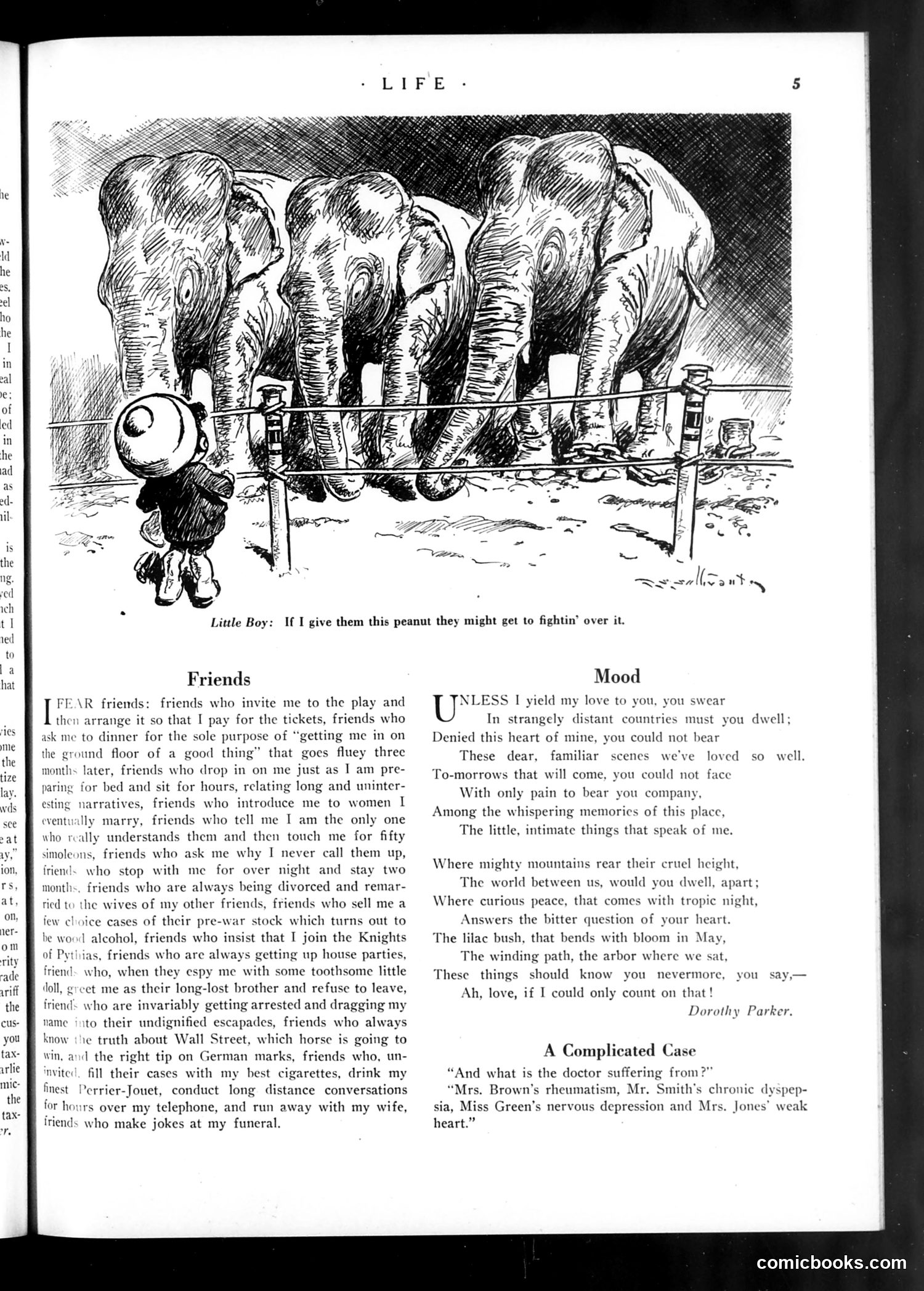
The illustration depicts a small boy holding a peanut, facing three elephants across a fence. The caption reads: "Little Boy: If I give them this peanut they might get to fightin' over it." This is a straightforward humor cartoon playing on the common practice of feeding peanuts to zoo or circus elephants. The joke's appeal lies in the boy's innocent but illogical reasoning—one small peanut among three large elephants wouldn't realistically cause conflict. The humor comes from the absurdity of his expectation that such a trivial reward would spark fighting among these massive animals. The accompanying prose pieces ("Friends" and "Mood") are unrelated literary content typical of Life magazine's mixed editorial format.
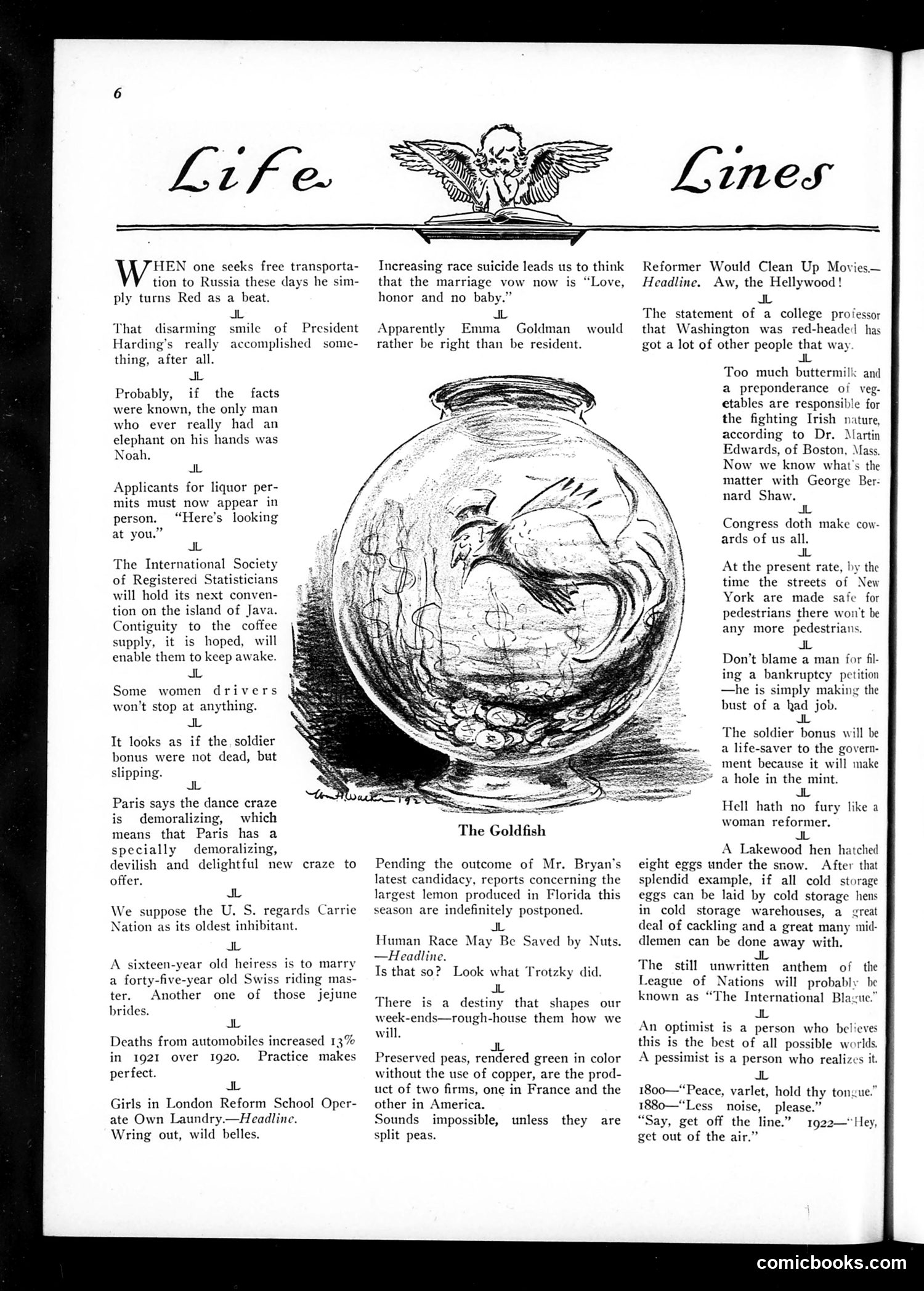
This page from *Life* magazine features a central illustration of a goldfish in a bowl, accompanying the headline "The Goldfish." The cartoon appears to comment on absurd news stories and social trends of the era. The surrounding "Life Lines" column contains satirical brief commentary on contemporary issues: automobiles, women drivers, reform schools, marriage, liquor permits, and dance crazes. The goldfish illustration likely represents the magazine's mockery of trivial or mundane news dominating public attention during this period—suggesting that even a simple goldfish bowl warrants journalistic coverage amid more significant events. The overall tone mixes cynicism about modern life with humorous jabs at societal preoccupations.
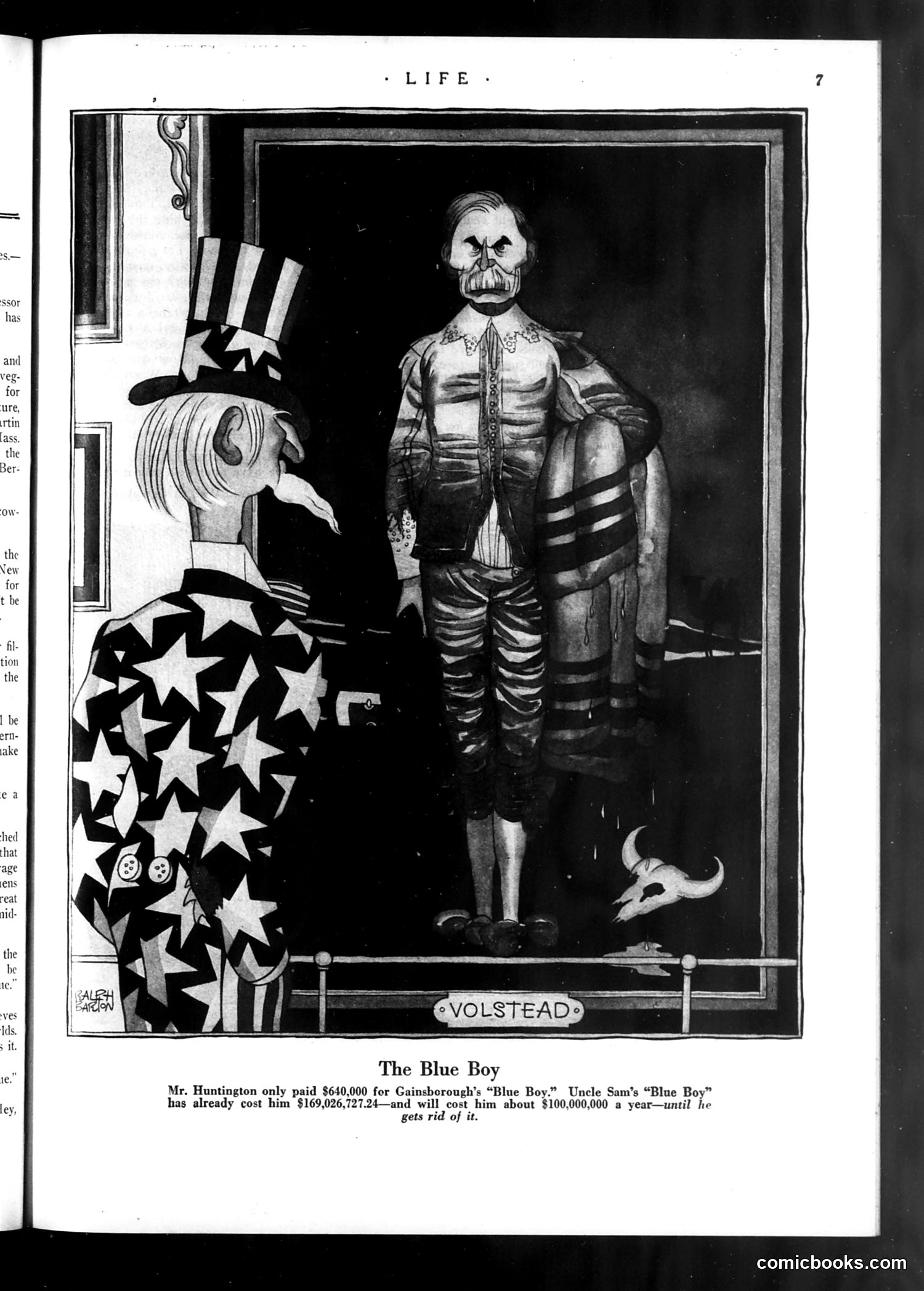
This Volstead cartoon satirizes massive military spending. On the left, Uncle Sam (identifiable by his starred suit and top hat) confronts a muscular, bandaged soldier on the right—representing America's bloated military-industrial complex. The caption reveals the specific target: Mr. Huntington paid $640,000 for Gainsborough's famous "Blue Boy" painting, while Uncle Sam's military budget costs approximately $100,000,000 yearly. The satire contrasts frivolous art collecting with wasteful defense spending, suggesting Americans spend far more on weapons than masterpieces. The soldier's exaggerated musculature and bandages emphasize militarism's physical toll and expense. This critiques post-WWI defense budgets during the 1920s peace period.
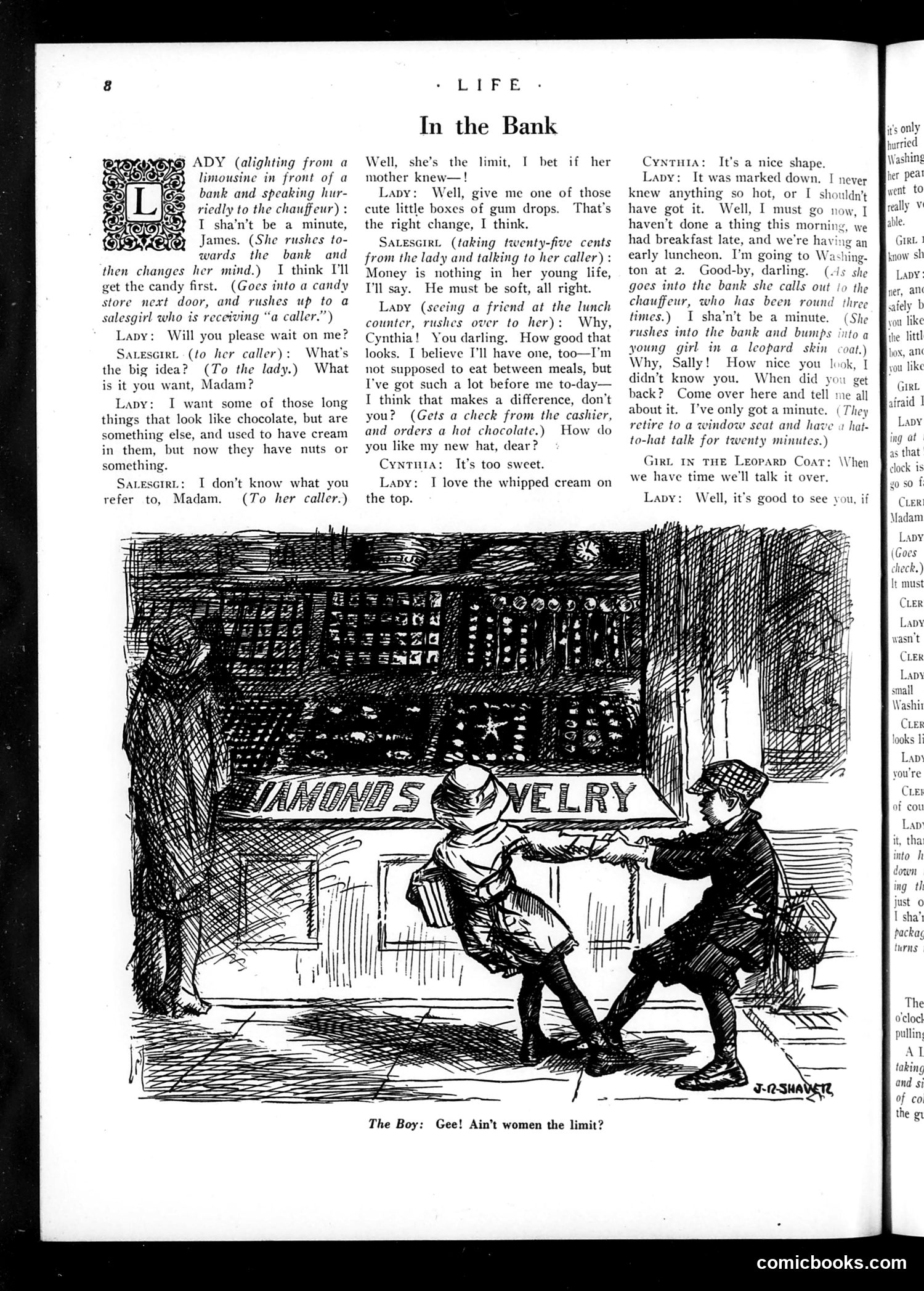
This page features a humorous dialogue between female shoppers and a salesman at a bank's confectionery counter, alongside a cartoon illustration. The sketch depicts a woman and boy outside a jewelry store window ("Diamonds & Jewelry"). **The satire's point:** The conversation mocks women's shopping habits and materialism—specifically their tendency to visit banks for frivolous purchases (candy, hats) rather than financial business. The dialogue suggests women were viewed as impulsive consumers rather than serious financial actors. The cartoon's caption—"The Boy: Gee! Ain't women the limit?"—reinforces the era's stereotypes about female irrationality and excessive spending, presenting women's consumer behavior as comically incomprehensible to men. This reflects early 20th-century attitudes about gender and economics.
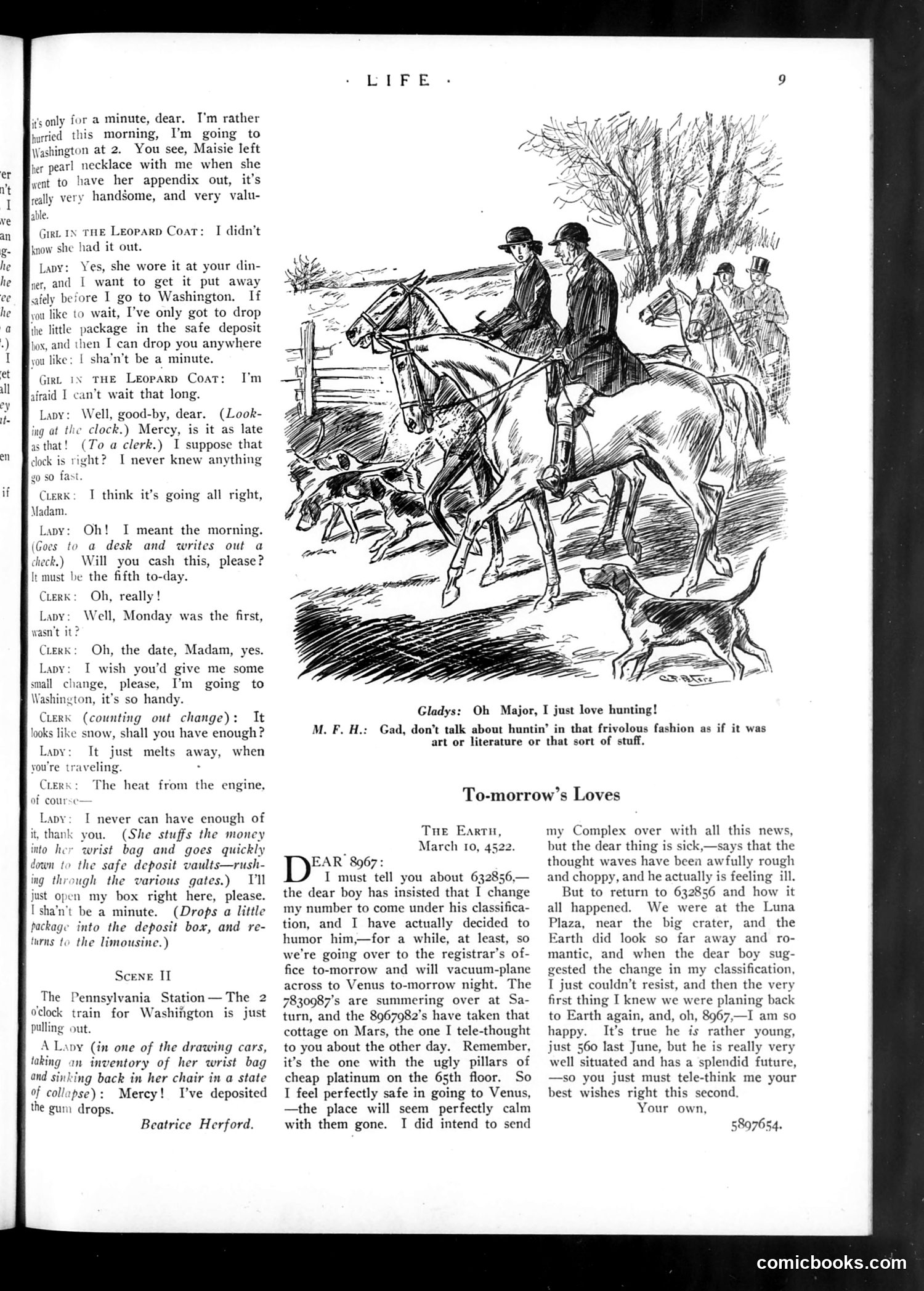
This page contains a dialogue-driven scene (labeled "Scene II") set at Pennsylvania Station, depicting a lady preparing to travel to Washington. The humor centers on a **clerk's inability to process a simple cash transaction** — the lady repeatedly asks him to "cash this, please?" while he misunderstands her requests, thinking she's asking about train schedules and dates instead. The accompanying **sketch shows a hunting scene** with dogs, horses, and riders. Below it, M.F.H. (Master of Fox Hounds) mockingly criticizes "Gladys" for discussing hunting in overly "frivolous" or literary terms — satirizing how people romanticize rural sports rather than engaging with them practically. The page also includes the beginning of "Tomorrow's Loves," a letter column discussing romantic matters and space travel to Venus, reflecting early 20th-century speculative fiction interests.
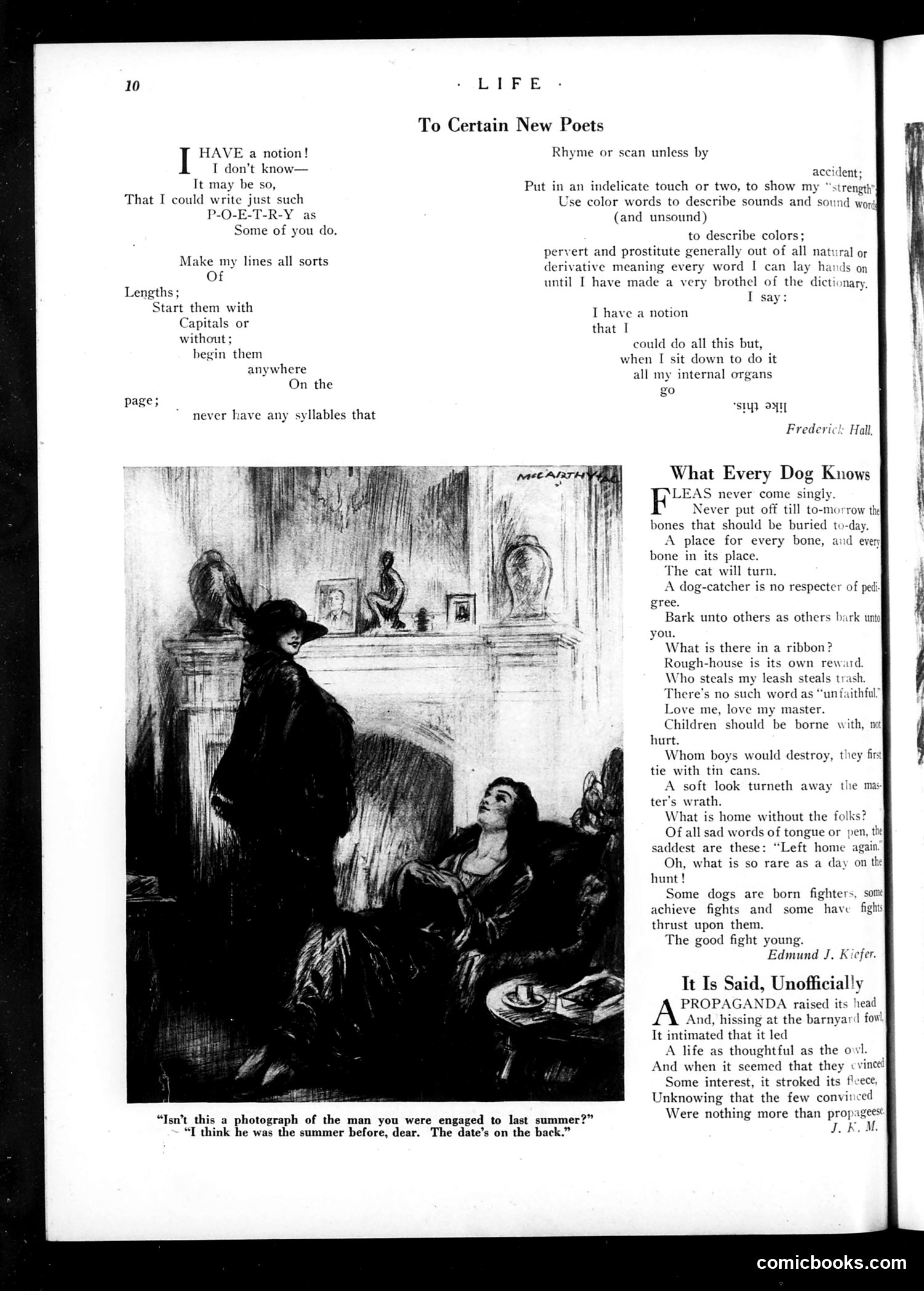
This page contains literary content and one sketch illustration. The main cartoon depicts two people in what appears to be a living room—a woman standing and a man seated—with the caption: "Isn't this a photograph of the man you were engaged to last summer?" "I think he was the summer before, dear. The date's on the back." The humor targets the social custom of casual romantic engagements among the wealthy leisure class, suggesting the woman has had multiple engagements in successive summers that she can barely distinguish or remember. The reliance on photograph dates to establish which fiancé is pictured satirizes both her poor memory and the seemingly interchangeable nature of her romantic partners—a common theme mocking upper-class courtship practices of the era.
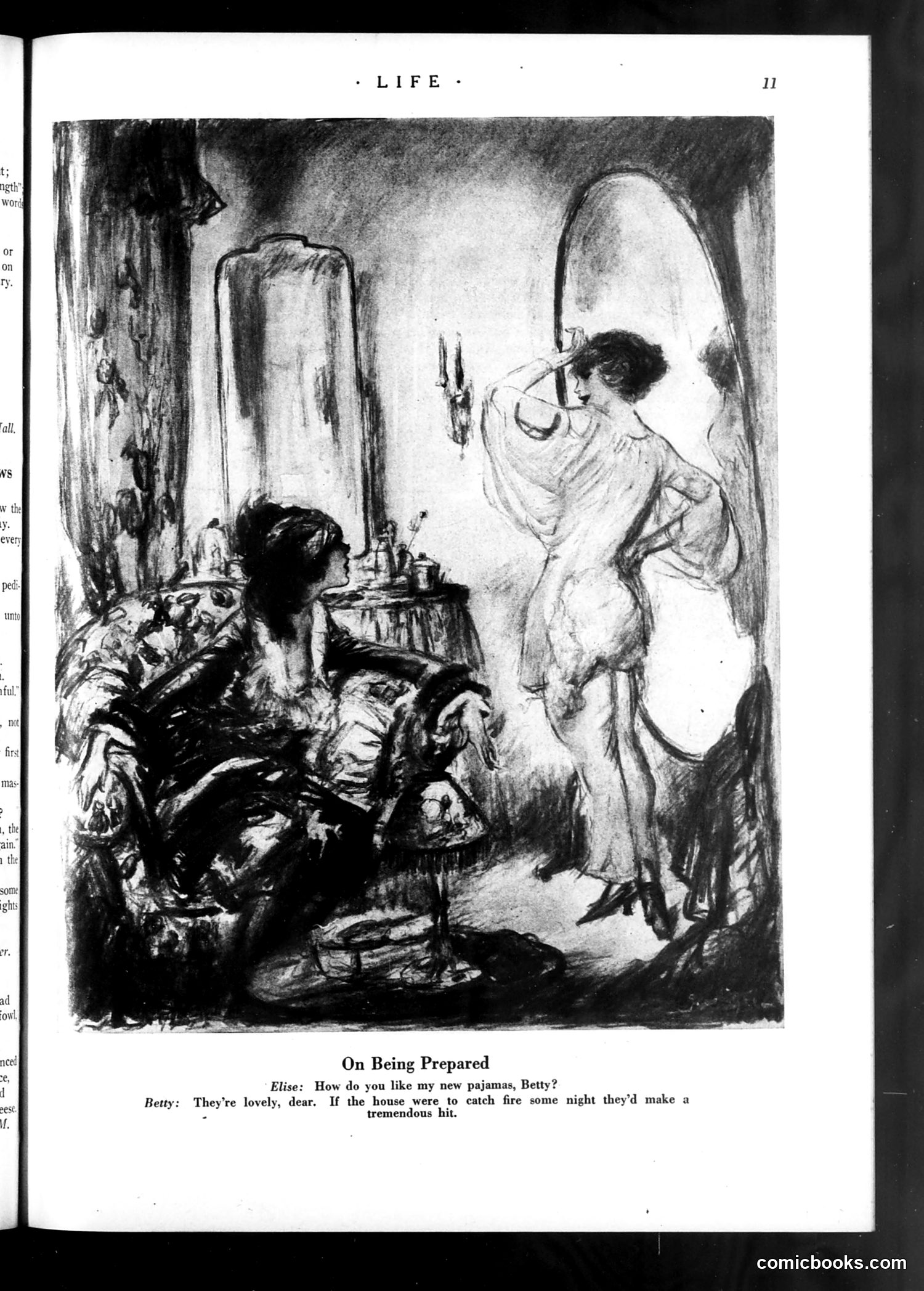
This illustration satirizes domestic life and fashion through a dialogue between two women named Elise and Betty. The scene depicts Betty showing off new pajamas to her friend Elise. Betty's comment—that the pajamas are so attractive "if the house were to catch fire some night they'd make a tremendous hit"—is the joke's punchline. The satire mocks the era's emphasis on fashionable appearance even in private, intimate wear. By suggesting fire as a scenario where pajamas would be "seen," the cartoon humorously critiques women's concern with looking attractive at all times, even in hypothetical disaster situations. It reflects early 20th-century attitudes about femininity, propriety, and the sometimes absurd priorities of fashion-conscious society.
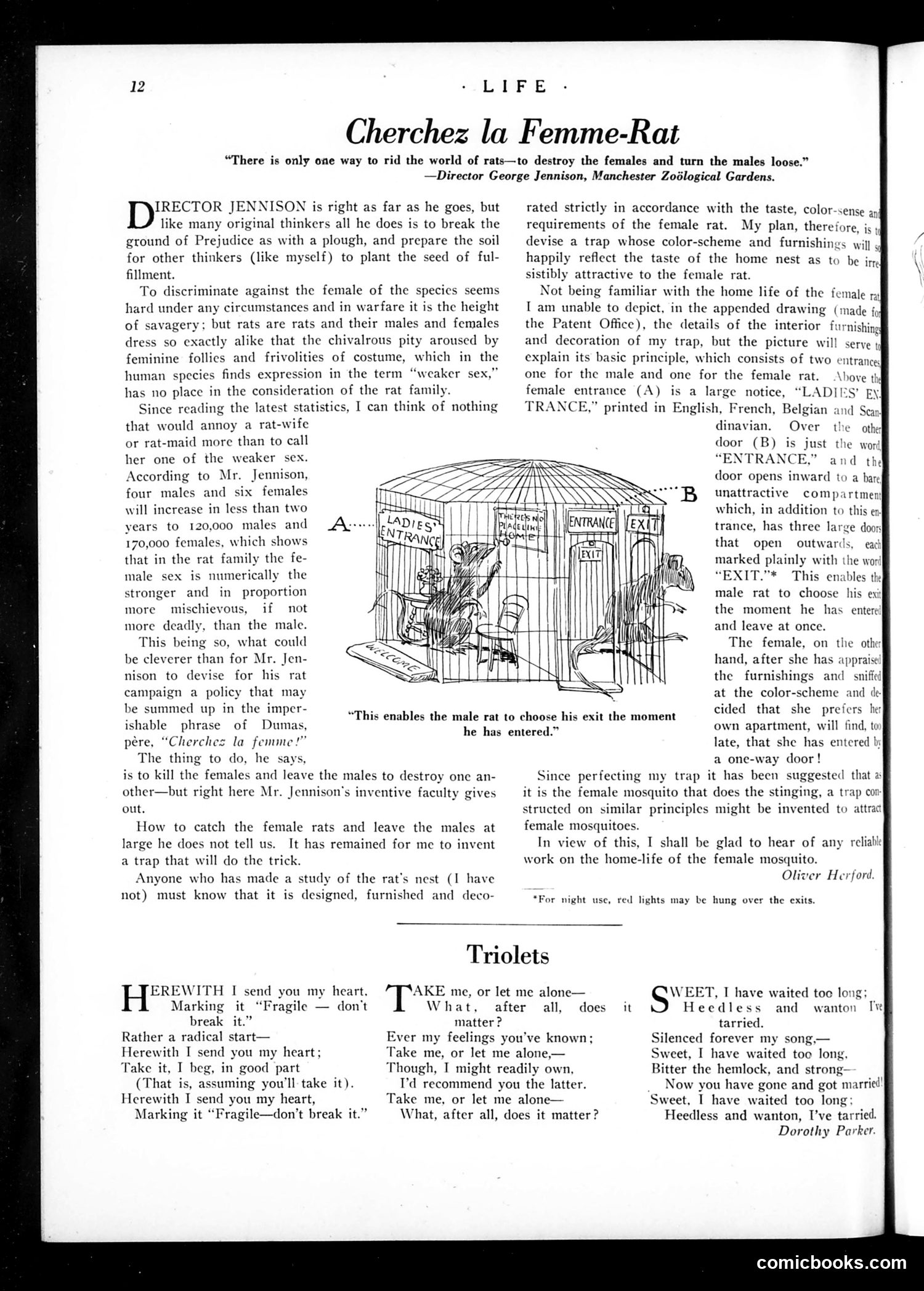
This satirical article uses rat-trapping as metaphor for gender relations. Director George Jennison of Manchester Zoo proposes eliminating female rats to control population—a literal approach to a common problem. The accompanying diagram shows an elaborate trap with separate entrances for males and females, allowing males to exit while trapping females. Author Oliver Hereford gently mocks this scheme, suggesting the real issue (like the female mosquito's "singing") lies with females, then ironically asks for scientific study of female mosquito behavior instead. The piece satirizes both Jennison's misogynistic solution and broader early-20th-century attitudes blaming women for social problems. The French phrase "cherchez la femme" (look for the woman) was a period cliché suggesting women caused trouble.
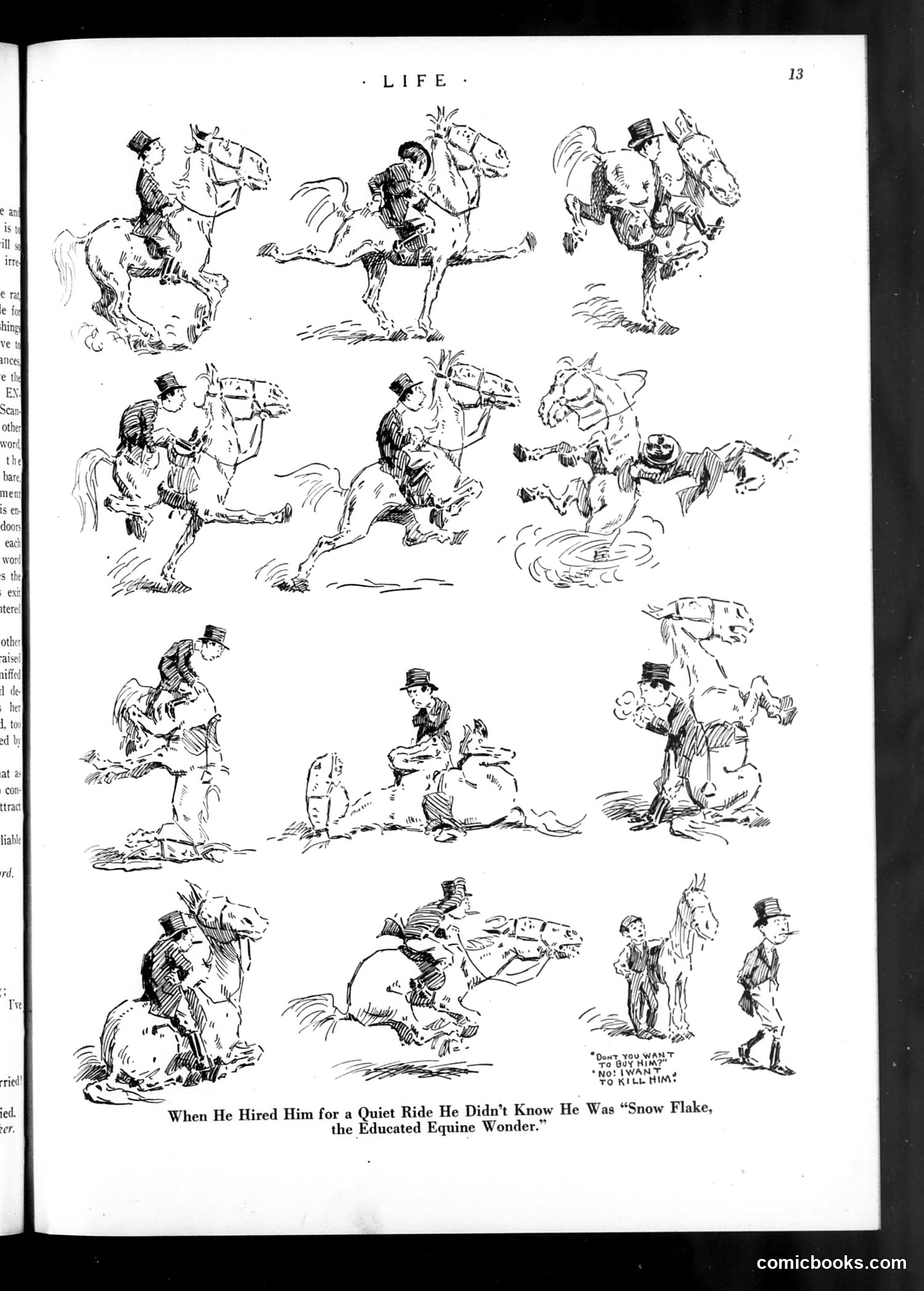
This is a humorous sequential narrative cartoon about a man who hires a horse for "a quiet ride," only to discover it's "Snow Flake, the Educated Equine Wonder"—a trained performing horse. The comic depicts the horse's increasingly absurd trick performances: rearing, bucking, diving into water, and other acrobatic stunts. The rider repeatedly protests ("Don't you want to behave?" "Not I want to kill him!"), but the horse continues its trained routine regardless. The satire ridicules both the deception of false advertising and the frustration of getting more—or rather, different—than expected. The "educated" horse is technically trained but utterly unsuitable for the client's actual purpose, making it a classic joke about the gap between promises and reality in commerce.
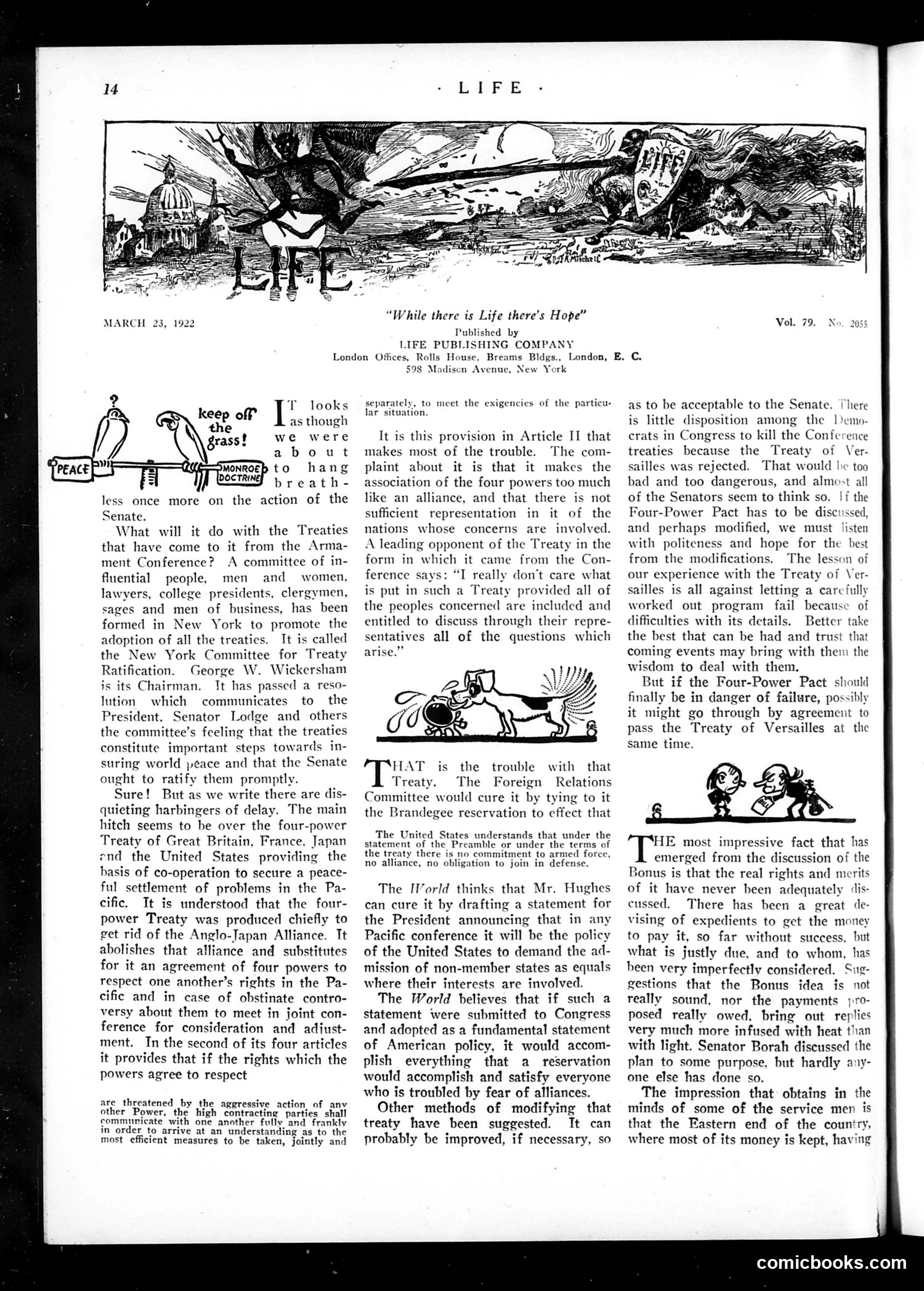
This page discusses the Four-Power Treaty and its ratification debates in the U.S. Senate. The top cartoon shows figures labeled "Peace" and "Monroe Doctrine" on a seesaw, illustrating tension between these concepts. The article criticizes Senate hesitation about treaty ratification, arguing that delays and procedural obstruction are preventing progress toward international peace. The text specifically addresses concerns about the Four-Power Pact's compatibility with American interests and the Monroe Doctrine. A second small cartoon depicts figures appearing to squabble or struggle, likely representing disagreement between nations or political factions over treaty terms. The satire targets Senate caution and legalistic objections as obstacles to achieving the post-WWI peace settlement the magazine believed necessary.
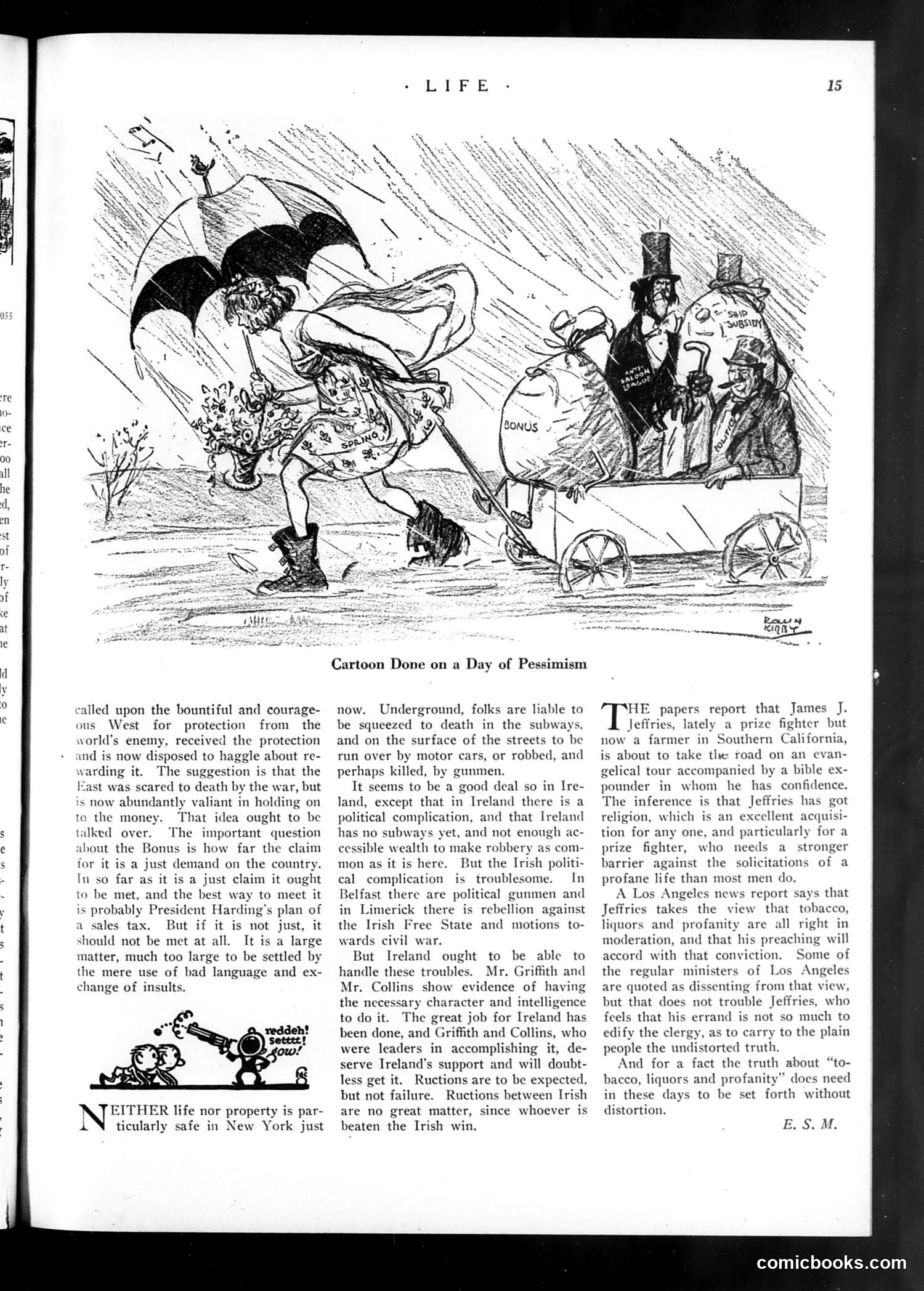
The main cartoon depicts a grotesque female figure (likely representing "Pessimism" or economic hardship) pulling a cart laden with well-dressed men labeled "BONUS." The imagery satirizes post-WWI veteran compensation debates: the Eastern establishment, having called on the West for war protection, now resists paying soldiers' bonuses through a proposed sales tax. The accompanying text expands this pessimism to include urban crime in New York (subway deaths, street violence, robbery) and Irish political instability (Belfast gunmen, Limerick rebellion against the Free State). The secondary item discusses boxer James J. Jeffries launching an evangelical tour promoting moderate tobacco, liquor, and profanity—which religious leaders oppose. The satire suggests even reformed prizefighters preach more practical morality than clergy. Overall, the page captures post-war American anxieties: federal stinginess toward veterans, urban chaos, Irish civil unrest, and religious rigidity.
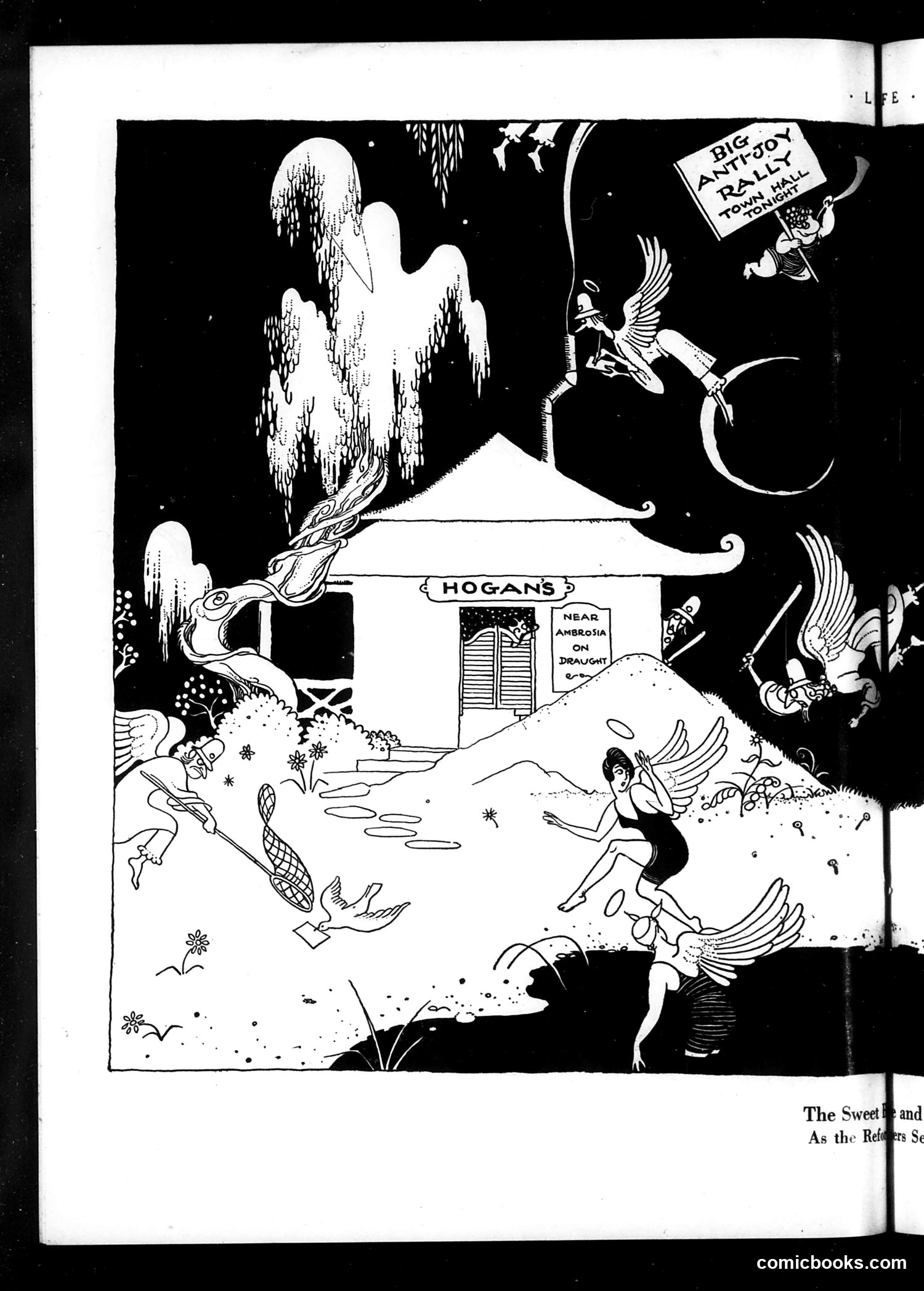
This page shows a whimsical illustration of what appears to be a fantastical seaside or beach scene. A structure labeled "HOGANS" sits centrally, with winged figures (possibly fairies or sprites) playing and flying about sandy ground. A banner reading "BIG ARAPAHO BALL TOWN HALL TONIGHT" appears in the upper right. The OCR text is largely illegible, making it difficult to identify the specific satirical target or political reference. Without clearer text, I cannot definitively explain what social or political commentary this cartoon intends. The whimsical art style and fantastical elements suggest lighthearted satire rather than serious political critique, but the exact subject matter—whether referencing Native American gatherings, local events, or something else—remains unclear from the visible evidence alone.
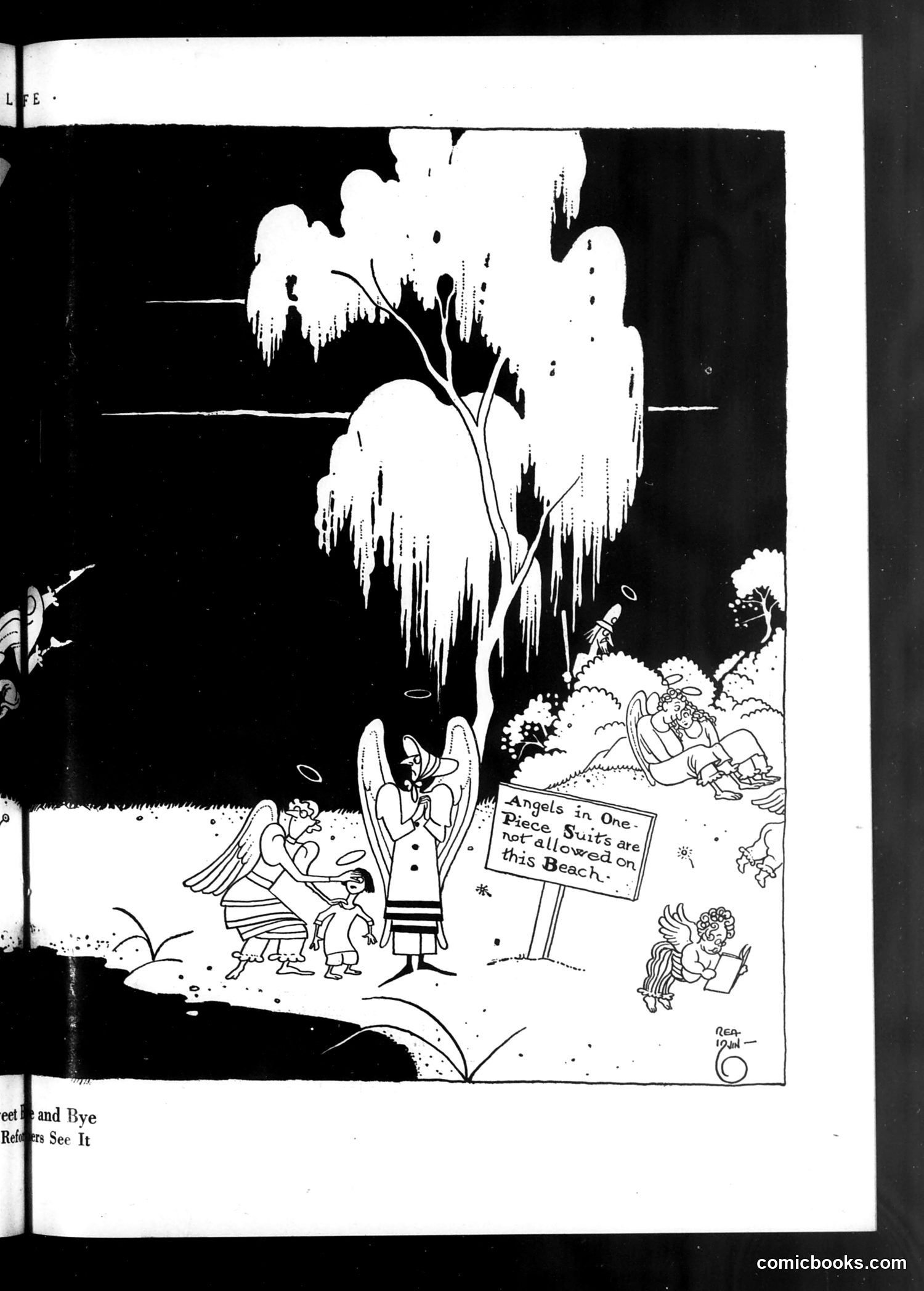
This is a humorous cartoon depicting angels at a beach. The sign reads: "Angels in One-Piece Suits are not allowed on this Beach." The satire targets early 20th-century American attitudes toward swimwear and modesty standards. "One-piece suits" were considered modest by the era's standards, yet the cartoon suggests they're still too revealing for certain venues—a commentary on the absurdly restrictive moral policing of women's beachwear during this period. The joke satirizes the contradiction: if even fully-covered angels (traditionally symbols of purity) cannot swim in their one-piece suits, the standard becomes ridiculously impossible to meet. This mocks the era's prudish attitudes toward women's bodies and the arbitrary, ever-shifting rules governing acceptable public appearance.
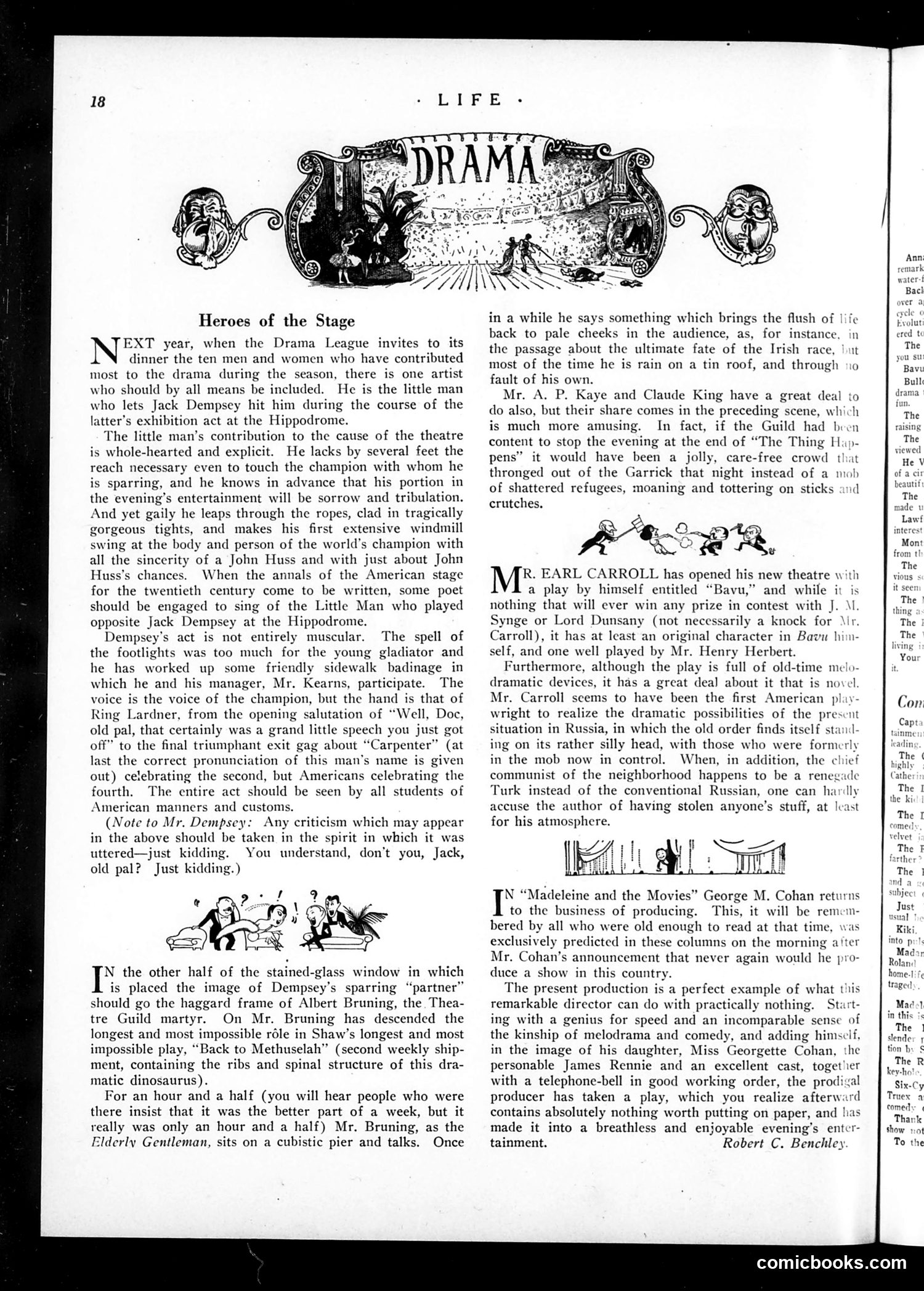
This page satirizes theatrical figures and productions of the era (appears to be 1920s based on references). **Main satire:** The opening section mocks Jack Dempsey, the heavyweight boxing champion, who apparently performed a sparring exhibition at the Hippodrome theater. Life sarcastically praises the "little man" who serves as Dempsey's punching bag during this act—a volunteer who knowingly gets hit while wearing "tragically gorgeous tights." The humor lies in celebrating this man's earnest futility as a theatrical contribution, comparing his hopeless situation to religious martyr John Huss. **Secondary reviews:** The text critiques Shaw's play "Back to Methuselah," performed by the Theatre Guild, describing it as tediously long with an actor (Bruning) delivering endless monologues described as "rain on a tin roof." Earl Carroll's new theater production "Bavu" receives mild commentary—acknowledging its originality without overstating its merit. The satire reflects Life's irreverent approach to both high theater and popular entertainment spectacle.
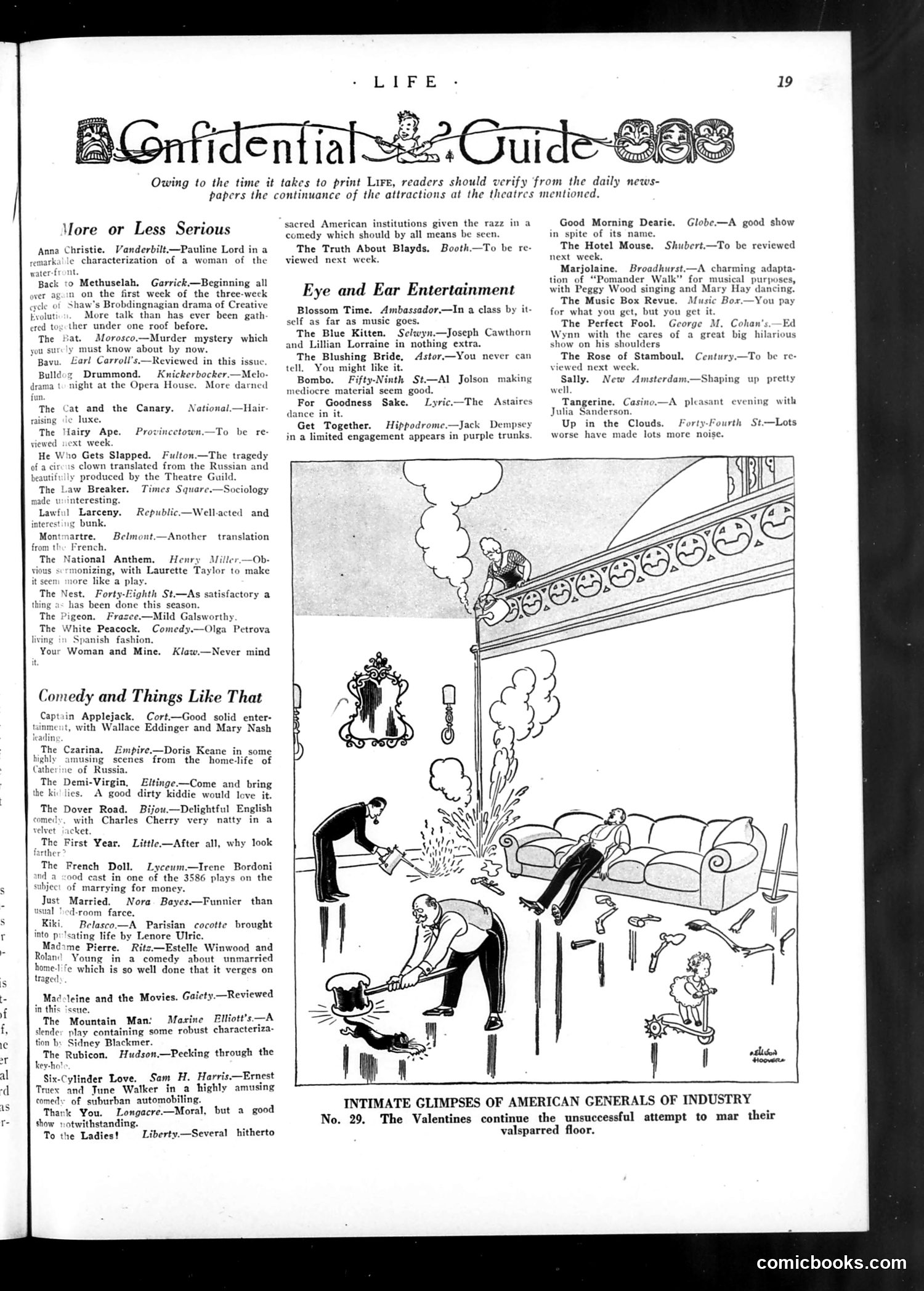
This page is a **theatre guide and review section** rather than political satire. The main content lists Broadway shows with brief critiques, typical of Life's entertainment coverage. The cartoon at bottom—titled "Intimate Glimpses of American Generals of Industry, No. 29"—depicts **The Valentines** attempting to furnish a room. Three men in formal dress are shown struggling comically with furniture and decorating, with one wielding a watering can at plants, another handling a couch. The satire mocks wealthy industrialists as incompetent at practical domestic tasks, positioning them as out-of-touch despite their status. The humor relies on class commentary: powerful businessmen reduced to bumbling amateurs in everyday situations. The theatrical reviews mention performers like Al Jolson, Peggy Wood, and Jack Dempsey, reflecting 1920s Broadway entertainment. Text notes Dempsey appears "in purple trunks" at the Hippodrome—likely a vaudeville or novelty appearance by the famous boxer.
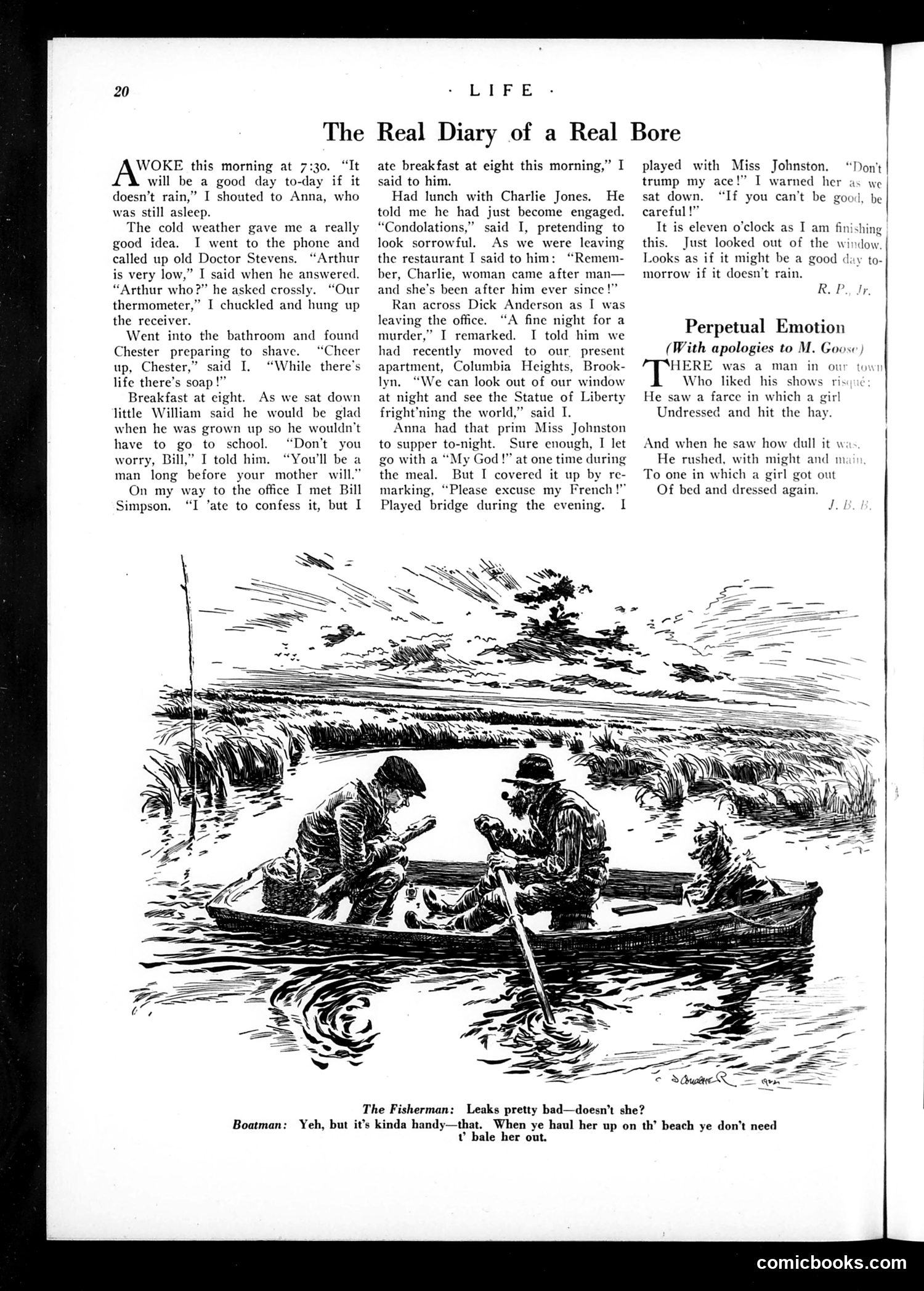
This is satirical humor mocking a tediously predictable man who tells stale jokes repeatedly throughout his day. The "bore" makes groan-worthy puns ("While there's life there's soap!"), tired wordplay about his thermometer being "very low," and recycled chestnuts about women chasing men. He's oblivious to how annoying he is. The accompanying cartoon shows two fishermen discussing a leaky boat—a visual gag where the boatman notes the leak is "handy" because you don't need to bail water out when beaching it. This illustrates the magazine's broader humor: finding absurd logic in everyday situations. The page satirizes the archetypal "bore"—someone so immersed in his own jokes that he doesn't recognize their lameness, while simultaneously depicting everyday working-class characters (fishermen, office workers) with deadpan acceptance of life's minor annoyances. The satire targets predictable male humor and social obliviousness.
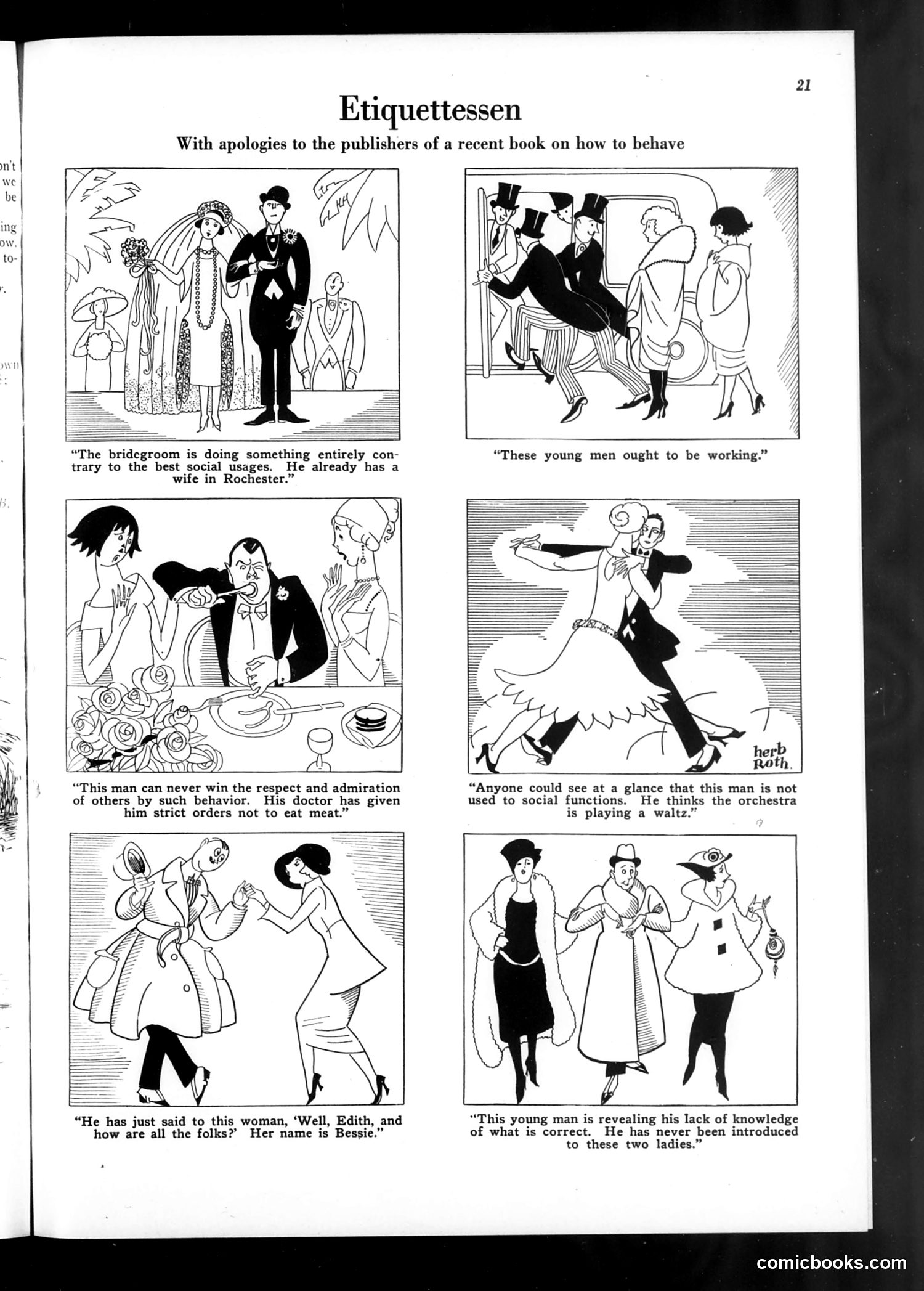
This satirical page mocks etiquette manuals popular in the early 20th century by illustrating absurd social violations. Each cartoon depicts a scenario where someone commits a faux pas, with captions explaining the breach of proper behavior. The jokes target both the rigid rules of high society and the people who violate them: a bigamist bridegroom, a man ignoring his doctor's orders at dinner, someone misidentifying a dance, a man using excessive familiarity with a stranger, and a fellow addressing women without proper introduction. The humor derives from the disconnect between the trivial nature of these infractions and the gravity with which etiquette books treated them. By presenting increasingly ridiculous violations, the cartoonist mocks how obsessed contemporary society manuals were with enforcing minute social conventions among the upper classes.
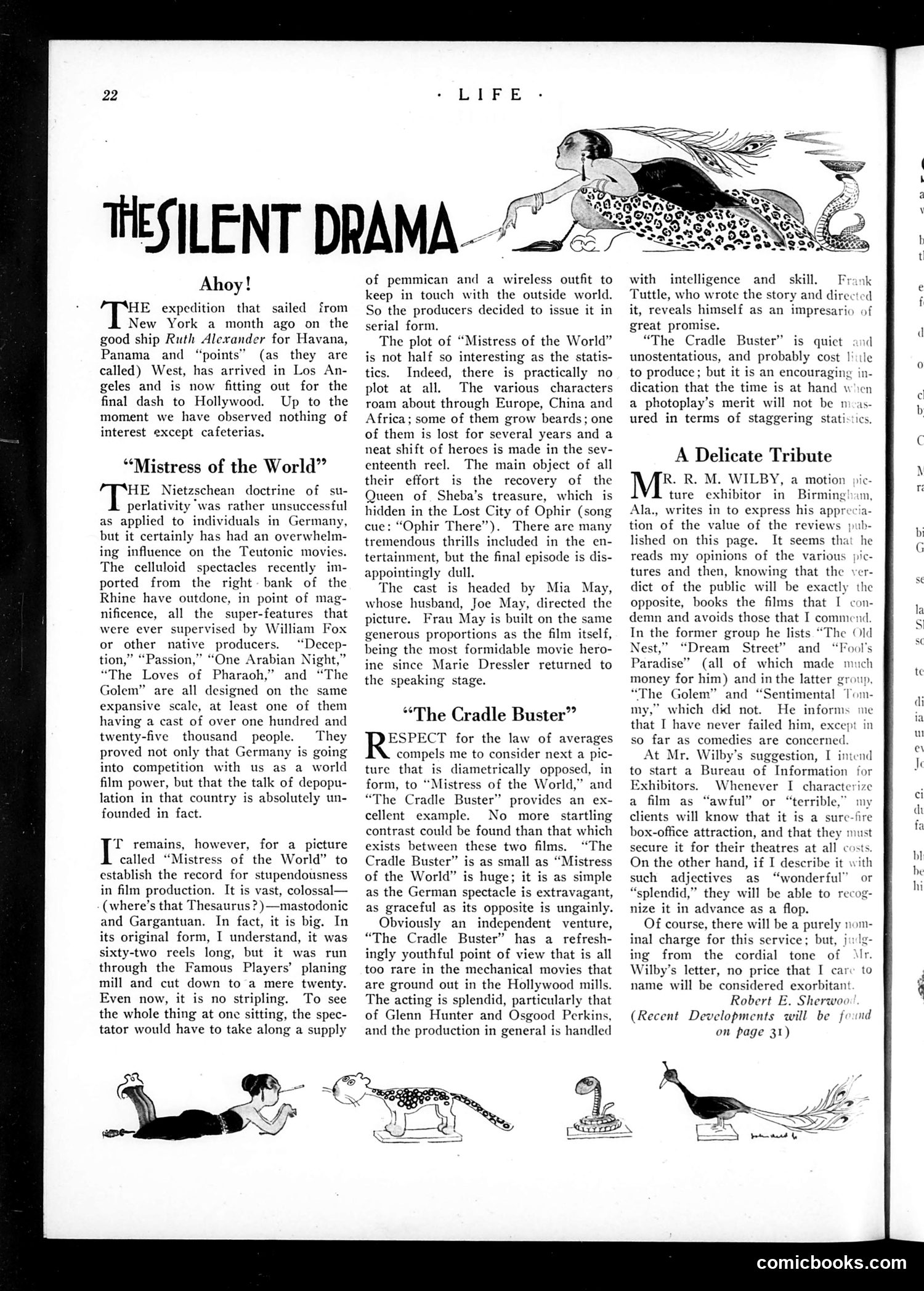
This page reviews three silent films in production or release. The opening section mockingly notes a film expedition's arrival in Los Angeles, suggesting Hollywood's obsession with spectacle. **"Mistress of the World"** satirizes German cinema's post-WWI ambitions. The critic praises its enormous scale (originally 62 reels, cut to 20) while admitting the plot is negligible—characters merely wander Europe, China, and Africa seeking Sheba's treasure. Star Mia May receives backhanded praise for her physical proportions matching the film's immensity. **"The Cradle Buster"** is presented as the opposite: a modest, graceful independent film starring Glenn Hunter and Osgood Perkins, with intelligent direction and writing. The satire targets German cinema's belief that sheer scale equals quality, contrasting it with American independent filmmaking's artistic restraint. The humor lies in the critic's mock-serious treatment of "Mistress of the World's" bloated production values versus genuine storytelling merit.
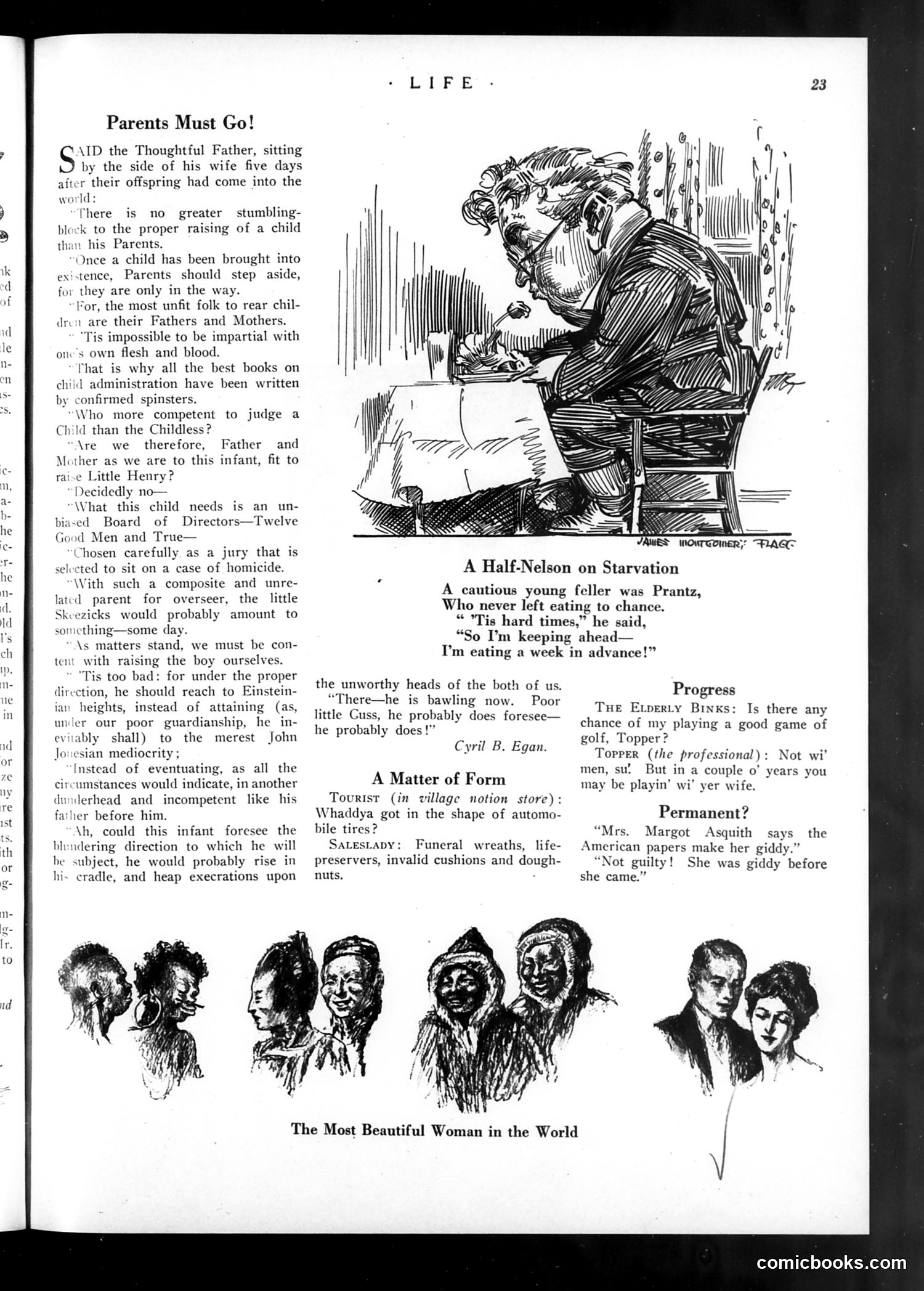
This page contains several short satirical pieces typical of early 20th-century Life magazine humor: **"Parents Must Go!"** mocks progressive child-rearing ideology by presenting a father's absurd argument that parents are incompetent to raise their own children. He suggests a "Board of Directors" of twelve impartial strangers would be better—a jab at trendy expert-driven parenting advice replacing parental instinct. The irony: he then admits he'll raise the boy himself anyway, concluding the child will inevitably become mediocre "like his father before him." **"A Half-Nelson on Starvation"** is a lighthearted limerick about a cautious man eating a week's worth of food in advance during hard times—mocking depression-era survival anxieties through absurdist humor. **Remaining items** include brief jokes: a tourist asking for automobile tires in a village store (the shopkeeper offers funeral wreaths instead—dark rural humor); golf and marriage humor; and a quip about Mrs. Margot Asquith being made giddy by American papers. The illustration shows a befuddled father with his newborn—visual support for the parenting satire.
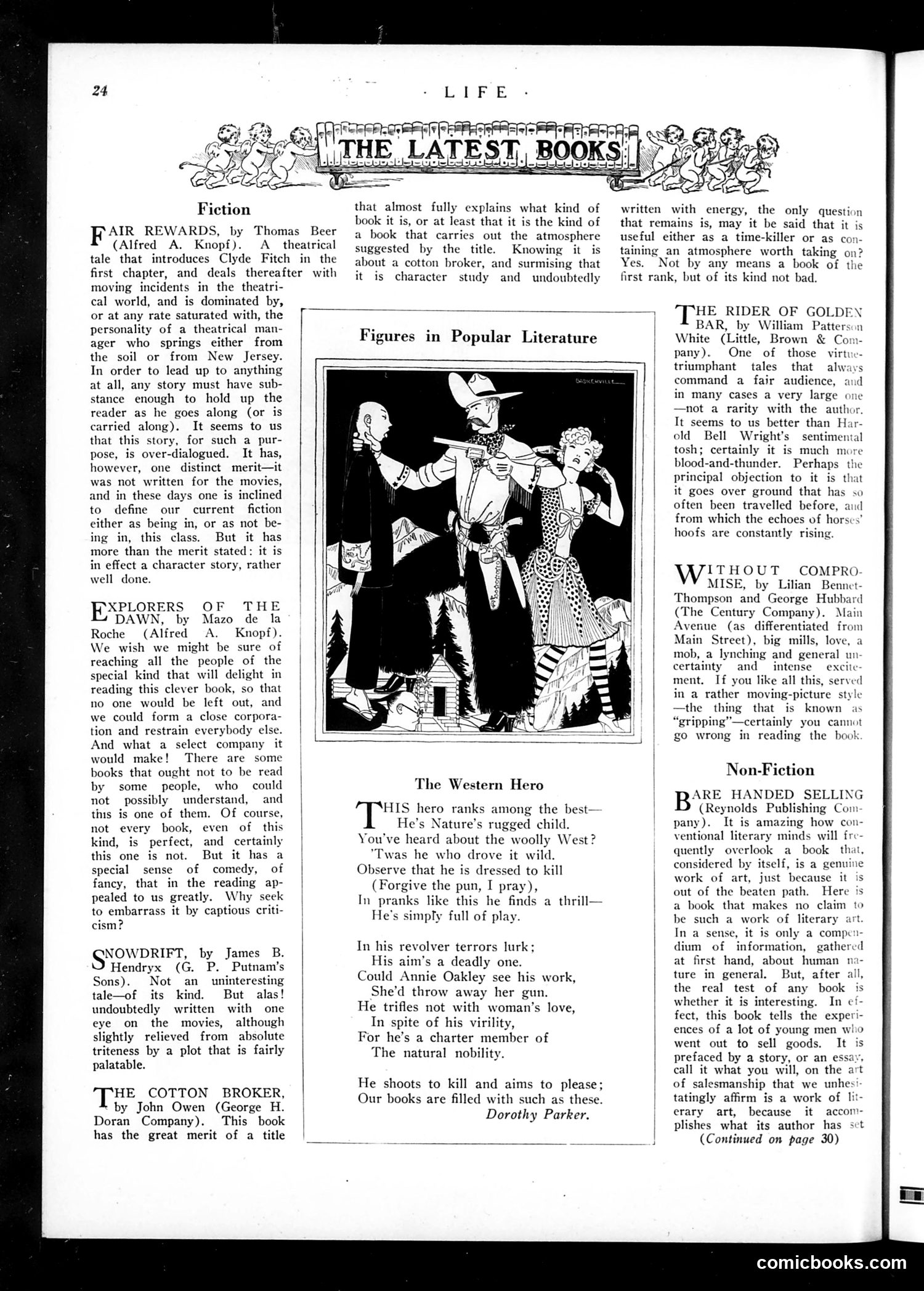
This is a book review section from Life magazine, not a political cartoon page. The single illustration—titled "Figures in Popular Literature"—depicts **"The Western Hero,"** a archetypal character being satirized through verse by Dorothy Parker. The cartoon shows a stereotypical cowboy in exaggerated Western attire (wide hat, spurs, ornate clothing) posing dramatically. Parker's accompanying poem mocks the Western pulp fiction genre popular at the time, describing this "Nature's rugged child" as someone obsessed with flashy dress and thrills rather than genuine heroism. Lines like "He's simply full of play" and "He shoots to kill and aims to please" suggest these adventure stories were superficial entertainment. The satire targets the mass-market Western novel genre itself—criticizing how publishers churned out formulaic tales, often written specifically for movie adaptation, that prioritized action and spectacle over literary merit. Parker's tone is playfully dismissive of both the genre and its readers' tastes.
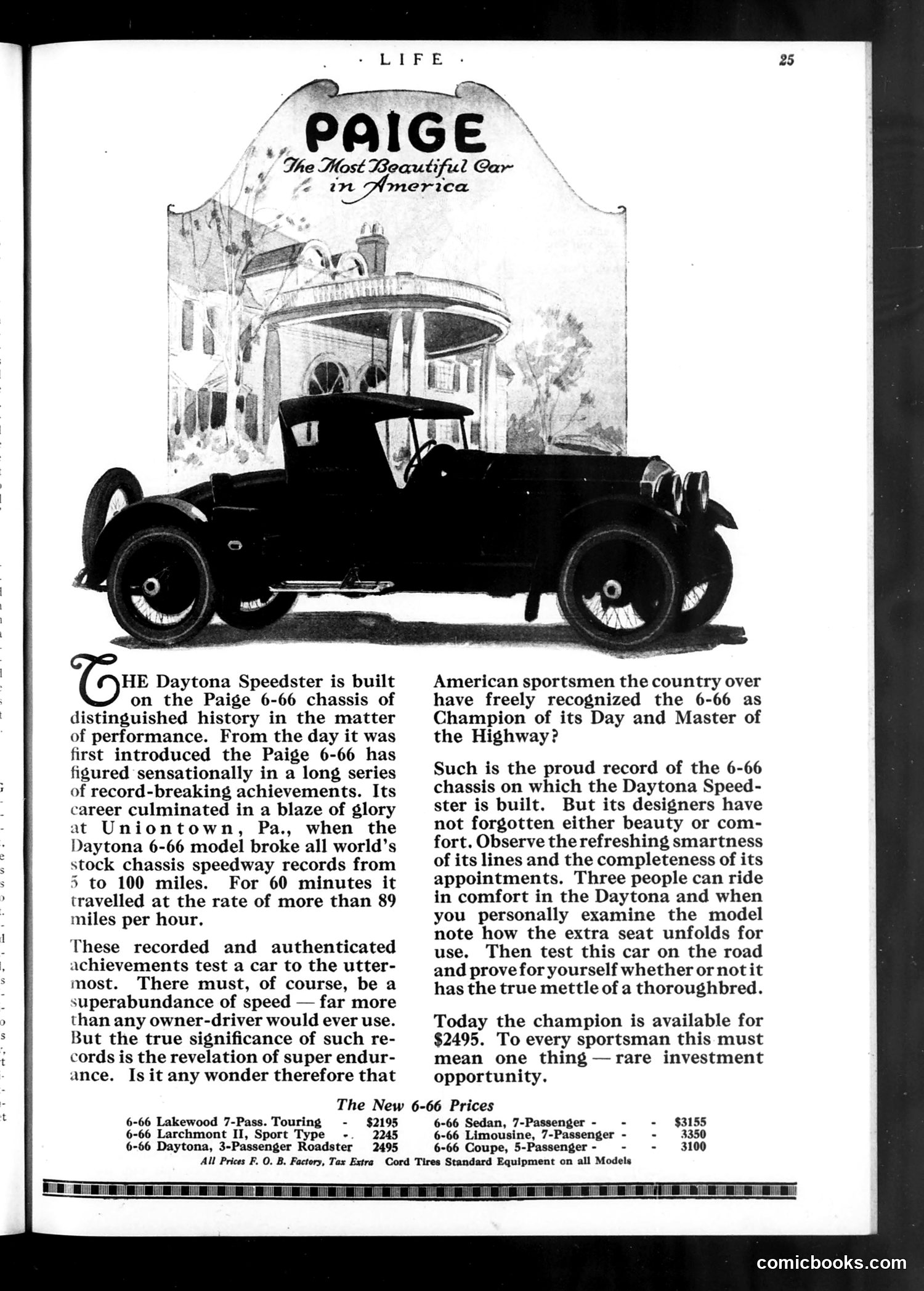
This is **not a cartoon or satire** — it's a straightforward automobile advertisement from Life magazine. The page promotes the Paige 6-66 automobile, specifically the Daytona Speedster model. The ad uses performance credibility to market luxury: it emphasizes that the Daytona 6-66 broke speed records at Uniontown, Pennsylvania, traveling over 89 mph for 60 minutes. This real achievement supposedly proves the car's endurance and reliability for everyday drivers. The marketing strategy targets wealthy "sportsmen," positioning the $2,495 vehicle as a prestigious investment. The text argues that record-breaking capability demonstrates superior engineering that benefits ordinary owners, even though they'll never need such extreme performance. The silhouetted car image and accompanying architectural scene convey elegance and modernity. This represents typical 1920s automotive advertising that leveraged motorsport achievements to sell consumer vehicles to the affluent.
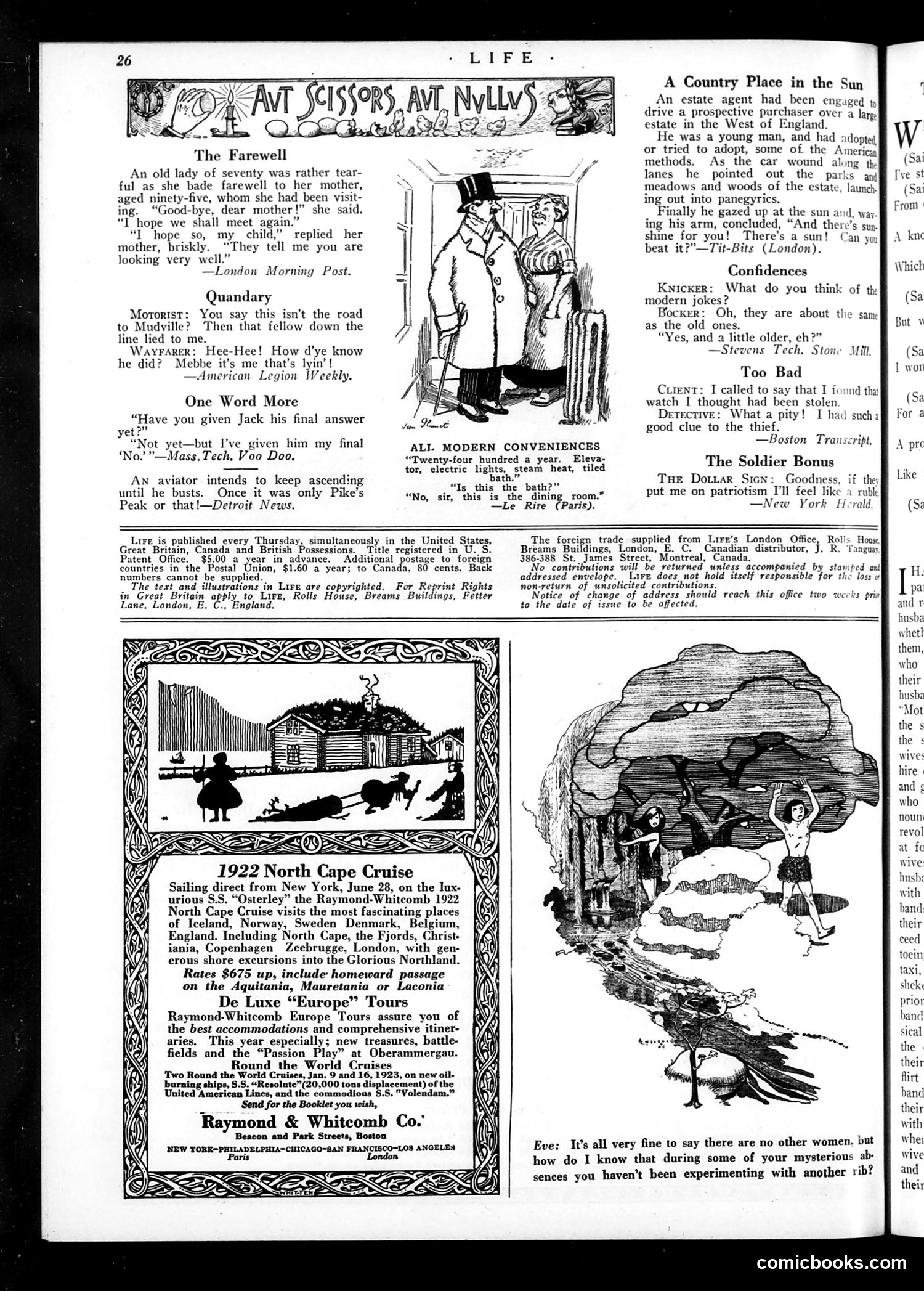
This page contains multiple short humorous anecdotes and advertisements typical of Life's format. The main cartoon depicts a gentleman in a top hat saying goodbye to an elderly woman at a doorway, illustrating "The Farewell" — a sentimental joke about an old lady tearfully parting from her 95-year-old mother. The surrounding text pieces are brief comedic vignettes about everyday situations: a motorist receiving conflicting directions, an aviator's dangerous ambition, and an estate agent's overly enthusiastic sales pitch about a property's "sunshine." The humor relies on wordplay, unexpected turns, and gentle observations about human nature rather than sharp political commentary. One joke mocks post-war "soldier bonus" debates by personifying a dollar sign complaining about patriotic appeals. The page is primarily **advertising travel cruises** (North Cape, Europe tours, world cruises) alongside the lighter entertainment content — standard revenue model for Life magazine during this period.
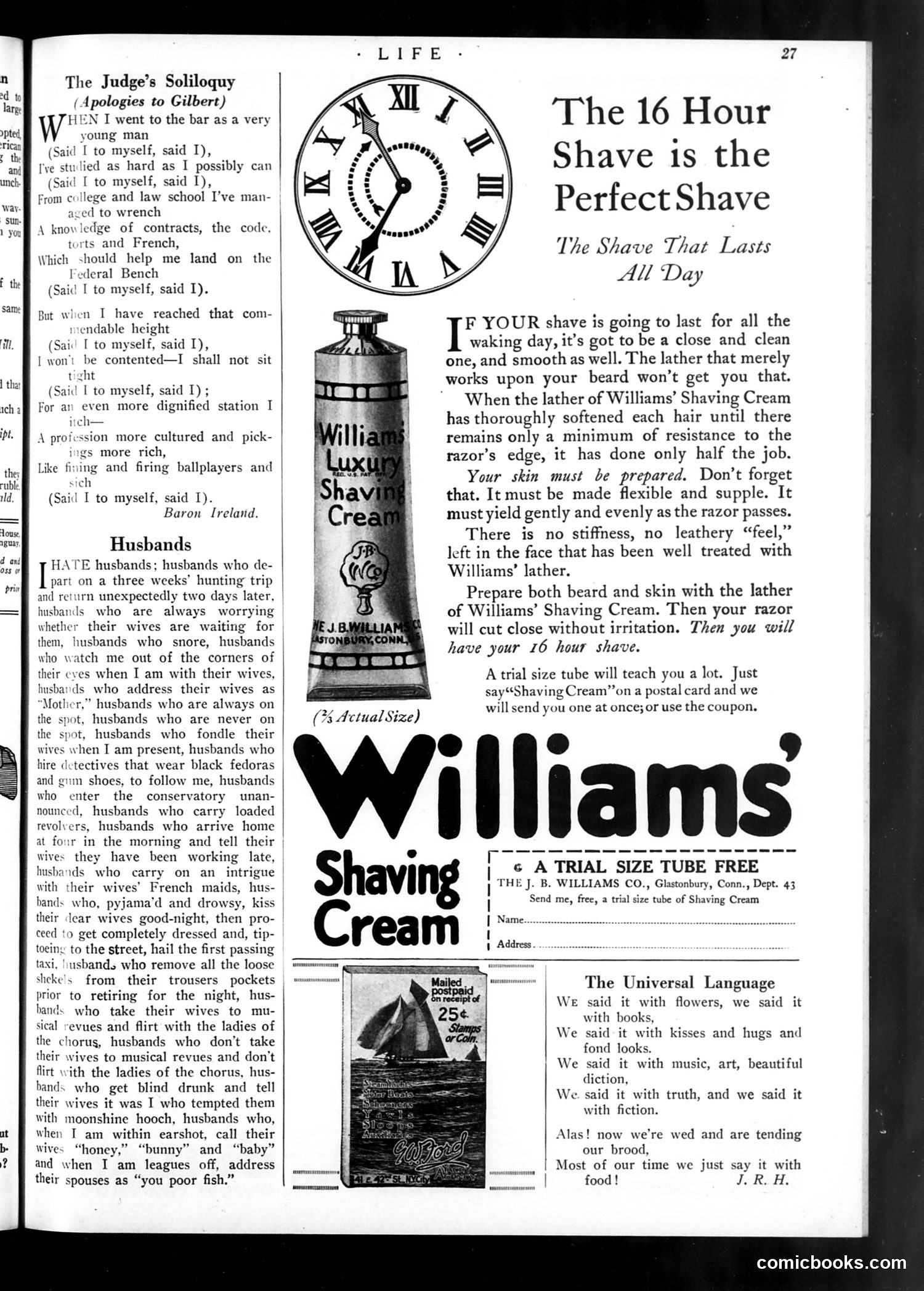
This page contains three distinct pieces of satirical humor typical of early 20th-century Life magazine: **"The Judge's Soliloquy"** parodies Gilbert & Sullivan's "I Am the Very Model of a Modern Major-General." A judge admits he lied constantly to reach the bench, and now aspires to an even more prestigious (and lucrative) position—firing baseball players. The satire mocks judicial corruption and ambition. **"Husbands"** is a comedic rant cataloging every type of husband the author despises, from snorers to suspicious detectives-hirers to men who call their wives "honey" but "you poor fish" in private. It's domestic satire targeting male hypocrisy and controlling behavior. **"Williams' Shaving Cream"** is straightforward advertising claiming a 16-hour shave, emphasizing skin preparation alongside beard-softening—typical early advertising rhetoric. The page reflects 1920s preoccupations: skepticism toward institutions (law), marital tensions (common satirical fodder), and consumer culture emerging through glossy product placement.
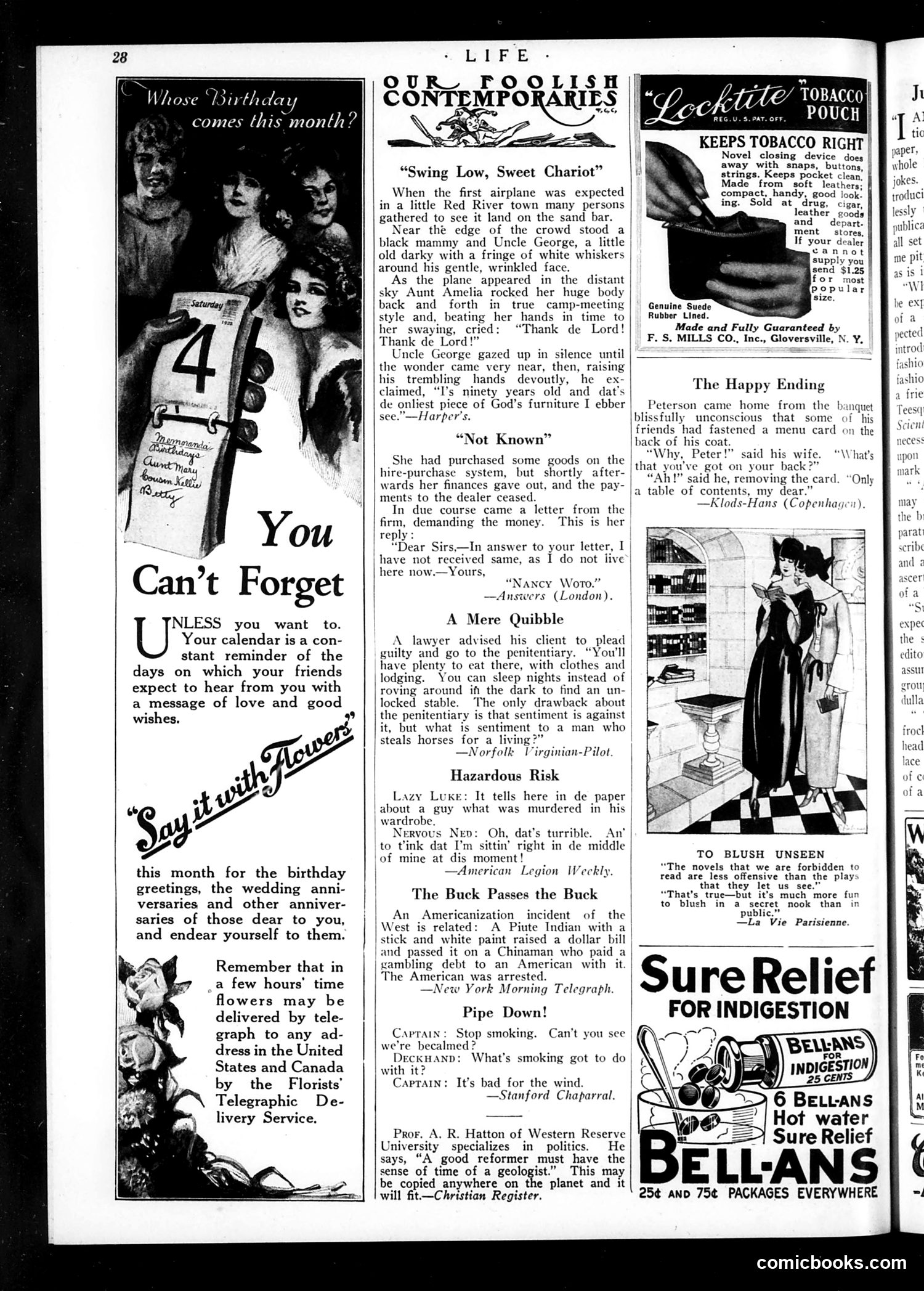
This page from *Life* magazine contains multiple brief satirical items reflecting early 20th-century American humor and social attitudes. **"Swing Low, Sweet Chariot"** depicts racist caricatures of Black Americans ("Aunt Amelia" and "Uncle George") reacting with exaggerated religious fervor to an airplane. The humor relies on stereotypical portrayals of Black speech and behavior, common to the era's offensive popular entertainment. The other short comic pieces ("Not Known," "A Mere Quibble," "Hazardous Risk," "The Buck Passes the Buck") are typical *Life* filler content—brief jokes mocking various situations: financial troubles, marital complications, criminal activity, and Americanization difficulties among immigrants. The page is primarily **advertising** (Locktite tobacco pouches, Bellans indigestion remedy), with satirical content serving as editorial framing. The social commentary targets working-class struggles, immigration, and petty crime rather than politics specifically. The casual racism reflects *Life*'s mainstream editorial voice of its era.
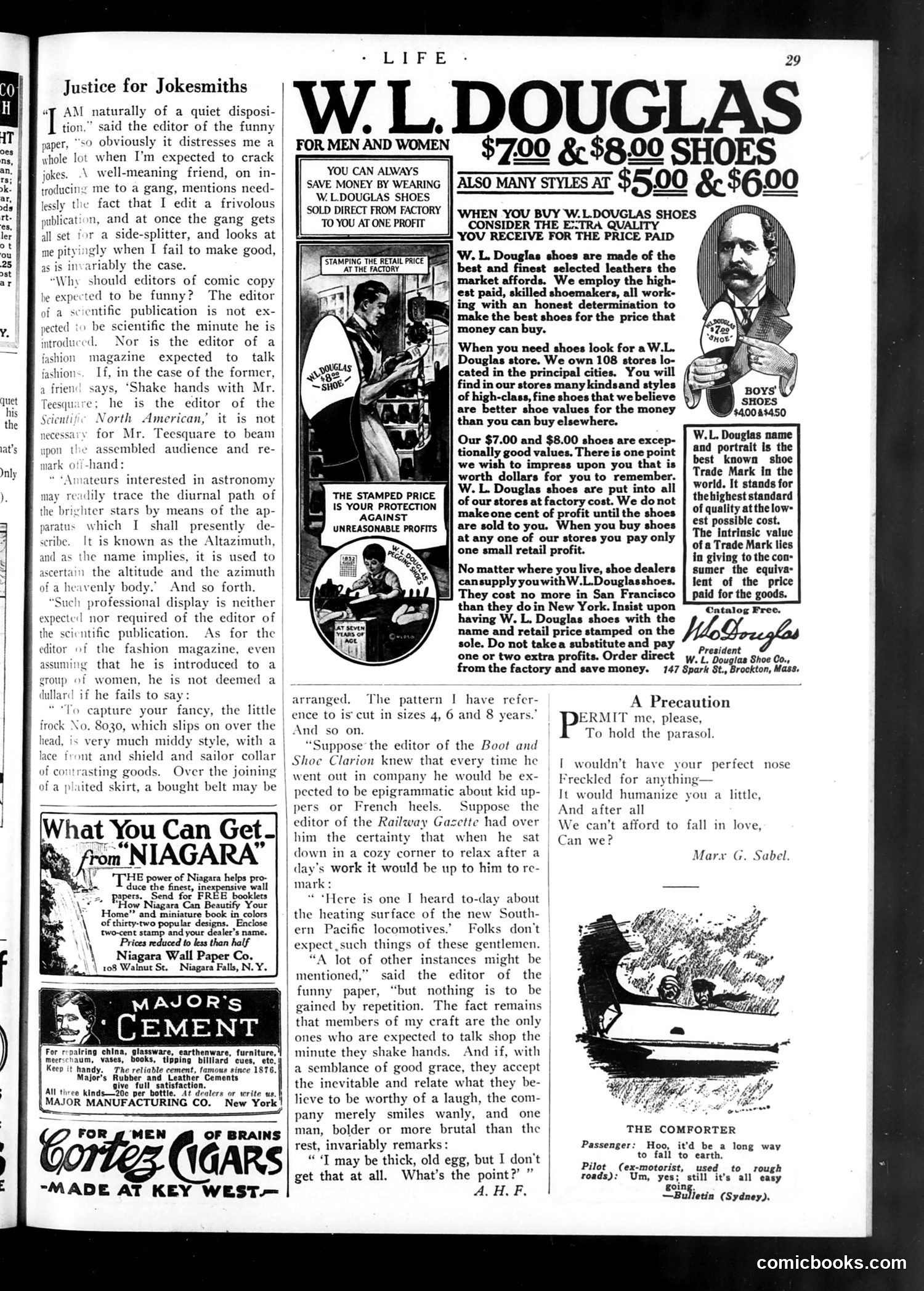
This page is primarily **advertising and miscellaneous content** rather than political satire or comics requiring historical context. The dominant feature is a **W.L. Douglas Shoes advertisement** (center-right), presenting a direct-to-consumer shoe business model emphasizing factory-to-retail efficiency and lower prices. The portrait shown appears to be W.L. Douglas himself, the shoe company founder. The left column contains an editorial essay titled "Justice for Jokesmiths" arguing that editors of humorous publications shouldn't be socially expected to be funny on demand—just as scientific or fashion editors aren't expected to spontaneously discuss their fields professionally. The page also includes **minor advertisements** for Niagara wallpaper, Major's cement, and Cortez cigars, plus a brief poem titled "A Precaution" about a parasol and love. There is **no significant political cartoon or satirical content** requiring specialized historical knowledge to understand.
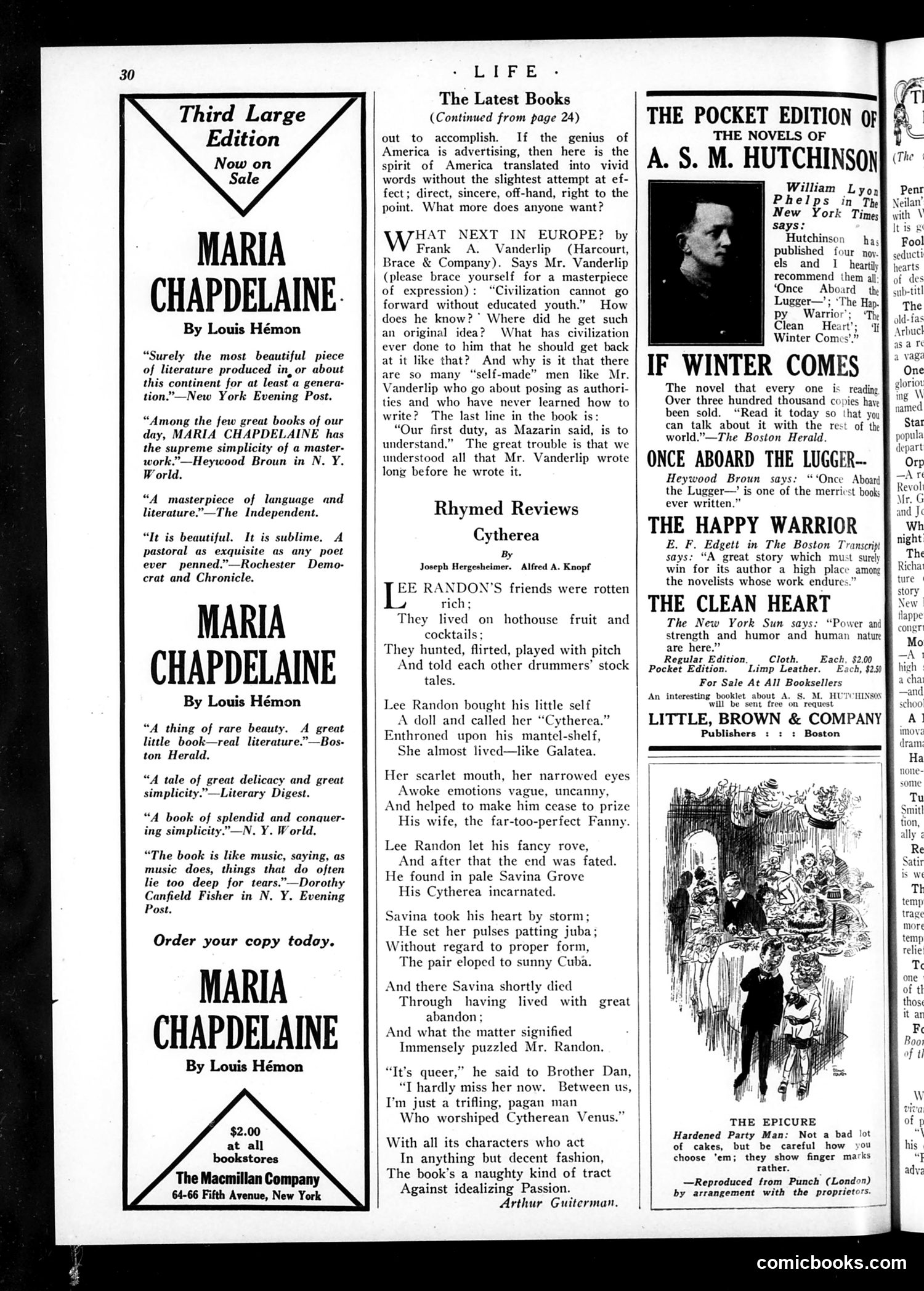
This page is primarily **book advertising and literary reviews** from an early 20th-century *Life* magazine—not political satire. The dominant content advertises **"Maria Chapdelaine"** by Louis Hémon (a Canadian novel), using glowing critical quotations. The "Rhymed Reviews" section offers humorous verse summaries of new books, including Joseph Hergesheimer's *Cytherea*—a satirical poem mocking a wealthy man (Lee Randon) who abandons his perfect wife for an idealized fantasy woman, only to be confused when reality disappoints him. Poet Arthur Guiterman concludes it's "a naughty kind of tract / Against idealizing Passion." The page also promotes A.S.M. Hutchinson's novels and *If Winter Comes*, noting 300,000 copies sold. **There is no political cartoon visible**—just a small sketch accompanying the book reviews. The "satire" here targets romantic idealism and literary trends, not politics or social movements.
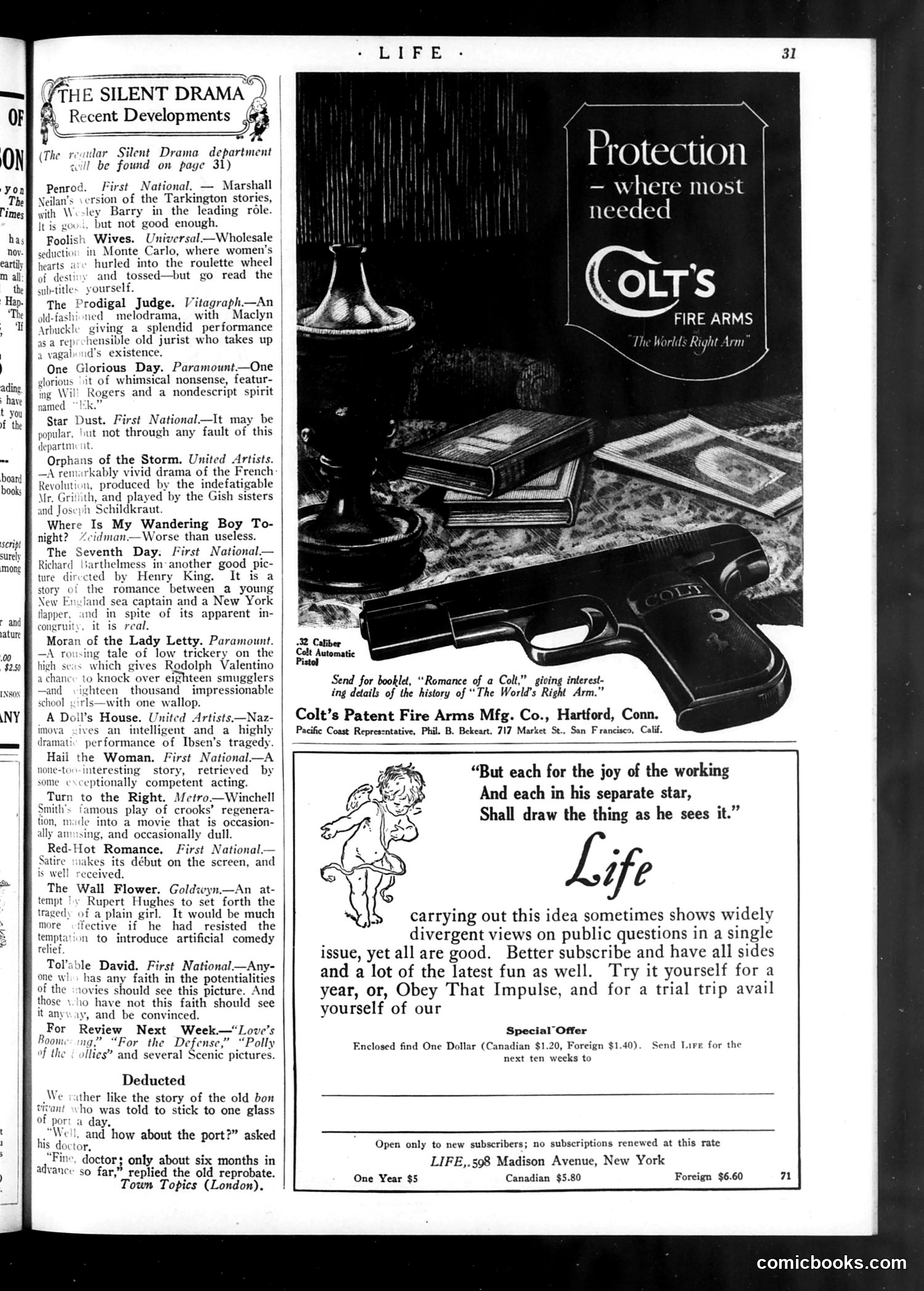
This page from *Life* magazine consists primarily of **film reviews** and **advertising**, not political satire. The left column reviews silent films from 1922, critiquing works like *Penrod*, *Foolish Wives*, and *Moran of the Lady Letty*—mostly dismissive assessments of contemporary cinema. The reviews mention actors like Wesley Barry, Maclyn Arbuckle, and Rudolph Valentino. The dominant visual element is a **Colt's Fire Arms advertisement** featuring a revolver and the tagline "Protection—where most needed." This is straightforward commercial advertising for weapons, not satire. The bottom section includes *Life*'s own self-promotional material, with a quote about drawing "the thing as he sees it" and an offer for discounted subscriptions ($1 for ten weeks). **No political cartoon or satirical critique is present.** This appears to be a standard magazine page mixing entertainment reviews with period advertising and subscription promotions.
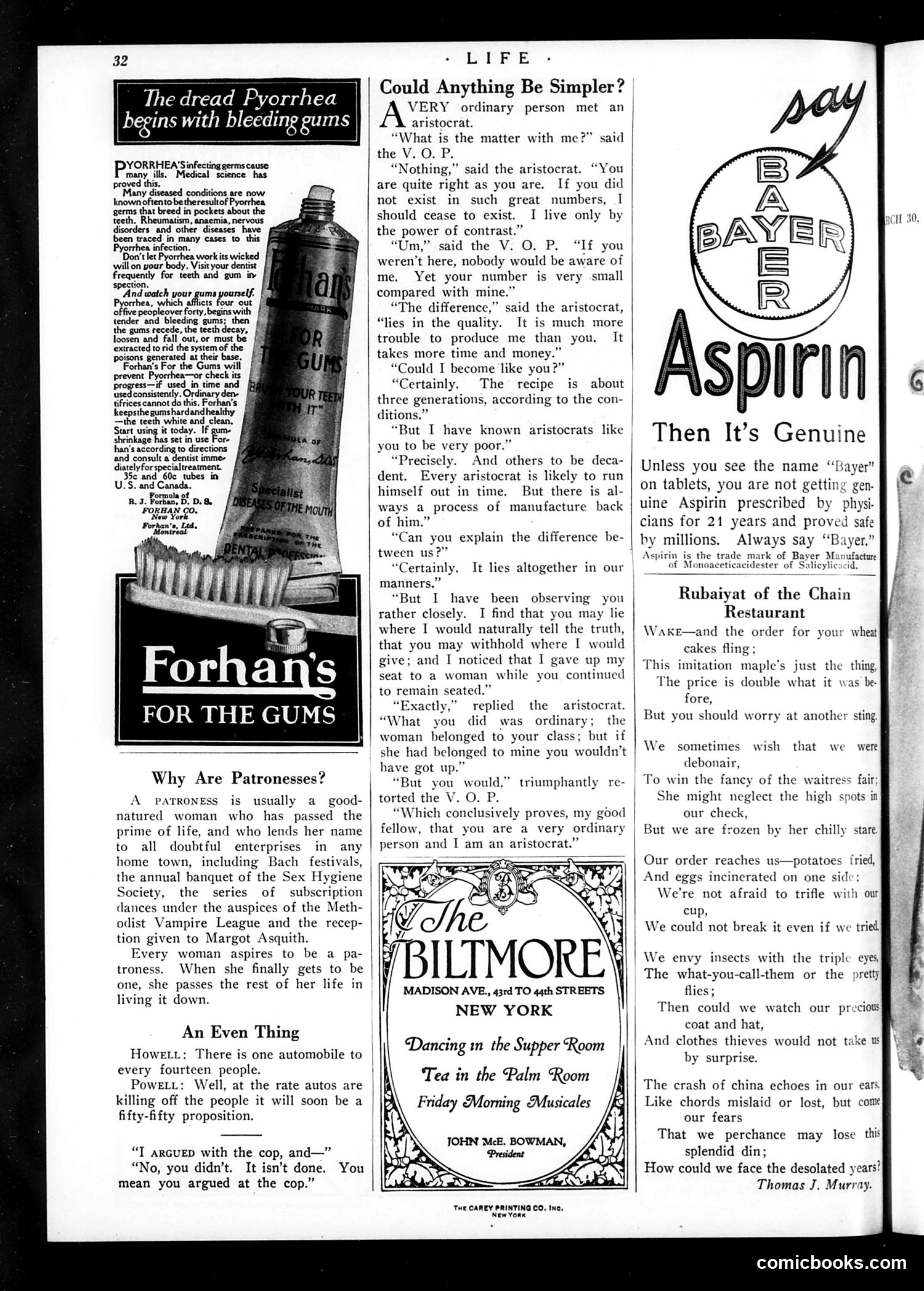
This page combines social satire with period advertising. The main cartoon presents a dialogue between a "Very Ordinary Person" (V.O.P.) and an aristocrat debating class differences. The aristocrat argues superiority derives from breeding and quality ("takes more time and money" to produce), while the V.O.P. observes that aristocrats actually behave *worse*—lying, withholding kindness, and refusing to yield seats to women. The joke's punchline reveals the aristocrat's hypocrisy: when the woman belonged to his own class, his discourtesy proved his ordinariness, not his refinement. The page also includes period advertisements (Forhan's dental product, The Biltmore restaurant) and lighter satirical pieces ("Why Are Patronesses?," "An Even Thing") mocking social pretensions and gender roles typical of 1920s Life magazine humor.