
Life, 1922-03-23 · page 24 of 34
Life — March 23, 1922 — page 24: what you’re looking at
What you’re looking at
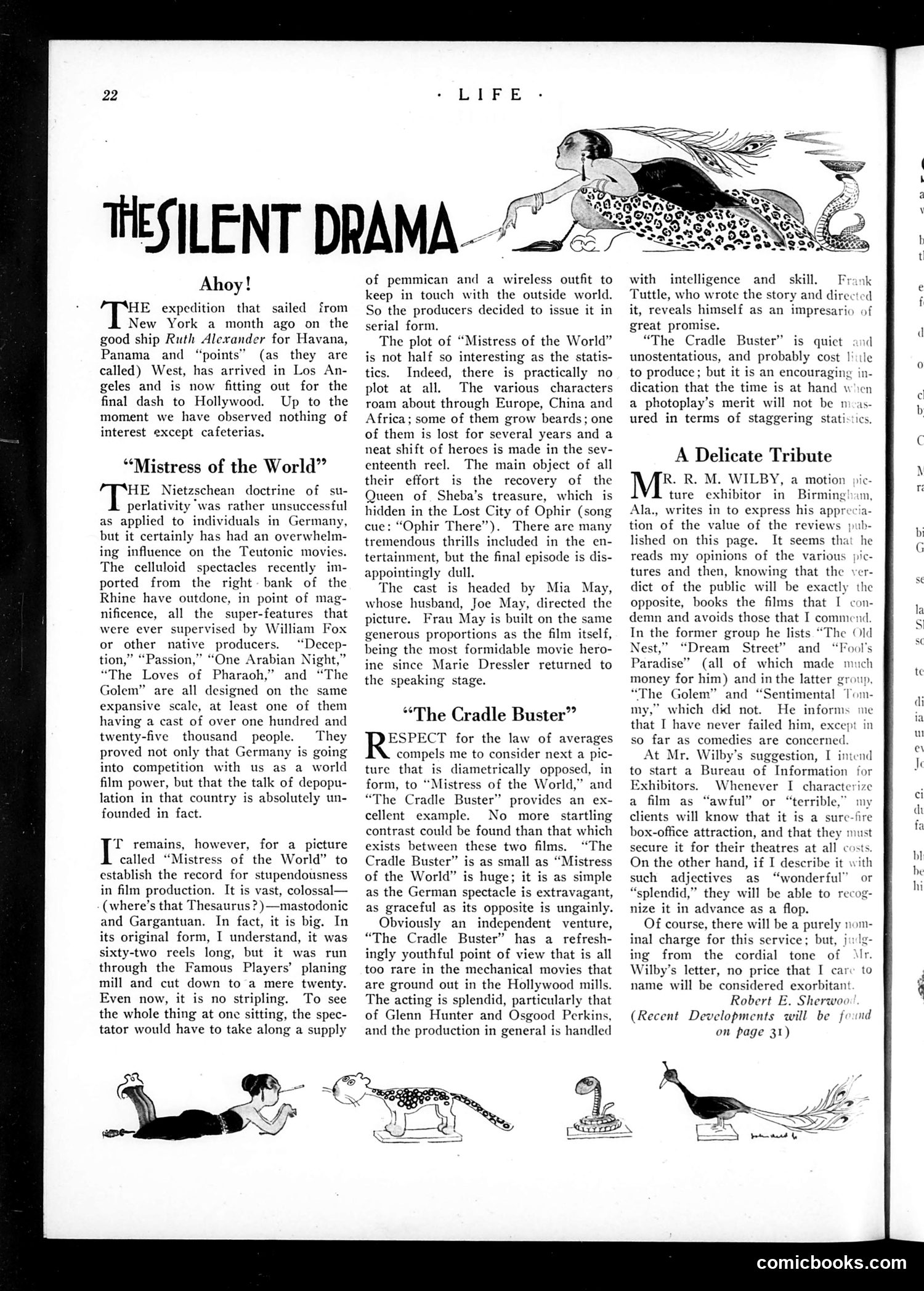
This page reviews three silent films in production or release. The opening section mockingly notes a film expedition's arrival in Los Angeles, suggesting Hollywood's obsession with spectacle. **"Mistress of the World"** satirizes German cinema's post-WWI ambitions. The critic praises its enormous scale (originally 62 reels, cut to 20) while admitting the plot is negligible—characters merely wander Europe, China, and Africa seeking Sheba's treasure. Star Mia May receives backhanded praise for her physical proportions matching the film's immensity. **"The Cradle Buster"** is presented as the opposite: a modest, graceful independent film starring Glenn Hunter and Osgood Perkins, with intelligent direction and writing. The satire targets German cinema's belief that sheer scale equals quality, contrasting it with American independent filmmaking's artistic restraint. The humor lies in the critic's mock-serious treatment of "Mistress of the World's" bloated production values versus genuine storytelling merit.
📄 Transcribed text from this page (OCR, searchable)
Machine-transcribed from the original scan — historical spelling and the odd misread are preserved.
TESILENT DRAMA Ahoy! ‘HE expedition that sailed from New York a month ago on the good ship Ruth Alexander for Havana, Panama and “points” (as they are called) West, has arrived in Los An- geles and is now fitting out for the final dash to Hollywood. Up to the moment we have observed nothing of interest except cafeterias. “Mistress of the World” HE Nietzschean doctrine of su- perlativity ‘was rather unsuccessful as applied to individuals in Germany, but it certainly has had an overwhelm- ing influence on the Teutonic movi The celluloid spectacles recently im- ported from the right. bank of the Rhine have outdone, in point of mag- nificence, all the super-features that were ever supervised by William Fox or other native producers. “Decep- tion,” “Passion,” “One Arabian Night,” “The Loves of Pharaoh,” and “The Golem” are all designed on the same expansive scale, at least one of them having a cast of over one hundred and twenty-five thousand people. They proved not only that Germany is going into competition with us as a world film power, but that the talk of depopu- lation in that country is absolutely un- founded in fact. T remains, however, for a picture called “Mistress of the World” to establish the record for stupendousness in film production. It is vast, colossal— (where’s that Thesaurus ?)—mastodonic and Gargantuan. In fact, it is big. In its original form, I understand, it was sixty-two reels long, but it was run through the Famous Players’ planing mill and cut down to a mere twenty. Even now, it is no stripling. To see the whole thing at one sitting, the spec- tator would have to take along a supply of pemmican and a wireless outfit to keep in touch with the outside world. So the producers decided to issue it in serial form. The plot of “Mistress of the World” is not half so interesting as the statis- tics. Indeed, there is practically no plot at all. The various characters roam about through Europe, China and Africa; some of them grow beards; one of them is lost for several years and a neat shift of heroes is made in the sev- enteenth reel. The main object of all their effort is the recovery of the Queen of Sheba’s treasure, which is hidden in the Lost City of Ophir (song cue: “Ophir There”). There are many tremendous thrills included in the en- tertainment, but the final episode is dis- appointingly dull. The cast is headed by Mia May, whose husband, Joe May, directed the picture. Frau May is built on the same generous proportions as the film itself, being the most formidable movie hero- ine since Marie Dressler returned to the speaking stage. “The Cradle Buster” SPECT for the law of averages compels me to consider next a pic- ture that is diametrically opposed, in form, to “Mistress of the World,” and “The Cradle Buster” provides an ex- cellent example. No more startling contrast could be found than that which exists between these two films. “The Cradle Buster” is as small as “Mistress of the World” is huge; it is as simple as the German spectacle is extravagant, as graceful as its opposite is ungainly. Obviously an independent venture, “The Cradle Buster” has a refresh- ingly youthful point of view that is all too rare in the mechanical movies that are ground out in the Hollywood mills. The acting is splendid, particularly that of Glenn Hunter and Osgood Perkins, and the production in general is handled with intelligence and _ skill. Tuttle, who wrote the story and di it, reveals himself as an impresario of great promise. “The Cradle Buster” is quiet and unostentatious, and probably cost Jiiile to produce; but it is an encouraging in- dication that the time is at hand w yen a photoplay’s merit will not be nias- ured in terms of staggering statistics. A Delicate Tribute R. R. M. WILBY, a motion pic- ture exhibitor in Birmingham, Ala., writes in to express his apprecia- tion of the value of the reviews pub- lished on this page. It seems that he reads my opinions of the various pic- tures and then, knowing that the yver- dict of the public will be exactly the opposite, books the films that I con- demn and avoids those that I commend. In the former group he lists “The Old Nest,” “Dream Street” and Paradise” (all of which made much money for him) and in the latter group. “The Golem” and “Sentimental my,” which did not. He informs me that I have never failed him, except in so far as comedies are concerne At Mr. Wilby’s suggestion, I intend to start a Bureau of Information for hibitors. Whenever I characterize a film as “awful” or “terrible,” my clients will know that it is a sure-fire box-office attraction, and that they must secure it for their theatres at all costs. On the other hand, if I describe it with such adjectives as “wonderful” or “splendid,” they will be able to recog- nize it in advance as a flop. Of course, there will be a purely nom- inal charge for this service; but, julg- ing from the cordial tone of \jr. Wilby’s letter, no price that I care to name will be considered exorbitant Robert E. Sherwoo (Recent Developments will be found on page 31) ‘om- comicbooks.com