
Life, 1922-03-23 · page 16 of 34
Life — March 23, 1922 — page 16: what you’re looking at
What you’re looking at
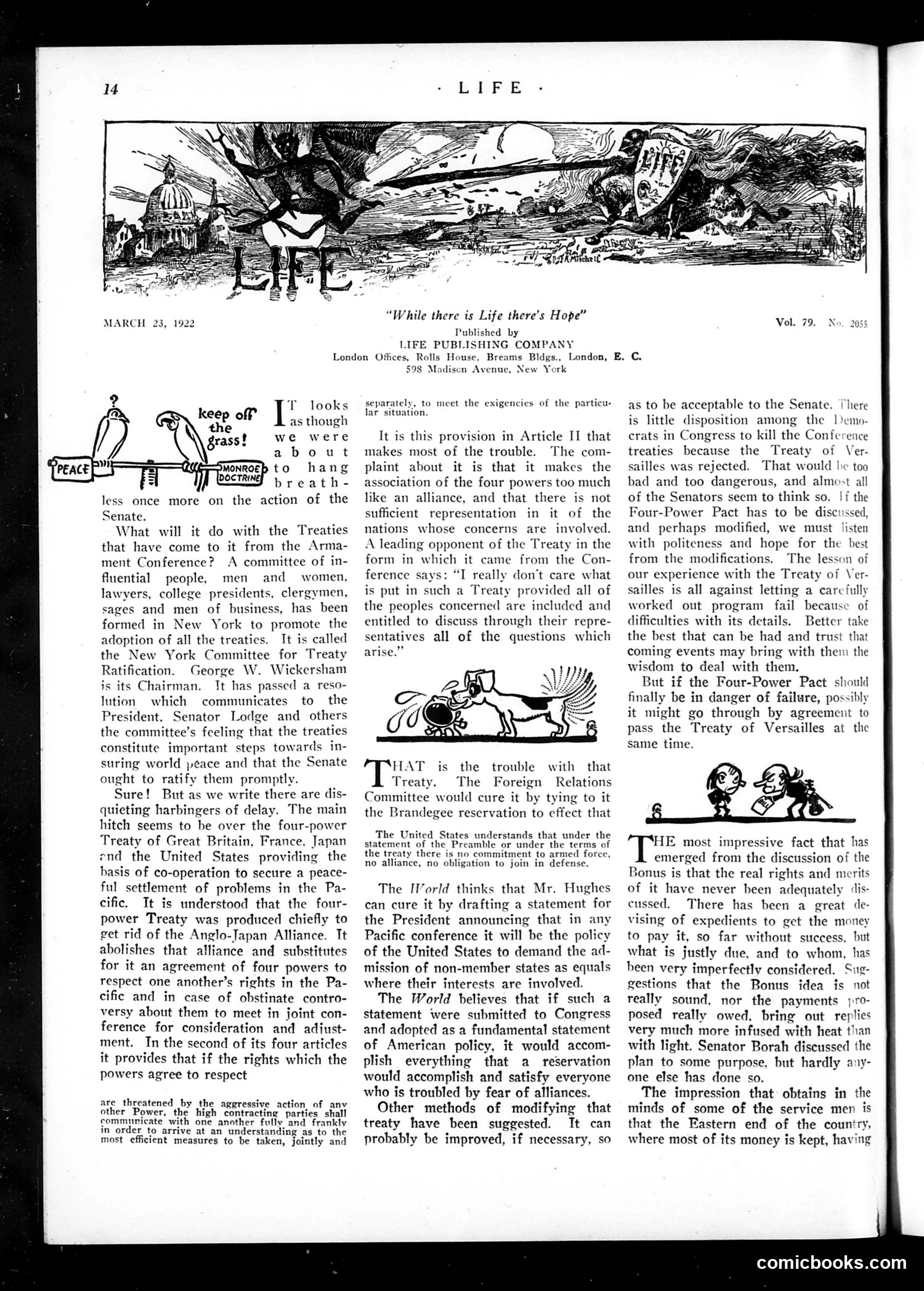
This page discusses the Four-Power Treaty and its ratification debates in the U.S. Senate. The top cartoon shows figures labeled "Peace" and "Monroe Doctrine" on a seesaw, illustrating tension between these concepts. The article criticizes Senate hesitation about treaty ratification, arguing that delays and procedural obstruction are preventing progress toward international peace. The text specifically addresses concerns about the Four-Power Pact's compatibility with American interests and the Monroe Doctrine. A second small cartoon depicts figures appearing to squabble or struggle, likely representing disagreement between nations or political factions over treaty terms. The satire targets Senate caution and legalistic objections as obstacles to achieving the post-WWI peace settlement the magazine believed necessary.
📄 Transcribed text from this page (OCR, searchable)
Machine-transcribed from the original scan — historical spelling and the odd misread are preserved.
MARCH 23, 1922 London Offices, lr looks ee of I as though grass! we were about MONROE to hang breath- less once more on the action of the Senate. What will it do with the Treaties that have come to it from the Arma- ment Conference? A committee of in- fluential people, men and women, lawyers, college presidents, clergymen, sages and men of business, has been formed in New York to promote the adoption of all the treaties. It is called the New York Committee for Treaty Ratification. George W. Wickersham is its Chairman. Jt has passed a reso- lution which communicates to the President. Senator Lodge and others the committee’s feeling that the treaties constitute important steps towards in- suring world peace and that the Senate ought to ratify them promptly. Sure! But as we write there are dis- quieting harbingers of delay. The main hitch seems to be over the four-power Treaty of Great Britain, France, Japan end the United States providing the hasis of co-operation to secure a peace- ful settlement of problems in the Pa- cific. It is understood that the four- power Treaty was produced chiefly to get rid of the Anglo-Japan Alliance. Tt abolishes that alliance and substitutes for it an agreement of four powers to respect one another’s rights in the Pa- cific and in case of obstinate contro- versy about them to meet in joint con- ference for consideration and adjust- ment. In the second of its four articles it provides that if the rights which the powers agree to respect are threatened by the aggressive action of anv other Power, the high contracting parties shall communicate with one another fully and frankly in order to arrive at an understanding as to the most efficient measures to be taken, jointly and “While there is Life there’s Hope” Published by LIFE PUBLISHING COMPANY s Breams Bldgs., London, $98 Madison Avenue, New York tely, to meet the exigencies of the particu: uation. It is this provision in Article IT that makes most of the trouble. The com- plaint about it is that it makes the association of the four powers too much like an alliance, and that there is not sufficient representation in it of the nations whose concerns are involved. A leading opponent of the Treaty in the form in which it came from the Con- ference says: “I really don't care what is put in such a Treaty provided all of the peoples concerned are included and entitled to discuss through their repre- sentatives all of the questions which HAT is the trouble with that Treaty. The Foreign Relations Committee would cure it by tying to it the Brandegee reservation to effect that The United States understands that under the statement of the Preamble or under the terms of the treaty there is no commitment to armed force, no alliance, no obligation to join in defense. The IVorld thinks that Mr. Hughes can cure it by drafting a statement for the President announcing that in any Pacific conference it will be the policy of the United States to demand the ad- mission of non-member states as equals where their interests are involved. The World believes that if such a statement were submitted to Congress and adopted as a fundamental statement of American policy, it would accom- plish everything that a reservation would accomplish and satisfy everyone who is troubled by fear of alliances. Other methods of modifying that treaty have been suggested. It can probably be improved, if necessary, so as to be acceptable to the Senate. here is little disposition among the |emo- crats in Congress to kill the Conferen treaties because the Treaty of Ver- sailles was rejected. That would lc too bad and too dangerous, and almost all of the Senators seem to think so. Ji the Four-Power Pact has to be discussed, and perhaps modified, we must listen with politeness and hope for the best from the modifications. The lesson of our experience with the Treaty of Ver- sailles is all against letting a carefully worked out program fail because of difficulties with its details. Better take the best that can be had and trust that coming events may bring with them the wisdom to deal with them. But if the Four-Power Pact should finally be in danger of failure, possibly it might go through by agreement to pass the Treaty of Versailles at the same time. ‘HE most impressive fact that has emerged from the discussion of the 3onus is that the real rights and merits of it have never been adequately ‘is- cussed. There has been a great de- vising of expedients to get the money to pay it, so far without stccess, but what is justly due, and to whom, has heen very imperfectly considered. Sug- gestions that the Bonus idea is not really sound, nor the payments )ro- posed really owed, bring out replies very much more infused with heat than with light. Senator Borah discussed the plan to some purpose, but hardly any- one else has done so. The impression that obtains in the minds of some of the service men is that the Eastern end of the country, where most of its money is kept, having comicbooks.com