
Life, 1922-03-23 · page 20 of 34
Life — March 23, 1922 — page 20: what you’re looking at
What you’re looking at
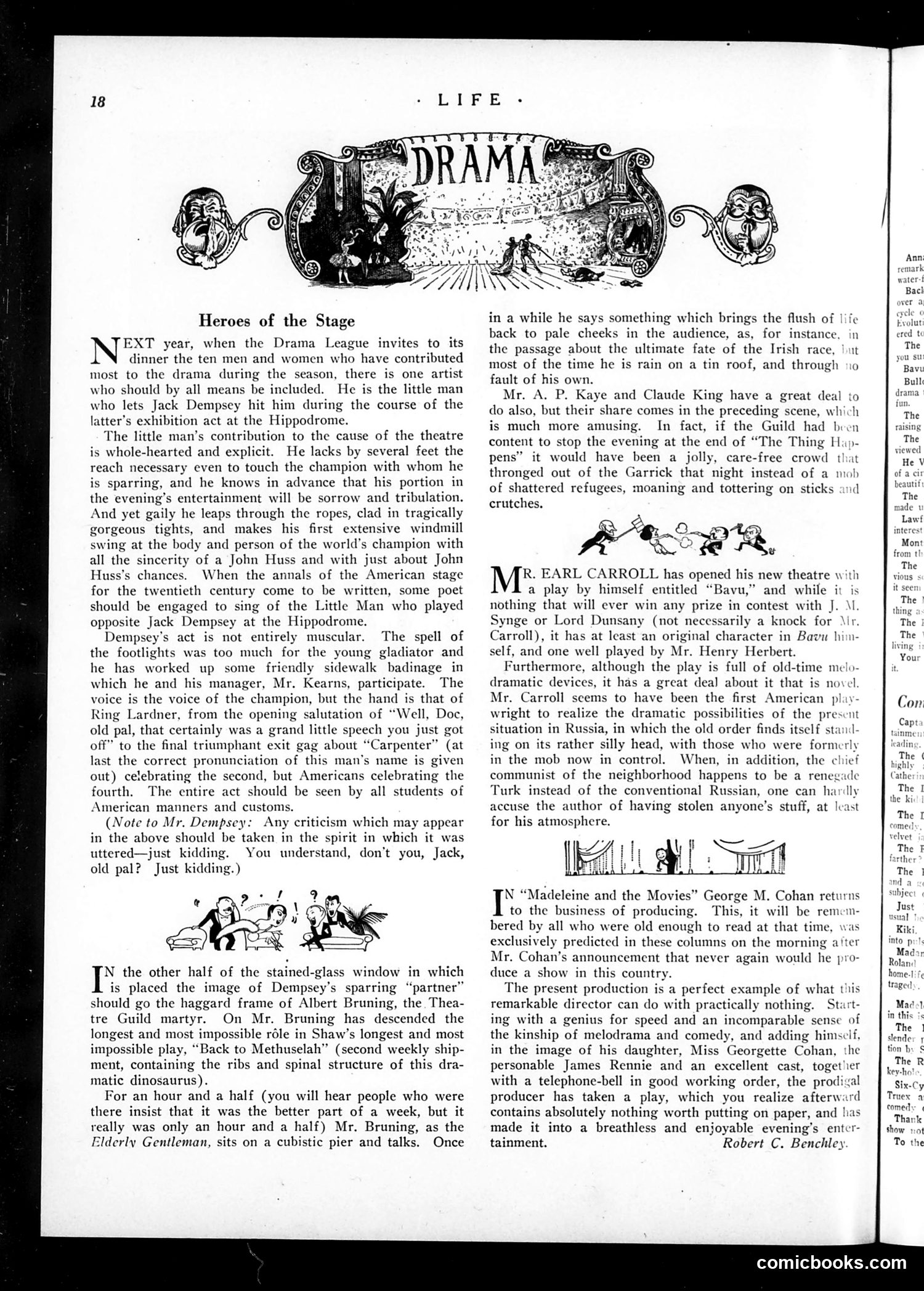
This page satirizes theatrical figures and productions of the era (appears to be 1920s based on references). **Main satire:** The opening section mocks Jack Dempsey, the heavyweight boxing champion, who apparently performed a sparring exhibition at the Hippodrome theater. Life sarcastically praises the "little man" who serves as Dempsey's punching bag during this act—a volunteer who knowingly gets hit while wearing "tragically gorgeous tights." The humor lies in celebrating this man's earnest futility as a theatrical contribution, comparing his hopeless situation to religious martyr John Huss. **Secondary reviews:** The text critiques Shaw's play "Back to Methuselah," performed by the Theatre Guild, describing it as tediously long with an actor (Bruning) delivering endless monologues described as "rain on a tin roof." Earl Carroll's new theater production "Bavu" receives mild commentary—acknowledging its originality without overstating its merit. The satire reflects Life's irreverent approach to both high theater and popular entertainment spectacle.
📄 Transcribed text from this page (OCR, searchable)
Machine-transcribed from the original scan — historical spelling and the odd misread are preserved.
Heroes of the Stage EXT year, when the Drama League invites to its dinner the ten men and women who have contributed most to the drama during the season, there is one artist who should by all means be included. He is the little man who lets Jack Dempsey hit him during the course of the latter’s exhibition act at the Hippodrome. The little man’s contribution to the cause of the theatre is whole-hearted and explicit. He lacks by several feet the reach necessary even to touch the champion with whom he is sparring, and he knows in advance that his portion in the evening’s entertainment will be sorrow and tribulation. And yet gaily he leaps through the ropes, clad in tragically gorgeous tights, and makes his first extensive windmill swing at the body and person of the world’s champion with all the sincerity of a John Huss and with just about John Huss’s chances. When the annals of the American stage for the twentieth century come to be written, some poet should be engaged to sing of the Little Man who played opposite Jack Dempsey at the Hippodrome. Dempsey’s act is not entirely muscular. The spell of the footlights was too much for the young gladiator and he has worked up some friendly sidewalk badinage in which he and his manager, Mr. Kearns, participate. The voice is the voice of the champion, but the hand is that of Ring Lardner, from the opening salutation of “Well, Doc, old pal, that certainly was a grand little speech you just got off” to the final triumphant exit gag about “Carpenter” (at last the correct pronunciation of this man’s name is given out) celebrating the second, but Americans celebrating the fourth. The entire act should be seen by all students of American manners and customs. (Note to Mr. Dempsey: Any criticism which may appear in the above should be taken in the spirit in which it was uttered—just kidding. You understand, don’t you, Jack, old pal? Just kidding.) window in which sparring “partner” | (et the other half of the stained-gla: is placed the image of Dempsey should go the haggard frame of Albert Bruning, the. Thea- tre Guild martyr. On Mr. Bruning has descended the longest and most impossible role in Shaw’s longest and most impossible play, “Back to Methuselah” (second weekly ship- ment, containing the ribs and spinal structure of this dra- matic dinosaurus). For an hour and a half (you will hear people who were there insist that it was the better part of a week, but it really was only an hour and a half) Mr. Bruning, as the Elderly Gentleman, sits on a cubistic pier and talks. Once in a while he says something which brings the flush of life back to pale cheeks in the audience, as, for instance, in the passage about the ultimate fate of the Irish race, |ut most of the time he is rain on a tin roof, and through :0 fault of his own. Mr. A. P. Kaye and Claude King have a great deal to do also, but their share comes in the preceding scene, which is much more amusing. In fact, if the Guild had been content to stop the evening at the end of “The Thing Hap- pens” it would have been a jolly, care-free crowd that thronged out of the Garrick that night instead of a mob of shattered refugees, moaning and tottering on sticks and crutches. > re oe, R. EARL CARROLL has opened his new theatre with a play by himself entitled “Bavu,” and while it is nothing that will ever win any prize in contest with J. \l Synge or Lord Dunsany (not necessarily a knock for \ir. Carroll), it has at least an original character in Bavu hin- self, and one well played by Mr. Henry Herbert. Furthermore, although the play is full of old-time melo- dramatic devices, it has a great dea) about it that is novel Mr. Carroll seems to have been the first American play- wright to realize the dramatic possibilities of the present situation in Russia, in which the old order finds itself staud- ing on its rather silly head, with those who were formerly in the mob now in control. When, in addition, the chief communist of the neighborhood happens to be a renegad Turk instead of the conventional Russian, one can harilly accuse the author of having stolen anyone’s stuff, at least for his atmosphere. N “Madeleine and the Movies” George M. Cohan returns to the business of producing. This, it will be remem- bered by all who were old enough to read at that time, was exclusively predicted in these columns on the morning alter Mr. Cohan’s announcement that never again would he pro- duce a show in this country. The present production is a perfect example of what this remarkable director can do with practically nothing. St: ing with a genius for speed and an incomparable sense of the kinship of melodrama and comedy, and adding himself, in the image of his daughter, Miss Georgette Cohan, the personable James Rennie and an excellent cast, toget!er with a telephone-bell in good working order, the prodigal producer has taken a play, which you realize afterward contains absolutely nothing worth putting on paper, and has made it into a breathless and enjoyable evening's entcr- tainment. Robert C. Benchley fun, The raising The viewed He V of a cir beautif The made v Lawf Mont from th The vious it see The thing The The comicbooks.com