
Life, 1922-03-23 · page 26 of 34
Life — March 23, 1922 — page 26: what you’re looking at
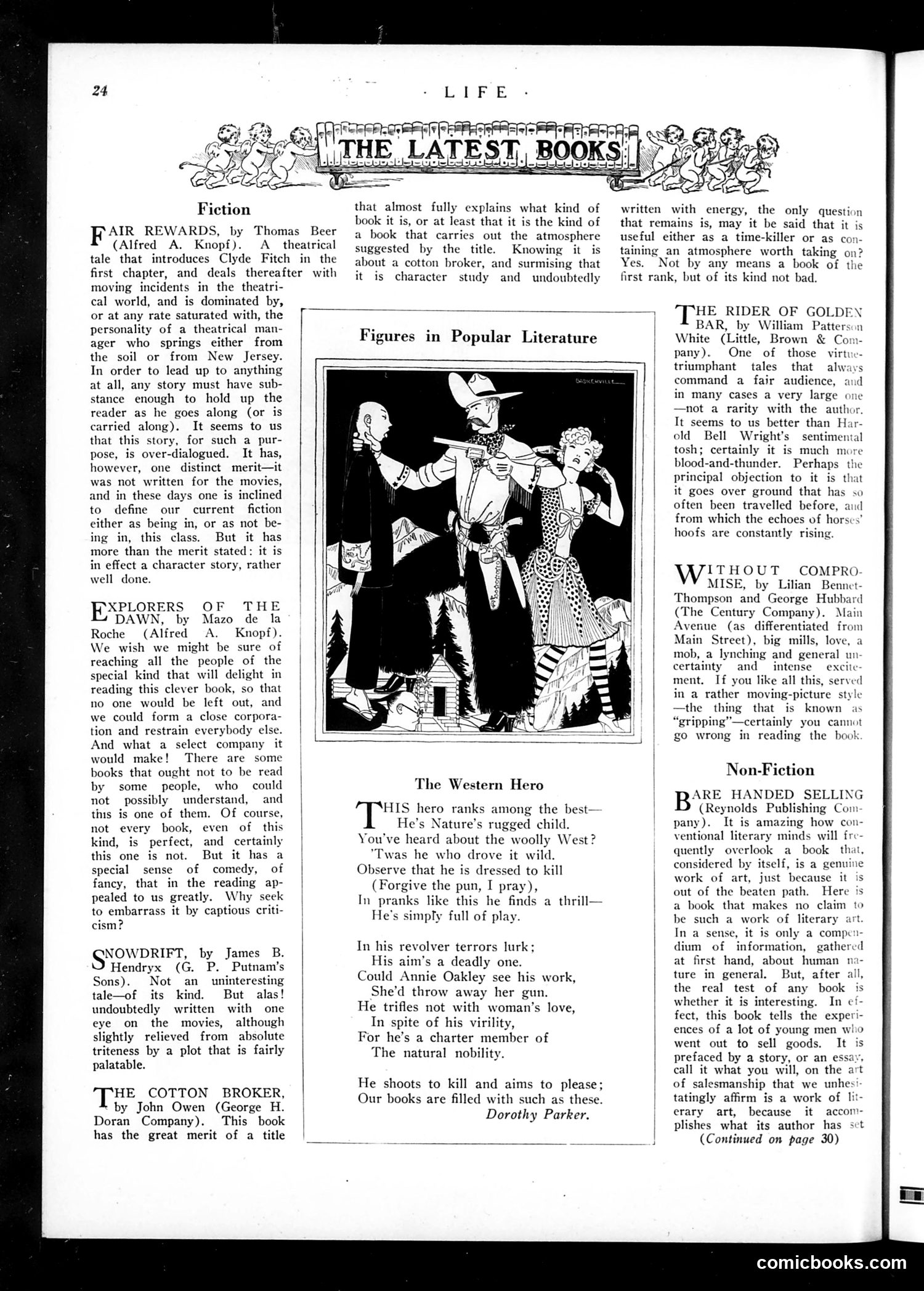
What you’re looking at
This is a book review section from Life magazine, not a political cartoon page. The single illustration—titled "Figures in Popular Literature"—depicts **"The Western Hero,"** a archetypal character being satirized through verse by Dorothy Parker. The cartoon shows a stereotypical cowboy in exaggerated Western attire (wide hat, spurs, ornate clothing) posing dramatically. Parker's accompanying poem mocks the Western pulp fiction genre popular at the time, describing this "Nature's rugged child" as someone obsessed with flashy dress and thrills rather than genuine heroism. Lines like "He's simply full of play" and "He shoots to kill and aims to please" suggest these adventure stories were superficial entertainment. The satire targets the mass-market Western novel genre itself—criticizing how publishers churned out formulaic tales, often written specifically for movie adaptation, that prioritized action and spectacle over literary merit. Parker's tone is playfully dismissive of both the genre and its readers' tastes.
📄 Transcribed text from this page (OCR, searchable)
Machine-transcribed from the original scan — historical spelling and the odd misread are preserved.
Fiction AIR REWARDS, by Thomas Beer (Alfred A. Knopf). A theatrical tale that introduces Clyde Fitch in the first chapter, and deals thereafter with moving incidents in the theatri- cal world, and is dominated by, that almost fully explains what kind of book it is, or at least that it is the kind of a book that carries out the atmosphere suggested by the title. Knowing it is about a cotton broke nd surmising that it is character study and undoubtedly written with energy, the only question that remains is, may it be said that it is useful either as a time-killer or as con- taining an atmosphere worth taking on? Yes. Not by any means a book of the first rank, but of its kind not bad. or at any rate saturated with, the personality of a theatrical man- ager who springs either from the soil or from New Jersey. Figures in Popular Literature HE RIDER OF GOLDEN BAR, by William Patterson White (Little, Brown & Com- pany). One of those virty triumphant tales that always In order to lead up to anything at all, any story must have sub- stance enough to hold up the reader as he goes along (or is carried along). It seems to us that this story, for such a pur- pose, is over-dialogued. It has, however, one distinct merit—it was not written for the movies, and in these days one is inclined to define our current fiction either as being in, or as not be- ing in, this class. But it has more than the merit stated: it is in effect a character story, rather well done. XPLORERS OF THE DAWN, by Mazo de la Roche (Alfred A. Knopf). We wish we might be sure of reaching all the people of the special kind that will delight in reading this clever book, so that no one would be left out, and we could form a close corpora- tion and restrain everybody else. command a fair audience, and in many cases a very large one —not a rarity with the author, It seems to us better than Har- old Bell Wright's sentimental tosh; certainly it is much more blood-and-thunder. Perhaps the principal objection to it is that it goes over ground that has so often been travelled before, aud from which the echoes of horses’ hoofs are constantly rising. ITHOUT COMPRO. MISE, by Lilian Bennet- Thompson and George Hubbard (The Century Company). Main Avenue (as differentiated from Main Street), big mills, love, a mob, a lynching and general un certainty and intense excite- ment. If you like all this, served in a rather moving-picture style —the thing that is known as “gripping”—certainly you cannot go wrong in reading the book And what a select company it would make! There are some books that ought not to be read by some people, who could not possibly understand, and this is one of them. Of course, not every book, even of this kind, is perfect, and certainly this one is not. But it has a special sense of comedy, of fancy, that in the reading ap- pealed to us greatly. Why seek to embarrass it by captious criti- cism? GNOWDRINT, by James B. Hendryx (G. P. Putnam's Sons). Not an uninteresting tale—of its kind. But alas! undoubtedly written with one eye on the movies, although slightly relieved from absolute triteness by a plot that is fairly palatable. HE COTTON BROKER, by John Owen (George H. Doran Company). This book has the great merit of a title The Western Hero HIS hero ranks among the best— He ature’s rugged child. You've heard about the woolly West? ‘Twas he who drove it wild. Observe that he is dressed to kill (Forgive the pun, I pray), In pranks like this he finds a thrill— He's simply full of play. In his revolver terrors lurk; His aim’s a deadly one. Could Annie Oakley see his work, She’d throw away her gun. He trifles not with woman’s love, In spite of his virility, For he’s a charter member of The natural nobility. He shoots to kill and aims to please; Our books are filled with such as these. Dorothy Parker. Non-Fiction ARE HANDED SELL (Reynolds Publishing Co pany). It is amazing how con- ventional literary minds will fre- quently overlook a book that, considered by itself, is a genuine work of art, just because it is out of the beaten path. Here is a book that makes no claim to be such a work of literary In a sense, it is only a comp dium of information, gathered at first hand, about human na- ture in general. But, after all, the real test of any book is whether it is interesting. In ef- fect, this book tells the experi- ences of a lot of young men whic went out to sell goods. It prefaced by a story, or an ess: call it what you will, on the of salesmanship that we unhes tatingly affirm is a work of lit- erary art, because it accom- plishes what its author has set (Continued on page 30) comicbooks.com