
Life, 1922-03-23 · page 6 of 34
Life — March 23, 1922 — page 6: what you’re looking at
What you’re looking at
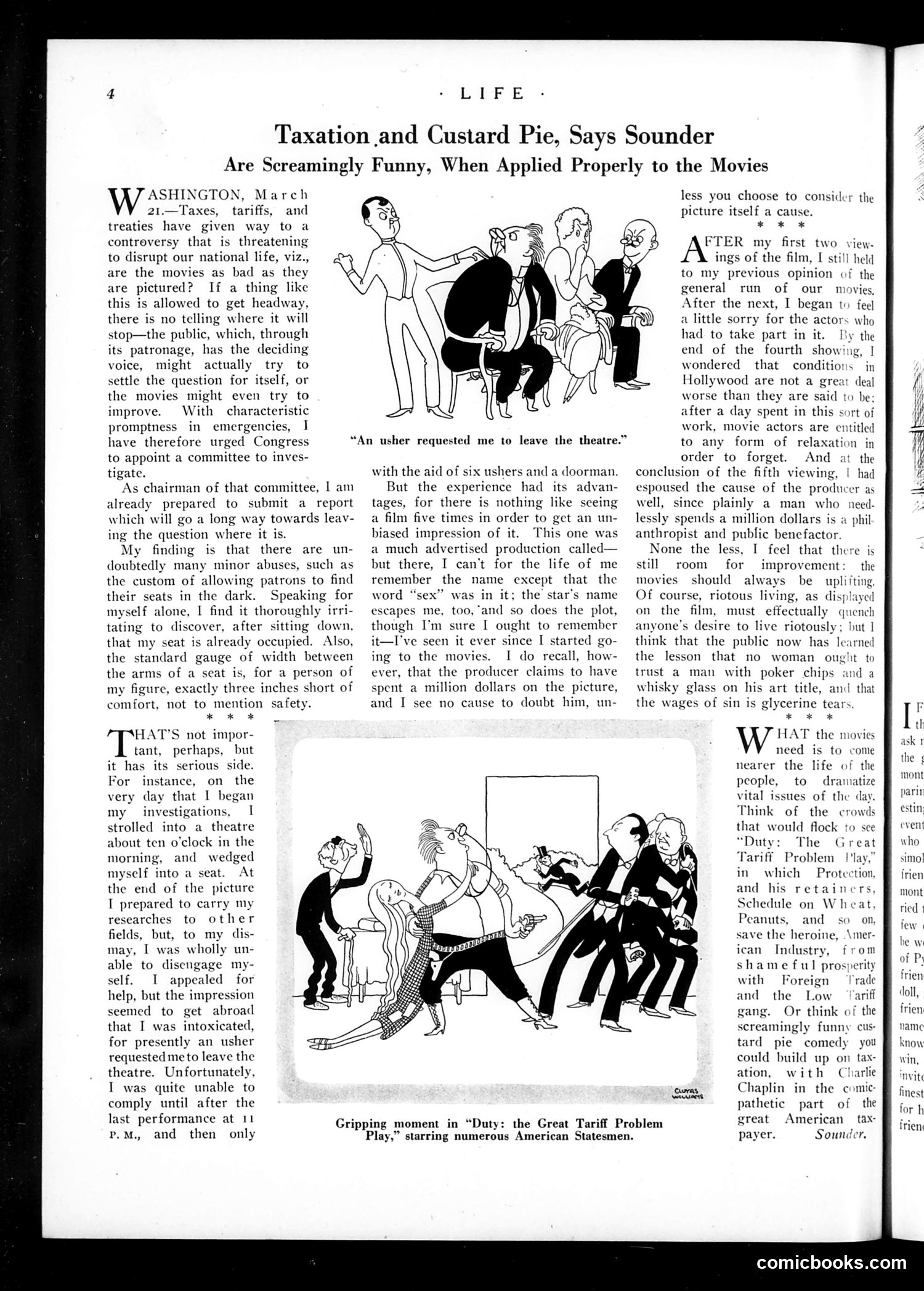
This is a satirical article by Sounder criticizing American cinema's content and production practices. The two cartoons illustrate his complaints: The first cartoon shows an usher forcibly removing a patron from a theater—satirizing the article's complaint that even basic theater comfort and safety are compromised by poor management. The second cartoon depicts what appears to be a chaotic film production scene (labeled as from "Duty: the Great Tariff Problem Play"), showing multiple figures in physical comedy or slapstick situations. This illustrates Sounder's point that movies are overly focused on crude humor and entertainment rather than addressing serious social issues like taxation and tariffs that matter to American life. The satire suggests film prioritizes escapism and physical comedy over meaningful engagement with important public concerns.
📄 Transcribed text from this page (OCR, searchable)
Machine-transcribed from the original scan — historical spelling and the odd misread are preserved.
> LIFE Taxation and Custard Pie, Says Sounder Are Screamingly Funny, When Applied Properly to the Movies \ J ASHINGTON, March 21.—Taxes, tariffs, and treaties have given way to a controversy that is threatening to disrupt our national life, viz., are the movies as bad as they are pictured? If a thing like this is allowed to get headway, there is no telling where it will stop—the public, which, through its patronage, has the deciding voice, might actually try to settle the question for itself, or the movies might even try to improve. With characteristic promptness in emergencies, | have therefore urged Congress to appoint a committee to inves- tigate. As chairman of that committee, | am already prepared to submit a report which will go a long way towards leav- ing the question where it is. My finding is that there are un- doubtedly many minor abuses, such as the custom of allowing patrons to find their seats in the dark. Speaking for myself alone, I find it thoroughly irri- tating to discover, after sitting down, that my seat is already occupied. Also, the standard gauge of width between the arms of a seat is, for a person of my figure, exactly three inches short of comfort, not to mention safety. x ok HAT’S not impor- Tos perhaps, but it has its serious side. For instance, on the very day that I began my investigations, | strolled into a theatre about ten o'clock in the morning, and wedged myself into a seat. At the end of the picture I prepared to carry my researches to other fields, but, to my dis- may, I was wholly un- able to disengage my- self. I appealed for help, but the impression seemed to get abroad that I was intoxicated, for presently an usher requested me to leave the theatre. Unfortunately, I was quite unable to comply until after the last performance at 11 P.M. and then only “An usher requested me to leave the theatre.” with the aid of six ushers and a doorman. But the experience had its advan- tages, for there is nothing like seeing a film five times in order to get an un- biased impression of it. This one was a much advertised production called: but there, I can’t for the life of me remember the name except that the word “sex” was in it; the star's name escapes me, too,’and so does the plot, though I'm sure I ought to remember it—I've seen it ever since I started go- ing to the movies. I do recall, how- ever, that the producer claims to have spent a million dollars on the picture, and I see no cause to doubt him, un- Gripping moment in “Duty: the Great Tariff Problem lay,” starring numerous American Statesmen. less you choose to consider the picture itself a cause. * ok * ACT my first two view- ings of the film, I still held to my previous opinion of the general run of our movi After the next, I began to feel a little sorry for the actors who had to take part in it. Ty the end of the fourth showing, I wondered that conditions in Hollywood are not a great deal worse than they are said to be; after a day spent in this sort of work, movie actors are entitled to any form of relaxation in order to forget. And the conclusion of the fifth viewing, | had espoused the cause of the producer as well, since plainly a man who need- lessly spends a million dollars is a phil anthropist and public benefactor. None the less, I feel that there is still room for improvement: _ the movies should always be upliiting. Of course, riotous living, as displayed on the film, must effectually quench anyone’s desire to live riotously; but | think that the public now has learned the lesson that no woman ought to trust a man with poker chips and a whisky glass on his art title, and that the wages of sin is glycerine tears F * * * wes F th HAT the movies ek need is to come . ee the nearer the life of the : people, to dramatize mont vital issues of the day, Pa Think of the crowds B en that would flock to sce event “Duty: The Great JJ who ariff Problem !'lay,” simol in which — Protection, frien and his retainers, mont Schedule on Wheat, B tied: Peanuts, and so on few | save the heroine, .\mer- J , : : be w ican Industry, from iP shame ful prosperity es with Foreign rade Biren and the Low ‘Yariff ‘oll, gang. Or think of the § rien screamingly funny cus- & "ame tard pie comedy you & know could build up on tax- win, ation, with Charlie te Chaplin in the comic: BF fines pathetic part of the Bj, 4, great American tax & ;. § a rien payer. Sounder. comicbooks.com