
Life, 1922-03-23 · page 4 of 34
Life — March 23, 1922 — page 4: what you’re looking at
What you’re looking at
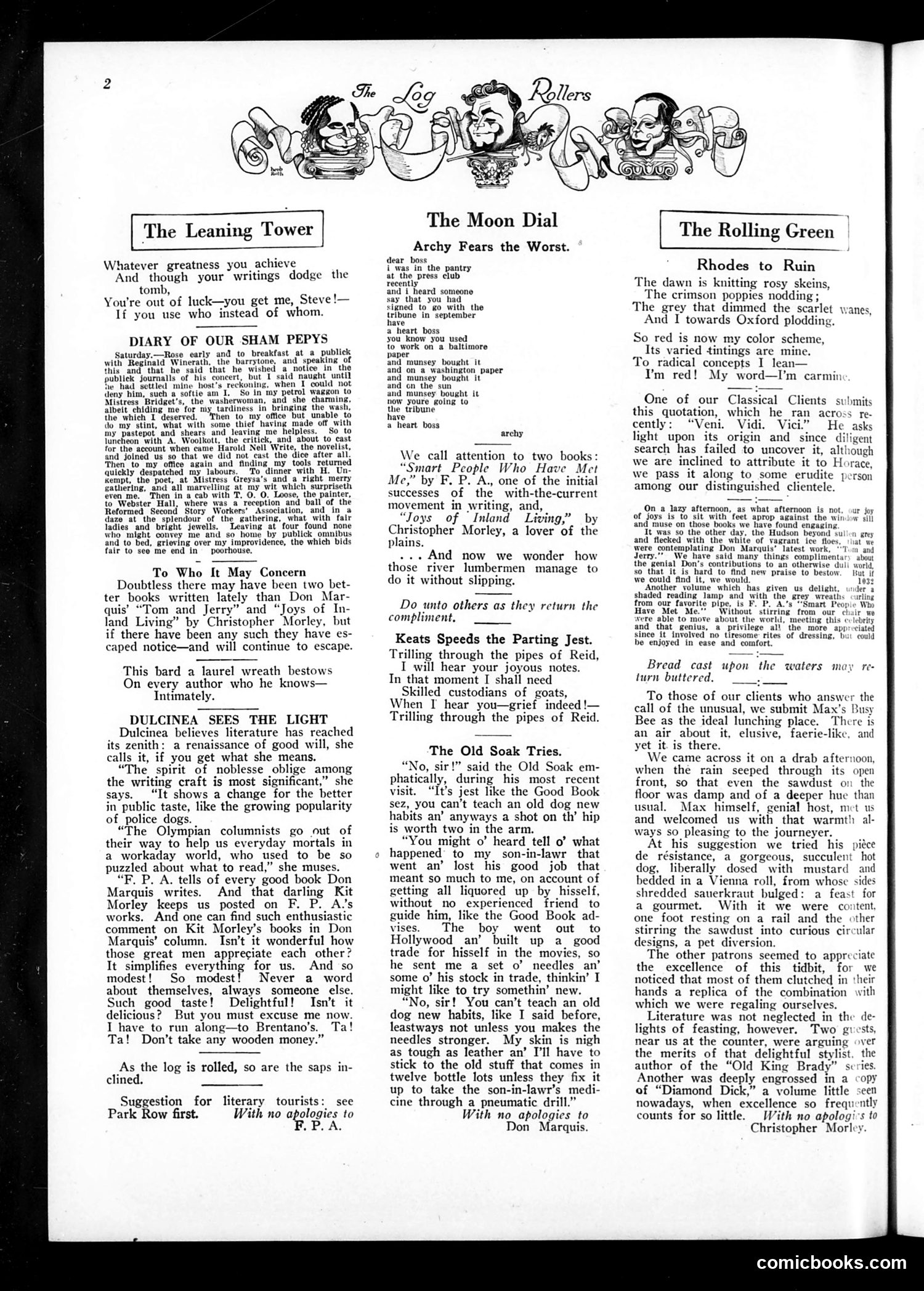
This page from *Life* magazine features three satirical columns with literary and social commentary rather than political cartoons. "The Leaning Tower" mocks pretentious modernist writing that sacrifices clarity for affectation. "The Moon Dial" contains poetry critiquing various public figures and social trends, including references to Baltimore and Washington. "The Rolling Green" discusses classical literature and contemporary writing trends. The header illustration shows caricatured "log rollers"—a period term for writers who promote each other's work through mutual praise rather than merit. The content satirizes literary pretension, self-promotion among authors, and the disconnect between experimental modernism and accessible storytelling. The references suggest this is early-to-mid 20th century literary criticism.
📄 Transcribed text from this page (OCR, searchable)
Machine-transcribed from the original scan — historical spelling and the odd misread are preserved.
The Leaning Tower Whatever greatness you achieve And though your writings dodge the tomb, You're out of luck—you get me, Steve!— If you use who instead of whom. DIARY OF OUR SHAM PEPYS Saturday.—Rose early and to breakfast at a publick with Reginald Winerath, the barrytone, and speaking of this and that he said that he wished a notice in the publick journalls of his concert, but I said naught until fe had settled mine host's reckoning, when I could not deny him, such a softie am I. So in my petrol waggon to Mistress ‘Bridget’s, the washerwoman, and she charming, albeit chiding me for my tardiness in bringing the wash, the which I deserved. ‘Then to my office but unable to do my stint, what with some thief having made off with my pastepot’ and shears and leaving me helpless. So to luncheon with A. Woolkott, the critick, and about to cast for the account when came Harold Nell Write, the novelist, and Joined us so that we did not cast the dice after all ‘Then to my office again and finding my tools returned quickly despatched my labours. To dinner with H. Un- Kempt, the poet, at Mistress Greysa’s and a right merry gathering, and all marvelling at my wit which surpriseth even me.” ‘Then in a cab with T. 0. 0. Loose, the painter, to Webster Hall, where was a reception and ball of the Reformed Second Story Workers’ Association, and in a daze at the splendour of the gathering, what with fair ladies and bright jewells. Leaving at four found none who might convey me and so home by publick omnibus and to bed, grieving over my improvidence, the which bids fair to see’ me end in poorhouse, To Who It May Concern Doubtless there may have been two bet- ter books written lately than Don Mar- quis’ “Tom and Jerry” and “Joys of In- land Living” by Christopher Morley, but if there have been any such they have es- caped notice—and will continue to escape. This bard a laurel wreath bestows On every author who he knows— Intimately. DULCINEA SEES THE LIGHT Dulcinea believes literature has reached its zenith: a renaissance of good will, she calls it, if you get what she means. “The spirit of noblesse oblige among the writing craft is most significant,” she says. “It shows a change for the better in public taste, like the growing popularity of police dogs. “The Olympian columnists go out of their way to help us everyday mortals in a workaday world, who used to be so puzzled about what to read,” she muses. “F. P. A. tells of every good book Don Marquis writes. And that darling Kit Morley keeps us posted on F. P. A.’s works, And one can find such enthusiastic comment on Kit Morley’s books in Don Marquis’ column. Isn’t it wonderful how those great men appreciate each other? It simplifies everything for us. And so modest! So modest! Never a word about themselves, always someone else. Such good taste! Delightful! Isn’t it delicious? But you must excuse me now. I have to run along—to Brentano's. T: Ta! Don’t take any wooden money.” As the log is rolled, so are the saps in- clined. Suggestion for literary tourists: see Park Row first. With no apologies to A. The Moon Dial Archy Fears the Worst. dear boss i was in the pantry at the press club recently and i heard someone say that you had signed to go with the tribune in september e a heart boss you know you used to work on a baltimore paper and munsey bought it and on a washington paper and munsey bought it and cn the sun and munsey bought it now youre going to the tribune have a heart boss archy We call attention to two books “Smart _ People Who Have Met Me,” by F. P. A,, one of the initial successes of the with-the-current movement in writing, and, “Joys of Inland Living,” by Christopher Morley, a lover of the plains. ...And now we wonder how those river lumbermen manage to do it without slipping. Do unto others as they return the compliment, Keats Speeds the Parting Jest. Trilling through the pipes of Reid, I will hear your joyous notes. In that moment I shall need Skilled custodians of goats, When I hear you—grief indeed !— Trilling through the pipes of Reid. The Old Soak Tries. “No, sir!” said the Old Soak em- phatically, during his most recent visit. “It’s jest like the Good Book sez, you can’t teach an old dog new habits an’ anyways a shot on th’ hip is worth two in the arm. “You might o’ heard tell o’ what happened’ to my_ son-in-lawr that went an’ lost his good job that meant so much to me, on account of getting all liquored up by hisself, without no experienced friend to guide him, like the Good Book ad- vises. The boy went out to Hollywood an’ built up a_ good trade for hisself in the movies, so he sent me a set o’ needles an’ some 0’ his stock in trade, thinkin’ I might like to try somethin’ new. “No, sir! You can’t teach an old dog new habits, like I said before, leastways not unless you makes the needles stronger. My skin is nigh as tough as leather an’ I'll have to stick to the old stuff that comes in twelve bottle lots unless they fix it up to take the son-in-lawr’s medi- cine through a pneumatic drill.” With no apologies to Don Marquis. The Rolling Green Rhodes to Ruin The dawn is knitting rosy skeins, The crimson poppies nodding ; The grey that dimmed the scarlet wanes, And I towards Oxford plodding, So red is now my color scheme, Its ied tintings are mine. To radical concepts I lean— I’m red! My word—I’m carmin ical Clients submits this quotation, which he ran across re- cently: “Veni. Vidi. Vici.” He asks light upon its origin and since diligent search has failed to uncover it, although we are inclined to attribute it to Horace, we pass it along to some erudite person among our distinguished clientele. On a lazy afternoon, as what afternoon is not, our joy of joys is to sit with ‘feet aprop against the window sill and muse on those books we have found engaging. It was so the other day, the Hudson beyond sullen grey and flecked with the white of vagrant ice floes, liat we Were contemplating Don Marquis’ latest work, and Jerry.” We have said many things complimentars about the ‘genial Don's contributions to an otherwise duli world, so that it is hard to find new praise to bestow. — Ii we could find it, we would. Another volume which has given us delight, shaded reading lamp and with the grey wreaths from our favorite pipe, is F. P. A.’s “Smart Peop Have Met Me." Without stirring from our chair we were able to move about the world, meeting this c:lebrity and that genius, a privilege all’ the more appreciated since it involved’ no tiresome rites of dressing, bui could be enjoyed in ease and comfort. Bread cast upon the waters may re- turn buttered. To those of our clients who answer the call of the unusual, we submit Max’s Busy Bee as the ideal lunching place. There is an air about it, elusive, faerie-l and yet it is there. We came across it on a drab afternoon, when thé rain seeped through its open front, so that even the sawdust on the floor was damp and of a deeper hue than usual. Max himself, genial host, met us and welcomed us with that warmth al- ways so pleasing to the journeyer. t his suggestion we tried his piéce de résistance, a gorgeous, succulent hot dog, liberally dosed with mustard and bedded in a Vienna roll, from whose sides shredded sauerkraut bulged: a feast for a gourmet. With it we were content, one foot resting on a rail and the other stirring the sawdust into curious circular designs, a pet diversion. The other patrons seemed to appreciate the excellence of this tidbit, for we noticed that most of them clutched in their hands a replica of the combination with which we were regaling ourselves. Literature was not neglected in the de- lights of feasting, however. Two gvests, near us at the counter, were arguing over the merits of that delightful stylist. the author of the “Old King Brady” series. Another was deeply engrossed in a copy of “Diamond Dick,” a volume little seen nowadays, when excellence so frequently counts for so little. With no apologi’s to Christopher Morley. comicbooks.com