
A complete issue · 34 pages · 1922
Life — February 2, 1922
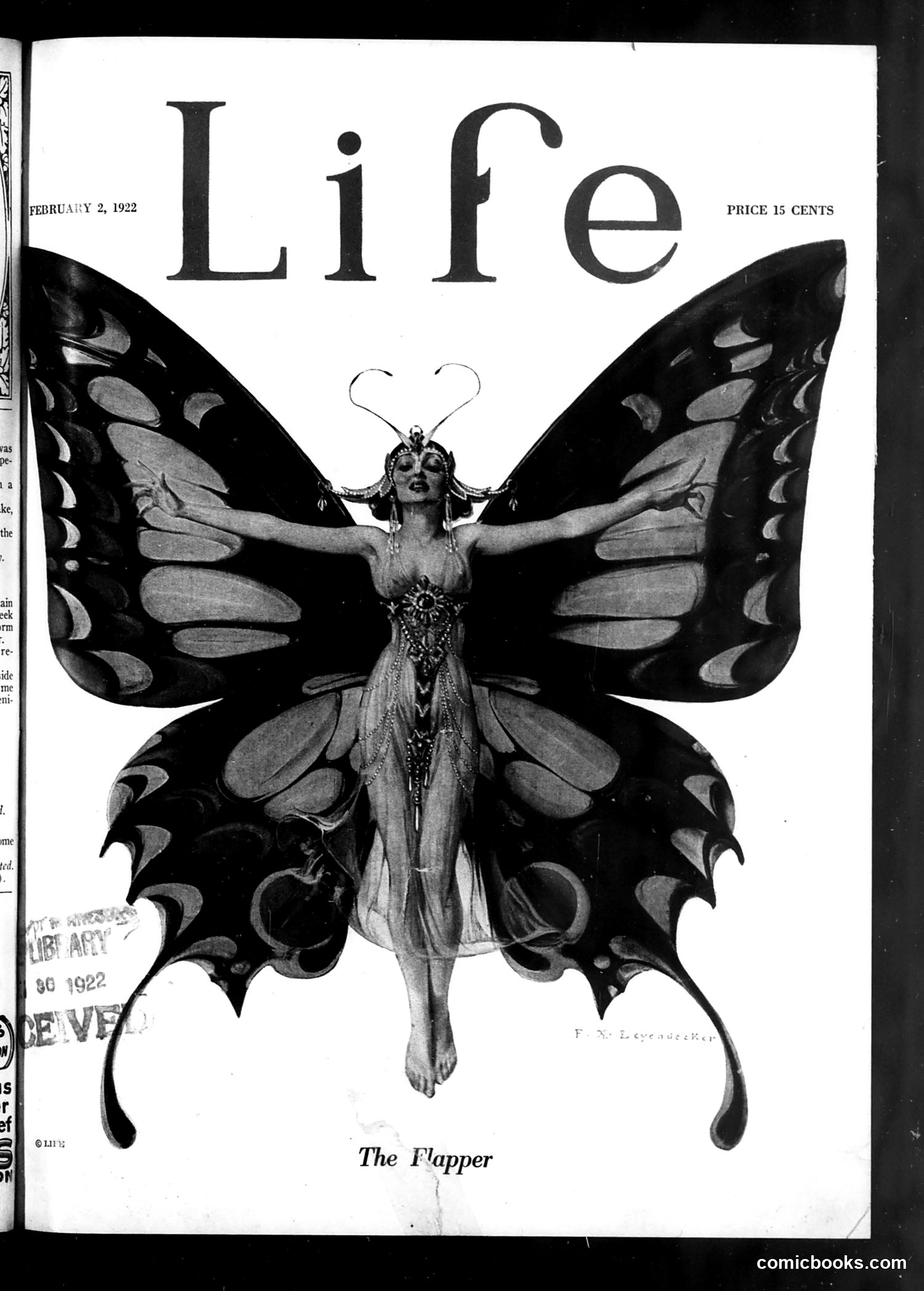
This cover satirizes the "Flapper"—a new type of young woman emerging in the 1920s who rejected Victorian social conventions. The butterfly imagery is key: the woman's transformation into a butterfly represents her radical social metamorphosis. Her abbreviated dress, bare legs, and confident pose embodied everything traditionalists found shocking about modern women: independence, sexual freedom, and rejection of domestic roles. The satire cuts both ways. The butterfly comparison could mock flappers as frivolous and insubstantial, or celebrate their liberation as beautiful transformation. Given Life's satirical tradition, it likely does both simultaneously—acknowledging the generational upheaval while poking fun at both the flappers' boldness and society's scandalized reaction to it.
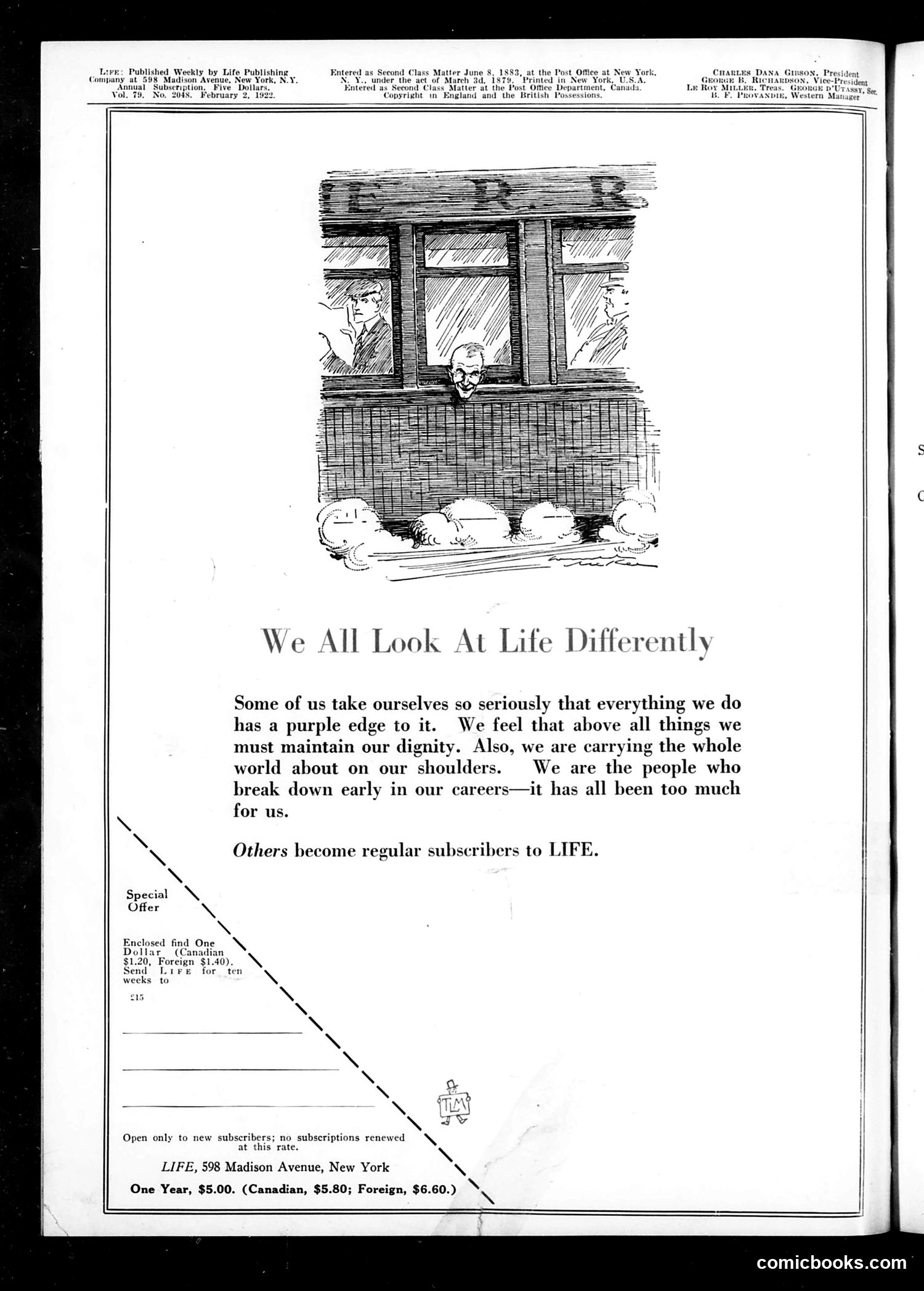
This is a subscription advertisement for *Life* magazine from February 2, 1922. The cartoon depicts a bald man peering from a window above what appear to be sleeping figures on the street below. The accompanying text uses social satire to pitch subscriptions. It contrasts two types of people: those who take life so seriously they "break down early" under the weight of dignity and worldly responsibility, versus those who become regular *Life* subscribers—implying that reading the magazine's humor provides psychological relief from modern life's pressures. The joke is that *Life* magazine serves as a mental health remedy for uptight, overworked individuals. The window scene reinforces the theme of perspective and detachment—looking at life differently through the magazine's satirical lens.
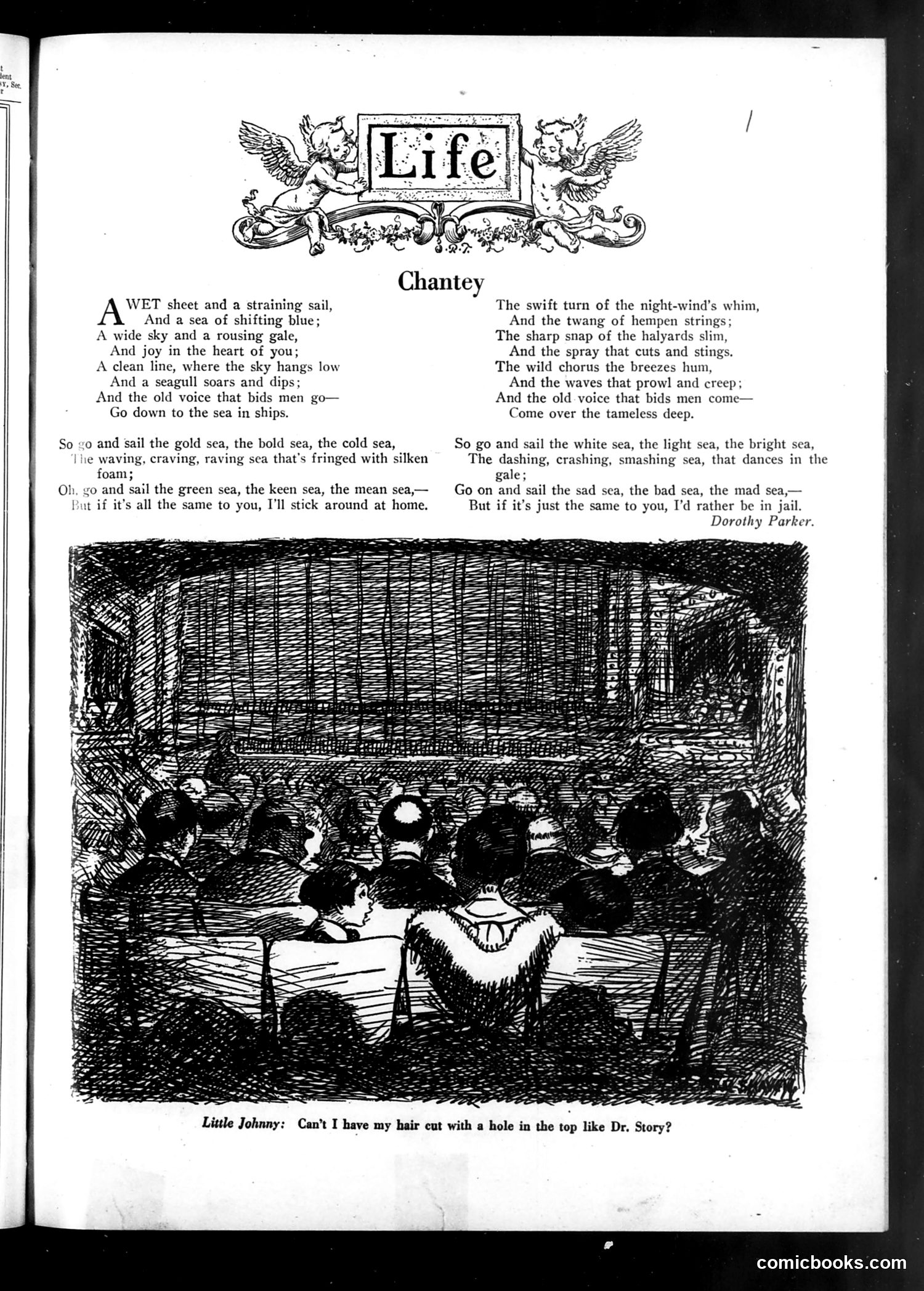
This page from *Life* magazine features "Chantey," a poem by Dorothy Parker about the appeal of seafaring adventure, contrasted with romantic reluctance to leave home. The illustration depicts an audience viewing what appears to be a theatrical performance or vaudeville show—the period's popular entertainment venue. The packed audience watches performers on an elevated stage behind a railing. The caption below presents a joke: "Little Johnny: Can't I have my hair cut with a hole in the top like Dr. Story?" This references a specific contemporary figure, likely a well-known performer or public personality named Dr. Story, whose distinctive hairstyle (possibly with a bald spot) had become recognizable enough to be comedy material for children. The humor relies on this person being identifiable to *Life*'s readers of the era.
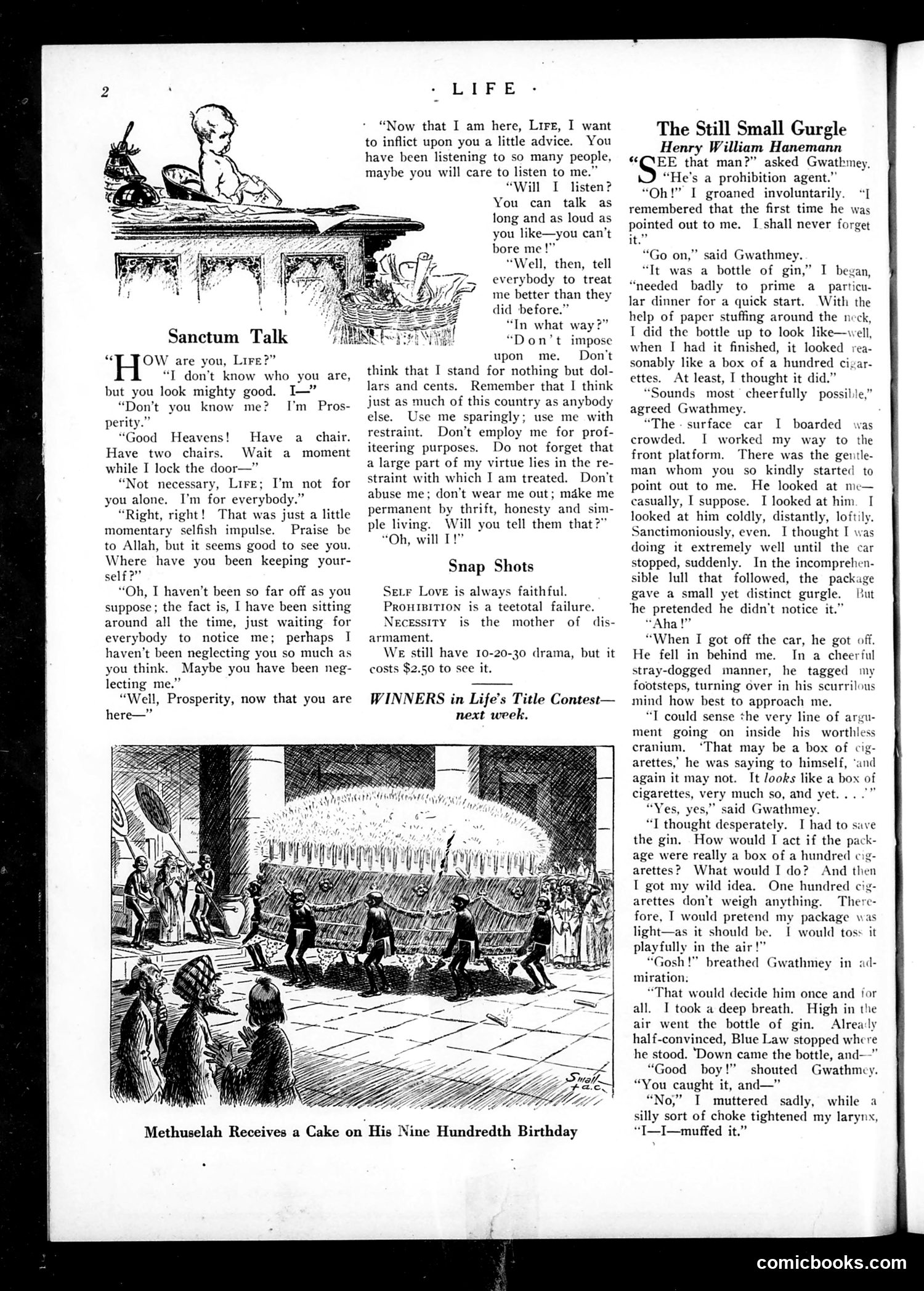
This page contains three separate pieces of satirical content: 1. **"Sanctum Talk"** — A philosophical dialogue between Life personified and Prosperity, advising restraint and virtue during prosperous times. It's generic social commentary rather than political satire. 2. **"Snap Shots"** — A humorous short story titled "The Still Small Gurgle" by Henry William Hanemann about a man who attempts to smuggle gin (during Prohibition) by concealing it in a box of cigarettes. The joke hinges on the absurdity of his scheme and his anxiety about getting caught. 3. **"Methuselah Receives a Cake on His Nine Hundredth Birthday"** — A cartoon depicting what appears to be a biblical or mythological celebration scene, likely satirizing extreme longevity or outdated traditions. The Prohibition reference dates this page to 1920-1933.
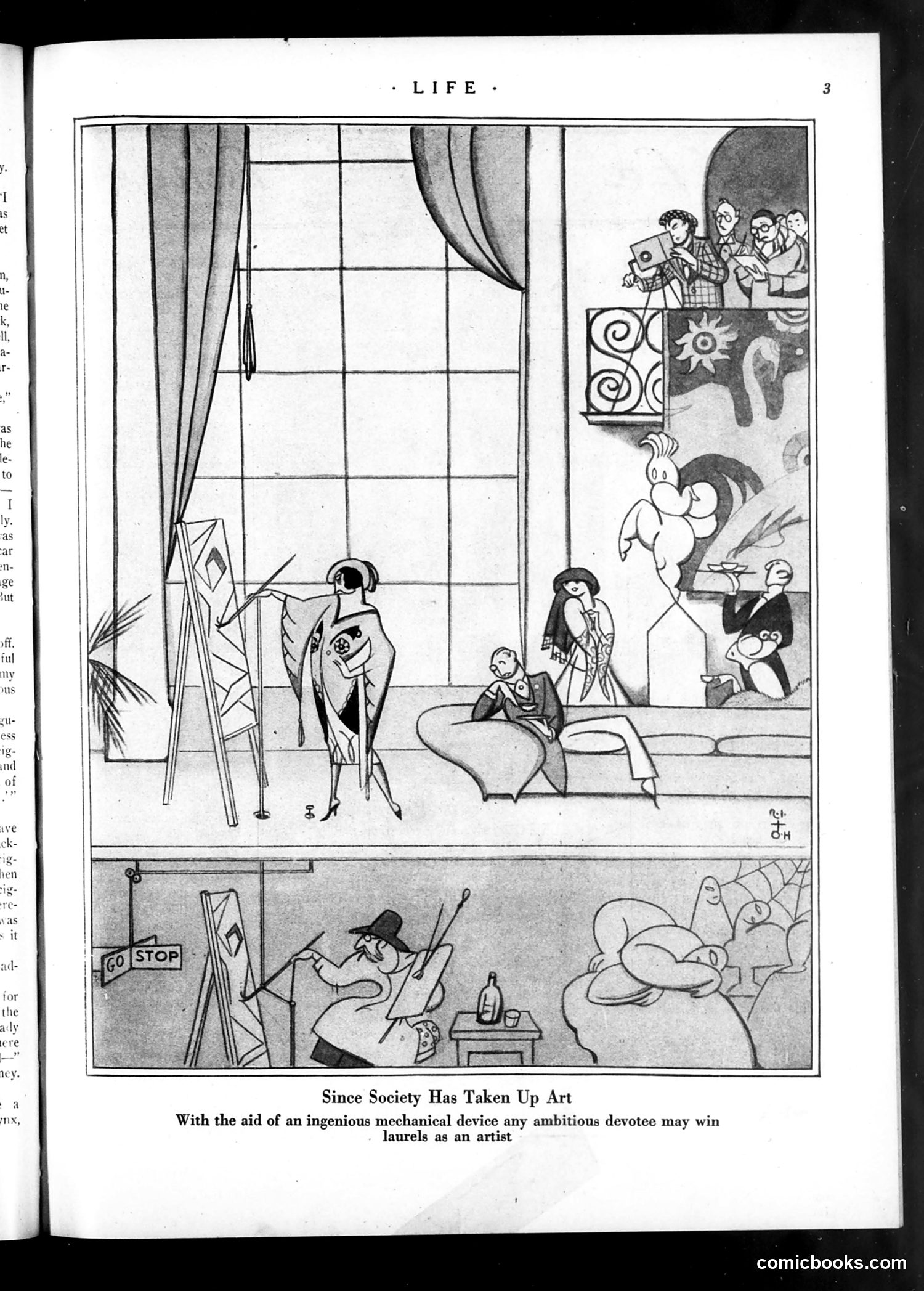
This two-panel satire mocks the democratization of art through modern mechanical devices. The top panel shows a fashionable art studio where wealthy society figures gather around a woman using some kind of mechanical apparatus to create art—suggesting she's essentially "cheating" by using technology rather than genuine talent. The bottom panel depicts the humorous consequences: a crude artist using the same device to produce work in a basement or lower-class setting, implying the mechanical aid produces equally poor results regardless of the operator's social status. The joke satirizes how new technology promised to make anyone an "artist," undermining traditional artistic skill and merit. It's a commentary on both art world pretension and technology's oversold democratizing promises.
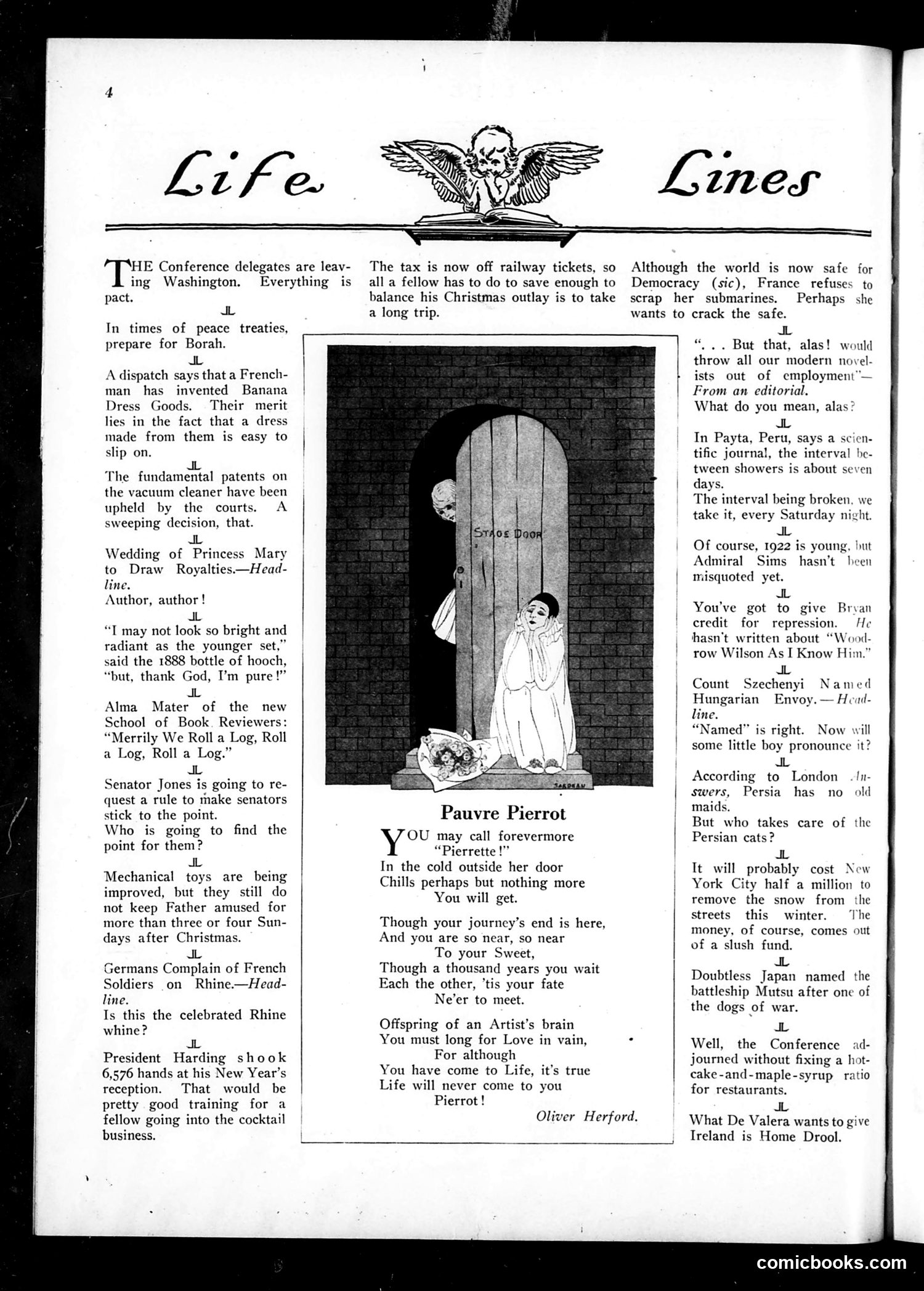
The central cartoon depicts a classical theatrical character—Pierrot, the sad clown figure from commedia dell'arte tradition—standing in a doorway on a cold night. The poem by Oliver Herford accompanying the image plays on this stock character's melancholy romantic fate: unrequited love, wandering, and ultimate destiny to meet another Pierrot after years of waiting. This appears to be sentimental rather than political satire, using Pierrot as a universal symbol of romantic disappointment and artistic suffering. The surrounding "Life Lines" section contains brief satirical notes on contemporary events (Washington conferences, patents, elections), but the Pierrot piece is pure theatrical nostalgia—a poetic meditation on love and loss dressed in traditional pantomime language.
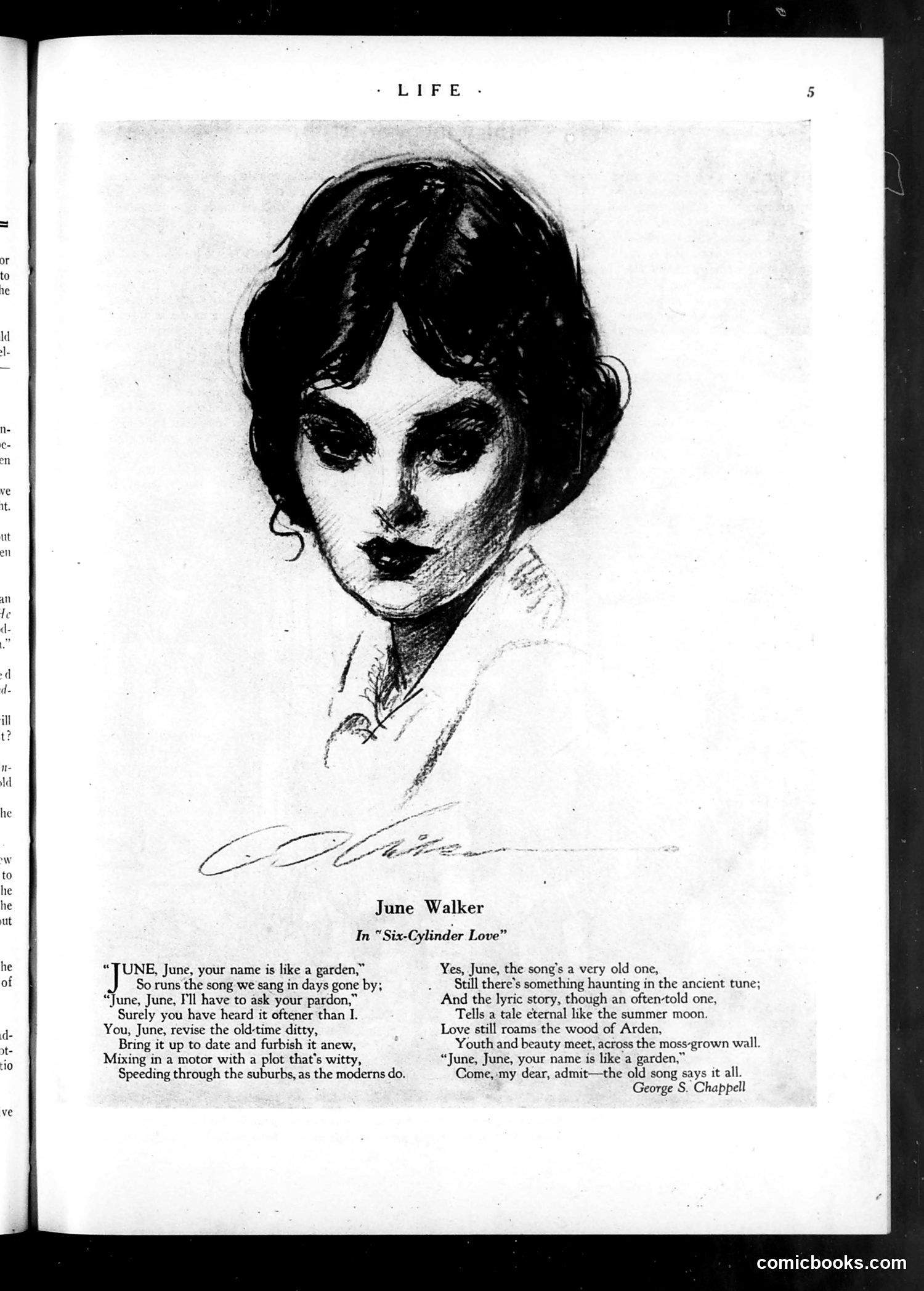
This page features a portrait sketch of **June Walker**, an actress, accompanied by a poem titled "In 'Six-Cylinder Love.'" The sketch is a classical pen-and-ink drawing showing a woman with 1920s-style short dark hair and defined features, signed by the artist. The poem below plays on the actress's name, with opening lines like "JUNE, June, your name is like a garden" and references to modernizing an old song. The verses by George S. Chappell appear to be light, humorous commentary mixing romantic imagery ("Love still roams the wood of Arden") with contemporary references to motor cars and suburban life. This appears to be a **celebrity profile** typical of Life magazine's entertainment coverage, rather than political satire.
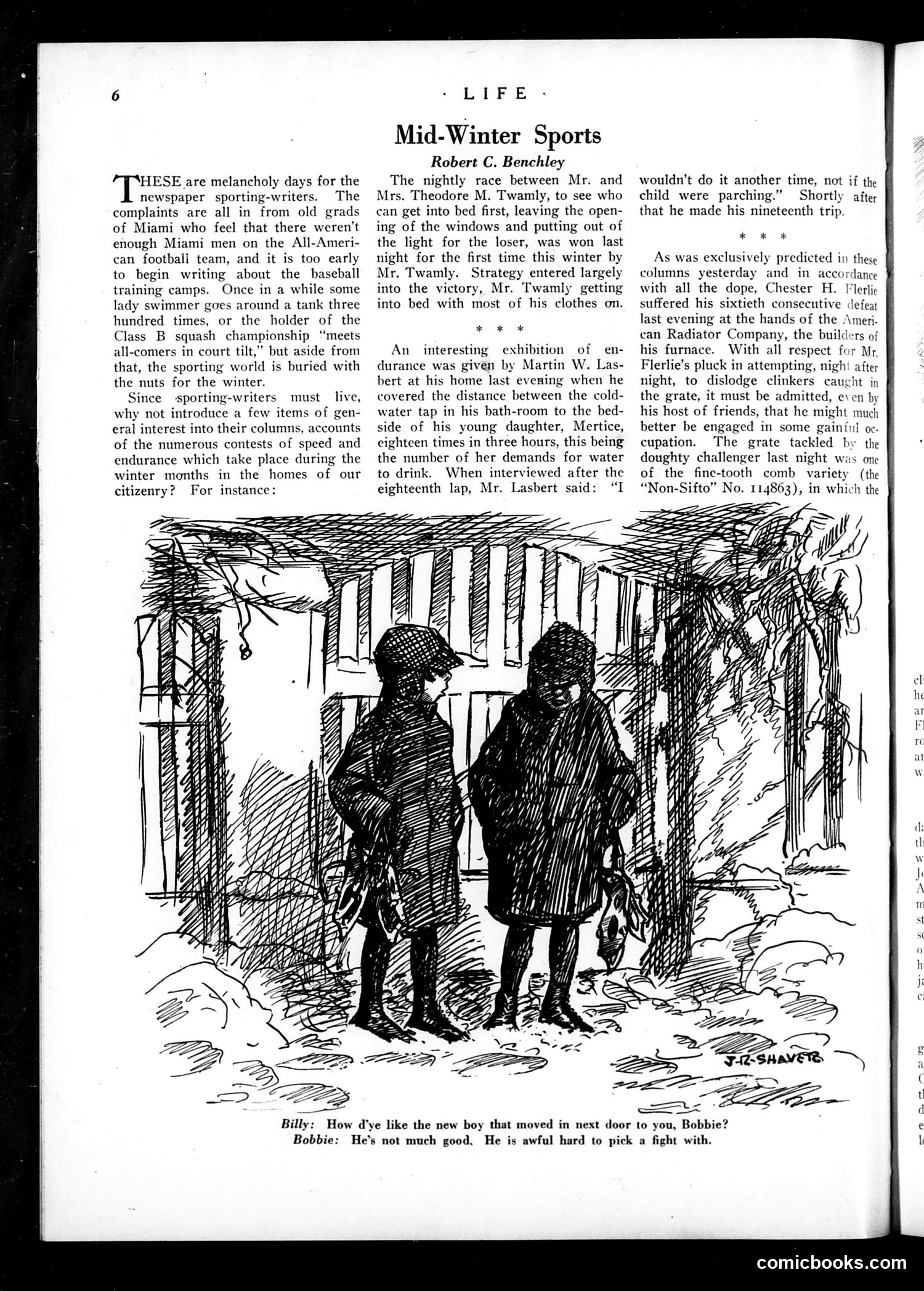
This satirical article pokes fun at sportswriters struggling to find newsworthy winter athletic events. Benchley complains that Miami has inadequate football talent and that baseball training camps haven't started, leaving the sporting press with little to cover—hence their resort to publishing trivial stories. The cartoon illustrates this desperation through a humorous anecdote: two boys discuss their new neighbor, with one claiming the boy is "awful hard to pick a fight with." The joke appears to mock how sportswriters, lacking significant events, resort to covering mundane neighborhood activities and children's squabbles as if they were sports news. The piece satirizes the newspaper industry's struggle during winter's slow sports season.
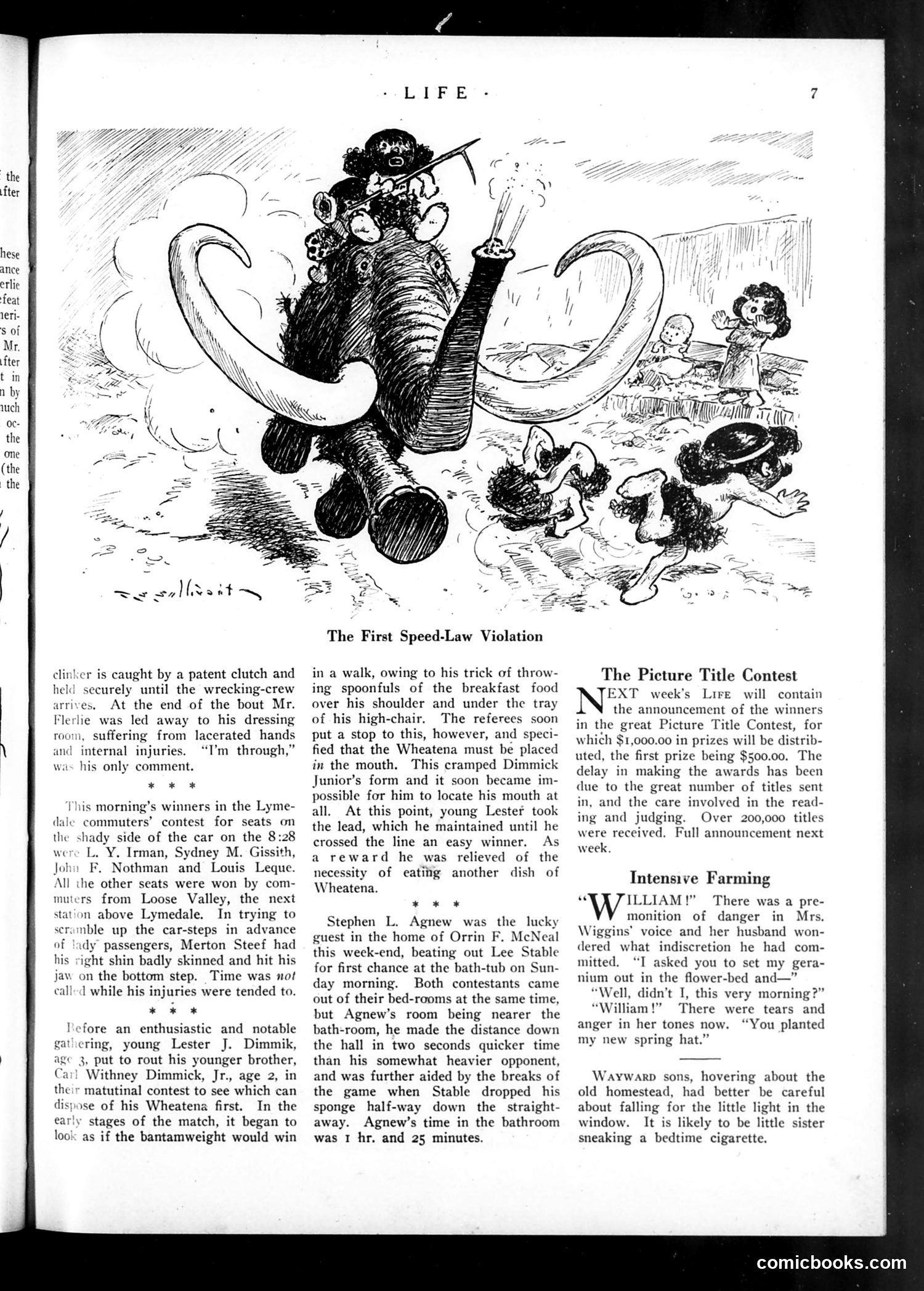
This cartoon depicts an elephant—likely representing President Theodore Roosevelt, known for his vigorous "big stick" approach—driving an automobile recklessly while small children play nearby. The elephant holds a rifle and appears to be speeding dangerously. The satire critiques early automobile speed laws and enforcement. The "First Speed-Law Violation" suggests the cartoon mocks either Roosevelt's aggressive policies or the emerging tension between powerful figures and new traffic regulations. The juxtaposition of the massive, armed elephant with vulnerable children emphasizes the danger posed by unchecked power and speed. The accompanying text discusses various humorous incidents, including a commuter contest and a "Wheaten" (wheat-based food) eating competition, typical of Life magazine's lighthearted social commentary.
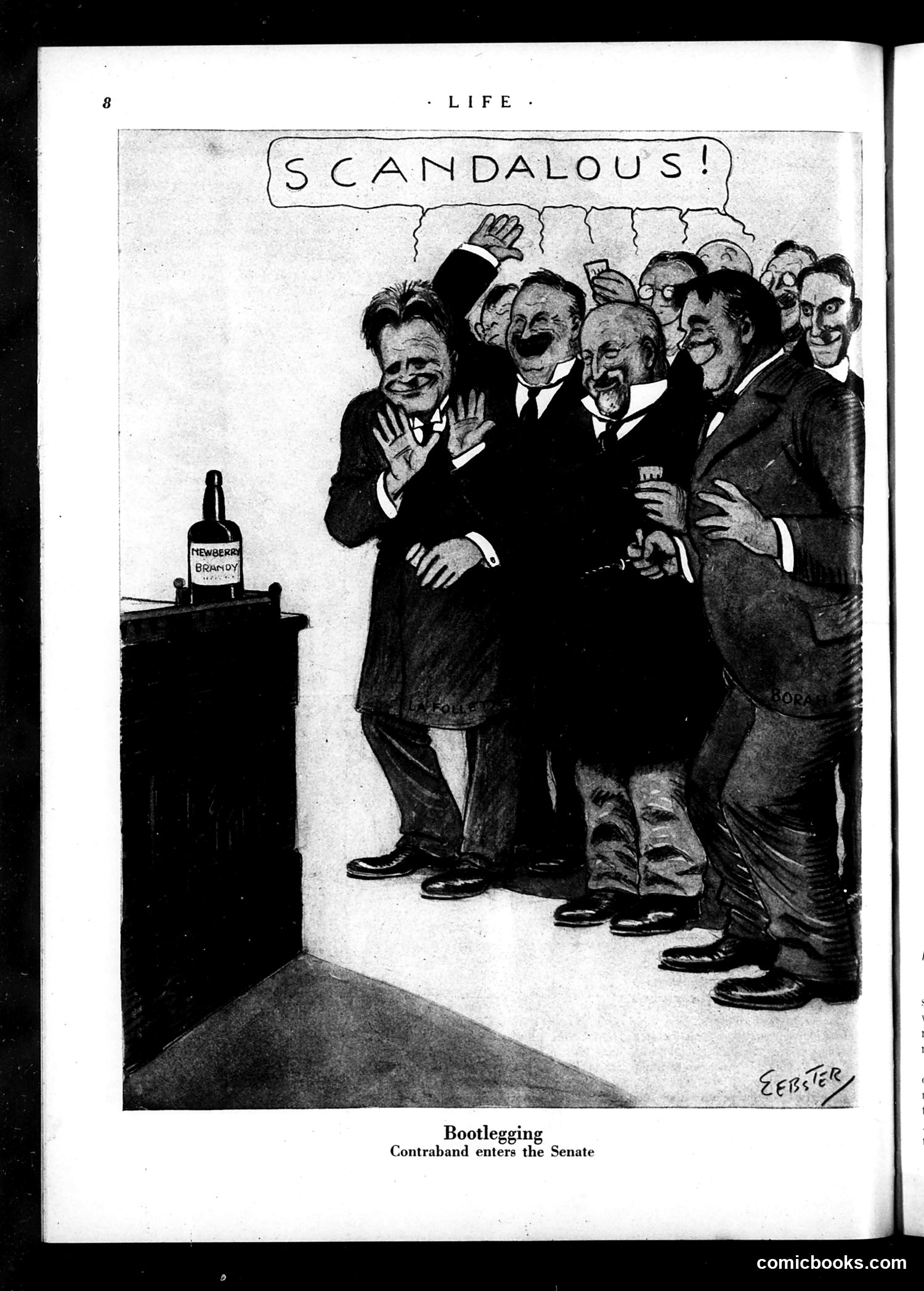
This political cartoon satirizes the infiltration of organized crime into the U.S. Senate during Prohibition. A group of exaggerated, menacing figures—appearing to represent bootleggers or gangsters—enters the legislative chamber while a senator exclaims "Scandalous!" A bottle labeled "Newberry's Booze" sits prominently on a pedestal, suggesting specific senatorial involvement in illegal alcohol trafficking. The cartoon critiques how Prohibition (1920-1933) empowered criminal syndicates and allegedly corrupted government officials. The senators' shocked reaction is ironic—their own complicity enables this criminal presence. The work comments on widespread belief that organized crime had penetrated the highest levels of American government during this era.
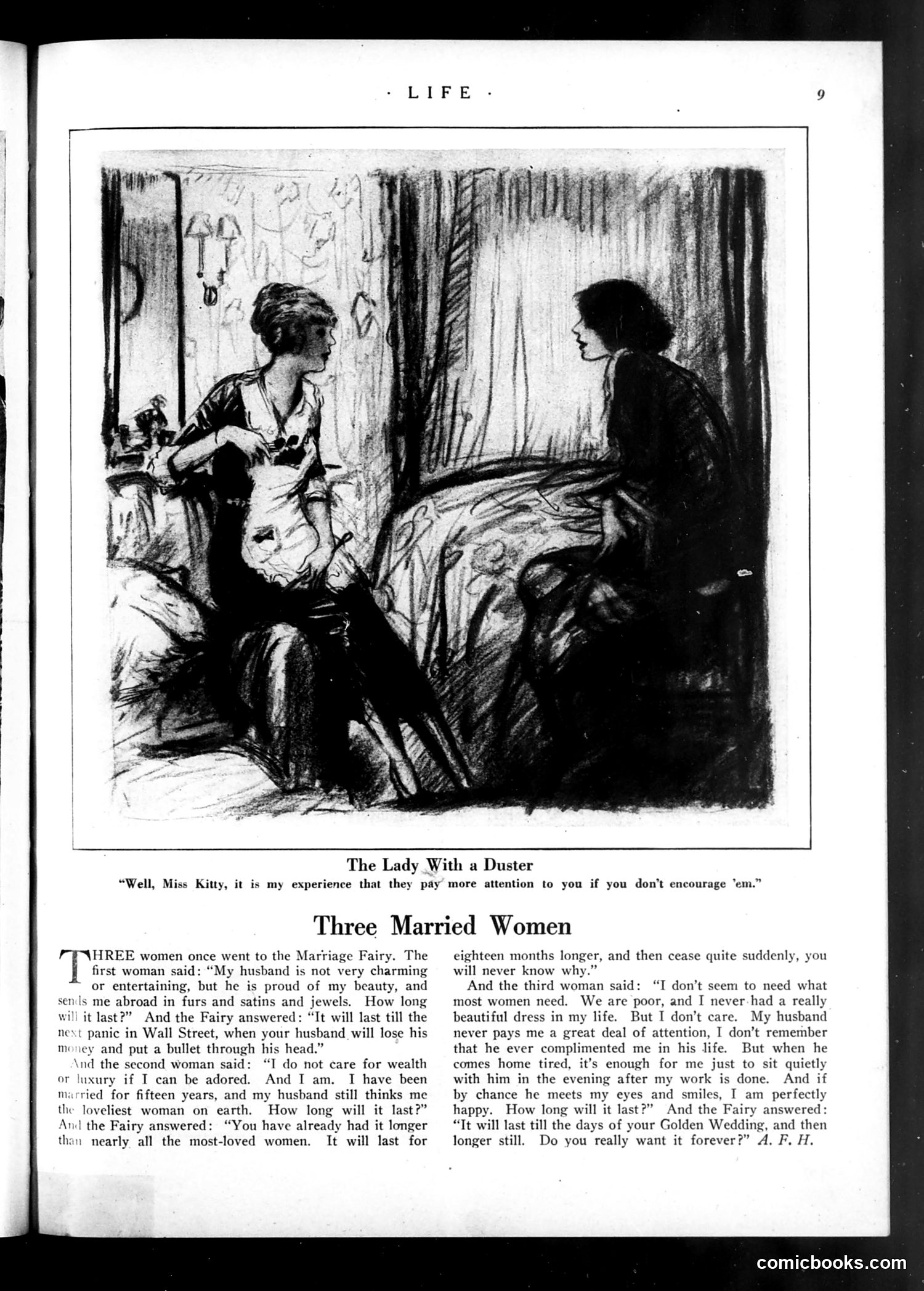
This page presents a fairy-tale styled satirical commentary on marriage and women's expectations. Three married women visit a "Marriage Fairy," each asking how long their happiness will last. The first woman brags about beauty and wealth; the second has endured 15 years of an inattentive husband; the third seeks no attention, content with quiet evenings. The fairy's response mocks all three: their happiness will last only "till the panic in Wall Street" (financial collapse), "nearly all the most-loved women" experience this decline, and ultimately until the "Golden Wedding" and death. The satire critiques both women's unrealistic marriage expectations and the economic instability threatening domestic security. The accompanying sketch shows two women in conversation—one dusting, illustrating the mundane domestic reality underlying romantic ideals.
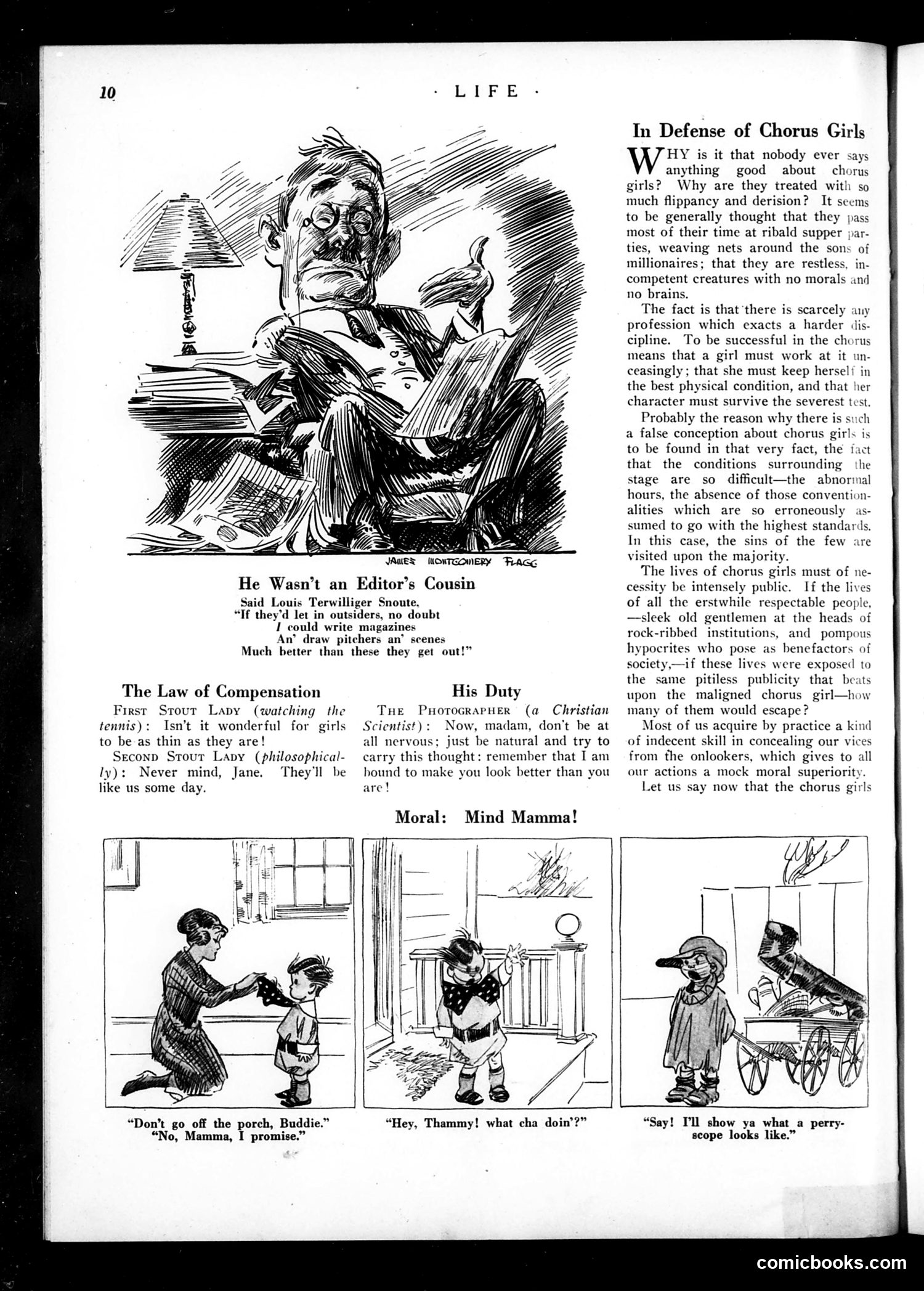
This page defends chorus girls against contemporary social criticism. The main article argues that chorus work requires intense discipline, physical conditioning, and moral character—countering the era's perception of chorus girls as frivolous, immoral women who frequent wealthy men's parties. The cartoon "He Wasn't an Editor's Cousin" satirizes nepotism in publishing, suggesting merit matters more than connections. Below, "Moral: Mind Mamma!" depicts three domestic scenes of mothers managing children—humorous reminders of parental responsibility. The page reflects early 20th-century attitudes toward theatrical performers, who faced social stigma despite their genuine professional demands. The defense suggests chorus girls were stereotyped and underestimated by respectable society.
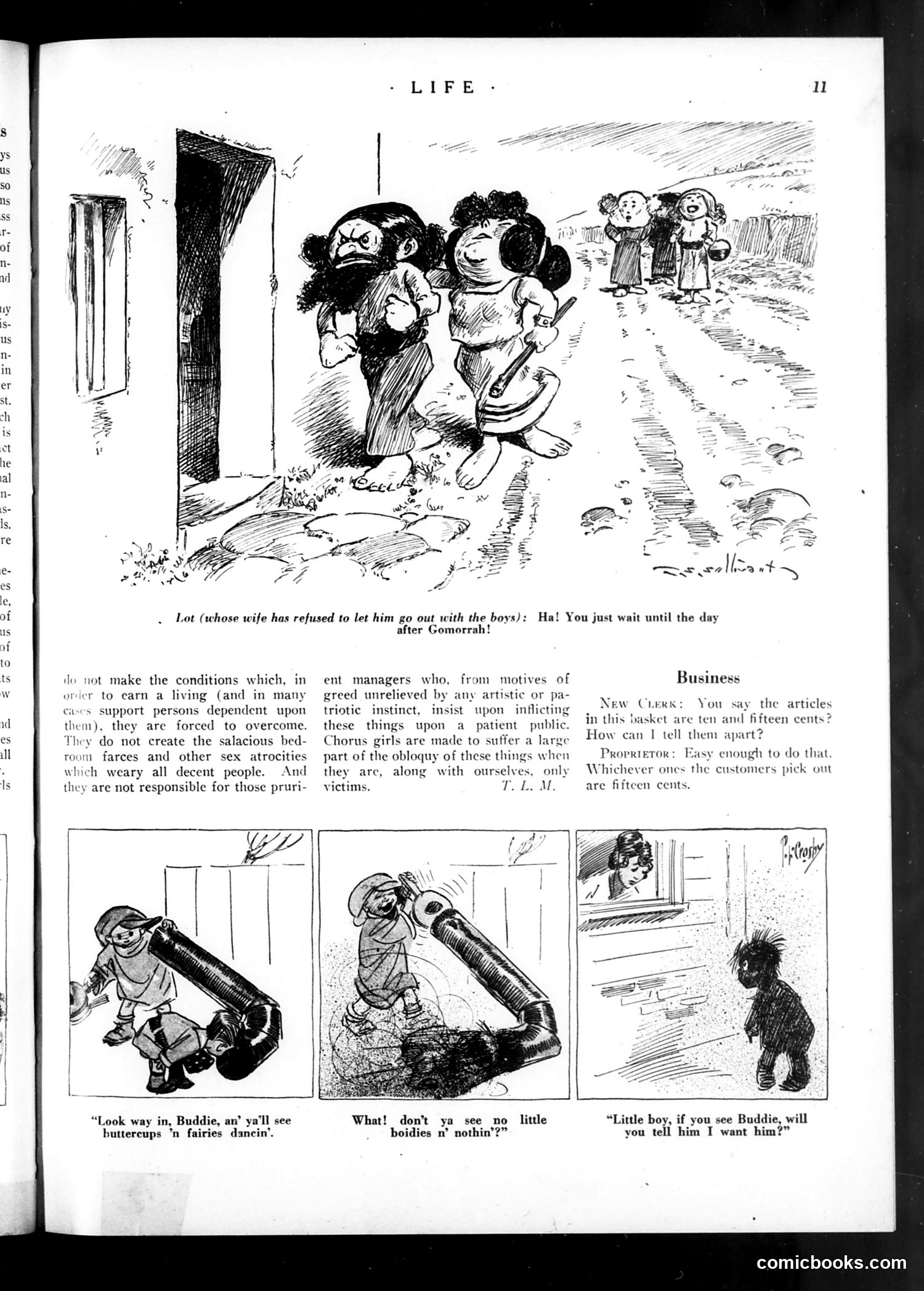
This page contains two distinct satirical pieces: **Top cartoon**: Shows children mocking a man leaving home, with the caption referencing "Gomorrah." The accompanying text criticizes entertainment industry managers who exploit chorus girls, forcing them into degrading performances while claiming artistic merit. The satire targets the hypocrisy of those who justify morally questionable practices under the guise of art. **Bottom comic strip**: Three panels show children playing with a telescope, using crude language and misbehaving. One child tells another to look for "buttercups 'n fairies"—a contrast between innocent imagery and the children's coarse reality. The final panel shows a boy being sent to deliver a message, suggesting children's mischief and poor behavior. Both pieces satirize urban working-class life and children's unsupervised, rough behavior.
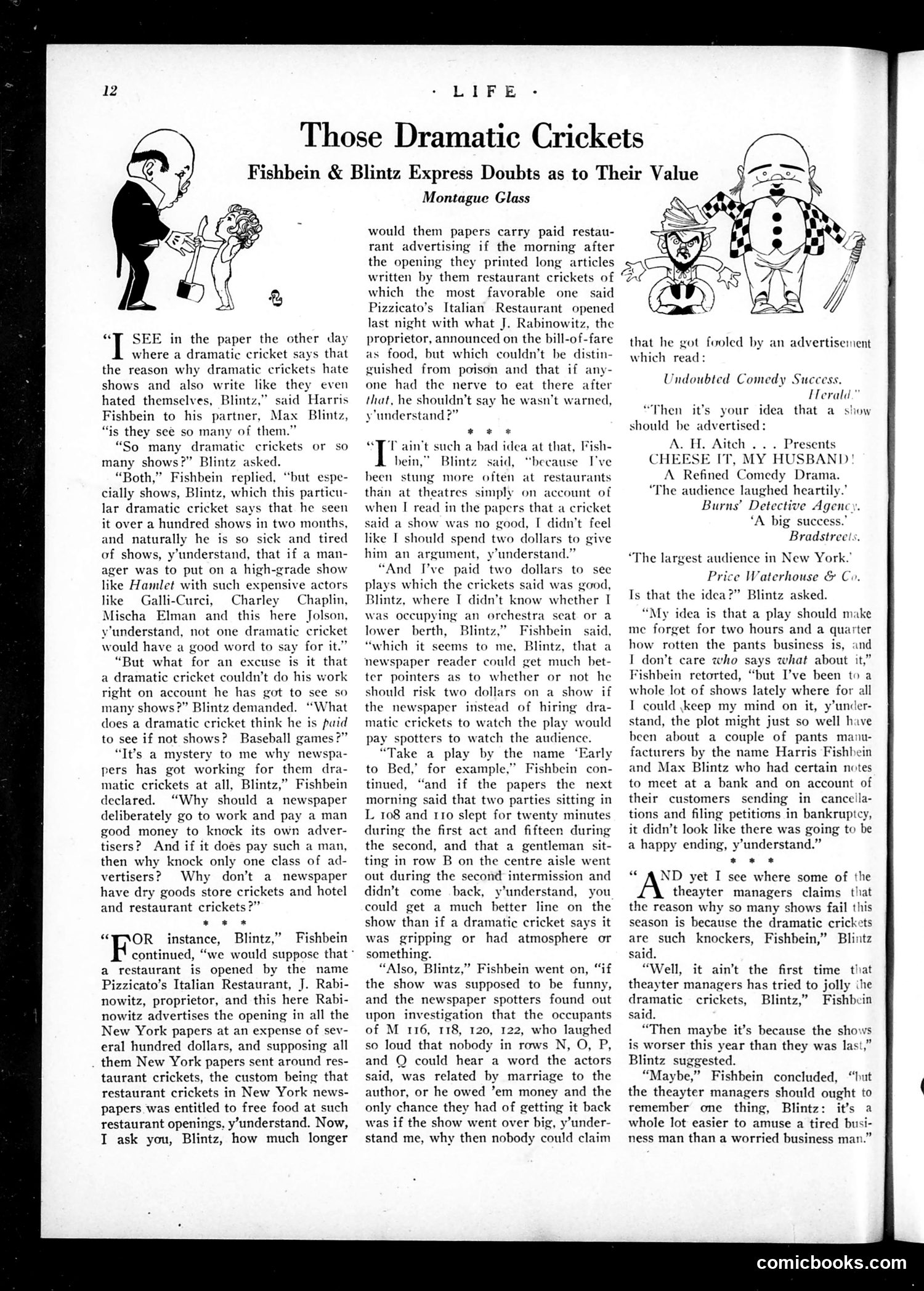
This article by Montague Glass satirizes the practice of newspapers publishing paid restaurant advertisements disguised as dramatic reviews. The term "dramatic crickets" refers to crickets (insects) placed in restaurants to create ambiance—a gimmick newspapers would cover with glowing reviews. The dialogue between characters Fishbein and Blintz (likely Jewish-immigrant stereotypes common to Glass's humor) exposes how newspapers profited from this scheme: restaurants paid for advertising space, yet newspapers claimed editorial independence by printing long articles praising the crickets as entertainment. The satire targets both newspaper greed and the absurdity of advertising disguised as journalism—a practice the author finds ridiculous enough to merit full comedic exposition to his readers.
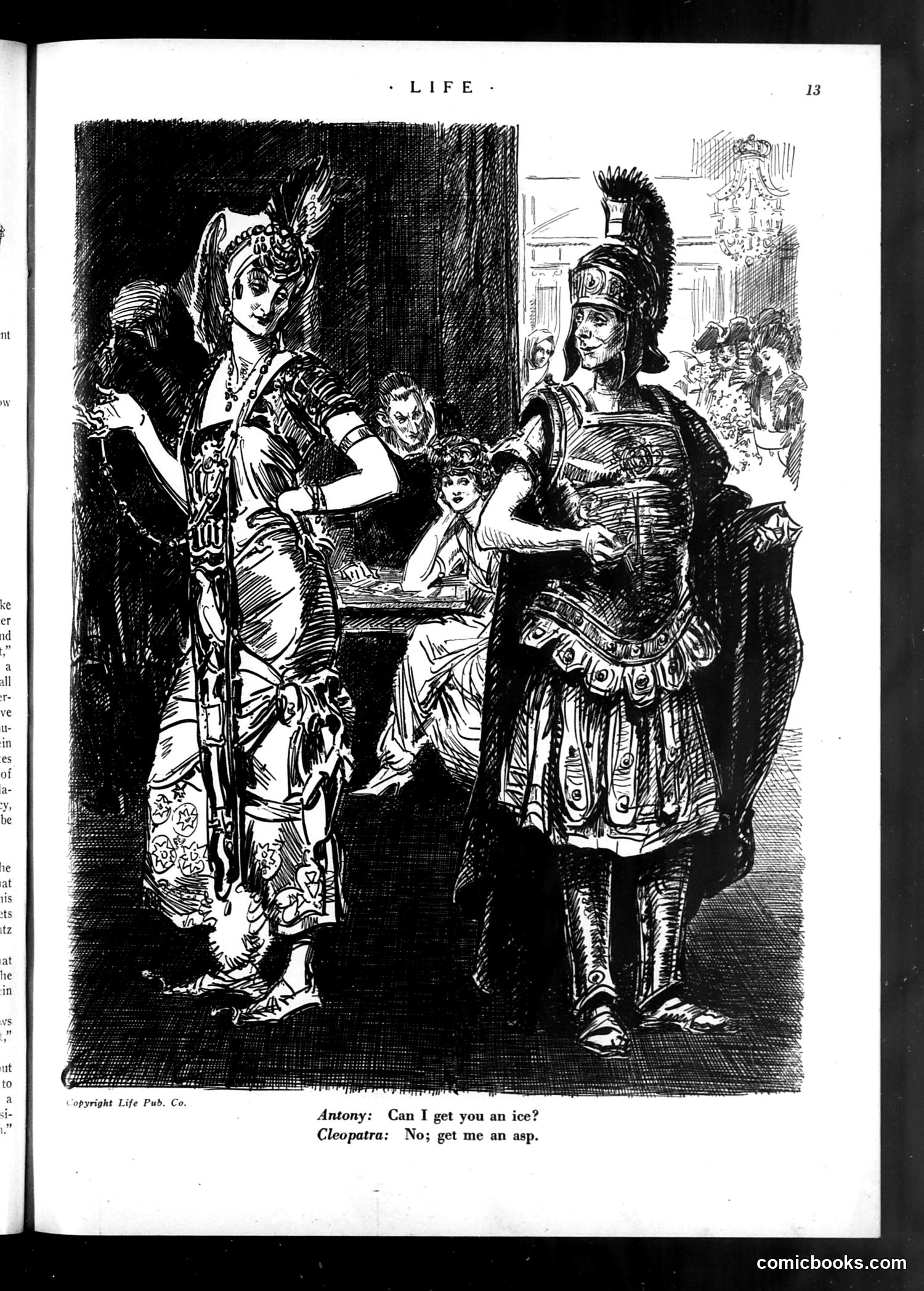
This is a theatrical illustration depicting a scene from Shakespeare's *Antony and Cleopatra*. The image shows two elaborately costumed figures in ancient Roman/Egyptian dress: Antony (male, in military armor) and Cleopatra (female, in ornate Egyptian costume with headdress). The caption presents a comedic exchange: - **Antony**: "Can I get you an ice?" - **Cleopatra**: "No; get me an asp." The joke is anachronistic wordplay. "Ice" (a frozen dessert) wouldn't exist in ancient times, making Antony's offer absurdly modern. Cleopatra's response references her historical suicide by asp bite, while "asp" sounds like "has," creating a pun on the modern offer of refreshment. The satire mocks theatrical productions that blend historical authenticity with contemporary elements.
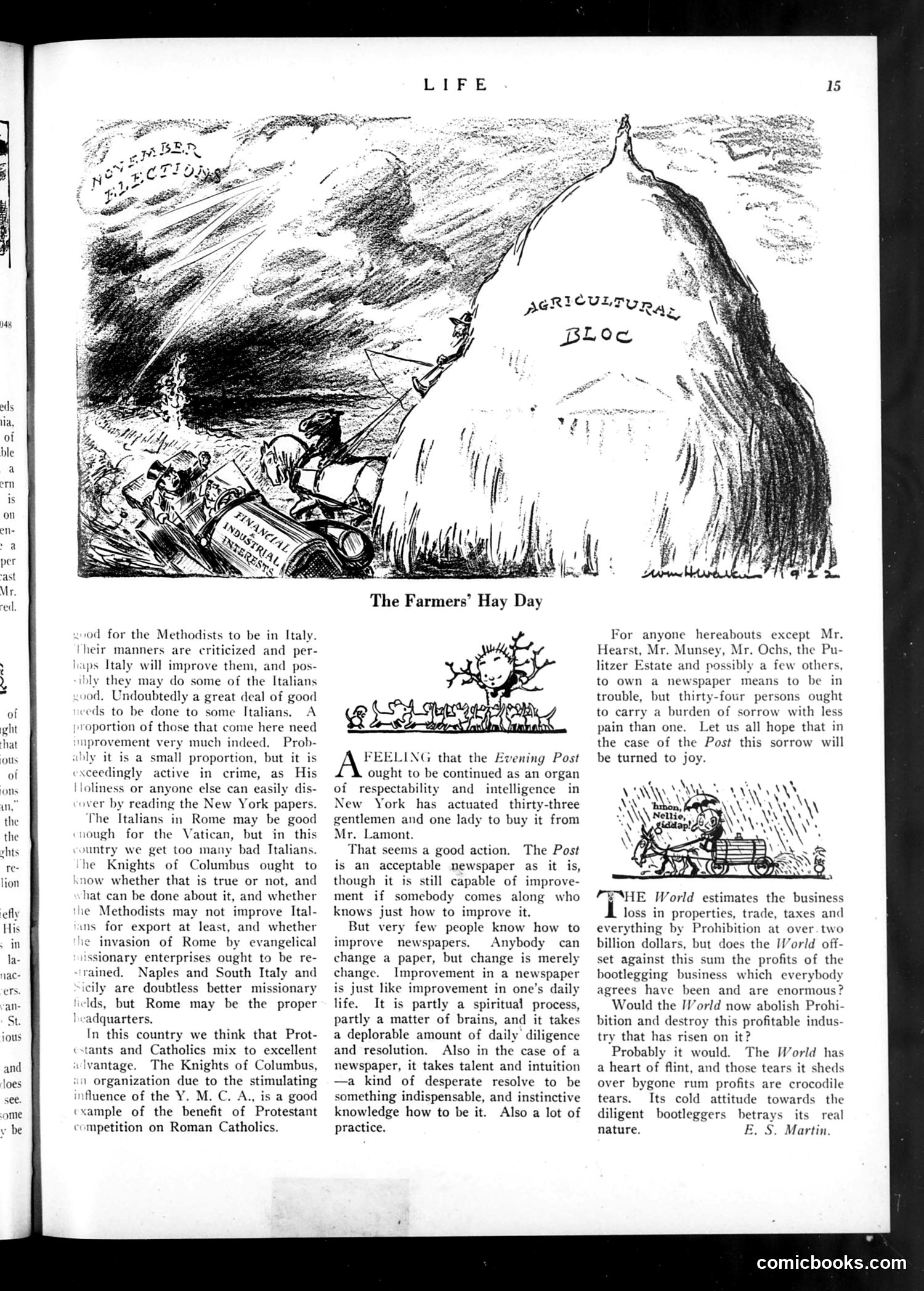
The main cartoon depicts an enormous agricultural bloc (labeled "AGRICULTURAL BLOC") towering over smaller figures, one of whom appears to be a farmer or laborer struggling beneath its weight. This satirizes the growing political power of American farmers in the early 20th century—specifically their organized influence on government policy. The "agricultural bloc" refers to a coalition of farm-state politicians who wielded substantial congressional power during this period, often blocking or demanding special treatment on legislation. The cartoon mocks how this interest group had become disproportionately powerful, crushing or dominating other concerns. The surrounding text discusses various social and political matters (Methodists in Italy, newspaper ownership, Prohibition) typical of *Life* magazine's satirical commentary on contemporary issues. The overall message critiques special-interest politics and the outsized influence farming interests held over national policy.
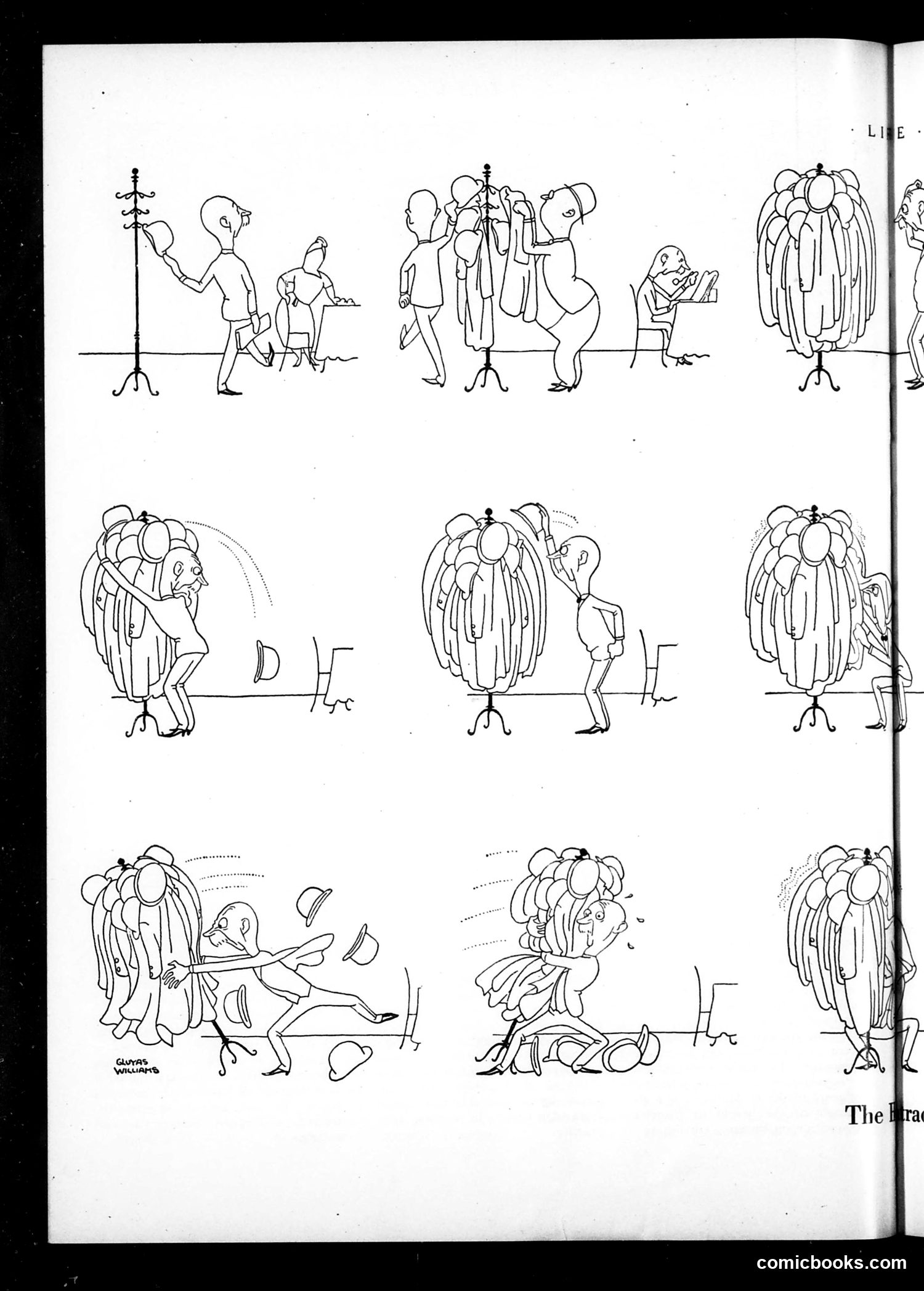
This page shows a sequential comic strip depicting what appears to be a cautionary tale about excessive consumption or greed. The top panel shows multiple figures gathered around a large, bulbous object (possibly representing wealth or excess). The subsequent panels show individual figures progressively struggling with or being overwhelmed by this same object—bending under its weight, being knocked down, or struggling to maintain control. The satire likely critiques materialism or the dangers of unchecked ambition/acquisition. The transformation from collective fascination to individual burden suggests that pursuing or hoarding excessive wealth or possessions leads to personal ruin. The comic's style and subject matter suggest this is social commentary typical of *Life* magazine's satirical approach to American consumer culture and economic behavior.
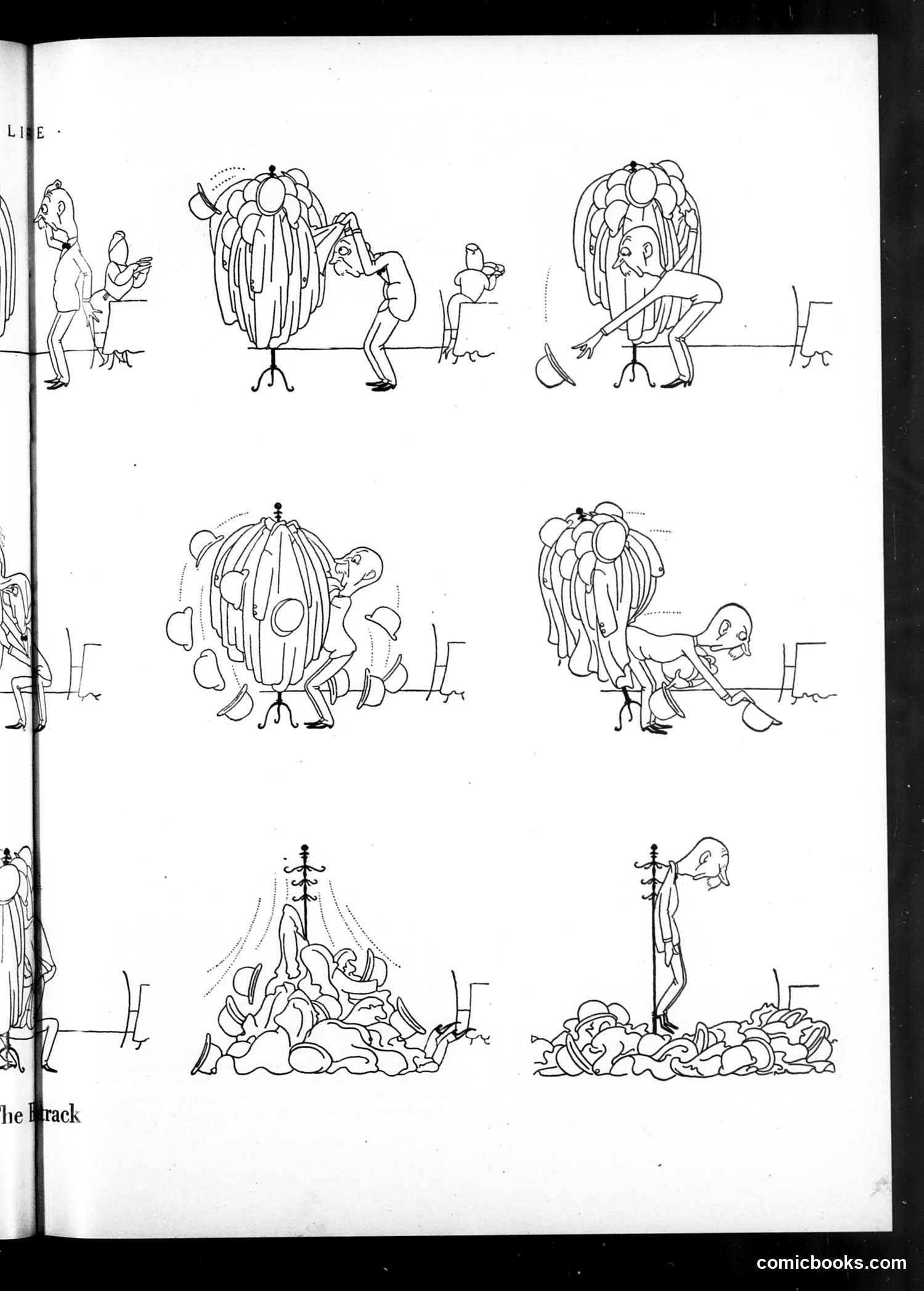
This page appears to be a sequential comic strip depicting the demise of a large, spiky fruit or produce item—possibly meant to represent a pineapple or similar agricultural commodity. The narrative shows: small human figures initially examining the object, then engaging with it, followed by what appears to be its destruction or dismantling (shown in middle panels with scattered pieces), culminating in a final scene where figures stand amid rubble with a pole or structure erected atop the debris. Without clear text or visible dates, the specific political or social reference is unclear. It could satirize industrial destruction, agricultural exploitation, or economic collapse, but the exact target—whether a particular industry, monopoly, or historical event—cannot be determined from the image alone. The symbolic intent appears critical or darkly humorous regarding something's complete ruin.
This is a theater review by Robert C. Benchley critiquing two Broadway musical comedies. The piece satirizes *"The Blue Kitten"* as tediously dull despite star Joseph Cawthorne and composer Rudolph Friml, with Benchley admitting his own unreliable taste as cover. He contrasts it with *"Up in the Clouds,"* which he finds superior despite lacking famous headliners. The humor lies in Benchley's self-deprecating honesty—he dozed through half the show and laughed only once—while backhanded compliments pepper his analysis (calling *"Up in the Clouds"* merely better than a terrible show is "faint praise"). The review mocks musical theater's pretensions while gently roasting himself as an incompetent judge of the form.
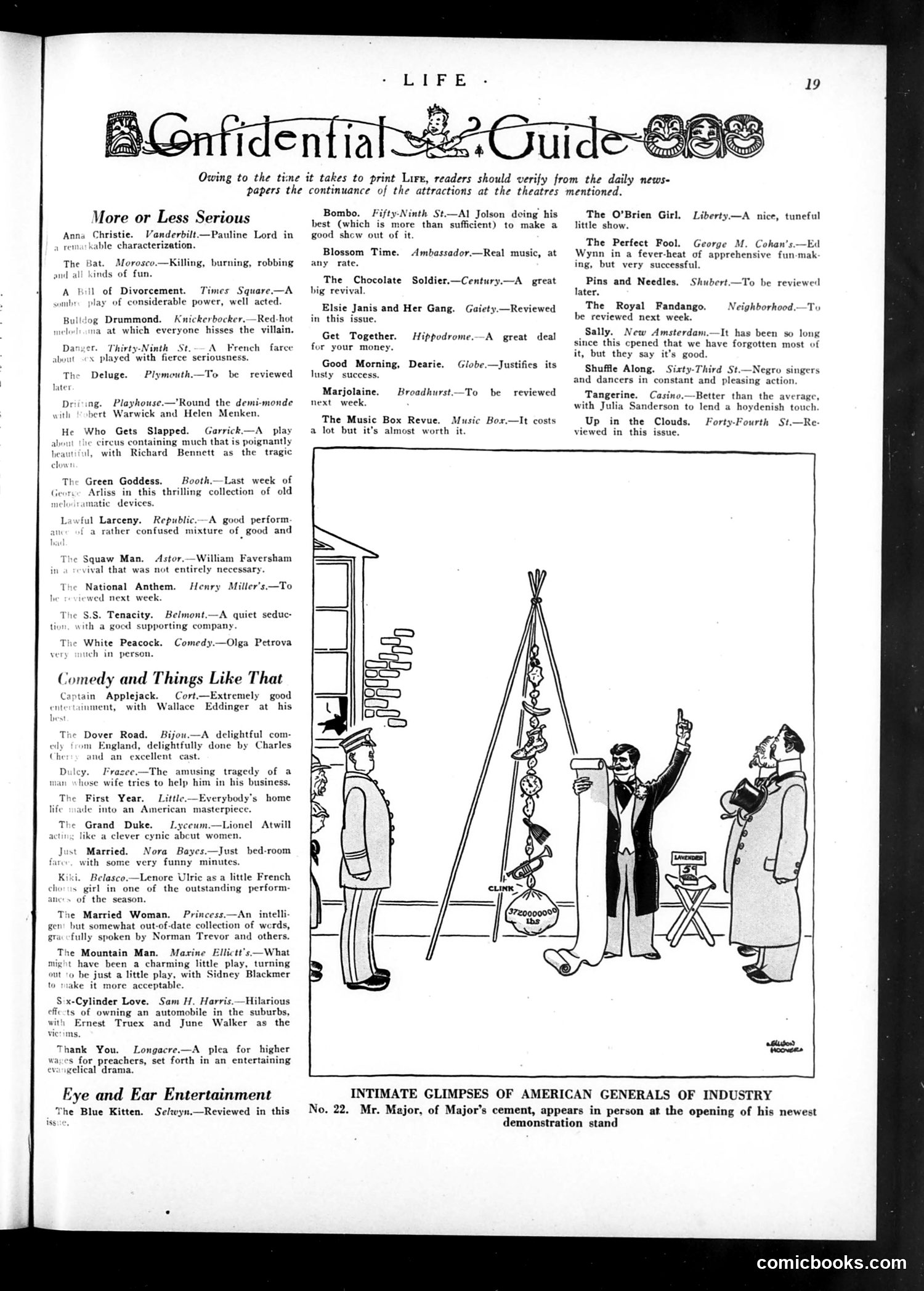
This is primarily a **theater review guide** rather than a political cartoon page. It lists Broadway shows with brief critical assessments, organized by category ("More or Less Serious," "Comedy and Things Like That," "Eye and Ear Entertainment"). The **single cartoon illustration** depicts what appears to be a camping or outdoor scene: two men in formal attire stand outside a tent, with one raising a glass in a toast. The humor seems to play on the incongruity of civilized, dressed-up behavior in a rustic camping setting—a common satirical theme of the era (1920s), mocking upper-class affectation. The page header warns readers to verify theater information in daily newspapers, since Life's printing timeline means listings may become outdated. Notable: Several reviews mention performers like **Al Jolson** and **Ed Wynn**, significant entertainers of the period. References to "Shuffle Along" (a Black musical revue) and various theatrical productions reflect 1920s Broadway culture. The content is informational rather than politically satirical—primarily a practical entertainment guide for Manhattan theater-goers.
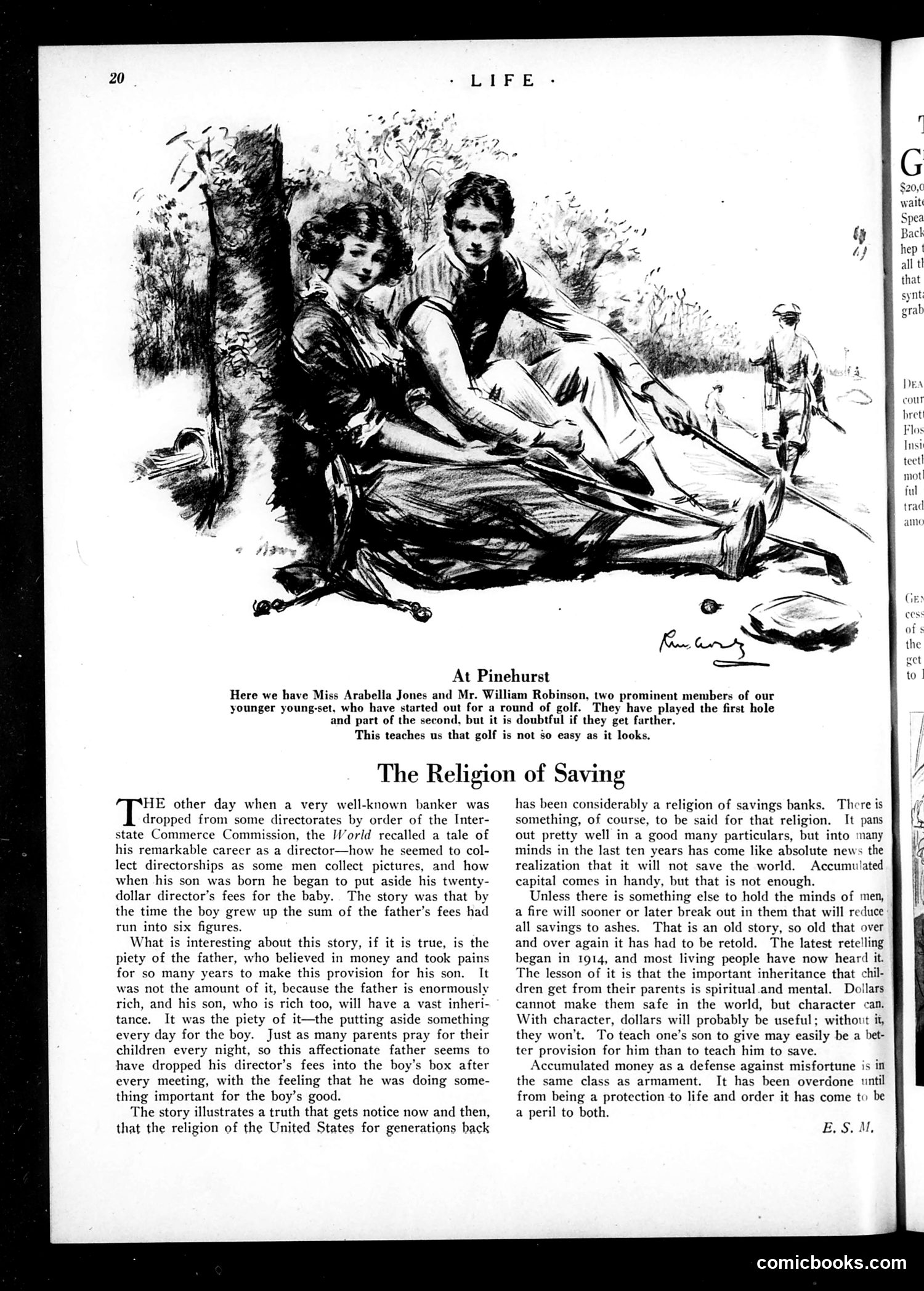
The top illustration depicts two young golfers—Miss Arabella Jones and Mr. William Robinson, identified as members of the wealthy "younger young-set"—struggling on a golf course. The satire mocks how difficult golf actually is despite its appearance of ease, poking fun at fashionable society's recreational pursuits. The accompanying essay criticizes American cultural values. It recounts a wealthy banker who saved his director's fees for his already-rich son, illustrating how American society had elevated *savings* to near-religious status. The author argues this is insufficient: mere accumulated wealth cannot protect society or provide moral grounding. Published likely during or shortly after World War I (the text references 1914), the piece sardonically suggests that character and spiritual inheritance matter more than money—a pointed critique of materialism and the failure of wealth alone to prevent catastrophe or social collapse.
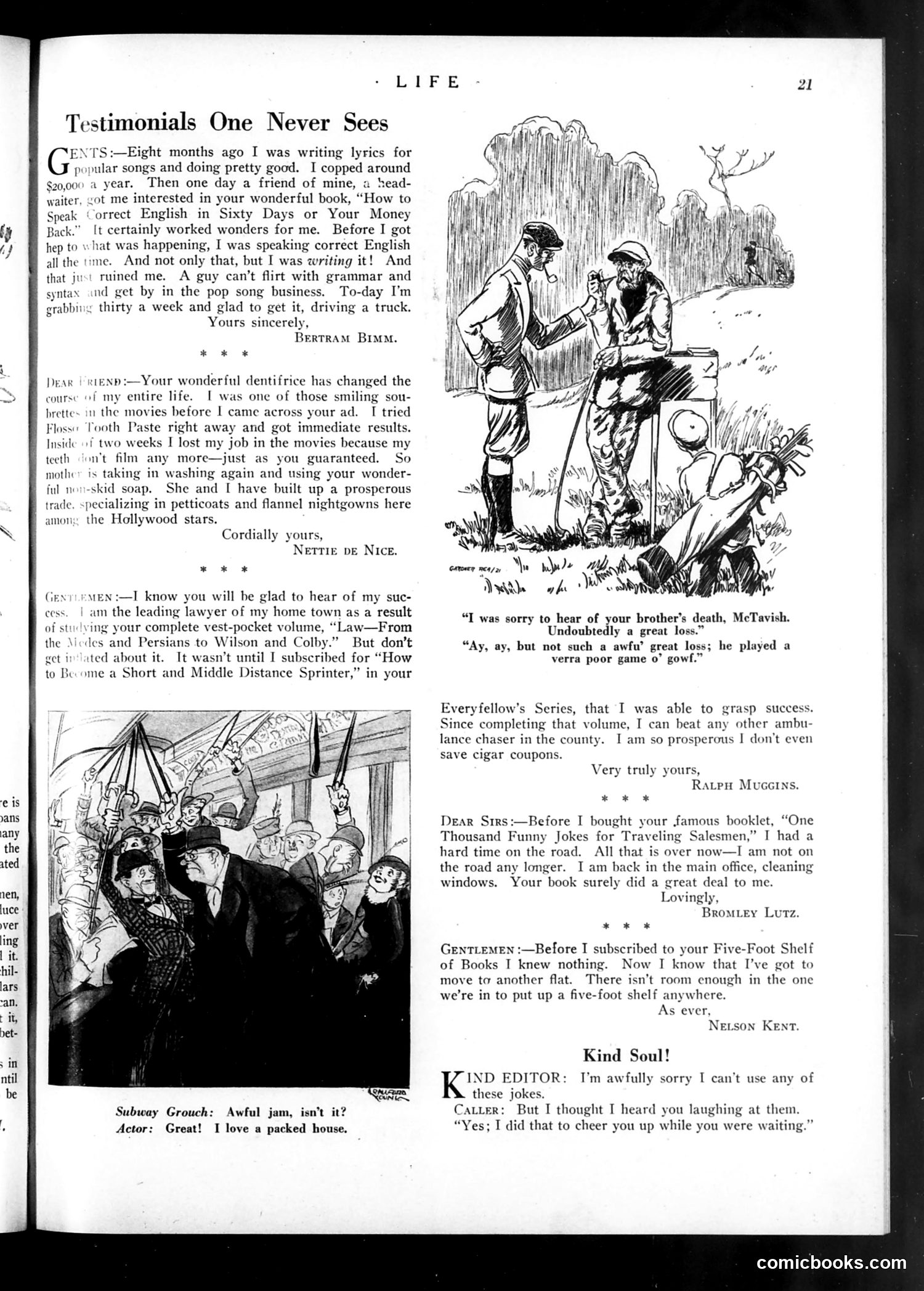
This page satirizes self-help books and mail-order courses popular in the early 20th century. The "testimonials" are fake endorsements that mock how these products claimed to transform lives—but reveal the opposite. The humor works by showing unintended consequences: a grammar book ruins a songwriter's career (correct English doesn't sell pop songs); a whitening toothpaste costs an actress her movie job; a legal guide makes someone a successful but morally questionable ambulance-chaser; joke books end a traveling salesman's road career; a "Five-Foot Shelf of Books" forces someone to move apartments. The cartoon shows a crowded subway or streetcar where people enjoy being packed together—the "grouch" complains while the "actor" loves the crowd, ironically illustrating how perspective shifts meaning. The final exchange mocks how editors reject jokes while secretly finding them funny—exposing editorial hypocrisy. The satire targets consumer culture's exaggerated product claims and the gap between marketing promises and messy reality.
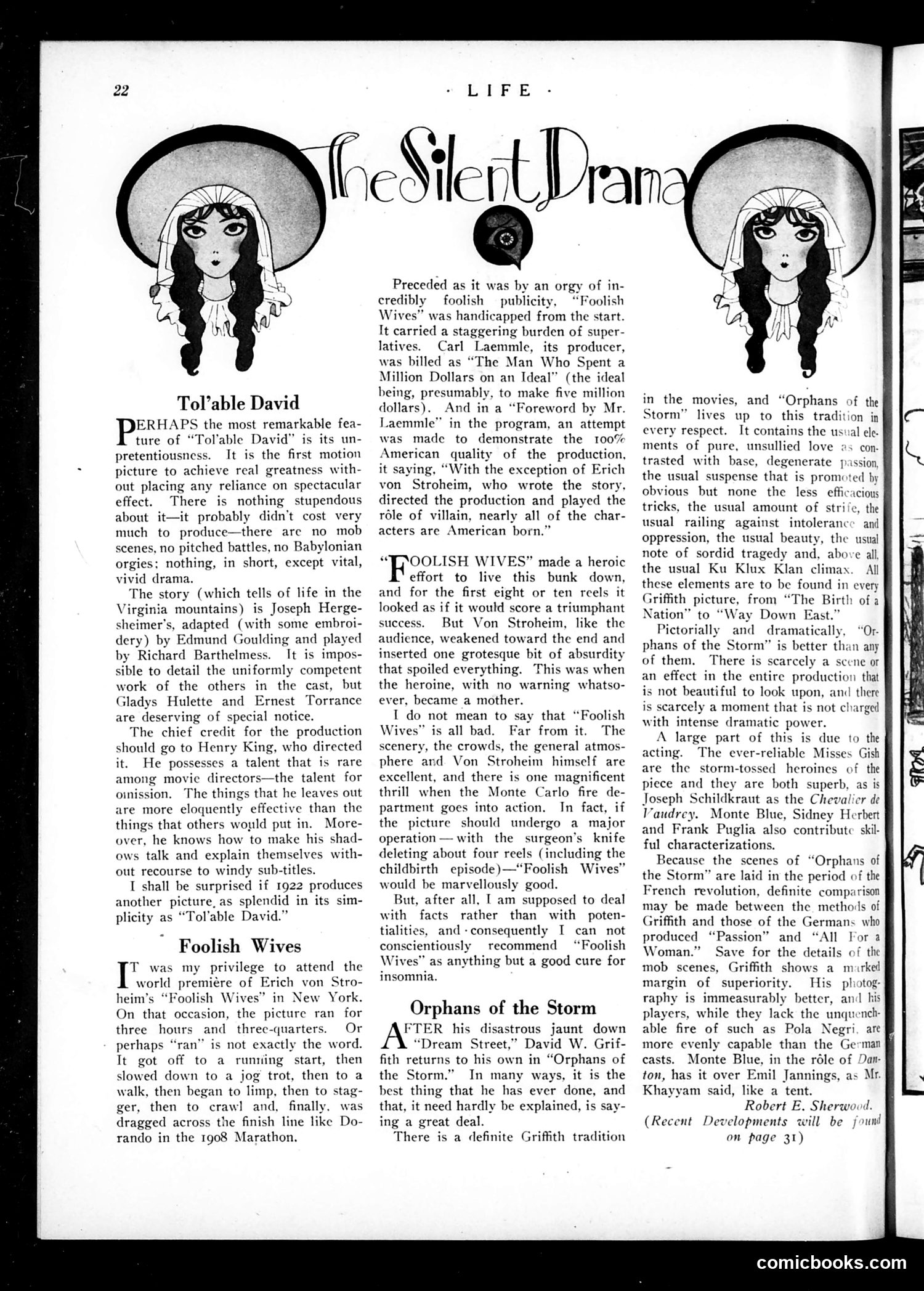
This page presents three film reviews from Life magazine, likely from 1922. The illustrations show a stylized woman's face in large hats—typical Art Deco imagery of the era. **"Tol'able David"** is praised as a remarkably effective film that achieves greatness through simplicity rather than spectacle. Set in Virginia mountains, it stars Richard Barthelmess and was directed by Henry King. The reviewer celebrates the film's restraint and effectiveness of what it *omits* rather than includes. **"Foolish Wives"** receives mixed criticism. Director Erich von Stroheim's film was burdened by producer Carl Laemmle's excessive publicity claiming it cost a million dollars. The reviewer finds the first eight reels promising but condemns a bizarre plot element (the heroine suddenly becoming a mother) as absurd. The review concludes sarcastically that it's "a good cure for insomnia." **"Orphans of the Storm"** by D.W. Griffith is introduced as his best recent work after a disappointing previous film. The review is cut off mid-page.
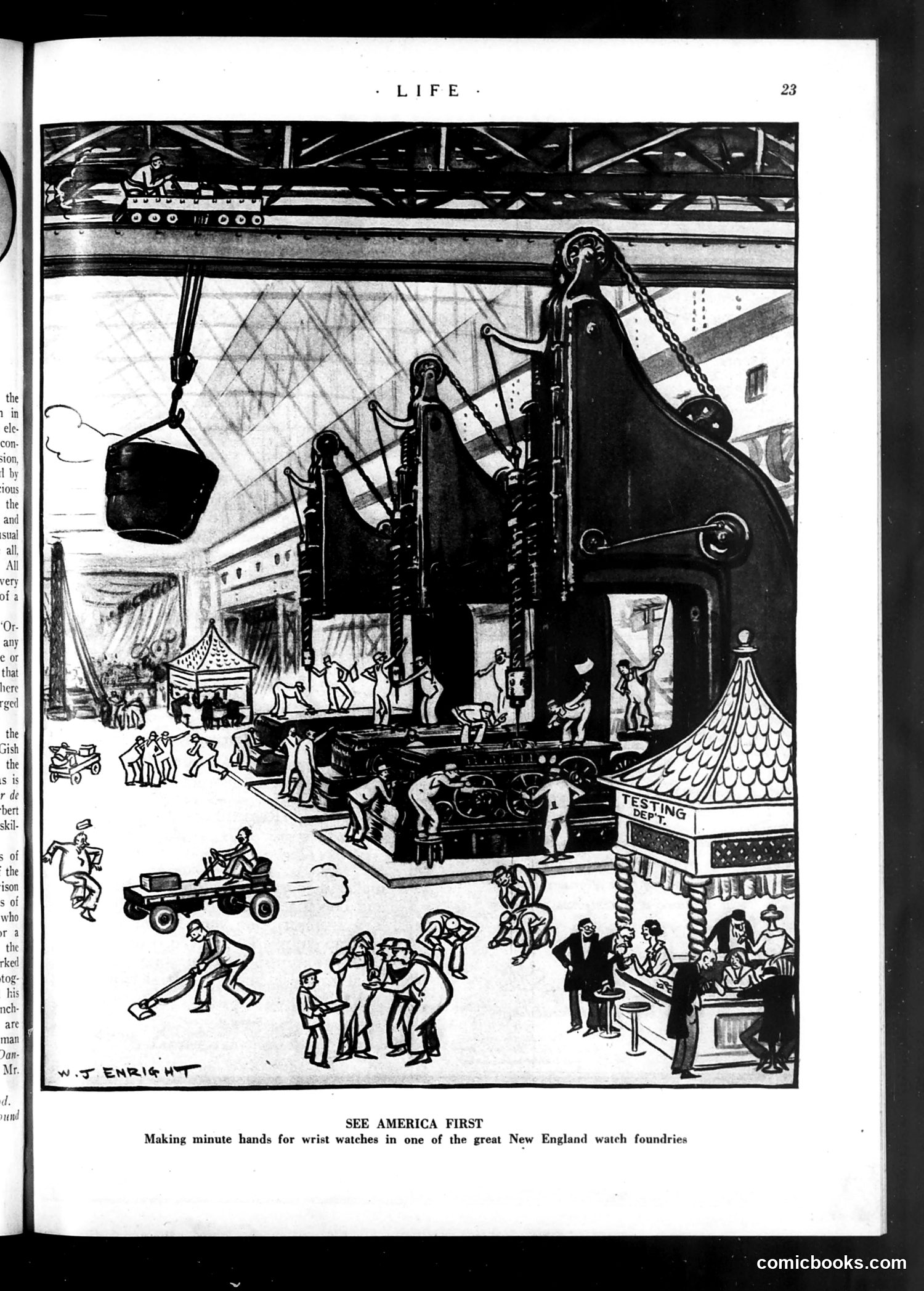
This illustration satirizes the "See America First" campaign, a 1910s-1920s push encouraging Americans to vacation domestically rather than abroad. The cartoon depicts a watch factory presented as a tourist attraction, complete with viewing stands, carnival elements (tent, food stall labeled "TESTING"), and crowds of leisure visitors. The satire mocks how industrial manufacturing was being repackaged as entertainment and national pride. Rather than showing actual workers, the image portrays the factory floor as spectacle—families and tourists casually observing precision metalwork as if at an amusement park. The juxtaposition of heavy industrial machinery with carnival atmosphere and well-dressed visitors ridicules both the artificiality of industrial tourism and American boosterism about domestic manufacturing. The "minute hands" reference underscores the tedious, repetitive labor being trivialized as tourist entertainment.
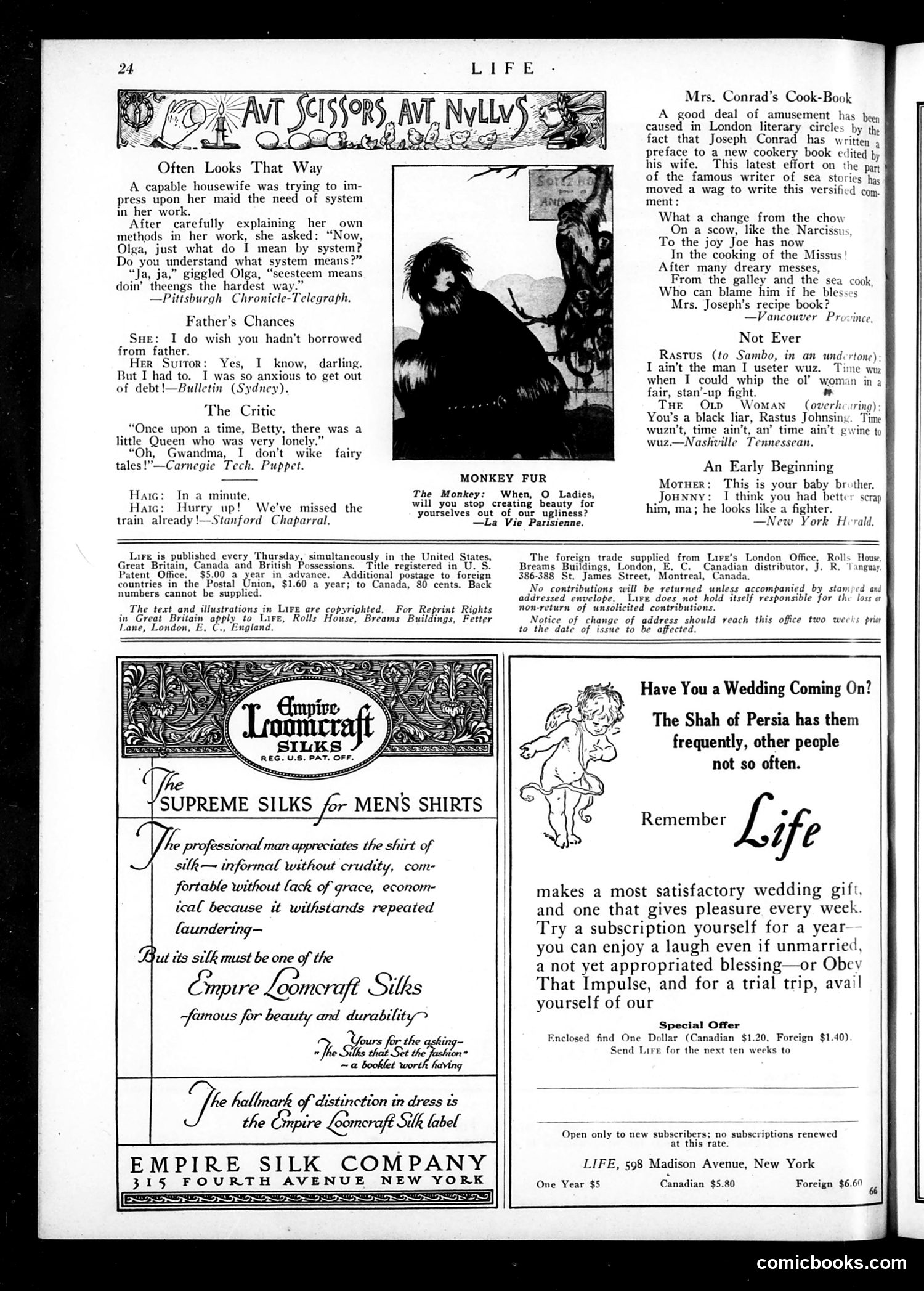
This page from *Life* magazine contains several brief humorous pieces typical of early 20th-century American satire: **"Mrs. Conrad's Cook-Book"**: A playful verse about author Joseph Conrad writing a preface to his wife's cookbook—amusing because it contrasts his serious literary reputation with domestic mundanity. **Racial Humor Pieces**: Two cartoons ("Not Ever" and "An Early Beginning") feature Black characters using dialect, reflecting the casual racial stereotyping common to the era. These depict domestic conflict and childhood observations in exaggerated "plantation" speech patterns—content modern readers would recognize as offensive caricature. **"Monkey Fur"**: A brief satirical quip where an anthropomorphized monkey protests that women create beauty using animal products at nature's expense. **Miscellaneous Jokes**: Brief comedic exchanges about housework, parenting, and train schedules—gentle domestic humor. The page also contains advertisements for silk shirts and *Life* magazine subscriptions, framing the editorial content. The overall tone is light, satirical commentary on contemporary middle-class life.
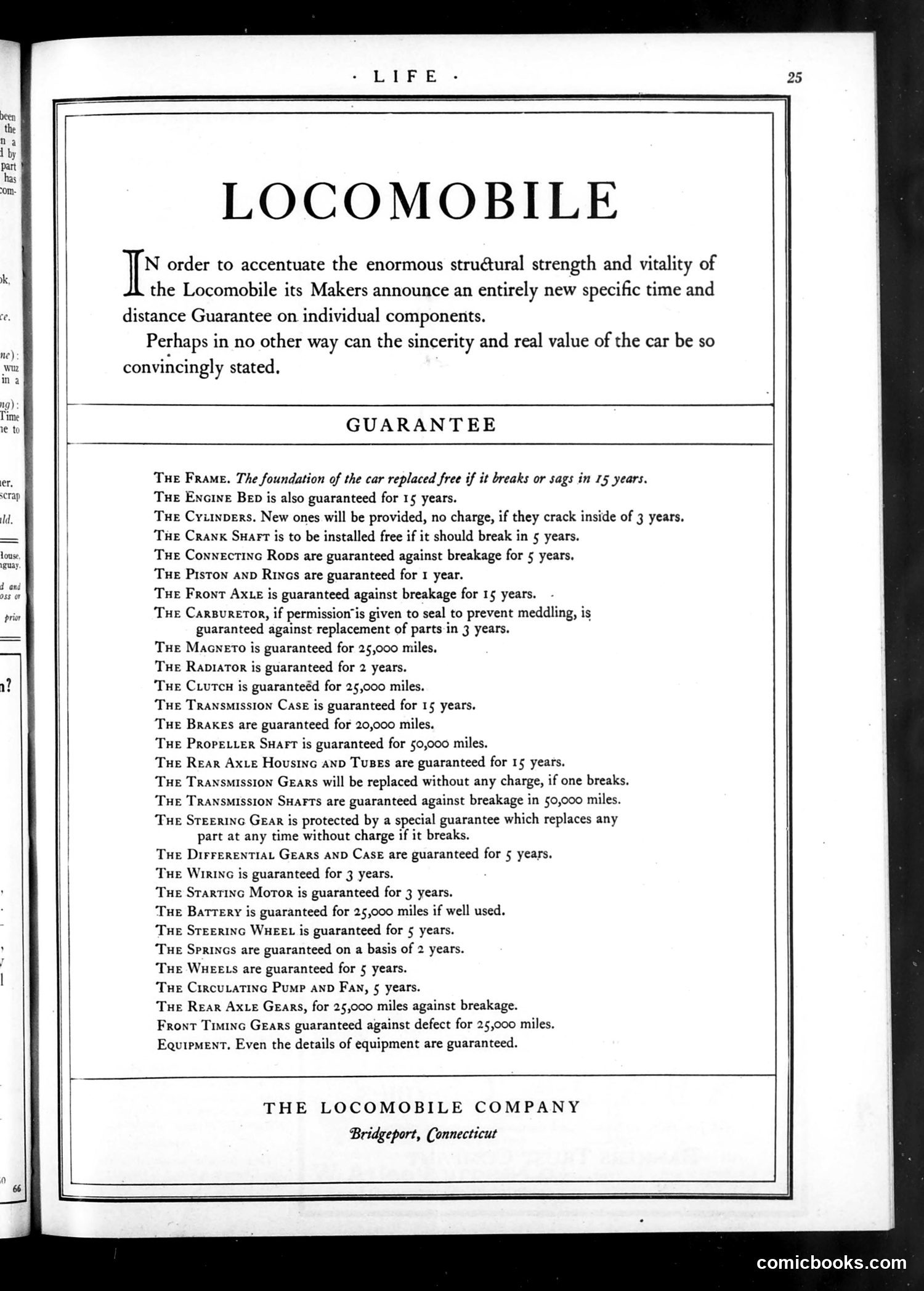
This is a straightforward automobile advertisement, not satire. The Locomobile Company uses this Life magazine page to showcase their car's reliability through an exhaustive component-by-component warranty. The ad lists guarantees for virtually every mechanical part—from the frame (15 years) down to springs (2 years) and wiring (3 years)—emphasizing durability as a selling point. The opening text frames this guarantee strategy as the most convincing way to demonstrate "the sincerity and real value of the car." This reflects early 1900s automotive marketing, when cars were still relatively new and reliability was a major consumer concern. By detailing specific warranties for individual components, Locomobile positioned itself as a premium, trustworthy manufacturer. The comprehensive nature of the guarantee itself became the advertisement's message.
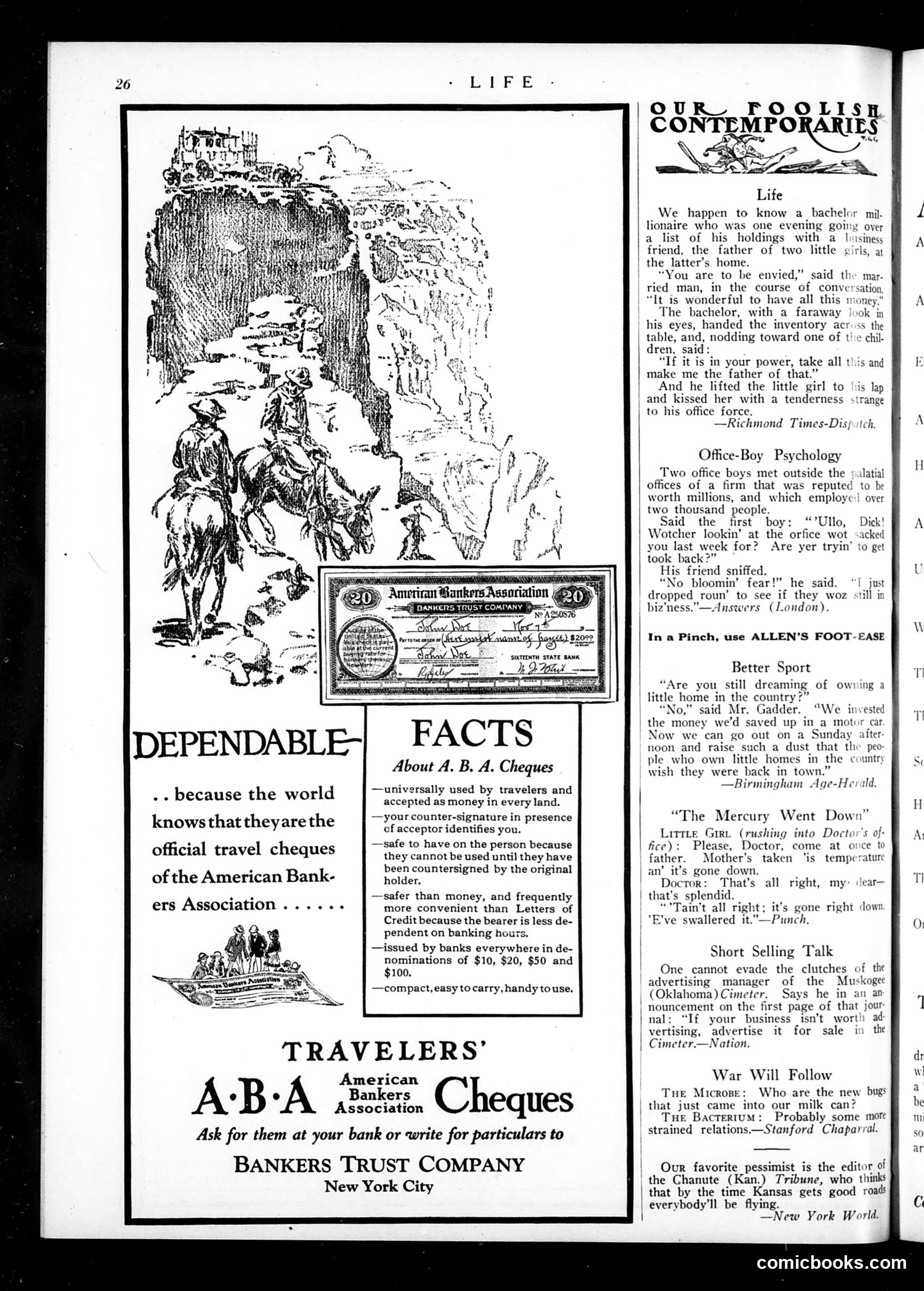
This page combines **advertising with humorous short pieces** typical of early-20th-century satirical magazines. The dominant feature is a full-page **A.B.A. Travelers Cheques advertisement** by the Bankers Trust Company—promoting "dependable" travel documents issued by the American Bankers Association. The ad emphasizes safety and convenience for travelers. The right column contains **brief comic anecdotes** drawn from various newspapers, illustrating everyday absurdities: - A wealthy bachelor envies a poor father's children, suggesting money cannot buy happiness - Office boys demonstrate casual workplace cynicism - A motorist trades a country cottage for a car to annoy homeowners with dust - A child misunderstands a thermometer dropping as dangerous - An advertising manager suggests businesses advertise themselves as "for sale" if unprofitable - A pessimistic Kansas editor quips everyone will be flying before roads improve These pieces use **gentle social satire**—mocking materialism, class pretense, workplace attitudes, and small-town boosterism. They reflect early-1900s anxieties about automobiles, modernization, and changing social values, delivered through mild humor rather than sharp political critique.
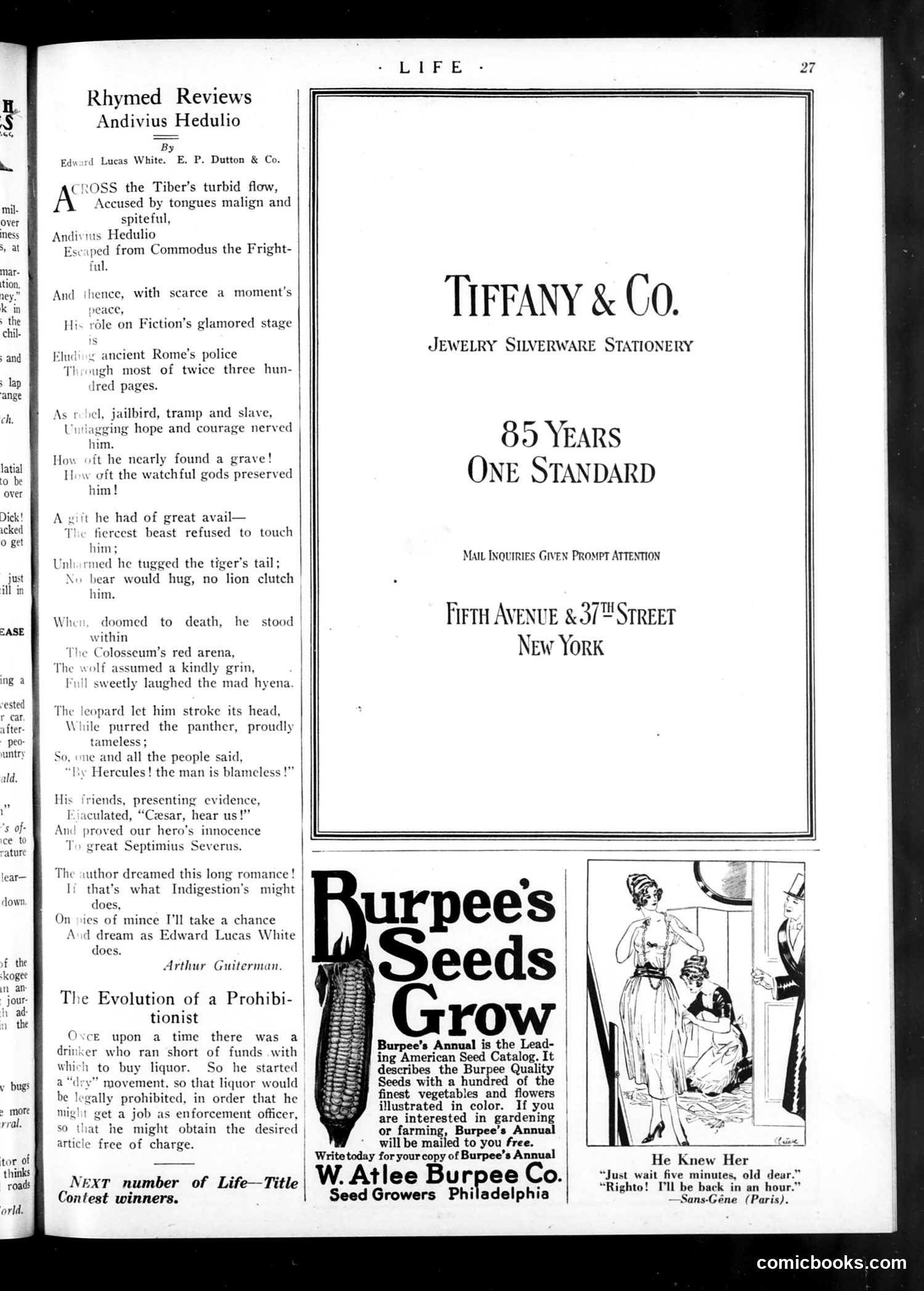
This page consists primarily of **book review and advertising content** rather than political cartoons. The main text reviews Edward Lucas White's novel "Andivius Hedulio," a historical fiction set in ancient Rome involving an escaped slave/fugitive named Andivius who encounters various dangers (tigers, beasts, the Colosseum) before being vindicated before Emperor Septimius Severus. **The satire** appears in Arthur Guiterman's brief poem "The Evolution of a Prohibitionist," which mocks temperance advocates: a poor drinker starts a "dry" movement to get hired as a liquor enforcement officer, thus obtaining free income—suggesting prohibitionists were motivated by self-interest rather than moral conviction. The page includes large advertisements for **Tiffany & Co.** (luxury goods), **Burpee's Seeds** (gardening), and a small cartoon captioned "He Knew Her" showing a romantic couple. The content reflects early 20th-century Life magazine's mix of literary criticism, gentle social satire, and high-end advertising targeting educated, affluent readers.
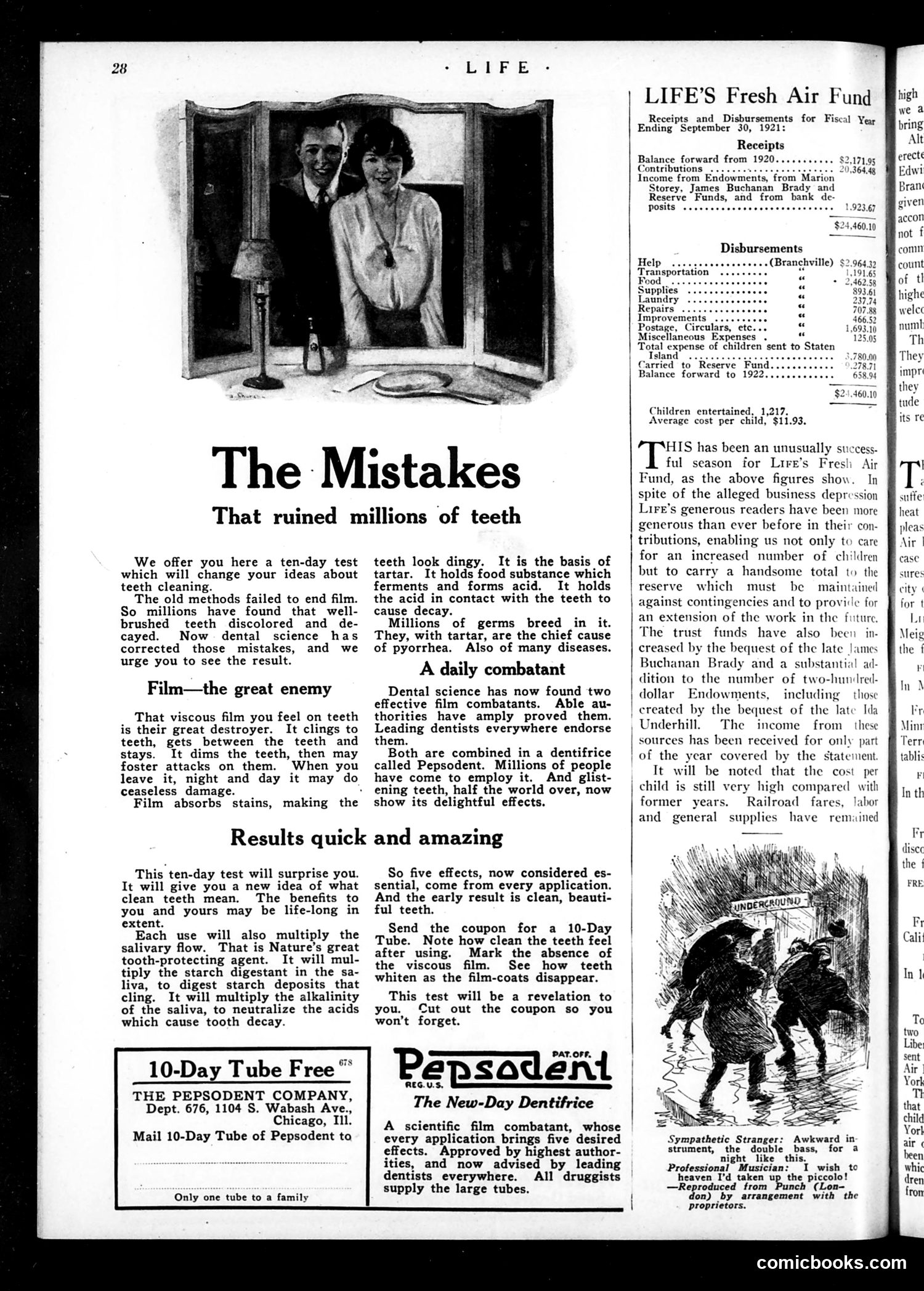
This page is primarily **advertising**, not satire. The main content is a Pepsodent toothpaste advertisement from around 1921. **The Advertisement's Claims:** The ad promotes a "10-day test" of Pepsodent, claiming it removes harmful "film" from teeth that causes decay, discoloration, and disease. It presents this as revolutionary dental science correcting "mistakes" of old brushing methods. **Historical Context:** This reflects early 20th-century advertising before FDA regulations. The claims about film causing multiple diseases and the product's "five desired effects" are typical of unregulated patent medicine-style marketing. Pepsodent was a real, popular product that used such exaggerated claims. **The Small Cartoon:** The right-side illustration labeled "Sympathetic Stranger" appears to show a humorous domestic scenario (unclear details), likely satirizing the awkwardness of dental hygiene discussions—a common advertising trope for the era. **The Fresh Air Fund Section:** The right column reports on Life magazine's charitable Fresh Air Fund for poor children, showing receipts and disbursements for 1921.
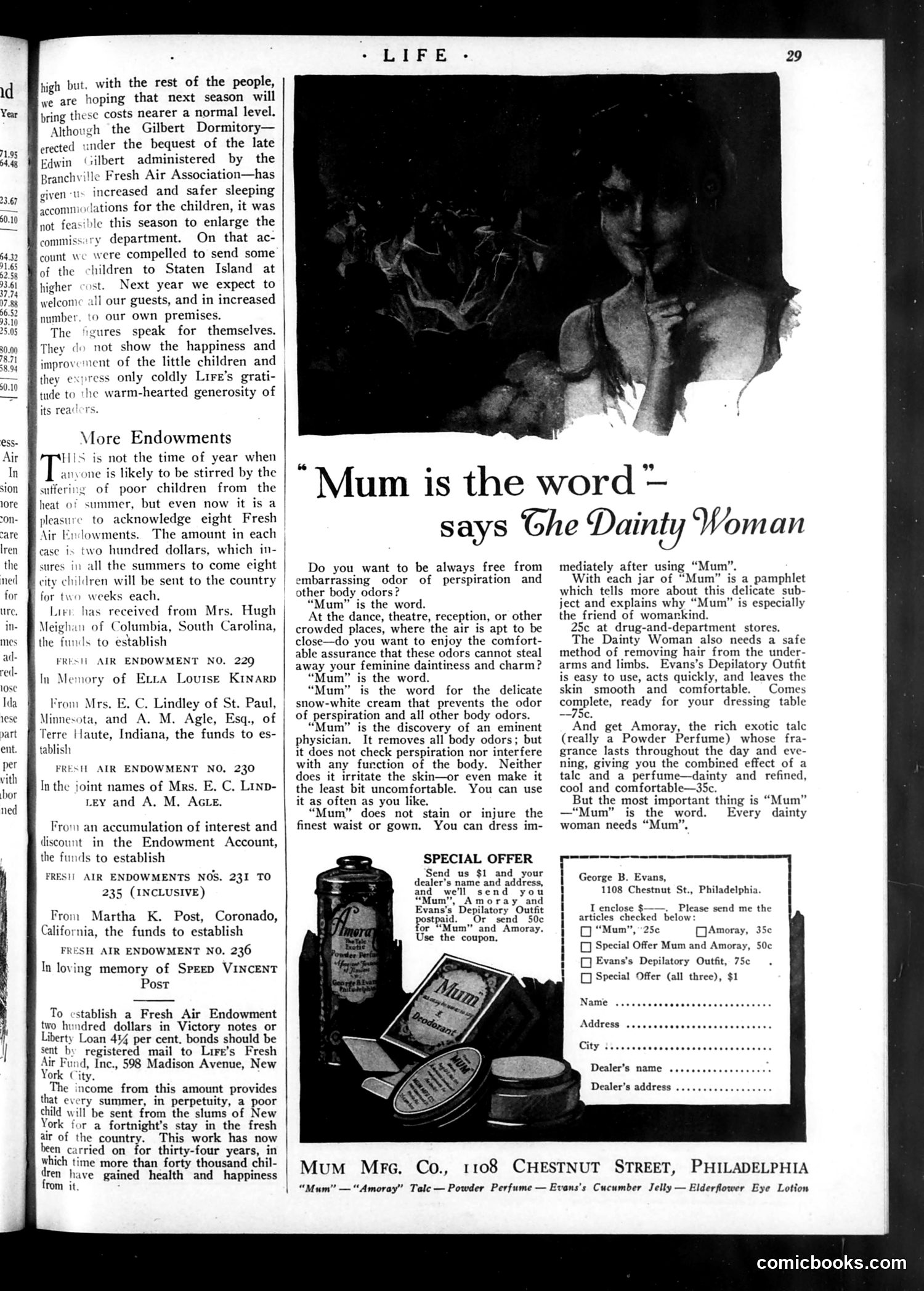
This page is primarily **advertising**, not political satire. The main content is a full-page advertisement for "Mum," an early deodorant product, featuring the slogan "Mum is the word—says the Dainty Woman." The ad targets women with anxiety about perspiration odor in social settings (dances, theaters, receptions). It emphasizes that Mum is a deodorant—not an antiperspirant—meaning it masks odor without blocking sweat, which was considered medically safer. The accompanying text mentions related products: Evans's Depilatory Outfit (hair removal) and Amoray powder perfume, all marketed as essential for feminine "daintiness." The page also contains brief editorial notes about Fresh Air endowments (charitable donations for poor children's summer retreats), which provide context about early 20th-century philanthropic concerns. The advertisement reflects period anxieties about female bodily functions and social acceptability—issues considered shameful enough to require coded language ("the word").
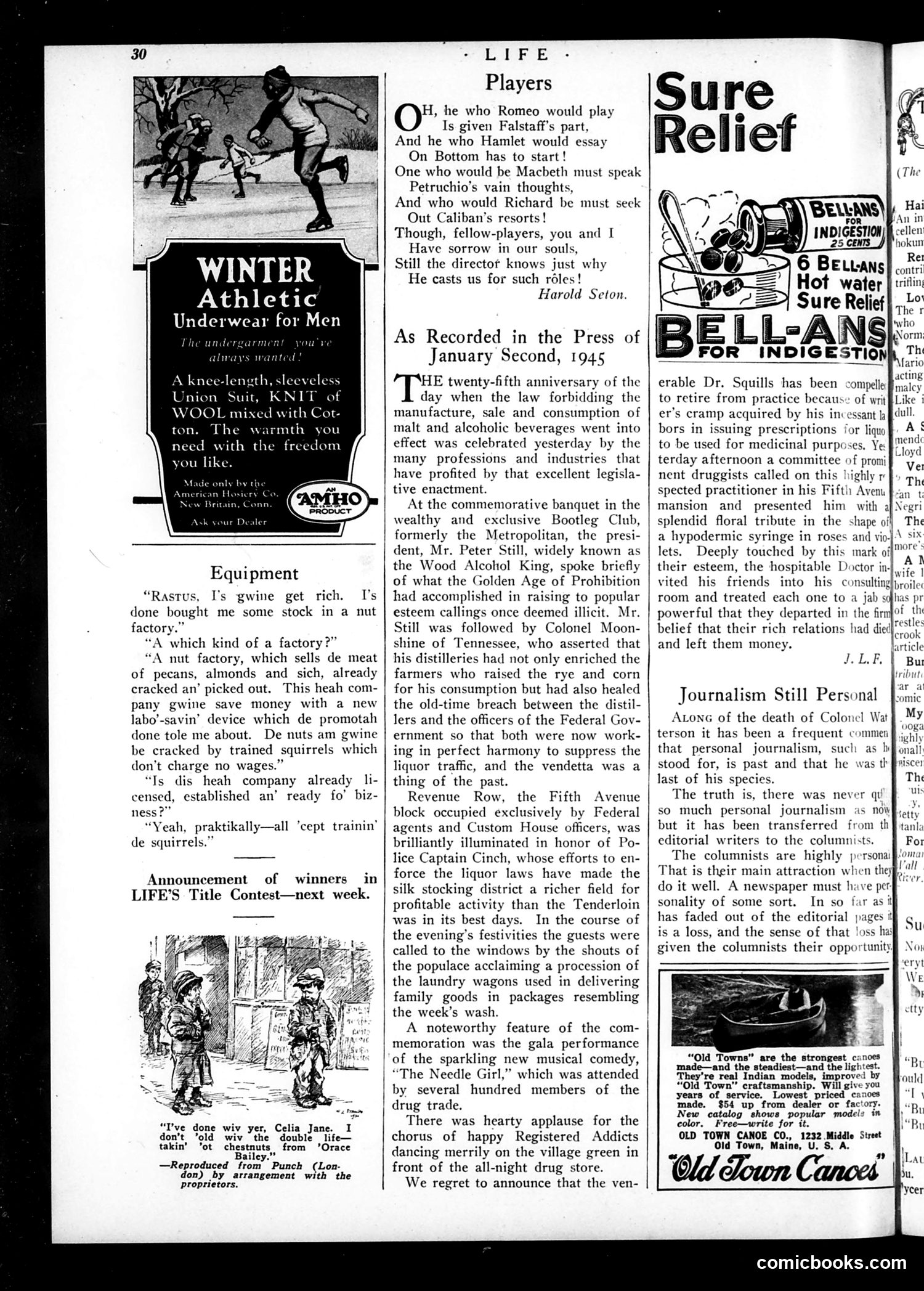
This page contains two separate satirical pieces from Life magazine (dated January 2, 1945). **"Players"** is a poem mocking theatrical casting decisions—the joke being that actors are deliberately cast in roles opposite their abilities (Romeo gets Falstaff, Hamlet gets Bottom, etc.), which frustrates performers but apparently amuses the director. **The longer piece satirizes Prohibition's 25th anniversary** (January 1920-1945). It's a biting mockery presenting the failed policy as a success, describing a celebratory "Bootleg Club" banquet where criminals—"the Wood Alcohol King," "Colonel Moonshine," and Federal agents—celebrate together. The satire highlights how Prohibition enriched organized crime, corrupted law enforcement, and created a thriving black market. References to "Revenue Row," drug addicts, and laundry wagons (used to disguise alcohol delivery) emphasize that Prohibition had spawned precisely the criminal enterprises it aimed to prevent. The tone suggests widespread recognition that the policy had backfired spectacularly.
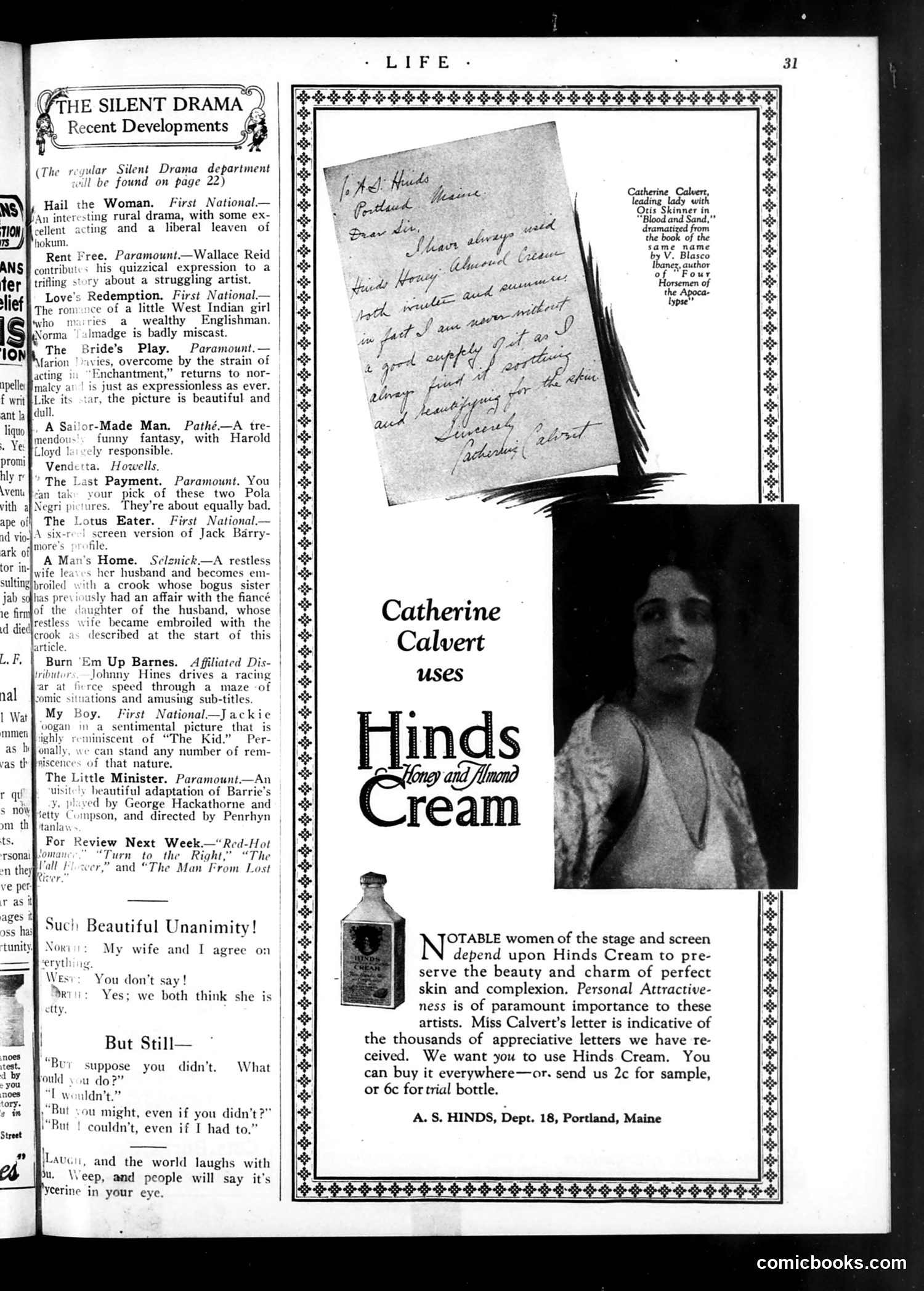
This page combines film reviews with advertising. The left column offers brief, dismissive critiques of silent films from major studios (First National, Paramount, Pathé, Selznick). The reviews are satirical—mocking both weak plots and wooden acting. For instance, Wallace Reid's "quizzical expression" and another actor being "just as expressionless as ever" mock performers who couldn't convey emotion convincingly. The centerpiece is an advertisement for Hinds Cream cosmetics, featuring actress Catherine Calvert. The ad capitalizes on celebrity endorsement—a common marketing strategy of the 1920s—claiming that stage and screen actresses depend on this product "to preserve the beauty and charm of perfect skin." Below the reviews sits a comedic dialogue about marital agreement, likely satirizing spousal dynamics of the era. The overall page reflects 1920s consumer culture intersecting with entertainment criticism, where celebrity and beauty products were heavily promoted through entertainment media.
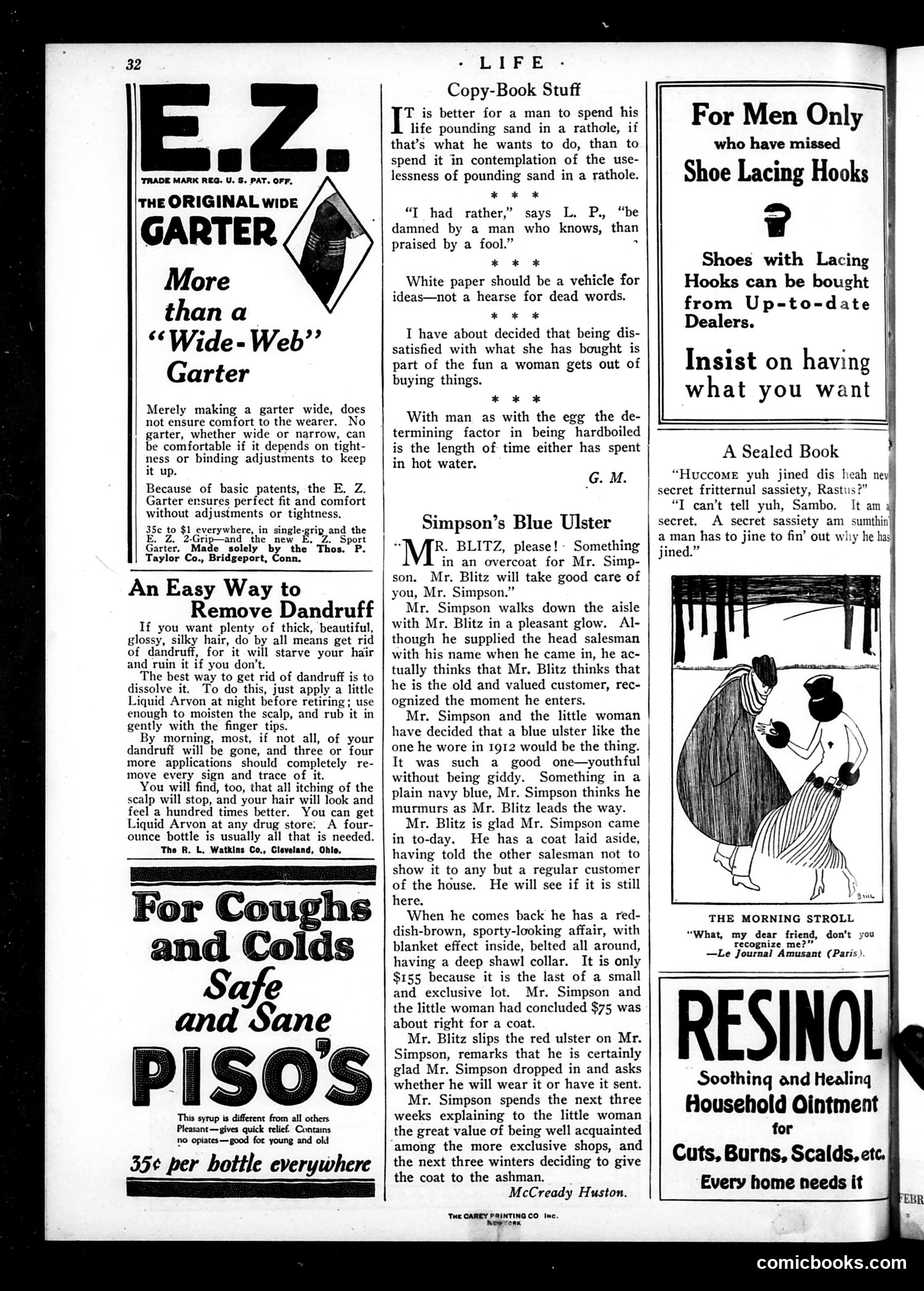
This page is primarily **advertisements and filler content** rather than political satire. The main items are: **Advertisements:** E.Z. Garters, dandruff removal (Liquid Arvon), cough syrup (Piso's), shoe lacing hooks, and Resinol ointment dominate the layout. **"Copy-Book Stuff"** (center): A collection of platitudes—cynical observations about human nature ("better to pound sand in a rathole," observations about women's buying habits, etc.). These are presented as worldly wisdom, likely satirizing the self-help aphorisms popular in the era. **"Simpson's Blue Ulster"** (right): A short satirical story mocking salesmanship and male vanity. Mr. Simpson wants a $75 coat, but a manipulative salesman (Mr. Blitz) flatters him into buying a $155 red-brown coat instead of the navy blue he requested—then Simpson must spend weeks justifying the purchase to his wife. The satire targets both deceptive retail tactics and men's susceptibility to flattery. The illustration shows a couple on a morning stroll, unrelated to the text.