
Life, 1922-02-02 · page 14 of 34
Life — February 2, 1922 — page 14: what you’re looking at
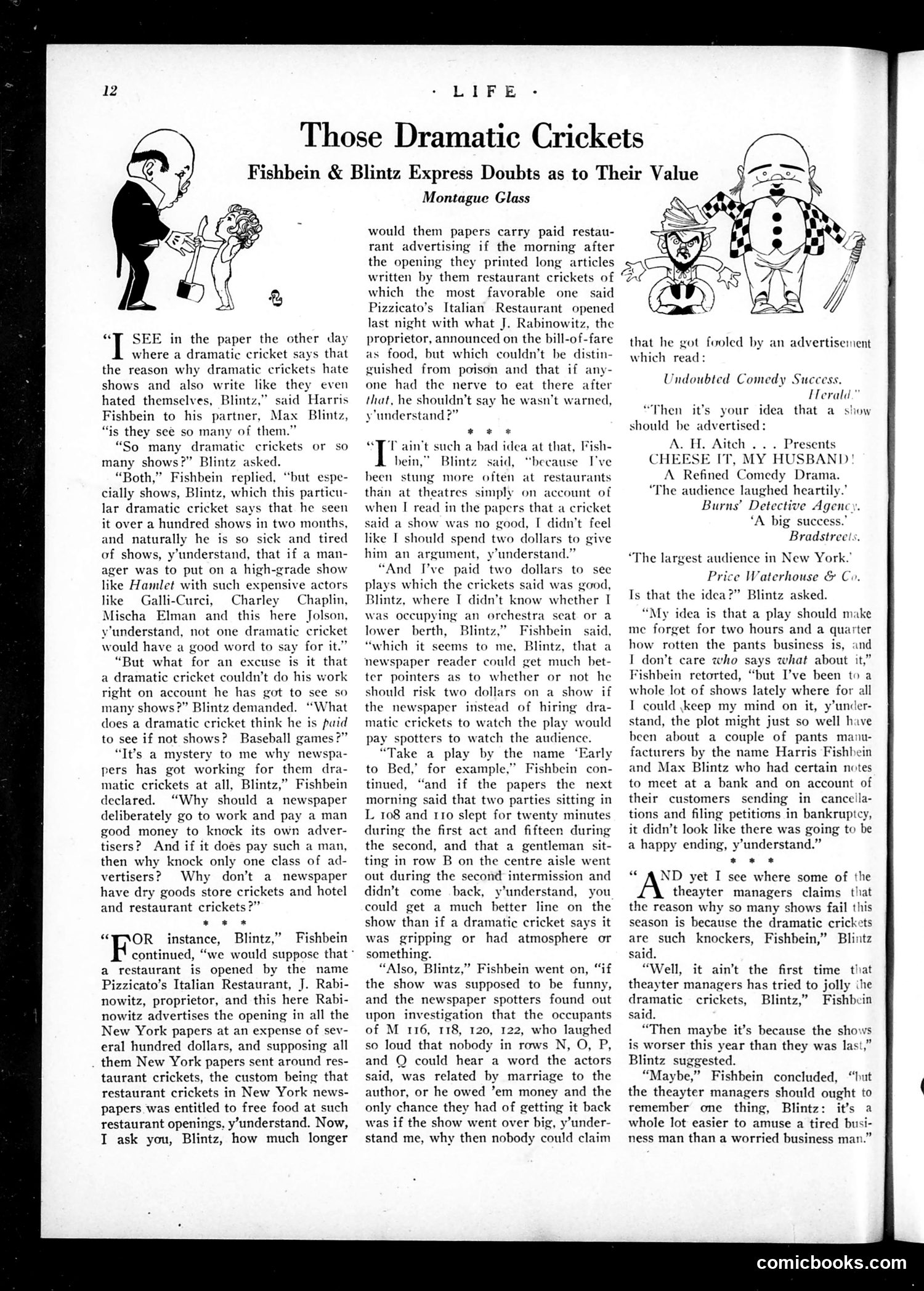
What you’re looking at
This article by Montague Glass satirizes the practice of newspapers publishing paid restaurant advertisements disguised as dramatic reviews. The term "dramatic crickets" refers to crickets (insects) placed in restaurants to create ambiance—a gimmick newspapers would cover with glowing reviews. The dialogue between characters Fishbein and Blintz (likely Jewish-immigrant stereotypes common to Glass's humor) exposes how newspapers profited from this scheme: restaurants paid for advertising space, yet newspapers claimed editorial independence by printing long articles praising the crickets as entertainment. The satire targets both newspaper greed and the absurdity of advertising disguised as journalism—a practice the author finds ridiculous enough to merit full comedic exposition to his readers.
📄 Transcribed text from this page (OCR, searchable)
Machine-transcribed from the original scan — historical spelling and the odd misread are preserved.
* LOR ETE- = Those Dramatic Crickets Fishbein & Blintz Express Doubts as to Their Value Montague Glass a | SE in the paper the other day where a dramatic cricket says that the reason why dramatic crickets hate shows and also write like they even hated themselves, Blin’ said Harris Fishbein to his partner, Max Blintz, “Gs they see so many of them.” “So many dramatic crickets or so many shows?” Blintz asked. “Both,” Fishbein replied, “but espe- cially shows, Blintz, which this particu- lar dramatic cricket says that he seen it over a hundred shows in two months, and naturally he so sick and tired of shows, y’understand, that if a man- ager was to put on a high-grade show like Hamlet with such expensive actors like Galli-Curci, Charley — Chaplin, Mischa Elman and this here Jolson, y'understand, not one dramatic cricket would have a good word to say for it.” “But what for an excuse is it that a dramatic cricket couldn't do his work right on account he has got to see so many shows?” Blintz demanded. “What does a dramatic cricket think he is paid to see if not shows? Baseball games?” “It’s a mystery to me why newspz pers has got working for them dra- matic crickets at all, Blintz,” Fishbein declared. “Why should a newspaper deliberately go to work and pay a man good money to knock its own adver- tisers? And if it does pay such a man, then why knock only one class of ad- vertisers? Why don’t a newspaper have dry goods store crickets and hotel and restaurant crickets?” se 8 instance, Blintz,” “POR Fishbein continued, “we would suppose that ° a restaurant is opened by the name Pizzicato’s Italian Restaurant, J. Rabi- nowitz, proprietor, and this here Rabi- nowitz advertises the opening in all the New York papers at an expense of sev- eral hundred dollars, and supposing all them New York papers sent around res- taurant crickets, the custom being that restaurant crickets in New York news- papers was entitled to free food at such restaurant openings, y’understand. Now, I ask you, Blintz, how much longer would them papers carry paid restau- rant advertising if the morning after the opening they printed long articles written by them restaurant crickets of which the most favorable one said Pizzicato’s Italian Restaurant opened last night with what J. Rabinowitz, the proprietor, announced on the bill-of-fare as food, but which couldn’t be distin- guished from poison and that if any- one had the nerve to eat there after that, he shouldn’t say he wasn’t warned, * ‘TI P ain't such a had idea at that, Fish- hein,” Blintz said, “because I've heen stung more often at restaurants than at theatres simply on account of when I read in the papers that a cricket said a show was no good, I didn’t feel like I should spend two dollars to give him an argument, y’understand.” “And I've paid two dollars to see plays which the crickets said was good, Blintz, where T didn’t know whether I Was occupying an orchestra seat or a lower berth, Blintz,” Fishbein said, “which it seems to me, Blintz, that a newspaper reader could get much bet- ter pointers as to whether or not he should risk two dollars on a show if the newspaper instead of hiring dra- matic crickets to watch the play would pay spotters to watch the audience. “Take a play by the name ‘Early to Bed,’ for example,” shbein con- tinued, “and if the papers the next morning said that two parties sitting in L 108 and rro slept for twenty minutes during the first act and fifteen during the second, and that a gentleman sit- ting in row B on the centre aisle went out during the second intermission and didn’t come back, y’understand, you could get a much better line on the show than if a dramatic cricket says it was gripping or had atmosphere or something. “Also, Blintz,” Fishbein went on, “if the show was supposed to be funny, and the newspaper spotters found out upon investigation that the occupants of M 116, 118, 120, 122, who laughed so loud that nobody in rows N, O, P, and Q could hear a word the actors said, was related by marriage to the author, or he owed ’em money and the only chance they had of getting it back was if the show went over big, y’under- stand me, why then nobody could claim that he got fooled by an advertisement which read: Undoubted Comedy Success. Terald that a “Then it’s your idea show should be advertised: A. H. Aitch . . . Presents CH IT, MY HUSBAND! A Refined Comedy Drama. ‘The audience laughed heartily. Burns’ Detective Agenc ‘A big success.’ Bradstreels. ‘The largest audience in New York.’ Price Waterhouse & Co. Is that the idea?” Blintz asked. “My idea is that a play should make me forget for two hours and a quarter how rotten the pants business is, and I don’t care who says what about it,” hbein retorted, “but I’ve been to a whole lot of shows lately where for all I could \keep my mind on it, y’under- stand, the plot might just so well have been about a couple of pants manu- facturers by the name Harris Fishbein and Max Blintz who had certain notes to meet at a bank and on account of their customers sending in cancella- tions and filing petitions in bankruptcy, it didn’t look like there was going to be a happy ending, y’understand.” ss 8 “ AND yet I see where some of the theayter managers claims that the reason why so many shows fail this season is because the dramatic crickets are such knockers, Fishbein,” Blintz said. “Well, it ain’t the first time that theayter managers has tried to jolly ihe dramatic crickets, Blintz,” Fishbein said. “Then maybe it’s because the shows is worser this year than they was last,” Blintz suggested. “Maybe,” Fishbein concluded, “hut the theayter managers should ought to remember one thing, Blintz: it’s a whole lot easier to amuse a tired busi- ness man than a worried business man.” comicbooks.com