
Life, 1922-02-02 · page 21 of 34
Life — February 2, 1922 — page 21: what you’re looking at
What you’re looking at
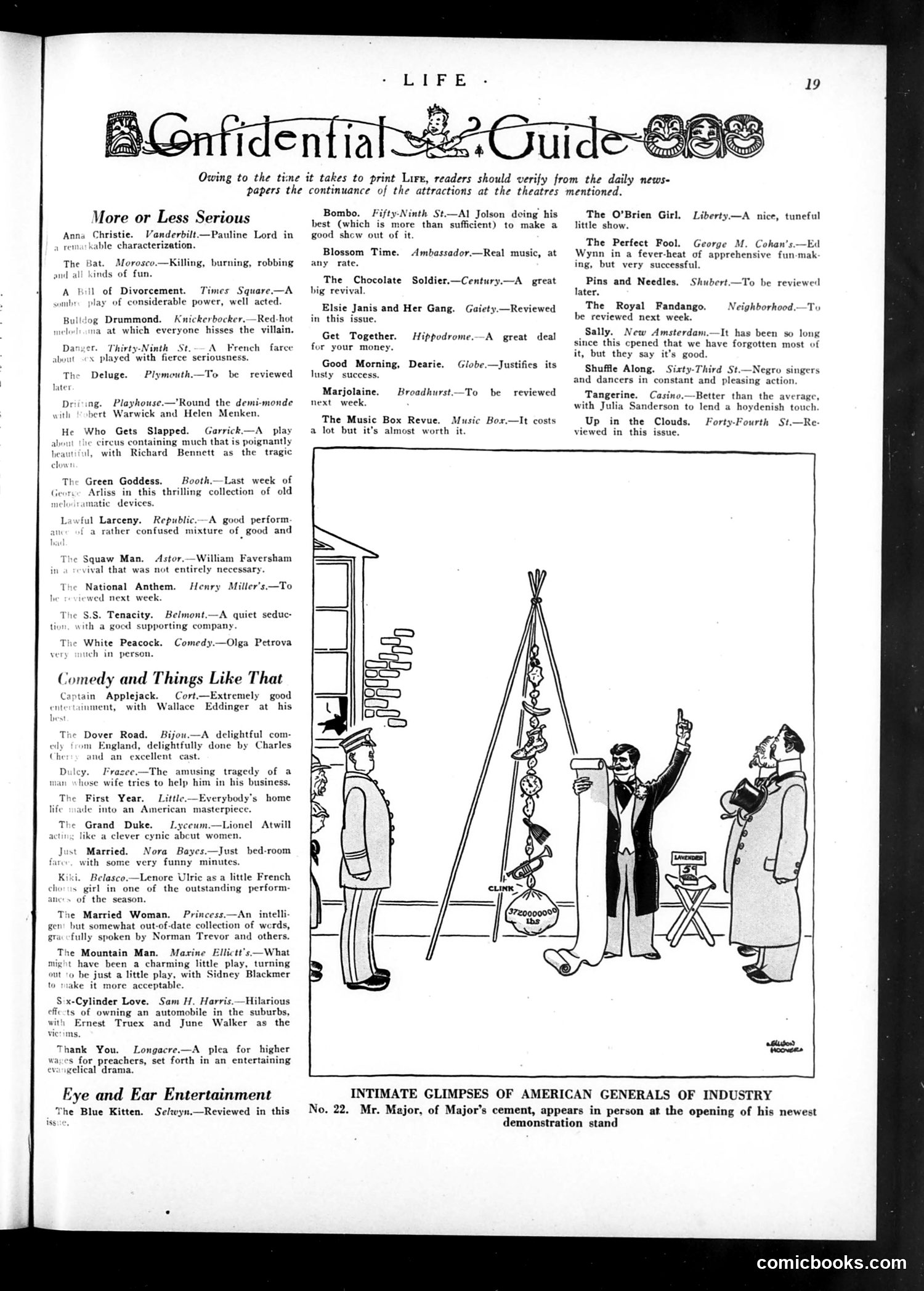
This is primarily a **theater review guide** rather than a political cartoon page. It lists Broadway shows with brief critical assessments, organized by category ("More or Less Serious," "Comedy and Things Like That," "Eye and Ear Entertainment"). The **single cartoon illustration** depicts what appears to be a camping or outdoor scene: two men in formal attire stand outside a tent, with one raising a glass in a toast. The humor seems to play on the incongruity of civilized, dressed-up behavior in a rustic camping setting—a common satirical theme of the era (1920s), mocking upper-class affectation. The page header warns readers to verify theater information in daily newspapers, since Life's printing timeline means listings may become outdated. Notable: Several reviews mention performers like **Al Jolson** and **Ed Wynn**, significant entertainers of the period. References to "Shuffle Along" (a Black musical revue) and various theatrical productions reflect 1920s Broadway culture. The content is informational rather than politically satirical—primarily a practical entertainment guide for Manhattan theater-goers.
📄 Transcribed text from this page (OCR, searchable)
Machine-transcribed from the original scan — historical spelling and the odd misread are preserved.
Owing to the time it takes to print Lire, readers should verify from the daily news- papers the continuance of the attractions at the theatres mentioned. More or Less Serious Anna Christie. Vanderbilt—Pauline Lord in , remarkable characterization. The Bat. Morosco.—Killing, burning, robbing inds of fun. and al At 1 of Divorcement. Times Square—A play of considerable power, well acted. Bulldog Drummond. Knickerbocker.—Red-hot mele a at which everyone hisses the villain. er. Thirty-Ninth St.-— A French farce x played with fierce seriousness. Deluge. Plymouth—To be reviewed ng. Playhouse—'Round the demi-monde bert Warwick and Helen Menke Slapped. Garrick.—A_play ining much that is poignantly Bennett as the tragic Who Gets © cireus conti il, with Richard Green Goddess. _ Booth.—Last week of Arliss in this thrilling collection of old matic devices. ful Larceny. Republic.—A good perform. {a rather confused mixture of good and Squaw Man. tor. —William Faversham ival that was not entirely necessary. National Anthem. Henry Miller’s—To ewed next week. © S.S. Tenacity. Belmont.—A quiet seduc- vith a gocd supporting company. > White Peacock. Comedy.—Olga Petrova ich in person. Comedy and Things Like That Applejack. Cort.—Extremely good with Wallace Eddinger at his Captain entertainment, Bijou.—A_ delightful com- The Dover Road. om E , delightfully done by Charles Che D 7 sing tragedy of a man hose wife tries to help him in his business. The First Year. Little. life ade into an American Grand Duke. like a clever cynic abcut women. Married. with so Everybody's home Atwill Nora Baycs.—Just bed-room very funny minutes. Kiki. Belasco.—Lenore Ulric asa little French chors girl in one of the outstanding perform- anc’» of the season. The Married Woman. Princess.—An_ intelli gen’ but somewhat out-of-date collection of werds, gracefully spoken by Norman Trevor and others. The Mountain Man. Maxine Ellictt's.—What might have been a charming little play, turning out ‘o be just a little play, with Sidney Blackmer to make it more acceptable. Six-Cylinder Love. Sam H. Harris.—Hilarious effets of owning an automobile in the suburbs, with Ernest Truex and June Walker as the vierims. Thank You. Longacre.—A plea for higher waves for preachers, set forth in an entertaining evo-gelical drama. Eye and Ear Entertainment The Blue Kitten. Selwyn.—Reviewed in this iss Ninth St—Al Jolson doing’ his than sufficient) to make a Bombo. Fifi best (which is more good shew out of it. Blossom Time. Ambassador.—Real music, at any rate. The Chocolate big revival. Soldier.—Century.—A great Elsie Janis and Her Gang. Gaiety.—Reviewed in this issue. Get Together. for your money. Hippodrome.—A great deal Good Morning, Dea Globe.—Justifies its lusty success. Marjolaine. Broadhurst.—To be reviewed next week. The Music Box Revue. Music Box.—It costs a lot but it’s almost worth it. The O’Brien Girl. little show. The Perfect Fool. George M. Cohan’s.—Ed Wynn in a fever-heat of apprehensive fun-mak ing, but very successful. Liberty.—A nice, tuneful Pins and Needles. Shubert.—To be reviewed later. The Royal Fandango. be reviewed next week. Sally. New Amsterdam.—It has been so long since this cpened that we have forgotten most of it, but they say it's good. Shuffle Along. Sisty-Third St.—Negro singers and dancers in constant and pleasing action. Neighborhood.—Tu Tangerine. Casino.—Better than the average, with Julia Sanderson to lend a hoydenish touch Up in the Clouds, St.—Re- viewed in this issue. Forty-Fourth INTIMATE GLIMPSES OF AMERICAN GENERALS OF INDUSTRY No. 22. Mr. Major, of Major’s cement, appears in person at the opening of his newest demonstration stand comicbooks.com