
Life, 1922-02-02 · page 12 of 34
Life — February 2, 1922 — page 12: what you’re looking at
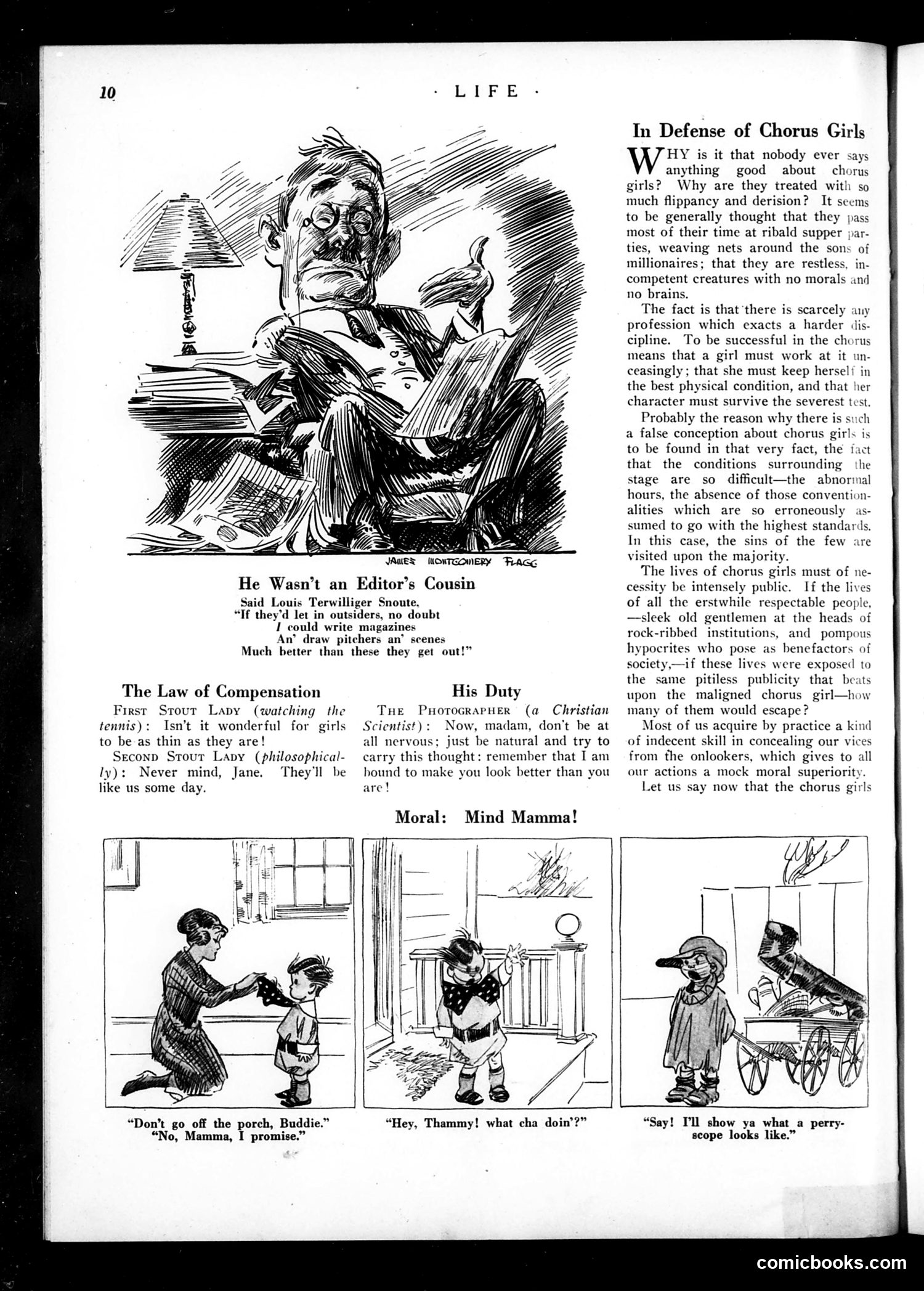
What you’re looking at
This page defends chorus girls against contemporary social criticism. The main article argues that chorus work requires intense discipline, physical conditioning, and moral character—countering the era's perception of chorus girls as frivolous, immoral women who frequent wealthy men's parties. The cartoon "He Wasn't an Editor's Cousin" satirizes nepotism in publishing, suggesting merit matters more than connections. Below, "Moral: Mind Mamma!" depicts three domestic scenes of mothers managing children—humorous reminders of parental responsibility. The page reflects early 20th-century attitudes toward theatrical performers, who faced social stigma despite their genuine professional demands. The defense suggests chorus girls were stereotyped and underestimated by respectable society.
📄 Transcribed text from this page (OCR, searchable)
Machine-transcribed from the original scan — historical spelling and the odd misread are preserved.
VAMES MONTGOMERY Frace He Wasn’t an Editor’s Cousin Said Louis Terwilliger Snoute. “If they'd let in outsiders, no doubt I could write magazines An’ draw pitchers an’ scenes Much better than these they get out!” The Law of Compensation First Stout Lapy (watching the tennis): Isn't it wonderful for girls to be as thin as they are! Second Stour Lapy (philosophical- ly): Never mind, Jane. They'll be like us some day. His Duty Tue PuorocrapHer (a Christian Scientist): Now, madam, don't be at all nervous; just be natural and try to carry this thought: remember that I am hound to make you look better than you are! Moral: Mind Mamma! In Defense of Chorus Girls HY is it that nobody ever says anything good about chorus girls? Why are they treated with so much flippancy and derision? It seems to be generally thought that they pass most of their time at ribald supper par- ties, weaving nets around the sons of millionaires; that they are restless, i competent creatures with no morals no brains. The fact is that there is scarcely profession which exacts a harder dis- cipline. To be successful in the chorus means that a girl must work at it un- ceasingly; that she must keep herseli in the best physical condition, and that her character must survive the severest test. Probably the reason why there ch a false conception about chorus girls is to be found in that very fact, the fact that the conditions surrounding the stage are so difficult—the abnormal hours, the absence of those convention- alities which are so erroneously as- sumed to go with the highest standards. In this case, the sins of the few are visited upon the majority. The lives of chorus girls must of ne- cessity be intensely public. If the lives of all the erstwhile respectable people, —sleek old gentlemen at the heads of ibbed institutions, and pompous who pose as benefactors of f these lives were exposed to the same pitiless publicity that beats upon the maligned chorus girl—how many of them would escape? Most of us acquire by practice a kind of indecent skill in concealing our vices from the onlookers, which gives to all our actions a mock moral superiority. Let us say now that the chorus girls “Don’t go off the porch, Buddie.” “No, Mamma, I promise.” “Hey, Thammy! what cha doin’?” “Say! I'll show ya what a perry- scope looks like.” comicbooks.com