
Life, 1922-02-02 · page 20 of 34
Life — February 2, 1922 — page 20: what you’re looking at
What you’re looking at
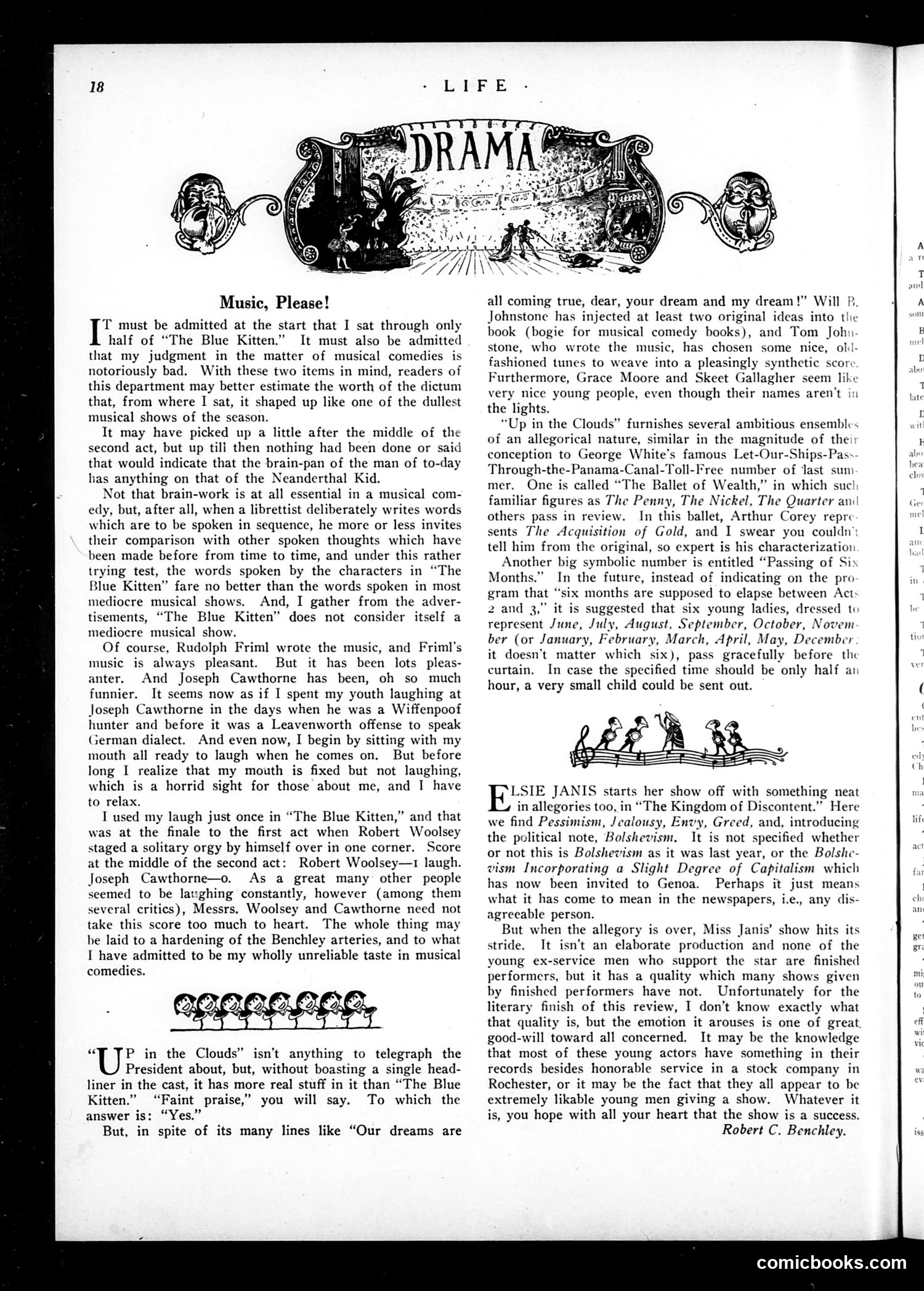
This is a theater review by Robert C. Benchley critiquing two Broadway musical comedies. The piece satirizes *"The Blue Kitten"* as tediously dull despite star Joseph Cawthorne and composer Rudolph Friml, with Benchley admitting his own unreliable taste as cover. He contrasts it with *"Up in the Clouds,"* which he finds superior despite lacking famous headliners. The humor lies in Benchley's self-deprecating honesty—he dozed through half the show and laughed only once—while backhanded compliments pepper his analysis (calling *"Up in the Clouds"* merely better than a terrible show is "faint praise"). The review mocks musical theater's pretensions while gently roasting himself as an incompetent judge of the form.
📄 Transcribed text from this page (OCR, searchable)
Machine-transcribed from the original scan — historical spelling and the odd misread are preserved.
Music, Please! T must be admitted at the start that I sat through only half of “The Blue Kitten.” It must also be admitted that my judgment in the matter of musical comedies is notoriously bad. With these two items in mind, readers of this department may better estimate the worth of the dictum that, from where I sat, it shaped up like one of the dullest musical shows of the season. It may have picked up a little after the middle of the second act, but up till then nothing had been done or said that would indicate that the brain-pan of the man of to-day has anything on that of the Neanderthal Kid. Not that brain-work is at all essential in a musical com- edy, but, after all, when a librettist deliberately writes words which are to be spoken in sequence, he more or less invites their comparison with other spoken thoughts which have been made before from time to time, and under this rather trying test, the words spoken by the characters in “The Blue Kitten” fare no better than the words spoken in most mediocre musical shows. And, I gather from the adver- tisements, “The Blue Kitten’ does not consider itself a mediocre musical show. Of course, Rudolph Friml wrote the music, and Friml's music is always pleasant. But it has been lots pleas- anter. And Joseph Cawthorne has been, oh so much funnier. It seems now as if I spent my youth laughing at Joseph Cawthorne in the days when he was a Wiffenpoof hunter and before it was a Leavenworth offense to speak German dialect. And even now, I begin by sitting with my mouth all ready to laugh when he comes on. But before long I realize that my mouth is fixed but not laughing, which is a horrid sight for those about me, and I have to relax. I used my laugh just once in “The Blue Kitten,” and that was at the finale to the first act when Robert Woolsey staged a solitary orgy by himself over in one corner. Score at the middle of the second act: Robert Woolsey—1 laugh. Joseph Cawthorne—o. As a great many other people seemed to be laughing constantly, however (among them several critics), Messrs. Woolsey and Cawthorne need not take this score too much to heart. The whole thing may he laid to a hardening of the Benchley arteries, and to what I have admitted to be my wholly unreliable taste in musical comedies. a P in the Clouds” isn’t anything to telegraph the President about, but, without boasting a single head- liner in the cast, it has more real stuff in it than “The Blue Kitten.” “Faint praise,” you will say. To which the answer is: “Yes.” But, in spite of its many lines like “Our dreams are all coming true, dear, your dream and my dream!” Will P. Johnstone has injected at least two original ideas into the book (bogie for musical comedy books), and Tom Johu- stone, who wrote the music, has chosen some nice, ol- fashioned tunes to weave into a pleasingly synthetic scor Furthermore, Grace Moore and Skeet Gallagher seem lik: very nice young people, even though their names aren't in the lights. “Up in the Clouds” furnishes several ambitious ensembles of an allegorical nature, similar in the magnitude of the conception to George White’s famous Let-Our-Ships-Pas» Through-the-Panama-Canal-Toll-Free number of ‘last sum mer. One is called “The Ballet of Wealth,” in which suc’ familiar figures as The Penny, The Nickel, The Quarter an others pass in review. In this ballet, Arthur Corey repri sents The Acquisition of Gold, and I swear you couldn’: tell him from the original, so expert is his characterization Another big symbolic number is entitled “Passing of Si Months.” In the future, instead of indicating on the pro gram that “six months are supposed to elapse between Act: 2 and 3,” it is suggested that six young ladies, dressed to represent June, July, August, September, October, Novem ber (or January, February, March, April, May, December it doesn’t matter which six), pass gracefully before thc curtain. In case the specified time should be only half an hour, a very small child could be sent out. LSIE JANIS starts her show off with something neat in allegories too, in “The Kingdom of Discontent.” Here we find Pessimism, Jcalousy, Envy, Greed, and, introducing the political note, Bolshevism. It is not specified whether or not this is Bolshevism as it was last year, or the Bolshe- vism Incorporating a Slight Degree of Capitalism which has now been invited to Genoa. Perhaps it just means what it has come to mean in the newspapers, i.e., any dis- agreeable person. But when the allegory is over, Miss Janis’ show hits its stride. It isn’t an elaborate production and none of the young ex-service men who support the star are finished performers, but it has a quality which many shows given by finished performers have not. Unfortunately for the literary finish of this review, I don’t know exactly what that quality is, but the emotion it arouses is one of great good-will toward all concerned. It may be the knowledge that most of these young actors have something in their records besides honorable service in a stock company in Rochester, or it may be the fact that they all appear to be extremely likable young men giving a show. Whatever it is, you hope with all your heart that the show is a success. Robert C. Benchley. comicbooks.com