
Life, 1922-02-02 · page 22 of 34
Life — February 2, 1922 — page 22: what you’re looking at
What you’re looking at
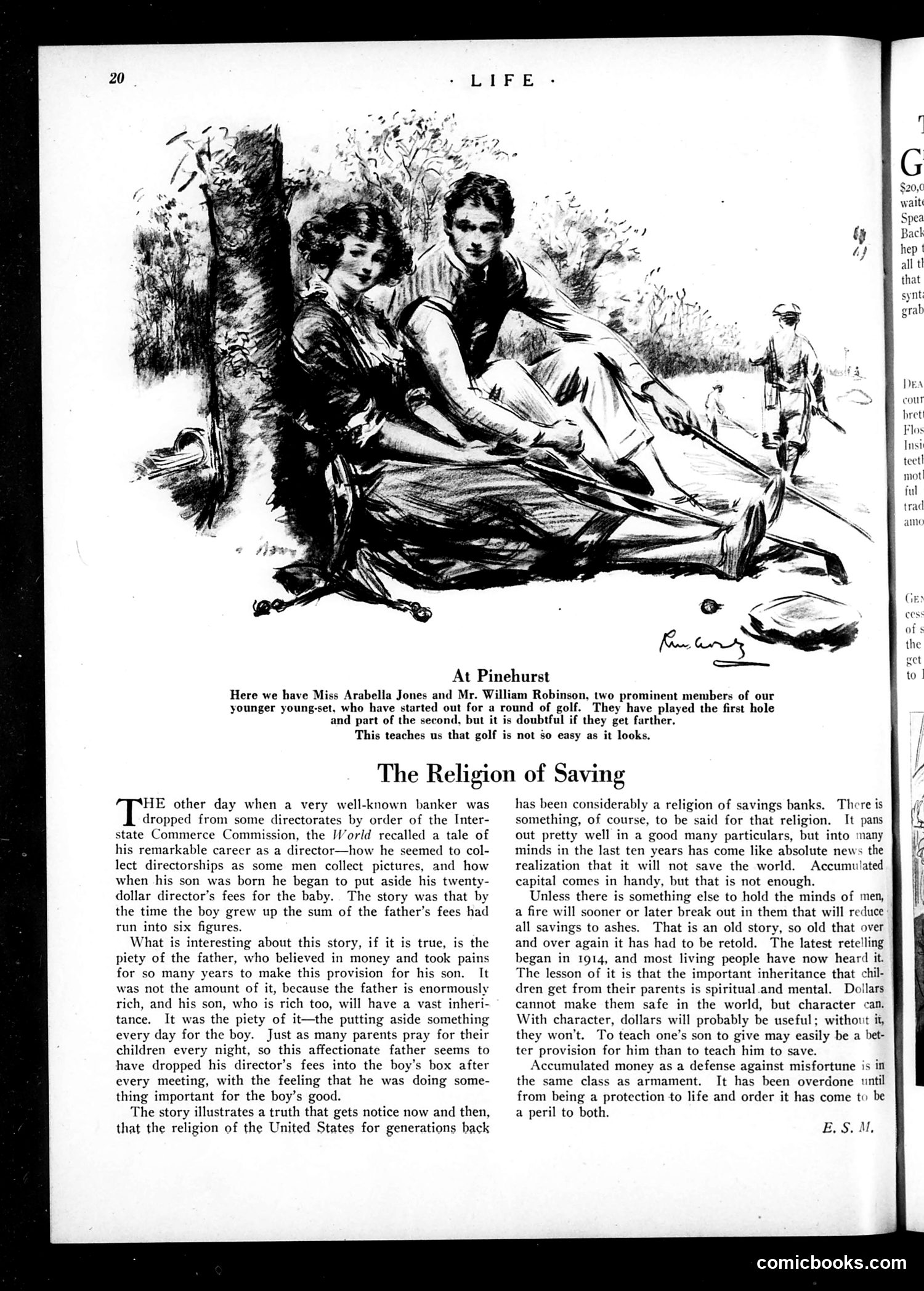
The top illustration depicts two young golfers—Miss Arabella Jones and Mr. William Robinson, identified as members of the wealthy "younger young-set"—struggling on a golf course. The satire mocks how difficult golf actually is despite its appearance of ease, poking fun at fashionable society's recreational pursuits. The accompanying essay criticizes American cultural values. It recounts a wealthy banker who saved his director's fees for his already-rich son, illustrating how American society had elevated *savings* to near-religious status. The author argues this is insufficient: mere accumulated wealth cannot protect society or provide moral grounding. Published likely during or shortly after World War I (the text references 1914), the piece sardonically suggests that character and spiritual inheritance matter more than money—a pointed critique of materialism and the failure of wealth alone to prevent catastrophe or social collapse.
📄 Transcribed text from this page (OCR, searchable)
Machine-transcribed from the original scan — historical spelling and the odd misread are preserved.
At Pinehurst Here we have Miss Arabella Jones and Mr. William Robinson, two prominent members of our younger young-set, who have started out for a round of golf. They have played the first hole and part of the second, but it is doubtful if they get farther. This teaches us that golf is not 0 easy as it looks. The Religion of Saving HE other day when a very well-known banker was dropped from some directorates by order of the Inter- state Commerce Commission, the World recalled a tale of his remarkable career as a director—how he seemed to col- lect directorships as some men collect pictures, and how when his son was born he began to put aside his twenty- dollar director’s fees for the baby. The story was that by the time the boy grew up the sum of the father’s fees had run into six figures. What is interesting about this story, if it is true, is the piety of the father, who believed in money and took pains for so many years to make this provision for his son. It was not the amount of it, because the father is enormously rich, and his son, who is rich too, will have a vast inheri- tance. It was the piety of it—the putting aside something every day for the boy. Just as many parents pray for their children every night, so this affectionate father seems to have dropped his director’s fees into the boy’s box after every meeting, with the feeling that he was doing some- thing important for the boy’s good. The story illustrates a truth that gets notice now and then, that the religion of the United States for generations back has been considerably a religion of savings banks. There is something, of course, to be said for that religion. It pans out pretty well in a good many particulars, but into many minds in the last ten years has come like absolute news the realization that it will not save the world. Accumulated capital comes in handy, but that is not enough. Unless there is something else to hold the minds of men, a fire will sooner or later break out in them that will reduce all savings to ashes. That is an old story, so old that over and over again it has had to be retold. The latest retelling began in 1914, and most living people have now heard it. The lesson of it is that the important inheritance that chil- dren get from their parents is spiritual.and mental. Dollars cannot make them safe in the world, but character can. With character, dollars will probably be useful; without it, they won't. To teach one’s son to give may easily be a bet- ter provision for him than to teach him to save. Accumulated money as a defense against misfortune is in the same class as armament. It has been overdone until from being a protection to life and order it has come to be a peril to both. G $20,0 waite Spea Back hep | all tl that synti grab DEA cour bret! Flos Insi tet! mot! ful trad amo comicbooks.com