
Life, 1922-02-02 · page 16 of 34
Life — February 2, 1922 — page 16: what you’re looking at
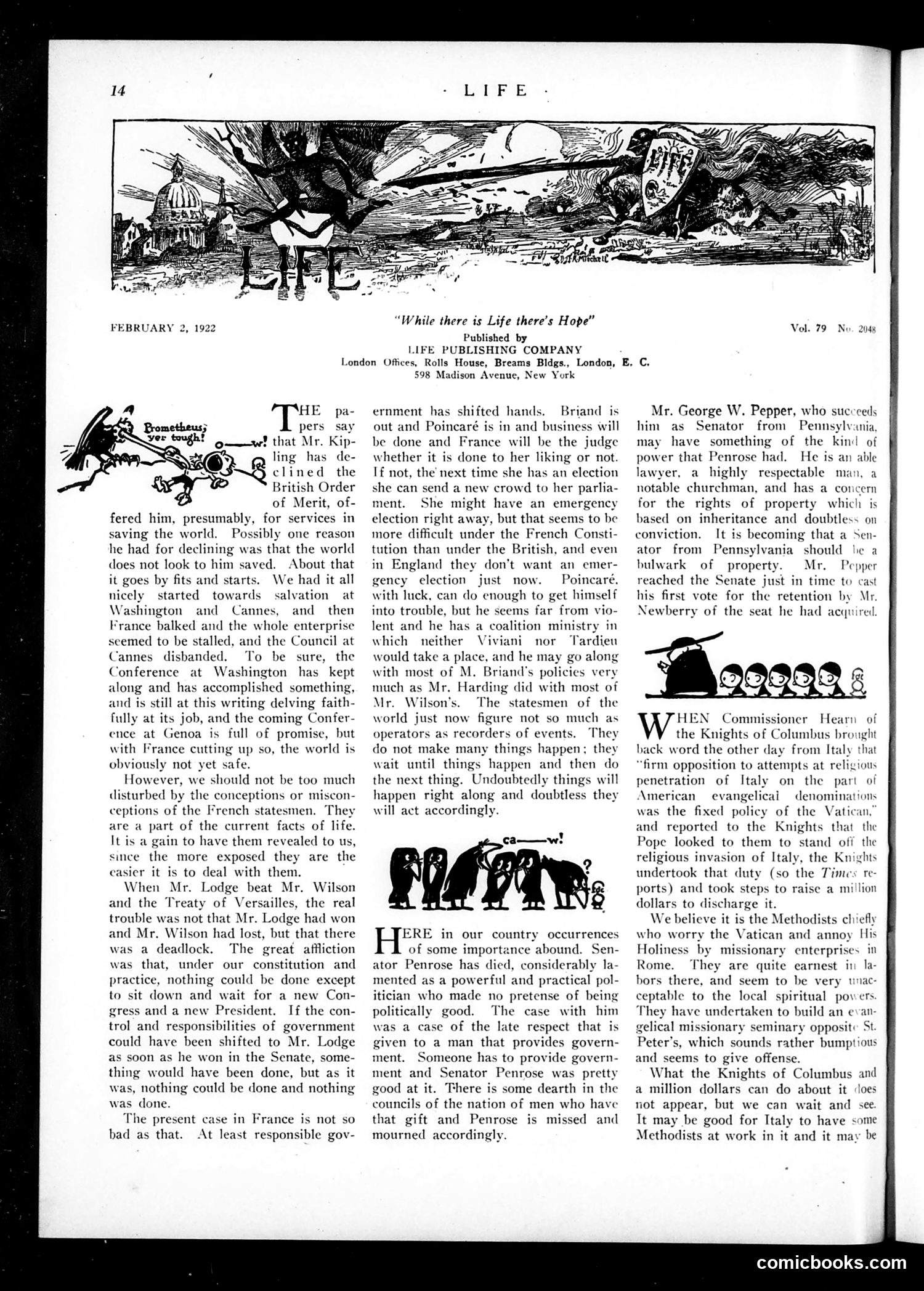
A restored page from Life, 1922-02-02. Page through the whole issue in the reader above.
📄 Transcribed text from this page (OCR, searchable)
Machine-transcribed from the original scan — historical spelling and the odd misread are preserved.
FEBRUARY 2, 192. London Offices, Rolls House, Breams Bldgs., London, E, HE pers o——w! that Mr. Kip- ‘ ling has de- clined the British Order of Merit, of- fered him, presumably, for services in saving the world. Possibly one reason he had for declining was that the world does not look to him saved. About that it goes by fits and starts. We had it all nicely started towards salvation at Washington and Cannes, and then France balked and the whole enterprise seemed to be stalled, and the Council at Cannes disbanded. To be sure, the Conference at Washington has kept along and has accomplished something, and is still at this writing delving faith- fully at its job, and the coming Confer- ence at Genoa is full of promise, but with France cutting up so, the world is obviously not yet safe. However, we should not be too much disturbed by the conceptions or miscon- ceptions of the French statesmen. They are a part of the current facts of life. It is a gain to have them revealed to us, since the more exposed they are the easier it is to deal with them. When Mr. Lodge beat Mr. Wilson and the Treaty of Versailles, the real trouble was not that Mr. Lodge had won and Mr. Wilson had lost, but that there was a deadlock. The great affliction was that, under our constitution and practice, nothing could be done except to sit down and wait for a new Con- gress and a new President. If the con- trol and responsibilities of government could have been shifted to Mr. Lodge as soon as he won in the Senate, some- thing would have been done, but as it was, nothing could be done and nothing was done. The present case in France is not so bad as that. At least responsible gov- pa- say ‘While there is Life there's Hope” Published by LIFE PUBLISHING COMPANY 598 Madison Avenue, New York ernment has shifted hands. Briand is out and Poincaré is in and business will be done and France will be the judge whether it is done to her liking or not. If not, the’ next time she has an election she can send a new crowd to her parlia- ment. She might have an emergency election right away, but that seems to be more difficult under the French Consti- tution than under the British, and even in England they don’t want an emer- gency election just now. Poincaré, with luck, can do enough to get himself into trouble, but he seems far from vio- lent and he has a coalition ministry in which neither Viviani nor Tardieu would take a place, and he may go along with most of M. Briand’s policies very much as Mr. Harding did with most of Mr. Wilson's. The statesmen of the world just now figure not so much as operators as recorders of events. They do not make many things happen; they wait until things happen and then do the next thing. Undoubtedly things will happen right along and doubtless they will act accordingly. ca——w! ERE in our country occurrences of some importance abound. Sen- ator Penrose has died, considerably la- mented as a powerful and practical pol- itician who made no pretense of being politically good. The case with him was a case of the late respect that is given to a man that provides govern- ment. Someone has to provide govern- ment and Senator Penrose was pretty good at it. There is some dearth in the councils of the nation of men who have that gift and Penrose is missed and mourned accordingly. Mr. George W. Pepper, who succeeds him as Senator from Pennsylvania, may have something of the kind of power that Penrose had. He is an able lawyer, a highly respectable man, a notable churchman, and has a concern for the rights of property which is based on inheritance and doubtless on conviction. It is becoming that a Sen- ator from Pennsylvania should lie a bulwark of property. Mr. Pepper reached the Senate just in time to cast his first vote for the retention by Mr. Newberry of the seat he had acquired. HEN Commissioner Hearn of the Knights of Columbus brought back word the other day from Italy that “firm opposition to attempts at religious penetration of Italy on the part of American evangelical denominations was the fixed policy of the Vatican, and reported to the Knights that the Pope looked to them to stand off the religious invasion of Italy, the Knights undertook that duty (so the Times re- ports) and took steps to raise a million dollars to discharge it. We believe it is the Methodists chiefly who worry the Vatican and annoy His Holiness by missionary enterprises i Rome. They are quite earnest it bors there, and seem to be very unac- ceptable to the local spiritual powers. They have undertaken to build an evan- gelical missionary seminary opposite St Peter’s, which sounds rather bumptious and seems to give offense. What the Knights of Columbus and a million dollars can do about it «oes not appear, but we can wait and see. It may be good for Italy to have some Methodists at work in it and it may be comicbooks.com