
Life, 1922-02-02 · page 17 of 34
Life — February 2, 1922 — page 17: what you’re looking at
What you’re looking at
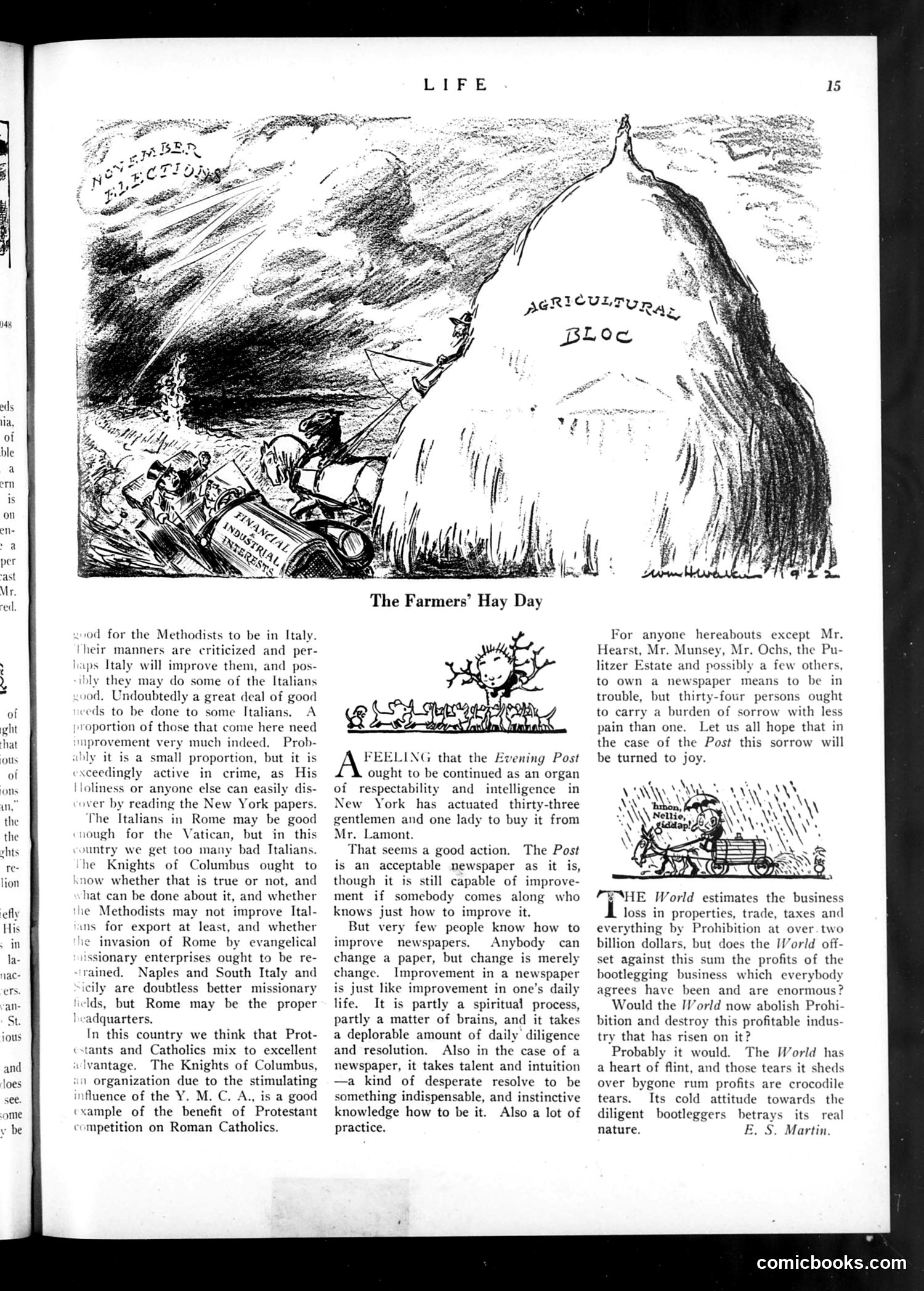
The main cartoon depicts an enormous agricultural bloc (labeled "AGRICULTURAL BLOC") towering over smaller figures, one of whom appears to be a farmer or laborer struggling beneath its weight. This satirizes the growing political power of American farmers in the early 20th century—specifically their organized influence on government policy. The "agricultural bloc" refers to a coalition of farm-state politicians who wielded substantial congressional power during this period, often blocking or demanding special treatment on legislation. The cartoon mocks how this interest group had become disproportionately powerful, crushing or dominating other concerns. The surrounding text discusses various social and political matters (Methodists in Italy, newspaper ownership, Prohibition) typical of *Life* magazine's satirical commentary on contemporary issues. The overall message critiques special-interest politics and the outsized influence farming interests held over national policy.
📄 Transcribed text from this page (OCR, searchable)
Machine-transcribed from the original scan — historical spelling and the odd misread are preserved.
of ght hat ous of ‘ons un,” the the rhts re- lion efly His ious and oes see. ome y be .vod for the Methodists to be in Italy. heir manners are criticized and _per- ips Italy will improve them, and pos- ly they may do some of the Italians vod, Undoubtedly a great deal of good ceds to be done to some Italians. A oportion of those that come here need iprovement very much indeed. Prob- ly it is a small proportion, but it is xceedingly active in crime, His \loliness or anyone else can easily dis- ver by reading the New York papers. lhe Italians in Rome may be good iough for the Vatican, but in this vuntry we get too many bad Italians. he Knights of Columbus ought to iow whether that is true or not, and hat can be done about it, and whether ie Methodists may not improve Ital- ins for export at least, and whether ie invasion of Rome by evangelical ssionary enterprises ought to be re- rained. Naples and South Italy and cily are doubtless better missionary Ids, but Rome may be the proper adquarters, In this country we think that Prot- tants and Catholics mix to excellent lvantage. The Knights of Columbus, an organization due to the stimulating nfluence of the Y. M. C. A,, is a good cxample of the benefit of Protestant competition on Roman Catholics. FEELING that the Evening Post ought to be continued as an organ oi respectability and intelligence in New York has actuated thirty-three gentlemen and one lady to buy it from Mr. Lamont. That seems a good action. The Post is an acceptable newspaper as it is, though it is still capable of improve- ment if somebody comes along who knows just how to improve it. But very few people know how to improve newspapers. Anybody can change a paper, but change is merely change. Improvement in a newspaper is just like improvement in one’s daily life. It is partly a spiritual process, partly a matter of brains, and it takes a deplorable amount of daily’ diligence and resolution. Also in the case of a newspaper, it takes talent and intuition —a kind of desperate resolve to be something indispensable, and instinctive knowledge how to be it. Also a lot of practice. For anyone hereabouts except Mr. Hearst, Mr. Munsey, Mr. Ochs, the Pu- litzer Estate and possibly a few others, to own a newspaper means to be in trouble, but thirty-four persons ought to carry a burden of sorrow with less pain than one. Let us all hope that in the case of the Post this sorrow will be turned to joy. TFSHE World estimates the business i loss in properties, trade, taxes and everything by Prohibition at over. two billion dollars, but does the [orld off- set against this sum the profits of the bootlegging business which everybody agrees have been and are enormous? Would the IVorld now abolish Prohi- bition and destroy this profitable indus- try that has risen on it? Probably it would. The World has a heart of flint, and those tears it sheds over bygone rum profits are crocodile tears. Its cold attitude towards the diligent bootleggers betrays its real nature. E. S. Martin. comicbooks.com 7