
Life, 1922-02-02 · page 24 of 34
Life — February 2, 1922 — page 24: what you’re looking at
What you’re looking at
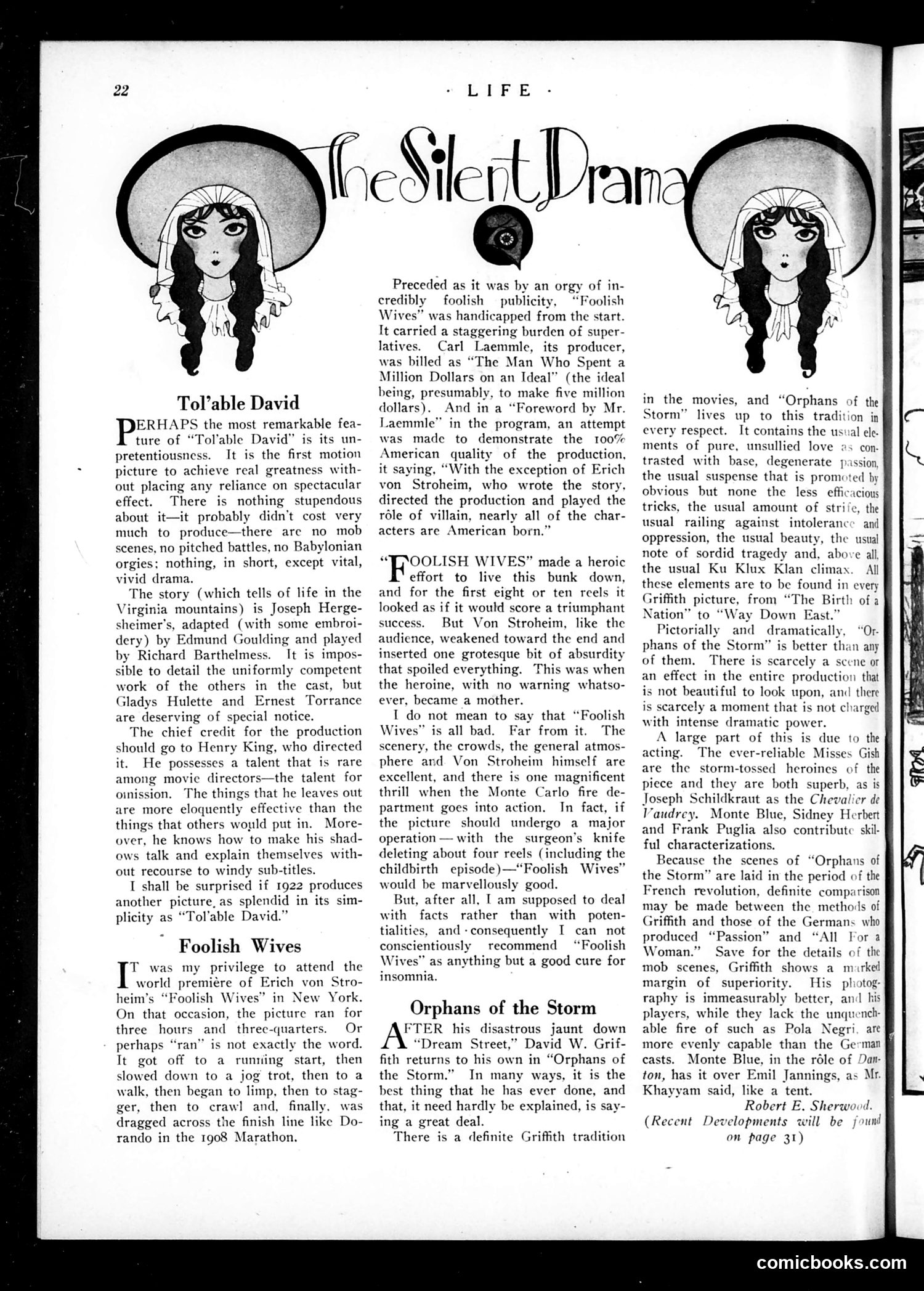
This page presents three film reviews from Life magazine, likely from 1922. The illustrations show a stylized woman's face in large hats—typical Art Deco imagery of the era. **"Tol'able David"** is praised as a remarkably effective film that achieves greatness through simplicity rather than spectacle. Set in Virginia mountains, it stars Richard Barthelmess and was directed by Henry King. The reviewer celebrates the film's restraint and effectiveness of what it *omits* rather than includes. **"Foolish Wives"** receives mixed criticism. Director Erich von Stroheim's film was burdened by producer Carl Laemmle's excessive publicity claiming it cost a million dollars. The reviewer finds the first eight reels promising but condemns a bizarre plot element (the heroine suddenly becoming a mother) as absurd. The review concludes sarcastically that it's "a good cure for insomnia." **"Orphans of the Storm"** by D.W. Griffith is introduced as his best recent work after a disappointing previous film. The review is cut off mid-page.
📄 Transcribed text from this page (OCR, searchable)
Machine-transcribed from the original scan — historical spelling and the odd misread are preserved.
Tol’able David IERHAPS the most remarkable fea- ture of “Tol’able David” is its un- pretentiousness. It is the first motion picture to achieve real greatness with- out placing any reliance on spectacular effect. There is nothing stupendous about it—it probably didn’t cost very much to produce—there are no mob scenes, no pitched battles, no Babylonian orgies; nothing, in short, except vital, vivid drama. The story (which tells of life in the Virginia mountains) is Joseph Herge- sheimer’s, adapted (with some embroi- dery) by Edmund Goulding and played by Richard Barthelmess. It is impos- sible to detail the uniformly competent work of the others in the cast, but Gladys Hulette and Ernest Torrance are deserving of special notice. The chief credit for the production should go to Henry King, who directed it. He possesses a talent that is rare among movie directors—the talent for oinission. The things that he leaves out are more eloquently effective than the things that others would put in. More- over, he knows how to make his shad- ows talk and explain themselves with- out recourse to windy sub-titles. I shall be surprised if 1922 produces another picture, as splendid in its sim- plicity as “Tol’able David.” Foolish Wives T was my privilege to attend the world premiére of Erich von Stro- heim’s “Foolish Wives” in New York. On that occasion, the picture ran for three hours and three-quarters. Or perhaps “ran” is not exactly the word. It got off to a running start, then slowed down to a jog trot, then to a walk, then began to limp, then to stag- ger, then to crawl and, finally, was dragged across the finish line like Do- rando in the 1908 Marathon. LIFE - Mert Dean Preceded as it was by an orgy of in- credibly foolish publicity, “Foolish Wives” was handicapped from the start. It carried a staggering burden of super- lativ Carl Laemmle, its producer, was billed as “The Man Who Spent a Million Dollars on an Ideal” (the ideal being, presumably, to make five million dollars). And in a “Foreword by Mr. Laemmle”™ in the program, an attempt was made to demonstrate the 100% American quality of the production, it saying, “With the exception of Erich von Stroheim, who wrote the story, directed the production and played the role of villain, nearly all of the char- acters are American born.” “TXOOLISH WIVES” made a heroic effort to live this bunk down, and for the first eight or ten reels it looked as if it would score a triumphant success. But Von Stroheim, like the audience, weakened toward the end and inserted one grotesque bit of absurdity that spoiled everything. This was when the heroine, with no warning whatso- ever, became a mother. I do not mean to say that “Foolish Wives” is all bad. Far from it. The scenery, the crowds, the general atmos- phere and Von Stroheim himself are excellent, and there is one magnificent thrill when the Monte Carlo fire de- partment goes into action. In fact, if the picture should undergo a major operation— with the surgeon's knife deleting about four reels (including the childbirth episode)—‘“Foolish Wives” would be marvellously good. But, after all, [ am supposed to deal with facts rather than with poten- tialities, and -consequently I can not conscientiously recommend ‘‘Foolish Wi as anything but a good cure for insomnia. Orphans of the Storm ‘TER his disastrous jaunt down “Dream Street,” David W. Grif- fith returns to his own in “Orphans of the Storm.” In many ways, it is the best thing that he has ever done, and that, it need hardly be explained, is say- ing a great deal. There is a definite Griffith tradition in the movies, and “Orphans Storm” lives up to this tradition in every respect. It contains the usual ele. ments of pure, unsullied love 2s con- trasted with base, degenerate passion, the usual suspense that is promoted by obvious but none the less efficacious tricks, the usual amount of e, the usual railing against intolerance and oppression, the usual beauty, the usual note of sordid tragedy and, above all, the usual Ku Klux Klan climax. All these elements are to be found in every iffth picture, from “The Birth ofa Nation” to “Way Down East.” Pictorially and dramatically, “Or phans of the Storm” is better than any of them. There is scarcely a scene or an effect in the entire production that is not beautiful to look upon, and there is scarcely a moment that is not charged with intense dramatic power. A large part of this is due to the acting. The ever-reliable Misses Gish are the storm-tossed heroines of the piece and they are both superb, as i Joseph Schildkraut as the Chevalier de Vaudr Monte Blue, Sidney Herbert and Frank Puglia also contribute skil- ful characterizations. Because the scenes of “Orphans of the Storm” are laid in the period of the French revolution, definite comparison may be made between the methods of Griffith and those of the Germans who produced “Passion” and “All For a Woman.” Save for the details of the mob scenes, Griffith shows a murked margin of superiority. His photog- raphy is immeasurably better, and his players, while they lack the unquench- able fire of such as Pola Negri, are more evenly capable than the German casts. Monte Blue, in the réle of Dan- ton, has it over Emil Jannings, as Mr. Khayyam said, like a tent. Robert E. Sherwood. (Recent Developments will be fount on page 31) of the comicbooks.com