
A complete issue · 44 pages · 1920
Life — May 27, 1920
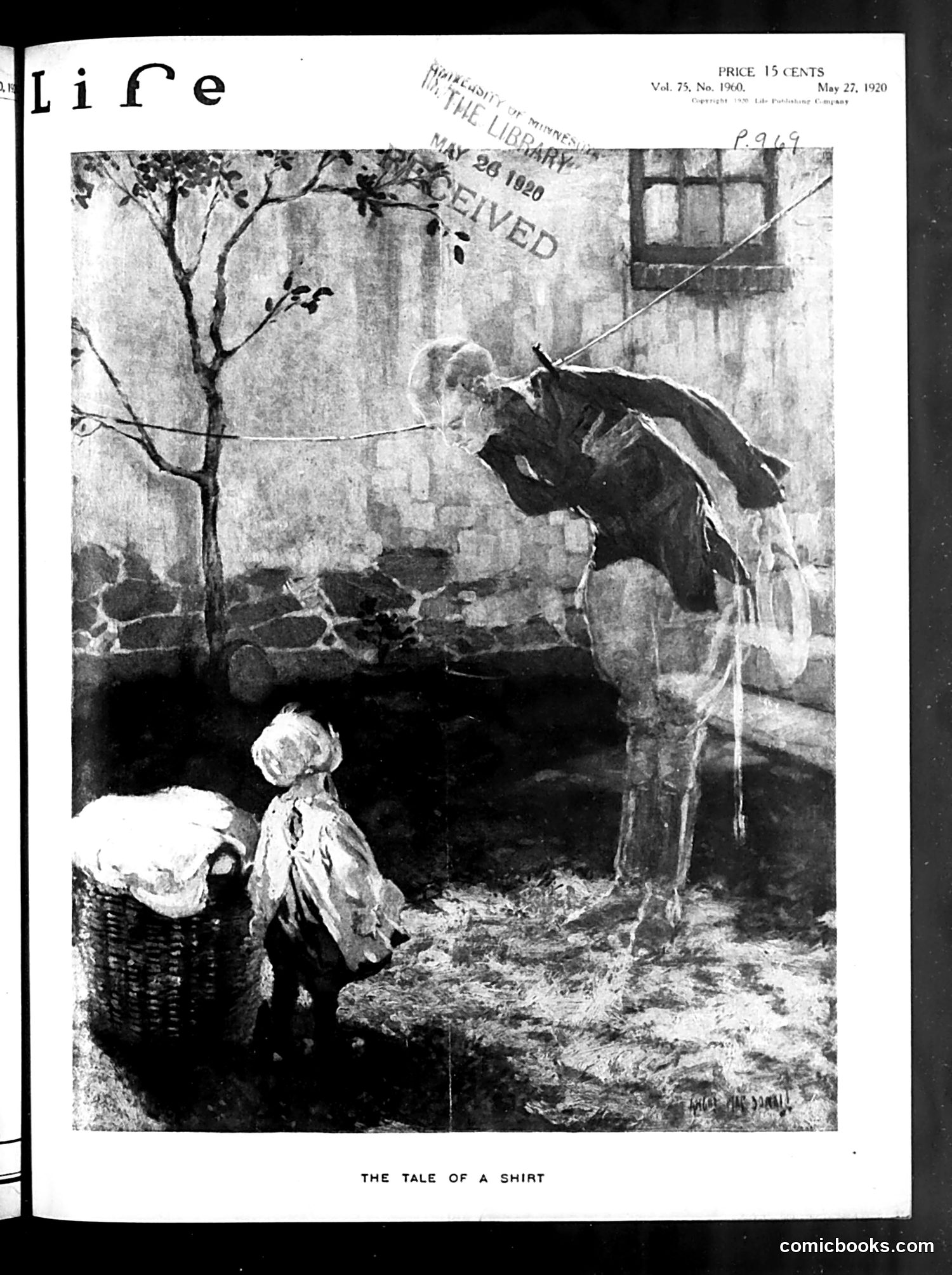
This satirical illustration depicts a scene of domestic laundry gone wrong. An elderly woman hangs clothes on a line while a man in dark clothing gestures dramatically from a window above, appearing distressed or angry about the garment being laundered. The title "The Tale of a Shirt" suggests this is a humorous commentary on the common domestic frustration of improper clothes care—likely a shirt has been damaged or shrunk during washing. The exaggerated body language of the man conveys the disproportionate emotional reaction men often display over minor laundry mishaps, poking fun at masculine overreaction to domestic matters. This reflects early 20th-century gender dynamics and household tensions around domestic labor and its imperfections.
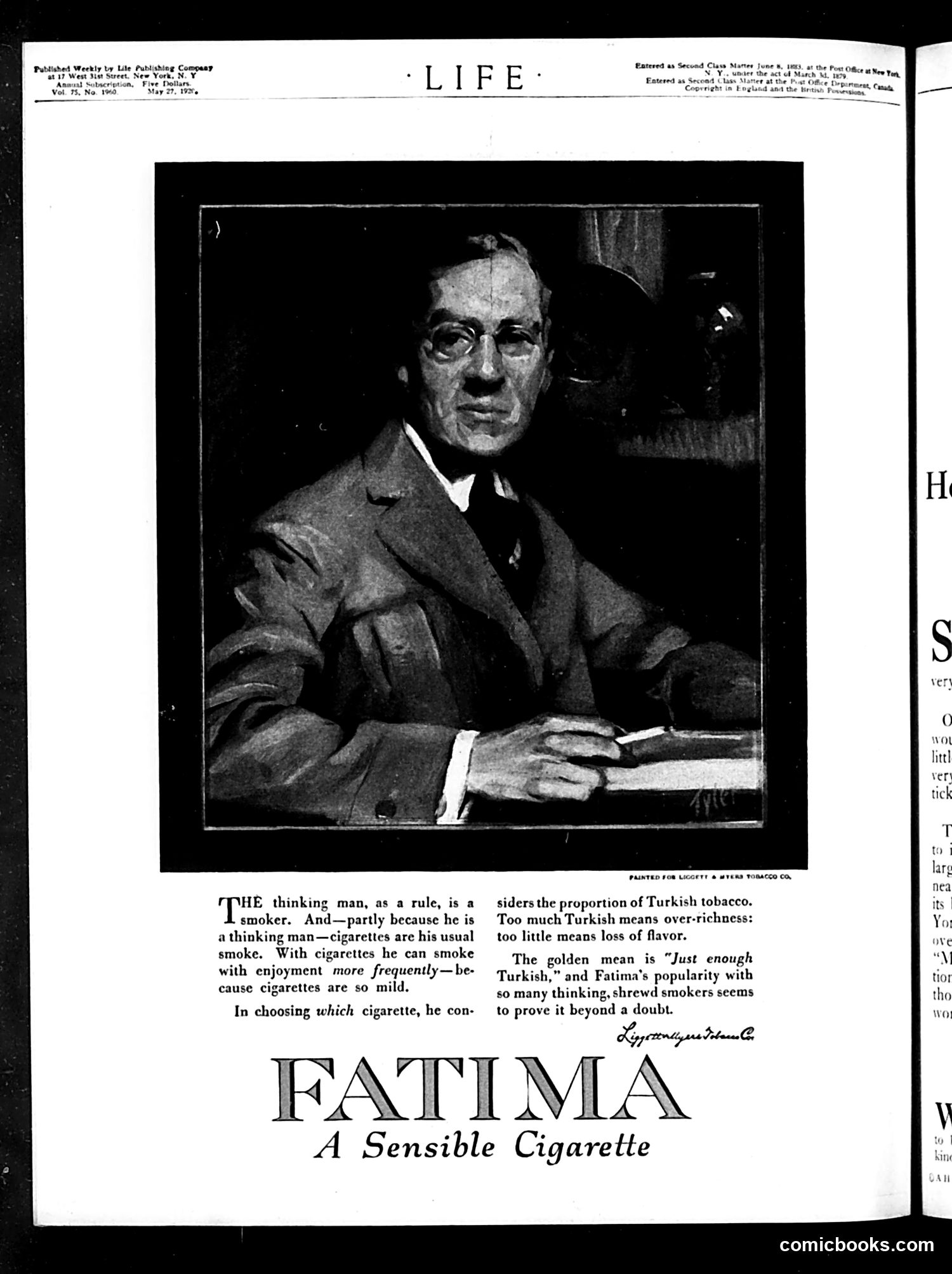
This page is primarily **advertising, not political satire**. It features a Fatima cigarette advertisement from Life magazine (dated May 27, 1925). The ad shows a well-dressed man with glasses in a portrait photograph. The accompanying text appeals to "the thinking man," arguing that cigarettes enable frequent smoking because they're mild. It promotes Turkish tobacco as the "golden mean" between excessive richness and insufficient flavor, claiming Fatima cigarettes strike this balance. The ad uses intellectual positioning as a marketing strategy—associating the product with thoughtful, refined consumption. There is no political cartoon or satire present; this is straightforward commercial messaging typical of 1920s magazine advertising.
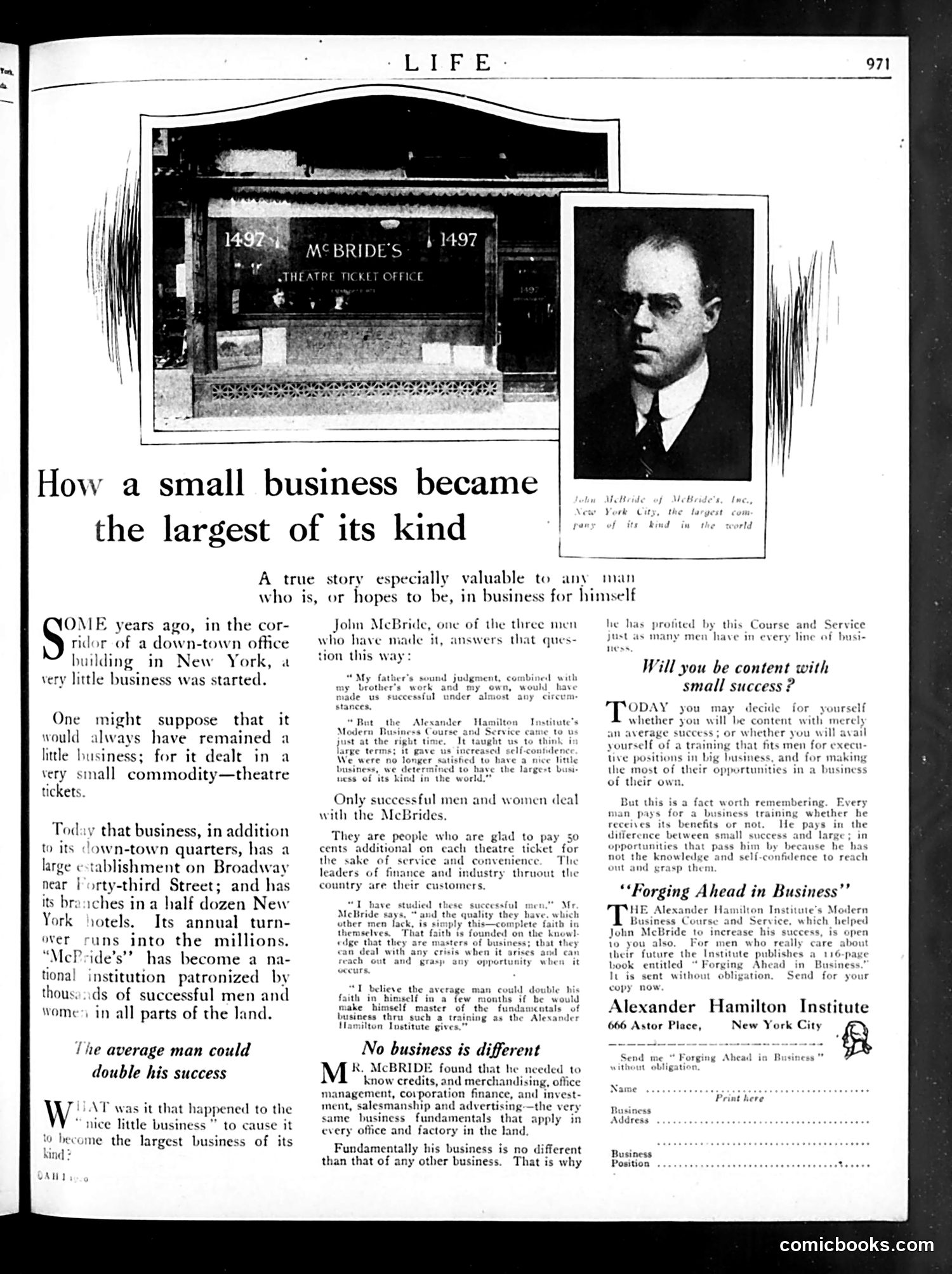
This page is **not a cartoon or satire**—it's a business advertisement disguised as editorial content, a common practice in early 20th-century magazines. The layout features a photograph of McBride's Theatre Ticket Office storefront (showing address 1497) and a portrait of **John McBride**, identified as head of McBride's Inc., "the largest company of its kind in the world." The article presents McBride's origin story: a small ticket business that grew into a major enterprise. It promotes the **Alexander Hamilton Institute's "Modern Business Course,"** which McBride credits for his success. The piece argues that ordinary businessmen can "double his success" through proper training. This is essentially advertorial—combining promotional biography with a course advertisement targeting aspiring entrepreneurs. The "story" serves to validate both McBride's business model and the Institute's educational program.
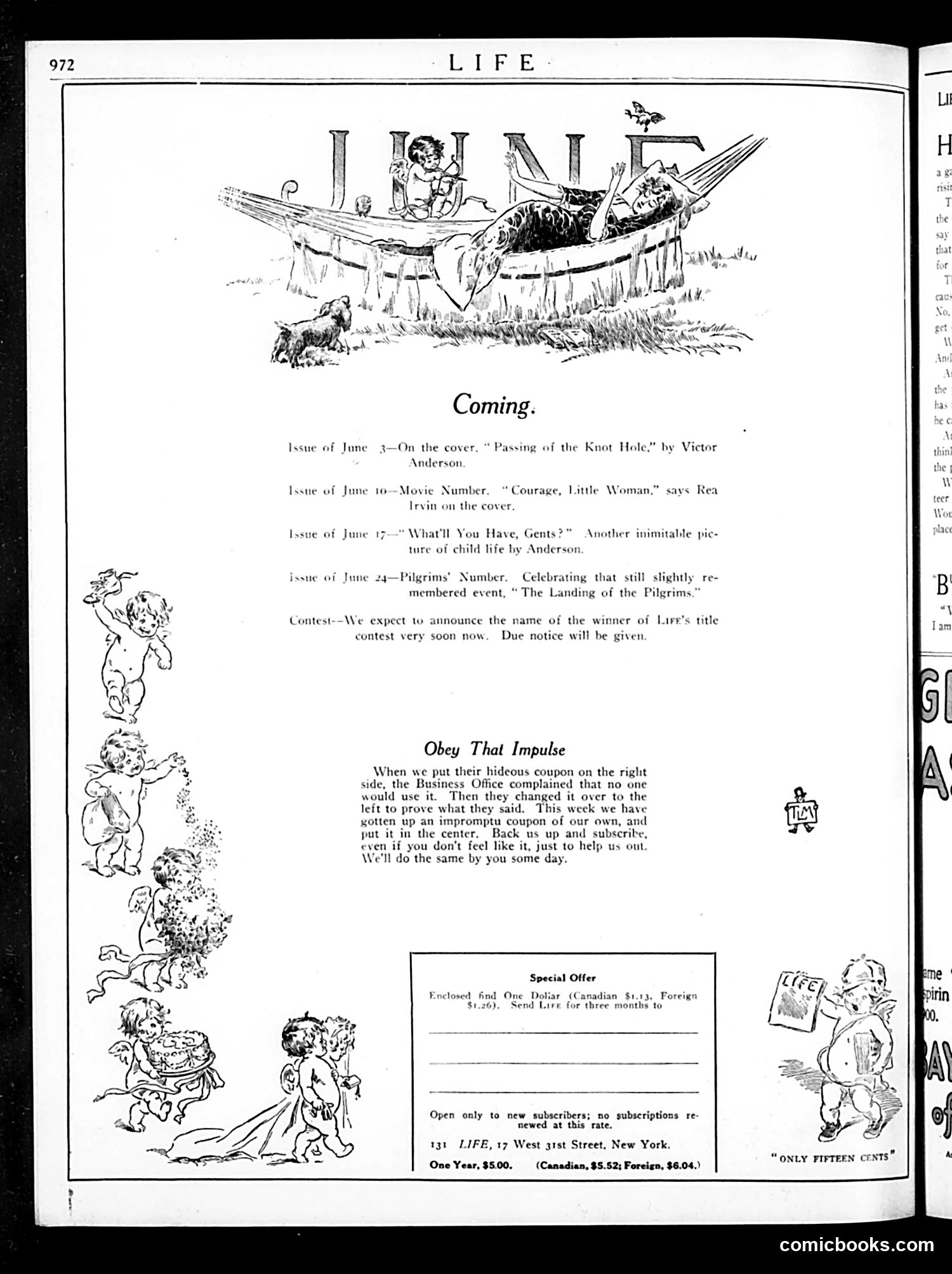
This page functions primarily as a **magazine preview and subscription advertisement** rather than political satire. The upper illustration shows a whimsical boat scene with cherubic figures, introducing upcoming content including works by Victor Anderson and Rea Irvin. The main section, "Obey That Impulse," humorously describes a **subscription promotion strategy**: Life apparently moved their coupon to the center of the magazine after discovering readers weren't using it on the right side. The text jokingly suggests readers subscribe "even if you don't feel like it, just to help us out." The left margin features decorative cherub illustrations typical of Life's style. A "Special Offer" box advertises annual subscriptions at $3.00 domestic/$3.52 Canadian/$6.04 foreign—"only fifteen cents" per issue. The page is essentially **marketing content disguised with editorial humor**, not political commentary.
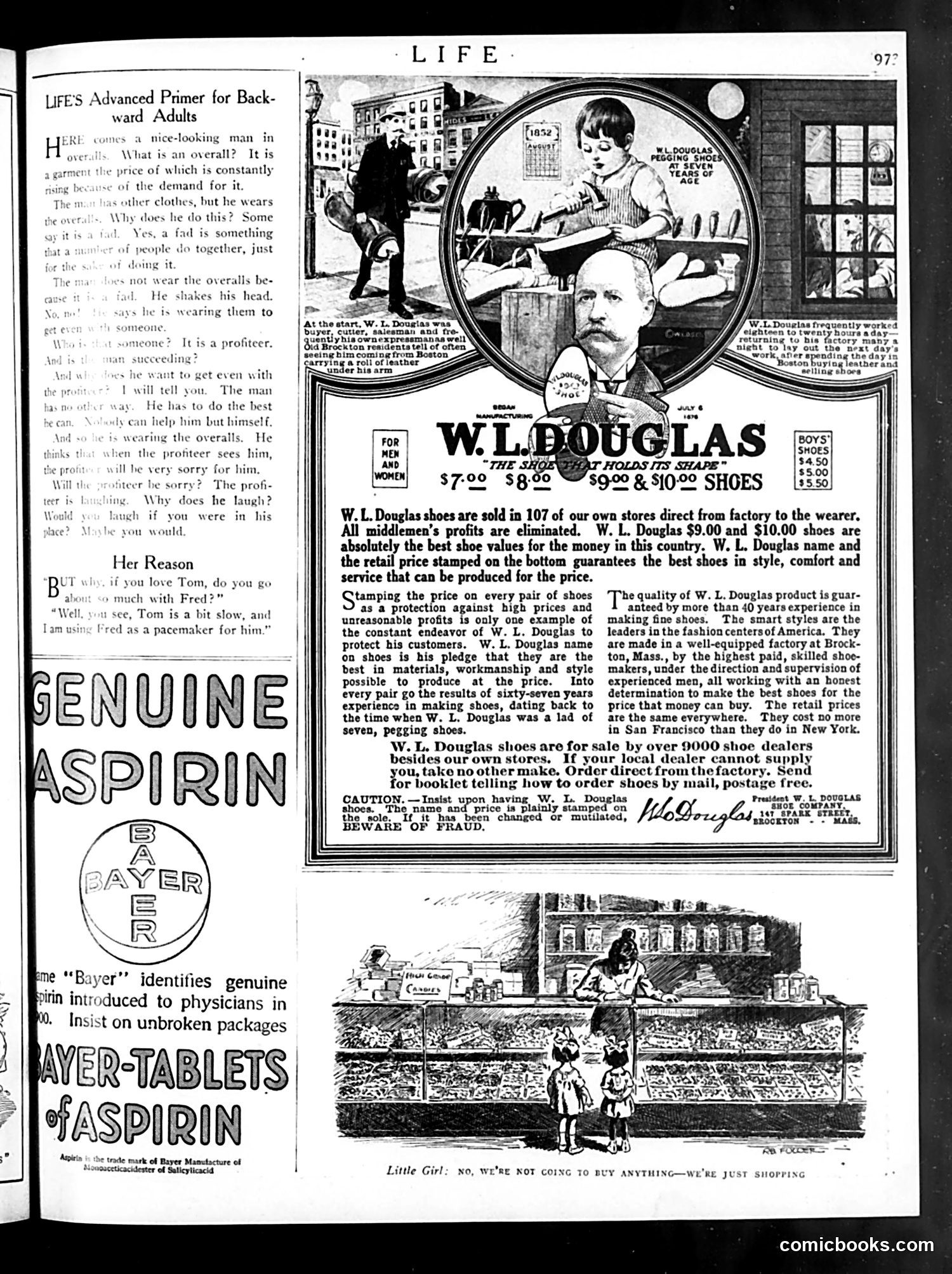
This page is primarily **advertising**, not satire. The dominant content is a large W. L. Douglas shoe advertisement featuring testimonials and images of the company founder and a young child using his products. The ad emphasizes direct factory-to-consumer sales that eliminate "middlemen's profits," positioning Douglas shoes as affordable quality footwear ($7-$10). The left column contains unrelated satirical content—"Life's Advanced Primer for Backward Adults"—a humorous piece mocking social pretension and profiteering. Below that is a Bayer Aspirin advertisement. At the bottom, a small cartoon shows children at a storefront saying they're "just shopping," not buying—likely poking fun at window-shopping during economically tight times, though the context remains unclear without additional information.
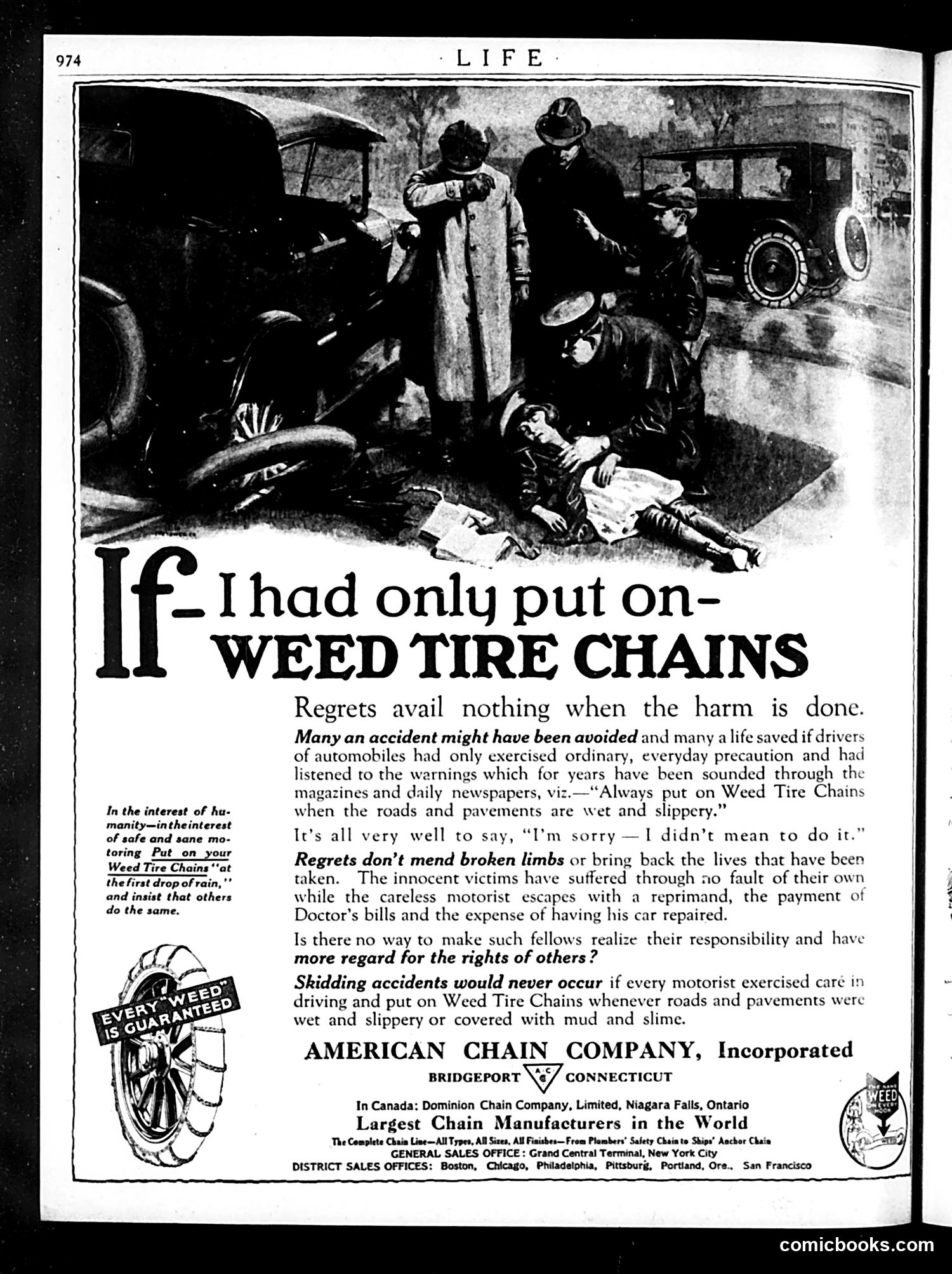
This is primarily a **safety advertisement** for Weed Tire Chains, not satire. The dramatic scene depicts an automobile accident with injured pedestrians and concerned onlookers. The ad's argument is straightforward: careless drivers who fail to use tire chains on wet, slippery roads cause preventable accidents and injuries. The headline "If—I had only put on WEED TIRE CHAINS" presents regret after harm occurs. The text emphasizes **personal responsibility**, shaming negligent motorists who escape consequences while innocent victims suffer. It's a moral appeal framed as public safety messaging—essentially arguing that using chains isn't optional precaution but a social obligation to protect others. This reflects early 20th-century automotive safety concerns, when tire chains were essential winter equipment. The ad targets motorists' conscience rather than offering product benefits.
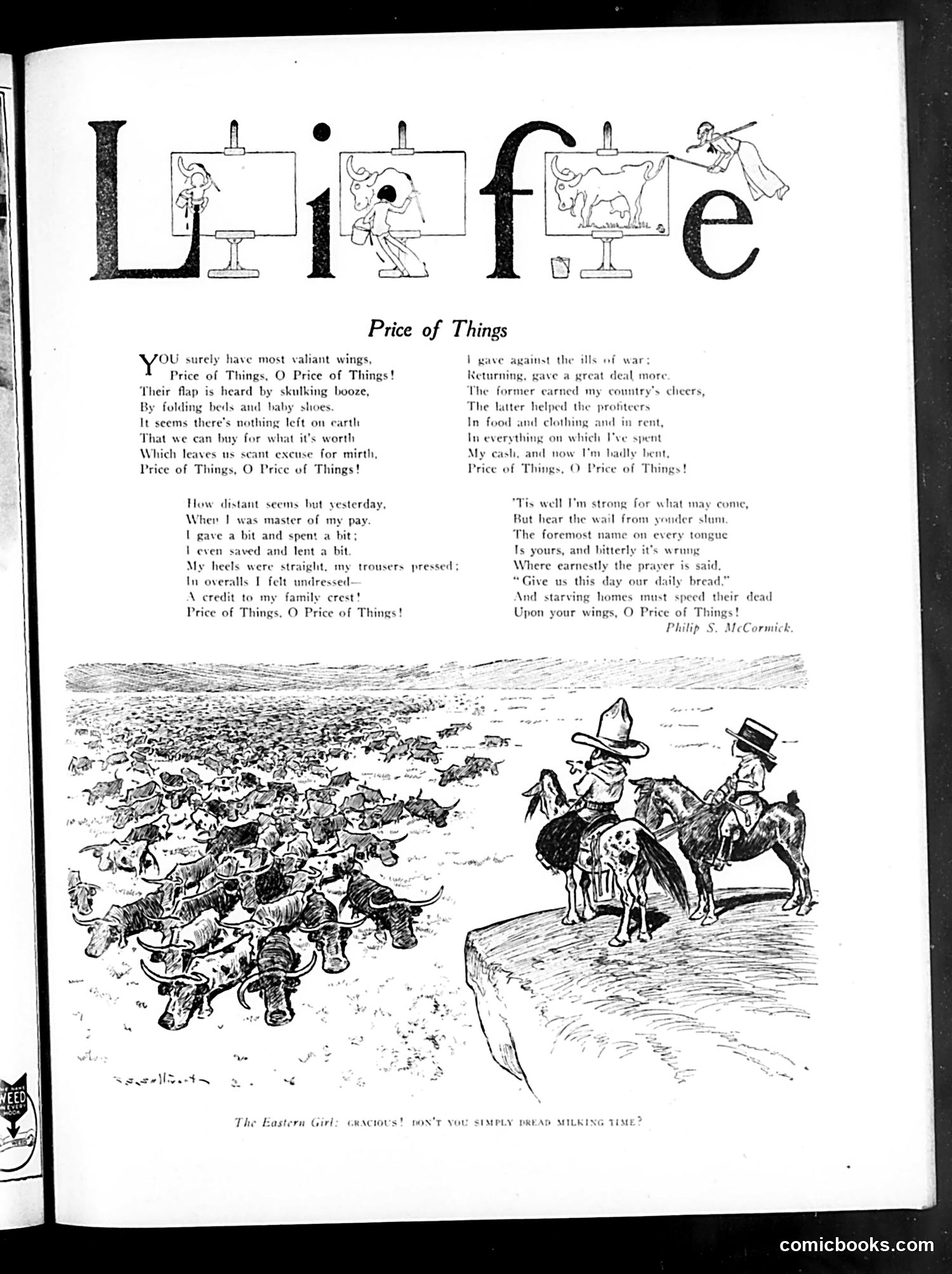
This page presents Philip S. McCormick's anti-war poem criticizing the economic costs of World War I. The decorative header "Life" features vignettes of domestic wartime rationing and sacrifice. The poem laments how war has depleted national resources—"nothing left on earth / That we can lay by for what it's worth"—while soldiers die. McCormick contrasts past prosperity ("heels were straight, my trousers pressed") with present hardship and debt. The satirical illustration below depicts two well-dressed gentlemen (likely politicians or profiteers) observing a vast battlefield littered with casualties. The caption "The Eastern Girl: 'GRACIOUS! DON'T YOU SIMPLY DREAD MILKING TIME?'" adds bitter irony—civilians complain of minor inconveniences while soldiers die overseas. The satire targets American complacency about war's true human cost.
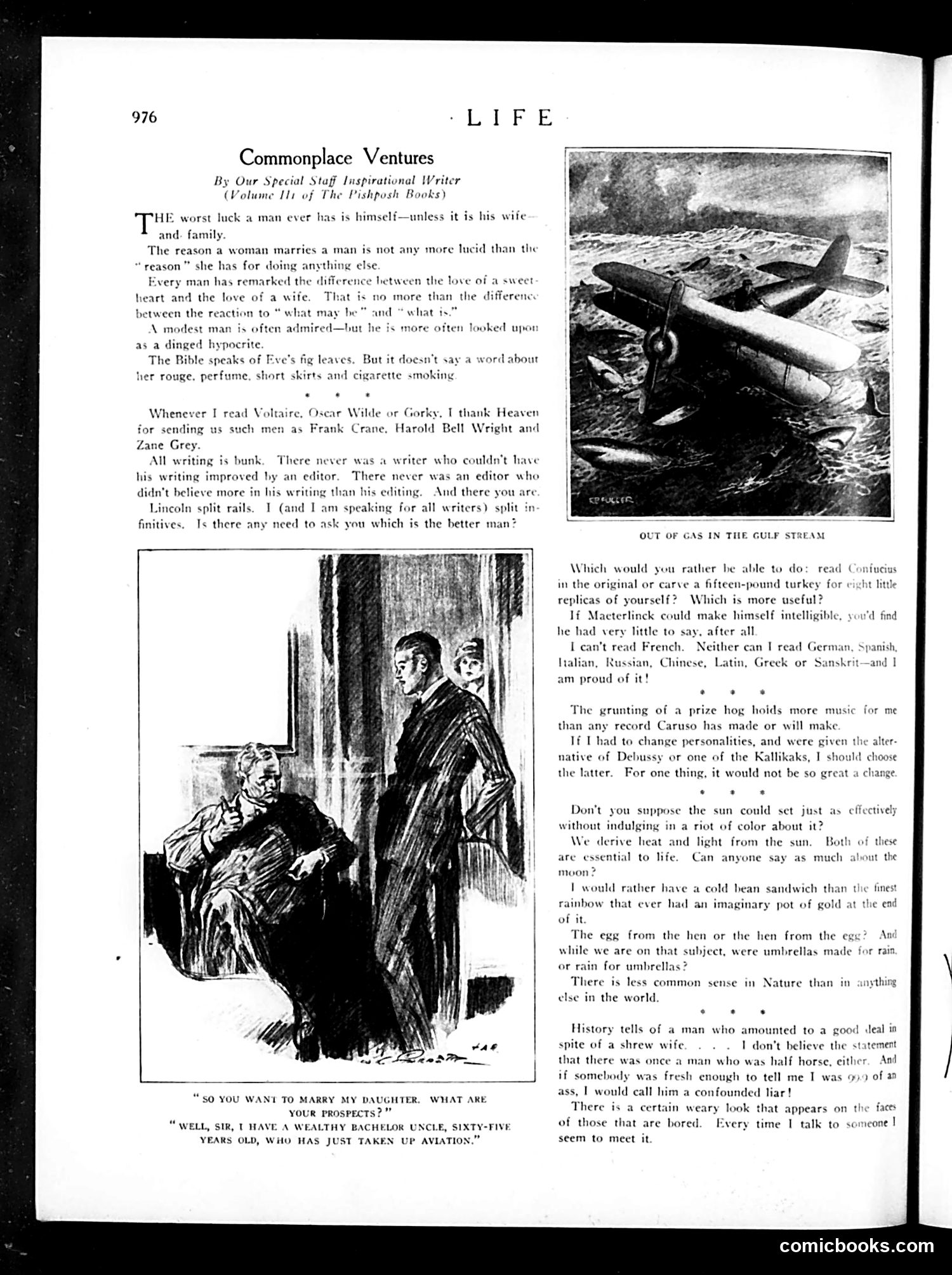
This satirical piece critiques pretentious intellectual and cultural affectations. The main cartoon depicts a father-daughter conversation about marriage prospects. The daughter's suitor is described as a "wealthy bachelor uncle, sixty-five years old, who has just taken up aviation"—satirizing how wealthy older men adopt fashionable hobbies to appear modern and appealing to younger women. The accompanying essay mocks various forms of pomposity: people who read untranslated foreign literature to seem cultured, those who prefer abstract art over practical utility, and those who make grandiose claims about nature and philosophy without genuine understanding. The satire targets the gap between pretense and reality—the notion that adopting fashionable interests or affectations can substitute for genuine character or substance.
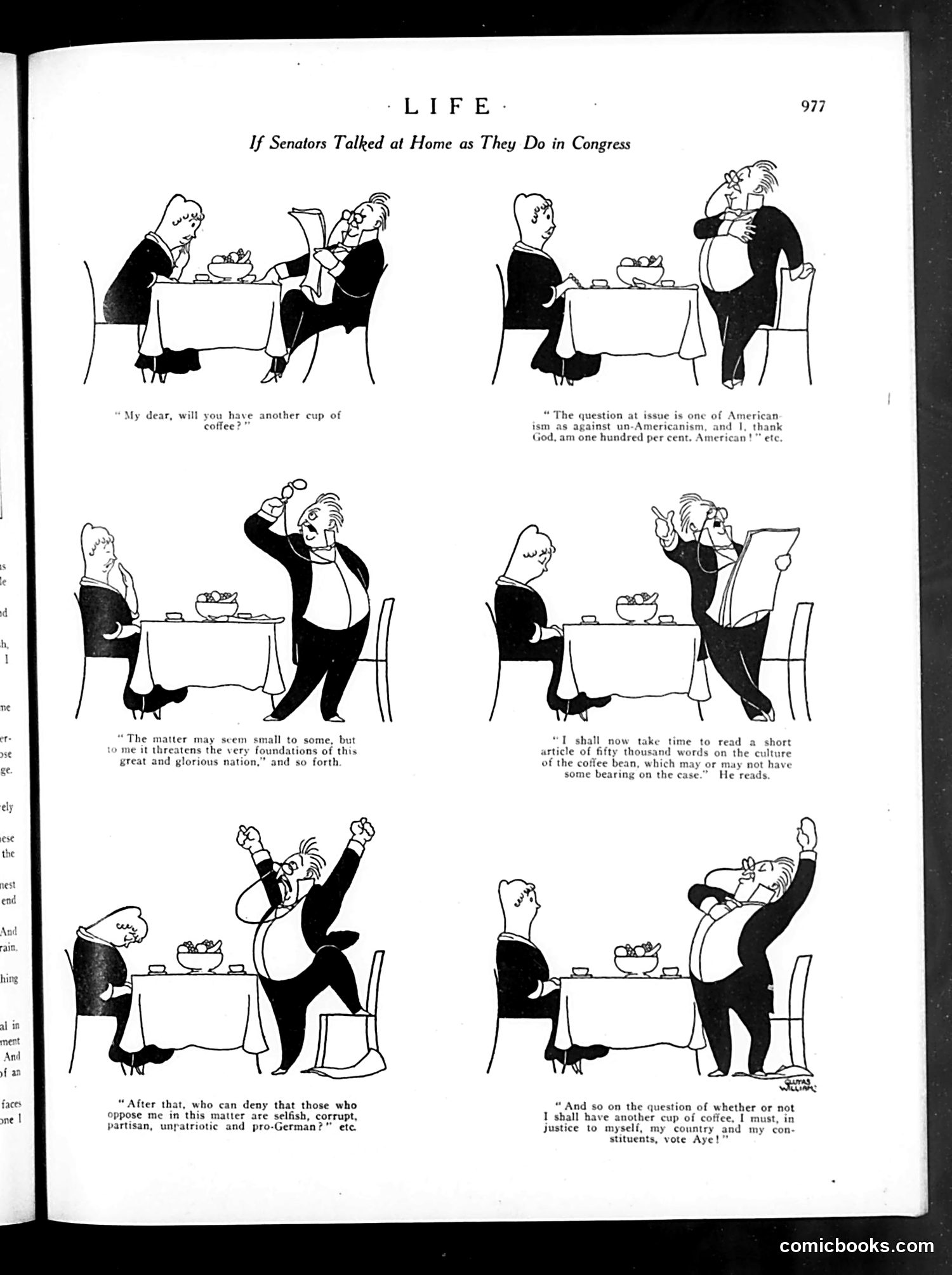
This satirical comic strip contrasts senators' public rhetoric with their home behavior. In six panels, a senator speaks to his wife with increasingly grandiose, flowery language borrowed from Congressional speeches—discussing ordinary matters like coffee with inflated patriotic rhetoric about "American ism as against un-Americanism" and the "foundations of this great and glorious nation." The joke satirizes senators' tendency to use pompous, verbose language and self-important declarations during official proceedings, even on trivial matters. The wife's patient, bemused reactions emphasize the absurdity of applying such overwrought political grandstanding to domestic life. The satire suggests senators are out-of-touch with reality and prone to theatrical excess in their public statements.
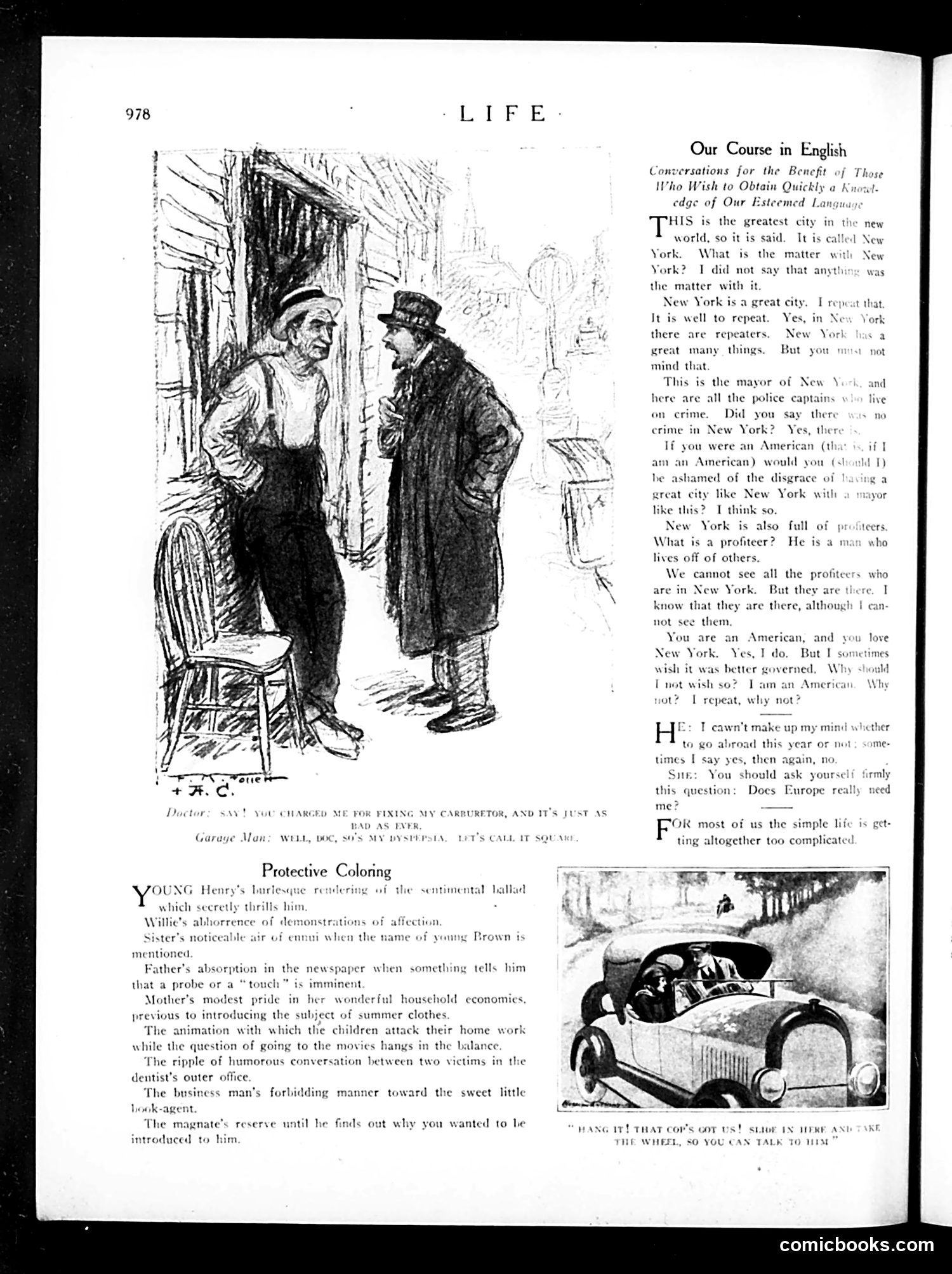
The top cartoon depicts two men in conversation on a city street. The caption quotes a "Doctor" complaining about carburetor repair costs, with a "Garage Man" responding dismissively about the expense. This satirizes the growing frustration with automobile maintenance costs in the early automotive era—a relatable complaint for the magazine's readers. The accompanying essay "Our Course in English" humorously critiques New York City through a dialogue about crime, corruption, and American values. It juxtaposes idealistic American principles with urban realities: crime, "profiteers," and moral compromises. The lower cartoon shows a car with two people, captioned about a cop's offer to move along. This satirizes police indifference or complicity in public conduct. Both pieces use humor to critique urban American society and its contradictions.
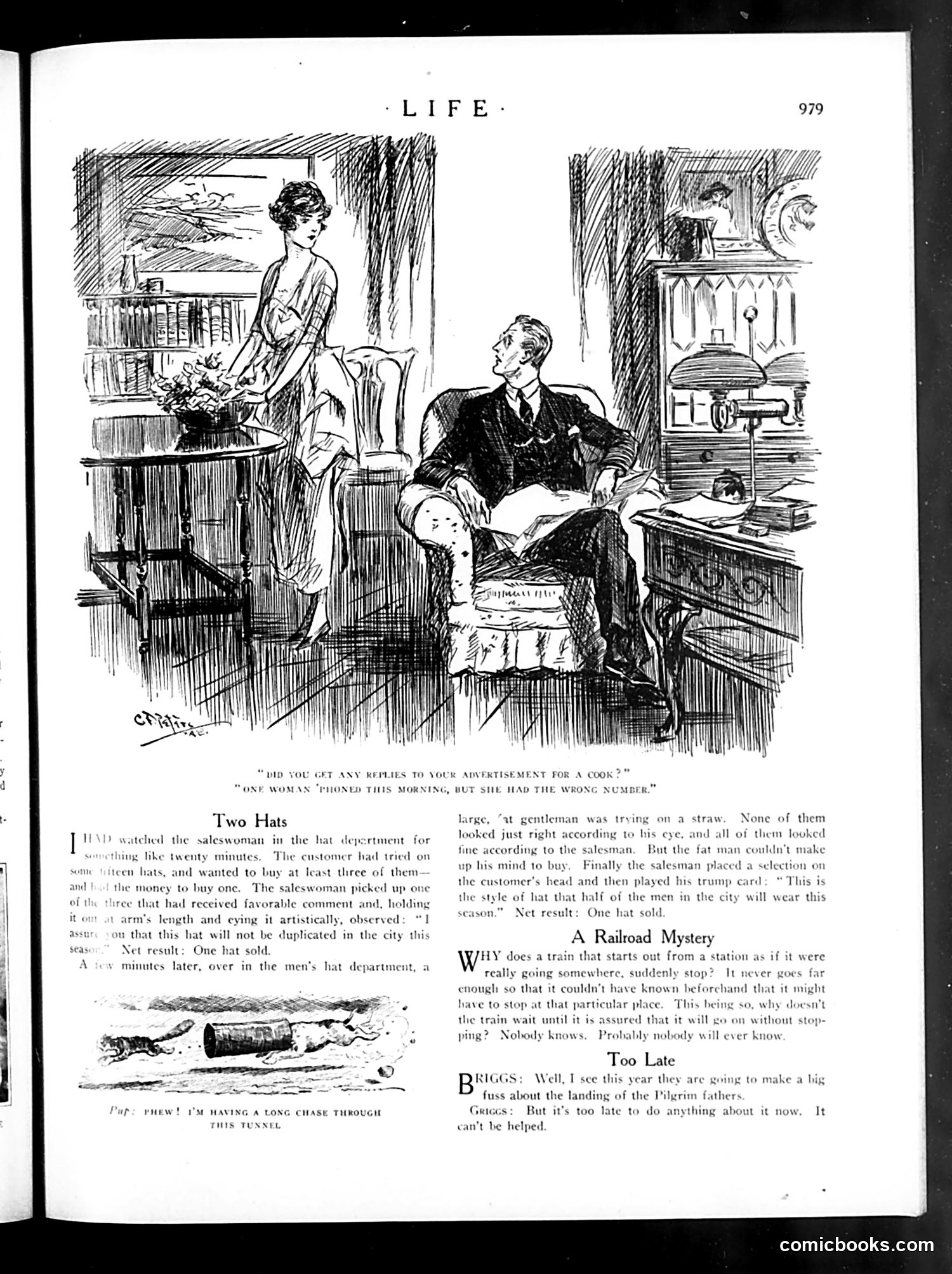
This page contains three separate humorous pieces: 1. **"Two Hats"** (top): A sketch shows a salesman struggling to sell hats. The joke is that he picked one hat that received "favorable comment" and tried to duplicate it for the city's wealthy clientele, but it failed to sell. The satire mocks both salesman overconfidence and the unpredictability of fashion trends. 2. **"A Railroad Mystery"** (right): Brief text humorously questions why trains depart punctually if they truly intend to go elsewhere, given they can't know beforehand whether they'll stop. It's absurdist humor about railroad reliability. 3. **"Too Late"** (bottom right): A short dialogue where Briggs and Griggs discuss the Pilgrims' landing—Griggs notes it's "too late" to do anything about it now, a dry joke about historical inevitability.
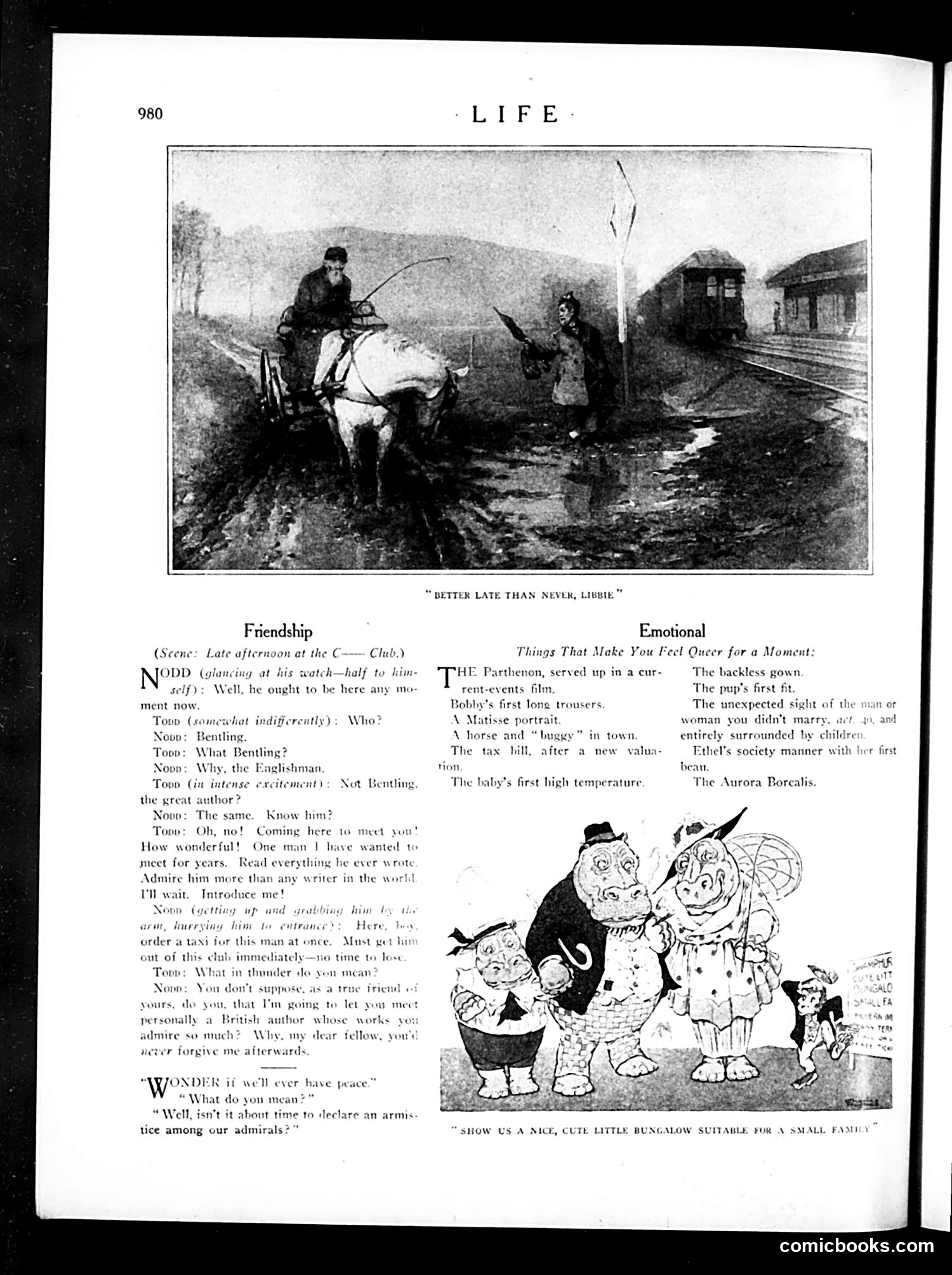
This page contains two separate pieces: **Left side - "Friendship"**: A comedic dialogue between characters named Nodd and Noon at a club, where Nodd attempts to introduce his friend Bentling (described as a great author whom he admires greatly). The humor relies on wordplay and misunderstanding—Noon initially mishears the introduction, creating confusion typical of early 20th-century comedy. **Right side - "Emotional"**: Lists sentimental scenarios meant to evoke brief feelings, followed by a cartoon showing exaggerated caricatured figures (appearing to depict various ethnic or social types) with the caption "Show us a nice, cute little bungalow suitable for a small family." The cartoon's humor appears to rely on period-typical ethnic caricature, though the specific satirical target remains unclear from the image alone.
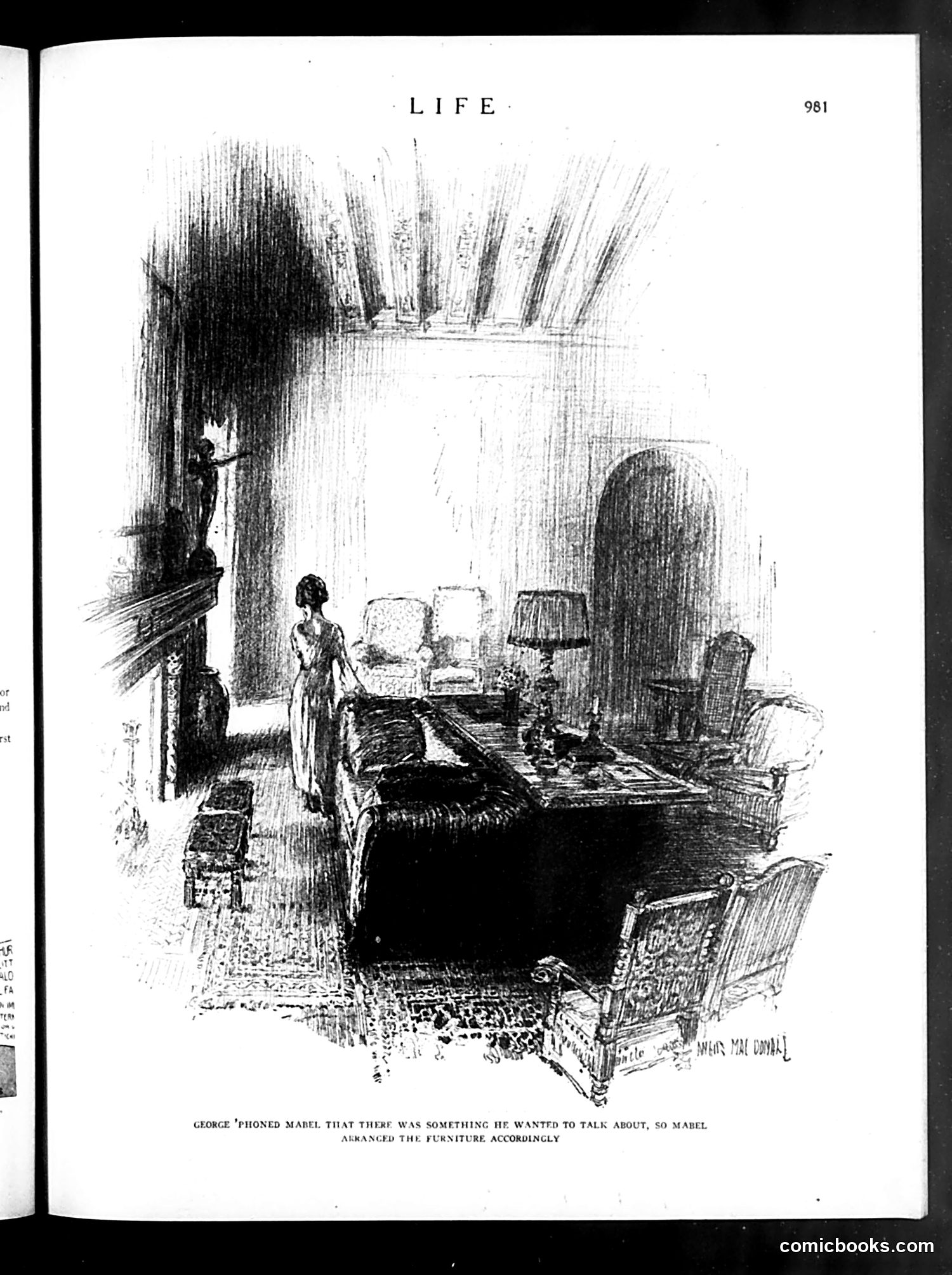
This is a sketch-style illustration accompanying a humorous domestic scene. The caption reads: "George phoned Mabel that there was something he wanted to talk about, so Mabel arranged the furniture accordingly." The cartoon satirizes marital communication dynamics. It depicts a wife (Mabel) who has strategically rearranged her living room furniture—placing chairs at opposite ends of a large bed—in preparation for a serious conversation with her husband (George). The joke suggests that Mabel anticipates bad news (likely infidelity or financial trouble) and has literally created physical distance between them as a defensive measure. The satire targets early 20th-century gender relations and anxieties about marriage, implying wives employ practical tactics to manage difficult household confrontations. The arrangement transforms the intimate bedroom into a formal negotiation space.
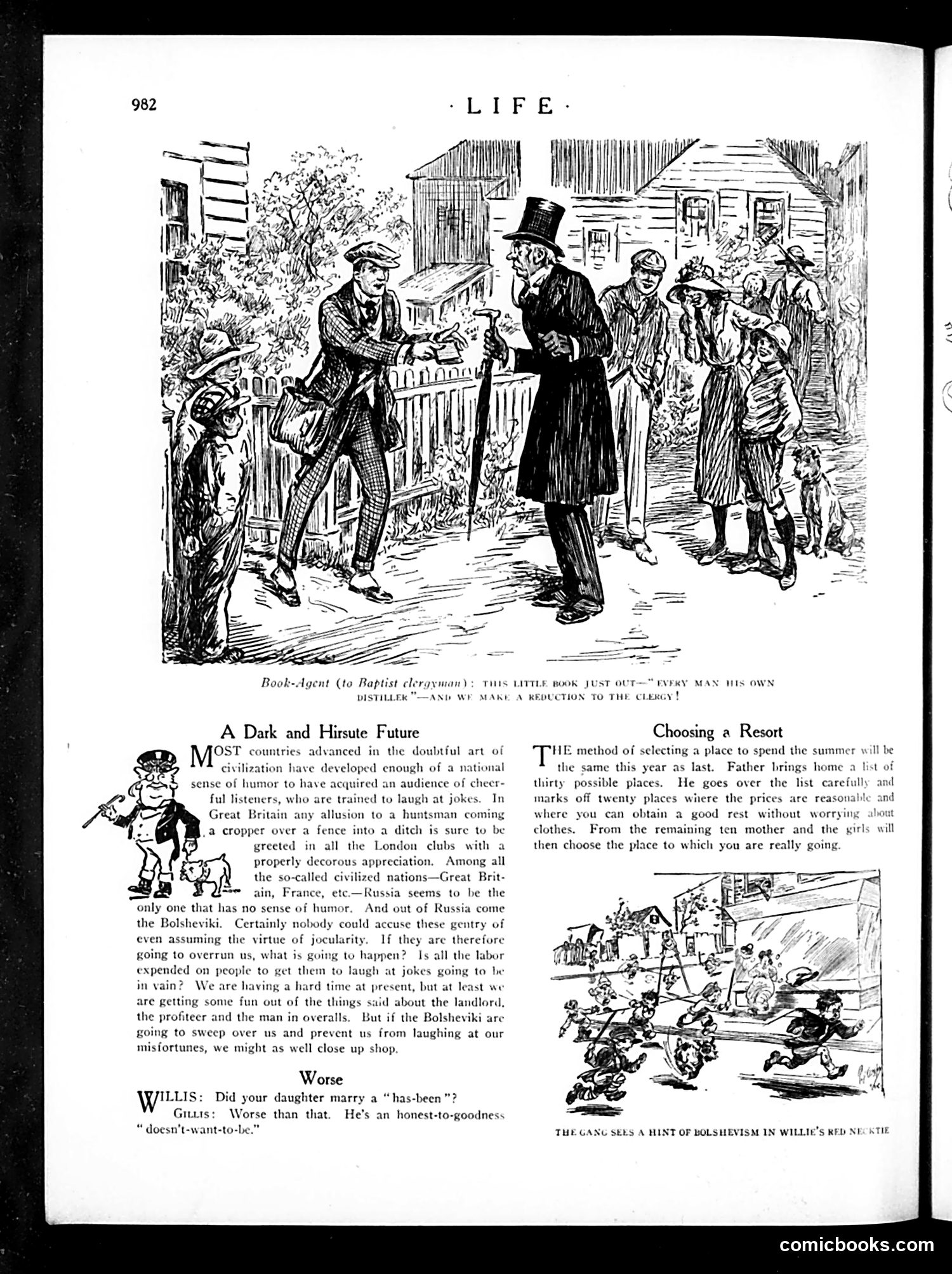
The top cartoon depicts a book agent pitching to a clergyman, with the caption suggesting the agent wants to sell religious books to church officials while offering a "reduction to the clergy." **"A Dark and Hirsute Future"** satirizes concerns about Bolshevism (Russian communism). The author worries that if Russia's Bolsheviks succeed in spreading their ideology, Britain—currently civilized and humorous—might lose its sense of humor and cultural sophistication. The piece treats this as an existential threat to British civilization. **"Choosing a Resort"** offers practical vacation advice about selecting affordable holiday destinations. **"Worse"** is a brief joke about marriage: Willis asks if his daughter married someone respectable; the response jokes that her husband is "honest-to-goodness doesn't-want-to-be"—wordplay mocking her husband's character.
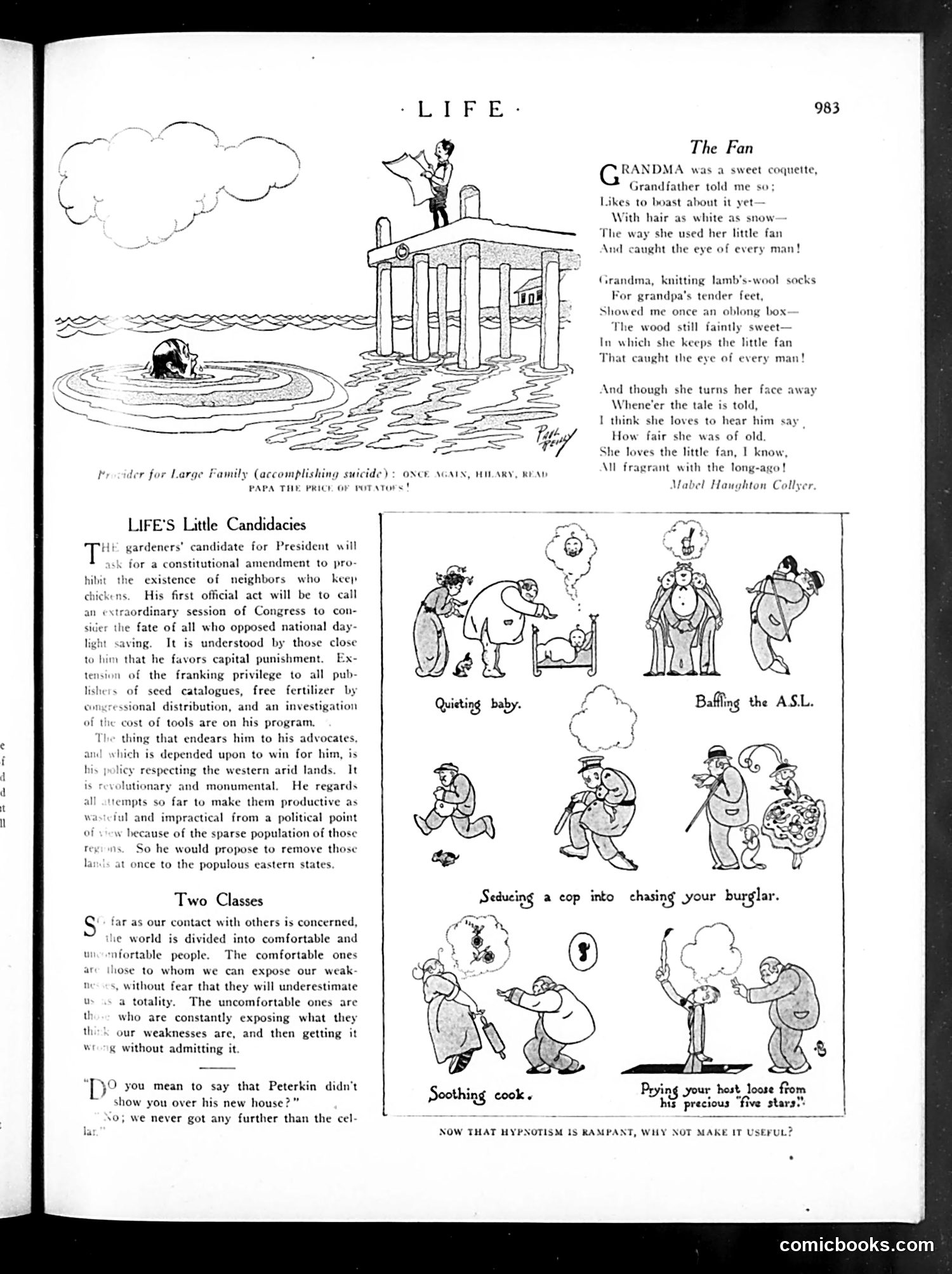
This page contains three distinct sections: a poem titled "The Fan" celebrating a grandmother's use of a decorative fan, a satirical piece called "LIFE's Little Candidacies" proposing a gardeners' candidate for President who would eliminate neighbors' chickens and fight daylight saving time, and a series of cartoon vignettes labeled "now THAT HYPNOTISM IS RAMPANT, WHY NOT MAKE IT USEFUL?" The cartoons humorously depict using hypnosis to accomplish difficult social tasks—quieting babies, avoiding the American Sign Language (ASL), seducing police officers away from burglaries, and soothing agitated cooks. The satire suggests that hypnotism, presented as trendy or fashionable, could comically solve everyday domestic and social problems. The page reflects early-20th-century American humor about contemporary fads and domestic frustrations.
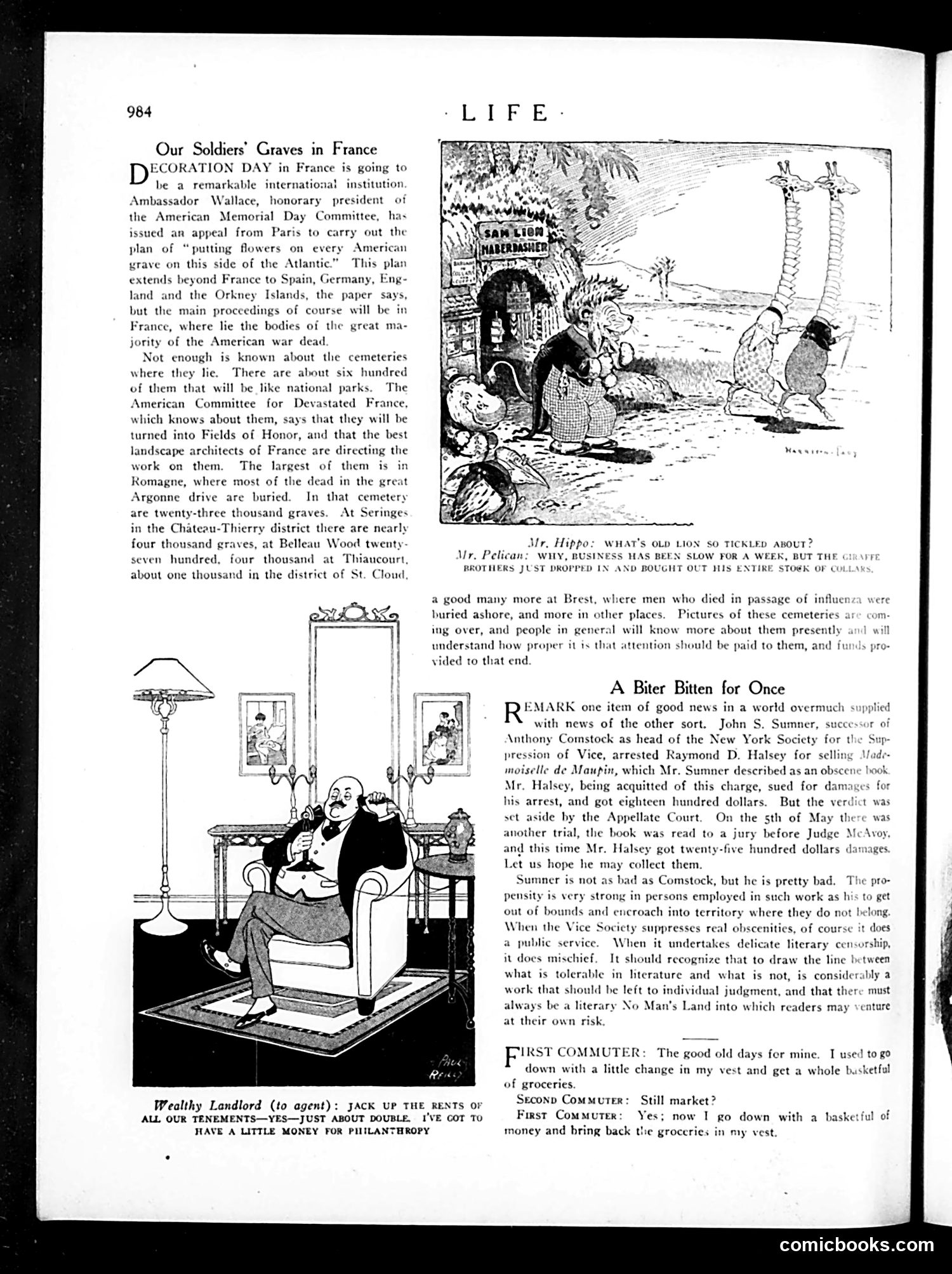
**Top Section - "Our Soldiers' Graves in France":** This article discusses Decoration Day observances at American military cemeteries in France following World War I. It describes plans to memorialize the approximately 600 graves across French burial sites, with the largest at Romagne containing 23,000 graves. The piece emphasizes proper landscaping and preservation by French architects. **Bottom Cartoon - "Wealthy Landlord":** This satirical cartoon depicts a well-dressed landlord demanding doubled rent from tenants, claiming he needs money "for philanthropy." The joke mocks wealthy individuals who raise rents while claiming charitable motivations—exposing the hypocrisy of the wealthy using philanthropic excuses to justify exploitation of poor tenants.
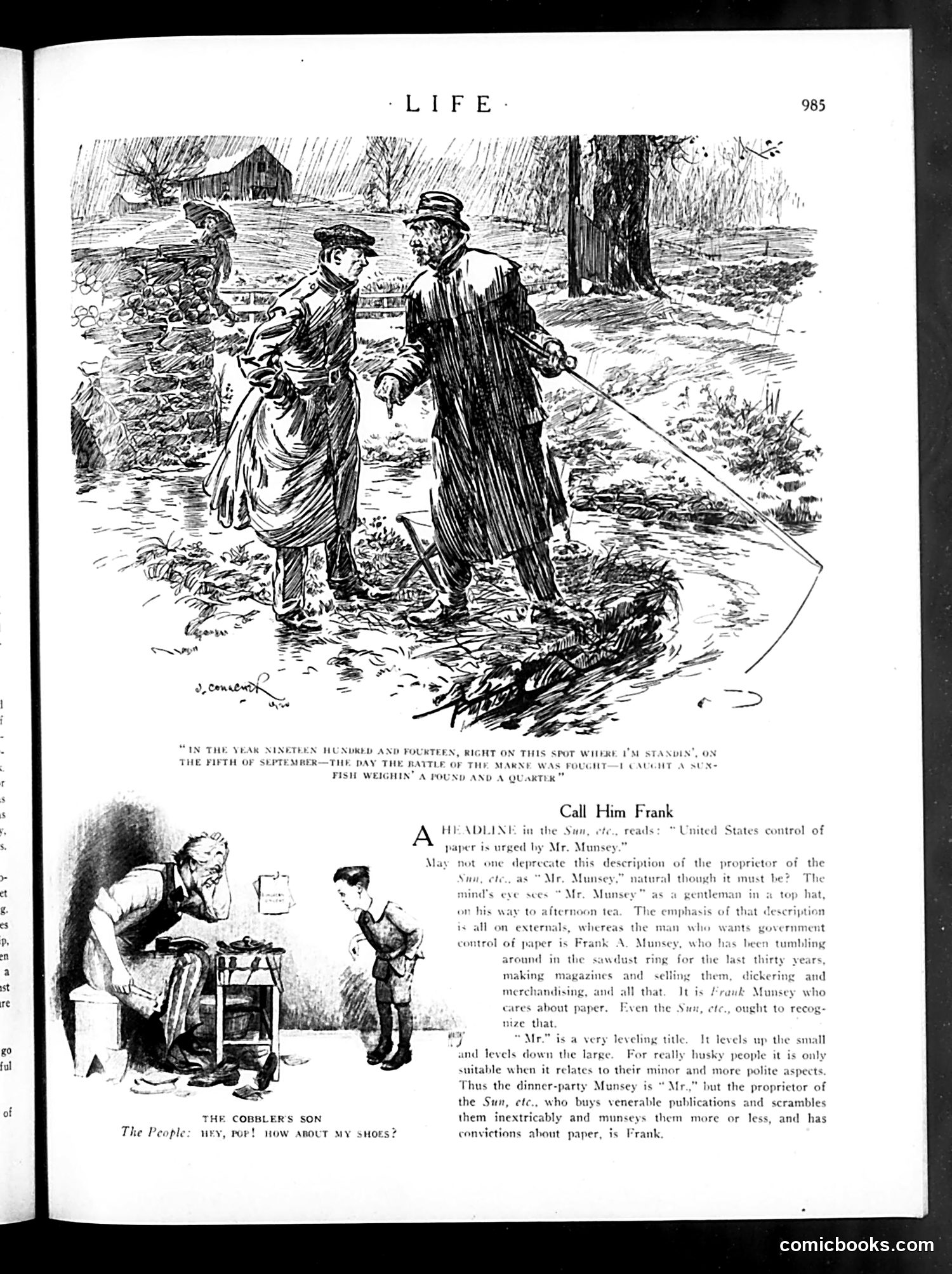
**Top Cartoon:** A rural man recounts catching a large fish on September 5, 1914—the date of the Battle of the Marne (a major WWI battle). The humor lies in the absurd juxtaposition: while momentous historical events occurred abroad, ordinary Americans were focused on trivial local matters like fishing. **Bottom Cartoon & Article:** The article satirizes Frank A. Munsey, publisher of the *Sun* newspaper, who advocated for government control of paper during wartime. The piece criticizes formal titles like "Mr." that obscure a person's actual character and accomplishments. It argues that the polite "Mr. Munsey" fails to convey the aggressive, rough businessman who has spent thirty years scrambling through magazine publishing and newspaper acquisition. The "Cobbler's Son" cartoon (likely depicting Munsey's working-class origins) reinforces this theme: his real identity isn't reflected in genteel social conventions. The satire critiques both wartime paper rationing debates and the gap between social polish and authentic character.
This satirical page presents verse caricatures of potential 1920 presidential candidates. Each entry mocks the subject's political record or persona: **Herbert Hoover** is praised for wartime food relief while questioning his leadership credentials. **Leonard Wood**, a general, is portrayed as riding Teddy Roosevelt's legacy without substance. **William Gibbs McAdoo**, Woodrow Wilson's son-in-law, is warned as potentially troublesome if Wilson declines to run. **Woodrow Wilson** appears as an enigmatic "Sphinx"—ambiguous about his intentions. **Frank Lowden** represents business-oriented conservatism. **A. Mitchell Palmer** is satirized as aggressively anti-radical (his "Red Scare" raids). **William Jennings Bryan** is presented as a has-been from prior conventions. **Calvin Coolidge** gains support from suppressing Boston's 1919 police strike. **Edward Edwards** is depicted as a wet candidate (pro-alcohol during Prohibition debates). **Hiram Johnson** represents progressive/anti-League sentiment. **Eugene V. Debs**, the Socialist, is noted as repeatedly imprisoned—even during previous administrations.
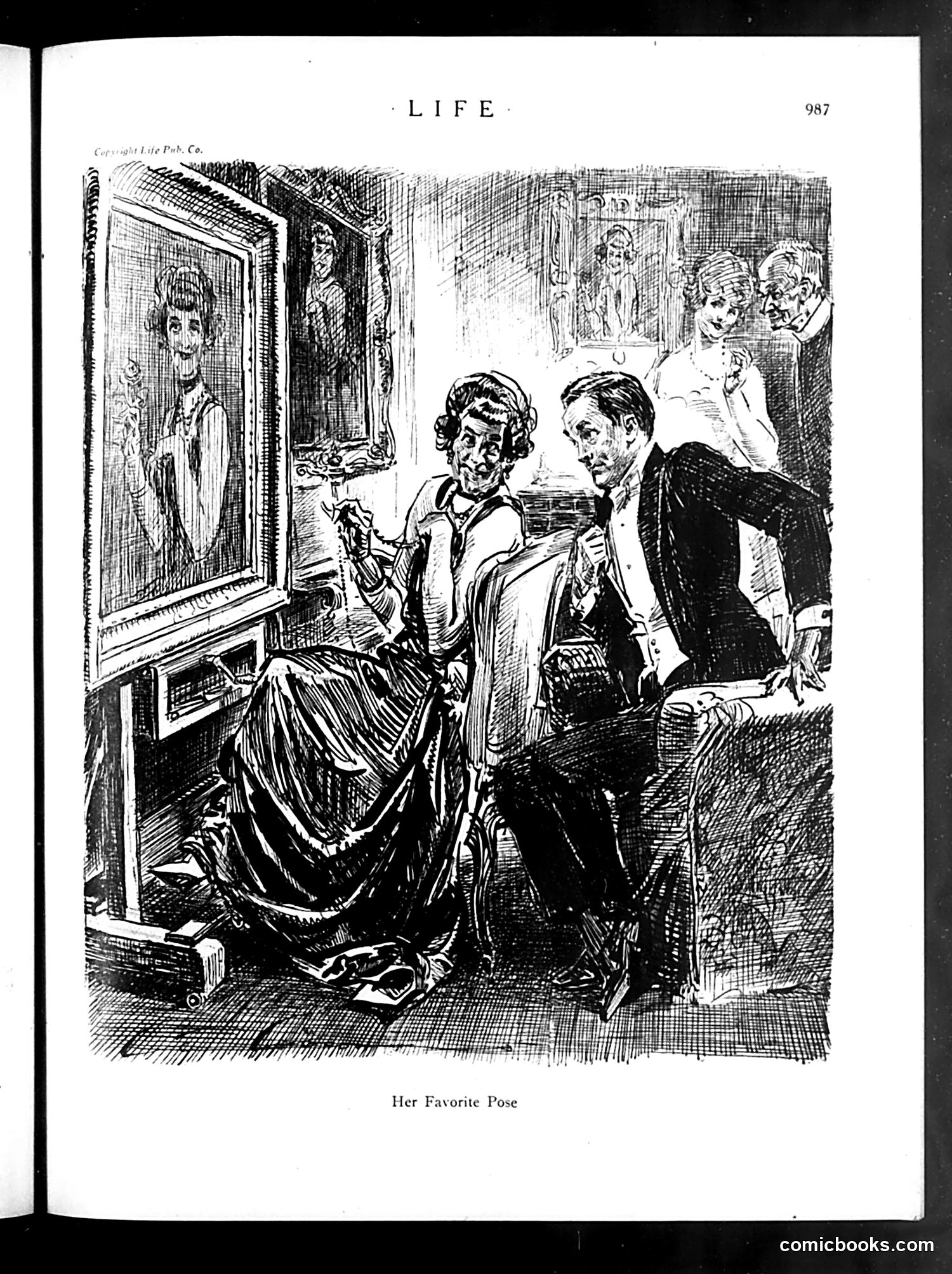
This satirical illustration depicts a woman seated before a mirror, striking what appears to be a posed or affected position for viewing. Two men observe her—one in formal attire leaning in closely, another in the background. Additional figures appear in the mirror's reflection. The cartoon satirizes vanity and performance, particularly female self-presentation for male attention. The title "Her Favorite Pose" suggests the woman's primary concern is how she appears to others rather than genuine behavior. The men's interested responses reinforce the satire: her elaborate posturing exists solely to attract and impress male viewers. This reflects early 20th-century satirical commentary on feminine artifice, beauty standards, and the performance of gender roles. The humor derives from exposing the calculated nature of such social performance.
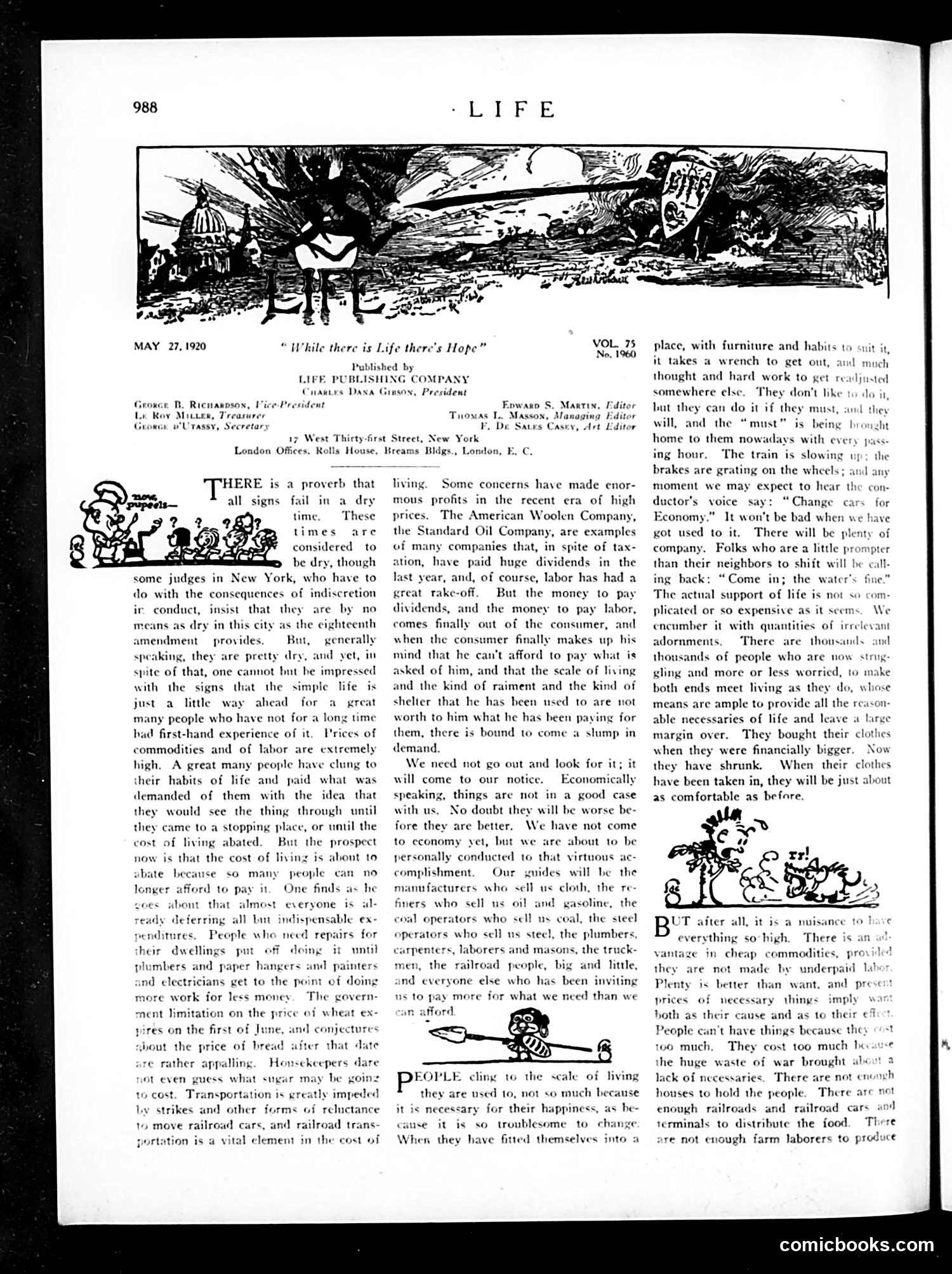
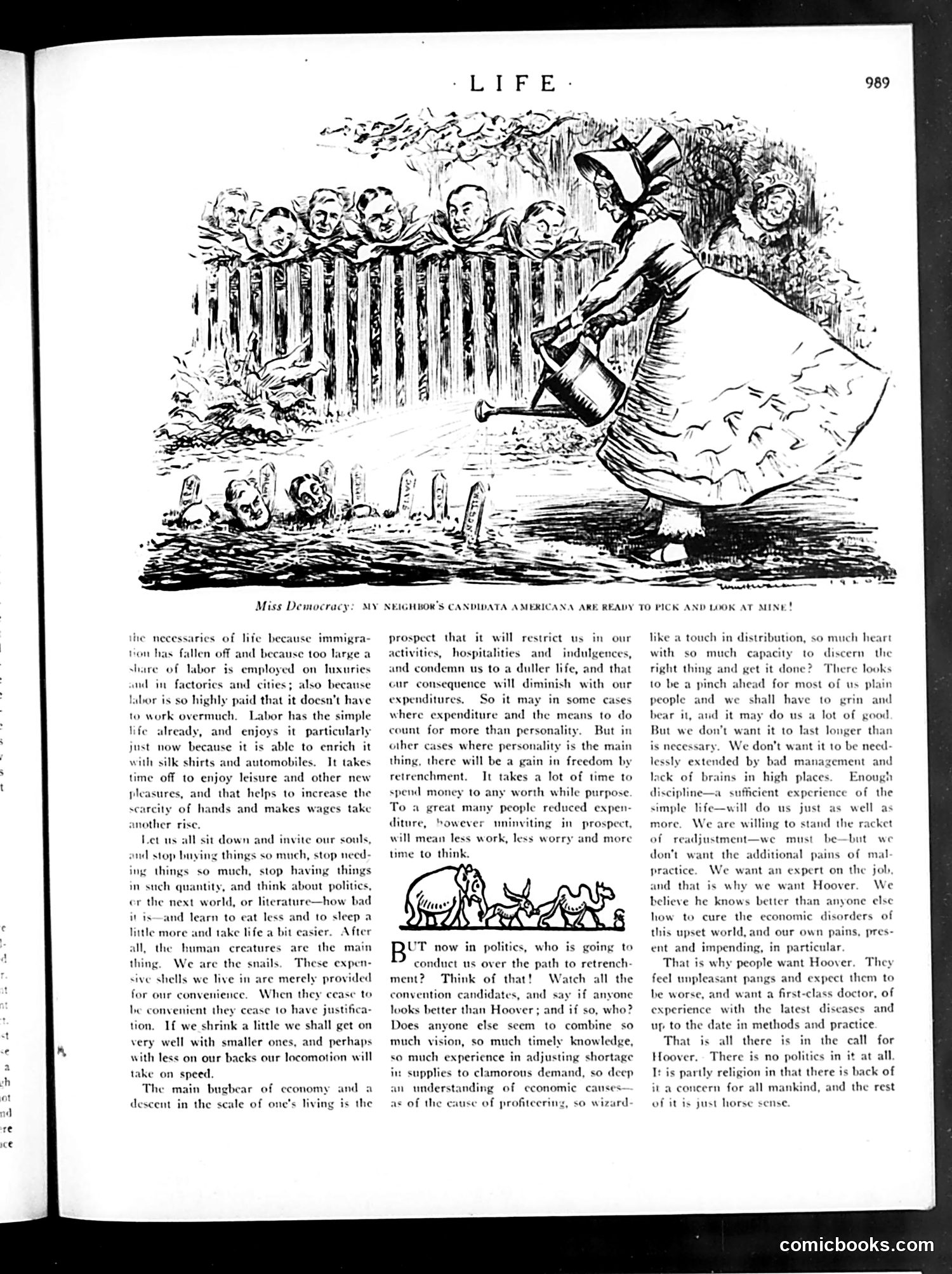
This editorial page addresses post-WWI economic anxieties. The author argues that despite visible signs of "the simple life" ahead—high prices for commodities and labor forcing consumers to reconsider spending—the wealthy (citing American Woolen Company and Standard Oil as examples) have profited enormously while ordinary people struggle. The satire targets consumer complacency and economic inequality. The piece notes that high living costs stem partly from war's waste and lack of necessities, yet people cling to expensive habits rather than genuinely economize. The author sarcastically suggests manufacturers, refiners, coal operators, and laborers will "personally conduct" citizens toward economy—meaning these industries will *force* frugality by making goods unaffordable. The cartoon illustrations (unclear in detail here) likely satirize either the wealthy enjoying excess or common people reluctantly downsizing. The overall message: inevitable economic correction is coming, whether Americans choose it or have it imposed upon them.
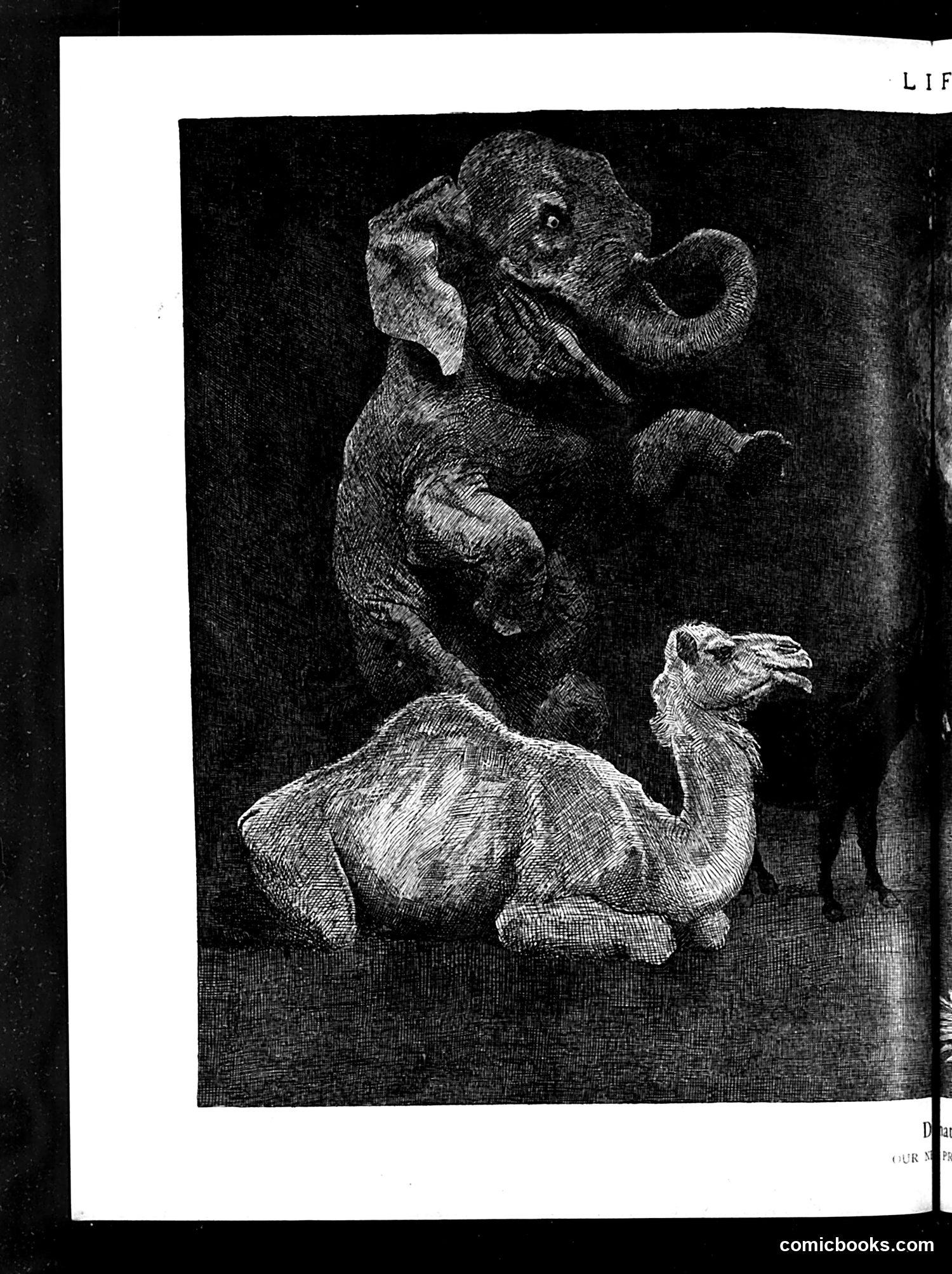
This engraving depicts two animals in what appears to be a satirical commentary. The image shows an elephant (standing upright on hind legs) and a camel in profile against a dark background. Without visible text identifying the specific figures or context, the exact political meaning is unclear. However, the juxtaposition of these two animals—the elephant and camel—likely references political parties or nations, as was common in 19th-century American political satire. The elephant traditionally symbolized the Republican Party, while a camel could represent various political opponents or foreign powers. The dramatic, somewhat confrontational poses suggest conflict or tension between the entities represented. However, without additional caption text visible on this page, the precise historical event or political dispute being satirized cannot be definitively determined.
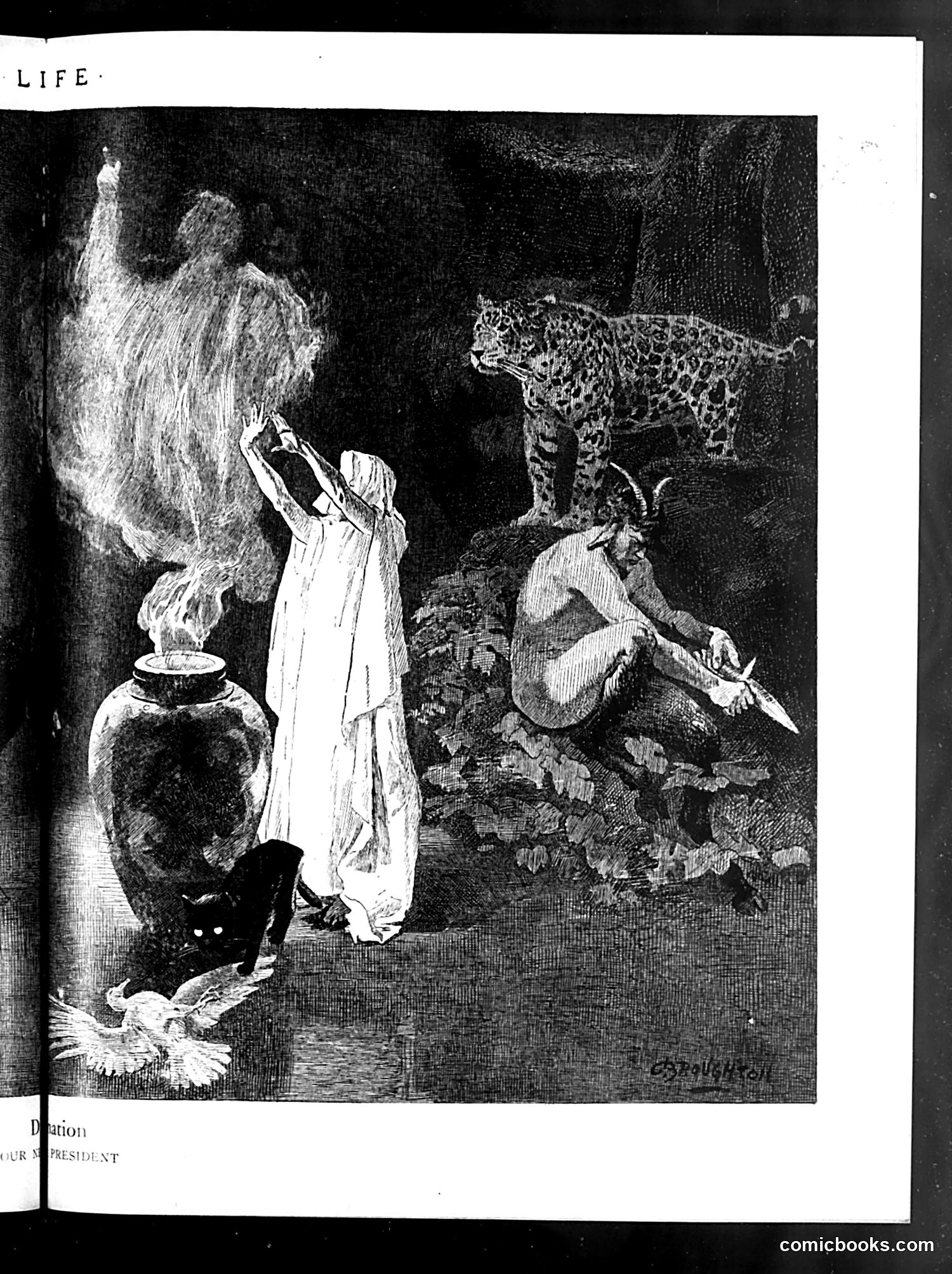
This appears to be a satirical illustration from *Life* magazine depicting a supernatural or fantastical scene. The image shows: - A ghostly, ethereal female figure in white robes with raised arms - A seated figure in dark clothing observing the apparition - A leopard or spotted wild cat in the background - Various mystical or occult elements (fire, vessels) The cartoon likely satirizes spiritualism, séances, or occult practices that were popular subjects of ridicule in late 19th/early 20th-century American satire. The juxtaposition of the ghostly "spirit" with the wild animal suggests the artist is mocking believers in supernatural phenomena, perhaps implying fraudulent mediumship or gullibility. However, without visible text identifying specific figures or events, I cannot determine the precise political or social target of this satire with certainty.
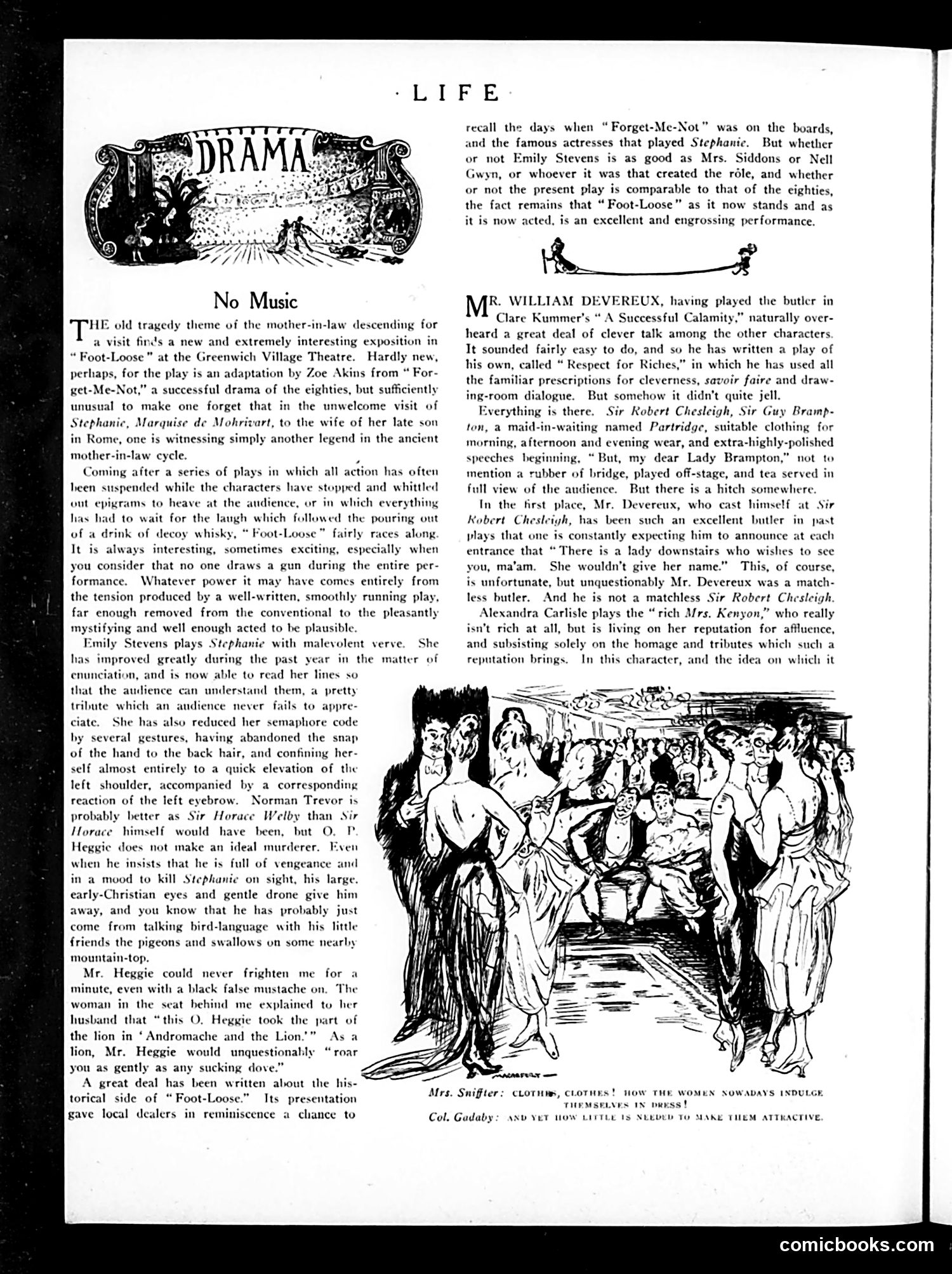
This page reviews two Broadway plays: "Foot-Loose" at Greenwich Village Theatre and "Respect for Riches." **"Foot-Loose"** is praised as an adaptation of an 1880s play featuring the classic "mother-in-law visits" plot. The reviewer credits its success to tight writing and plausible acting rather than gimmicks. Emily Stevens plays the antagonistic Stephanie; O.P. Heggie plays a would-be murderer whom the critic finds unconvincingly gentle—even imagining him cooing to pigeons rather than threatening anyone. **The cartoon** (bottom) shows a crowded social scene with the caption mocking how women's clothing and minimal tailoring effort create attractiveness at society gatherings. The second review notes William Devereux adapted his butler role into "Respect for Riches," employing familiar drawing-room comedy formulas that "didn't quite jell." Both reviews reflect early 1920s theater criticism emphasizing character acting and plot construction over theatrical spectacle.
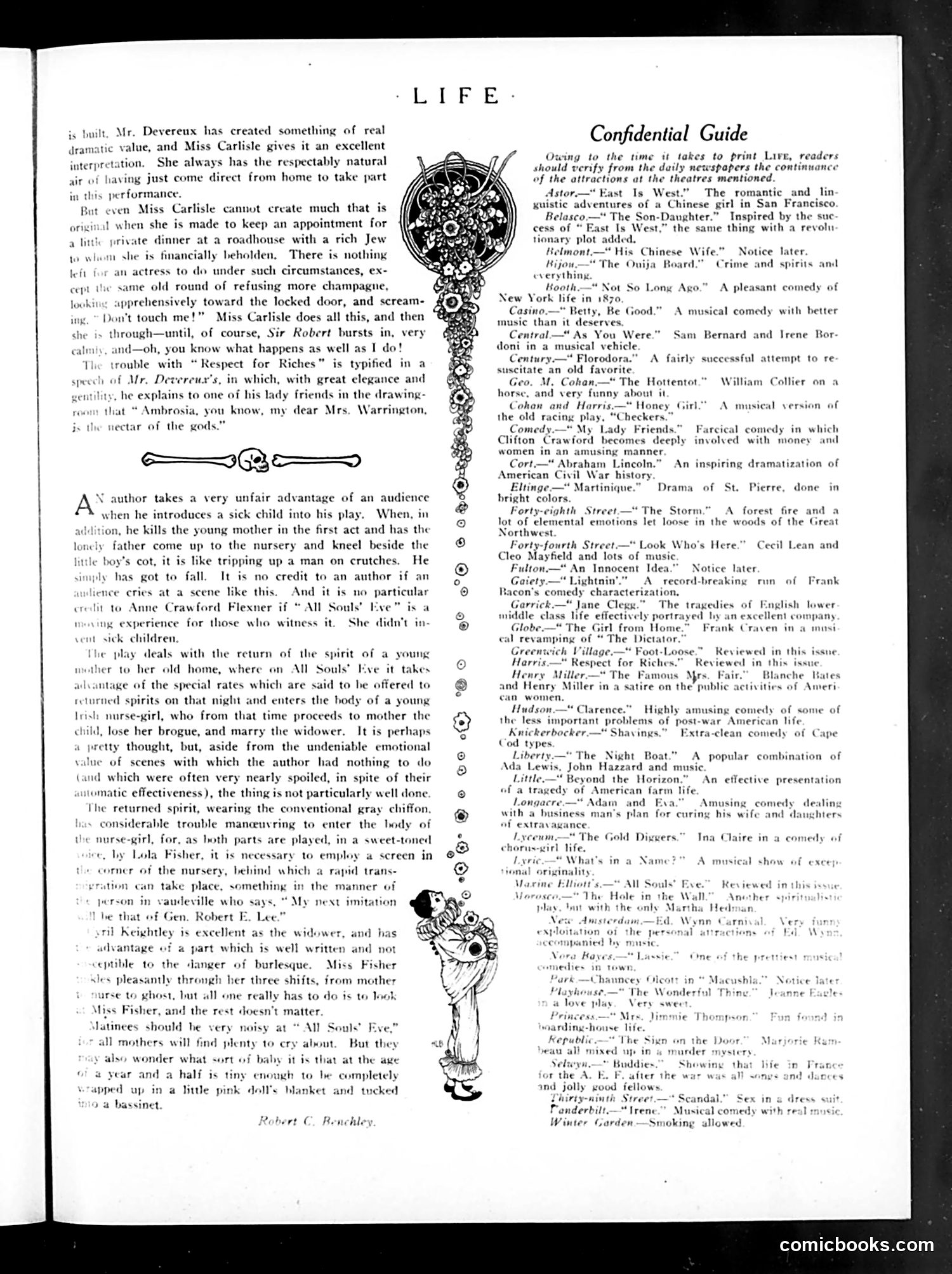
This page contains theater reviews by Robert C. Benchley, the famous humorist and drama critic. The left column critiques two plays: "Respect for Riches" (starring Miss Carlisle) and "All Souls' Eve." Benchley employs sharp satire to expose dramatic manipulation. He mocks "Respect for Riches" for including an uncomfortable scene where a wealthy Jewish man pressures a young actress into a private dinner—a scenario designed to manipulate audience sympathy. More pointedly, he attacks "All Souls' Eve" for cheaply exploiting the emotional power of dead children and grieving parents, arguing that audiences will cry regardless of the playwright's actual skill. Benchley argues this is unfair: audiences cannot help their emotional response to such vulnerable subjects, so including them proves nothing about the author's talent. The right column lists current theatrical attractions with brief descriptions—a "Confidential Guide" for readers. The ornamental illustrations (the decorative circular design and the small figure sketch) are typical Life magazine embellishments from this era.
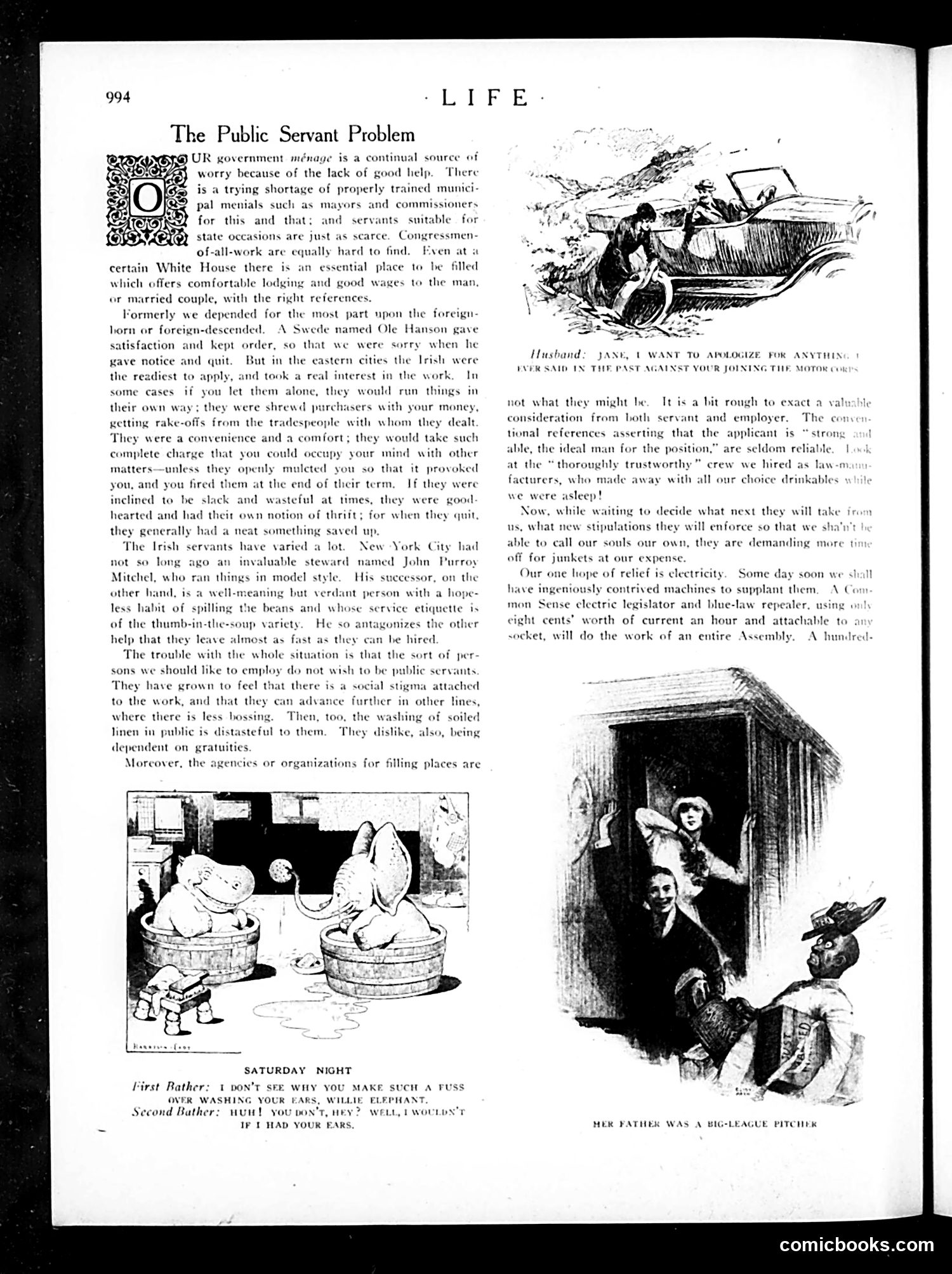
This page satirizes the American shortage of reliable public servants and household help. The main article complains that government positions and domestic service roles lack qualified workers—citing past reliance on Irish and Swedish immigrants who, while sometimes corrupt or inefficient, at least showed initiative. The cartoons illustrate the theme humorously: 1. **"Saturday Night"**: Two elephants bathing debate ear-washing, a joking commentary on accepting unpleasant necessities. 2. **"Husband" caption**: A man apologizes to his wife Jane for past criticism of her joining "the Motor Corps" (likely a WWI-era women's volunteer organization), suggesting changing social attitudes toward women's public roles. 3. **"Her Father Was a Big-League Pitcher"**: Shows a family scene, implying class mobility and American social change. The article's conclusion—that electrical machines might eventually replace human servants—reflects early-20th-century optimism about labor-saving technology. The satire targets both servant unreliability and the era's class anxieties about labor shortages.
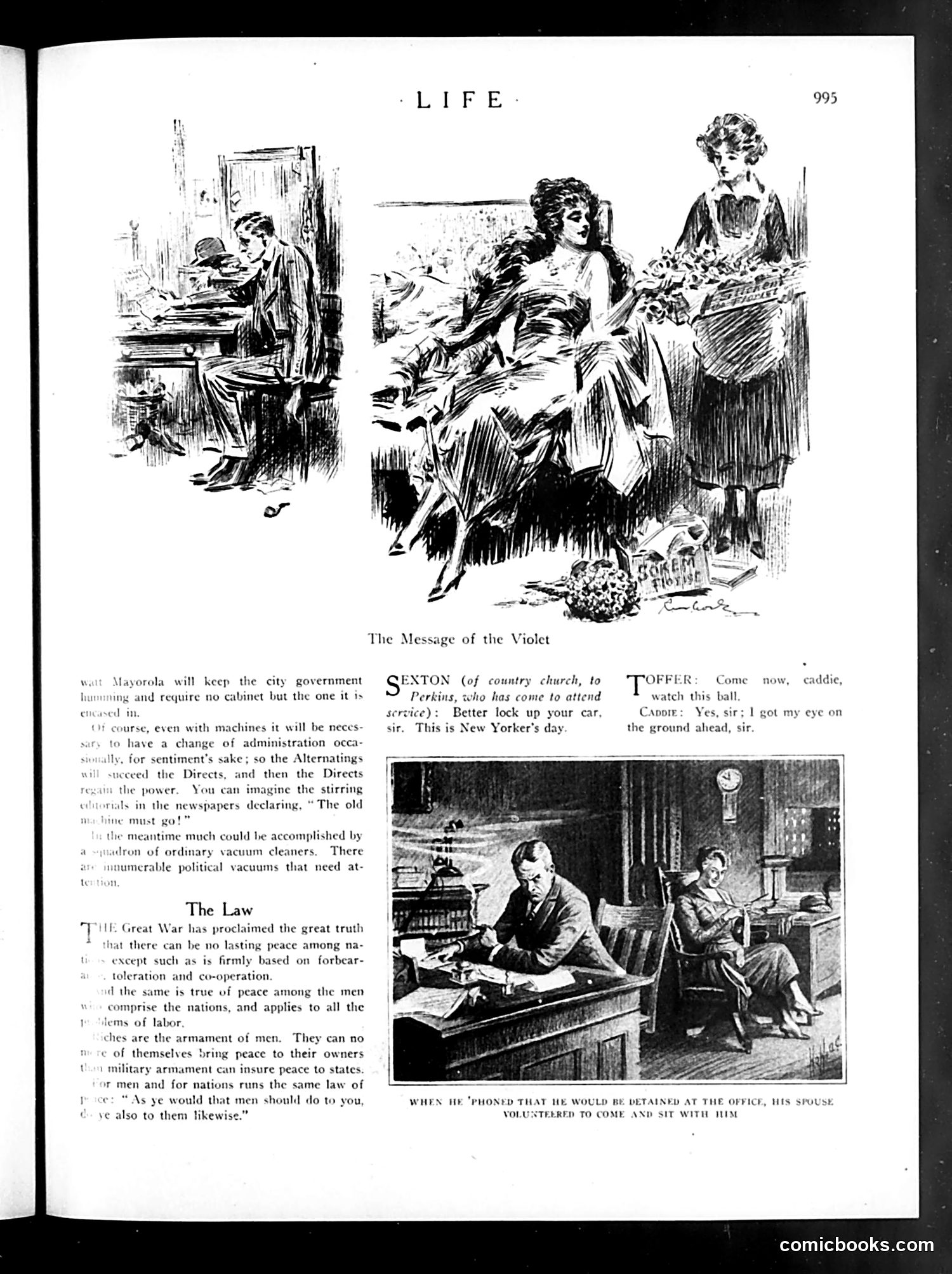
This page contains multiple satirical pieces typical of *Life* magazine's social commentary: **"The Message of the Violet"** (top illustration): Shows a woman receiving flowers, likely satirizing romantic gestures or courtship rituals of the era. **"The Law"** (text section): Discusses post-WWI peace philosophy, arguing that lasting peace requires forbearance and cooperation—not military armament. The piece draws parallels between international relations and labor disputes, suggesting the same principles apply to both. **"Sexton" cartoon** (bottom): A country church sexton warns a visitor to lock his car because it's "New Yorker's day"—satirizing the reputation of New York City residents as thieves or morally questionable visitors to small towns. **"Golf caddie" dialogue** (right): A brief joke about a caddie watching a golf ball. **Bottom photograph**: Shows a domestic scene of a spouse joining her husband at his office when he's detained—apparently illustrating companionship or devotion. The page satirizes post-war ethics, urban stereotypes, and domestic life.
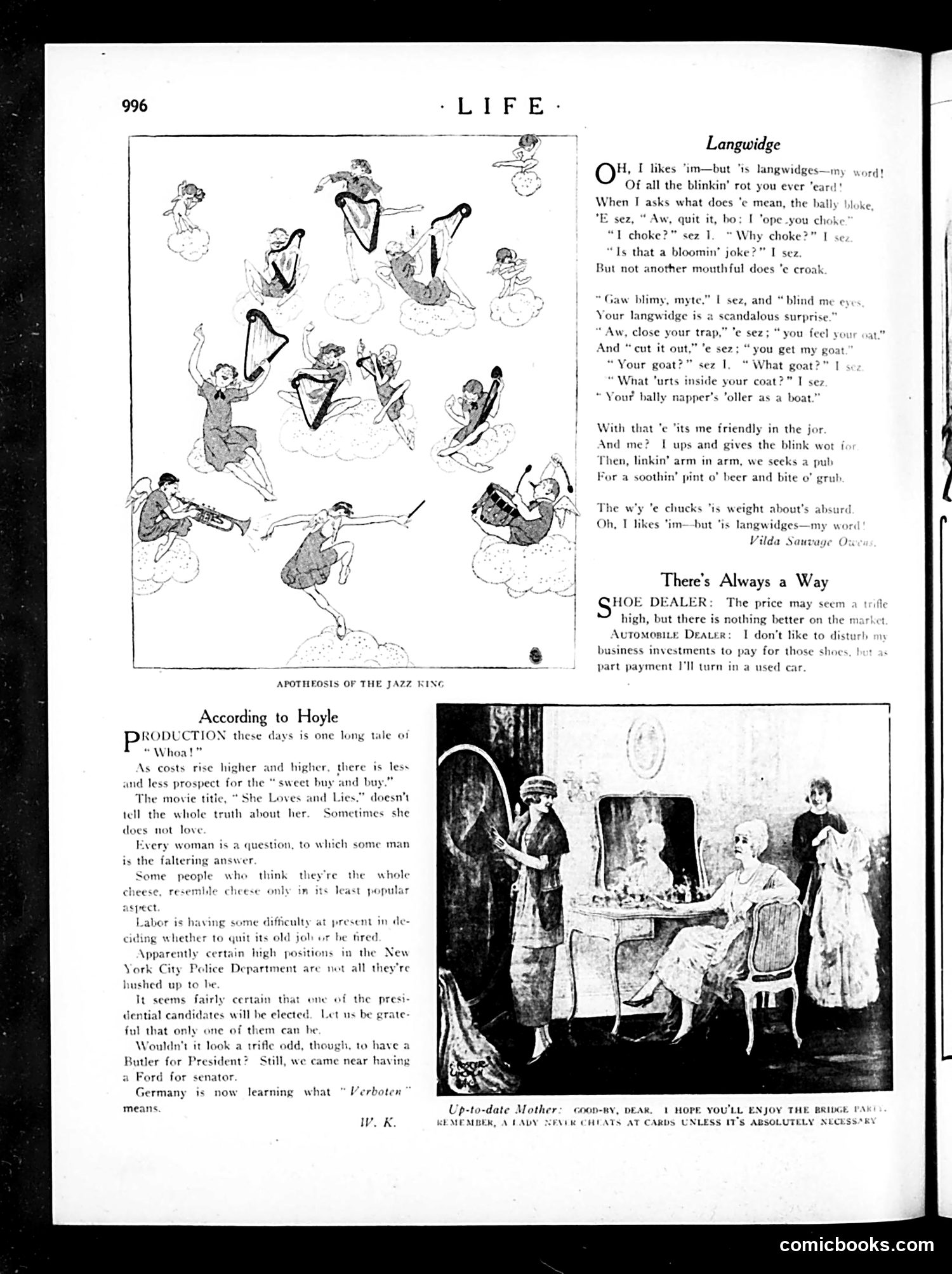
**"Langwidge" Poem (top left):** A humorous dialect piece using exaggerated Cockney English ("blinkin'," "gaw blimy," "bloomin'") to depict working-class British speech. The joke satirizes both the difficulty of understanding heavy accents and the class divide—the speaker complains about incomprehensible slang while eventually bonding with the other person over beer. The accompanying illustration shows figures floating in clouds with harps, suggesting a jazz-influenced heavenly apotheosis. **"There's Always a Way" (middle):** A brief exchange between a shoe dealer and automobile dealer, satirizing Depression-era bartering and economic desperation—unable to afford shoes with cash, one trades in a used car. **"According to Hoyle" (bottom left):** Short observational commentary on contemporary issues: rising production costs, women as puzzles to men, labor disputes, and political candidates. References to New York City Police Department and Germany's "Verboten" (forbidden) suggest 1920s-early 1930s dating. **"Up-to-date Mother" (right photo):** Captioned image mocking modern parenting values—the "progressive" mother teaches her child that card-cheating is acceptable under certain circumstances, satirizing moral relativism.
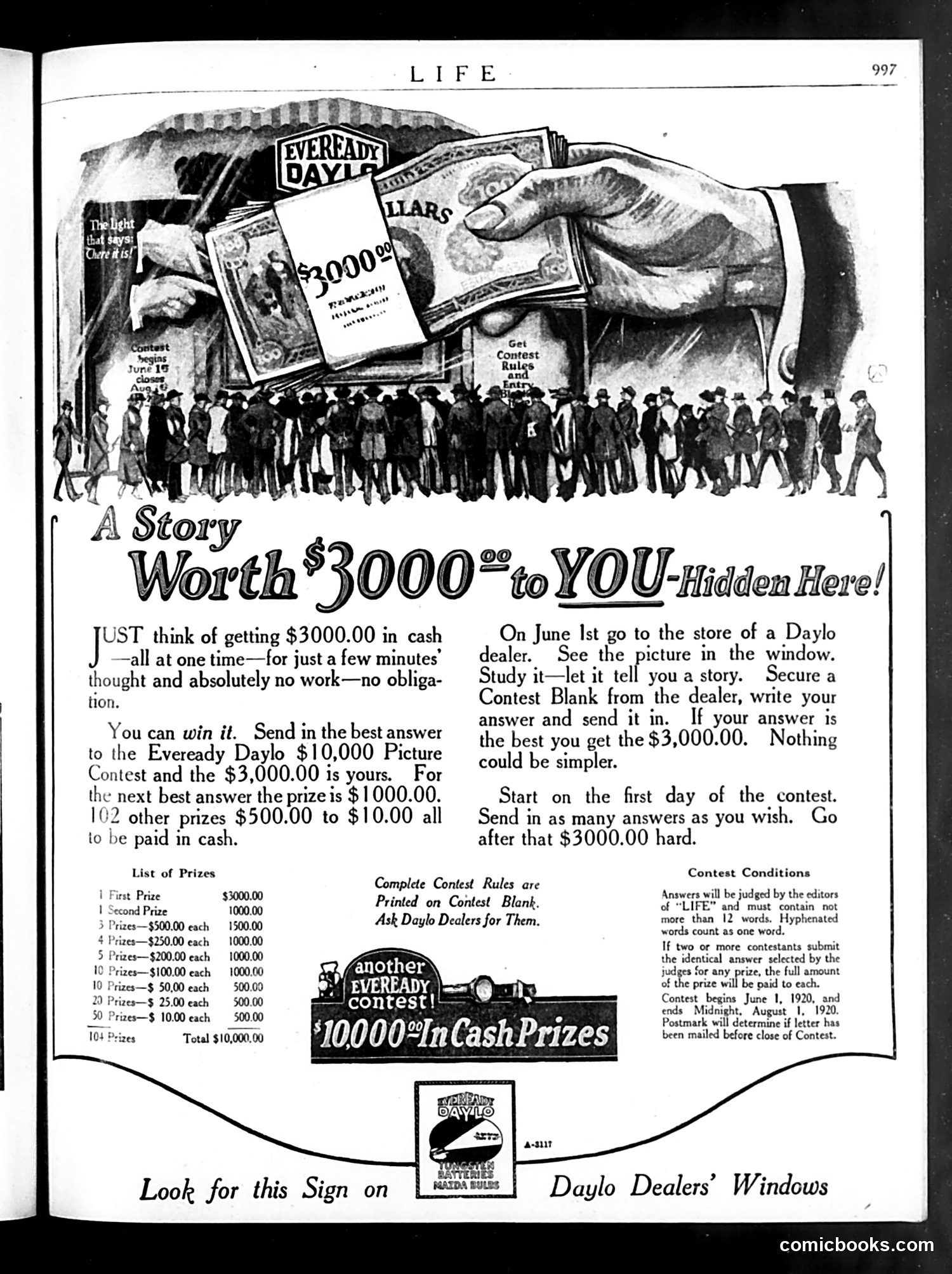
This is a **full-page advertisement**, not political satire. It promotes an Eveready Daylo battery contest running June-August 1920. The large illustration shows two giant hands exchanging cash above a crowd of people, visually emphasizing the prize money available. The contest mechanics are straightforward: participants visit a Daylo dealer, view a picture in the window, interpret its "story" in 12 words or fewer, and submit answers for cash prizes totaling $10,000. The appeal targets Depression-era or post-WWI audiences by emphasizing easy money for minimal effort ("absolutely no work—no obligation"). The satirical *Life* magazine ran such ads alongside humorous content. The page contains no political figures or caricatures—it is purely commercial promotion designed to drive store traffic and brand engagement.
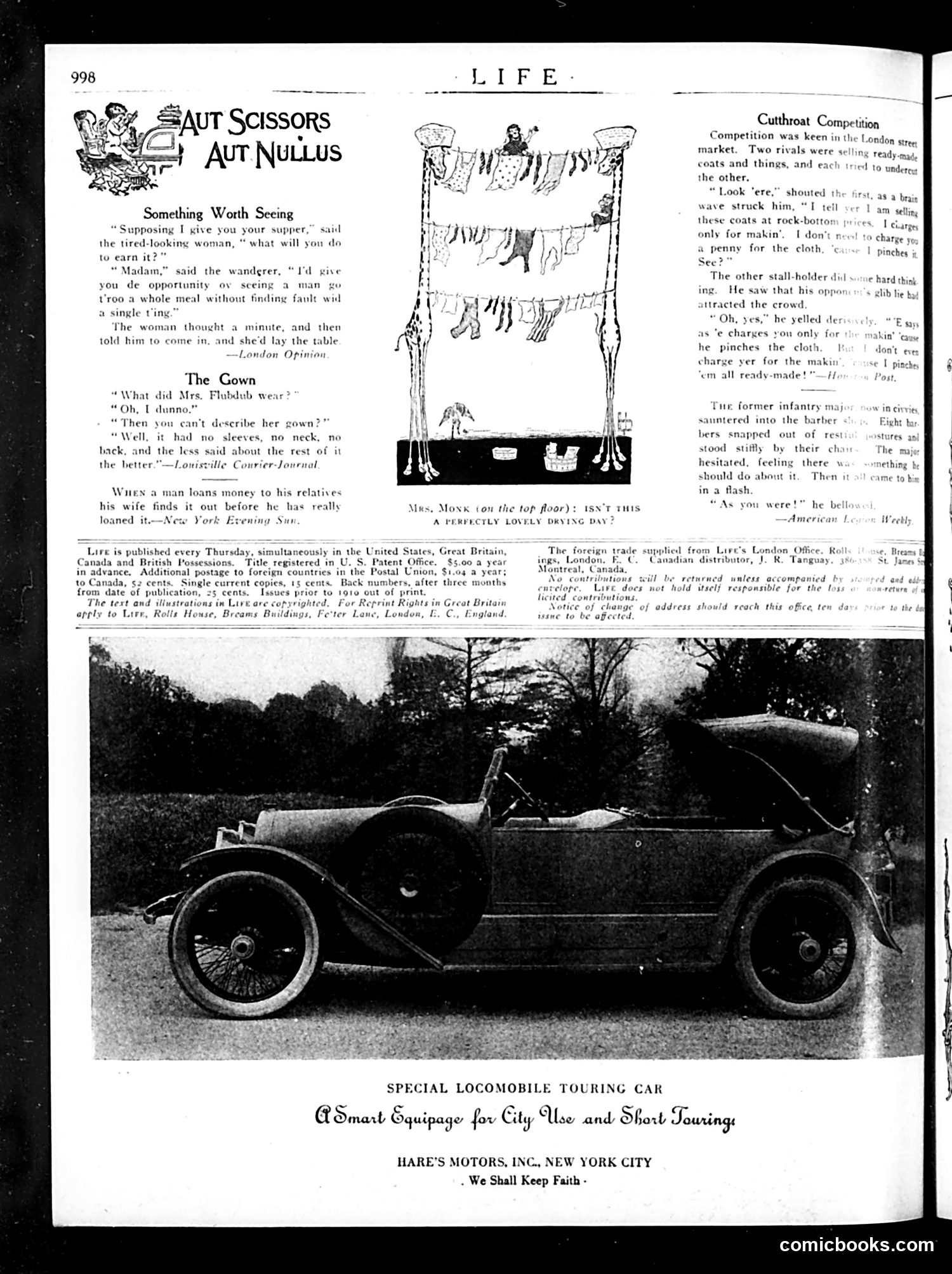
This page mixes satirical humor with advertising, typical of early 20th-century Life magazine. **The cartoons/jokes:** The "Aut Scissors Aut Nullus" section contains three brief humorous anecdotes mocking human nature and social pretense. The "Cutthroat Competition" strip depicts two street vendors selling coats in London, each exaggerating their bargains to undercut the other—satirizing competitive dishonesty. "The Gown" jokes about a woman's unflattering dress by suggesting it's easier to describe what's missing than what's present. Another quip mocks wives learning about loans to relatives before they're actually made. These are gentle social satire rather than political commentary—targeting everyday human folly: deception in commerce, vanity about appearance, marital dynamics. **The advertisement** at bottom promotes a Locomobile touring car from Hare's Motors, described as suitable for "City Use and Short Touring." The page represents Life's characteristic blend of light satirical commentary on ordinary life with commercial content.
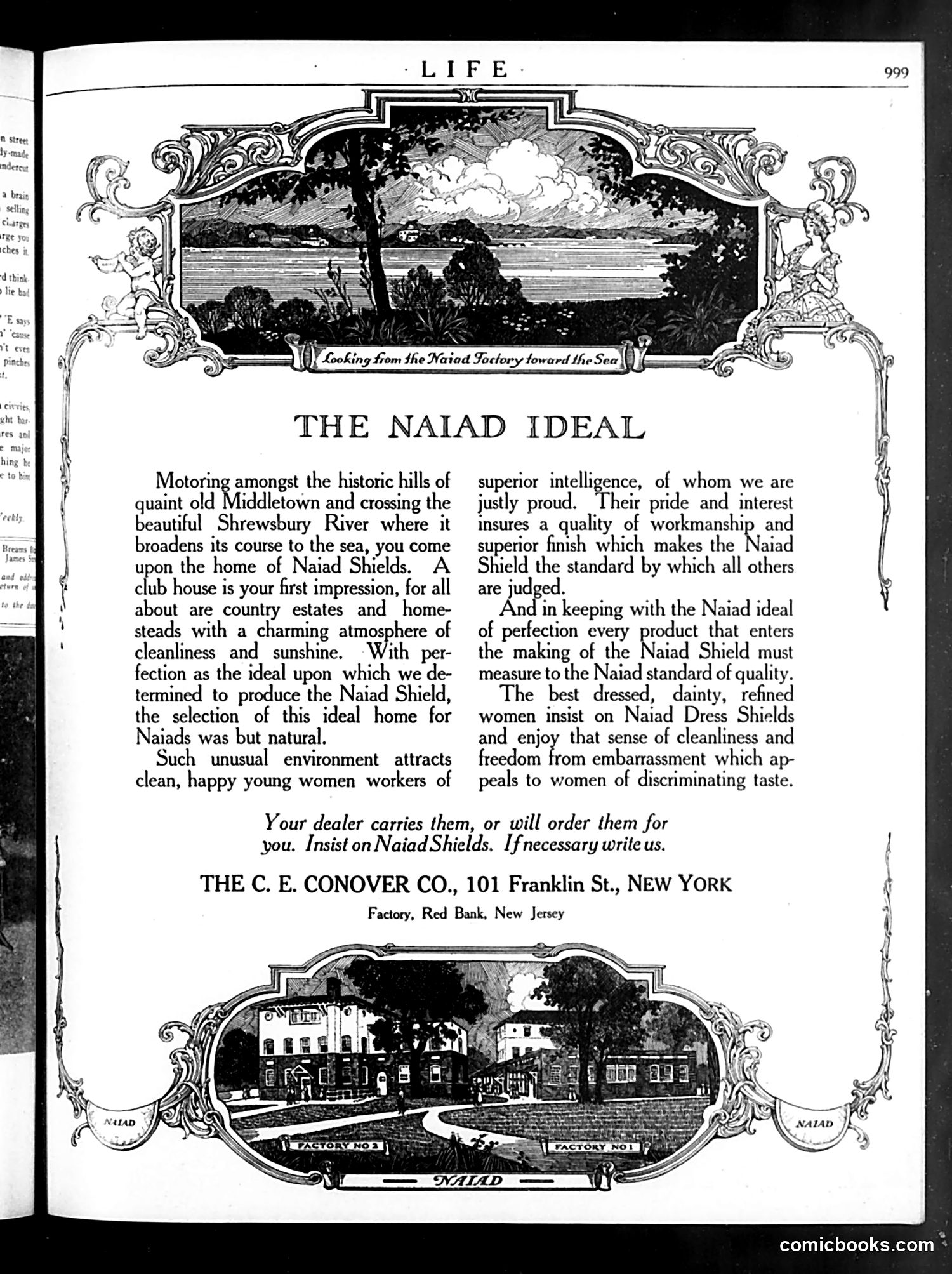
This is **not satire or political commentary**—it's a straightforward advertisement for Naiad Dress Shields (undergarment absorbent pads), disguised as editorial content in Life magazine. The "ideal" being marketed is a pastoral fantasy: a pristine factory in rural New Jersey where "clean, happy young women workers of superior intelligence" produce quality products in an idyllic setting. The advertisement conflates the product's virtue with the workers' virtue, suggesting that refined women deserve refined undergarments. The text emphasizes "cleanliness," "freedom from embarrassment," and appeal to "women of discriminating taste"—euphemistic language addressing period menstruation and perspiration concerns without explicit reference. The decorative border and landscape vignettes give the ad a prestigious, editorial appearance typical of early 20th-century magazine advertising. This reflects historical advertising practices: selling products to women by cultivating aspirational lifestyle imagery and appealing to social propriety and class anxieties.
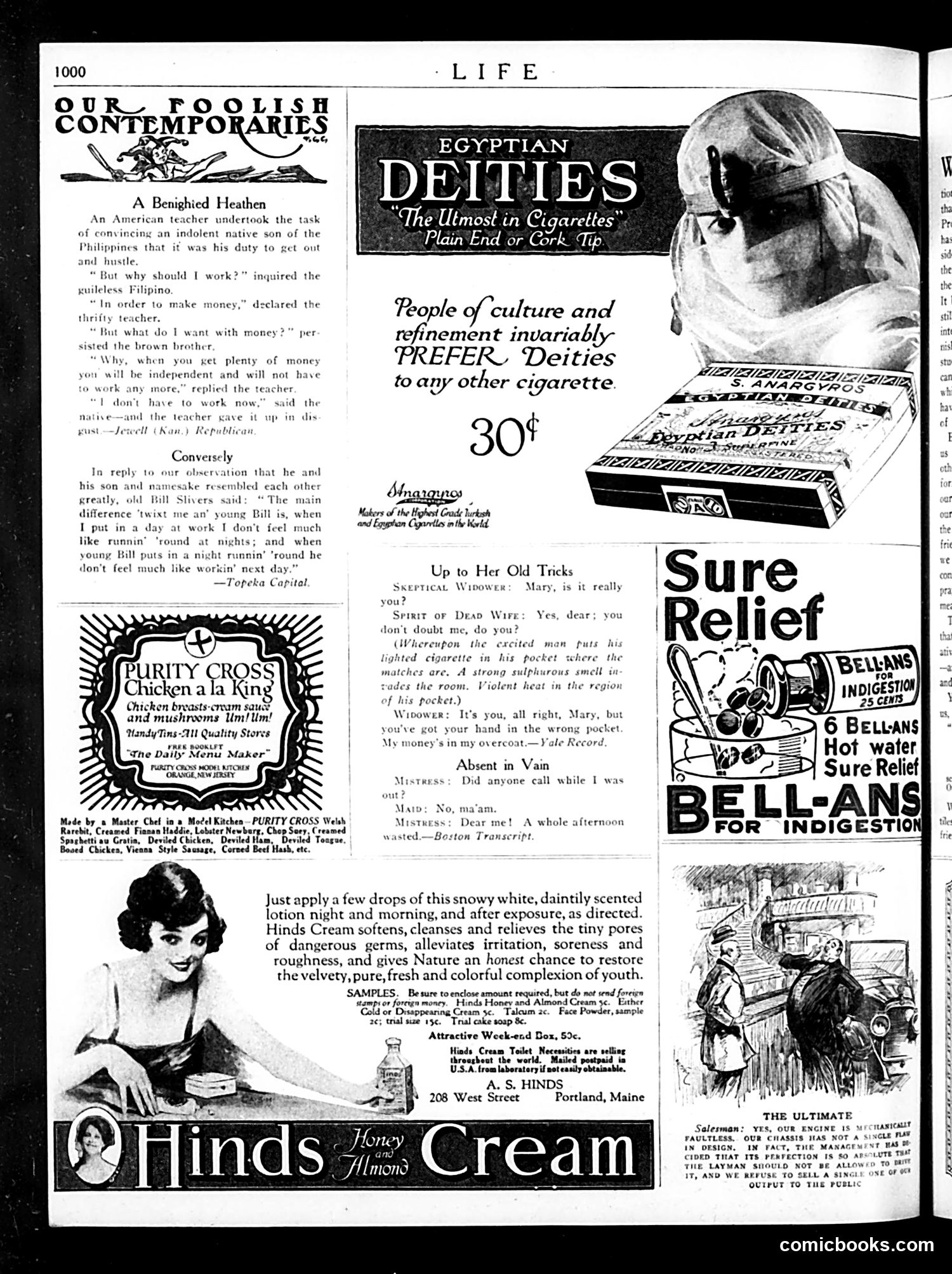
This page is primarily **advertising**, with brief satirical commentary sections interspersed. The main satire appears in "A Benighted Heathen"—a colonial-era joke mocking Filipino workers. An American teacher tries convincing a Filipino laborer that work enables leisure and money, but the Filipino logically counters that if money means not working, why work now? The teacher "gives in disgust," suggesting the joke's humor relies on stereotypes about non-Western "laziness" and supposed logical simplicity. Other brief comedic pieces mock marital dynamics ("Up to Her Old Tricks," where a wife accidentally sets her dress on fire with a cigarette) and domestic staff misconduct ("Absent in Vain"). The page is dominated by **product advertisements**: Egyptian Deities cigarettes, Purity Cross food products, Hinds Honey and Almond Cream (a complexion aid), and Bell-Ans indigestion remedy. These ads reflect early-20th-century consumer culture targeting middle-class readers.
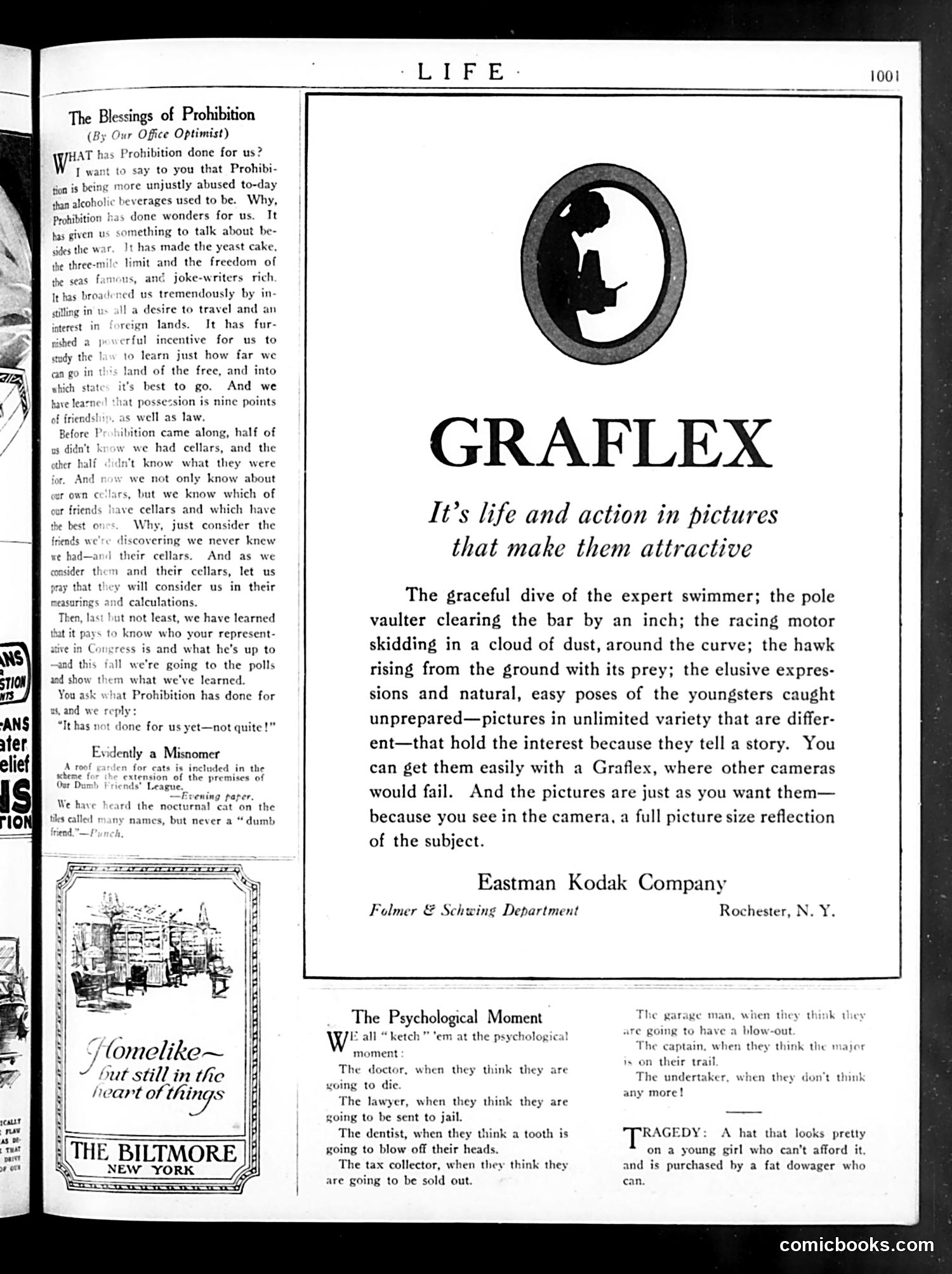
This page contains satirical commentary on Prohibition (the ban on alcohol, 1920-1933). The main article is titled "The Blessings of Prohibition" and presents mock praise from "Our Office Optimist." The satire works by listing supposed "benefits" that are actually complaints: Prohibition gave people something to obsess over, made citizens interested in breaking laws and traveling to wet states, taught them about hidden cellars and friends' wealth, and motivated them to vote. The final joke—"It has not done for us yet—not quite!"—undercuts the entire argument, suggesting Prohibition has actually failed. The piece lampoons Prohibition-era hypocrisy: Americans publicly supported the law while privately circumventing it, and the ban had become a national obsession rather than solving social problems. The satire targets both the government's failed policy and citizens' newfound interest in lawbreaking as entertainment.
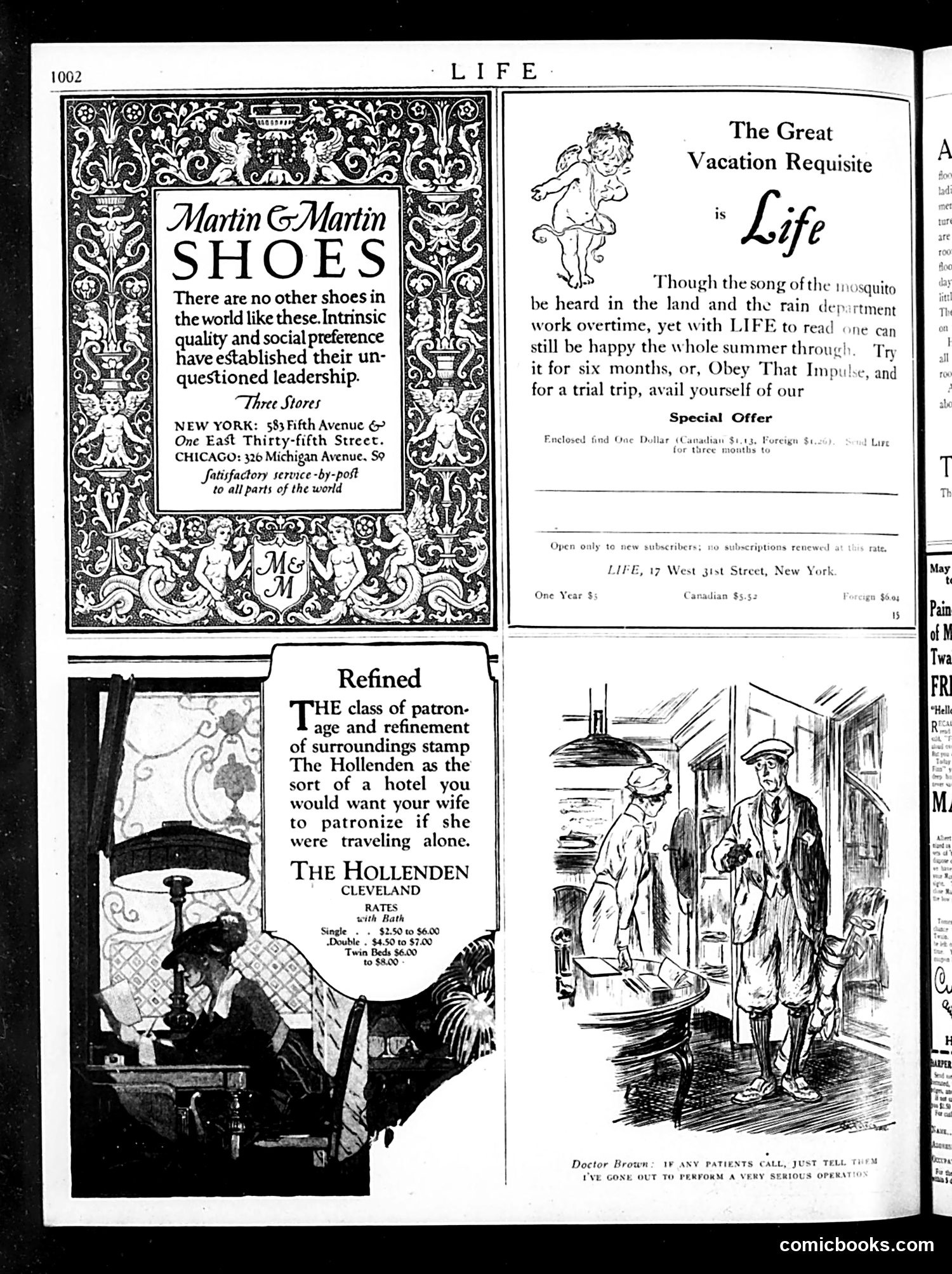
This is primarily an **advertising page** from Life magazine (circa early 1900s), not a political cartoon. The page contains three advertisements: 1. **Martin & Martin Shoes** - emphasizing quality and "unquestioned leadership" 2. **Life Magazine subscription offer** - humorously suggesting that reading Life magazine is the essential vacation requirement, even better than escaping mosquitoes and rain 3. **The Hollenden Hotel (Cleveland)** - advertising itself as refined and safe, specifically marketed toward women traveling alone, reflecting early 20th-century concerns about female travelers' respectability and security The bottom illustration is a **humorous cartoon** (not political satire): a doctor tells a caller that he's "gone out to perform a very serious operation"—likely a joke implying the doctor is actually pursuing leisure/vacation activities rather than medical work. The overall page reflects period concerns: consumer goods, leisure travel, women's independence, and professional respectability.
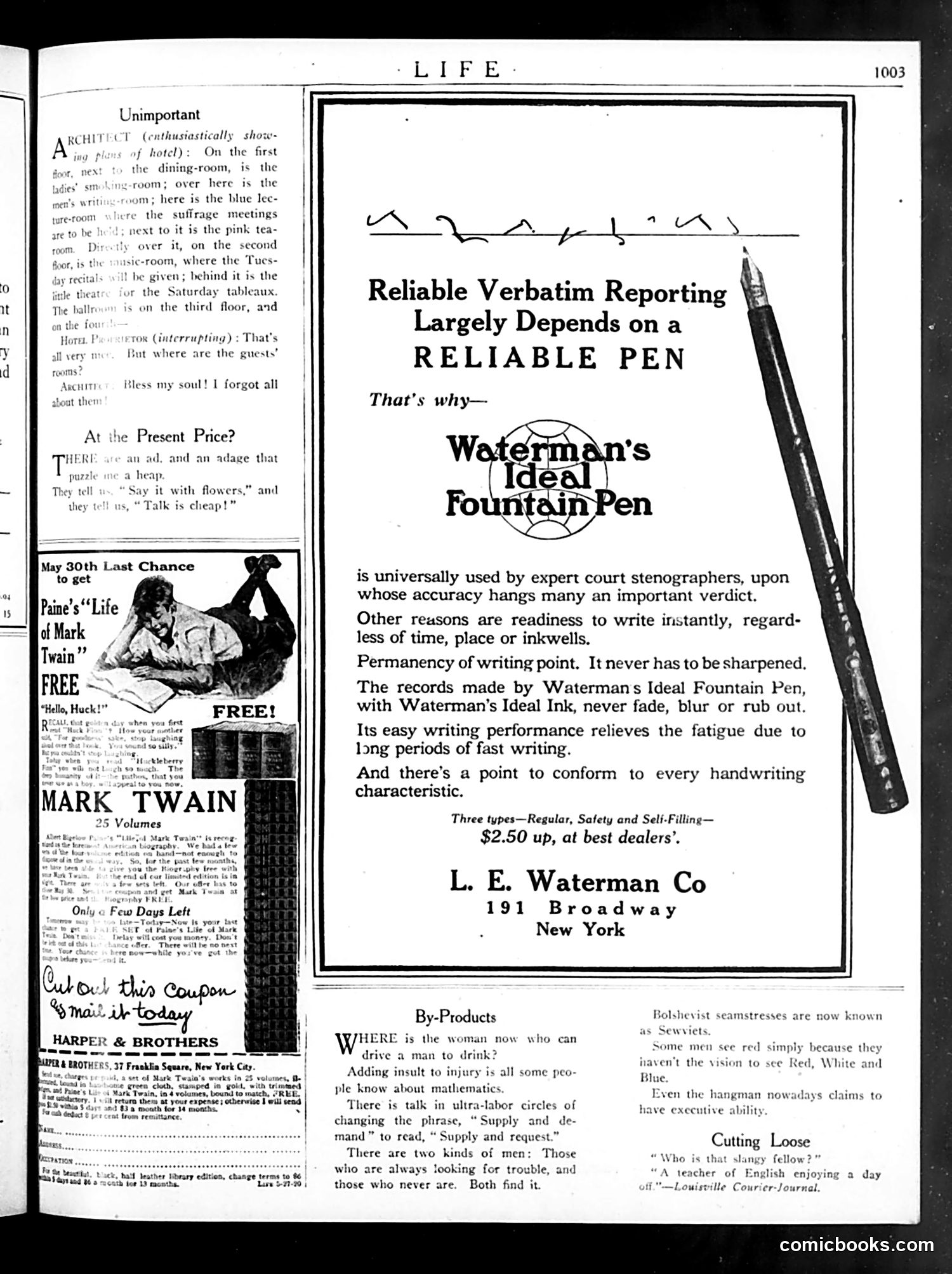
This page is primarily **advertising and satirical humor columns**, not a political cartoon. The main advertisement promotes **Waterman's Ideal Fountain Pen**, emphasizing its reliability for court stenographers and professional writing. The pitch connects pen quality to accurate "verbatim reporting"—a practical sales argument for a business tool. The satirical "By-Products" column contains brief jokes mocking contemporary social trends: - A jab at Bolshevists ("Sewviets"—a pun on "sewers" and "Soviets"), reflecting anti-communist sentiment common in 1920s America - Humor about labor activism, specifically mockery of attempts to replace "Supply and demand" with "Supply and request" - Observations about human nature and gender relations The **Mark Twain book promotion** (25 volumes, free offer) is a separate advertisement. Overall, this reflects typical Life magazine content from the interwar period: consumer advertising mixed with lighthearted social commentary targeting educated, middle-class readers skeptical of labor movements and radical politics.
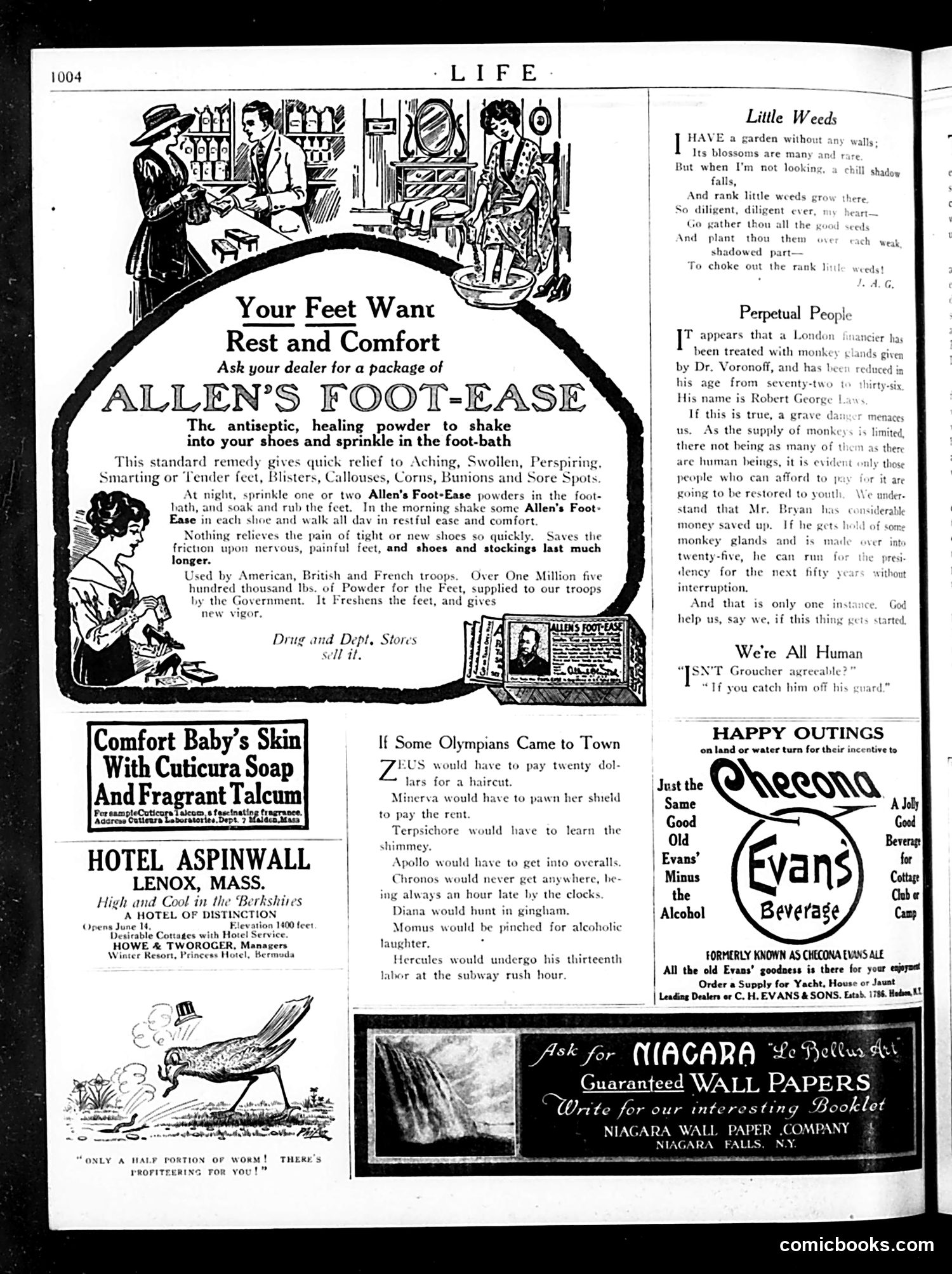
This page is primarily **advertising content** with several satirical pieces interspersed. The main humor appears in **"If Some Olympians Came to Town,"** which imagines Greek mythological gods navigating modern (1920s) urban economics. The satire mocks contemporary costs and social conditions: Zeus paying $20 for a haircut, Minerva pawning her shield for rent, Apollo working in overalls, Diana hunting in gingham. The joke criticizes inflation and economic hardship—even gods couldn't afford living expenses. A smaller cartoon shows a bird saying "Only a hale portion of worm! There's profiteering for you!"—likely referencing wartime/postwar price gouging. The rest comprises standard era advertisements (Allen's Foot-Ease powder, hotel resorts, soap) and poems ("Little Weeds," "Perpetual People"). The "Perpetual People" item references a London banker supposedly rejuvenated through monkey-gland treatment by Dr. Voronoff—reflecting genuine 1920s fascination with this fraudulent anti-aging procedure. The page captures Life's blend of satirical commentary on economic and social issues mixed with period advertising.
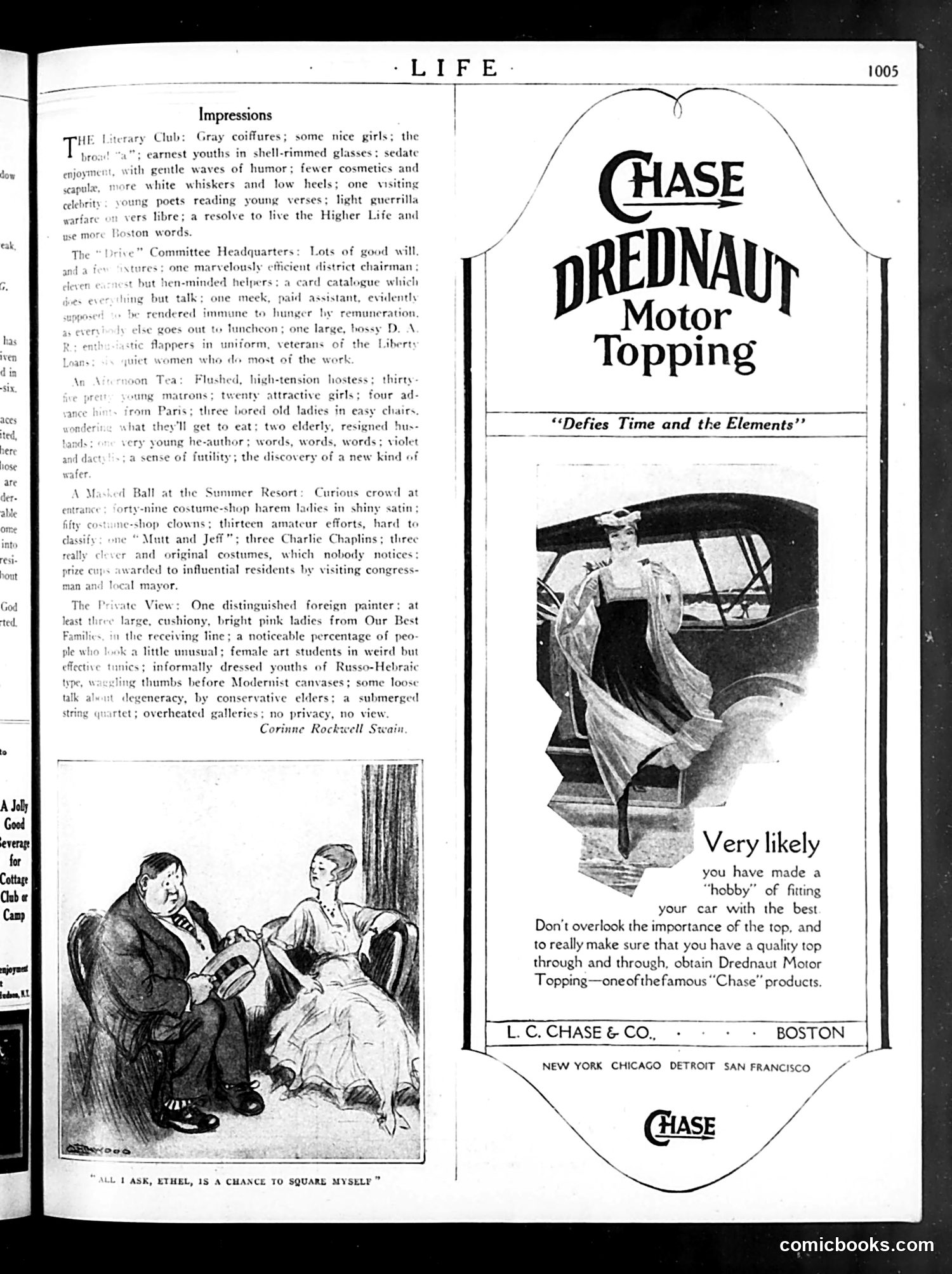
This page contains social satire by Corinne Rockwell Swain describing various Boston social gatherings of the 1920s era. The "Impressions" column mocks pretentious cultural institutions: a Literary Club populated by earnest young poets and affected attendees; a suffrage "Drive" Committee with well-meaning but scattered volunteers; an Afternoon Tea featuring flushed hostesses and bored society women; a Masquerade Ball with derivative costumes; and a "Private View" art exhibition showcasing bohemian types and foreign painters. The cartoon below depicts a man asking a woman for "a chance to square myself"—likely referencing marital reconciliation or redemption from some transgression. The satire targets the affectations and social pretensions of Boston's intellectual and artistic circles, particularly their earnestness and conformity despite claims of sophistication. The adjacent Chase Motor Topping advertisement is unrelated commercial content.
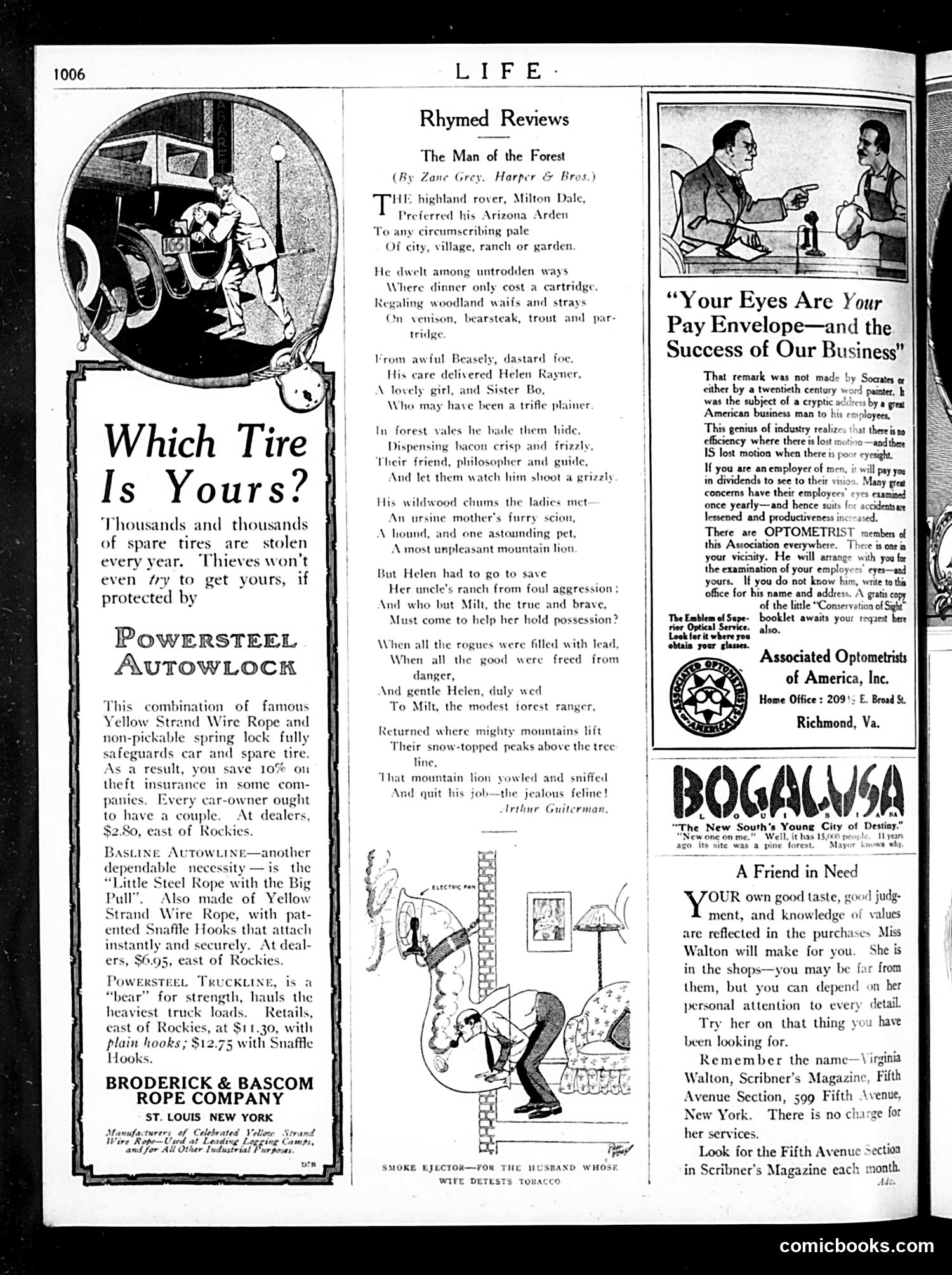
This page mixes advertisements with literary content typical of early 20th-century Life magazine. **The Advertisements:** - **Powersteel Autowlock** (top left): A tire-lock security device marketed to prevent spare tire theft, which was apparently common enough to warrant insurance discounts - **Rope products** (Broderick & Bascom): Industrial and automotive ropes and hooks - **Optometrists ad**: An appeal to employers about worker productivity, arguing that poor eyesight causes "lost motion" and reduced efficiency—a workplace safety/wellness pitch - **Bogalusa**: A town promotion - **Virginia Walton's shopping service**: A personal shopper offering remote purchasing assistance **Literary Content:** "The Man of the Forest" by Zane Grey receives a humorous verse review by Arthur Guiterman, mocking the romance plot (hero saves heroine in Arizona wilderness) with the absurdist ending where a jealous mountain lion quits his job. The page reflects turn-of-the-century concerns: auto theft, industrial efficiency, and consumer services for the wealthy.
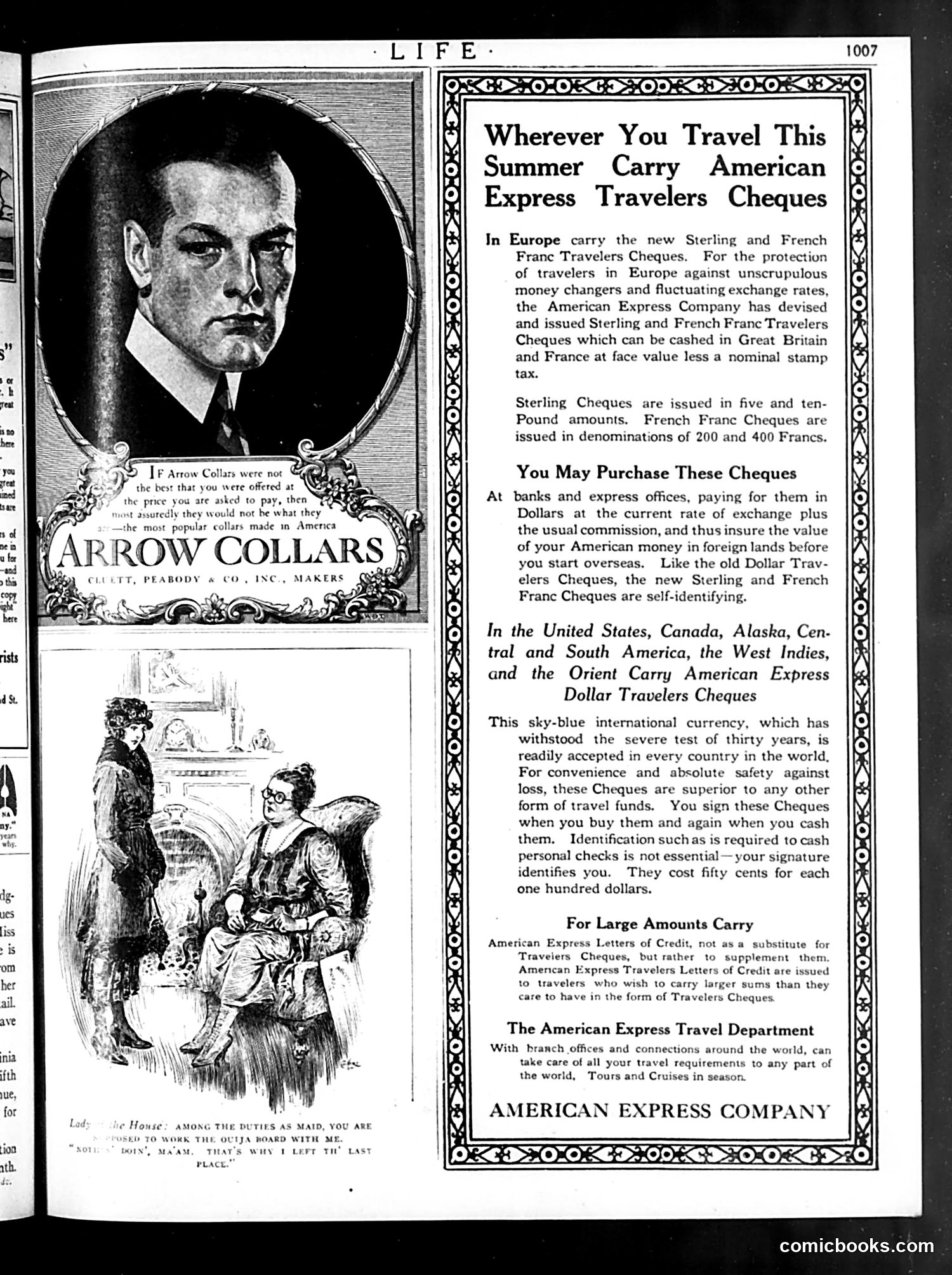
This page is primarily **advertising**, not satire or political commentary. It contains two main ads: **Arrow Collars** (left): A portrait-style advertisement featuring a distinguished man's face in an oval frame. The copy claims Arrow Collars are "the most popular collars made in America"—a straightforward product endorsement typical of early 20th-century advertising. Below is an unrelated sketch captioned as a domestic scene. **American Express Travelers Cheques** (right): The bulk of the page promotes financial products for summer travelers. It advertises Sterling and French Franc cheques for European travel, plus American Express Dollar cheques for other destinations. The text emphasizes safety, convenience, and worldwide acceptance—practical information rather than humor or satire. The small domestic sketch at bottom appears to be filler content unrelated to the advertisements' messaging. This is a commercial page with no discernible political satire or social commentary.
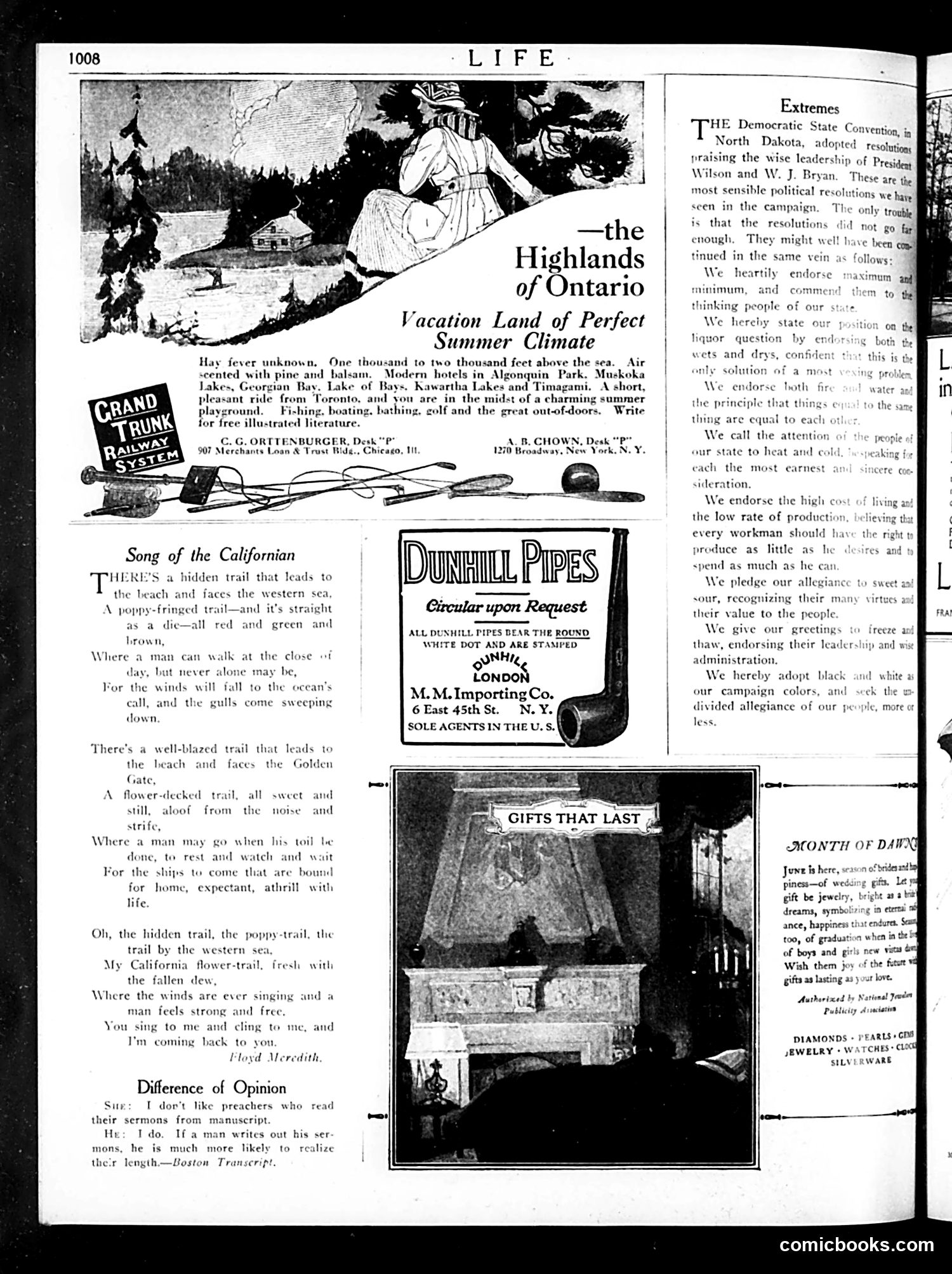
The main satirical piece is "Extremes," which mocks the Democratic State Convention in North Dakota for praising President Wilson and William Jennings Bryan with vague, feel-good resolutions. The satire works by suggesting the Democrats could have continued with equally meaningless endorsements—praising both high living standards *and* low production rates, encouraging workers to "produce as little as he pleases" while "spend[ing] as much as he can," and adopting contradictory positions on virtually every issue. This lampoons the convention's resolutions as empty political rhetoric lacking substance or logical consistency. The piece appears critical of Democratic leadership during the Wilson era for offering platitudes rather than concrete policy positions. The humor lies in exposing how absurd such partisan double-speak becomes when extended to its logical extreme. The rest of the page contains period travel/luxury advertisements and lighter humor pieces unrelated to the political satire.
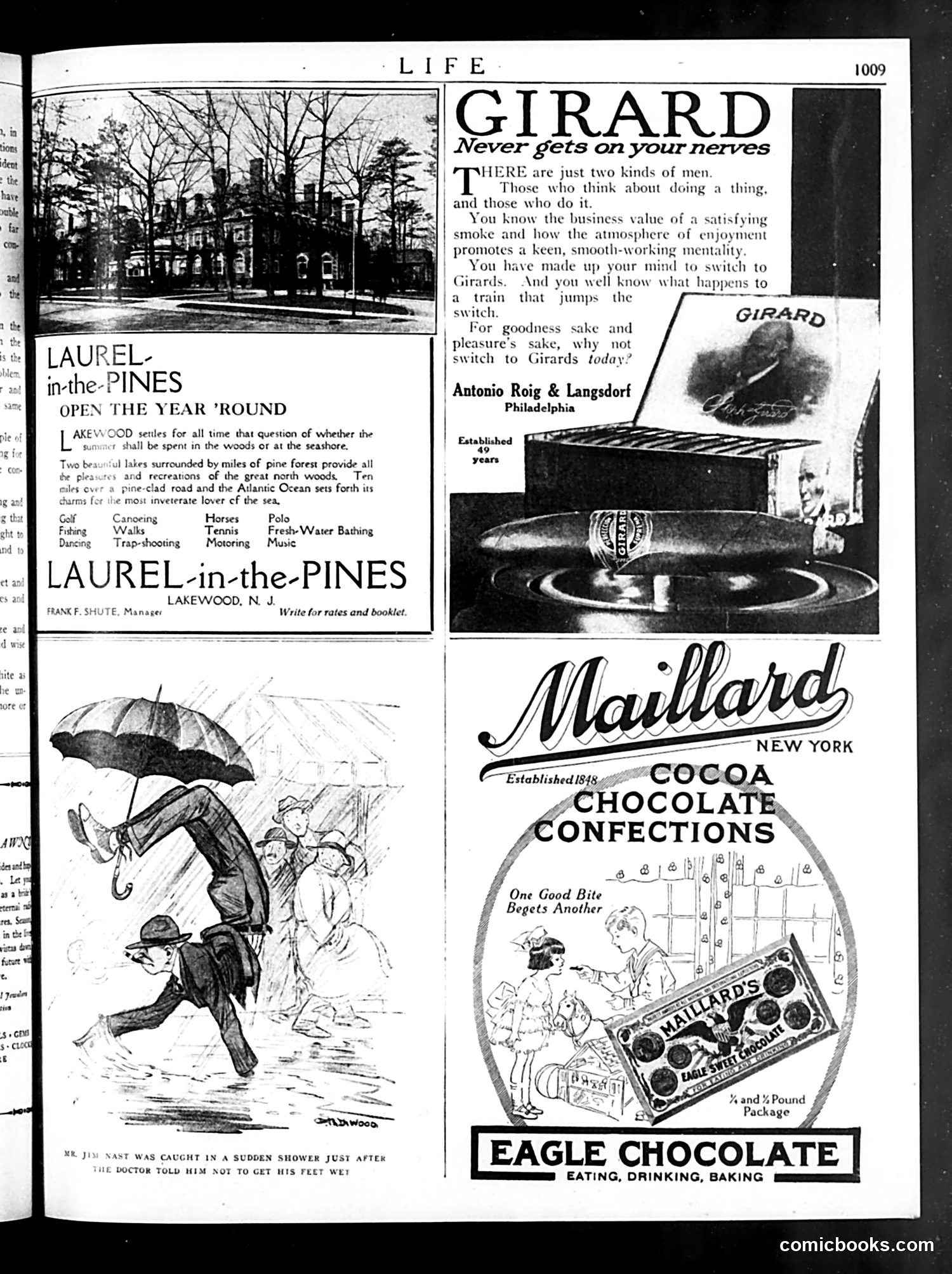
This page is primarily **advertising**, not political satire. It contains four product advertisements from approximately the 1910s-1920s era: 1. **Laurel-in-the-Pines** (resort): Promotes a year-round vacation destination in New Jersey offering golf, fishing, canoeing, and other leisure activities. 2. **Girard Cigars**: Uses a business-minded pitch suggesting that smoking promotes "keen, smooth-working mentality"—an appeal to male professionals. The metaphor about trains jumping switches is unclear but likely warns against switching brands. 3. **Maillard Cocoa & Chocolate**: Features an illustration of chocolate confections with the tagline "One Good Bite Begets Another," emphasizing the product's appeal. 4. **Eagle Chocolate**: Advertises cocoa chocolate for "eating, drinking, baking." The single cartoon (bottom-left) shows a man caught in rain after being told not to wet his feet—a humorous domestic mishap unrelated to the advertisements. These represent typical early-20th-century consumer marketing targeting middle-class Americans.
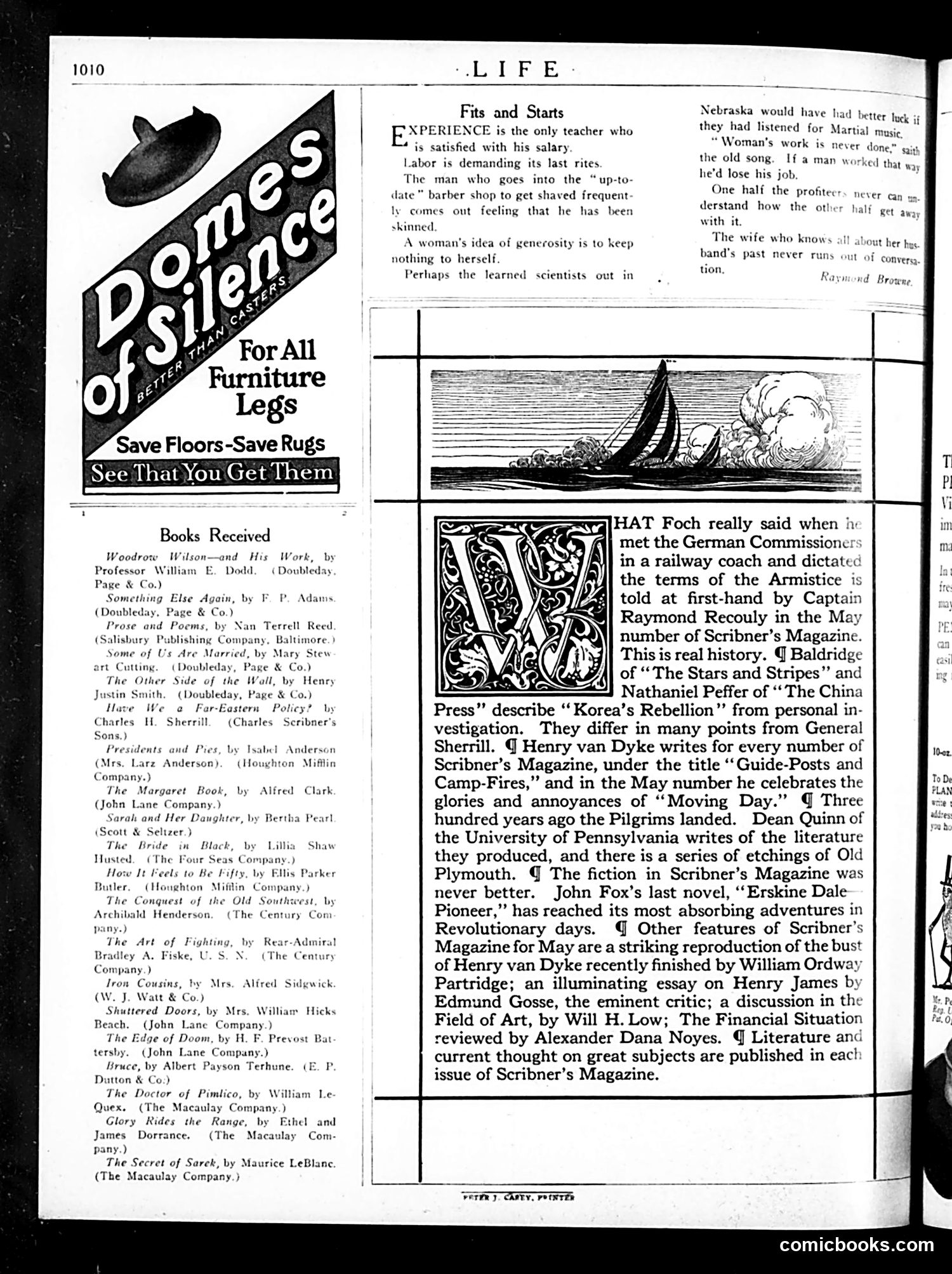
This page contains light satirical commentary in the "Fits and Starts" column alongside book reviews and advertising. The satire addresses early 20th-century labor and gender dynamics: **The Social Commentary:** Short quips mock contemporary attitudes—a barber shop that overcharges ("skinned"), a wife who hoards generosity, labor demands for better conditions, and profiteers during (apparently) wartime. The Nebraska reference likely alludes to WWI-era tensions. **The Advertisement:** A "Doomes Silence" furniture product promises to silence squeaky chair legs, protecting floors and rugs—a mundane household concern positioned as practical innovation. **The Magazine Content:** The page primarily showcases *Scribner's Magazine* offerings, including historical accounts of WWI's Armistice negotiations by Captain Recouly and coverage of Korea's rebellion, alongside literary fiction and cultural essays. The overall tone is gentle mockery of domestic life and business practices rather than sharp political satire, typical of *Life* magazine's approach during the post-WWI period.
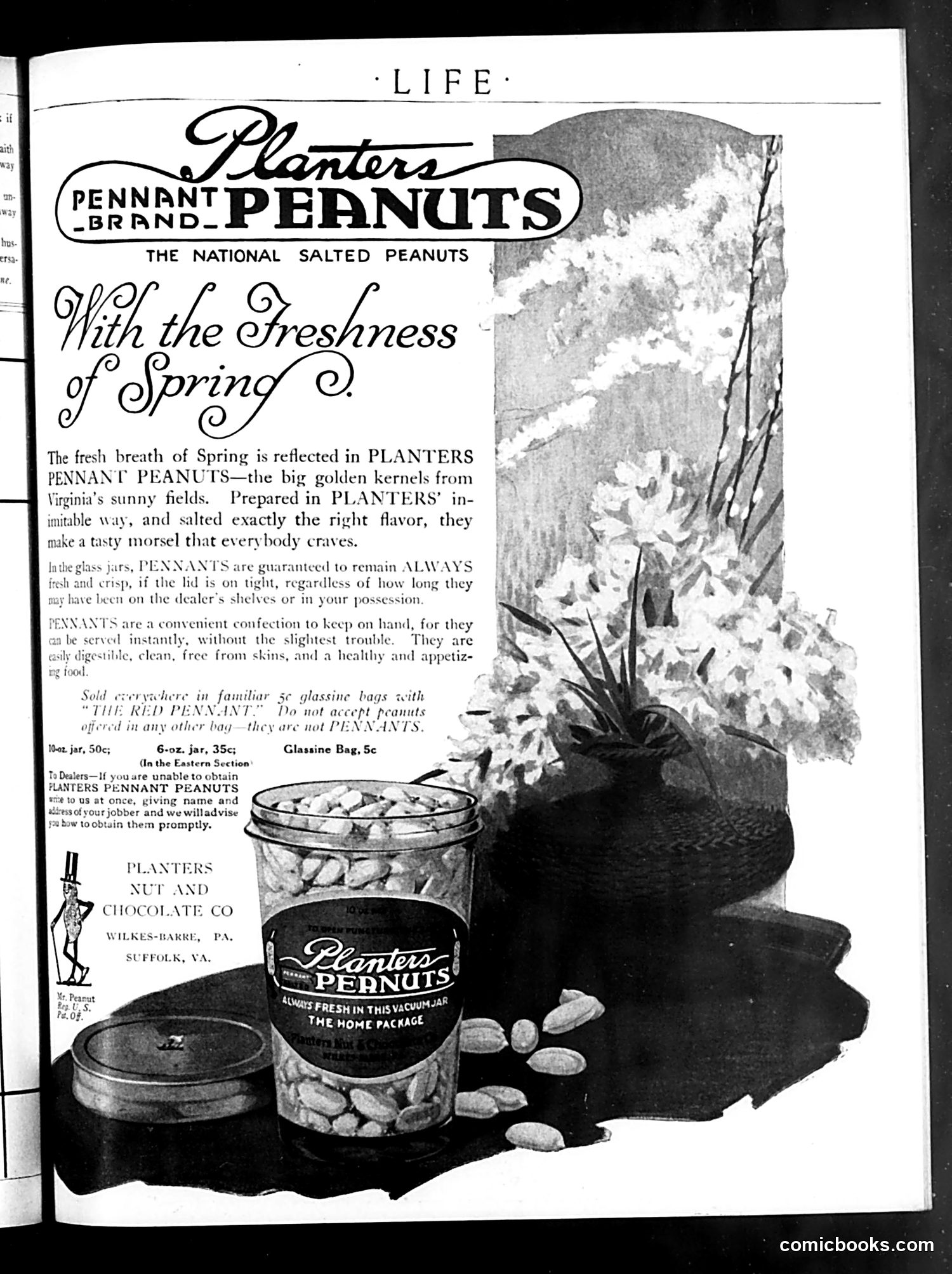
This is not a cartoon or satirical content—it's a **straightforward advertisement** for Planters Pennant brand peanuts, published in *Life* magazine. The page features a product ad promoting salted peanuts from Virginia, emphasizing their freshness, quality packaging (glass jars with tight lids), and convenience. The spring-themed imagery (flowers, pastoral scene) is purely decorative marketing rather than commentary. There is no political satire, caricature, or social critique present. This appears to be a standard commercial advertisement that *Life* magazine accepted for publication, likely from the early 20th century based on typography and design style. The Planters Nut and Chocolate Company contact information (Wilkes-Barre, PA and Suffolk, VA) anchors it as a genuine product promotion with no hidden meanings or jokes beyond typical period advertising rhetoric about product freshness and quality.
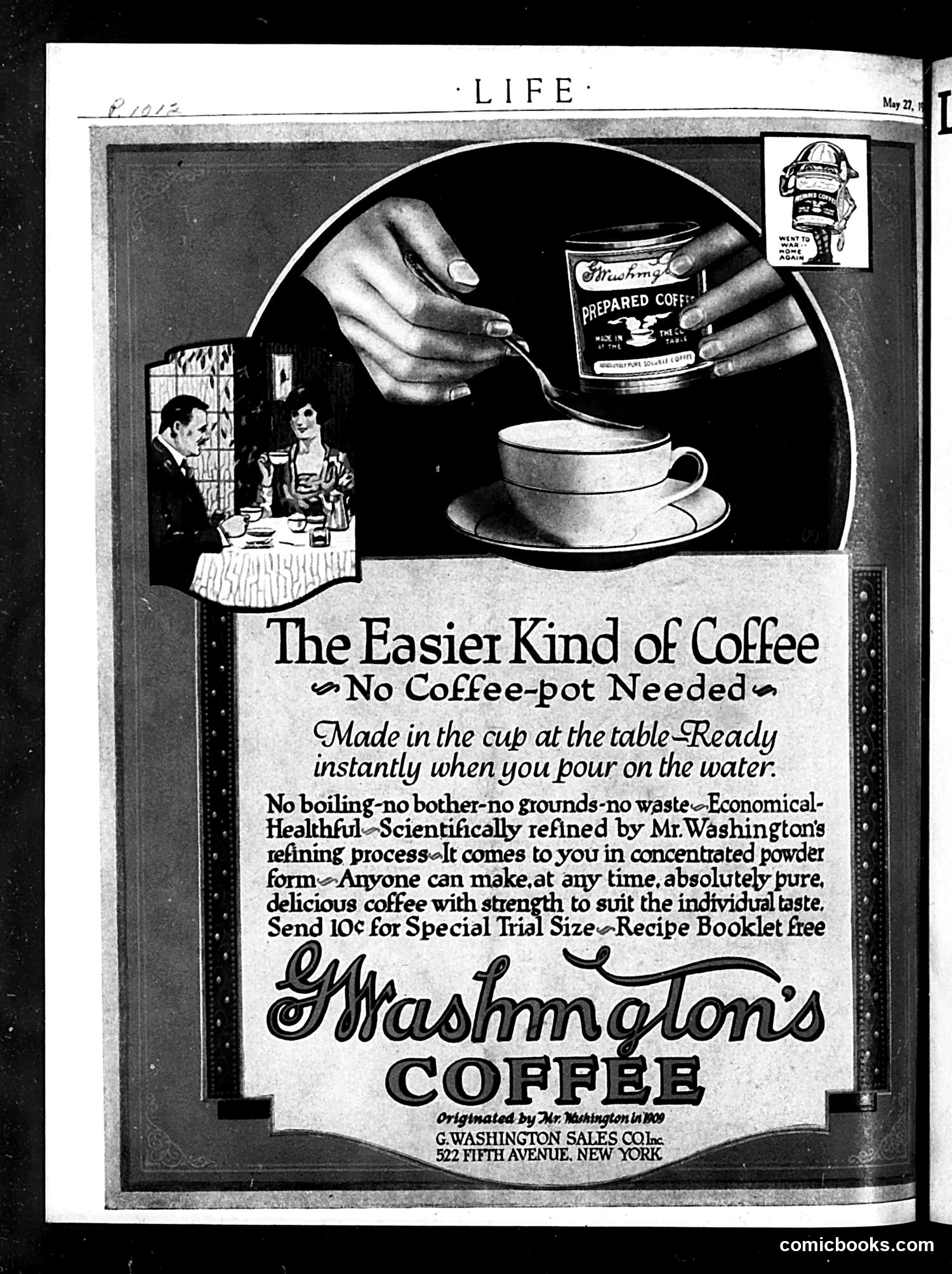
This is a **product advertisement**, not a political cartoon. It promotes "Washington's Coffee," an instant coffee product from the G. Washington Sales Co. in New York. The ad emphasizes convenience—no coffee pot, grounds, or boiling required. Users simply add hot water to concentrated powder in their cup. The small illustration (left) shows a couple at a table, presumably enjoying the ease of preparation. The product's name references its inventor, Mr. Washington (unclear if this is a real person or marketing). The ad targets modern efficiency-minded consumers by highlighting time-saving and cleanliness ("no waste," "absolutely pure"). This reflects early 20th-century marketing trends promoting instant/processed foods as markers of progress and convenience for busy households.