
Life, 1920-05-27 · page 20 of 44
Life — May 27, 1920 — page 20: what you’re looking at
What you’re looking at
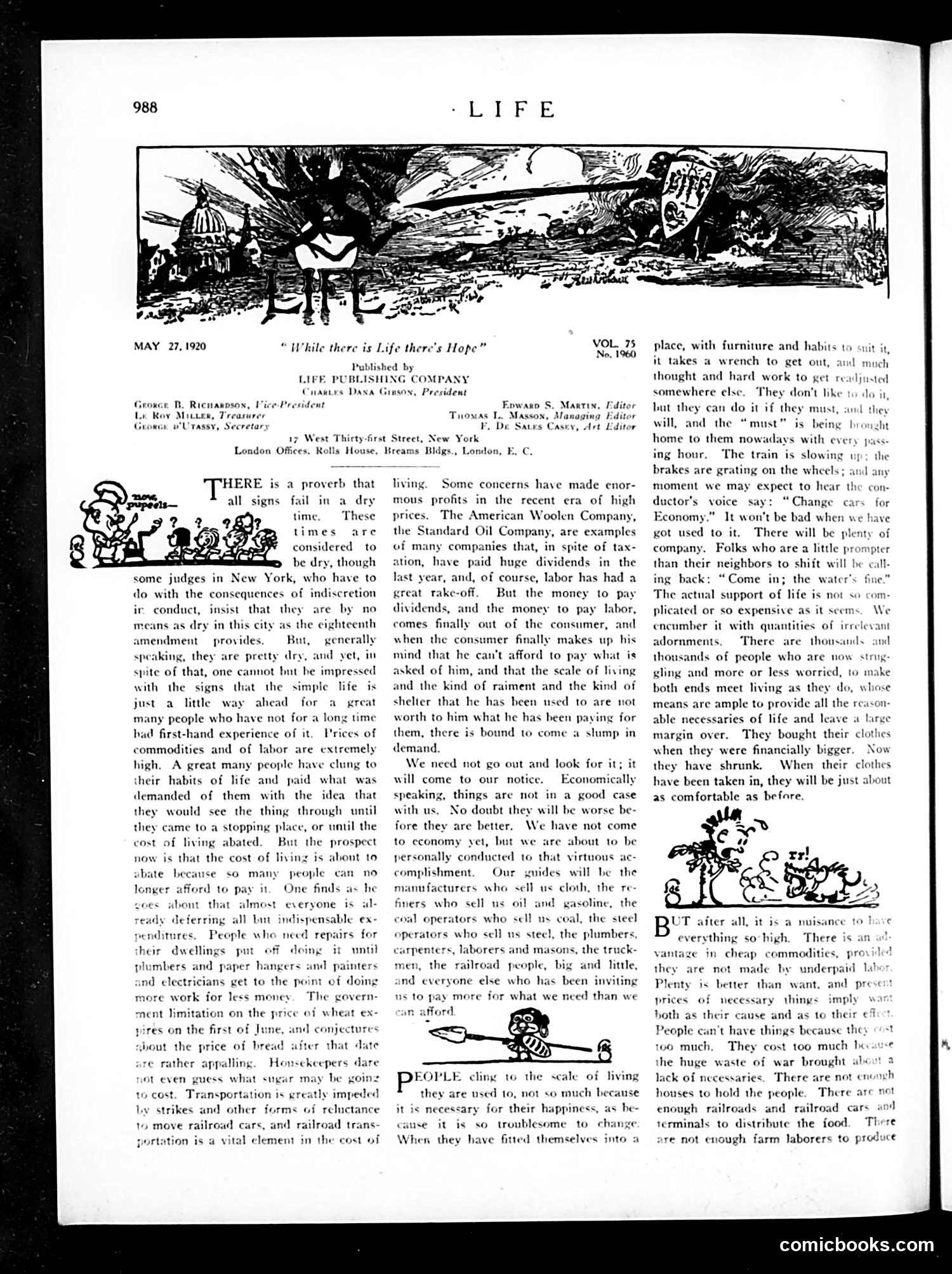
This editorial page addresses post-WWI economic anxieties. The author argues that despite visible signs of "the simple life" ahead—high prices for commodities and labor forcing consumers to reconsider spending—the wealthy (citing American Woolen Company and Standard Oil as examples) have profited enormously while ordinary people struggle. The satire targets consumer complacency and economic inequality. The piece notes that high living costs stem partly from war's waste and lack of necessities, yet people cling to expensive habits rather than genuinely economize. The author sarcastically suggests manufacturers, refiners, coal operators, and laborers will "personally conduct" citizens toward economy—meaning these industries will *force* frugality by making goods unaffordable. The cartoon illustrations (unclear in detail here) likely satirize either the wealthy enjoying excess or common people reluctantly downsizing. The overall message: inevitable economic correction is coming, whether Americans choose it or have it imposed upon them.
📄 Transcribed text from this page (OCR, searchable)
Machine-transcribed from the original scan — historical spelling and the odd misread are preserved.
MAY 27, 1920 Publishe LIFE PUBLISHIN' Crates Dasa Gr Grorce B. Ricnarpsox, Vice? Le Koy Mitter, Treasn Grores v'Urassy, Secretary ident 7 West Thirty-first London Offices, Rolls House, Bs HERE is a proverb that all signs fail in a dry time. These times are considered to be dry, though some judges in New York, who have to do with the consequences of indiscretion conduct, insist that they are by no means as dry in this city as the eighteenth amendment But, speaking, they are pretty dry, and yet, in provides, generally spite of that, one cannot but he impressed with the signs that the simple life just a. little way ahead many people who have not for a long time is for a great had first-hand experience of it, Prices of commodities and of labor are extremely high. A great many their habits of life people have clung to and paid what was demanded of them with the idea that they would see the thing through until they a stopping place, or until the cost living abated. But the prospect now is that the cost of living is about to wbate L longer 2 me td cause so many people can no std to pay it finds as he that everyone al- rring all but indispensable ex- irs for until One coes about almost is ready de venditures, People who need rep the put off plumbers and paper hangers and painters nd electricians get to the point of doing The ment limitation on the price of wheat ex- dwellings doing it more work for less money govern- pires on the first of June, and conjectures about the price of brew that date He ot even guess what sugar r are rather appalling sekeepers dare coins cost. Transportation is greatly impeded strikes und other forms of reluctance ilroad cars, and railroad trans- Ly move jon is a vital element in the cost of “While there is Life there's Hope” d by COMPANY nso, President Fowaro S. Martin, Edit Tuomas T.. Masson, Managing Edit F, De Sates Casey, Art Editor Street, New York reams Bldgs., London, E. C, living. Some concerns have made enor- mous profits in the recent era of high prices. The American Woolen Company, the Standard Oil Company, are examples of many companies that, in spite of tax- tion, have paid huge dividends in the last year, and, of course, labor has had a great rake-off. But the money to pay dividends, and the money to pay labor, comes finally out of the consumer, and when the consumer finally makes up his mind that he can't afford to pay what is asked of him, and that the scale of living and the kind of raiment and the kind of shelter that he has been used to are not worth to him what he has heen paying for them, there is bound to come a slump in demand. We need not go out and look for i will come to our notice. 3 it Economically speaking, things are not in a good case with us. No doubt they will be worse be- fore they are better, We have not come to economy yet, but we are about to be personally conducted to that virtuous ac- complishment the manufacturers who sell us cloth, the re Our guides will be finers who sell us oil and gasoline, the operators who sell us coal, the steel operators who sell us steel, the plumbers carpenters, laborers and masons, the truck- men, the railroad people, big and little, and everyone else who has been inviting us to pay more for what we need than we an afford of EOPLE cli they are used to, not so much because ng 10 living it is necessary for their happiness, as be- cause it troublesome to When they have fitted themselves is so change. ito place, with furniture and habits to suit it it takes a wrench to get out, much sedjusted thought and hard work to get re somewhere else. They don’t like but they can do it if they must, snd will, and the “must” ey is being brought home to them nowadays with every pass- ing hour. The train is slowing up; the brakes are grating on the wheels; and any moment we may expect to hear th ductor’s con- voice say: “Change cars Economy.” It won't be bad when we have got used to it. There will be plenty of company. Folks who are a little prompter than their neighbors to shift will be call- ing back: “Come in; the water's The actual support of | plicated or so expensive as it sec for is not so com We encumber it with quantities of irrelevant adornments. There are and thousands of people who are now strug gling and more or less worried, to make both ends meet living as they do, whose means are ample to provide all the rea able necessaries of life and leave a large margin over. They bought their clo when they were financially bigger. Now they have shrunk. When their clothes have been taken in, they will be just about as comfortable as before. thousands UT ater all, it is a nuisance to! There is cheap commodities, pre everything so: high. an vantage in they are not Plenty prices made by underpaid lat is better than want, and pre imply of things to their ef necessary both as their cause and a People can't have things because they «ot too much. They cost too much hx ¢ enough the huge waste of war brought lack of necessaries. There are ne There enough railroads and railroad cars ao terminals to distribute the food. There are not enough farm laborers to produce houses to hold the people not comicbooks.com