
Life, 1920-05-27 · page 42 of 44
Life — May 27, 1920 — page 42: what you’re looking at
What you’re looking at
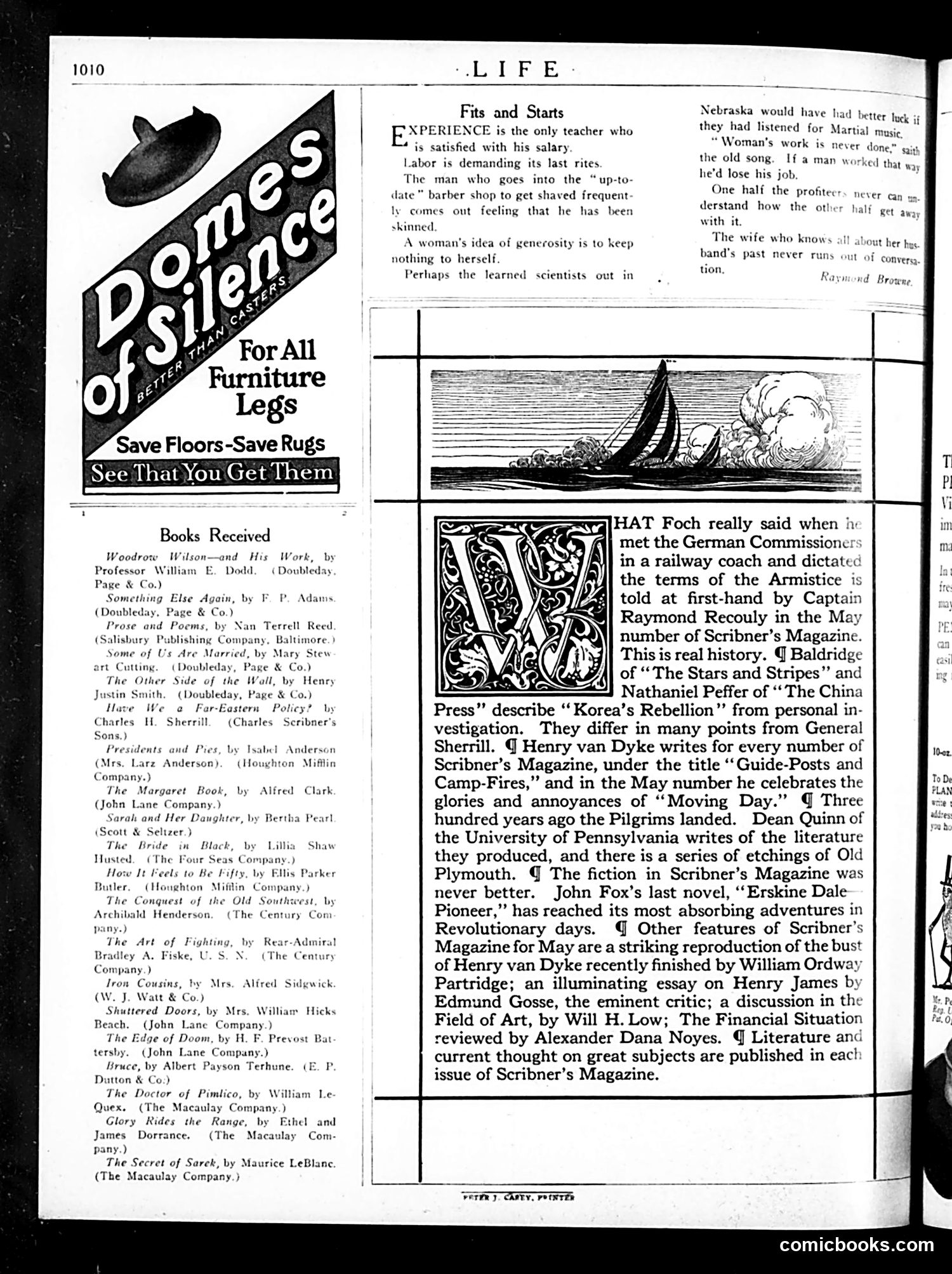
This page contains light satirical commentary in the "Fits and Starts" column alongside book reviews and advertising. The satire addresses early 20th-century labor and gender dynamics: **The Social Commentary:** Short quips mock contemporary attitudes—a barber shop that overcharges ("skinned"), a wife who hoards generosity, labor demands for better conditions, and profiteers during (apparently) wartime. The Nebraska reference likely alludes to WWI-era tensions. **The Advertisement:** A "Doomes Silence" furniture product promises to silence squeaky chair legs, protecting floors and rugs—a mundane household concern positioned as practical innovation. **The Magazine Content:** The page primarily showcases *Scribner's Magazine* offerings, including historical accounts of WWI's Armistice negotiations by Captain Recouly and coverage of Korea's rebellion, alongside literary fiction and cultural essays. The overall tone is gentle mockery of domestic life and business practices rather than sharp political satire, typical of *Life* magazine's approach during the post-WWI period.
📄 Transcribed text from this page (OCR, searchable)
Machine-transcribed from the original scan — historical spelling and the odd misread are preserved.
“Li EVE = Nebraska would have had better fuck j they had listened for Martial music, : “Woman's work is never done” the old song. If a man worked he'd lose his job. One half the profiteer derstand how the other with it. Fits and Starts XPERIENCE is the only teacher who is satisfied with his salary Labor is demanding its last rites. The man who goes into the “ up-to- date” barber shop to get shaved frequent ly comes out feeling that he has been skinned, saith that way never can gn half get awa The wife who knows ai! A woman's idea of generosity is to keep about her hes nothing to herself. band S past never runs out of cony . tion. Perhaps the learned scientists out in Books Received Woodrow Wilson—and His Work, by Professor William E. Dodd, (Doubleday Page & Co.) Something Else Again, by FP. (Doubleday, Page & Co.) Prose and Poems, by Nan Terrell Reed (Salisbury Publishing Company, Baltimore.) Some of Us Are Married, by Mary Stew art Cutting. (Doubleday, Page & Co.) The Other Side of the Wall, by Henry Justin Smith. (Doubleday, Page & Co.) Have We @ Far-Eastern Policy? by Charles H. Sherrill (Charles Scribner's Sons.) Presidents and Pres, by Isabel And n (Mrs. Larz Anderson). (Houghton Mifflin Company.) The Margaret Book, by Alfred Clark (John Lane Company.) Sarah and Her Daughter, by Bertha Pearl (Scott & Seltzer.) The Bride in Black, by Lillia Shaw Husted. (The I Seas Company.) How It Feels to Be Fifty, by Ellis Parker Butler, (Houghton Mifflin Company.) The Conquest of the Old Southwest Archibald Henderson. pany.) The Art of Fighting, by Rear-Ad Bradley A. Fiske, U. S. N Company.) Adams. (The Century Com (The Cent Iron Cousins, by Mrs. Alfred Sidgwick (W. J. Watt & Co.) Shuttered Doors, by Mrs. William Hicks Beach. (John Lane Company.) The Edge of Doom, by H. F. Prevost Bat tersby. (John Lane Company.) Bruce, by Albert Payson Terhune. (E. P. Dutton & Co.) The Doctor of Pimlico, by William Le Quex. (The Macaulay Company.) Glory Rides the Range, by Ethel and James Dorrance. (The Macaulay Com- pany.) The Secret of Sarck, by Maurice LeBlanc. (The Macaulay Company.) HAT Foch really said when hv met the German Commissioners in a railway coach and dictated the terms of the Armistice is told at first-hand by Captain Raymond Recouly in the May number of Scribner’s Magazine. This is real history. Baldridge of “‘The Stars and Stripes”’ and Nathaniel Peffer of ‘‘ The China Press” describe ‘‘ Korea’s Rebellion’’ from personal in- vestigation. They differ in many points from General Sherrill. @ Henry van Dyke writes for every number of Scribner’s Magazine, under the title “‘Guide-Posts and Camp-Fires,” and in the May number he celebrates the glories and annoyances of “Moving Day.” 4 Three hundred years ago the Pilgrims landed. Dean Quinn of the University of Pennsylvania writes of the literature they produced, and there is a series of etchings of Old Plymouth. Q The fiction in Scribner’s Magazine was never better. John Fox’s last novel, “‘Erskine Dale Pioneer,” has reached its most absorbing adventures in Revolutionary days. 4 Other features of Scribner's Magazine for May are a striking reproduction of the bust of Henry van Dyke recently finished by William Ordway Partridge; an illuminating essay on Henry James b) Edmund Gosse, the eminent critic; a discussion in the Field of Art, by Will H. Low; The Financial Situation reviewed by Alexander Dana Noyes. Q Literature and current thought on great subjects are published in eac! issue of Scribner’s Magazine. comicbooks.com