
Life, 1920-05-27 · page 25 of 44
Life — May 27, 1920 — page 25: what you’re looking at
What you’re looking at
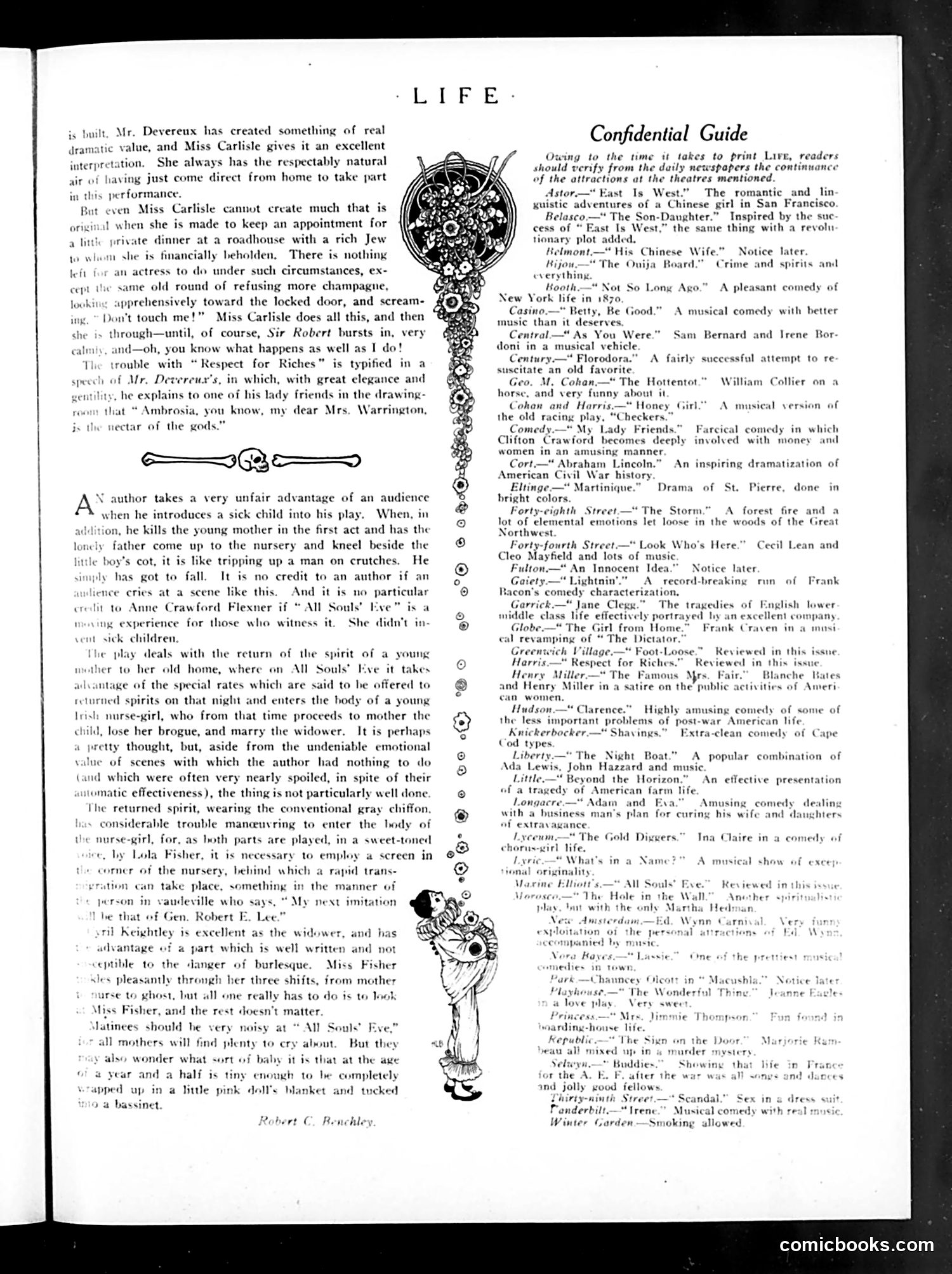
This page contains theater reviews by Robert C. Benchley, the famous humorist and drama critic. The left column critiques two plays: "Respect for Riches" (starring Miss Carlisle) and "All Souls' Eve." Benchley employs sharp satire to expose dramatic manipulation. He mocks "Respect for Riches" for including an uncomfortable scene where a wealthy Jewish man pressures a young actress into a private dinner—a scenario designed to manipulate audience sympathy. More pointedly, he attacks "All Souls' Eve" for cheaply exploiting the emotional power of dead children and grieving parents, arguing that audiences will cry regardless of the playwright's actual skill. Benchley argues this is unfair: audiences cannot help their emotional response to such vulnerable subjects, so including them proves nothing about the author's talent. The right column lists current theatrical attractions with brief descriptions—a "Confidential Guide" for readers. The ornamental illustrations (the decorative circular design and the small figure sketch) are typical Life magazine embellishments from this era.
📄 Transcribed text from this page (OCR, searchable)
Machine-transcribed from the original scan — historical spelling and the odd misread are preserved.
is built, Mr. Devereux has created something of real dramatic value, and Miss Carlisle gives it an excellent interpretation. She always has the respectably natural air of having just come direct from home to take part in this perform But even Miss Carl nnot create much that is il when she is made to keep an appointment for a lith private dinner at a roadhouse with a rich Jew to whom she is financially heholden, There is nothing left for an actress to do under such circumstances, ex- the same old round of refusing more champagne, ing apprehensively toward the locked door, and scream- ing,” Don't touch me!" Miss Carlisle does all this, and then she is through—until, of course, Sir Robert bursts in, very calmly, and—oh, you know what happens as well as I do! 1 trouble with “Respect for Riches” is typified in a speech of Mr. Devereux's, in which, with great elegance and he explains to one of his lady friends in the drawing- nce. origi that “ Ambrosia, you know, my dear Mrs, Warrington, ctar of the god — 303 author takes a very unfair advantage of an audience when he introduces a sick child into his play, When, in tion, he kills the young mother in the first act and has the lonely father come up to the nursery and kneel beside the little boy’s cot, it is like tripping up a man on crutches. He imply has got to fall. It is no credit to an author if an cries at a scene like this. And it is no particul: Anne Crawford Flexner if “ All Souls’ Eve” is a or those who witness it ience credit to movi experience She didn’t in- ent sick children, he play deals with the return of the spirit of a young n AML Souls’ Eve it takes hare sa rer to her old home, where 1 to he offered to returned spirits on that night and enters the body of a young wihvantage of the special rates whi nurse-girl, who from that time proceeds to mother the lose her brogue, and marry the widower. It is perhaps 4 pretty thought, but, aside from the undeniable emotional value of scenes with which the author had nothing to do (and which were often very nearly spoiled, in spite of their automatic effectiveness), the thing is not particularly well done Ihe returned spirit, wearing the conventional gray chiffon, considerable trouble manceuvring to enter the body of the nurse-girl, for, as both parts are playe ce, by Lola F comer € in a sweet-toned sher, it is necessary to employ a screen in the nursery, gyration can take plac person i hehind which a rapid trans- something in the manner of vaudeville who says, “My next imitation Robert E. Lee.” Lhe that of Gen. sTil Keightley is excellent as the widower, and has a part which is well written and not Miss Fisher igh her three shifts, from mother urse to ghost, but all one really Miss Fishe advantage ceptible to the danger of burlesque. sles pleasantly th as to do is to look and the rest doesn’t matter. All Souls’ Ey But the: aby itis that at the ag Matinees should he very noisy at y about all mothers will find plenty to ¢ also wonder what sort a year and a half is tiny « apped up in a litte pink » & bassinet uh to he completely Ws Manket and tucked Robert C. Renchley fo) @ Confidential Guide Owing to the time it takes to print Live, readers should verify from the daily newspapers the continuance of the attractions at the theatres mentioned. Astor. East Is Wes The romantic and lin guistic adventures of a Chinese girl in San Francisco. Daughter.” Inspired by the suc the same thing with a revoli His Chinese Wife.” Notice later. Kijou—" The Ouija Board.” Crime and spirits and everything Hooth.—* Not So Long Ago.” A pleasant comedy of New York life in 1870. Casino.— Betty, Be Good.” music than it deserves. Central —" As You Were.” doni in a musical vehicle Century.—" Florodora.” suscitate an old favorite Geo. M. Cohan.—" The Hottentot.” horse, and very funny about it Cohan and Harri Honey Girl.” the old racing play, “Checkers. Comedy.—" My Lady Friends.” Farcical comedy in which Clifton Crawford becomes deeply involved with money and women in an amusing manner. Cort." Abraham Lincoln.” American Civil War history Eltinge —* Martinique.” bright colors. Forty-eighth Stre lot of elemental emo! Northwest Forty-fourth Street—" Look Who's Her Cleo Mayfield and lots of music Fulton.—* An Innocent Idea.” Gaie! Lightnin’.” A con's comedy characteriz Garrick.—" Jane Clegg.” The tragedies of English lower iddle class life effectively portrayed hy an excellent Glob The Girl from Home.” Frank Craven in cal revamping of “The Dictator.” Greenwich Village.—" Foot-Loose.” Reviewed in this issne Harris.—" Respect for Riches.” Reviewed in this iss Henry Miller—* The Famous Mrs. Fair.” Blanche Bates and Henry Miller in a satire on the public activities of Ameri can wome Hud Clarence.” Highly amusing comedy of some of the less important problems of post-war American life Knickerbocker—" Shavings.” Extra-clean comedy of Cape Cod types Liberty —" The Night Boat.” A popular combination of Ada Lewis, John Hazzard and music Little-—" Beyond the Horizon of a tragedy of American farm li Longacre.—" Adam and Eva.” with a business man’s plan for curin of extravagance A musical comedy with better Sam Bernard and Irene Bor- A fairly successful attempt to re William Collier on a A musical version of An inspiring dramatization of Drama of St. Pierre, done in “The Storm.” A forest fire and a ons let loose in the woods of the Great Cecil Lean and Notice later record-breaking run of ion. Frank An effective presentation Amusing comedy his wife dealing and daughters Lyceum.—" The Md Diggers.” Ina Claire in a comedy of « sir life. Lyrie.—* What's in a Name?" A musical show of exces tional originality Marine Elliott's —" All Souls’ Eve.” Reviewed in this issue —" The Hole in the Wall.” Another spirit play, but with the only Martha Hedmar New Amsterdam 1. Wynn Carni Very fur e tion of the personal attracti i Ed Wy ceompanied by muste Vora Ka smedies on rows ark —Char Mlayhouse.— a love play neey f tin* The Wonderful Very sweet “Mrs. Jimmie Thomp ise life. * The Sign « Lup ins mu * Buddies F. after the war was al ind jolly good fellows Lhirty-ninth Street —* Scandal.’ Panderbilt,—" Irene.” Mu Winter Garden he Door ler mystery Showing tha Sex ina ¢ ‘al comedy with real music Smoking allowed comicbooks.com