
Life, 1920-05-27 · page 26 of 44
Life — May 27, 1920 — page 26: what you’re looking at
What you’re looking at
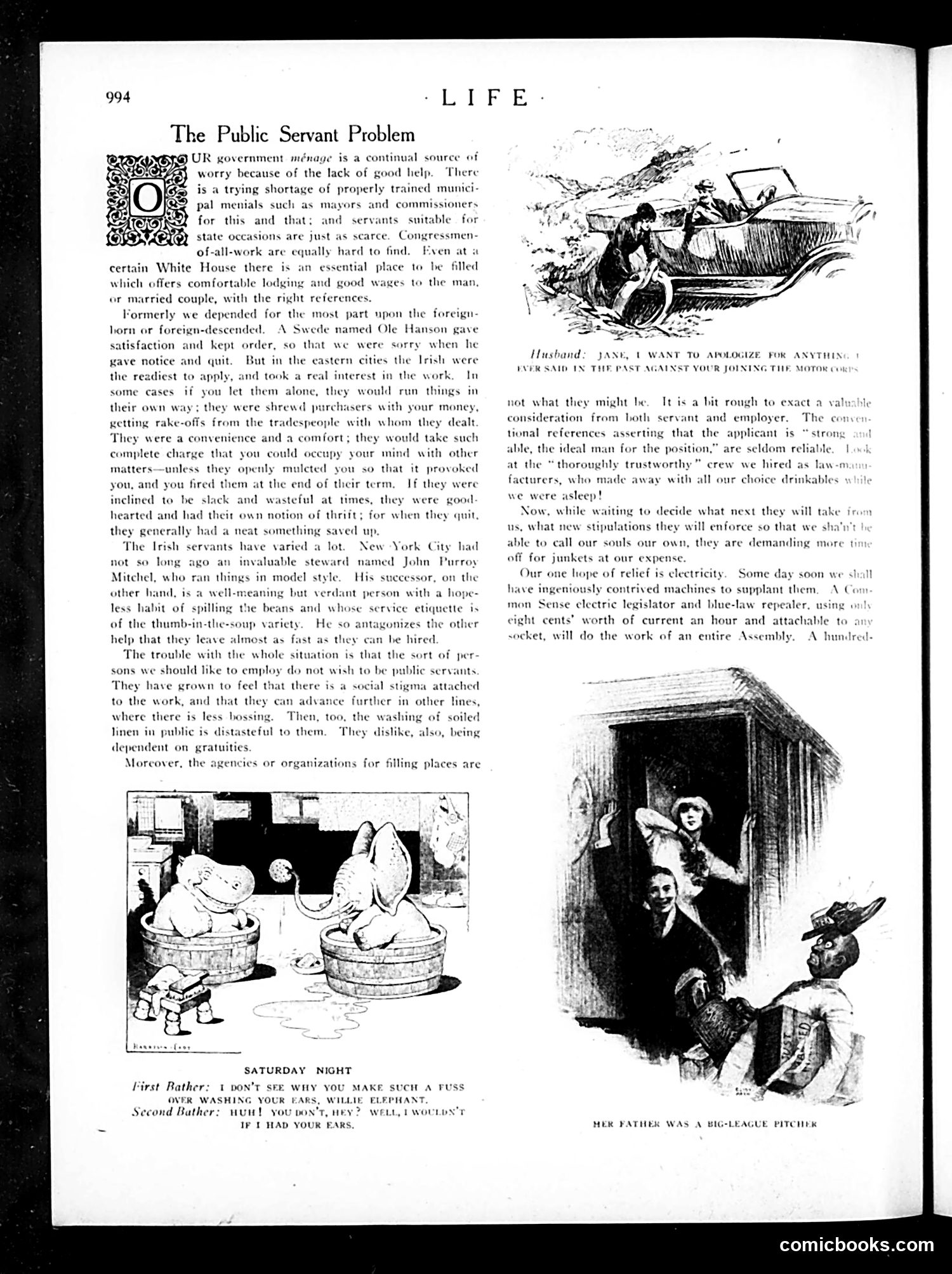
This page satirizes the American shortage of reliable public servants and household help. The main article complains that government positions and domestic service roles lack qualified workers—citing past reliance on Irish and Swedish immigrants who, while sometimes corrupt or inefficient, at least showed initiative. The cartoons illustrate the theme humorously: 1. **"Saturday Night"**: Two elephants bathing debate ear-washing, a joking commentary on accepting unpleasant necessities. 2. **"Husband" caption**: A man apologizes to his wife Jane for past criticism of her joining "the Motor Corps" (likely a WWI-era women's volunteer organization), suggesting changing social attitudes toward women's public roles. 3. **"Her Father Was a Big-League Pitcher"**: Shows a family scene, implying class mobility and American social change. The article's conclusion—that electrical machines might eventually replace human servants—reflects early-20th-century optimism about labor-saving technology. The satire targets both servant unreliability and the era's class anxieties about labor shortages.
📄 Transcribed text from this page (OCR, searchable)
Machine-transcribed from the original scan — historical spelling and the odd misread are preserved.
~LIFE. The Public Servant Problem $@) UR government ménay iS} worry because of the lack of good help. ‘There is a trying shortage of properly trained munici- continual source of pal menials such as mayors and commissioners for this and that; and servants suitable for state occasions are just as scarce. Congressmen- of-all-work are equally hard to find. Even ata certain White House there is an essential place to be filled which offers comfortable lodging and good wages to the man, or married couple, with the right references. Formerly we depended for the most part upon the foreign- horn or foreign-descended. A Swede named Ole Hanson gave satisfaction and kept order, so that we were sorry when he gave notice and quit. But in the tern cities the Irish were the readiest to apply, and took a real interest in the work, In some cases if you let them alone, they would run things in their own way: they were shrewd purchasers with your money, getting rake-offs from the tradespeople with whom they dealt They were a convenience and a comfort; they would take such complete charge that you could oceupy your mind with other voked If they were matters—unless they openly muleted you so that it pr you, and you fired them at the end of their term. inclined to be slack and wasteful at times, they were good hearted and had theit own notion of thrift; for when they quit, they generally had a neat something saved up. The Irish servants have varied a lot. New York City had not so long ago an invaluable steward named John Purroy Mitchel, who ran things in model style. His cessor, on the other hand, is a well-meaning but verdant person with a h t of spillir of the thumb-in-the-soup variety. He so antagonizes the other the beans and whose service etiquette is help that they leave almost as fast as they can he hired. The trouble with the whole situation is that the sort of per sons we should like to employ do not wish to be public servants They have grown to feel that there is cial stigma attached to the work, and that they can advance further in other lines, where there is less bossing. Then, toc linen in public is distasteful to them the washing of soiled hey dislike, also, being dependent on gratuities Moreover, the wencies or org tions for filling places are SATURDAY NIGHT First Rather: 1 pon’t see WHY YOU MAKE SUCH A FUSS OVER WASHING YOUR EARS, WILLIE ELEPHANT Second Bather: woul you pox'’t, wey? weit, 1 WOULDN'T IF } HAD YOUR EARS, Husband: JANt, | WANT TO APOLOGIZE FOR ANYTHLN EVER SMD IN THE PAST AGAINST YOUR JOINING THE MOTOR C4 not what they might be. Tt is a bit rough to exact a valu consideration from both servant and employer. The cor tional references asserting that the applicant is “strong able, the ideal man for the position,” are seldom reliable. | at the “thoroughly trustworthy” crew we hired as law-9 facturers, who made away with all our choice drinkables we were asleep! Now, while waiting to decide what nest they will take us, what new stipulations they will enforce so that we sha ble to call our souls our own, they are demanding more off for junkets at our expense. Our one hope of relief is electricity. Some day soon we have ingeniously contrived machines to supplant them. A Ce mon Sense electric legislator and blue-law repealer, usir eight cents’ worth of current an hour and attachable to ¢ socket, will do the work of an entire Assembly, A hundred- MER FATHEK WAS A BIG-LEAGUE PITCHEK comicbooks.com