
Life, 1920-05-27 · page 24 of 44
Life — May 27, 1920 — page 24: what you’re looking at
What you’re looking at
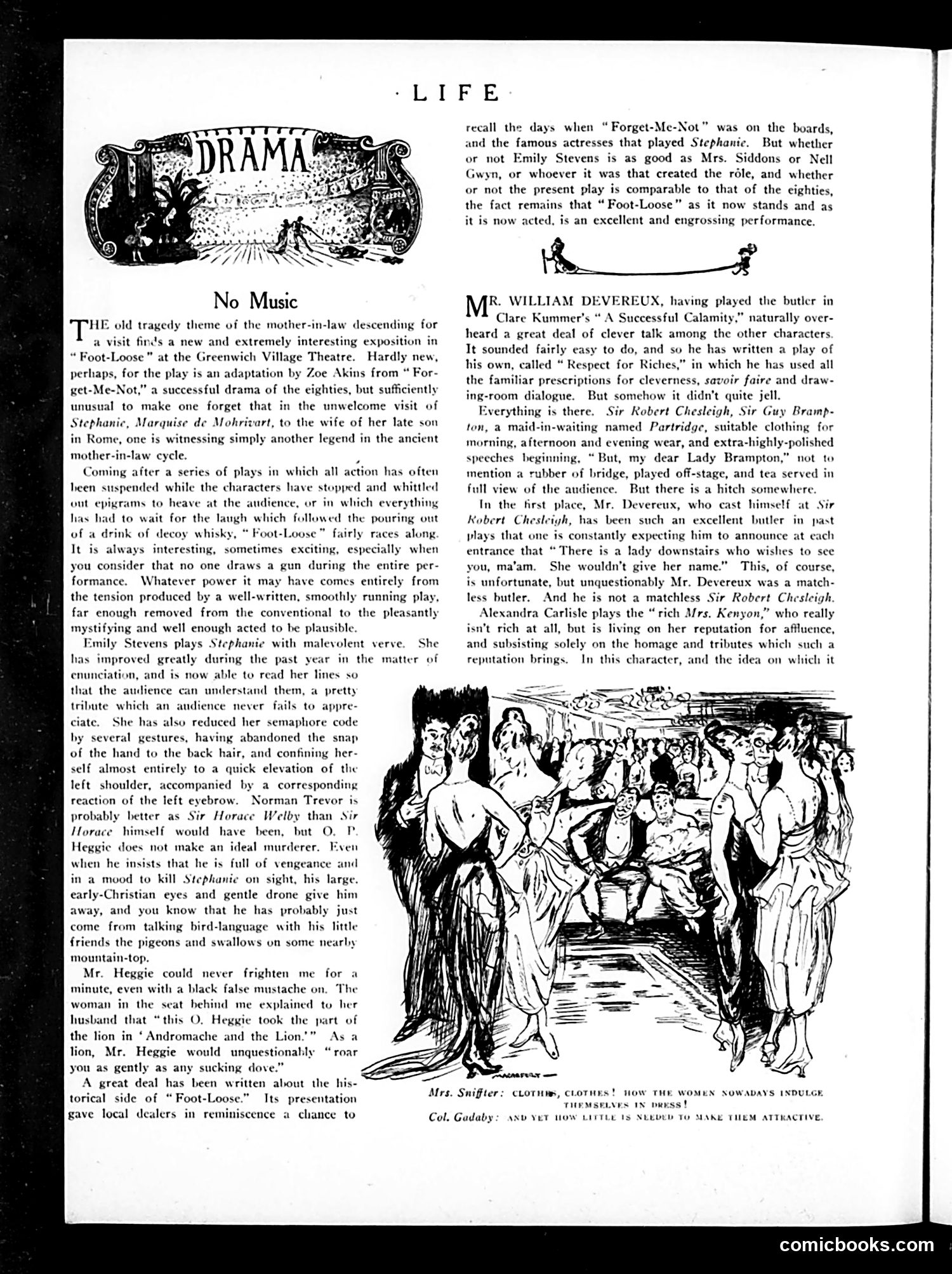
This page reviews two Broadway plays: "Foot-Loose" at Greenwich Village Theatre and "Respect for Riches." **"Foot-Loose"** is praised as an adaptation of an 1880s play featuring the classic "mother-in-law visits" plot. The reviewer credits its success to tight writing and plausible acting rather than gimmicks. Emily Stevens plays the antagonistic Stephanie; O.P. Heggie plays a would-be murderer whom the critic finds unconvincingly gentle—even imagining him cooing to pigeons rather than threatening anyone. **The cartoon** (bottom) shows a crowded social scene with the caption mocking how women's clothing and minimal tailoring effort create attractiveness at society gatherings. The second review notes William Devereux adapted his butler role into "Respect for Riches," employing familiar drawing-room comedy formulas that "didn't quite jell." Both reviews reflect early 1920s theater criticism emphasizing character acting and plot construction over theatrical spectacle.
📄 Transcribed text from this page (OCR, searchable)
Machine-transcribed from the original scan — historical spelling and the odd misread are preserved.
No Music HE old tragedy theme of the mother-in-law descending for ines a new and extremely interesting exposition in “ Foot-Loos at the Greenwich Village Theatre. Hardly new, perhaps, for the play is an adaptation by Zoe Akins from “ For- get-Me-Not,” a successful drama of the eighties, but sufficiently unusual to make one forget that in the unwelcome visit of hanie, Marquise de Mohrivart, to the wife of her late son in Rome, one is witnessing simply another legend in the ancient mother-in-law cycle. Ps ter a series of plays in which all action has often © stopped and whittled Coming a rin which everything out epigrams to heave at the audience, has had to wait for the laugh which followed the pouring out of a drink of decoy whisky, “ Foot-Loose” fairly races along. It is always interesting, sometimes exciting, especially when you consider that no one draws a gun during the entire per- formance. Whatever power it may have comes entirely from the tension produced by a well-written, smoothly running play, far enough removed from the conventional to the pleasantly mystifying and well enough acted to he plausible. Emily Stevens plays Stephanie with malevolent verve. She has improved greatly during the past year in the matter of enunciation, and is now able to read her lines so that the aud tribute which an audience never fails to appre- ciate. She has also reduced her semaphore code ibandoned the snap nee can understand them, a pretty hy several gestures, having of the hand to the back hair, self almost entirely to a quick elevation of the left shoulder, accompanied by a corresponding reaction of the left eyebrow. Norman Trevor is probably better as Sir Horace Welby than Sir Horace himself would have been, but O, P. Heggic does not make an ideal murderer. F nd confining her- en when he insists that he is full of vengeance and in a mood to kill Stephanie on sight, his large. early-Christian © and gentle drone give him away, and you know that he has probably just come from talking bird-language with his little friends the pigeons and swallows on some nearby mountain-top. Mr. Heggie could never frighten me for a minute, even with a black false mustache on. The woman in the seat behind me explained to her husband that “this O. Heggie took the part of the lion in ‘Andromache and the Lion.’” As a lion, Mr. Heggie would unquestionably “ roar you as gently as any sucking dove.” A great deal has been written about the his- torical side of “Foot-Loose.” Its presentation gave local dealers in reminiscence a chance to ~LIFE Mrs. Sniffter: cLotums, cLorues Col. Gadaby recall the days when “Forget-Me-Not” was on the boards, and the famous actresses that played Stephanie. But whether or not Emily Stevens is as good as Mrs. Siddons or Nell Gwyn, or whoever it was that created the role, and whether or not the present play is comparable to that of the eighties, the fact remains that “Foot-Loose” as it now stands and as it is now acted, is an excellent and engrossing performance. _——— R. WILLIAM DEVEREUX, having played the butler in Clare Kummer’s “ A Successful Calamity heard a great deal of clever talk among the other characters. It sounded fairly easy to do, and so he has written a play of his own, called “ Respect for Riches,” in which he has used all the familiar prescriptions for cleverness, savoir faire and draw- ing-room dialogue. But somehow it didn't quite jell iverything is there. Sir Robert Chesleigh, Sir Guy Bramp- ton, a maid-in-waiting named Partridge, suitable clothing for morning, afternoon and evening wear, and extra-highly-polished speeches beginning, “But, my dear Lady Brampton,” not to naturally over- mention a rubber of bridge, played off-stage, and tea served in full view of the audience. But there is a hitch somewhere. In the first place, Mr. Devereux, who cast himself at Sir Robert Chesleigh, Was been such an excellent butler in’ past plays that one is constantly expecting him to announce at cach entrance that “ There is a lady downstairs who wishes to sce you, ma'am. She wouldn't give her name.” This, of course, is unfortunate, but unquestionably Mr. Devereux was a match- less butler. And he is not a matchless Sir Robert Chesleigh. Alexandra Carlisle plays the “rich Mrs. Kenyon,” who really isn’t rich at all, but is living on her reputation for affluence, and subsisting solely on the homage and tributes which such a reputation brings. In this character, and the idea on which it ! HOW THE WOMEN NOWADAYS INDULGE THEMSELVES IN AND YET HOW LITTLE 1S Nbe} RES: TO MAKE THEM ATTRACTIVE. comicbooks.com