
Life, 1920-05-27 · page 10 of 44
Life — May 27, 1920 — page 10: what you’re looking at
What you’re looking at
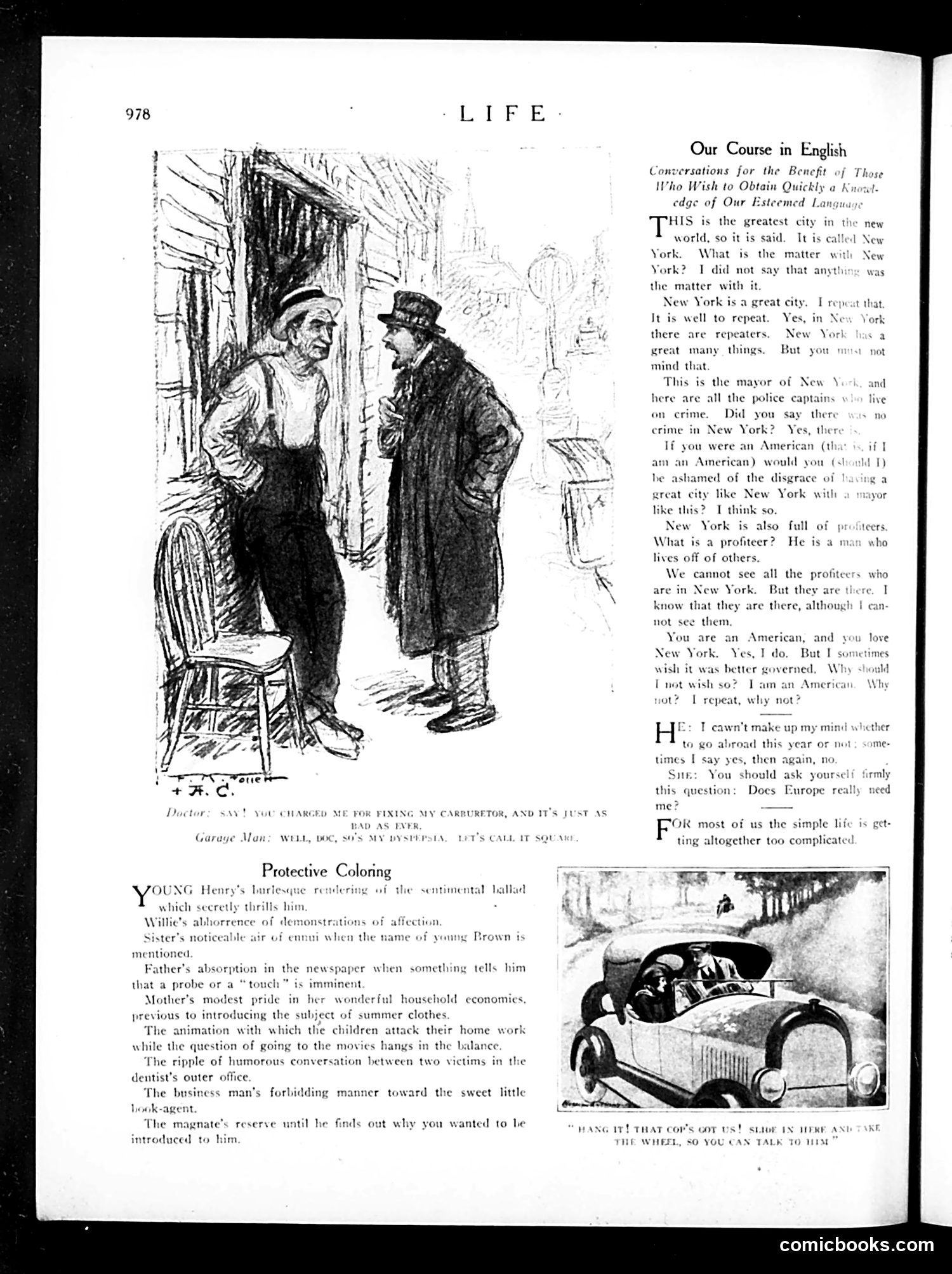
The top cartoon depicts two men in conversation on a city street. The caption quotes a "Doctor" complaining about carburetor repair costs, with a "Garage Man" responding dismissively about the expense. This satirizes the growing frustration with automobile maintenance costs in the early automotive era—a relatable complaint for the magazine's readers. The accompanying essay "Our Course in English" humorously critiques New York City through a dialogue about crime, corruption, and American values. It juxtaposes idealistic American principles with urban realities: crime, "profiteers," and moral compromises. The lower cartoon shows a car with two people, captioned about a cop's offer to move along. This satirizes police indifference or complicity in public conduct. Both pieces use humor to critique urban American society and its contradictions.
📄 Transcribed text from this page (OCR, searchable)
Machine-transcribed from the original scan — historical spelling and the odd misread are preserved.
Our Course in English Conversations for the Bene r Who Wish to Obtain Quickly a } edge of Our Esteemed Lang HIS is the greatest city in the new world, so it is said. It is called New York. What is the matter with New York? I did not say that anyt! was the matter with it, New York is a great city. I repeat that It is well to repeat. Yes, in New York there are repeaters. New York thas a great many things. But yor ms not mind that This is the mayor of New \ and here are all the police captains live on crime. Did you say there wus no crime in New York? Yes, ther If you were an American (tI an American) would you (s he ashamed of the disgrace of great city like New York with yor like this? T think so. New York is also full of protiteers. What is a profiteer? He is a man who lives off of others. We cannot see all the profiteers who are in New York. But they are there. I know that they are there, although | can not see them. You are an American, and you love New York. Yes, I do. But I vetimes wish it was better governed, Why she | not wish so? Tam an Americar not? I repeat, "tmake up my r abroad this yea times I say yes, then agai Site: You should ask yourse this question: Does Europe reall : me? OU CHARGED ME FOR FIXING MY CARBURETOR, AND IT'S JUST AS BAD AS EVER. 'OR most of us the simple life is get- Garage Man: wis, voc, o's MY pystt rst, Let's CALL IT SQUA ting altogether too complicated Protective Colonng YOUNG Henry's burl P Jering of the sentimental ballad which secretly th : Willie’s abhorrence of demonstrations of affec H Sister’s noticeable air of ennui when the name of young Brown is mentioned. Father's absorption in the newspaper when something tells him that a probe or a “touch” is imminent Mother’s modest pride in her wonderful household economies, previous to introducing the subject summer clothes. The animation with which the children attack their home work while the question of going to the movies hangs in the balance. The ripple of humorous conversation between two victims in the dentist's outer office. The business man's forbidding manner toward the sweet little > oe hook-agent . . ae The magnate’s reserve until he finds out why you wanted to he ; “WANG ITE THAT COP’s GOT US! SLIDE EX HERE ANT introduced to him THE WHEEL, SO YOU CAN TALK TO WIM” comicbooks.com