
A complete issue · 40 pages · 1920
Life — March 11, 1920
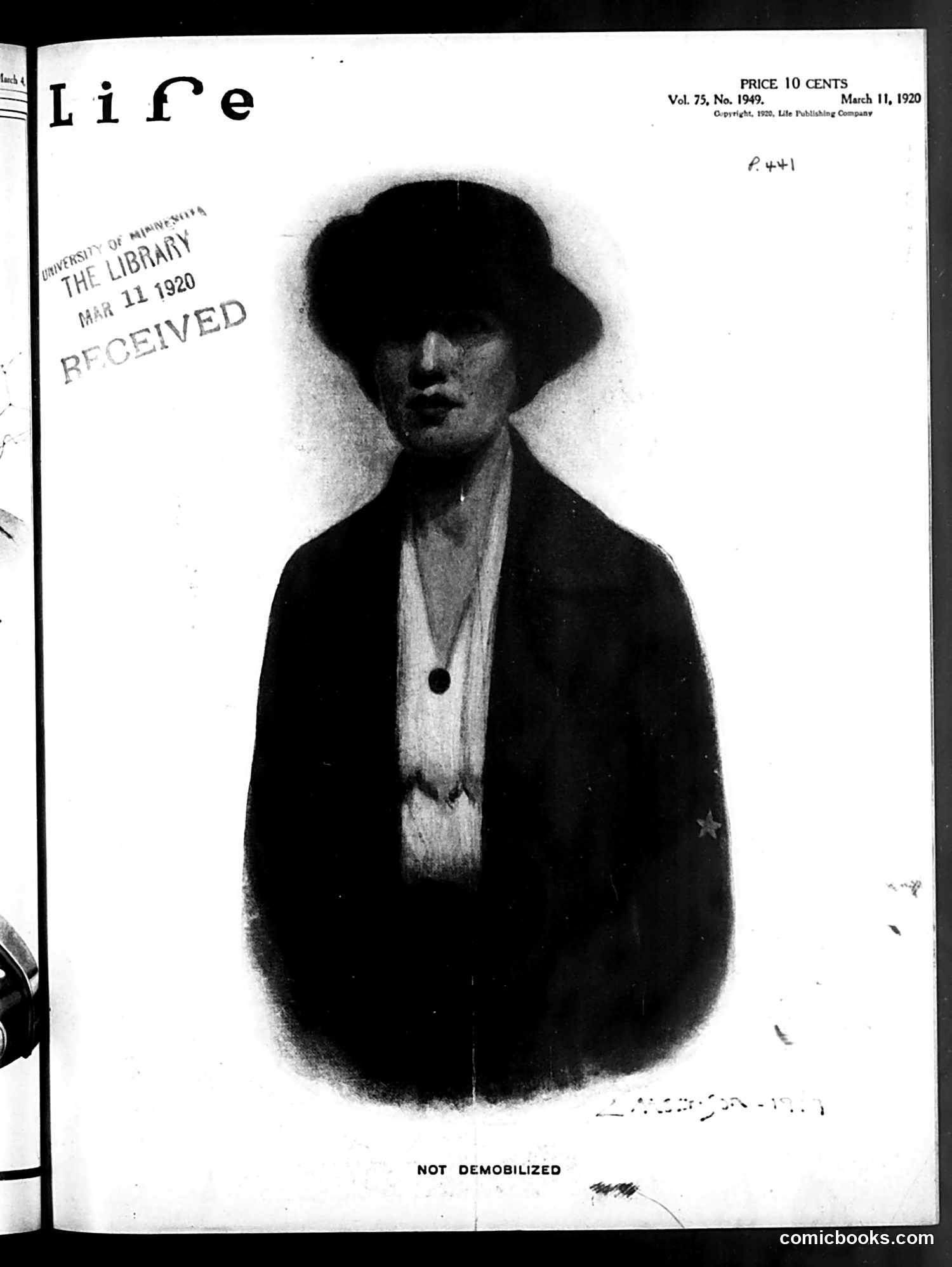
This appears to be a portrait cover rather than a political cartoon. The image shows a woman wearing a dark coat and cloche hat (fashionable 1920s style) with a stern or serious expression. The caption reads "NOT DEMOBILIZED." The phrase "demobilized" refers to the post-World War I period—soldiers were being demobilized (discharged from military service). The satire likely comments on women's roles during and after the war. "Not demobilized" suggests this woman remained active, serious, or militant in some cause—possibly women's suffrage or labor activism, which were prominent issues in 1920. The stern expression reinforces the idea of unwavering commitment to her cause rather than returning to pre-war domesticity.
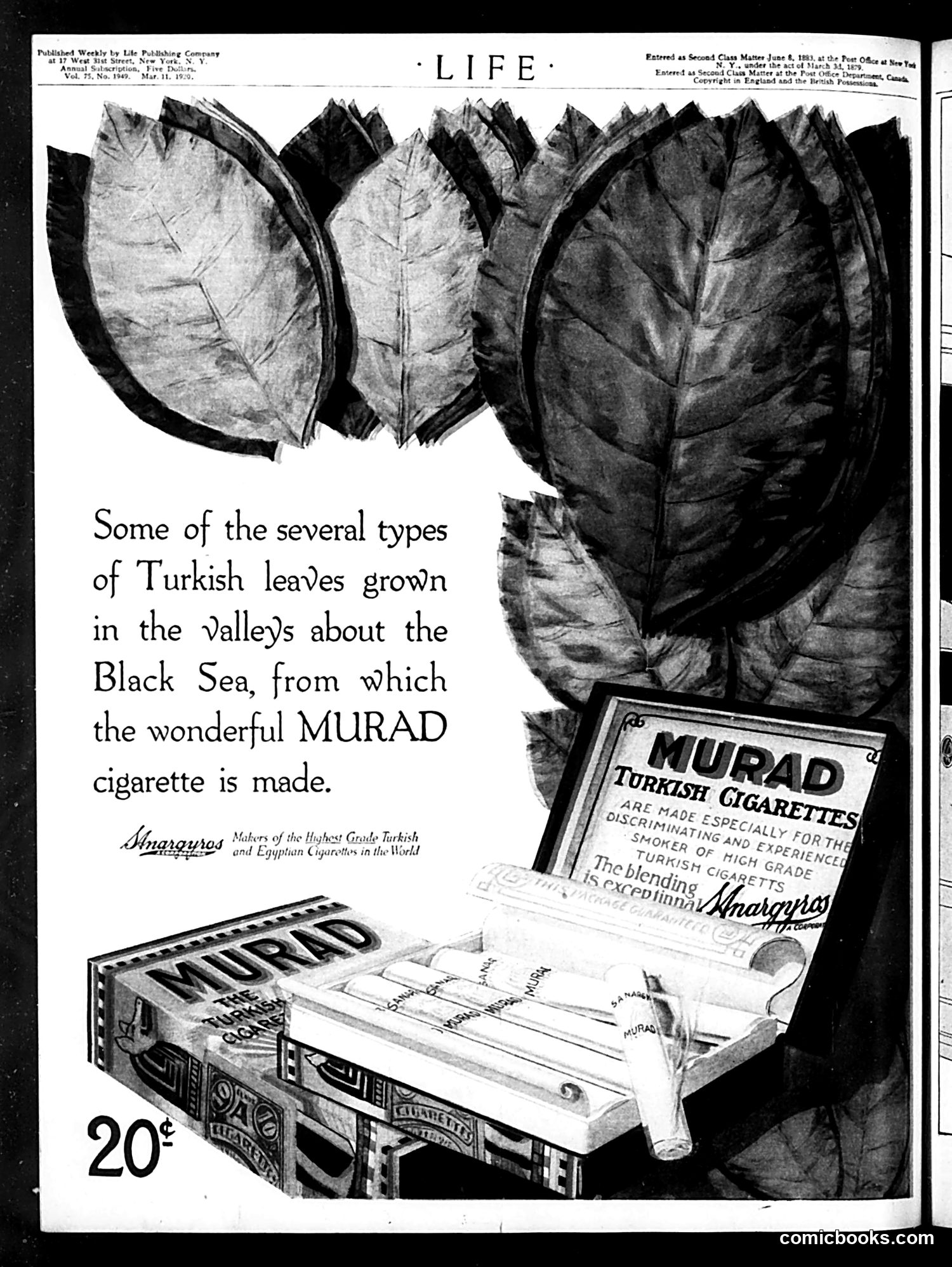
This is **not a political cartoon or satire** — it's a straightforward **cigarette advertisement** for Murad Turkish cigarettes, published in *Life* magazine. The ad features photographs of tobacco leaves from Turkey's Black Sea region, presented as evidence of quality. It emphasizes that Murad cigarettes are "made especially for the discriminating and experienced smoker of high grade Turkish cigarettes," positioning them as a premium product. The pricing of 20¢ per pack and the manufacturer credit to "Anargyros" (prominent Turkish tobacco producers) are factual commercial information. There is no satirical content, political commentary, or hidden meaning — this is period advertising highlighting the tobacco's geographic origin as a selling point.
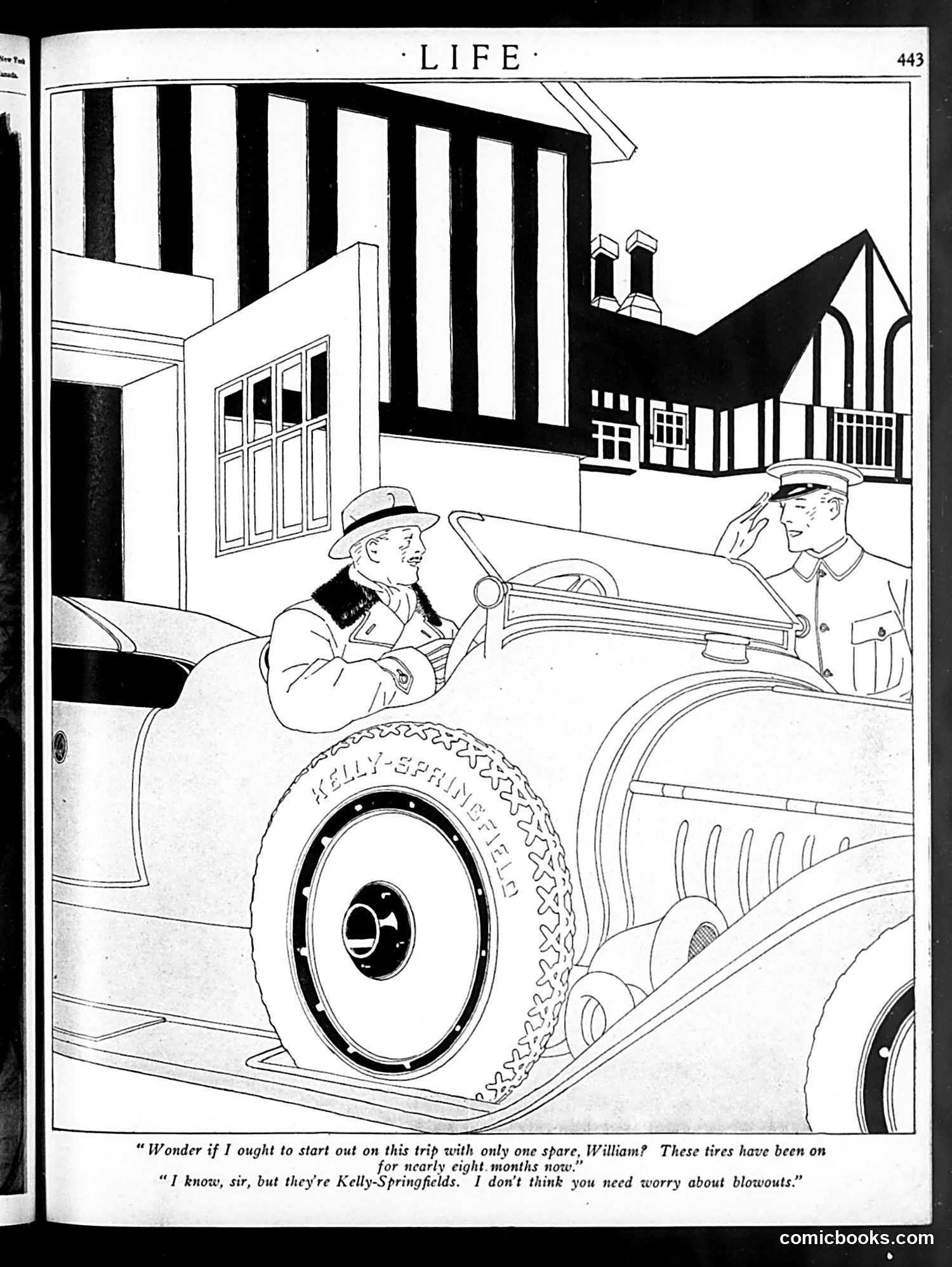
This is a single-panel cartoon from *Life* magazine depicting two men with a car. The driver (wearing a hat) expresses concern about starting a trip with only one spare tire, given that the tires have been on for nearly eight months. The uniformed passenger responds confidently that they're "Kelly-Springfields" and he doesn't think blowouts will be a problem. The joke advertises Kelly-Springfield brand tires by having the uniformed official (likely a police officer or traffic authority figure) vouch for their reliability and durability. The humor relies on the contrast between the driver's reasonable anxiety and the official's reassurance based on brand quality. This is essentially **branded advertising content** disguised as humorous commentary about tire performance and road safety—a common practice in early 20th-century *Life* magazine.
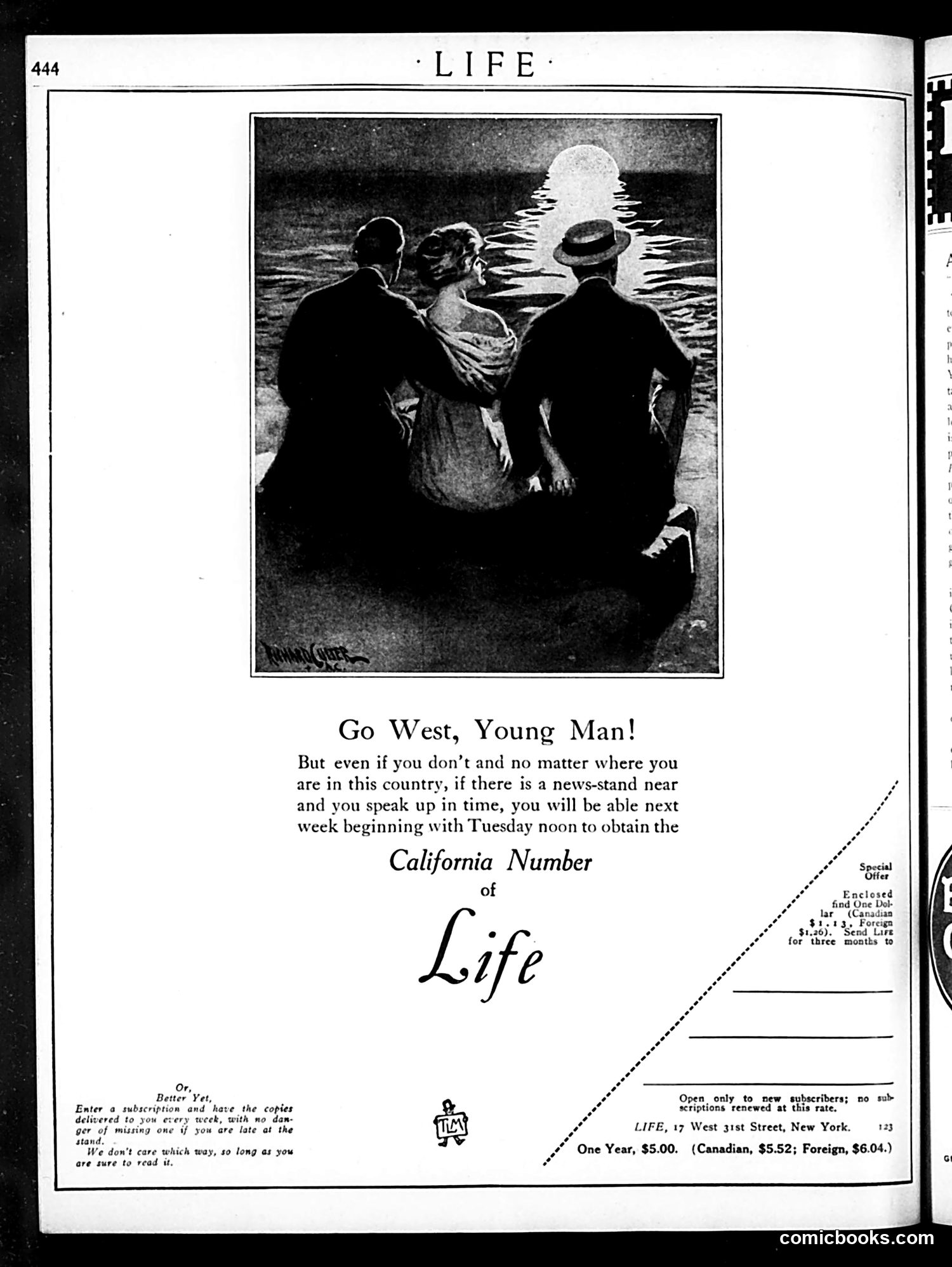
This is primarily a **subscription advertisement** for *Life* magazine, not a political cartoon. The image shows three men in dark suits accompanying a woman toward a moonlit seashore—a romantic or dramatic scene rendered in silhouette. The headline "Go West, Young Man!" references the famous 19th-century phrase encouraging westward expansion and opportunity-seeking. The ad's copy plays on this: even if readers don't go west themselves, they can access *Life*'s "California Number" via newsstand starting Tuesday noon. The accompanying text emphasizes *Life*'s accessibility and reliability as a weekly publication available nationwide. The romantic imagery likely appeals to aspirational readers, while the subscription offer (one year, $5.00) promotes the magazine's cultural relevance and entertainment value.
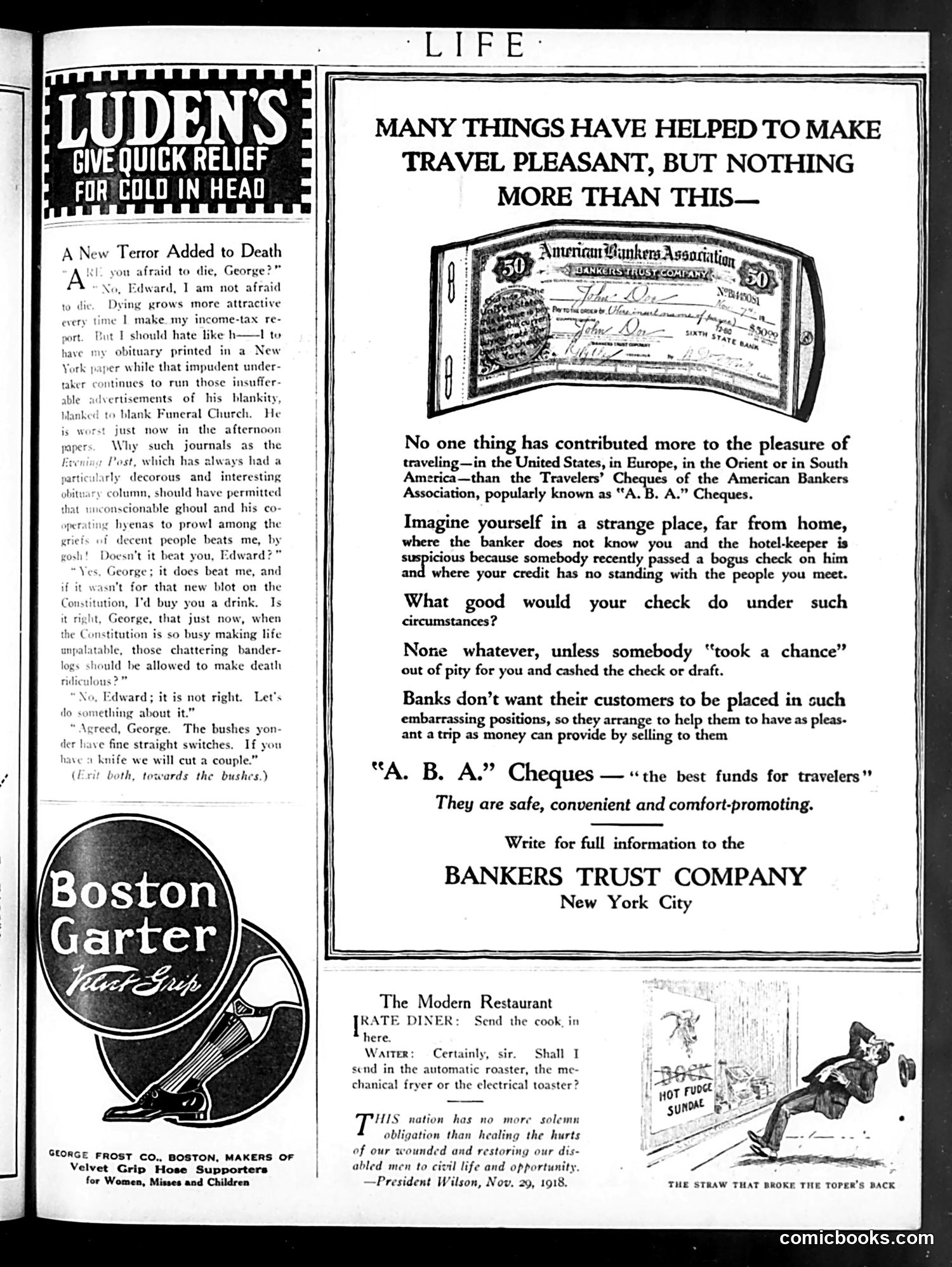
This page contains primarily **advertising rather than political satire**. The main content promotes "A.B.A." traveler's cheques from Bankers Trust Company, addressing a practical concern: how travelers could safely carry money when banks didn't know them and credit was unreliable. The ad uses a relatable scenario—a stranger in a distant place with a rejected check—to sell the solution. The left side includes a Ludens cough medicine ad and a Boston Garter hosiery ad. At bottom, "The Modern Restaurant" section appears to be humor about a waiter's response to a customer requesting the cook. The only potentially satirical element is the small cartoon titled "The Straw That Broke the Toper's Back" (bottom right), though its meaning is unclear from this image alone.
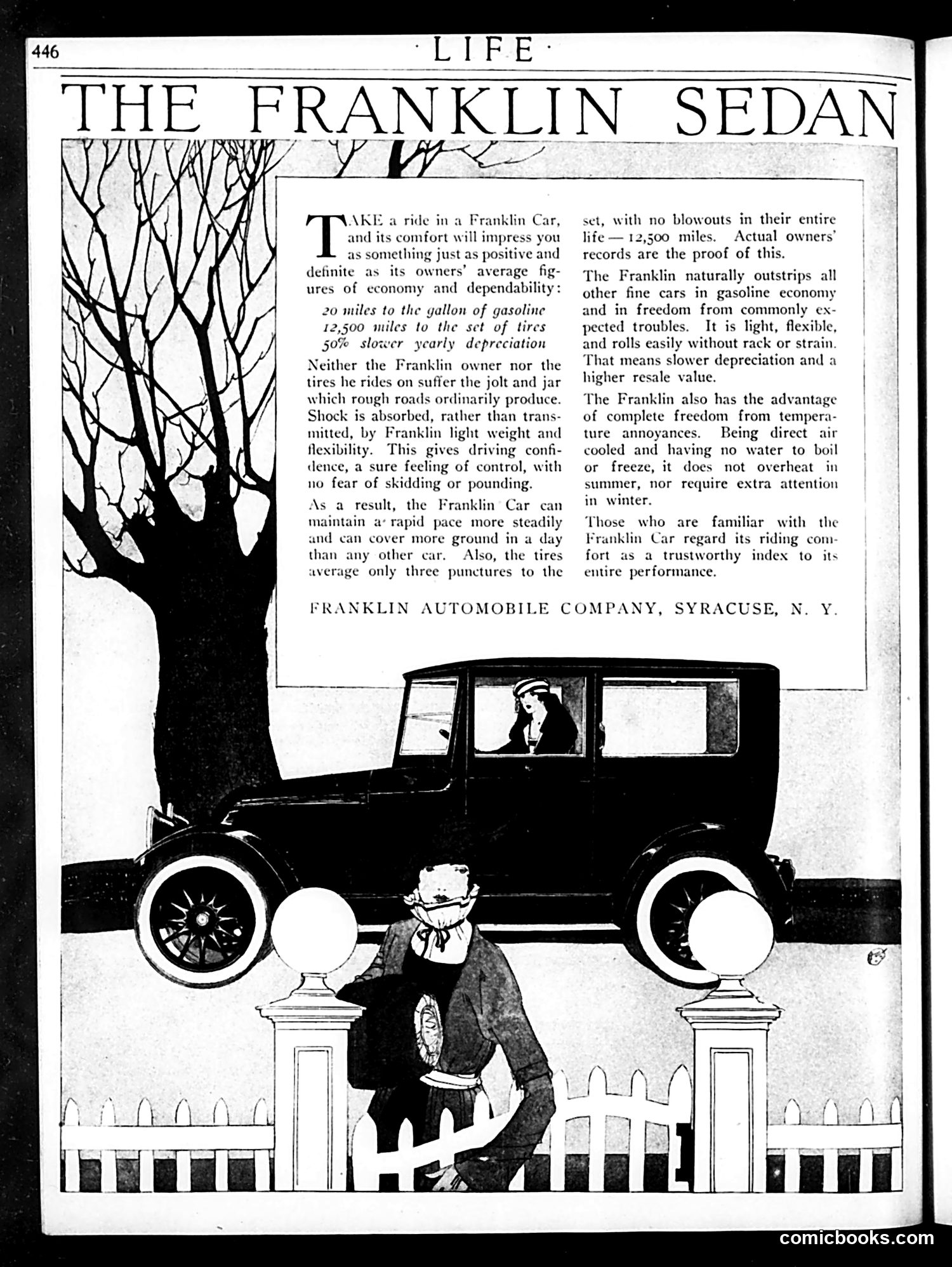
This is a **straightforward advertisement**, not satire or political commentary. The page promotes the Franklin Automobile Company's sedan model from Syracuse, New York. The ad emphasizes practical virtues: 20 miles per gallon fuel economy, 12,500-mile tire life, and 50% slower yearly depreciation than competitors. It highlights the Franklin's unique air-cooled engine (requiring no radiator), which allegedly provides superior comfort and reliability compared to water-cooled rivals. The illustrated scene shows a well-dressed woman admiring a Franklin sedan parked near her home—a common advertising strategy targeting affluent consumers. The copy positions the Franklin as combining luxury comfort with exceptional reliability and economy, framing car ownership as a prudent financial investment for the discerning buyer.
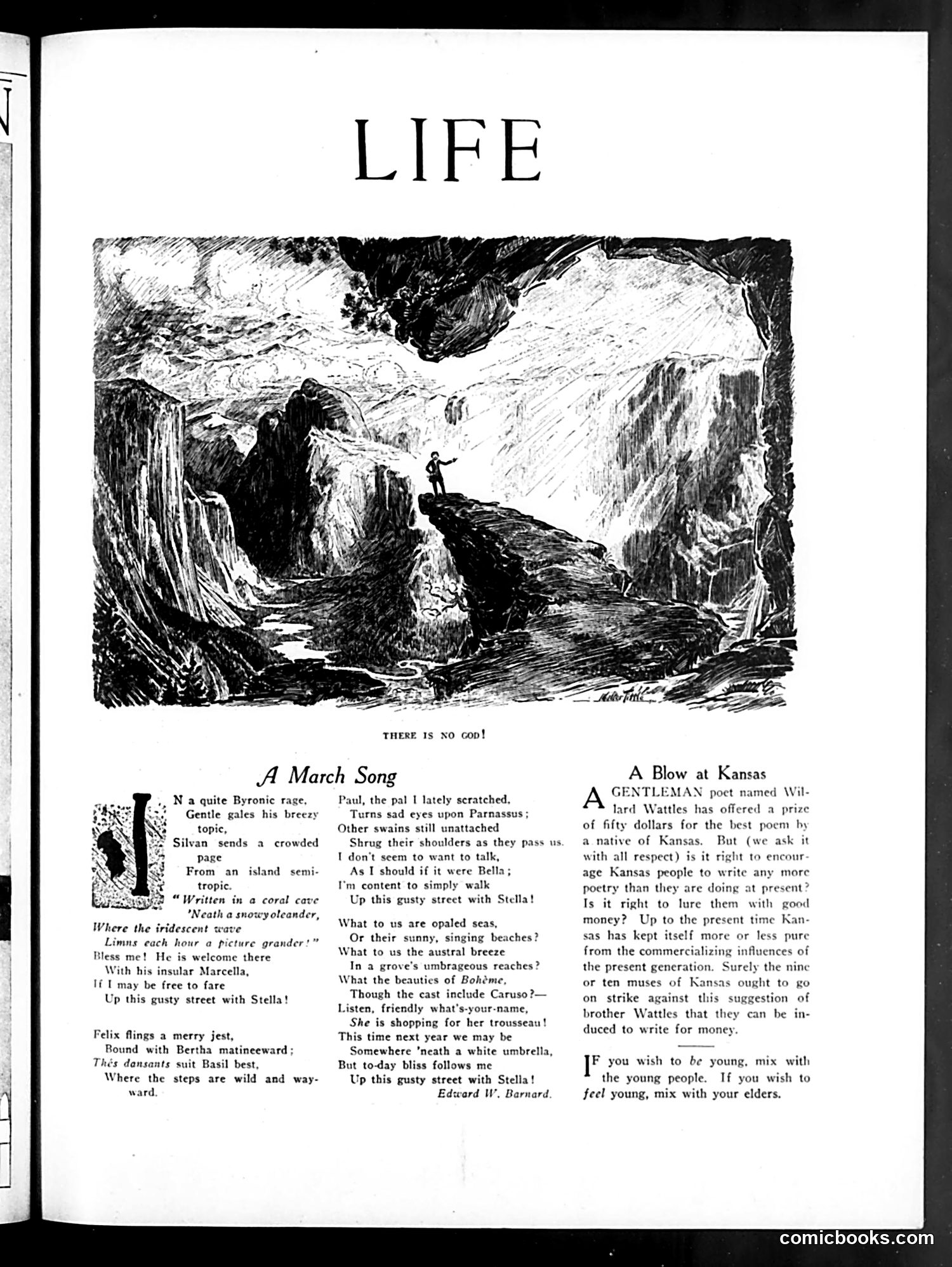
This page features two distinct literary pieces rather than political cartoons: **"A March Song"** is a poem by Edward W. Barnard celebrating spring and urban life, with references to characters named Silvan, Stella, and Felix in Byronic/romantic tones. **"A Blow at Kansas"** is a prose piece critiquing a literary prize competition. It mocks a Kansas gentleman poet named Willard Wattles who offered fifty dollars for the best poem about Kansas. The author sarcastically questions whether Kansas poetry has deteriorated enough to require financial incentives, and suggests Kansas writers should focus on genuine literary merit rather than monetary rewards. This represents urban East Coast literary snobbery toward Midwestern cultural aspirations—a common satirical theme in early 20th-century Life magazine. The etching above depicts a solitary figure in a dramatic landscape, illustrating the romantic themes below.
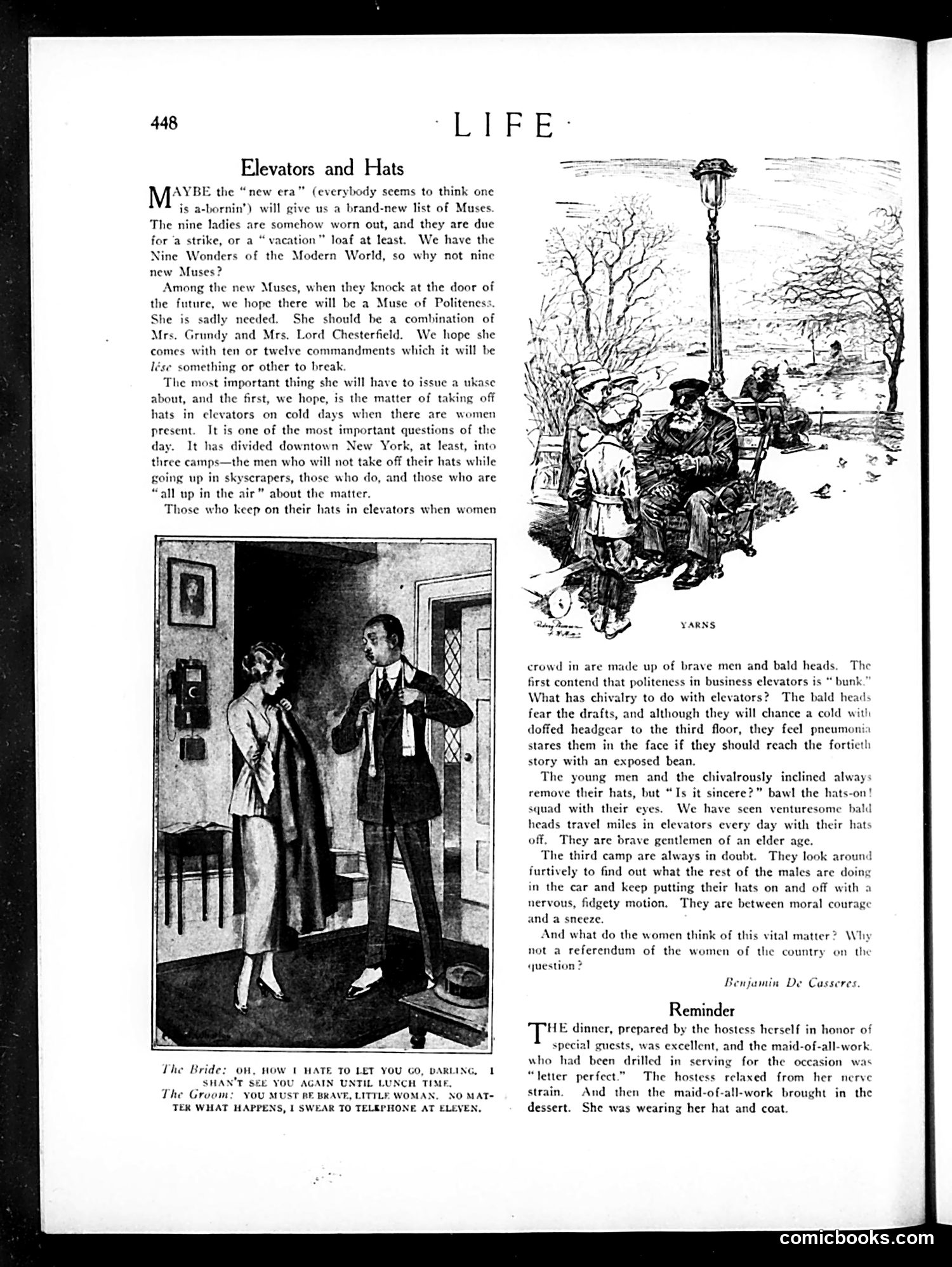
This satirical piece critiques the etiquette debate over whether men should remove their hats in crowded elevators when women are present. The article divides male riders into three camps: those who keep hats on (deemed impolite), those who remove them (seen as overly deferential), and those uncertain and fidgety about the choice. The accompanying illustration shows an elevator scene with a woman and man, humorously depicting the awkwardness. The text satirizes the obsessive concern with this minor social rule, suggesting it reflects broader anxieties about changing gender relations and masculine propriety in modern urban spaces. The author (Benjamin De Casseres) proposes a referendum on the issue, mocking the controversy as overwrought.
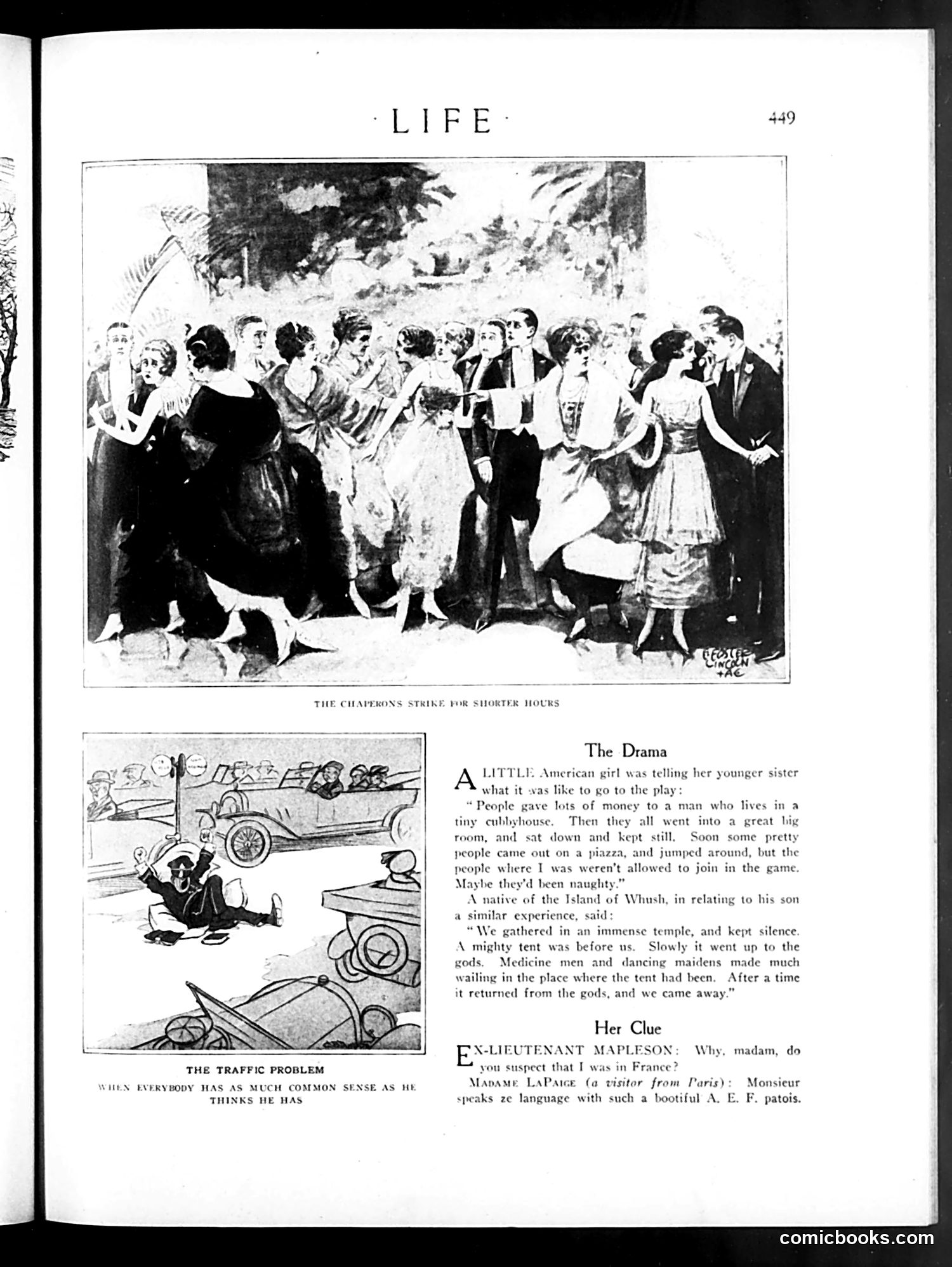
This page from Life magazine contains three distinct pieces: **"The Chaperon's Strike for Shorter Hours"** (top): A satirical illustration depicting well-dressed adults at what appears to be a social gathering or party. The caption suggests chaperones are demanding reduced working hours—poking fun at the exhausting social obligations of supervising young people at events. **"The Traffic Problem"** (bottom left): A cartoon showing automobiles and pedestrians in chaotic street conditions. The caption jokes that "everybody has as much common sense as he thinks he has"—satirizing poor driving and traffic safety awareness during the early automobile era. **"The Drama" and "Her Clue"** (right): Brief humorous anecdotes. One recounts a child's experience at theater; another presents a witty exchange about a Frenchman's accent, playing on contemporary ethnic humor stereotypes. The page reflects early 20th-century American social concerns and comedic conventions.
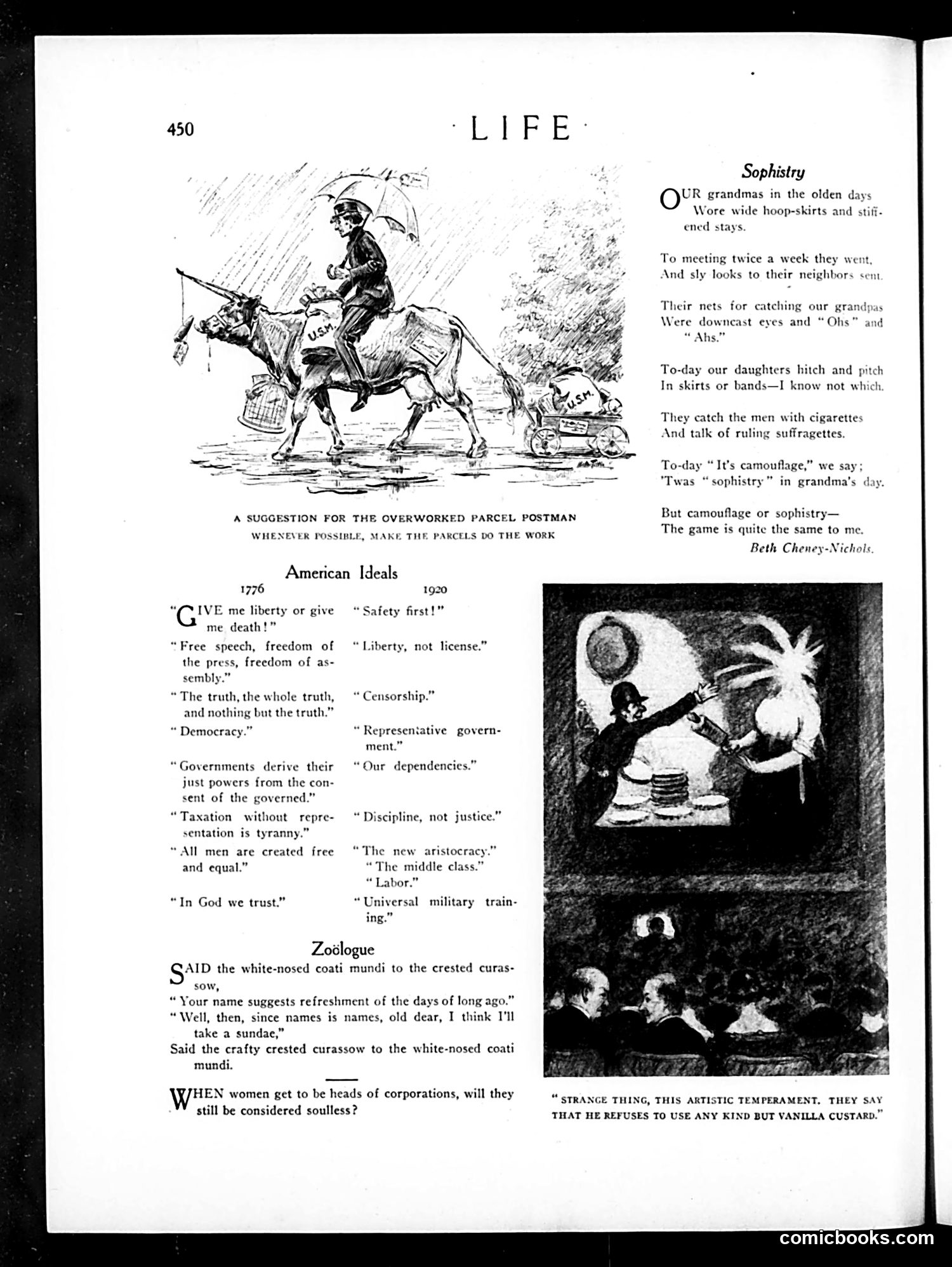
This Life magazine page contains three separate satirical pieces: **"Sophistry"** (top): A poem by Beth Chenery-Nichols contrasts how grandmothers' social scheming ("hoop-skirts and stiff-ended stays") resembles modern young women's tactics ("catch the men with cigarettes / And talk of ruling suffragettes"). The accompanying cartoon shows an overworked postman delivering parcels, satirizing mail volume. **"American Ideals"** (center): A two-column comparison contrasts 1776 founding principles ("Give me liberty or give me death") with 1920 realities ("Safety first," "Discipline, not justice"), mocking how contemporary society has abandoned revolutionary ideals. **"Zoologue"** (bottom): A brief dialogue where a curassow bird makes a pun about its own name, representing wordplay humor common to the era. The page satirizes 1920s social change, particularly women's evolving roles and behavior, alongside broader critiques of declining American values.
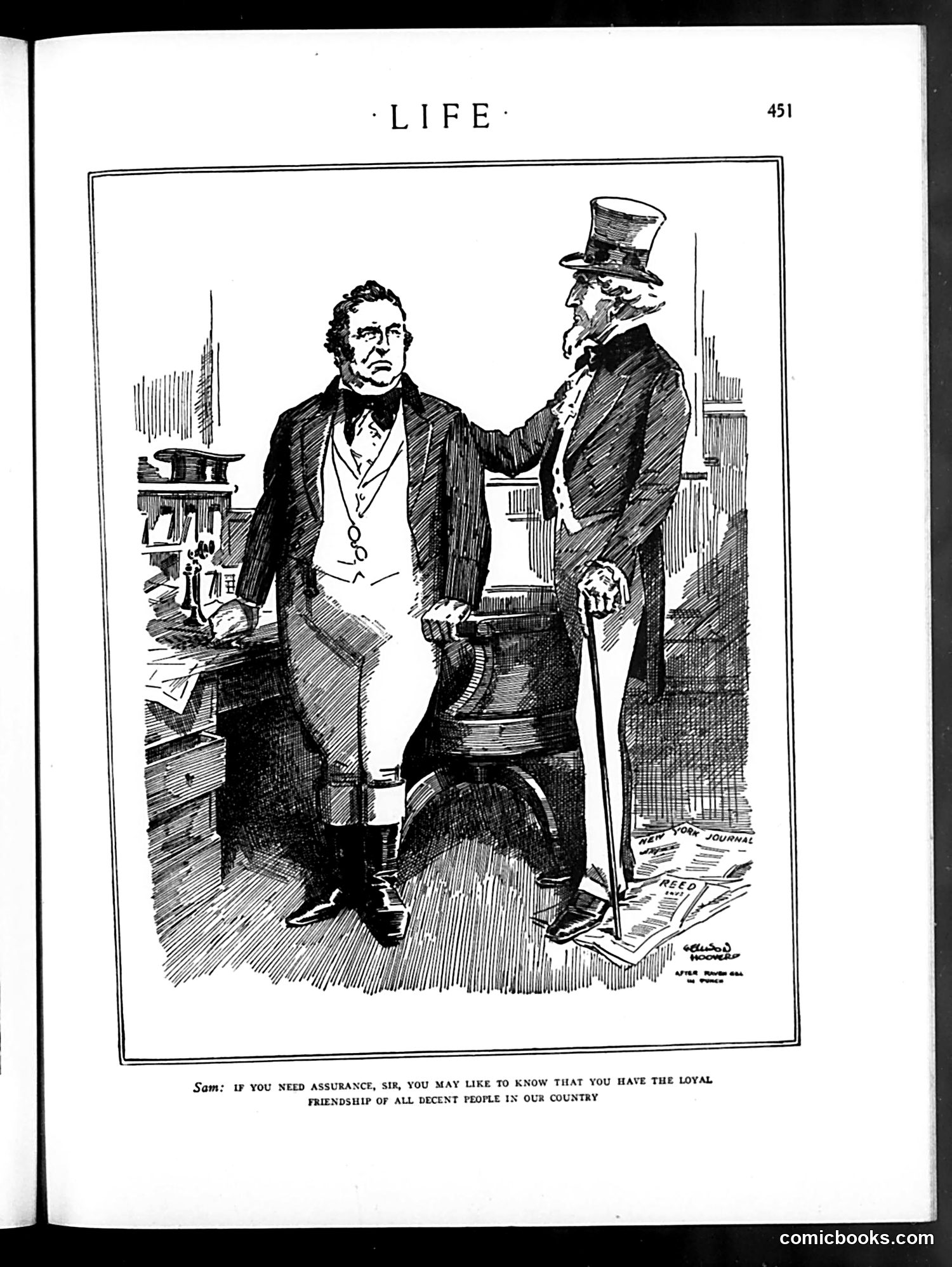
This Life magazine cartoon depicts two well-dressed gentlemen in what appears to be an office setting. The figure on the right, wearing a top hat, addresses the seated figure on the left with the caption: "If you need assurance, sir, you may like to know that you have the loyal friendship of all decent people in our country." The satire appears to target political reassurance or propaganda—specifically, someone seeking validation of their standing or legitimacy among "decent people." The formal setting and the gentleman's somewhat defensive posture suggest the figure being addressed may be a political or public figure whose reputation requires bolstering. The cartoon critiques either hollow political reassurance or the self-serving nature of such claims about public support. Without additional context, the specific political figure or situation being referenced remains unclear, though the piece likely addressed a contemporary controversy from Life's publication era.
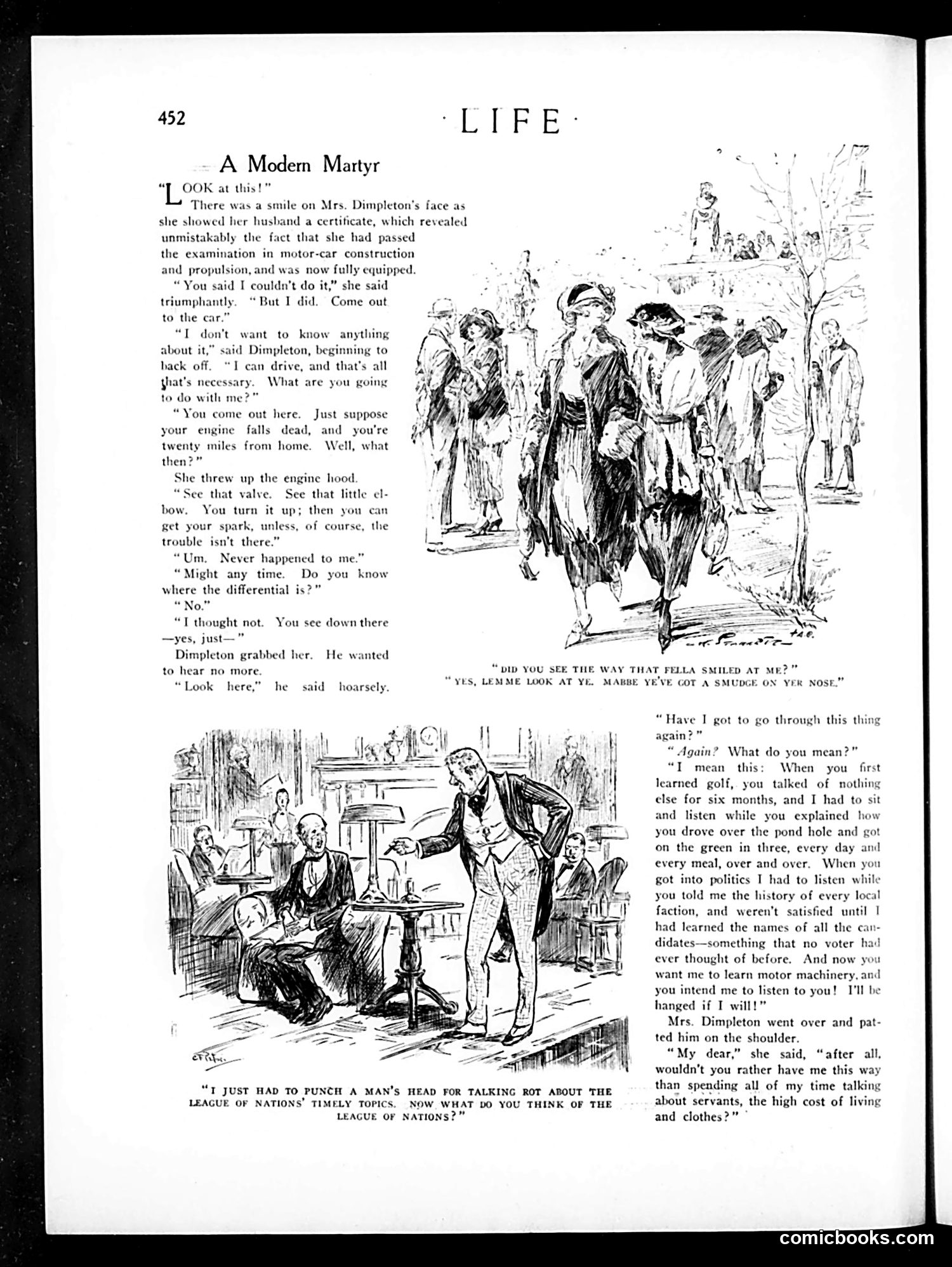
This page satirizes a husband's frustration with his wife's newfound independence and mechanical knowledge. Mr. Dimpleton, having learned to drive and passed a motor-car construction exam, now refuses to listen to her husband's complaints about car troubles. The satire targets the tension between traditional male authority and women's emerging competence and autonomy in the early automotive era. Mrs. Dimpleton weaponizes her expertise, shutting down her husband's attempted mansplaining about differentials and engine problems. The lower cartoon mocks his further complaint: she previously monopolized conversation about golf, politics, and servants' costs. The joke inverts the typical gender dynamic—now *he* must listen to *her* expertise, which he finds unbearable. It's satirical commentary on shifting power dynamics as women gained practical skills and independence.
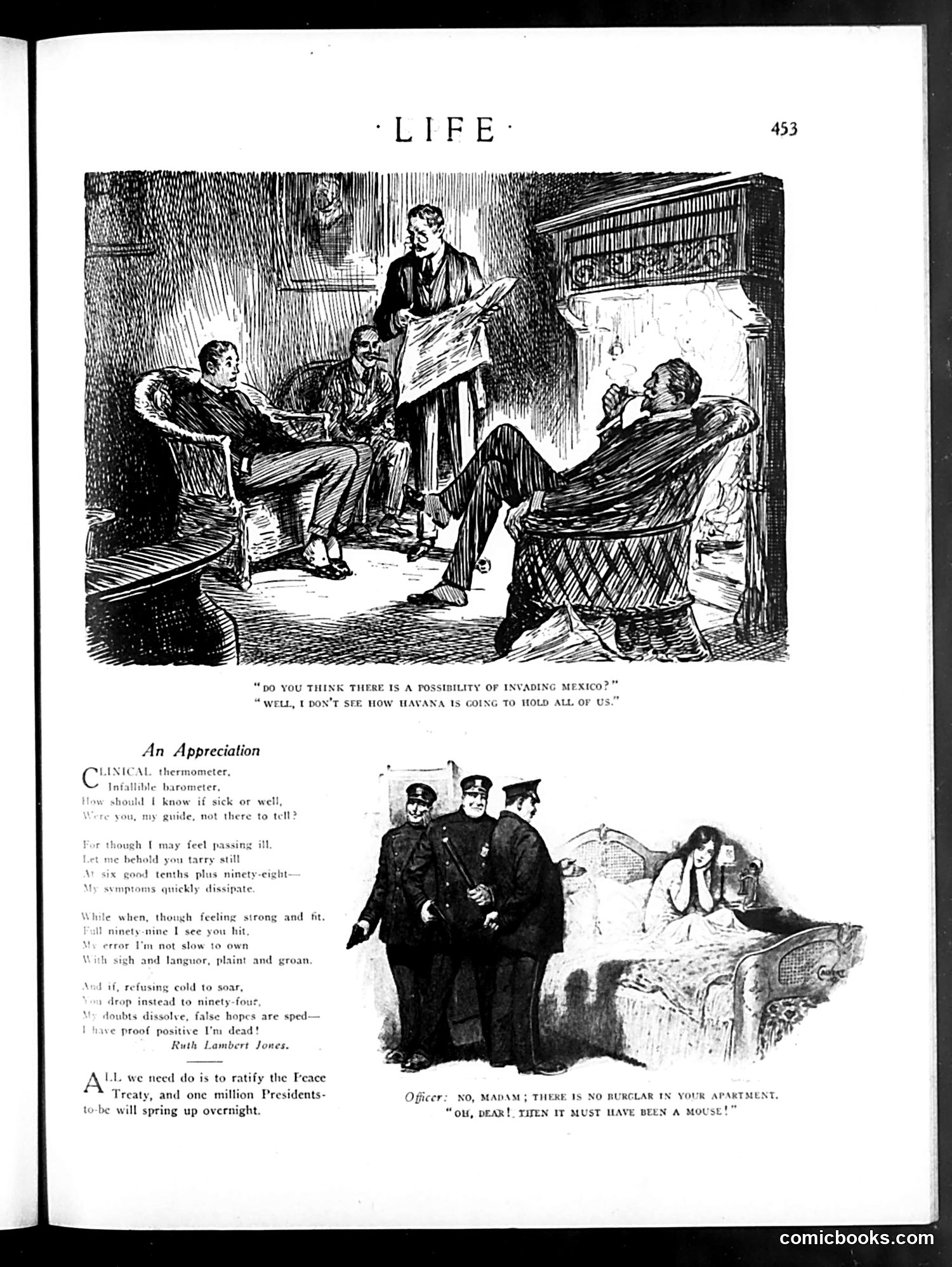
**Top Cartoon:** Two military/government officials discuss invading Mexico while a third reads a newspaper. One expresses concern about Mexico, while another dismissively notes they needn't worry about Havana "holding all of us"—suggesting the conversation involves broader imperial ambitions or military overreach in the Caribbean/Latin America region. This appears to satirize American interventionist foreign policy discussions, likely from the early 20th century. **Bottom Section:** "An Appreciation" is a humorous poem about a clinical thermometer and barometer by Ruth Lambert Jones, personifying medical instruments. Below it, a separate cartoon shows police officers at a patient's bedside; an officer assures a woman there's "no burglar," suggesting "it must have been a mouse!"—likely playing on fears versus mundane reality.
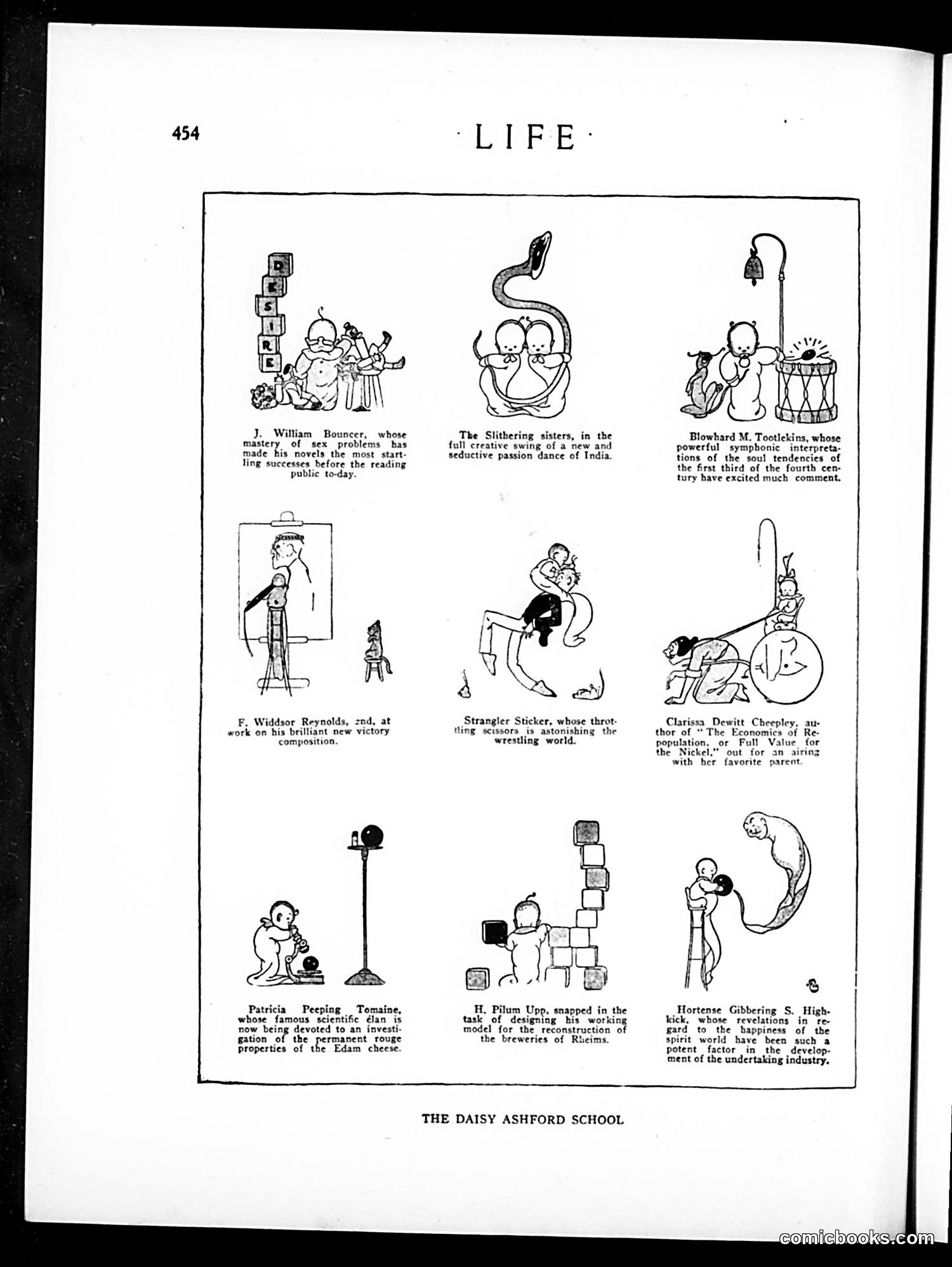
This page satirizes early 20th-century literary and cultural figures through cartoons supposedly inspired by child author Daisy Ashford's innocent perspective. The captions identify real public figures—including William Bouncer (sex advice writer), the "Slithering Sisters" (Indian dancers), Bloward M. Tootlekins (soul tendency commentator), F. Widdor Reynolds (composer), and others—depicting them in absurd, reductive situations. The humor relies on treating serious adult pursuits (wrestling, architecture, philosophy) as childishly simple, mimicking Ashford's famously naive but observant young-author style. Each figure becomes a type or pretension to mock: the pseudointellectual, the fashionable exotic dancer, the overly complex theorist—all diminished to nursery-level drawings and explanations, exposing their pretentiousness.
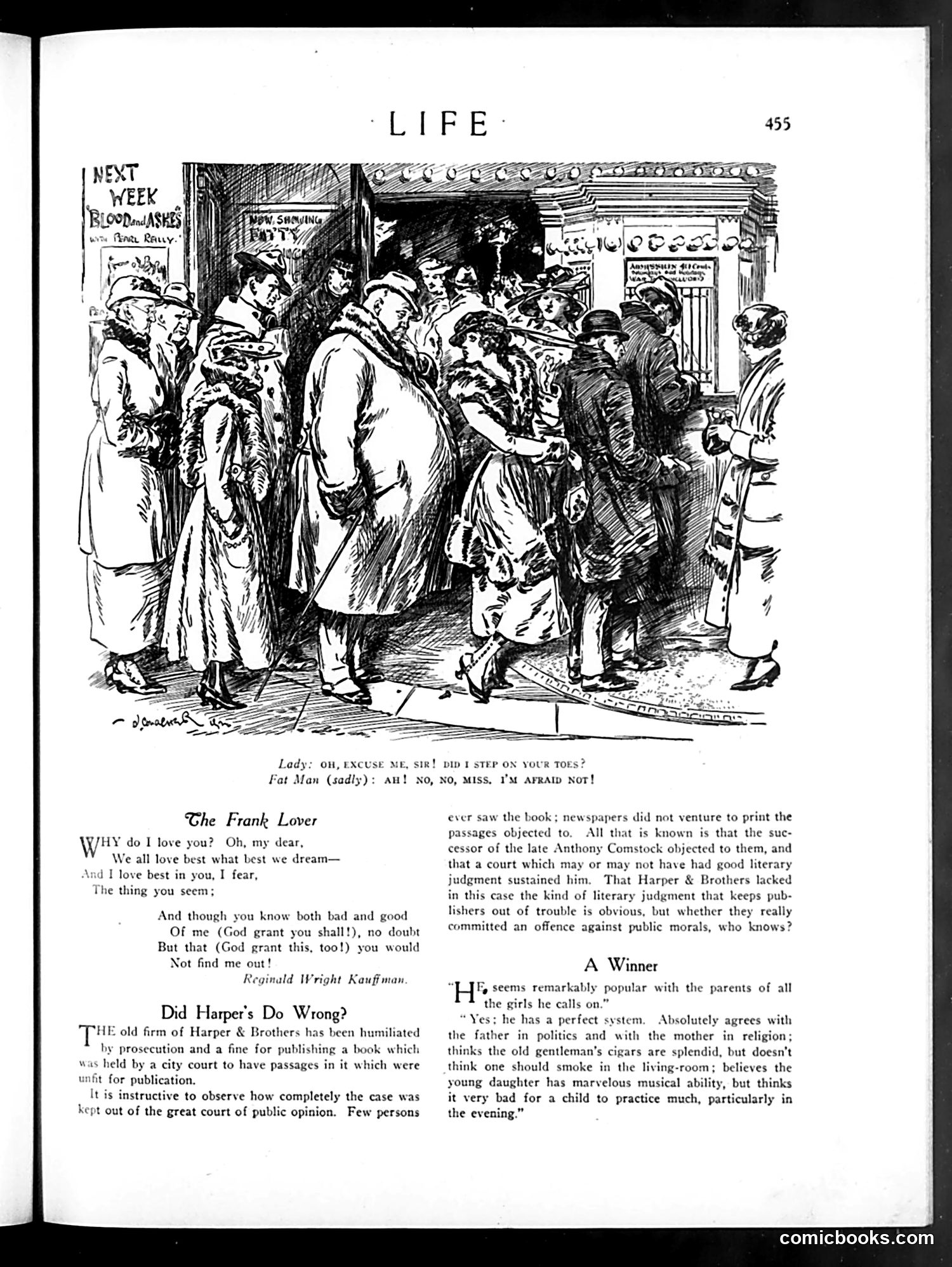
The top illustration depicts a crowded street scene with a woman accidentally stepping on a man's toes, prompting his worried response: "I'm afraid not!" This appears to be simple observational humor about urban social awkwardness. Below, the page contains literary content including "The Frank Lover" (a poem by Reginald Wright Kauffman) and two prose pieces: "Did Harper's Do Wrong?" discusses a court case involving Harper & Brothers publishing a book deemed unfit for publication due to objectionable passages—likely referencing obscenity litigation. "A Winner" humorously describes a man popular with parents for his agreeable personality and conventional views. The content reflects early 20th-century concerns about publishing standards, propriety, and respectability.
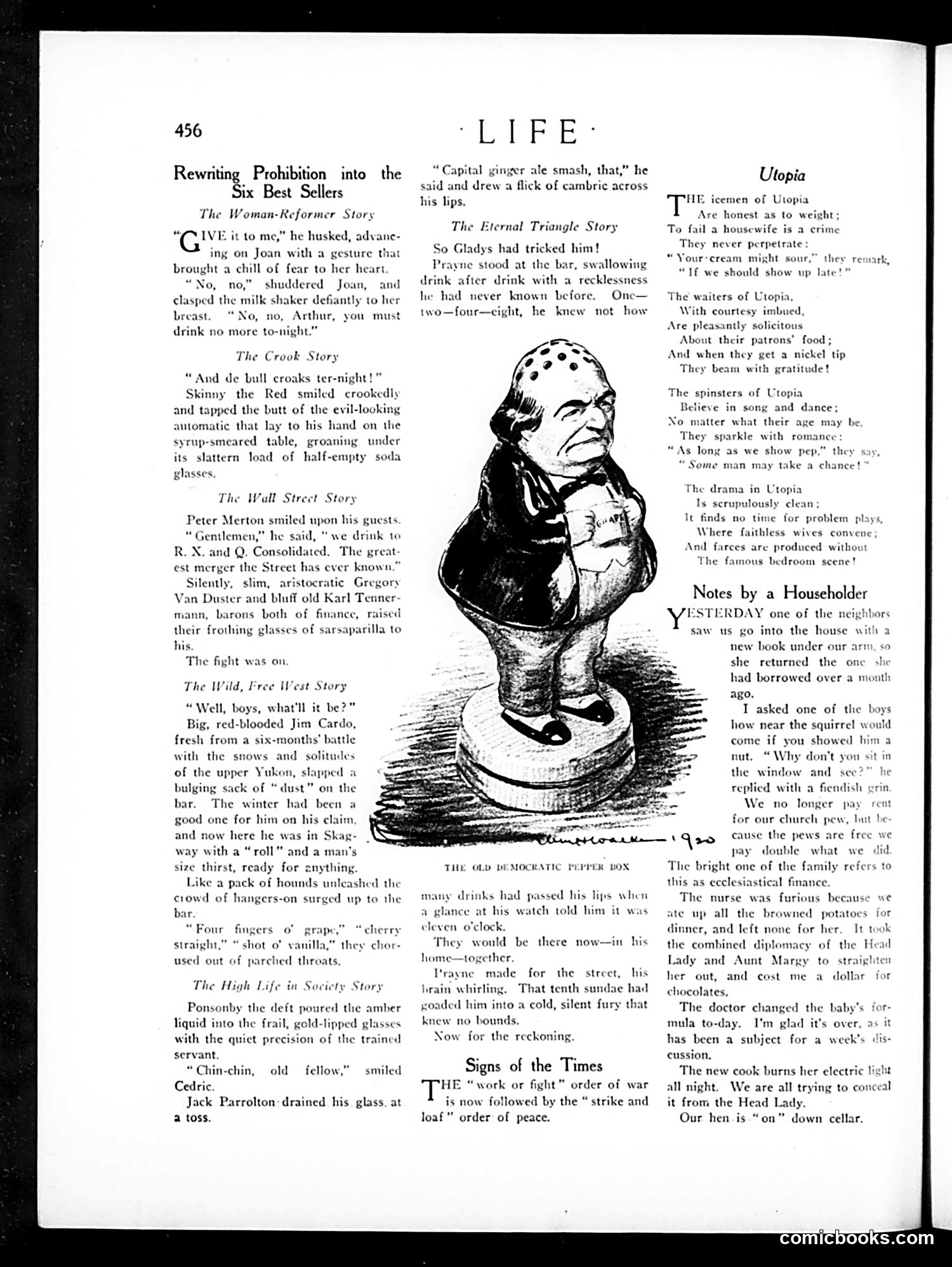
This cartoon depicts a rotund, elderly man in formal dress sitting atop a pedestal, labeled "THE OLD IN-MOCRATIC PUTTER BOY." The figure appears to be a caricature of a political or social establishment figure—likely referencing Democratic Party politics, given the "mocratic" wordplay. The satire seems to mock an aging, self-satisfied member of the political establishment or wealthy elite class, portrayed as ornamental and out-of-touch. The pedestal treatment suggests he's been elevated to ridiculous importance by his party or social circle. Without more specific context about Life magazine's publication date and contemporary figures, I cannot identify the exact person intended, but the cartoon clearly mocks entrenched political power and institutional complacency.
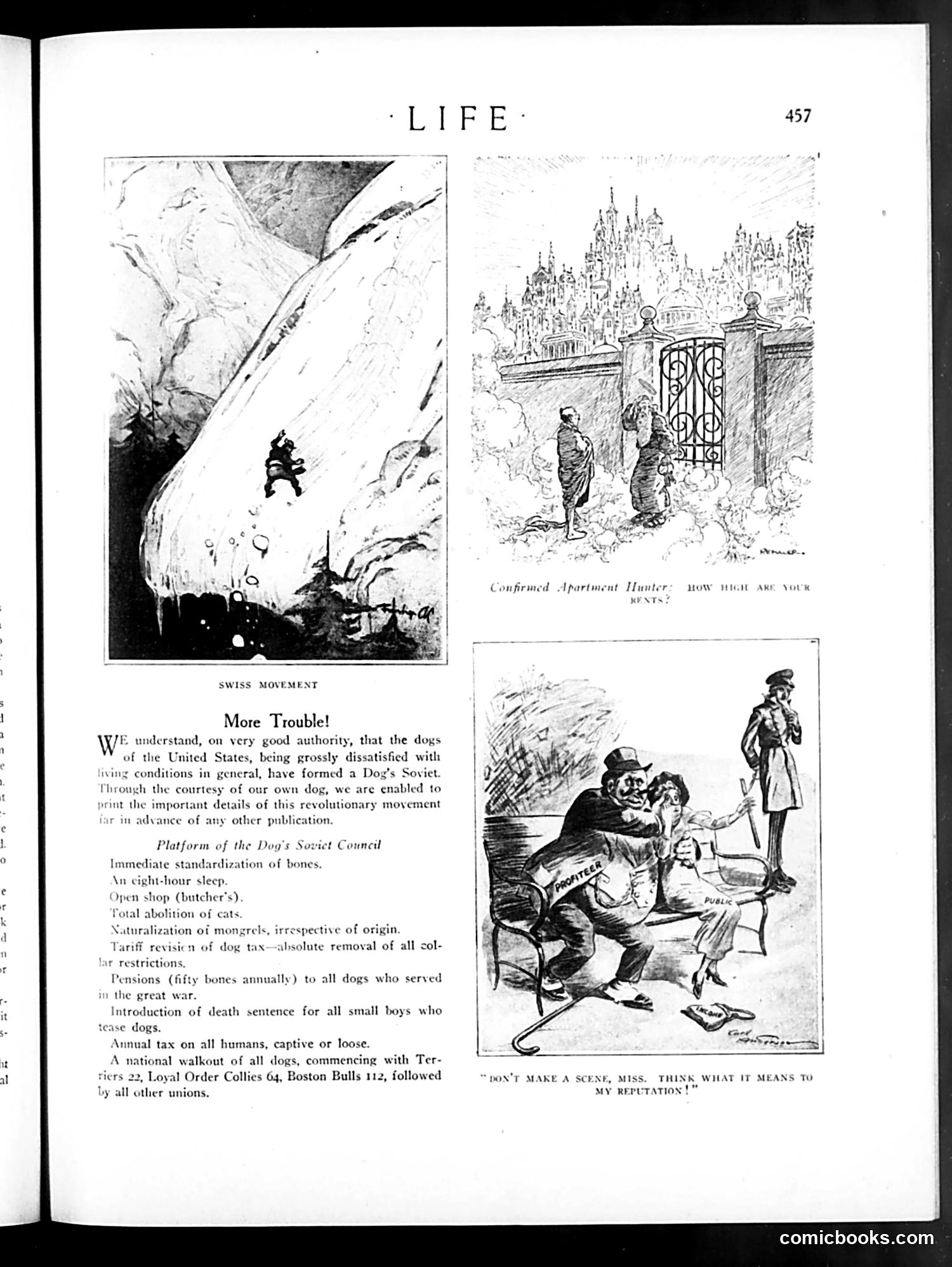
This page satirizes the Russian Bolshevik Revolution (circa 1917-1920s) by imagining American dogs forming their own communist "Dog's Soviet." The joke mocks both communist ideology and contemporary labor unrest. The "Platform of the Dog's Soviet Council" parodies communist demands—standardized resources, shorter work hours, abolition of class distinctions (cats as enemies), removal of restrictions (collars as oppression), pensions for war service, and organized labor walkouts by dog "unions" (Terriers, Collies, Boston Bulls). The satire works on multiple levels: it trivializes revolutionary rhetoric by applying it to dogs' mundane complaints (bones, sleep, teasing boys), while implicitly mocking American labor movements that were adopting similar tactics. The accompanying cartoons show everyday frustrations: apartment hunting and social embarrassment—unrelated humor typical of *Life*'s miscellaneous satirical format. The satire reflects post-WWI American anxiety about communist ideology spreading to the U.S.
This March 1920 *Life* editorial satirizes President Wilson's approach to post-WWI peace negotiations. The main text criticizes Wilson's reluctance to engage in traditional European power-balancing (refusing to make the Adriatic an "Italian lake"), arguing that isolationism won't work—"the sin of omission" will catch up with America eventually. The piece then mocks Wilson's surprise appointment of Bainbridge Colby as Secretary of State. The author notes Colby's unexpected selection, describing him as physically aggressive and bold—a "d'Artagnan" type—presumably what Wilson wants for tough negotiations. The final criticism concerns Hearst's approval of Colby. The cartoonist notes Colby once chaired a Hearst-backed meeting opposing Panama Canal toll repeal, making Hearst's endorsement suspicious and potentially damaging to Colby's credibility with Wilson's progressive supporters.
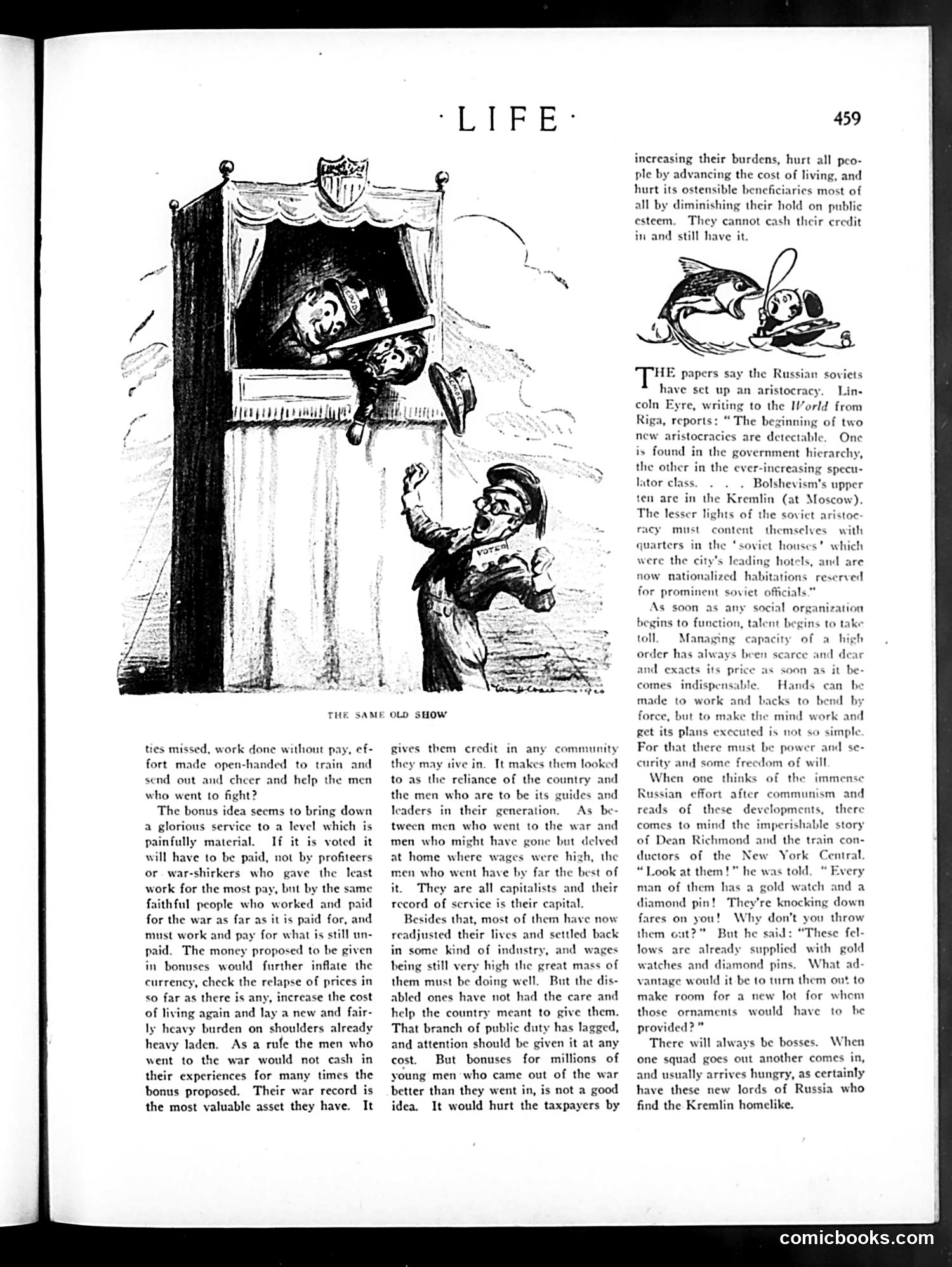
This page contains two separate pieces of political commentary: **Left cartoon ("The Same Old Show"):** A satirical drawing showing a theatrical booth where figures inside appear to be performing the same act repeatedly while an audience member below watches. This likely critiques cyclical political corruption or governmental performance—the suggestion that despite changes in administration or circumstances, the same corrupt practices continue unchanged. **Right text:** Discusses Russian Soviet aristocracy, reporting that despite communist ideology, a new hierarchy has emerged. Soviet leaders occupy the Kremlin while lesser officials inhabit nationalized hotels. The accompanying anecdote about Dean Richmond and train conductors suggests an ironic point: replacing one privileged class with another accomplishes nothing—talent and management always command rewards, making ideology irrelevant. **Underlying theme:** Both pieces express skepticism that revolutionary or reform rhetoric produces genuine change; structural human nature (desire for hierarchy, privilege) persists regardless of political systems or promises.
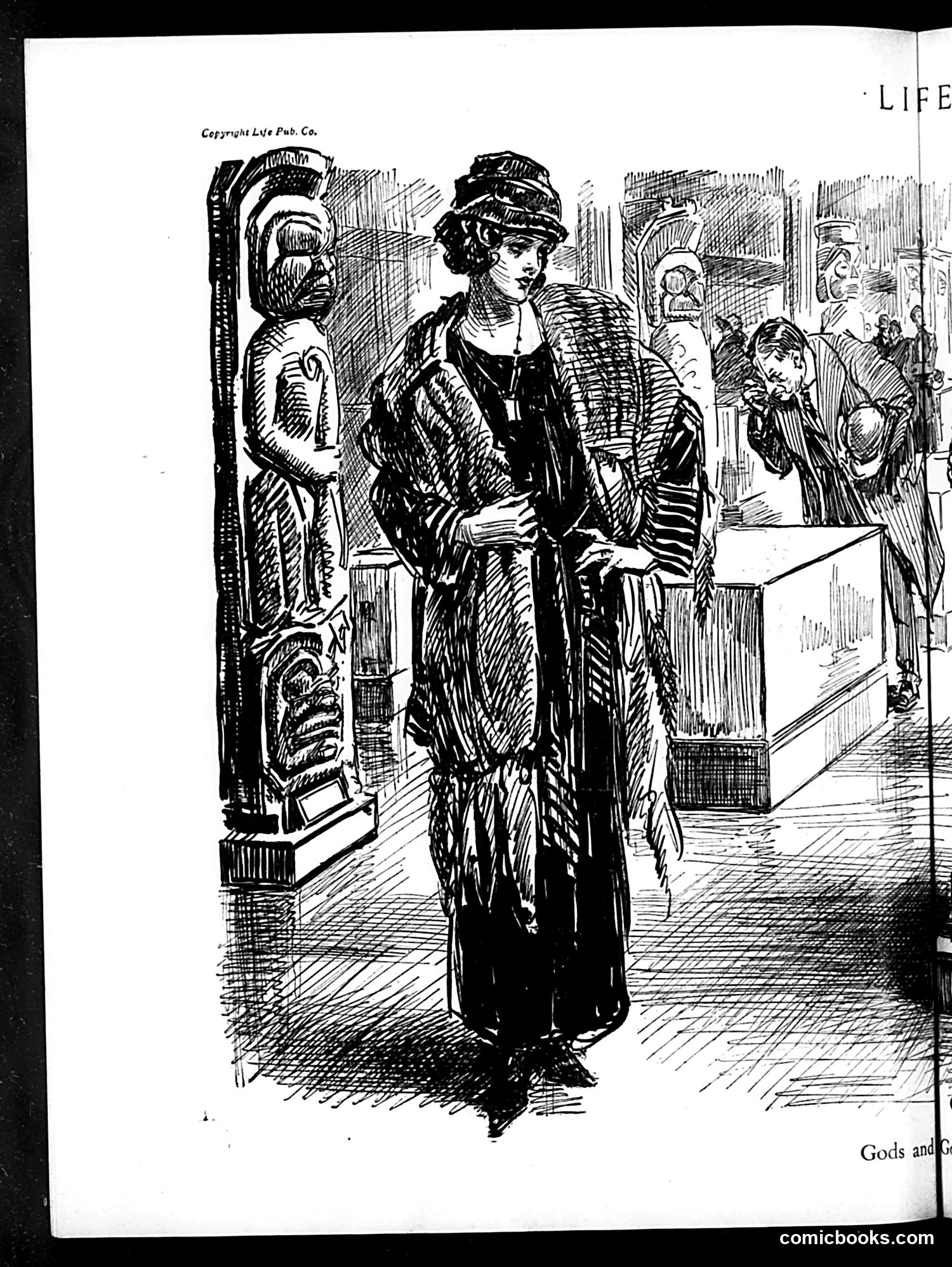
This appears to be a page from *Life* magazine showing a single satirical illustration rather than multiple cartoons. The image depicts an elegantly dressed woman in fashionable early 20th-century attire (fur stole, decorated hat, long dress) standing in what appears to be an upscale interior hallway or building entrance. Other figures are visible in the background. The OCR text is largely corrupted and illegible, making it impossible to determine the specific caption or intended message. Without readable text, the satire's exact target remains unclear—whether it comments on wealth, fashion, social pretension, or another contemporary social issue typical of *Life*'s satirical content from this era. The illustration's quality and style suggest commentary on urban upper-class society, but the specific point requires the original caption.
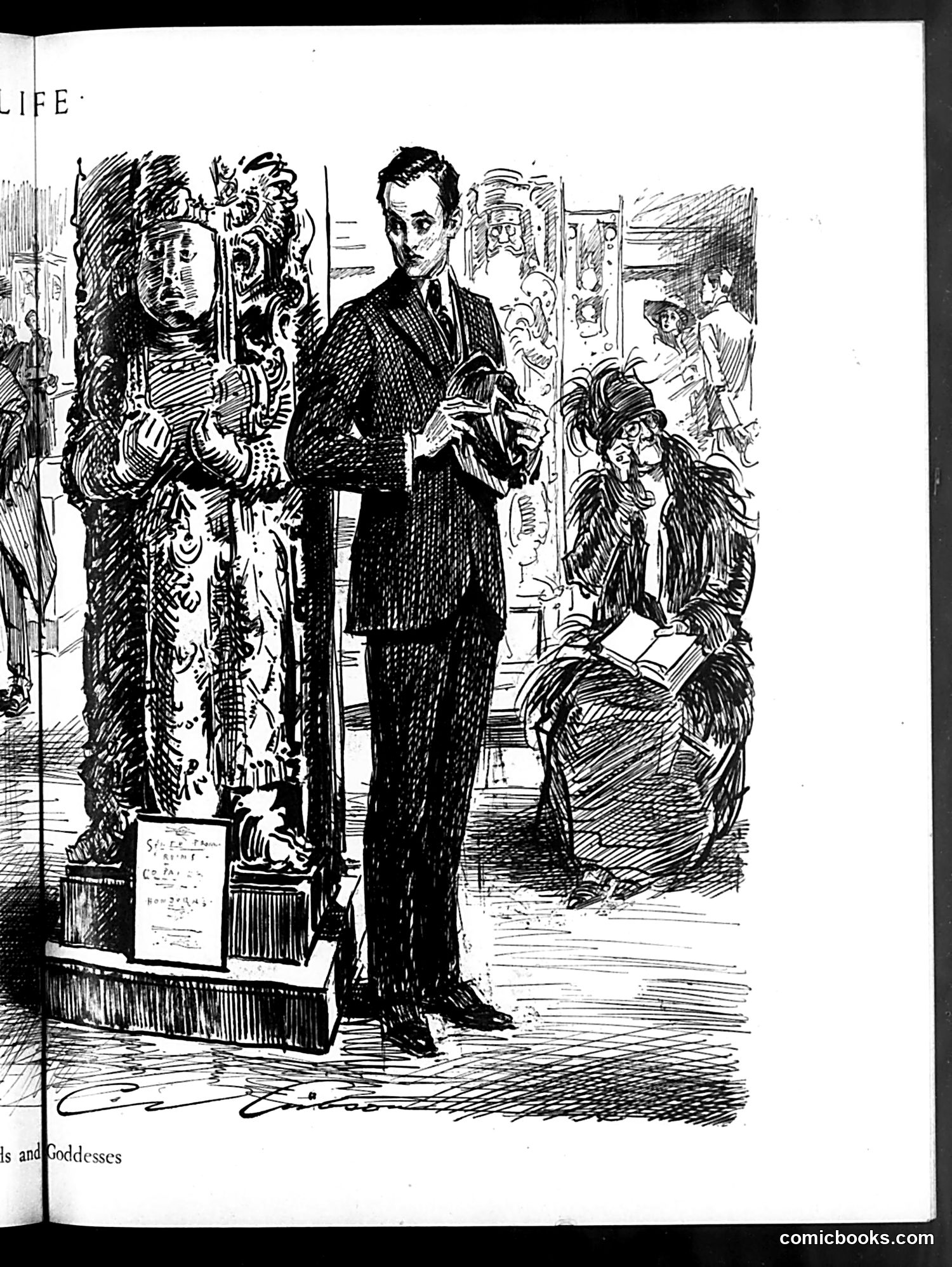
This is a satirical sketch from *Life* magazine showing a well-dressed man in a suit standing before ornate statues or figurines labeled as "Gods and Goddesses" (visible at bottom left). The man appears to be presenting or promoting these objects to an audience of working-class figures on the right side of the image. The satire likely mocks the pretentious marketing or commercialization of classical culture—selling "high art" or luxury goods to ordinary people. The contrast between the refined, formally-dressed presenter and the rough, common-looking audience suggests commentary on class divisions or the absurdity of imposing elite tastes on the masses. The specific identities of figures and exact historical context remain unclear without additional caption or date information visible in this excerpt.
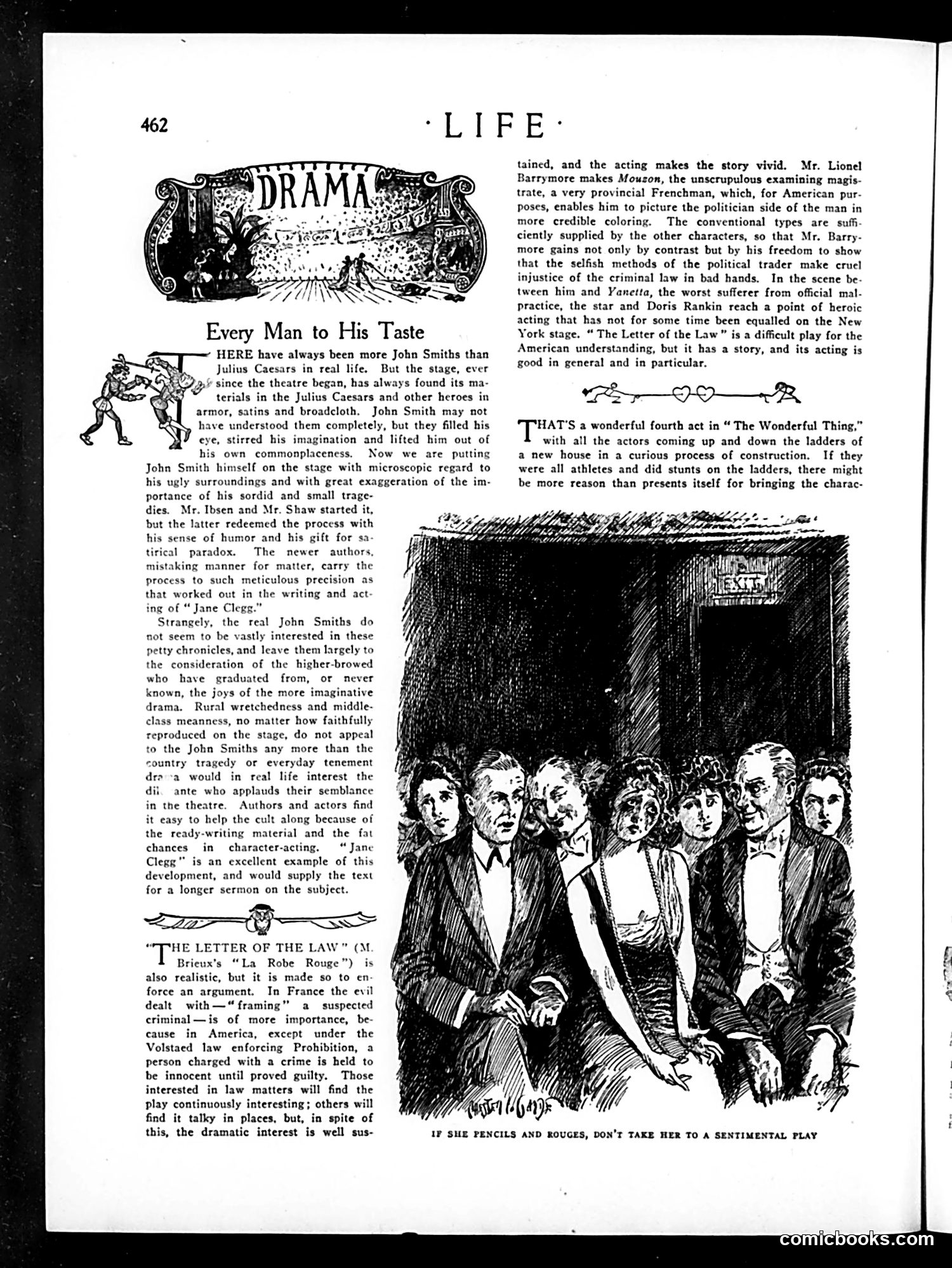
This page reviews contemporary theatrical productions, critiquing a shift in dramatic subject matter. The article "Every Man to His Taste" argues that modern playwrights (influenced by Ibsen and Shaw) now focus on ordinary people's mundane struggles rather than heroic figures. The writer suggests this realistic approach—exemplified by "Jane Clegg"—appeals only to intellectuals, not to average audiences ("John Smiths") who prefer escapism. The review of "The Letter of the Law" (Brieux's "La Robe Rouge") discusses a French legal drama about judicial corruption. Lionel Barrymore's performance as an unscrupulous magistrate is praised for its provincial characterization, allowing American audiences to understand the political abuse of power. The caption's joke about not taking women who wear makeup to sentimental plays is a period aside, suggesting cosmetics signify superficiality incompatible with emotional drama.
This page contains theater reviews from Life magazine, a satirical publication. The visible content focuses on Broadway play critiques rather than political cartoons. The reviews discuss productions including Arnold Bennett's "Sacred and Profane Love" (starring Elsie Ferguson) and "Tick-Tack-Toe," a girl-and-music show. The critic praises the versatility of Herman Timberg, who simultaneously served as owner, producer, composer, librettist, and principal comedian. A notable satirical reference appears regarding "Tick-Tack-Toe"—the reviewer suggests this entertainment could be "sent over bodily" to the newly established "Jewish Republic in Palestine" with assurance it's "completely Kosher from the first curtain to the last chorus-girl." This reflects contemporary 1910s-1920s cultural attitudes toward Jewish identity and the emerging Zionist movement. The page primarily serves as entertainment journalism rather than political satire, reviewing theatrical productions of the era.
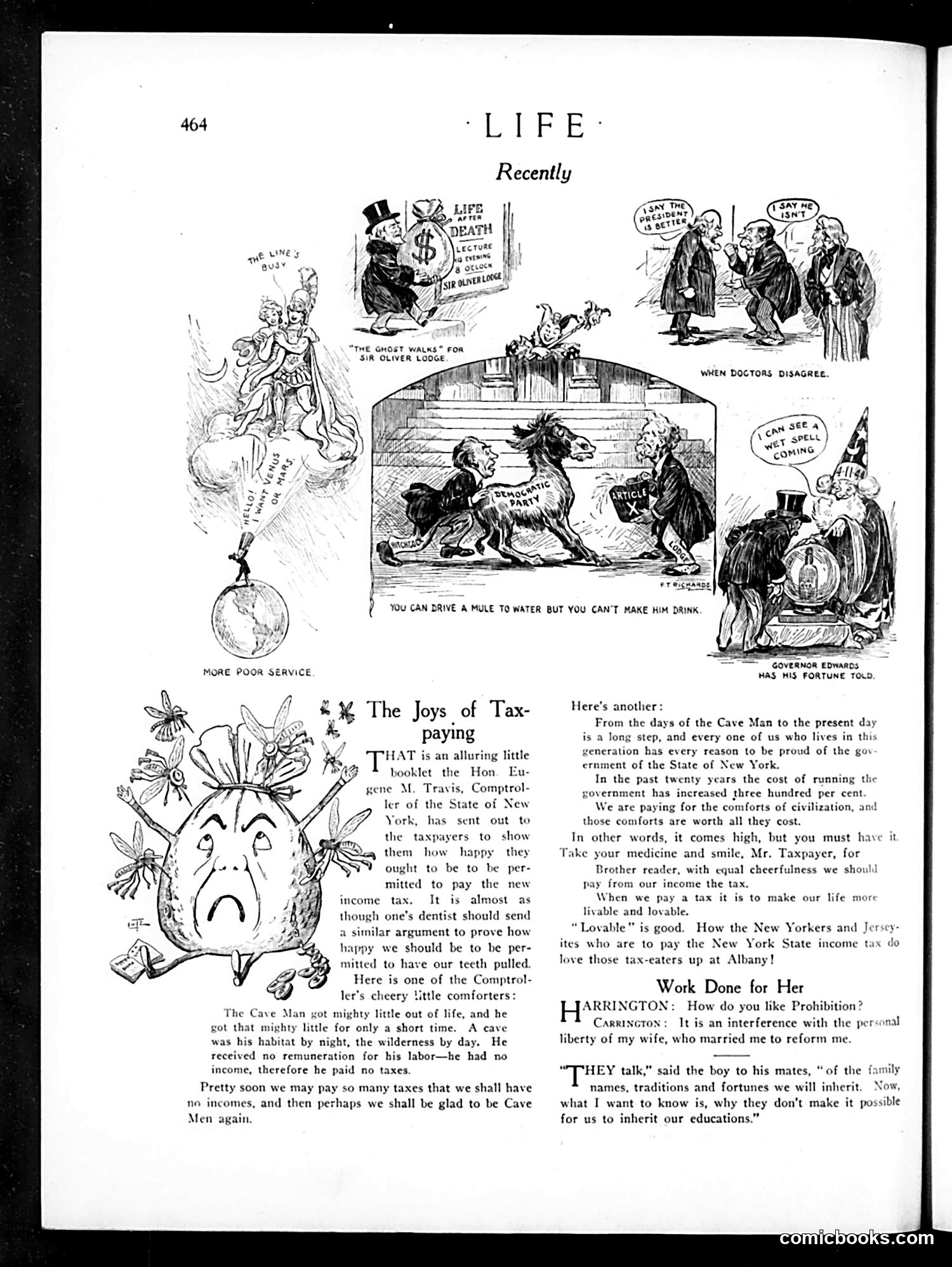
This page satirizes New York State's new income tax and government excess. Comptroller Eugene M. Travis circulated a cheerful booklet justifying the tax; Life mocks this as absurd—comparing government persuasion to a dentist praising tooth extraction. The central cartoon shows a taxpayer as a mule being driven to water (labeled "Democratic Party" and "Arithmetic"), unable to drink—meaning citizens cannot resist taxation despite arguments. Other cartoons ridicule: - **"The Joys of Tax-paying"**: A bitter analogy that before taxes existed (the "Cave Man" era), people had no income and thus paid nothing. Now taxes will eventually consume all income. - **Governor Edwards' fortune-telling**: Sarcastically suggests New York's tripled government costs (300% increase) are worth celebrating. - **"Lovable" taxes**: Mocking bureaucratic language claiming taxes make life "lovable." The bottom section criticizes prohibition as government overreach and questions why inheriting education isn't prioritized as much as inheriting wealth—broader critiques of state intervention and priorities.
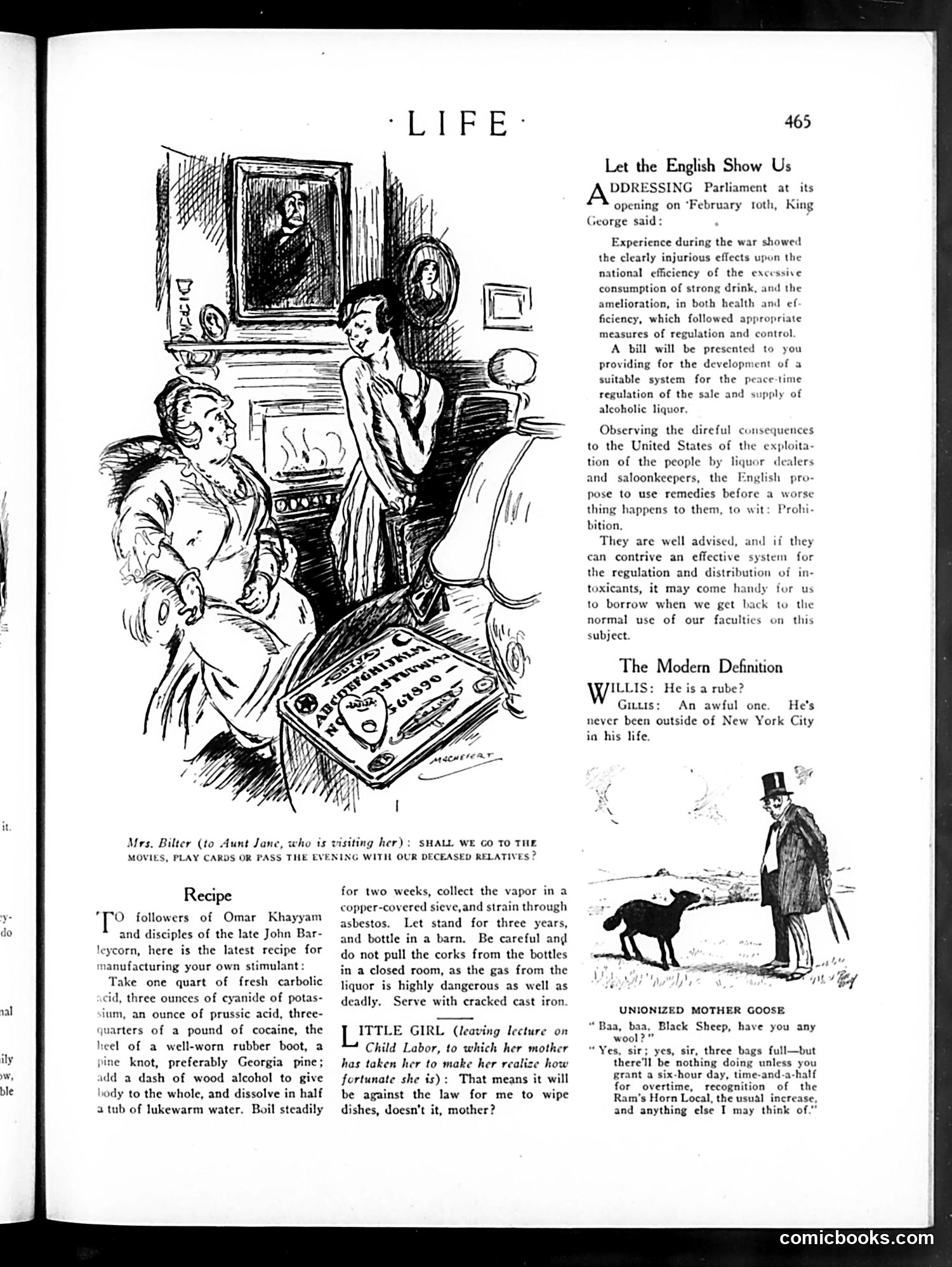
This page contains multiple satirical pieces mocking Prohibition and labor movements: **Main Cartoon**: Mrs. Bilter jokingly asks her visiting aunt whether they should go to movies, play cards, or "pass the evening with our deceased relatives"—a dark joke about séances, suggesting the boredom of Prohibition-era entertainment options. **"Recipe" Section**: A darkly humorous fake recipe for homemade alcohol using poisonous substances (carbolic acid, cyanide, cocaine). It mocks people desperate enough to manufacture dangerous bootleg liquor during Prohibition. **"Little Girl" Joke**: Satirizes child labor reform by showing a girl misunderstanding a lecture—she thinks new laws will prevent her from doing household chores, missing the point about exploitative factory work. **"Modern Definition"**: Defines a "rube" as someone who's never left New York City—mockery of rural/unsophisticated Americans. **"Unionized Mother Goose"**: Parodies the nursery rhyme with a sheep demanding union wages, six-hour days, and overtime—satirizing aggressive labor organizing of the era. The page reflects 1920s anxieties about Prohibition, bootlegging, labor unrest, and urbanization.
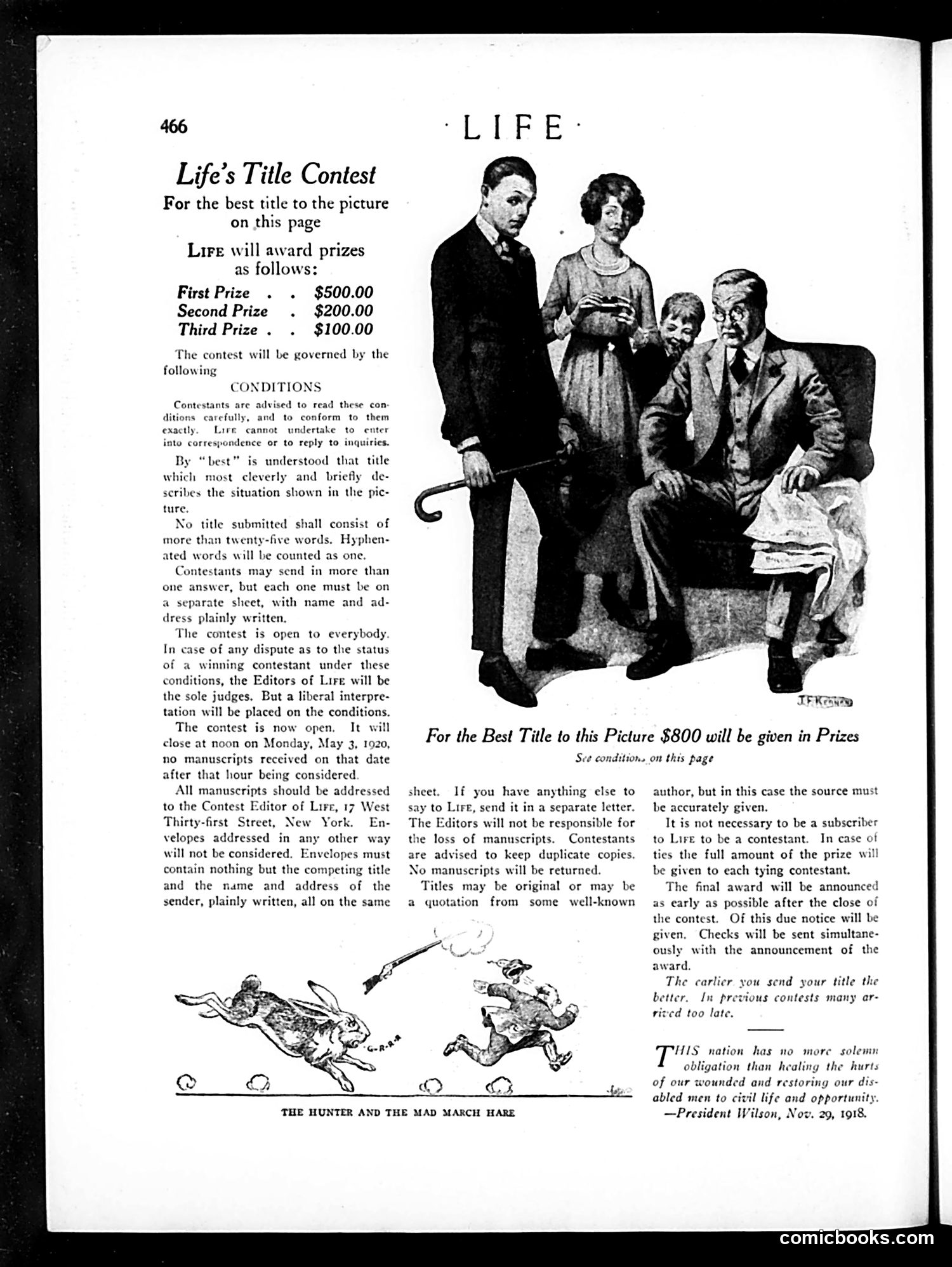
This page announces a **title-writing contest** for a cartoon, offering $800 in prizes ($500 first place). The main image shows five figures examining what appears to be a map or document—labeled "THE HUNTER AND THE MAD MARCH HARE." The cartoon likely references **post-WWI readjustment**: the figures appear to represent government officials or administrators dealing with wounded veterans or disability claims. The "Mad March Hare" reference (from *Alice in Wonderland*) suggests chaotic or absurd bureaucratic processes. President Wilson's quoted statement (Nov. 29, 1918) about the nation's obligation to heal wounded and disabled soldiers provides context—this satirizes the government's actual handling of veteran welfare during the post-war period. Readers were invited to submit clever, brief titles (max 25 words) describing the situation depicted. The contest reflects Life magazine's satirical mission: poking fun at contemporary political and social failures through reader participation.
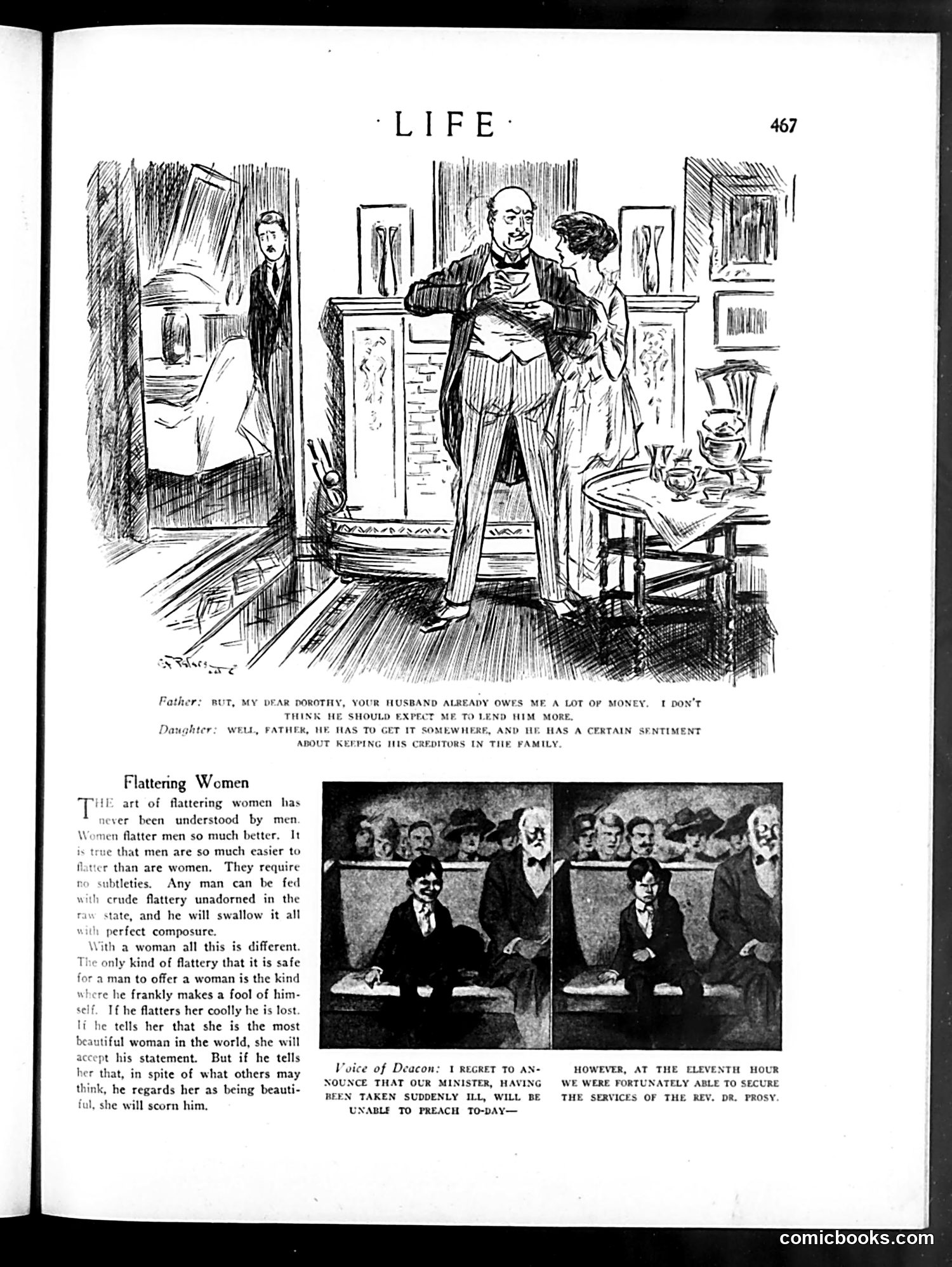
**Top Cartoon:** A domestic scene where a daughter defends her husband's request for a loan from her father. The father objects that the son-in-law already owes him money. The daughter's response—that her husband "has a certain sentiment about keeping his creditors in the family"—is the satirical joke: she's suggesting it's better to stay indebted to family than to outside creditors, inverting normal financial logic for humorous effect. **"Flattering Women" Essay:** This is satirical commentary on gender differences in flattery. The piece argues that men are easily flattered with crude compliments, while women require subtlety. Paradoxically, it claims the only "safe" flattery for women involves self-deprecating humor—a man must mock himself rather than praise her directly, or she'll reject the compliment as insincere. The piece reflects early 20th-century attitudes about courtship and gender psychology. **Bottom Photos:** Appear to be a church scene involving a deacon announcing a minister's illness, with text about securing "Rev. Dr. Prosy" as a replacement—likely satirizing tedious sermons.
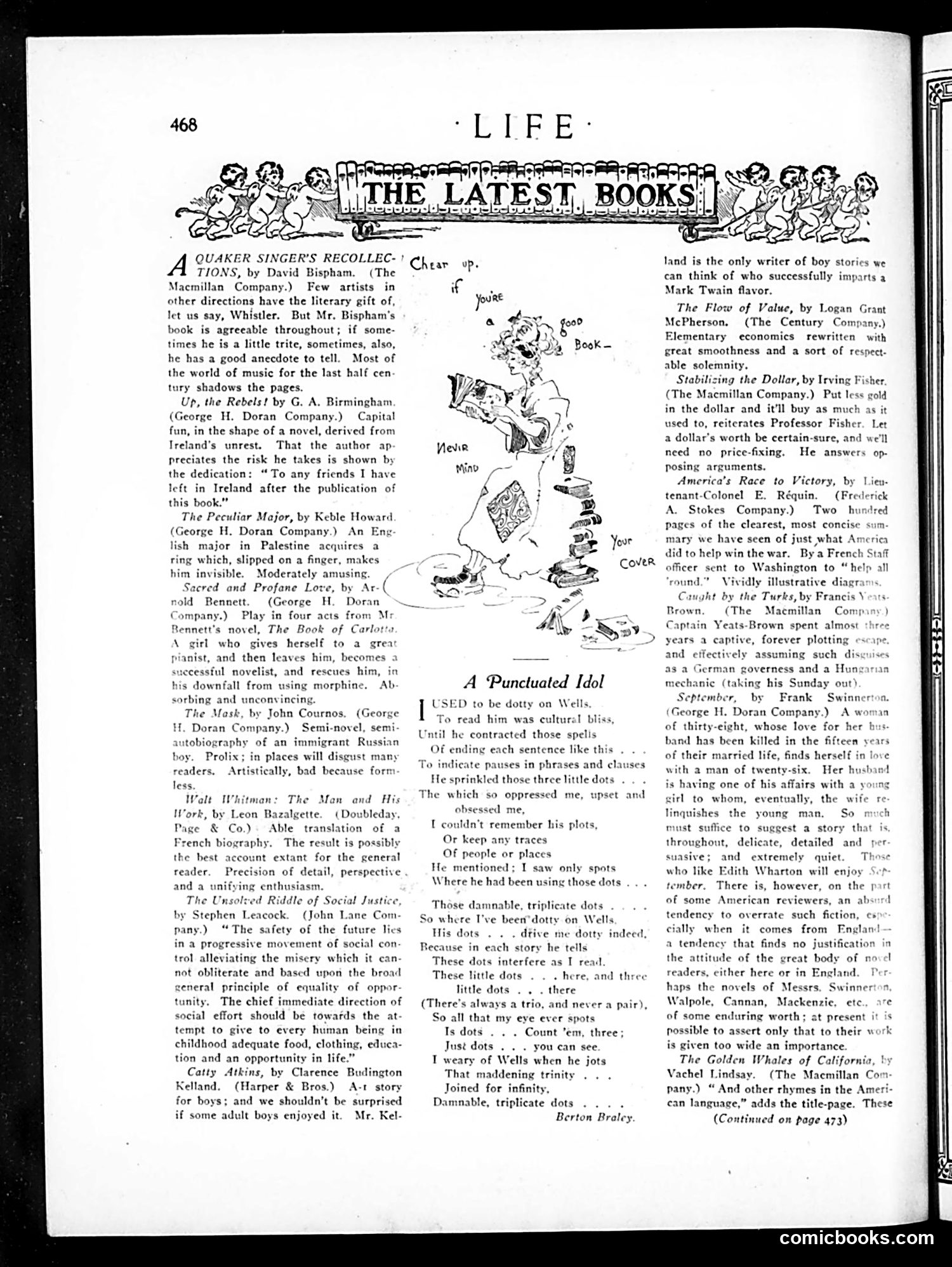
This page features a humorous poem mocking author H.G. Wells's notorious overuse of ellipses (three dots "...") in his writing. The cartoon illustration shows a figure constructed entirely from books, with the dots literally becoming visual obstructions. The poem's speaker describes becoming obsessed with Wells's work until frustrated by the constant punctuation marks interrupting every sentence. The repeated refrain emphasizes how these "damnable, triplicate dots" disrupted reading comprehension—the dots prevent him from remembering plots, characters, or locations. The satire targets a real stylistic quirk: Wells was known for using ellipses excessively to indicate pauses and hesitations, creating a manneristic rhythm that annoyed many readers. By personifying his irritation and making the dots literally block vision in the illustration, the poem transforms literary criticism into comedic complaint. This reflects Life magazine's tradition of gentle mockery toward prominent cultural figures.
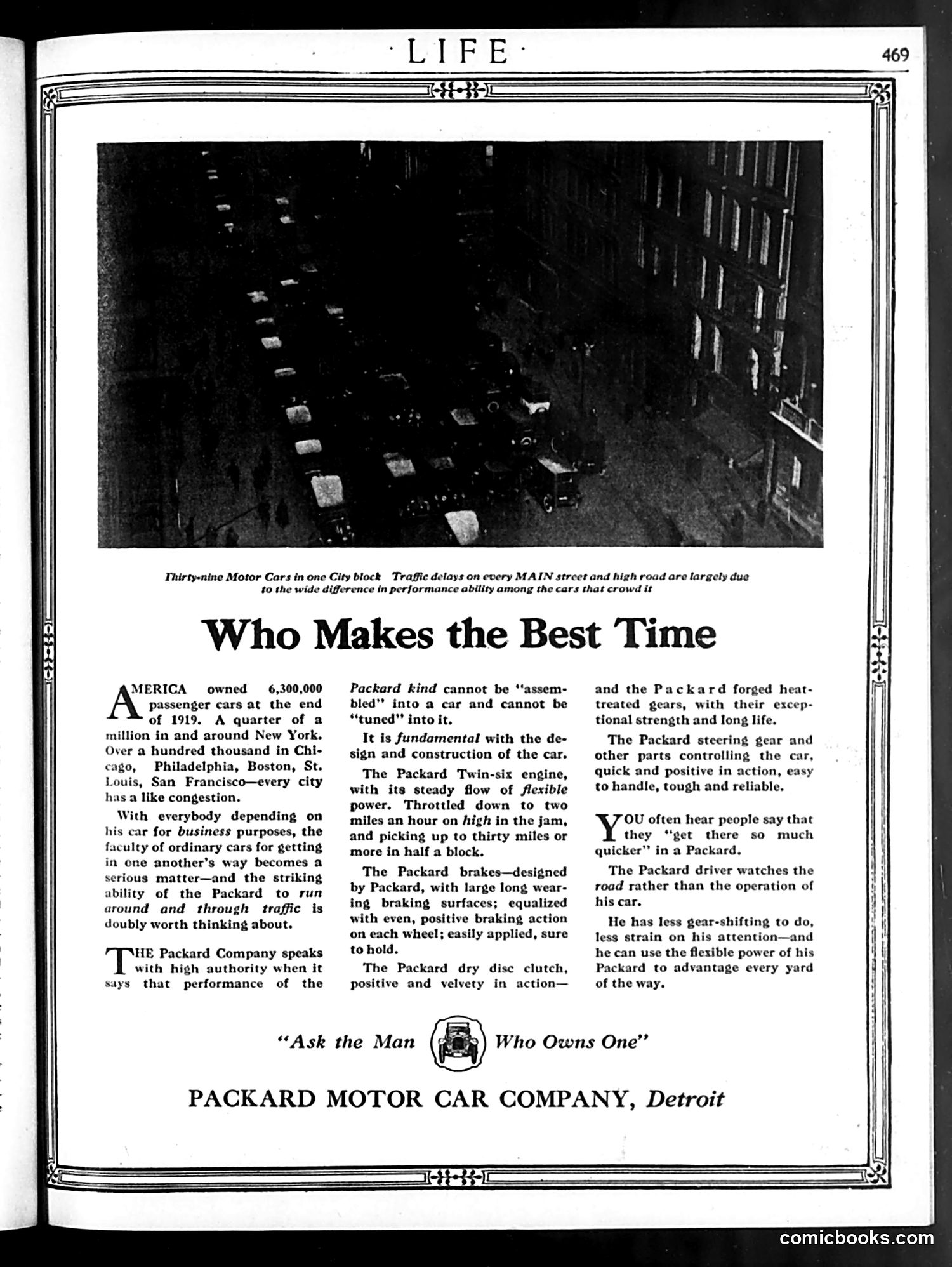
This is a **Packard automobile advertisement**, not a cartoon or satire. The page addresses a genuine 1919-1920 social concern: urban traffic congestion caused by the proliferation of motor cars (6.3 million in America by 1919's end). The advertisement's central argument is that traffic delays result from performance differences among vehicles—implying inferior cars clog streets. Packard positions itself as the solution through superior engineering: a flexible Twin-six engine, reliable brakes, responsive clutch, and precise steering that allow drivers to navigate congestion more effectively. The photograph shows thirty-nine cars in one city block, visualizing the congestion problem. The phrase "Ask the Man Who Owns One" was Packard's actual period slogan, appealing to owners' testimonies rather than manufacturer claims. This reflects early automotive marketing before standardization, when mechanical reliability and driver control genuinely varied significantly between manufacturers.
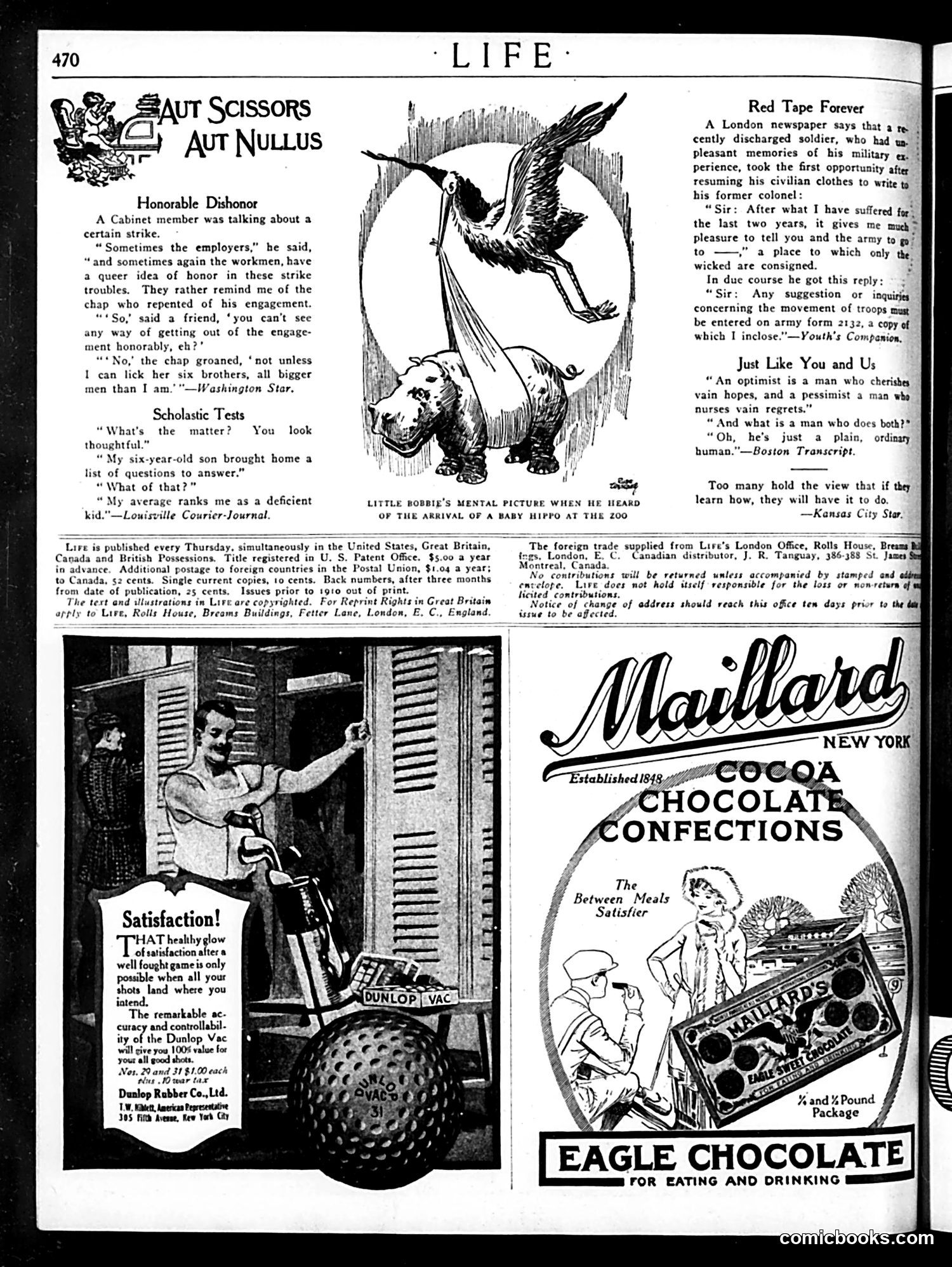
This page from *Life* magazine contains several short humorous anecdotes and advertisements typical of early 20th-century American satirical publishing. **The Main Cartoon:** "Little Bobbie's Mental Picture When He Heard of the Arrival of a Baby Hippo at the Zoo" depicts a child's imagination—a stork carrying a baby hippopotamus. The joke plays on children conflating the "stork delivers babies" myth with zoo arrivals, creating absurd imagery. **The Text Pieces:** Brief jokes about honor during labor strikes, scholastic testing burdens on parents, military bureaucracy's indifference, and philosophical definitions of optimists versus pessimists. These satirize contemporary concerns: labor unrest, education, post-WWI veteran treatment, and human nature. **The Advertisements:** Dunlop Vac (golf balls), Maillard chocolate confections, and Eagle Chocolate represent period consumer goods marketed through illustrated appeals to satisfaction and leisure. The page exemplifies *Life*'s format: mixing social commentary humor with commercial sponsorship.
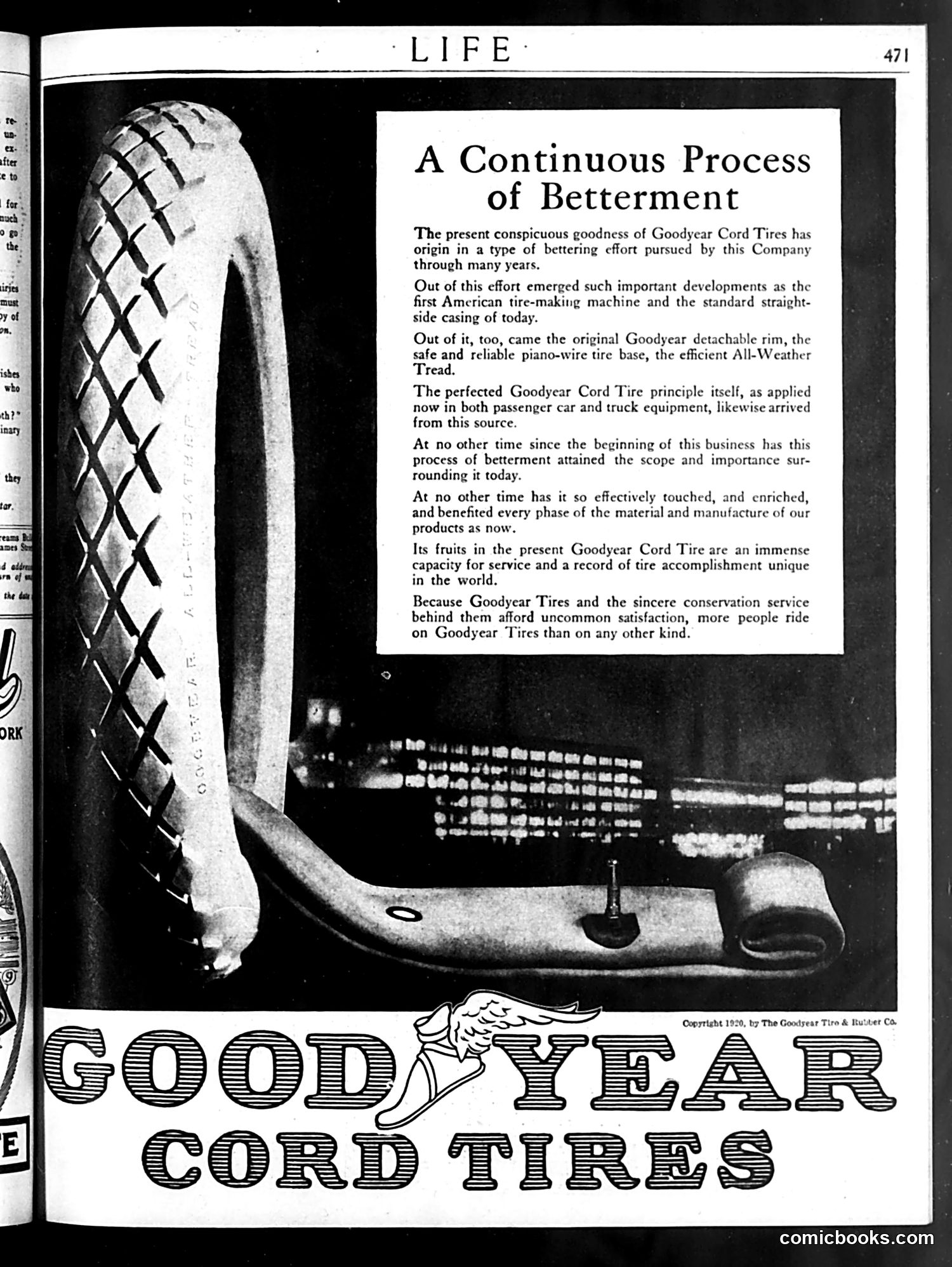
This is not a cartoon or satire—it's a straightforward **advertisement for Goodyear Cord Tires** from LIFE magazine (page 471). The page features a large photograph of a tire on the left alongside promotional text on the right. The ad employs corporate marketing rhetoric typical of the era, emphasizing "continuous betterment" and innovation. It claims Goodyear pioneered key tire technologies: the first American tire-making machine, straight-side casings, detachable rims, and the "All-Weather Tread." The text argues that Goodyear's commitment to improvement is unmatched and that their tires consequently dominate the market ("more people ride on Goodyear Tires than on any other kind"). There is no political or social satire present—this is genuine commercial advertising presenting Goodyear's manufacturing history and product superiority claims.
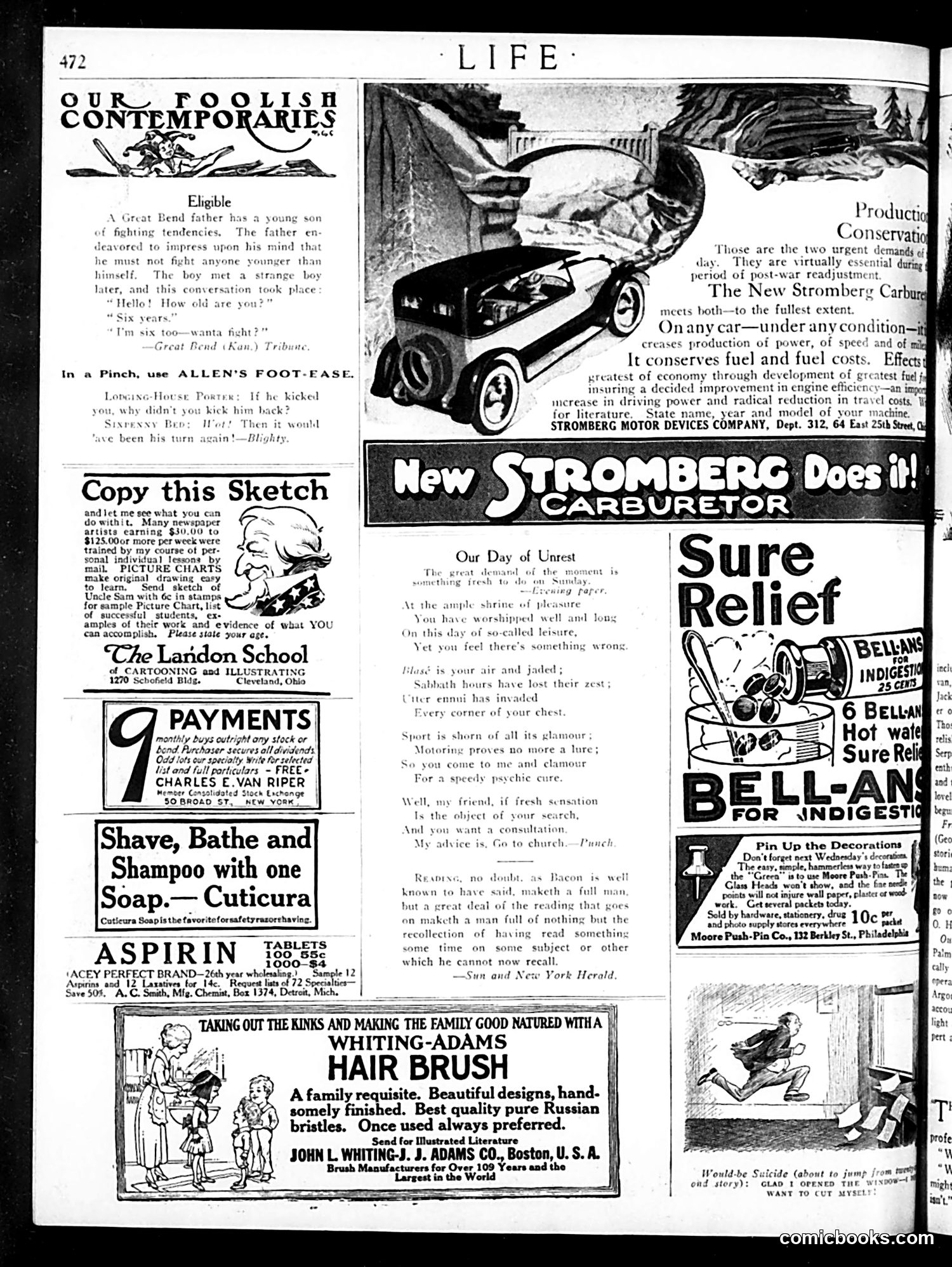
This is primarily an **advertising and humor page** from Life magazine (a satirical weekly publication). The main content includes: **"Our Foolish Contemporaries" cartoon**: A brief satire about a father teaching his young son not to fight anyone younger—then the boy encounters another six-year-old and immediately asks "wanna fight?" The humor mocks parental advice that children ignore. **"Our Day of Unrest" poem**: A longer satirical piece criticizing modern leisure and boredom. It suggests that despite opportunities for pleasure, people feel empty—worshipping at shrines of leisure, finding motoring dull, and seeking superficial "psychic cures." The final jab mocks reading itself: people retain nothing from books except vague memories. **Advertisements dominate the page**, promoting the Stromberg carburetor, Cuticura soap, Aspirin, the Landon School of cartooning, and hair brushes—typical 1920s consumer goods. The satire reflects post-WWI anxieties about modern malaise and spiritual emptiness amid material comfort and consumerism.
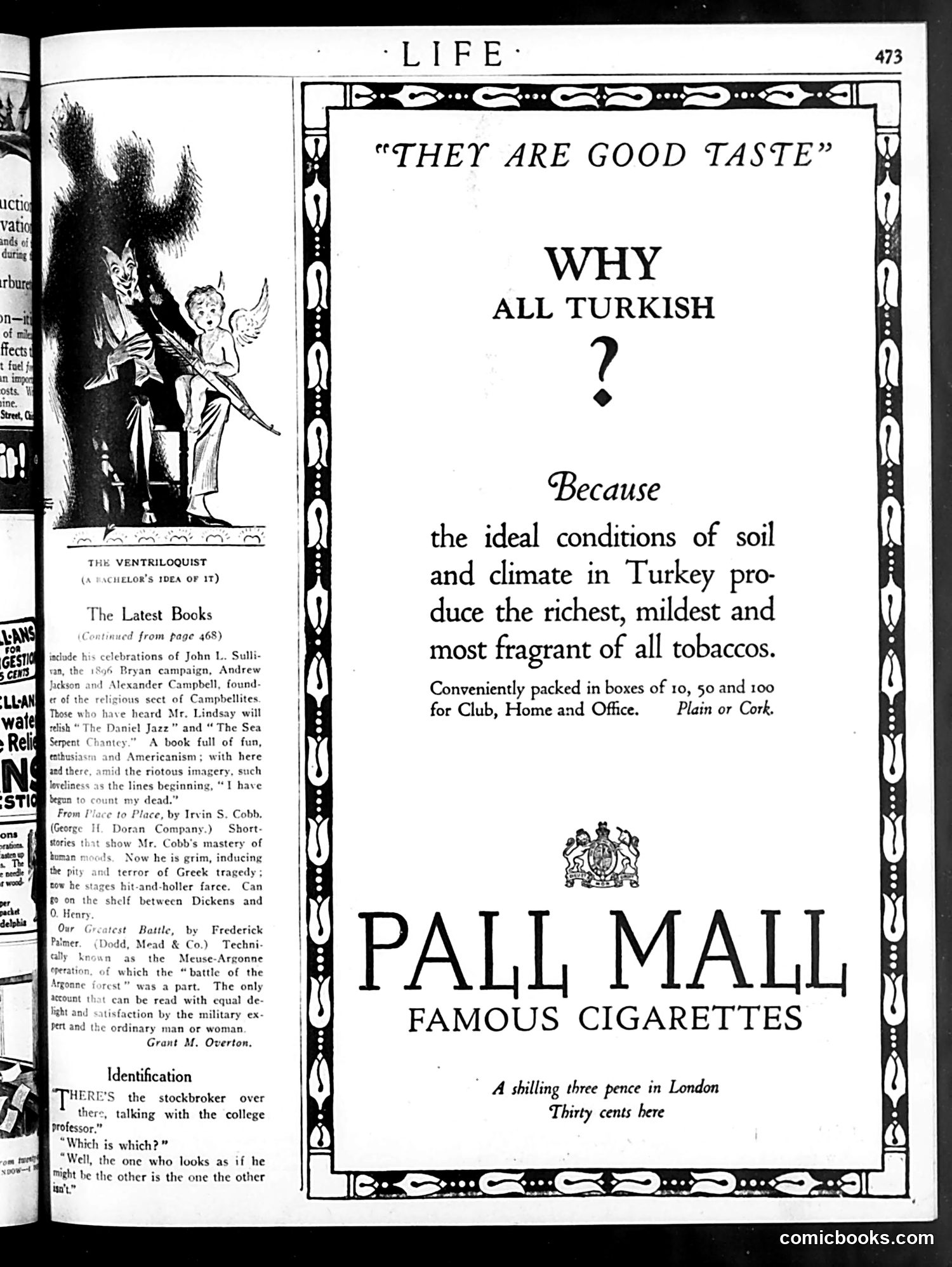
This page consists primarily of a **Pall Mall cigarette advertisement** (right side), with book reviews and a small cartoon on the left. **The Advertisement:** Uses a marketing strategy common in early 20th-century tobacco ads—appealing to quality and taste. The claim that Turkish tobacco is superior due to soil and climate was a standard luxury cigarette pitch of the era. Prices are given in both British (shilling three pence) and American currency (thirty cents), indicating international marketing. **The Left-Side Content:** Includes book reviews and a small cartoon titled "The Ventriloquist," depicting what appears to be a devil or sinister figure manipulating a cherub—likely a satirical visual metaphor about manipulation or control, though the cartoon's specific point is unclear without fuller context. The page reflects early 1900s magazine design: advertisements mixed with literary content, and casual acceptance of cigarette marketing as normal editorial space.
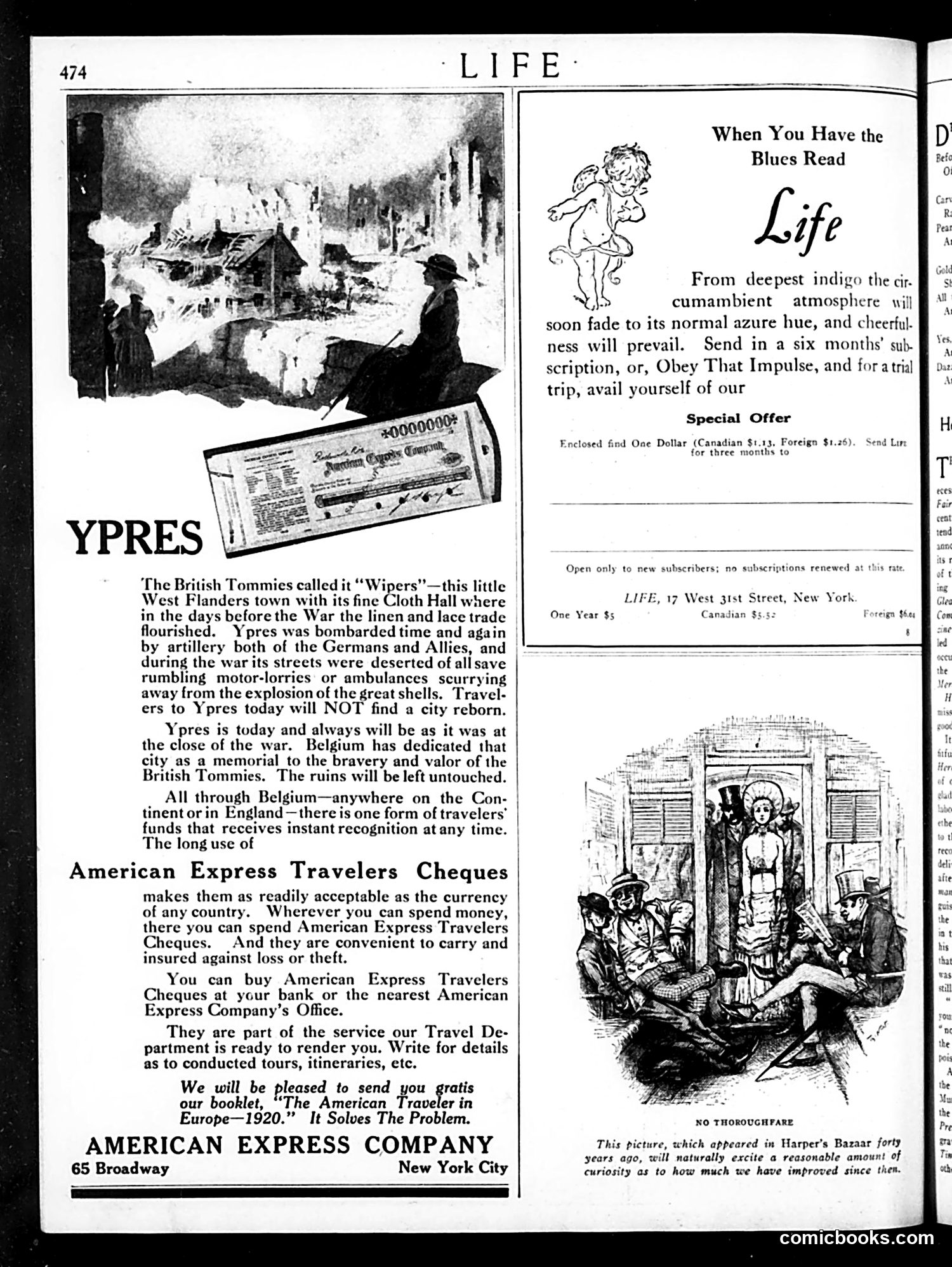
This page contains primarily **advertising** rather than political satire. The main content promotes American Express Travelers Cheques, using post-World War I tourism as its hook. The left side features an ad about **Ypres, Belgium**—a city devastated by trench warfare that Belgium has deliberately left in ruins as a war memorial to British soldiers ("Tommies"). The ad uses this solemn historical reference to pitch travelers cheques as essential for European tourism. The right side advertises **Life magazine itself** as a cure for depression ("When You Have the Blues Read Life"), offering subscription discounts. The bottom illustration labeled "No Thoroughfare" appears to be a reprinted 1880s-era Harper's Bazaar image, included somewhat ironically to show how publishing has "improved" over forty years—a self-congratulatory nod to modern graphic design. The page reflects 1920s post-war optimism: Americans now traveled abroad, needed reliable currency, and read illustrated magazines for both information and mood-lifting entertainment.
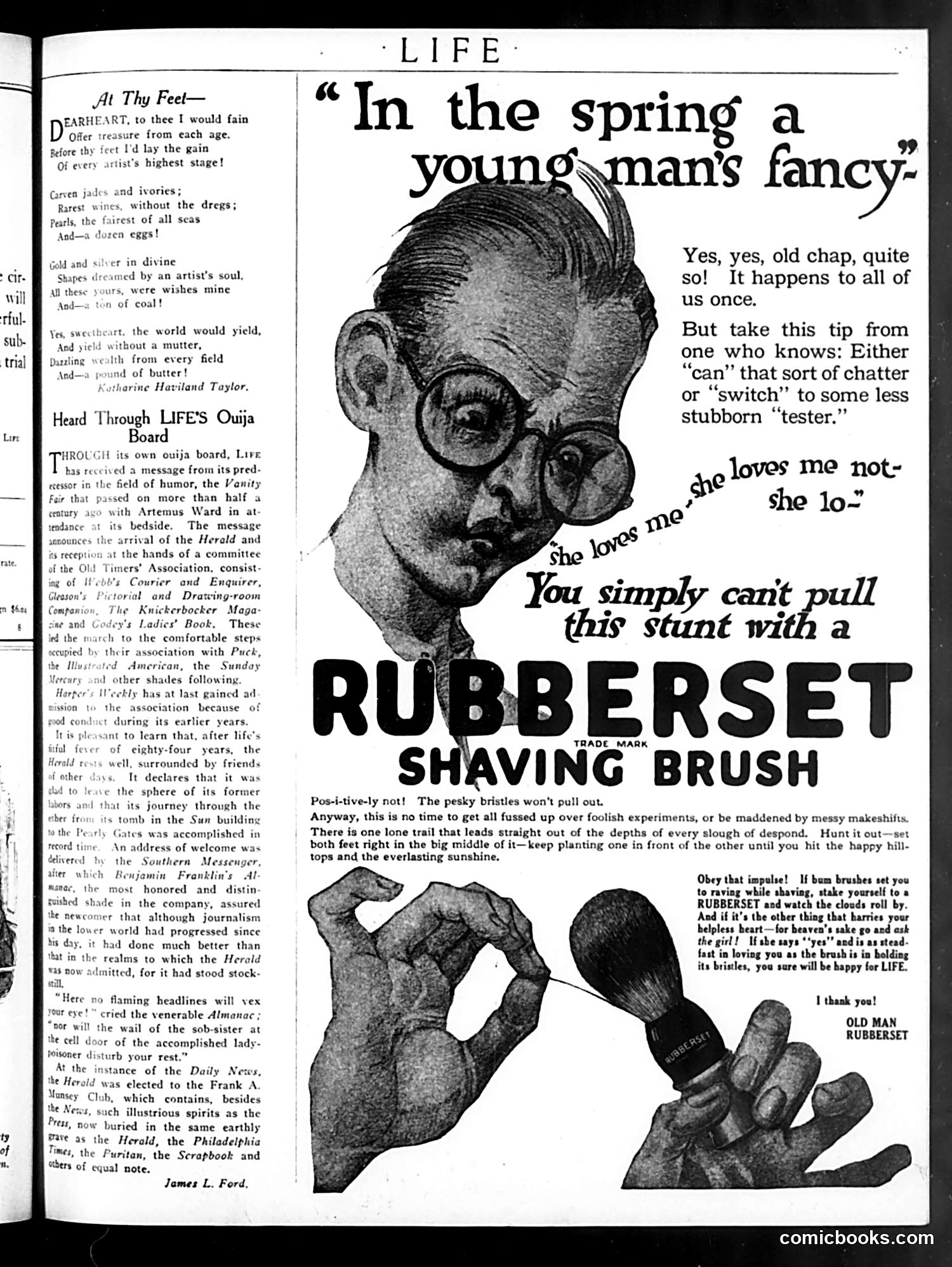
This page mixes editorial content with advertising. The left side contains two pieces: a poem "At Thy Feet" and "Heard Through LIFE's Ouija Board," a humorous piece announcing that the *Herald* newspaper has died and been welcomed into the afterlife by defunct publications (the *Vanity Fair*, *Puck*, etc.), treated as a gentlemen's club for defunct media. The right side is a **Rubberset Shaving Brush advertisement** disguised as editorial content. It opens with a joke about youthful romantic obsession ("In the spring a young man's fancy")—referencing the famous Tennyson line—then pivots: the solution to relationship troubles is *not* romantic experimentation but switching to a better shaving brush. The ad sarcastically suggests that if your girlfriend loves you inconsistently, at least your brush bristles won't fail you. It's absurdist humor treating a grooming product as the answer to existential romantic anxiety, typical of early 20th-century advertising's playful tone.
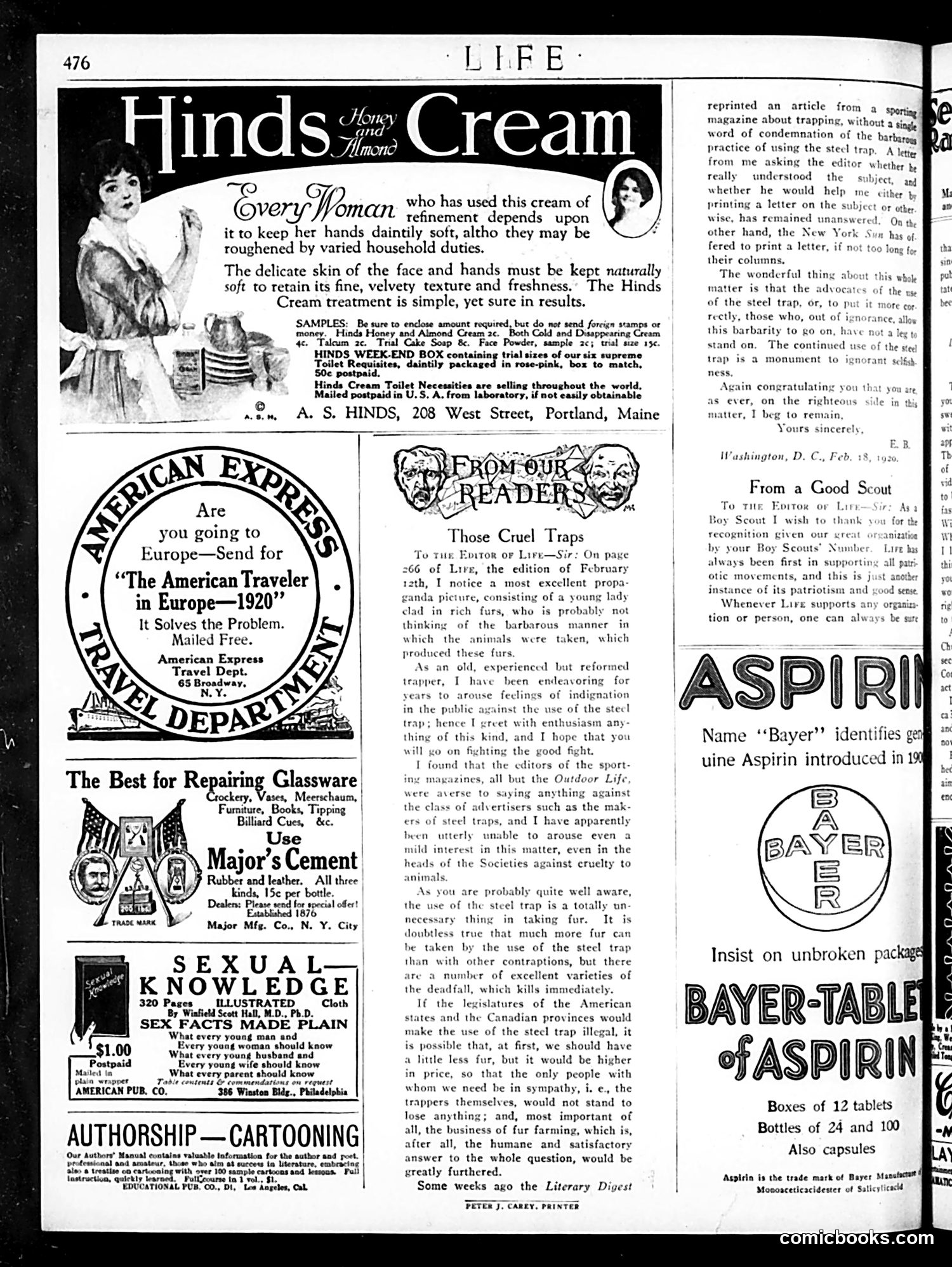
This page is primarily **advertising**, with one substantive letter to the editor. The main content is a reader's letter criticizing the use of steel traps in fur trapping. The writer, apparently an experienced trapper, praises Life's February 12th editorial featuring "a young lady clad in rich furs" as propaganda against cruel trapping methods. He notes that most sporting magazines refuse to criticize steel trap manufacturers (major advertisers), and argues that steel traps are unnecessarily cruel compared to alternatives like deadfalls, which kill animals instantly. The letter advocates for legislation banning steel traps, arguing this would increase fur prices enough that trappers wouldn't lose income, while eliminating animal suffering and potentially encouraging humane fur farming instead. The surrounding advertisements (Hinds Cream, Major's Cement, sexual knowledge guides, travel services) are unrelated to the editorial content—typical for Life's format.
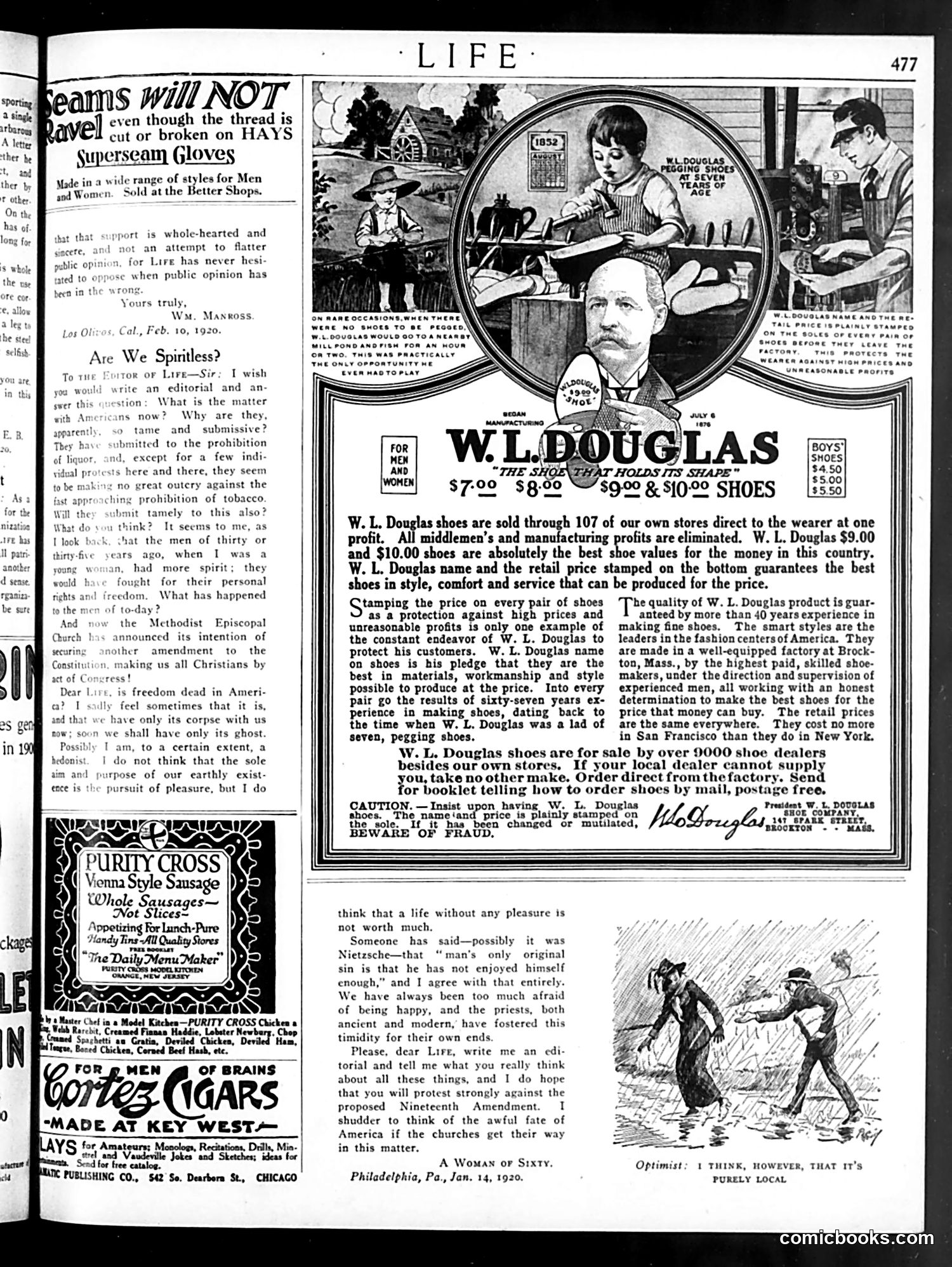
This page is primarily **advertising-heavy**, dominated by a large W.L. Douglas shoe advertisement. The ads include Hayseeds Gloves, Purity Cross sausage, and Cortez cigars. The editorial letters discuss **American social decline**. One correspondent laments lost civic spirit, noting that men of his generation (30+ years prior) fought for personal freedoms, but modern Americans seem passive—particularly regarding Prohibition and tobacco restrictions. He expresses anxiety about government overreach (the Methodist Episcopal Church's push for a constitutional amendment) and fears "freedom" is dead in America, existing only as a "corpse." The response acknowledges legitimate concerns but argues that **complete pleasure-seeking isn't life's purpose**—citing Nietzsche approvingly. The editor suggests complaints about Prohibition may be "purely local." The cartoons are small and poorly reproduced in this image, making their specific content unclear. The overall page reflects **1920 American anxieties** about personal liberty, religious institutional power, and social conformity during the Prohibition era.
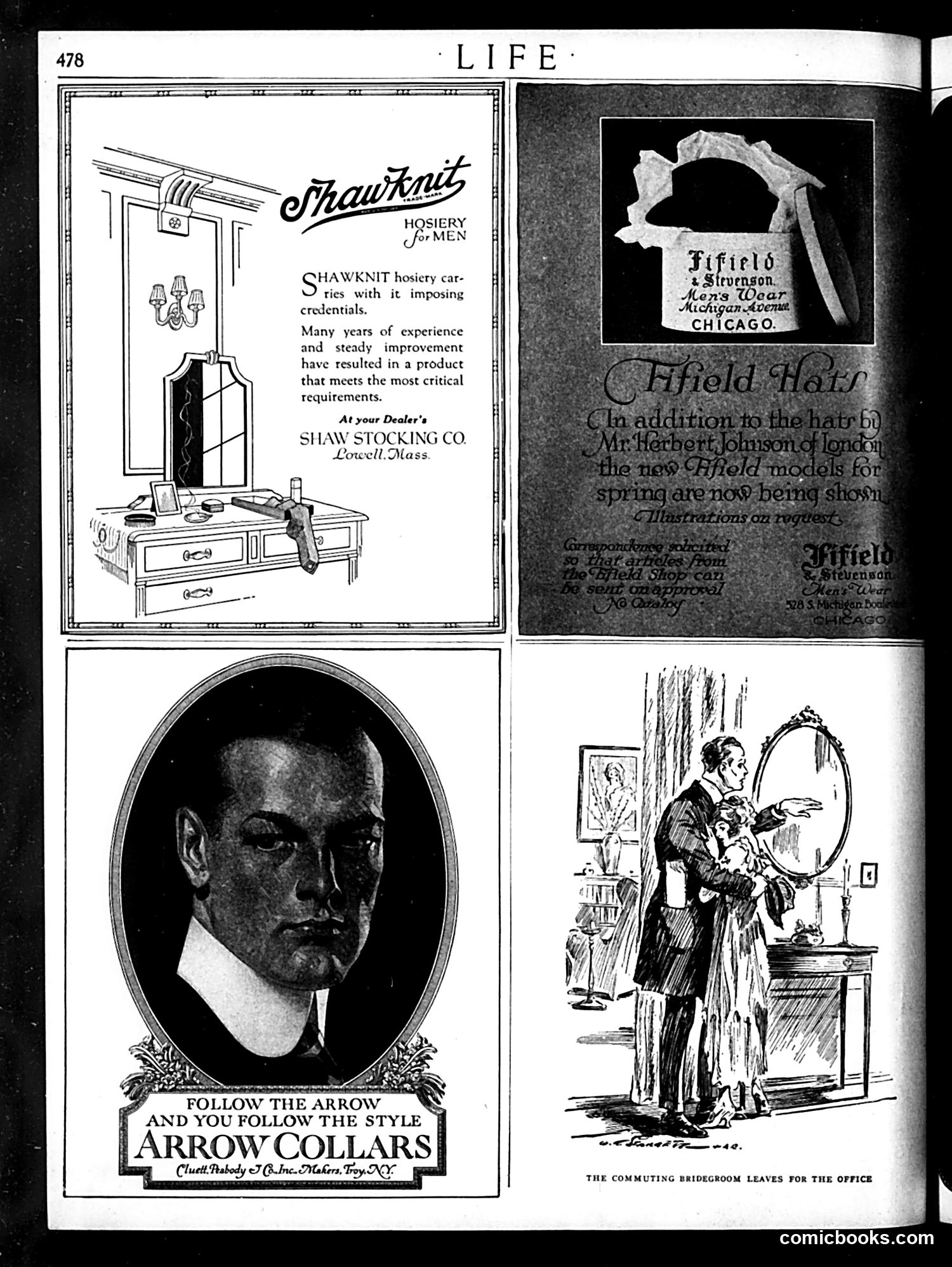
This page contains **three advertisements and one cartoon** from an early 20th-century Life magazine issue. The **main cartoon** (bottom right) depicts "The Commuting Bridegroom Leaves for the Office"—showing a newly married man departing for work while his bride waves goodbye at home. The satire targets the emerging phenomenon of suburban commuting and the domestic separation it created for modern married couples. The husband, dressed formally, represents the new urban professional worker, while the wife remains confined to the domestic sphere. The **advertisements** promote Arrow Collars, Hawknit hosiery, and Fifield hats—all men's fashion items emphasizing style and respectability, which humorously contrasts with the cartoon's commentary on modern married life and work-life balance. The page collectively satirizes turn-of-the-century masculine identity: professional appearance, commuting culture, and changing marriage dynamics.
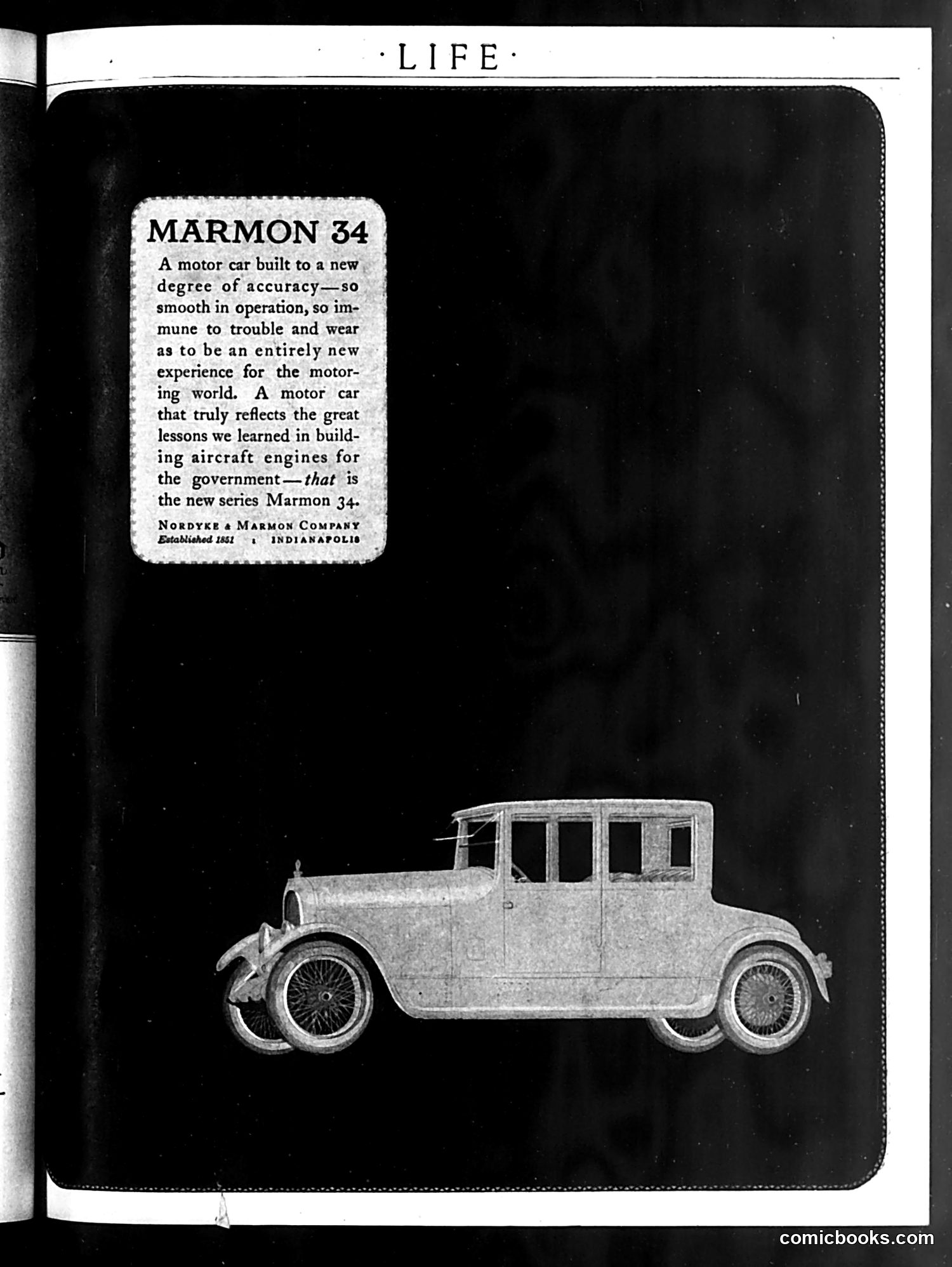
This is a **commercial advertisement**, not satire or political commentary. It promotes the Marmon 34 automobile, manufactured by Nordyke & Marmon Company in Indianapolis. The ad claims the Marmon 34 represents a technological breakthrough—a car built with aircraft-engine precision, making it exceptionally smooth and reliable. The key selling point references **World War I aircraft engine manufacturing** for the U.S. government, positioning the car as embodying cutting-edge engineering lessons from military aviation. The accompanying illustration shows a side-view drawing of the automobile itself. For modern readers: this appeal to military-industrial expertise was a common 1920s marketing strategy, leveraging patriotic associations with wartime production to suggest superior quality and American innovation.
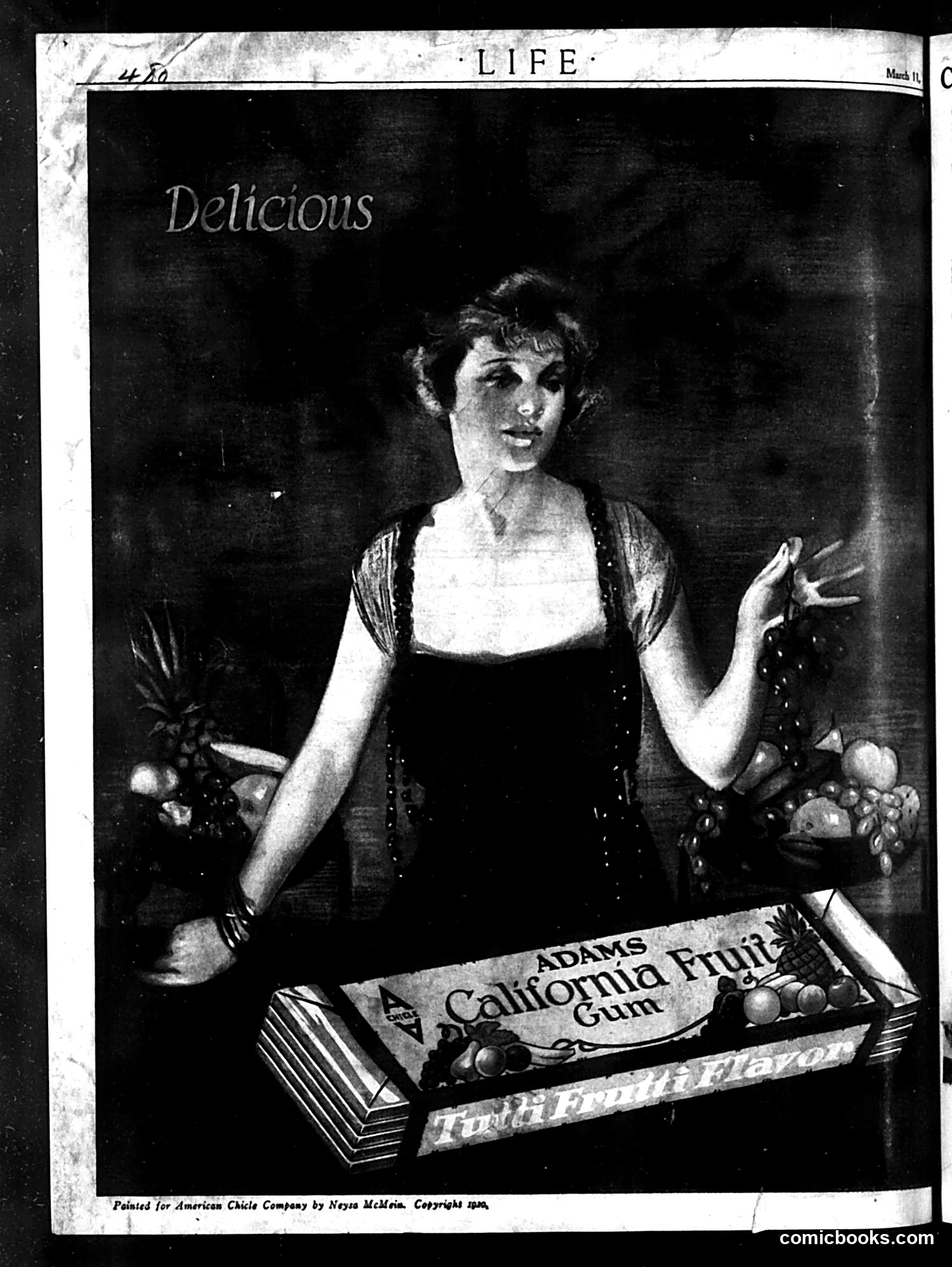
This is an advertisement for Adams California Fruit Gum, painted by artist Neysa McMein, copyrighted 1920. The word "Delicious" appears at the top. The image shows a woman in 1920s dress holding fresh fruit (grapes visible in both hands) alongside a package of the gum product. The advertisement uses visual association to suggest the gum tastes like real California fruit—a common marketing technique of the era. This appears in *Life* magazine's advertising section rather than as satire or political commentary. It's a straightforward commercial promotion leveraging the appeal of natural fruit flavoring and California's agricultural reputation to sell chewing gum to American consumers during the early twentieth century.