
Life, 1920-03-11 · page 19 of 40
Life — March 11, 1920 — page 19: what you’re looking at
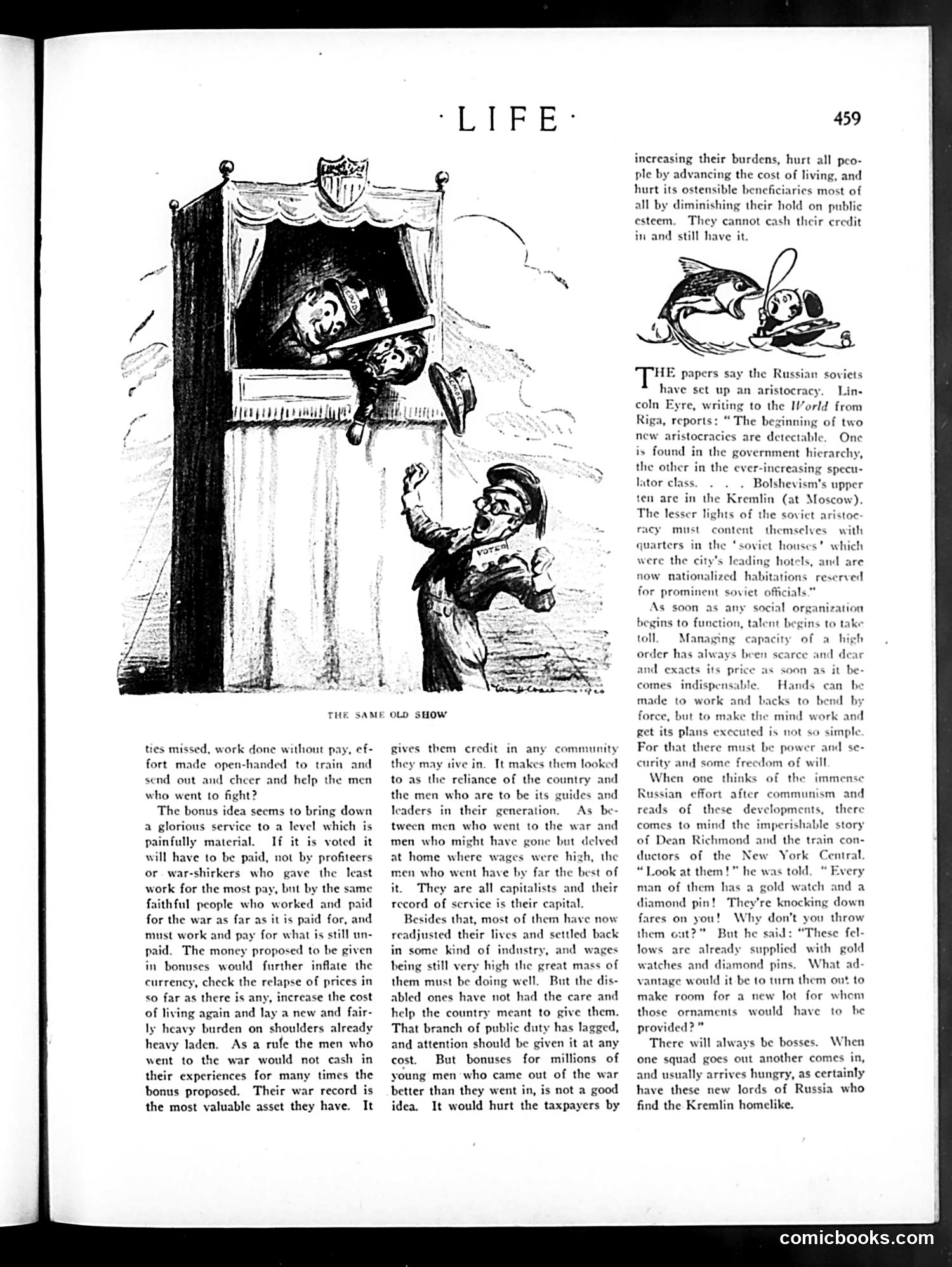
What you’re looking at
This page contains two separate pieces of political commentary: **Left cartoon ("The Same Old Show"):** A satirical drawing showing a theatrical booth where figures inside appear to be performing the same act repeatedly while an audience member below watches. This likely critiques cyclical political corruption or governmental performance—the suggestion that despite changes in administration or circumstances, the same corrupt practices continue unchanged. **Right text:** Discusses Russian Soviet aristocracy, reporting that despite communist ideology, a new hierarchy has emerged. Soviet leaders occupy the Kremlin while lesser officials inhabit nationalized hotels. The accompanying anecdote about Dean Richmond and train conductors suggests an ironic point: replacing one privileged class with another accomplishes nothing—talent and management always command rewards, making ideology irrelevant. **Underlying theme:** Both pieces express skepticism that revolutionary or reform rhetoric produces genuine change; structural human nature (desire for hierarchy, privilege) persists regardless of political systems or promises.
📄 Transcribed text from this page (OCR, searchable)
Machine-transcribed from the original scan — historical spelling and the odd misread are preserved.
THE ties missed, work done without pay, ef- fort made open-handed to train and send out and cheer and help the men who went to fight? The bonus idea seems to bring down a glorious service to a level which is painfully material. If it is voted it will have to be paid, not by profiteers or war-shirkers who gave the least work for the most pay, but by the same faithful people who worked and paid for the war as far as it is paid for, and must work and pay for what is still un- paid. The money proposed to be given in bonuses would further inflate the currency, check the relapse of prices in so far as there is any, increase the cost of living again and lay a new and fair- ly heavy burden on shoulders already heavy laden. As a rufe the men who went to the war would not cash in their experiences for many times the bonus proposed. Their war record is the most valuable asset they have. It SAME OLD SHOW gives them credit in any community they may tive in. It makes them looked to as the reliance of the country and the men who are to be its guides and leaders in their generation. As be- tween men who went to the war and men who might have gone but delved at home where wages were high, the men who went have by far the best of it. They are all capitalists and their record of service is their capital Besides that, most of them have now readjusted their lives and settled back in some kind of industry, and wages being still very high the great mass of them must be doing well, But the dis- abled ones have not had the care and help the country meant to give them. That branch of public duty has lagged, and attention should be given it at any cost. But bonuses for millions of young men who came out of the war better than they went in, is not a good idea. It would hurt the taxpayers by 459 increasing their burdens, hurt all peo- ple by advancing the cost of living, and hurt its ostensible beneficiaries most of all by diminishing their hold on public esteem. They cannot cash their ercdit in and still have it. HE papers say the Russian soviets have sct up an aristocracy. Lin- yre, writing to the World from Riga, reports: “ The beginning of two new aristocracies are detectable. One is found in the government hicrarch coln the other in the ever-increasing specu- lator class. Bolshevism's upper ten are in the Kremlin (at Moscow). The lesser lights of the soviet aristoe racy must content themselves with quarters in the ‘sovict houses’ which were the city’s leading hotels, and are now nationalized habitations reserved for prominent soviet officials.” As soon as any social organization ake high and dear ins to function, talent begins to toll. Managing capacity of a order has always been scarce and exacts its price as soon as it be- comes indispensable, Hands can he end by mind work and made to work and backs to force, but to make th get its plans execu! For that there must be pov curity and som dom of will When one thinks of the Russian effort after communism and reads of there comes to mind the imperishable story of Dean Richmond and the train con- ductors of the New York Central. “Look at them!” he was told. “ Every man of them has a gold watch and a diamond pin! They're knocking down fares on you! Why don't you throw them out?” But he saic These fel- lows are already supplied with gold watches and diamond pins. What ad- vantage would it be to turn them out to dis not so simple nd se- immense these developments, make room for a new lot for whem those ornaments would have to be provided?” There will always be bosses. When one squad goes out another comes in, and usually arrives hungry, as certainly have these new lords of Russia who find the Kremlin homelike. comicbooks.com