
Life, 1920-03-11 · page 12 of 40
Life — March 11, 1920 — page 12: what you’re looking at
What you’re looking at
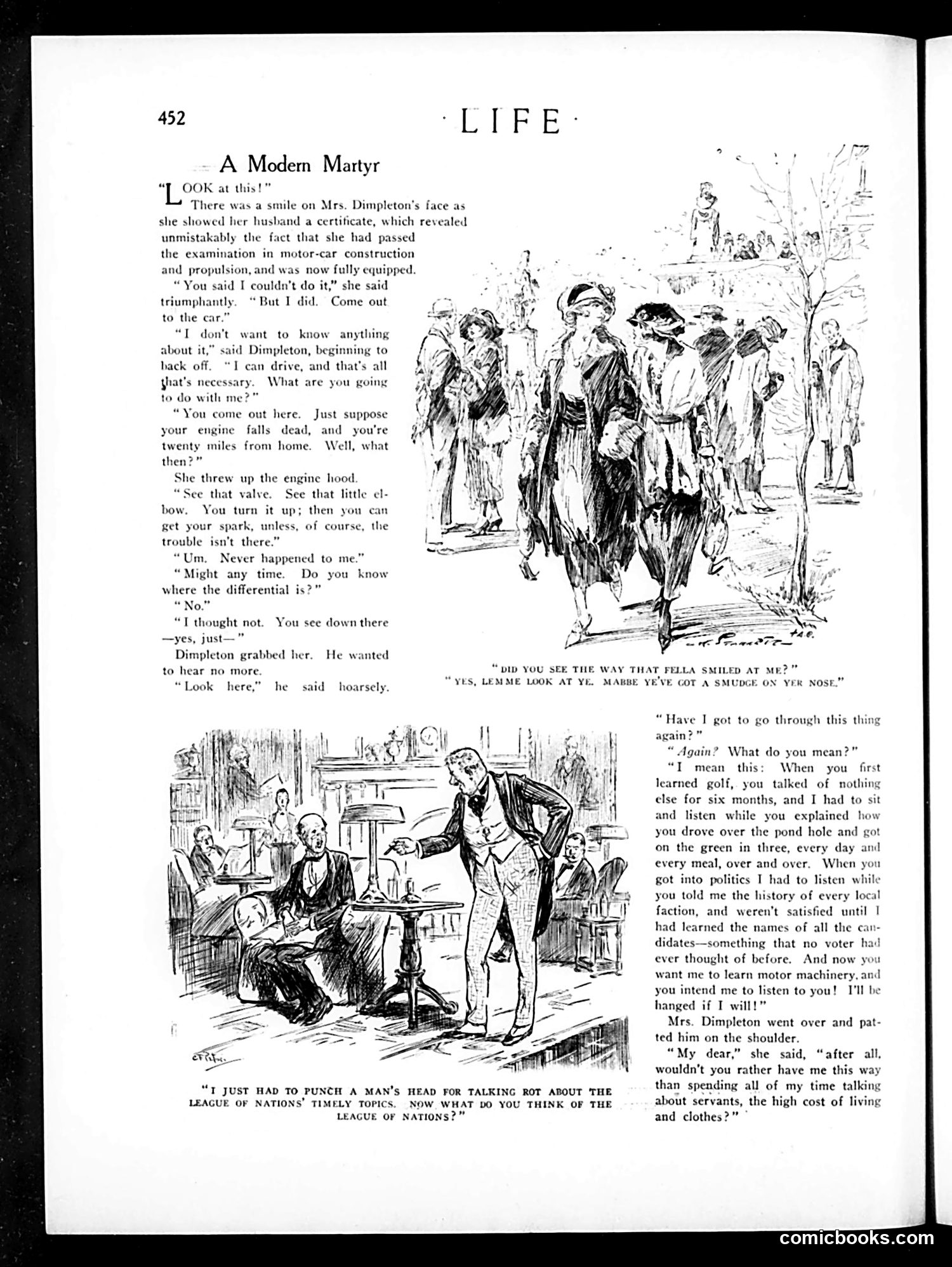
This page satirizes a husband's frustration with his wife's newfound independence and mechanical knowledge. Mr. Dimpleton, having learned to drive and passed a motor-car construction exam, now refuses to listen to her husband's complaints about car troubles. The satire targets the tension between traditional male authority and women's emerging competence and autonomy in the early automotive era. Mrs. Dimpleton weaponizes her expertise, shutting down her husband's attempted mansplaining about differentials and engine problems. The lower cartoon mocks his further complaint: she previously monopolized conversation about golf, politics, and servants' costs. The joke inverts the typical gender dynamic—now *he* must listen to *her* expertise, which he finds unbearable. It's satirical commentary on shifting power dynamics as women gained practical skills and independence.
📄 Transcribed text from this page (OCR, searchable)
Machine-transcribed from the original scan — historical spelling and the odd misread are preserved.
w2 LIFE: A Modern Martyr “T OOK at this!” There was a smile on Mrs. Dimpleton’s face as she showed her husband a certificate, which revealed unmistakably the fact that she had passed the examination in motor-car construction and propulsion, and was now fully equipped. “You said I couldn't do it,” she said triumphantly. “But I did. Come out to the car.” “T don't want to know anything about it,” said Dimpleton, beginning to hack off. “I can drive, and that’s all ghat's necessary. What are you going to do with me?” “You come out here. Just suppose your engine falls dead, and you're y miles from home. Well, what She threw up the engine hood. “See that valve. See that little el- bow. ou turn it up; then you can get ye spark, unless, of course, the trouble isn’t there.” “Um. Never happened to me.” “Might any time. Do you know where the differential is?” “T thought not. You see down there —yes, just—” Dimpleton grabbed her. He wanted to hear no more. “Look here,” he said hoarsely. “T JUST HAD TO PUNCH A MAN'S HEAD FOR TALKING ROT ABOUT THE LEAGUE OF NATIONS’ TIMELY TOPICS. NOW WHAT DO YOU THINK OF THE LEAGUE OF NATIONS?” “pip YOU SEE THE WAY THAT FELLA SMILED AT ME?” “YES, LEMME LOOK AT YE. MABBE YE'VE GOT A SMUDGE ON YER NOSE.” {gain? What do you mean?” “T mean this: When you first learned golf, you talked of nothing else for six months, and I had to sit and listen while you explained how you drove over the pond hole and got on the green in three, every day and every meal, over and over. When you got into politics I had to listen while you told me the history of every local faction, and weren't satisfied until | had learned the names of all the can- didates—something that no voter had ever thought of before. And now you want me to learn motor machinery, and you intend me to listen to you! I'll be hanged if I will!” Mrs. Dimpleton went over and pat- ted him on the shoulder. “My dear,” she said, “after all, wouldn't you rather have me this way than spending all of my time talkin; about servants, the high cost of living and clothes?” comicbooks.com