
Life, 1920-03-11 · page 15 of 40
Life — March 11, 1920 — page 15: what you’re looking at
What you’re looking at
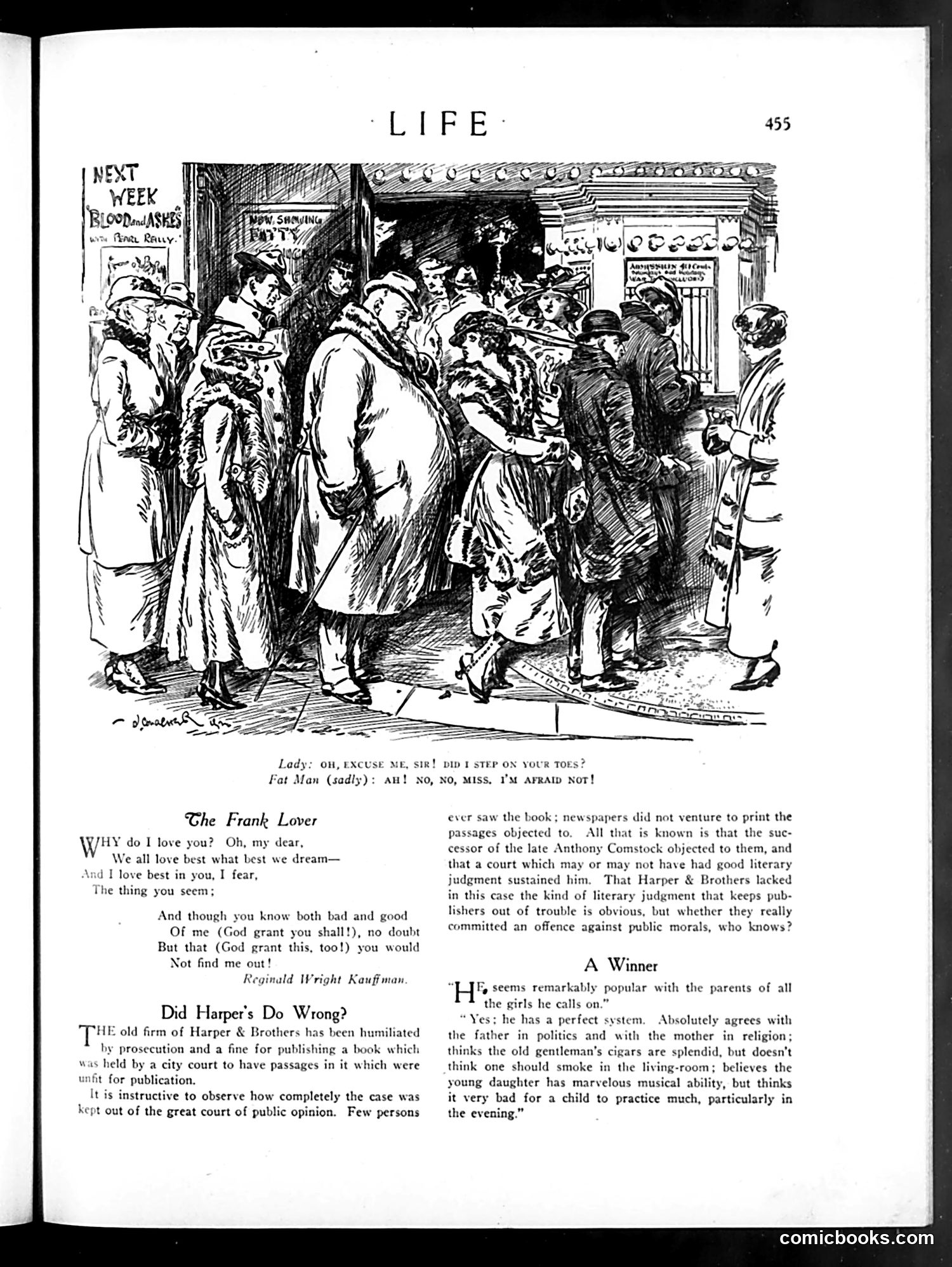
The top illustration depicts a crowded street scene with a woman accidentally stepping on a man's toes, prompting his worried response: "I'm afraid not!" This appears to be simple observational humor about urban social awkwardness. Below, the page contains literary content including "The Frank Lover" (a poem by Reginald Wright Kauffman) and two prose pieces: "Did Harper's Do Wrong?" discusses a court case involving Harper & Brothers publishing a book deemed unfit for publication due to objectionable passages—likely referencing obscenity litigation. "A Winner" humorously describes a man popular with parents for his agreeable personality and conventional views. The content reflects early 20th-century concerns about publishing standards, propriety, and respectability.
📄 Transcribed text from this page (OCR, searchable)
Machine-transcribed from the original scan — historical spelling and the odd misread are preserved.
_— ck NeO Cees Lady: OW, EXCUSE ME, SIR! DID I STEP ON YOUR TOES? Fat Man (sadly): au! NO, NO, MISS, I'M AFRAID Not! Che Frank Lover iY HY do I love you? Oh, my dear, We all love best what best we dream— And I love best in you, I fear, The thing you seem; And though you know both bad and good Of me (God grant you shall!), no doubt But that (God grant this, too!) you would Not find me out! Reginald Wright Kauffman Did Harper's Do Wrong? = old firm of Harper & Brothers has been humiliated by prosecution and a fine for publishing a book which was held by a city court to have passages in it which were unfit for publication, It is instructive to observe how completely the case was Kept out of the great court of public opinion. Few persons ever saw the book; newspapers did not venture to print the passages objected to. All that is known is that the suc- cessor of the late Anthony Comstock objected to them, and that a court which may or may not have had good literary judgment sustained him. That Harper & Brothers lacked in this case the kind of literary judgment that keeps pub- lishers out of trouble is obvious, but whether they really committed an offence against public morals, who knows? A Winner ss F, seems remarkably popular with the parents of all the girls he calls on.” “Yes; he has a perfect system. Absolutely agrees with the father in politics and with the mother in religion; thinks the old gentleman's cigars are splendid, but doesn’t think one should smoke in the living-room; believes the young daughter has marvelous musical ability, but thinks it very bad for a child to practice much, particularly in the evening.” comicbooks.com