
Life, 1920-03-11 · page 18 of 40
Life — March 11, 1920 — page 18: what you’re looking at
What you’re looking at
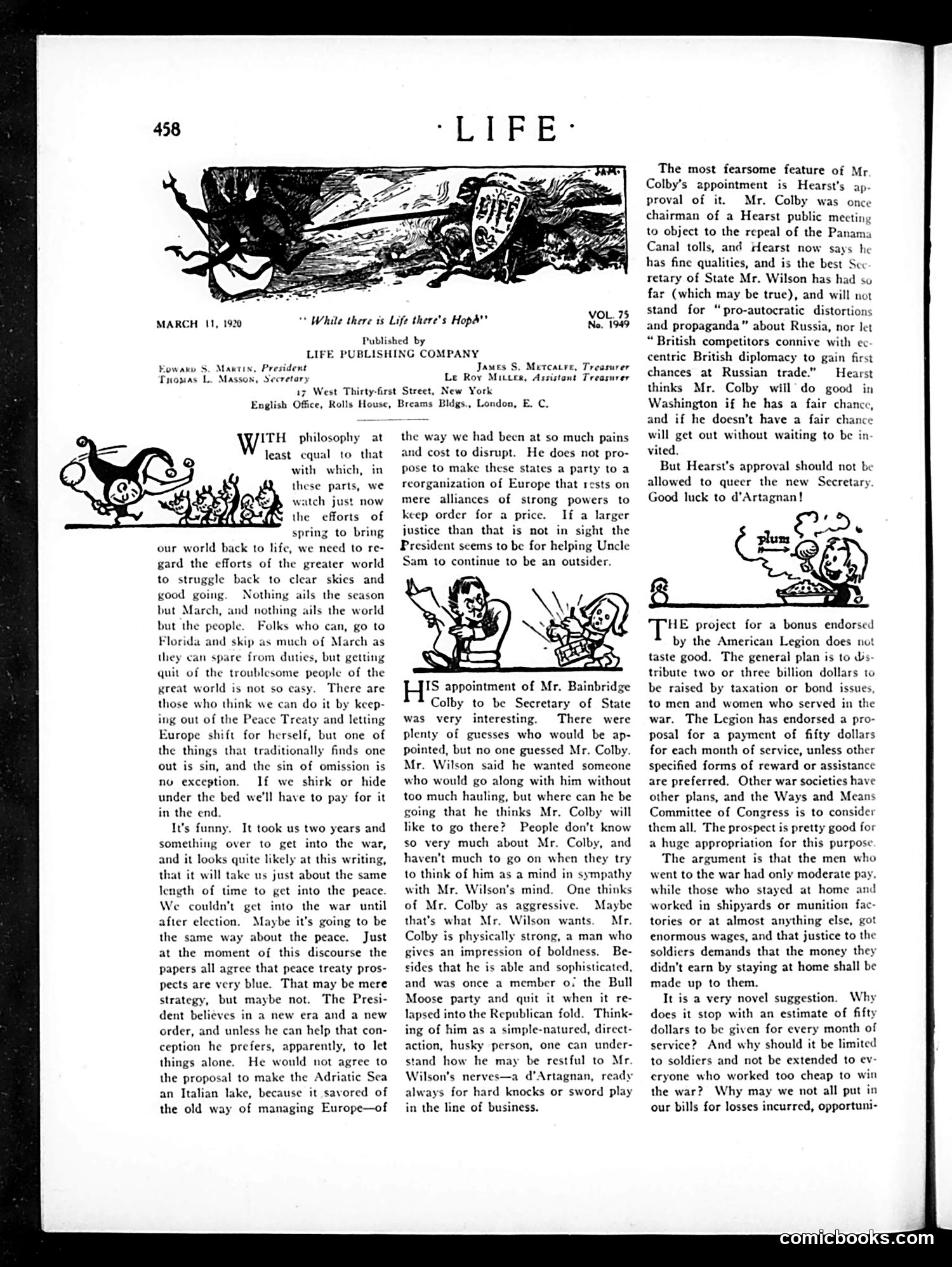
This March 1920 *Life* editorial satirizes President Wilson's approach to post-WWI peace negotiations. The main text criticizes Wilson's reluctance to engage in traditional European power-balancing (refusing to make the Adriatic an "Italian lake"), arguing that isolationism won't work—"the sin of omission" will catch up with America eventually. The piece then mocks Wilson's surprise appointment of Bainbridge Colby as Secretary of State. The author notes Colby's unexpected selection, describing him as physically aggressive and bold—a "d'Artagnan" type—presumably what Wilson wants for tough negotiations. The final criticism concerns Hearst's approval of Colby. The cartoonist notes Colby once chaired a Hearst-backed meeting opposing Panama Canal toll repeal, making Hearst's endorsement suspicious and potentially damaging to Colby's credibility with Wilson's progressive supporters.
📄 Transcribed text from this page (OCR, searchable)
Machine-transcribed from the original scan — historical spelling and the odd misread are preserved.
MARCH II, 1920 ** While there is Life there's Hopa"’ Published by LIFE PUBLISHING COMPANY Eowaky S. Mantin, President Tuomas L. Masson, Secretary James S. Metcatre, Treasurer Le Roy Miter, Assistant Treasurer 17 West Thirty-first Street, New York English Office, Rolls House, Breams Bldgs., London, E. C. ITH philosophy at least cqual to that with which, in these parts, we watch just now the efforts of spring to bring our world back to life, we need to re- gard the efforts of the greater world to struggle back to clear skies and good going. Nothing ails the season but March, and nothing ails the world but the people. Folks who go to Florida and skip as much of March as they can spare from duties, but getting quit of the troublesome people of the great world is not so easy. There are those who think we can do it by keep- ing out of the Peace Treaty and letting Europe shift for herself, but one of the things that traditionally finds one out is sin, and the sin of omission is no exception. If we shirk or hide under the bed we'll have to pay for it in the end. It's funny, It took us two years and something over to get into the war, and it looks quite likely at this writing, that it will take us just about the same length of time to get into the peace. We couldn't get into the war until after election. Maybe it’s going to be the same way about the peace. Just at the moment of this discourse the papers all agree that peace treaty pros- pects are very blue. That may be mere strategy, but maybe not. The Presi- dent believes in a new era and a new order, and unless he can help that con- ception he prefers, apparently, to let things alone. He would not agree to the proposal to make the Adriatic Sea an Italian lake, because it savored of the old way of managing Europe—of the way we had becn at so much pains and cost to disrupt. He does not pro- pose to make these states a party to a reorganization of Europe that rests on mere alliances of strong powers to keep order for a price. If a larger justice than that is not in sight the President seems to be for helping Uncle Sam to continue to be an outsider. H's appointment of Mr. Bainbridge Colby to be Secretary of State was very interesting. There were plenty of guesses who would be ap- pointed, but no one guessed Mr. Colby. Mr. Wilson said he wanted someone who would go along with him without too much hauling, but where can he be going that he thinks Mr. Colby will like to go there? People don’t know so very much about Mr. Colby, and haven't much to go on when they try to think of him as a mind in sympathy with Mr. Wilson’s mind. One thinks of Mr. Colby as aggressive. Maybe that’s what Mr. Wilson wants. Mr. Colby is physically strong, a man who gives an impression of boldness. Be- sides that he is able and sophisticated, and was once a member o/ the Bull Moose party and quit it when it re- lapsed into the Republican fold. Think- ing of him as a simple-natured, direct- action, husky person, one can under- stand how he may be restful to Mr Wilson’s nerves—a d’Artagnan, ready always for hard knocks or sword play in the line of business. The most fearsome feature of Mr Colby’s appointment is Hearst's ap- proval of it. Mr. Colby was once chairman of a Hearst public mecting to object to the repeal of the Panama Canal tolls, and Hearst now says he has fine qualities, and is the best Sec retary of State Mr. Wilson has had so far (which may be true), and will not stand for “pro-autocratic distortions and propaganda” about Russia, nor let “British competitors connive with ec centric British diplomacy to gain first chances at Russian trade.” Hearst thinks Mr. Colby will’ do good in Washington if he has a fair chance, and if he doesn’t have a fair chance will get out without waiting to be in vited. But Hearst's approval should not be allowed to queer the new Secretary. Good luck to d’Artagnan! peek “ fw HE project for a bonus endorsed by the American Legion does not taste good. The general plan is to Ws tribute two or three billion dollars to be raised by taxation or bond issues, to men and women who served in the war. The Legion has endorsed a pro- posal for a payment of fifty dollars for each month of service, unless other specified forms of reward or assistance are preferred. Other war societies have other plans, and the Ways and Means Committee of Congress is to consider them all. The prospect is pretty good for a huge appropriation for this purpose. The argument is that the men who went to the war had only moderate pay, while those who stayed at home and worked in shipyards or munition fac- tories or at almost anything else, got enormous wages, and that justice to the soldiers demands that the money they didn’t earn by staying at home shall be made up to them. It is a very novel suggestion. Why does it stop with an estimate of fifty dollars to be given for every month of service? And why should it be limited to soldiers and not be extended to ev- eryone who worked too cheap to win the war? Why may we not all put in our bills for losses incurred, opportuni-