
Life, 1920-03-11 · page 28 of 40
Life — March 11, 1920 — page 28: what you’re looking at
What you’re looking at
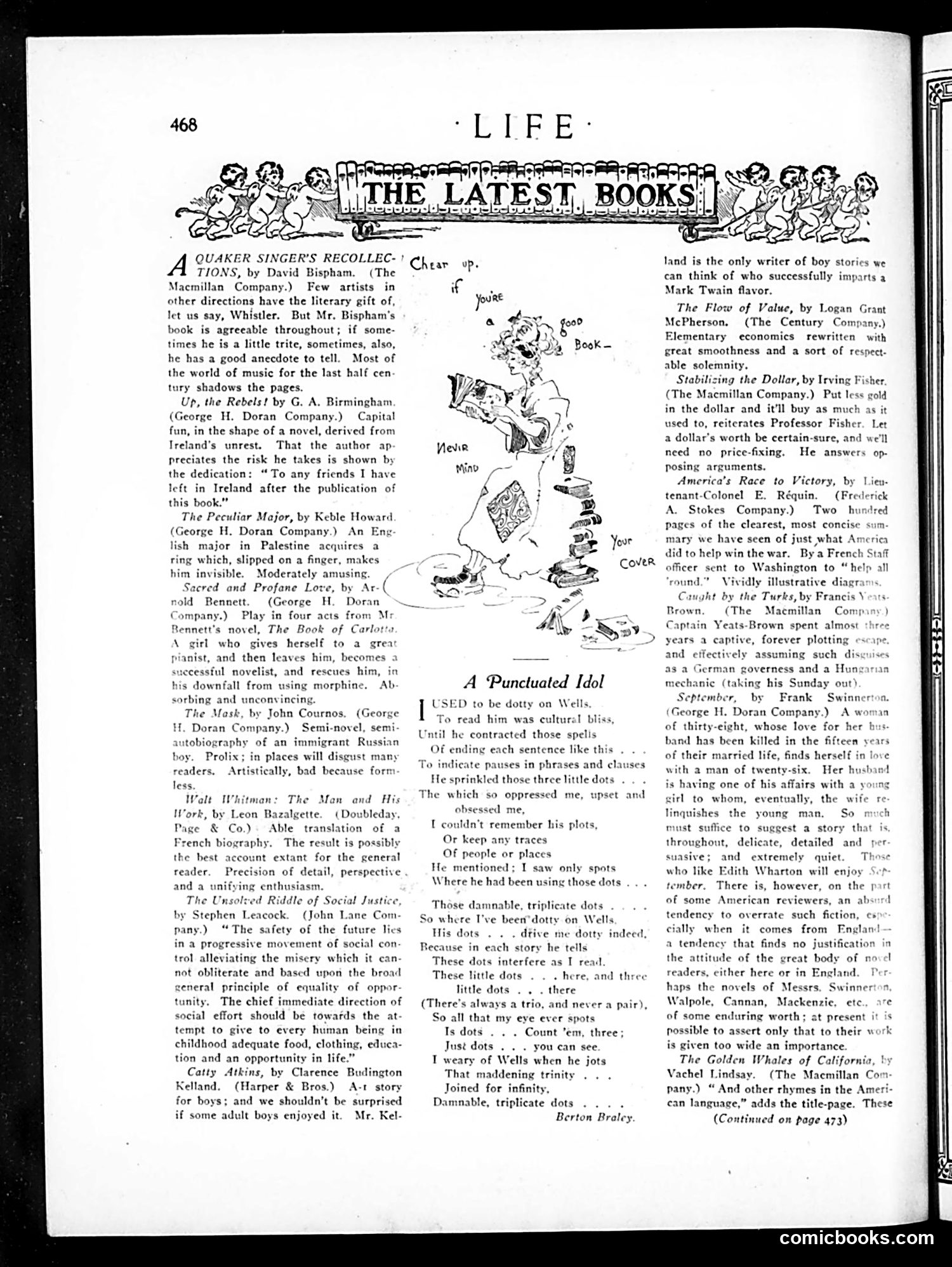
This page features a humorous poem mocking author H.G. Wells's notorious overuse of ellipses (three dots "...") in his writing. The cartoon illustration shows a figure constructed entirely from books, with the dots literally becoming visual obstructions. The poem's speaker describes becoming obsessed with Wells's work until frustrated by the constant punctuation marks interrupting every sentence. The repeated refrain emphasizes how these "damnable, triplicate dots" disrupted reading comprehension—the dots prevent him from remembering plots, characters, or locations. The satire targets a real stylistic quirk: Wells was known for using ellipses excessively to indicate pauses and hesitations, creating a manneristic rhythm that annoyed many readers. By personifying his irritation and making the dots literally block vision in the illustration, the poem transforms literary criticism into comedic complaint. This reflects Life magazine's tradition of gentle mockery toward prominent cultural figures.
📄 Transcribed text from this page (OCR, searchable)
Machine-transcribed from the original scan — historical spelling and the odd misread are preserved.
QUAKER SINGER'S RECOLLEC- ? TIONS, by David Bispham. (The Macmillan Company.) Few artists in other directions have the literary gift of, let us say, Whistler. But Mr. Bispham's book is agreeable throughout; if some- times he is a little trite, sometimes, also, he has a good anecdote to tell. Most of the world of music for the last half cen tury shadows the pages. Up, the Rebels! by G. A. Birmingham. (George H. Doran Company.) Capital fun, in the shape of a novel, derived from Ireland's unrest. That the author ap preciates the risk he takes is shown by the dedication: “To any friends I have left in Ireland after the publication of this book.” The Peculiar Major, by Keble Howard (George H. Doran Company.) An E lish major in Palestine acquires a ring which, slipped on a finger, makes him invisible. Moderately Sacred and Profane Love, by Ar-( nold Bennett. (George H. Doran Company.) Play in four acts from Mr Bennett's novel, The Book of Carlotts \ girl who gives herself to a great pianist, and then leaves him, becomes cessful novelist, and rescues him, in is downfall from using morphine. Ab sorbing and unconvincing. The Mask, by John Cournos. Doran Company.) Semi-novel, semi autobiography of an immigrant Russian . Prolix; in places will disgust many readers, Artistically, bad because form using, (George less. Walt The Work, by Leon Bazalgette. (Doubleday, Page & Co.) Able translation of a French biography. The result is possibly the best account extant for the general reader. Man and His Whitman: Precision of detail, perspective unifying enthusiasm. ed R of Social Justice, by Stephen Leacock. (John Lane Com- pany.) “The safety of the in a progressive movement of social con- trol alleviating the misery which it can- not obliterate and based upon the broad general principle of equality of oppor tunity. The chief immediate direction of social effort should be towards the at- tempt to give to every human being in childhood adequate food, clothing, educa- tion and an opportunity in life.” Catty Atkins, by Clarence Budington Kelland. (Harper & Bros.) A-t story for boys; and we shouldn’t be surprised if some adult boys enjoyed it. Mr. Kel- and a ure lies A Punctuated Idol USED to be dotty on Wells > read him was cultural bi Until he contracted those spells Of ending each sentence like this . . To indicate pauses in phrases and cl He sprinkled those three little dots . The which so oppressed me, upset ; obsessed me, U couldn't remember his plots, Or keep any traces OF people or places He mentioned; I saw only spots Where he had been using those dots . . . Those damnable, triplicate dots . So where I've been*dotty on Wells His dots . dtive me dotty indeed, Because in each story he tells These dots interfere as T read These little dots + here, little dots . there (There's always a ti and never a pair), So all that my eye ever spots Is dots . . . Count 'em, three; Just dots . . . you can see. I weary of Wells when he jots That maddening trinity Joined for infinity, Damnable, triplicate dots 8 Berton Braley. and three land is the only writer of boy stories we can think of who successfully imparts a Mark Twain flavor. The Flow of Value, by Logan Grant McPherson. (The Century Company.) Elementary economics rewritten with great smoothness and a sort of respect- able solemnity. Stabilizing the Dollar, by Irving Fisher. (The Macmillan Company.) Put less gold in the dollar and it'll buy as much as it used to, reiterates Professor Fisher. Let a dollar's worth be certain-sure, and we'll need no price-fixing. posing arguments. America’s Race to Victory, by Lieu tenant-Colonel E. Réquin. (Frederick A. Stokes Company.) Two hundred pages of the clearest, most concise sum- mary we have seen of just what America did to help win the war. By a French Sta officer sent to Washington to “h all ‘round.” Vividly illustrative diagr: Caught by the Turks, by Francis \ (The Macmillan Comp. Captain Yeats-Brown spent almost years a captive, forever plotting and eff He answers op- Brown. ely assuming such dis an governess and a Hungar hanic (taking his Sunday out) ember, by Frank Swinnert orge H. Doran Company.) A wo’ of thirty-eight, whose love for her bus band has been killed in the fifteen years of their married life, finds herself in love with a man of twenty-six. Her husband is having one of his affairs with a young girl to whom, eventually, the wife young man. So a Ger linquishes the must suffice to suggest a s y that throughout, delicate, detail and suasive; and extremely quiet who like Edith Wharton will enjoy tember. There is, however, on the part of some American reviewers, an abs tendency to overrate such fiction, es cially when it comes from Englan‘! a tendency that finds no justification the attitude of the great body of no readers, cither here or in England. 1° haps the novels of Messrs. Swin: Walpole, Cannan, Mackenzie, ete of some enduring worth; at present it is possible to assert only that to their work is given too wide an importance. The Golden Whales of California Vachel Lind: (The Macmillan Com- pany.) nd other rhymes in the Ameri- can language,” adds the title-page. These (Continued on page 473) comicbooks.com