
Life, 1920-03-11 · page 29 of 40
Life — March 11, 1920 — page 29: what you’re looking at
What you’re looking at
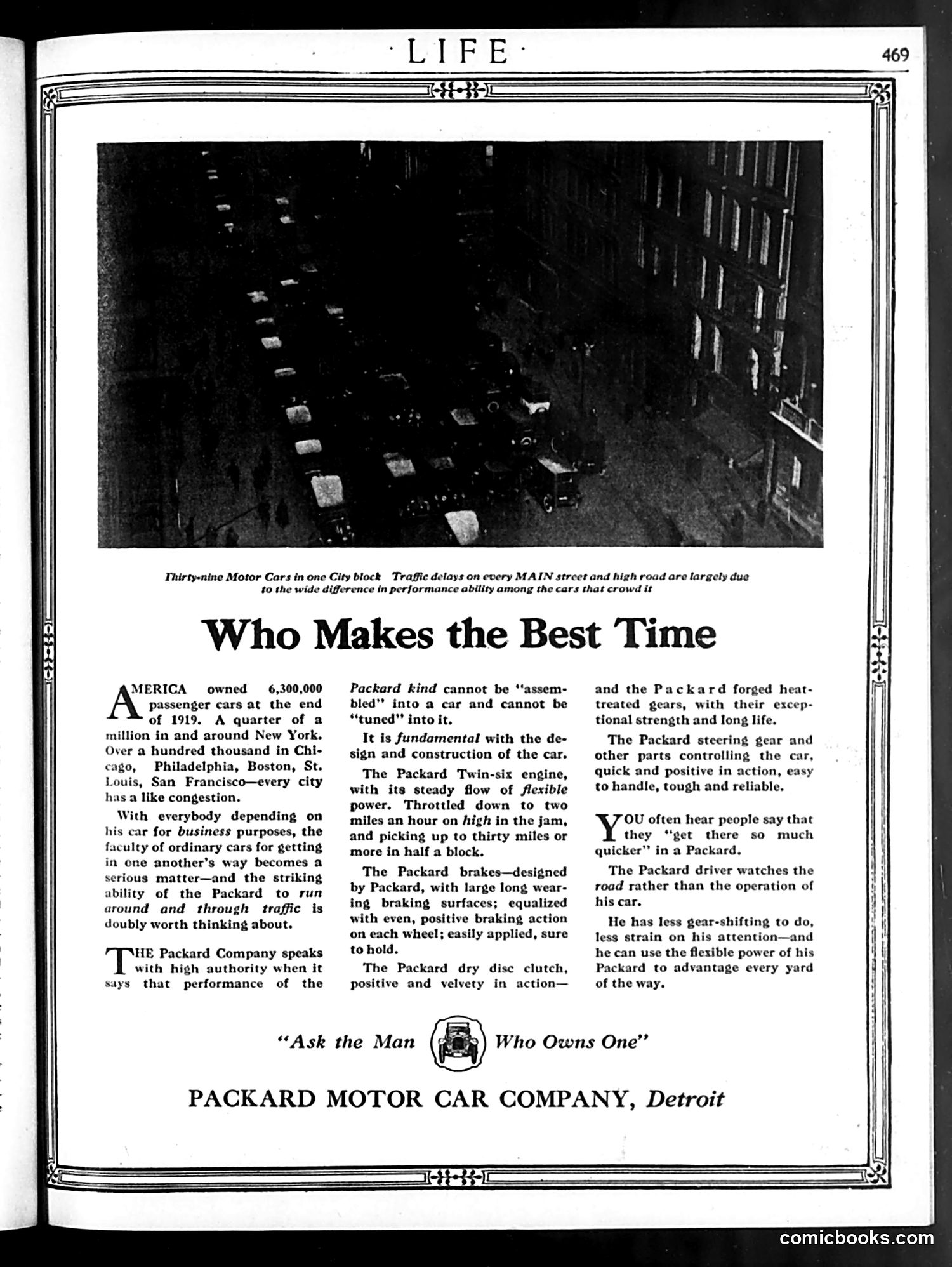
This is a **Packard automobile advertisement**, not a cartoon or satire. The page addresses a genuine 1919-1920 social concern: urban traffic congestion caused by the proliferation of motor cars (6.3 million in America by 1919's end). The advertisement's central argument is that traffic delays result from performance differences among vehicles—implying inferior cars clog streets. Packard positions itself as the solution through superior engineering: a flexible Twin-six engine, reliable brakes, responsive clutch, and precise steering that allow drivers to navigate congestion more effectively. The photograph shows thirty-nine cars in one city block, visualizing the congestion problem. The phrase "Ask the Man Who Owns One" was Packard's actual period slogan, appealing to owners' testimonies rather than manufacturer claims. This reflects early automotive marketing before standardization, when mechanical reliability and driver control genuinely varied significantly between manufacturers.
📄 Transcribed text from this page (OCR, searchable)
Machine-transcribed from the original scan — historical spelling and the odd misread are preserved.
Thirty-nine Motor Cars in one City block Traffic delays on every MAIN street and high road are largely due to the wide difference in performance ability among the cars that crowd it Who Makes the Best Time MERICA owned 6,300,000 A passenger cars at the end of 1919. A quarter of a million in and around New York. Over a hundred thousand in Chi- cago, Philadelphia, Boston, St. Louis, San Francisco—every city has a like congestion. With everybody depending on his car for business purposes, the faculty of ordinary cars for getting in one another's way becomes a serious matter—and the striking ability of the Packard to run around and through traffic is doubly worth thinking about. HE Packard Company speaks with high authority when it says that performance of the Packard kind cannot be ‘‘assem- bled"? into a car and cannot be “tuned” into it. It is fundamental with the de- sign and construction of the car. The Packard Twin-six engine, with its steady flow of flexible power. Throttled down to two miles an hour on high in the jam, and picking up to thirty miles or more in half a block. The Packard brakes—designed by Packard, with large long wear- ing braking surfaces; equalized with even, positive braking action on each wheel; easily applied, sure to hold. The Packard dry disc clutch, positive and velvety in action— and the Packard forged heat- treated gears, with their excep- tional strength and long life. The Packard steering gear and other parts controlling the car, quick and positive in action, easy to handle, tough and reliable. OU often hear people say that they “get there so much quicker” in a Packard. The Packard driver watches the road rather than the operation of his car. He has less gear-shifting to do, less strain on his attention—and he can use the flexible power of his Packard to advantage every yard of the way. “Ask the Man i Who Owns One’’ PACKARD MOTOR CAR COMPANY, Detroit comicbooks.com