
Life, 1920-03-11 · page 22 of 40
Life — March 11, 1920 — page 22: what you’re looking at
What you’re looking at
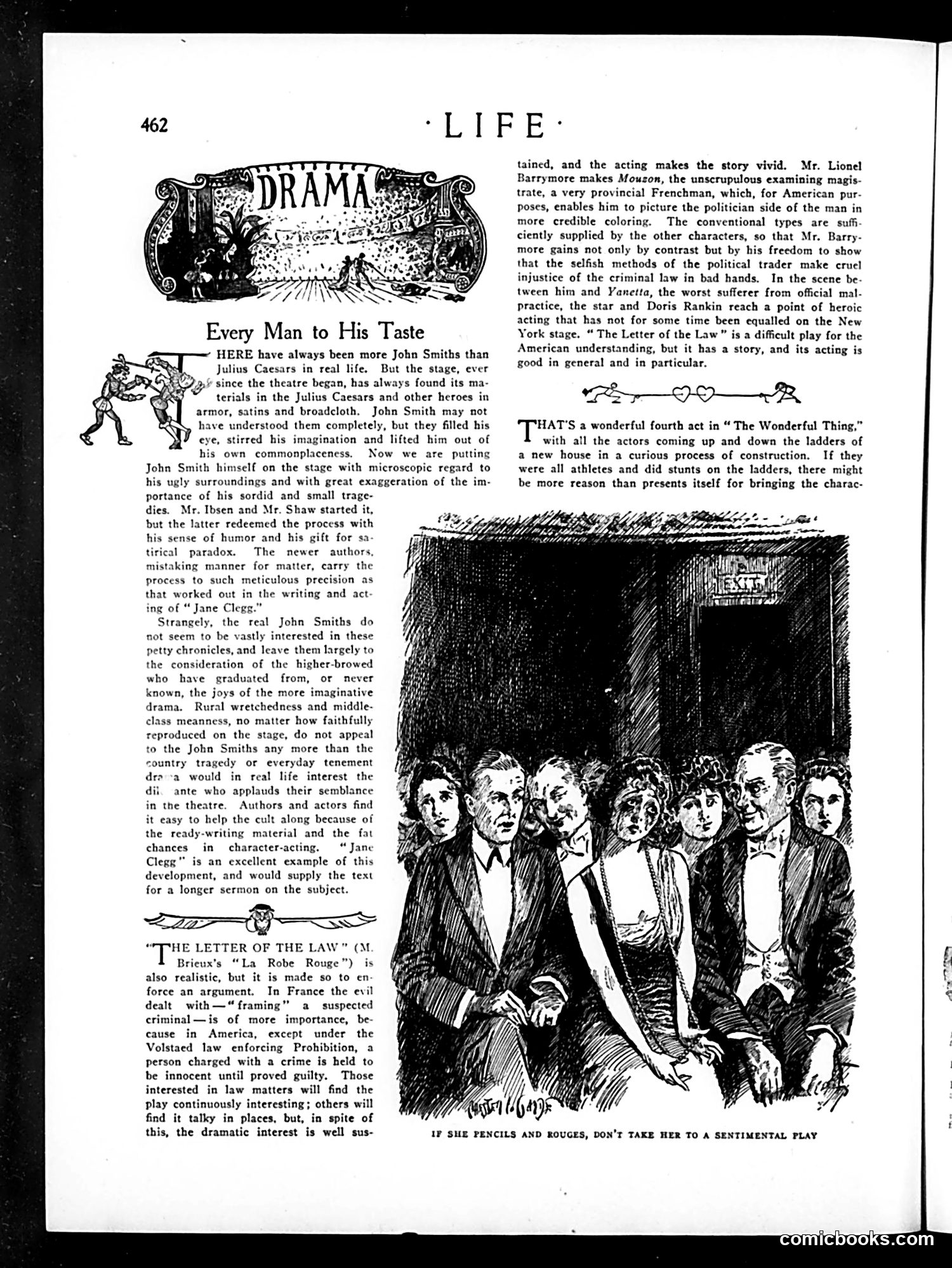
This page reviews contemporary theatrical productions, critiquing a shift in dramatic subject matter. The article "Every Man to His Taste" argues that modern playwrights (influenced by Ibsen and Shaw) now focus on ordinary people's mundane struggles rather than heroic figures. The writer suggests this realistic approach—exemplified by "Jane Clegg"—appeals only to intellectuals, not to average audiences ("John Smiths") who prefer escapism. The review of "The Letter of the Law" (Brieux's "La Robe Rouge") discusses a French legal drama about judicial corruption. Lionel Barrymore's performance as an unscrupulous magistrate is praised for its provincial characterization, allowing American audiences to understand the political abuse of power. The caption's joke about not taking women who wear makeup to sentimental plays is a period aside, suggesting cosmetics signify superficiality incompatible with emotional drama.
📄 Transcribed text from this page (OCR, searchable)
Machine-transcribed from the original scan — historical spelling and the odd misread are preserved.
‘LIP E« Every Man to His Taste HERE have always been more John Smiths than Julius Caesars in real life. But the stage, ever b*® since the theatre began, has always found its ma- terials in the Julius Caesars and other heroes in armor, satins and broadcloth. John Smith may not have understood them completely, but they filled his eye, stirred his imagination and lifted him out of his own commonplaceness. Now we are putting John Smith himself on the stage with microscopic regard to his ugly surroundings and with great exaggeration of the im- portance of his sordid and small trage- dies. Mr. Ibsen and Mr. Shaw started it, but the latter redeemed the process with his sense of humor and his gift for sa tirical paradox. The newer authors, mistaking manner for matter, carry the process to such meticulous precision as that worked out in the writing and act- ing of “ Jane Clegg.” Strangely, the real John Smiths do not seem to be vastly interested in these petty chronicles, and leave them largely to the consideration of the higher-browed who have graduated from, or never known, the joys of the more imaginative drama. Rural wretchedness and middle- class meanness, no matter how faithfully reproduced on the stage, do not appeal to the John Smiths any more than the country tragedy or everyday tenement dra -a would in real life interest the dil, ante who applauds their semblance in the theatre. Authors and actors find it easy to help the cult along because of the ready-writing material and the fat chances in character-acting. “ Jane Clegg" is an excellent example of this development, and would supply the text for a longer sermon on the subject. 7 “"CHE LETTER OF THE LAW” (M Brieux’s “La Robe Rouge”) is also realistic, but it is made so to en force an argument. In France the evil dealt with—“ framing” a suspected criminal—is of more importance, be- cause in America, except under the Volstaed law enforcing Prohibition, a person charged with a crime is held to be innocent until proved guilty. Those interested in law matters will find the play continuously interesting; others will find it talky in places, but, in spite of this, the dramatic interest is well sus- tained, and the acting makes the story vivid. Mr. Lionel Barrymore makes Mouzon, the unscrupulous examining magis- trate, a very provincial Frenchman, which, for American pur- poses, enables him to picture the politician side of the man in more credible coloring. The conventional types are suffi- ciently supplied by the other characters, so that Mr. Barry- more gains not only by contrast but by his freedom to show that the selfish methods of the political trader make cruel injustice of the criminal law in bad hands. In the scene be- tween him and Yanetta, the worst sufferer from official mal- practice, the star and Doris Rankin reach a point of heroic acting that has not for some time been equalled on the New York stage. “ The Letter of the Law” is a difficult play for the American understanding, but it has a story, and its acting is good in general and in particular. Poy —9O—_-R 'HAT'S a wonderful fourth act in “ The Wonderful Thing,” with all the actors coming up and down the ladders of a new house in a curious process of construction. If they were all athletes and did stunts on the ladders, there might be more reason than presents itself for bringing the charac- IF SHE PENCILS AND ROUGES, DON’T TAKE HER TO A SENTIMENTAL PLAY