
A complete issue · 36 pages · 1918
Life — November 7, 1918
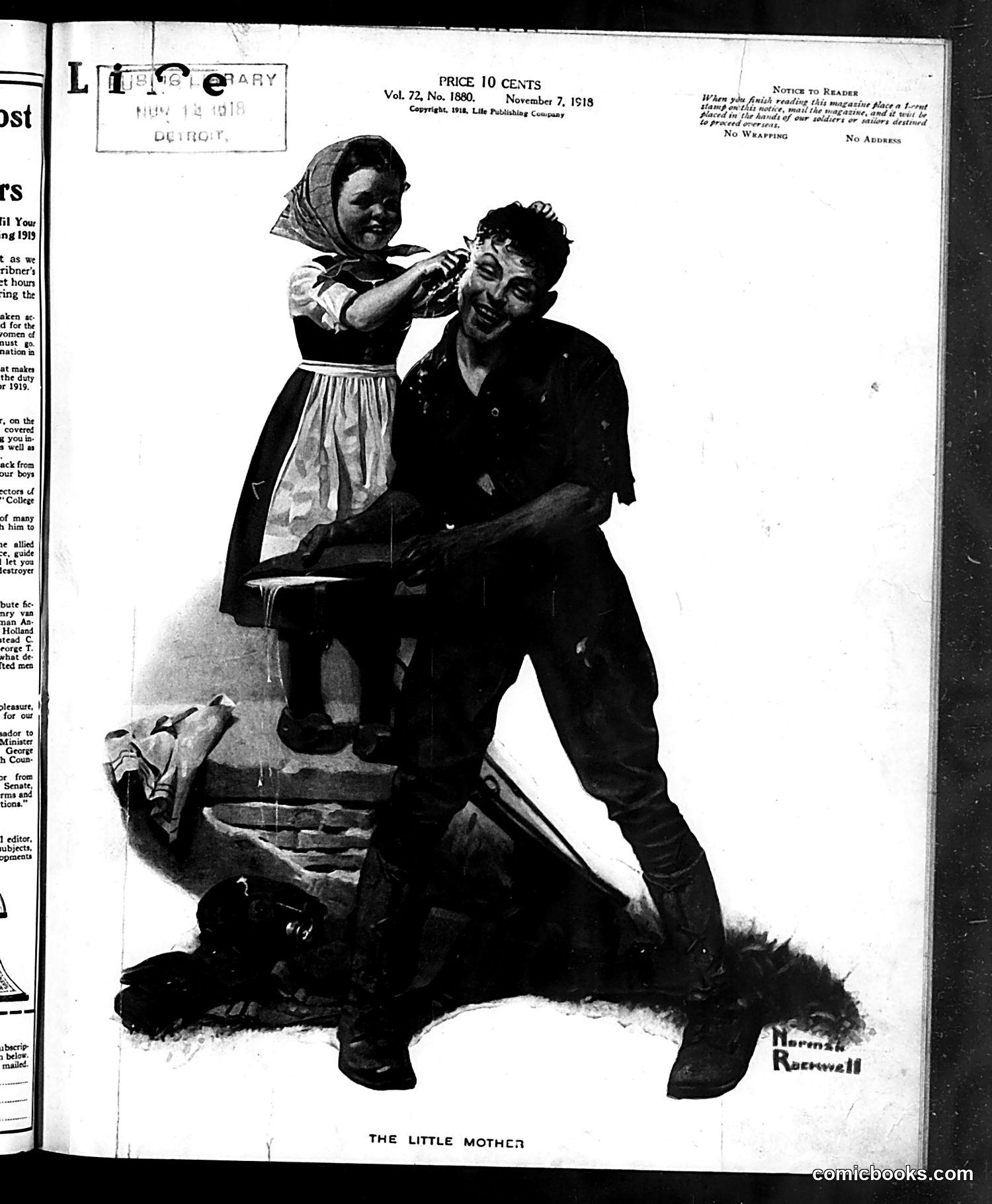
This illustration by Norman Rockwell depicts a domestic scene titled "The Little Mother." A young woman, wearing a headscarf and apron, appears to be tending to or examining a seated man's face—possibly shaving him or treating a wound. The man is dressed in dark work clothes. Given the November 1918 date (just as World War I ended), this likely carries wartime meaning: the woman represents the American home front, caring for soldiers or working men. The intimate, nurturing scene suggests themes of domestic support during wartime—women's essential role in sustaining the nation while men served or labored. Rockwell's sentimental style emphasizes patriotic sacrifice and gender roles typical of WWI-era American culture.
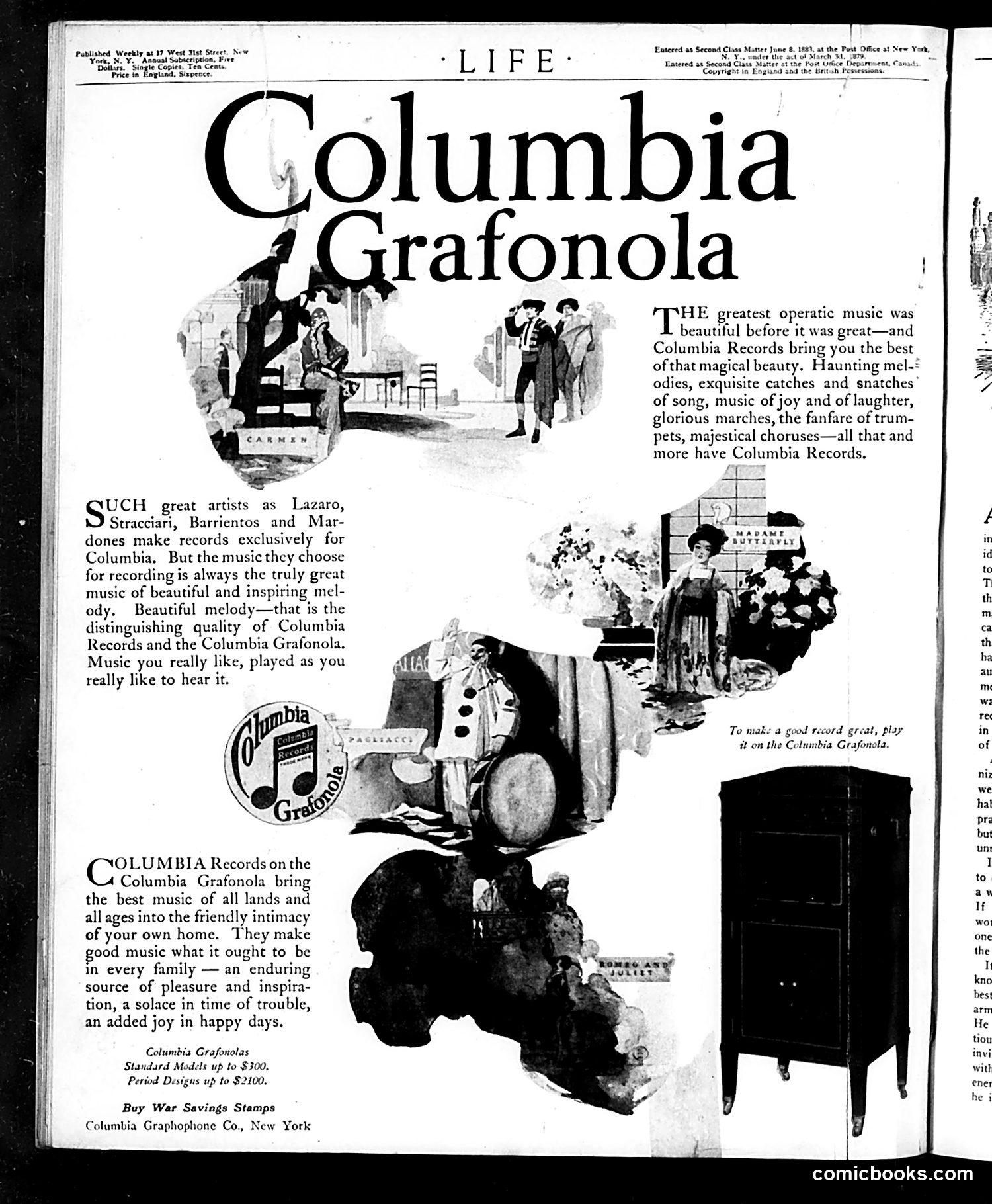
This page is primarily **advertising for Columbia Records and their Grafonola phonograph**, not political satire. The headline "Columbia Grafonola" dominates the layout. The ad emphasizes that Columbia Records features exclusive recordings by famous opera singers (Lazaro, Stracciari, Barrientos, and Arrientos are named). It promotes the Grafonola as a home entertainment device that brings "the best music of all lands" into "your own home." The imagery shows scenes from opera (including one labeled "Carmen"), a Grafonola phonograph, and a furniture-style cabinet model. A small note at bottom says "Buy War Savings Stamps," indicating this was published during WWI era (the magazine header shows June 1918). This is essentially a luxury consumer product advertisement with no apparent satire or political commentary.
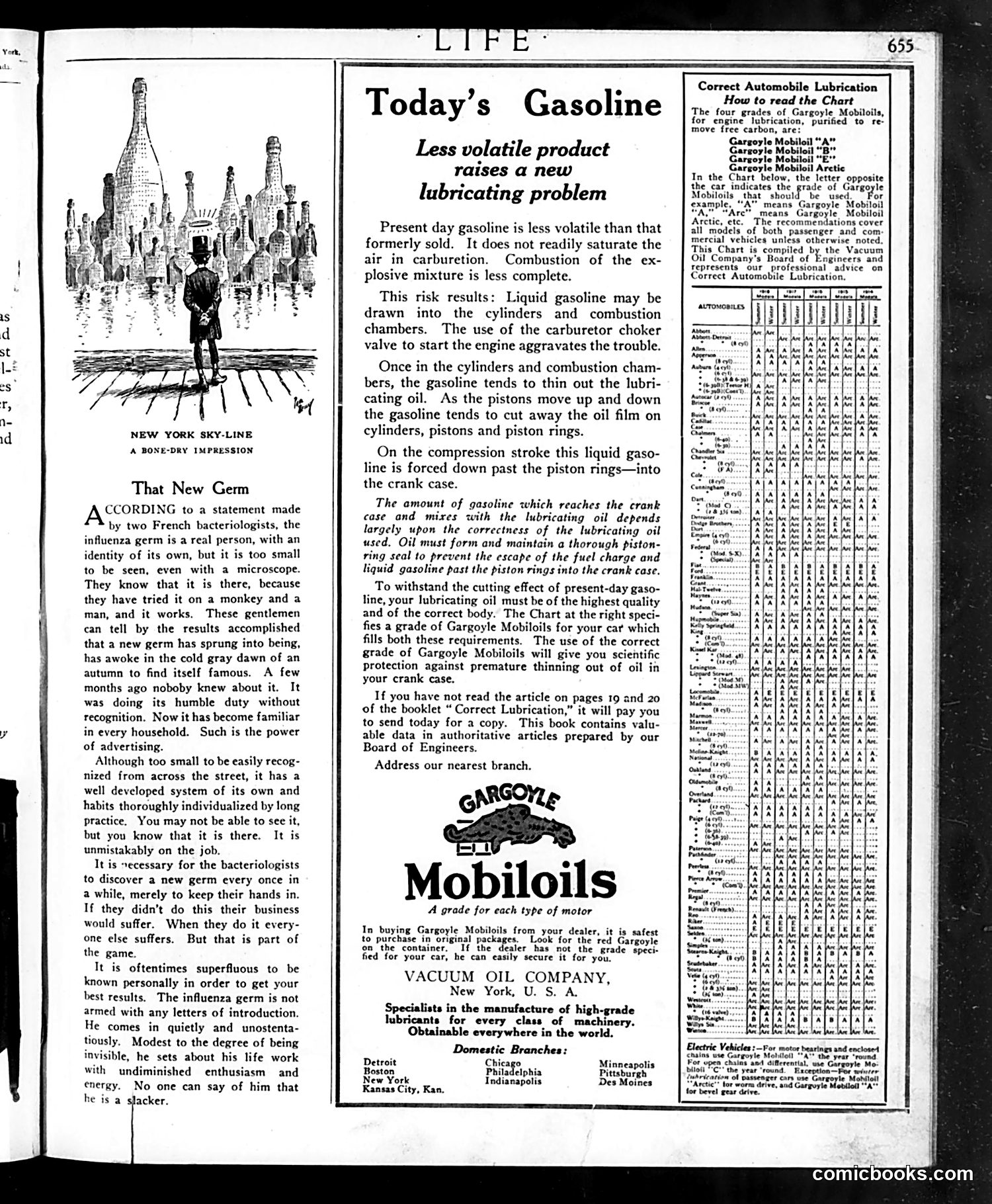
This page is primarily **advertising**, not satire. The main content consists of: 1. **"Today's Gasoline" article** - A technical advertisement by Gargoyle Mobiloils explaining lubrication problems caused by modern gasoline's lower volatility, which can thin engine oil. 2. **"That New Germ" cartoon and article** - A humorous piece about a French bacteriologist's discovery of an influenza germ. The accompanying sketch shows a figure dwarfed before the New York skyline, illustrating the microscopic nature of this "real person" germ. The tone is light and whimsical, celebrating scientific discovery. 3. **Large Gargoyle Mobiloils advertisement** - Promoting their motor oil products with a detailed lubrication chart for various automobile models. The page reflects early 20th-century concerns: modern automotive engineering challenges and contemporary enthusiasm for scientific advancement during the flu pandemic era.
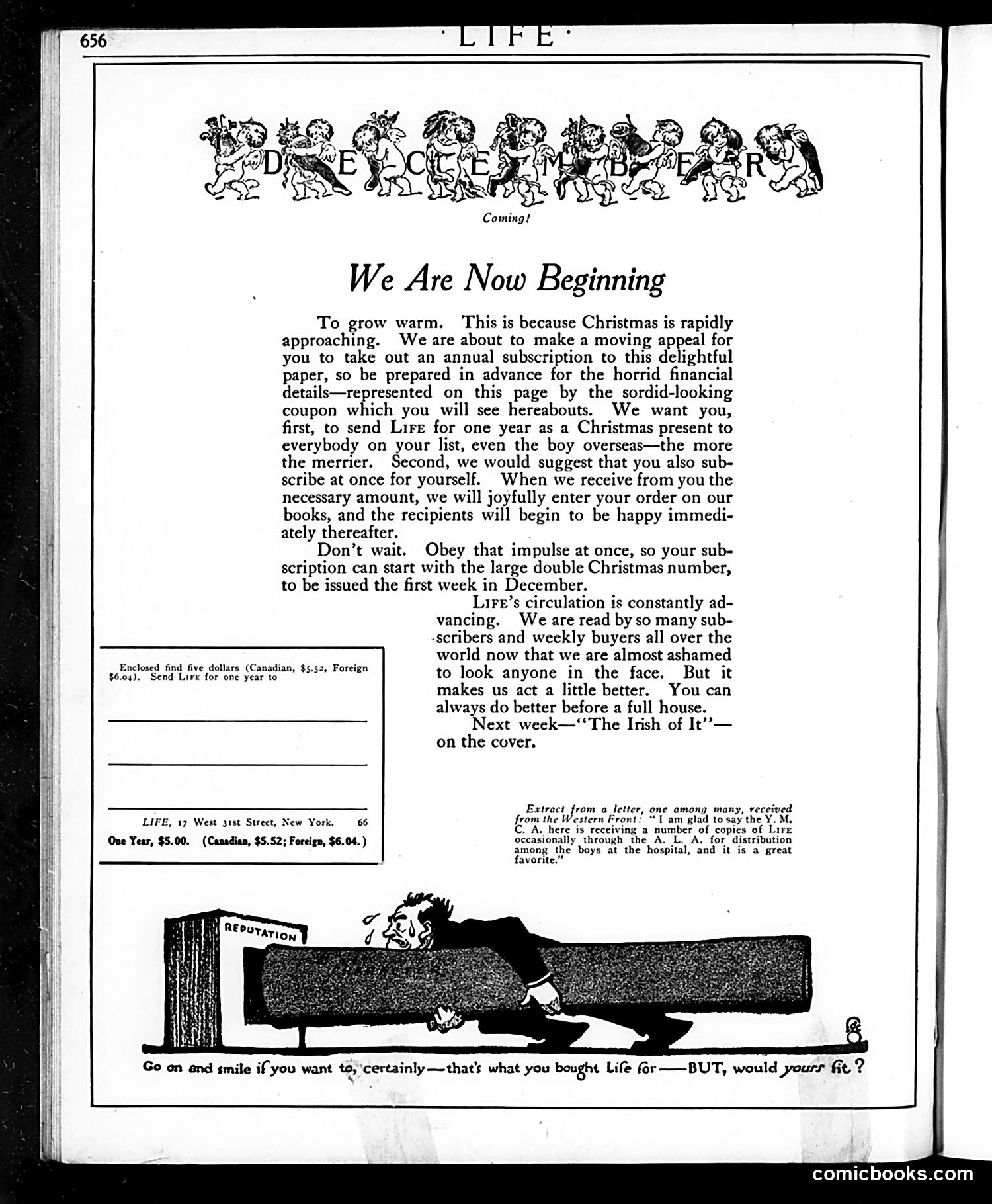
This page is primarily a **subscription solicitation** disguised as editorial content, urging readers to purchase Life magazine subscriptions as Christmas gifts. The **bottom cartoon** depicts a man labeled "REPUTATION" being crushed under a heavy log. The caption reads: "Go on and smile if you want to; certainly—that's what you bought Life for—BUT, would yours fit?" The **satire targets Life's readers themselves**: the implication is that Life magazine's humor and satirical content appeal to people's desire to appear sophisticated and witty in social settings. The crushing weight suggests the burden or strain of maintaining such a reputation through reading—a self-aware joke about the magazine's own cultural positioning as arbiter of educated taste and humor during this era.
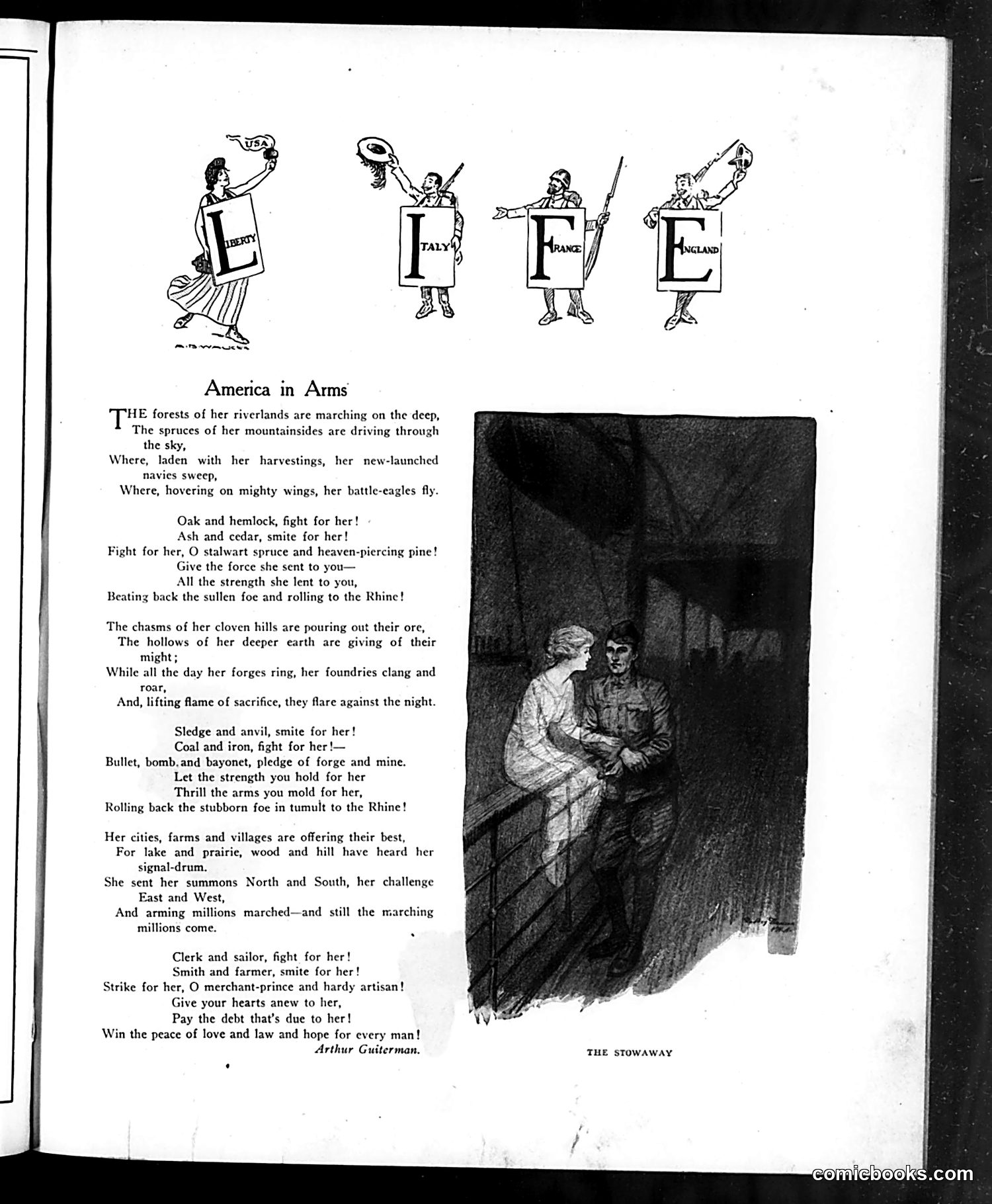
The four cartoon figures at the top represent personified nations: **Liberty** (America), **Italy**, **France**, and **England**—America's allies in World War I. Each holds a shield bearing their nation's name and displays weapons or martial posture, illustrating their unified military commitment. The poem "America in Arms" by Arthur Guiterman beneath celebrates American industrial and human resources mobilized for war—forests, mountains, forges, farms, and citizens (clerks, sailors, smiths, farmers, merchants). The illustration titled "The Stowaway" shows a woman and soldier together, likely representing America joining the conflict after initially attempting neutrality—a "stowaway" joining the Allied cause. This is patriotic WWI propaganda encouraging American industrial and military support for the Allied powers.
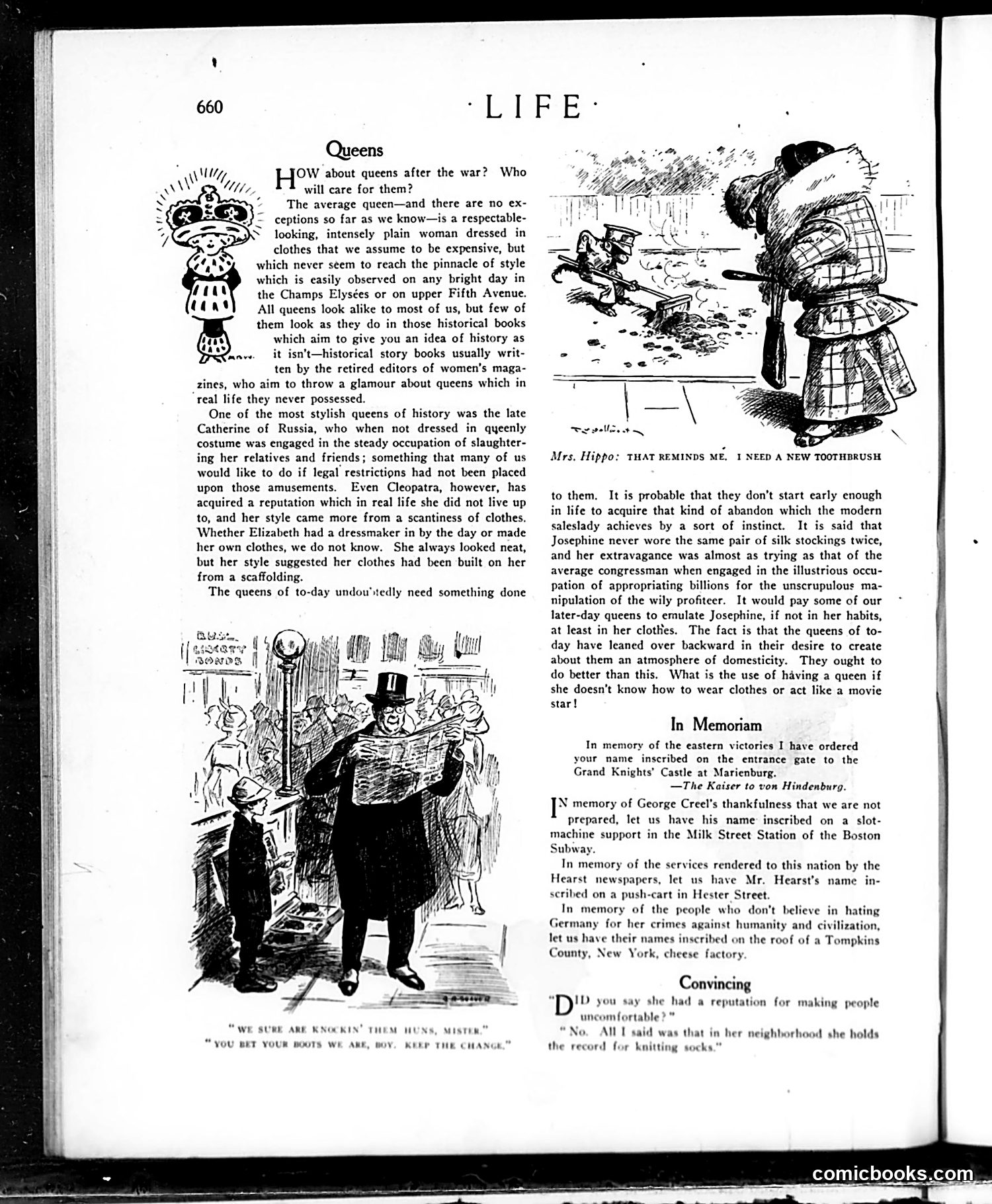
This page contains two distinct satirical pieces: **"Queens" (top section):** A commentary on post-WWI royal women, critiquing their plain appearance and lack of glamour compared to historical queens. The text mocks how modern queens fail to embody the splendor expected of royalty—they dress expensively but plainly, unlike Catherine of Russia or Cleopatra. The satire suggests queens should either dress more elaborately or abandon pretense altogether. The accompanying illustration depicts a street scene, though the specific reference is unclear. **Lower cartoon:** Shows a man in formal dress with children, captioned with working-class dialect ("We sure are knockin' them huns, sister"). This appears to reference WWI patriotism or propaganda, though the exact context requires additional historical knowledge. Both pieces use humor to critique expectations versus reality in the post-war era.
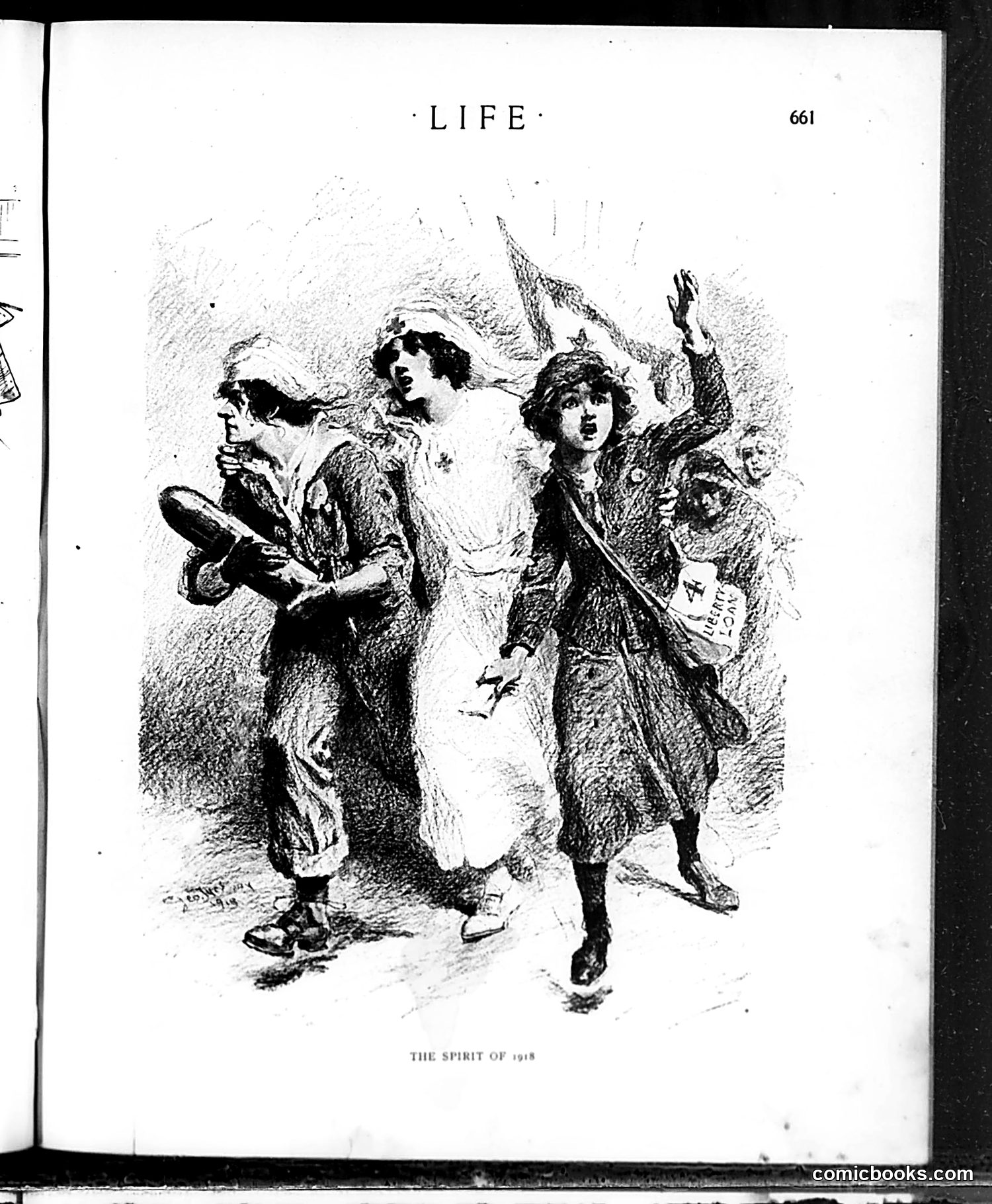
This satirical illustration from *Life* magazine depicts four figures representing different national or political entities during World War I (the war ended in November 1918). The central female figure appears to represent Liberty or America, surrounded by Allied representatives. The figures display animated, celebratory gestures—raising arms and appearing to shout or cheer. The title "The Spirit of 1918" likely references the final year of WWI, capturing the mood of victory and liberation as the conflict concluded. The satirical style suggests commentary on the Allied nations' triumphalism or the collective spirit of the moment. The exaggerated poses and expressions typical of *Life's* satirical approach emphasize the emotional fervor of the period, though the specific identities of each figure remain unclear from the image alone.
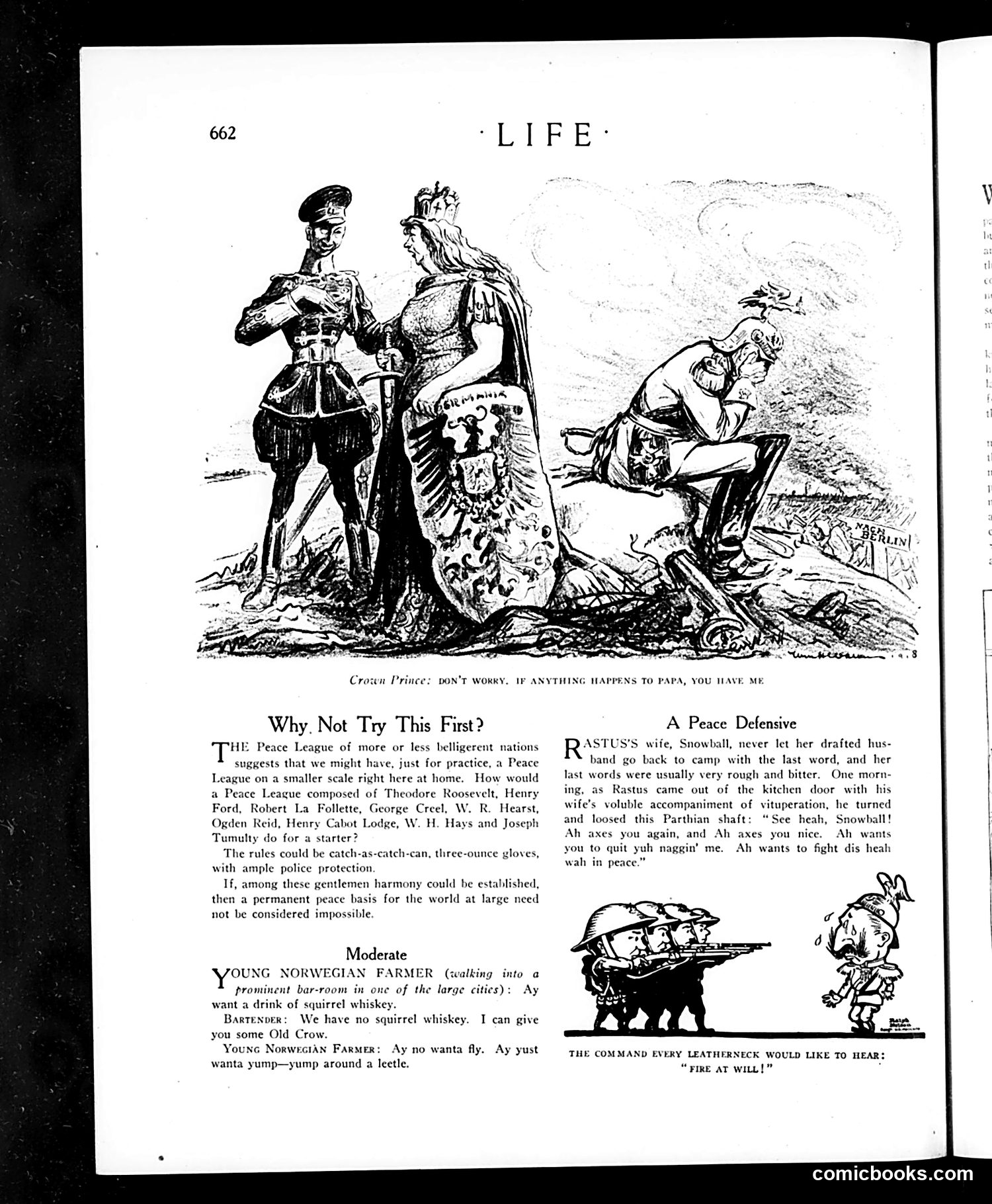
This page satirizes World War I peace proposals. The top cartoon mocks the "Crown Prince" (of Germany, identifiable by his military uniform and spiked helmet) reassuring his wife that if anything happens to "Papa" (Kaiser Wilhelm II), he'll inherit the throne—suggesting German leadership's self-interest over genuine peace. Below, two sections mock peace efforts: "Why Not Try This First?" satirizes proposals for a "Peace League" composed of prominent American businessmen (Theodore Roosevelt, Henry Ford, etc.) settling disputes through boxing matches—absurdly trivializing conflict resolution. "A Peace Defensive" depicts a Rastus character (a racist caricature) whose wife prevents him from fighting, suggesting stereotypes about Black masculinity and domestic conflict. The bottom cartoon mocks overeager military enthusiasm. The page reflects wartime skepticism about peace initiatives.
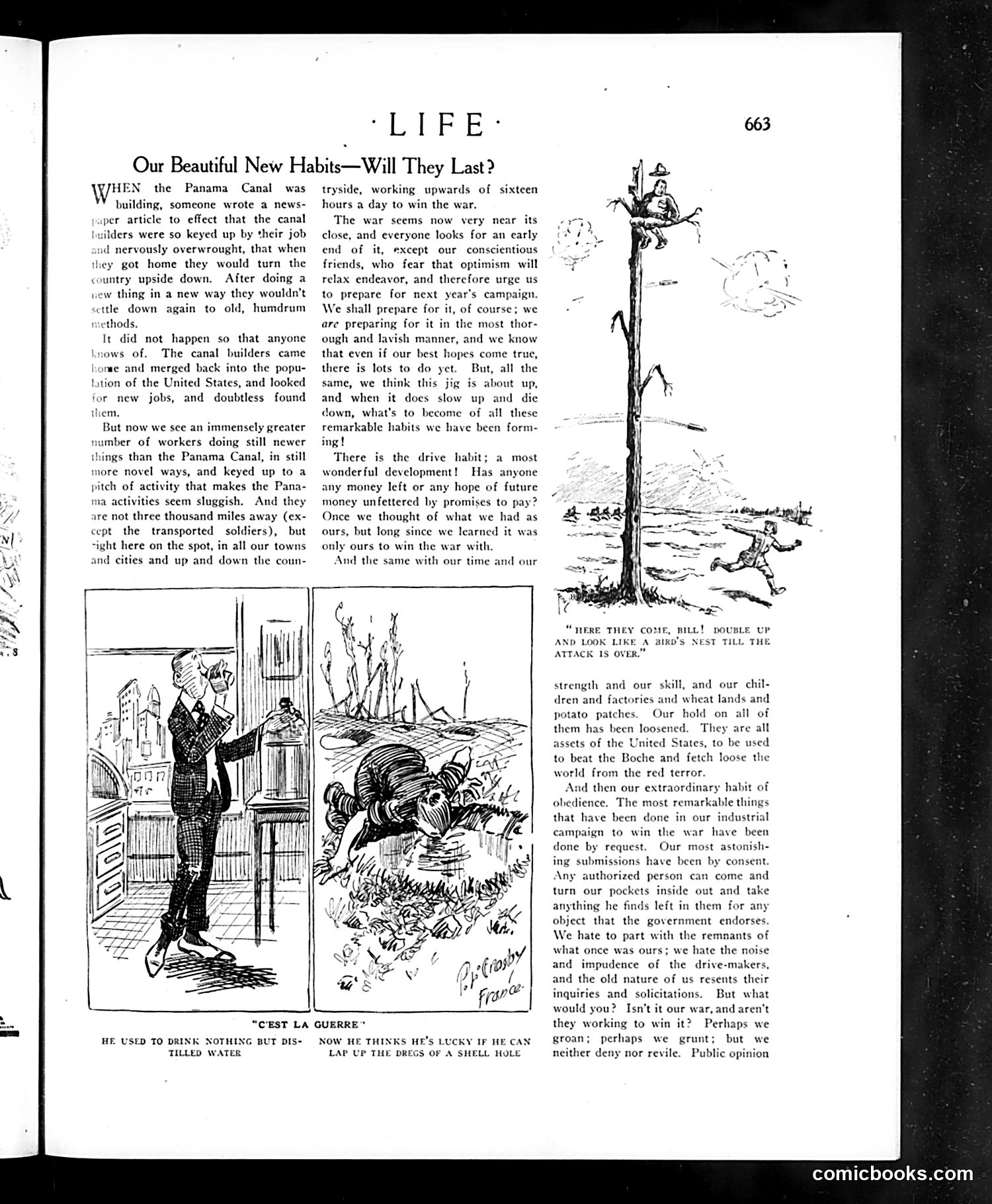
This 1918 Life magazine page satirizes American wartime habits and attitudes during World War I. The title "Our Beautiful New Habits—Will They Last?" questions whether wartime behavioral changes will persist after the conflict ends. The cartoons illustrate specific wartime adaptations: one shows someone drinking distilled water instead of other beverages (likely referencing Prohibition efforts), while another depicts military discipline becoming normalized in civilian life. The main text argues that extraordinary habits—like industrial efficiency, obedience to authority, and sacrifice—were adopted to "win the war." The author expresses doubt these habits will survive peacetime, musing whether Americans will return to pre-war complacency or maintain their newfound discipline and unity. The satire critiques American inconsistency and questions whether wartime unity can translate into lasting social improvement.
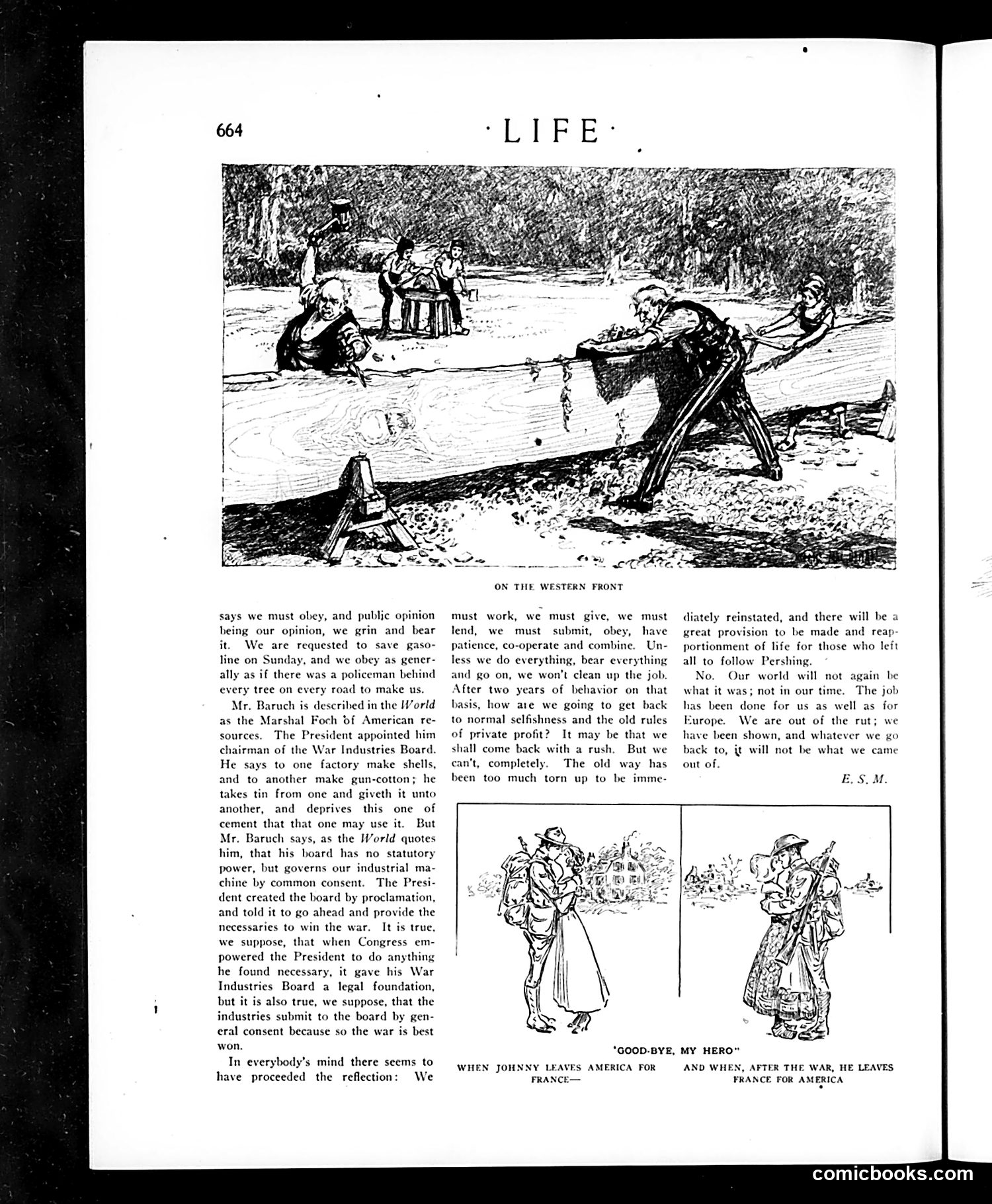
This page features a WWI-era cartoon titled "On the Western Front" depicting soldiers in a trench scene. The accompanying text discusses industrial mobilization for war, referencing Mr. Baruch (likely Bernard Baruch, head of the War Industries Board) and debates over governmental control versus private profit in wartime production. The two smaller illustrations at bottom show a soldier departing for France ("Good-bye, My Hero") and his return after the war. These contrast the enthusiastic send-off with the soldier's reintegration home, likely satirizing changing attitudes toward returning veterans or the gap between wartime patriotism and peacetime treatment. The overall message critiques the tension between collective sacrifice ("we must work, we must give") and preserving private interests during wartime mobilization.
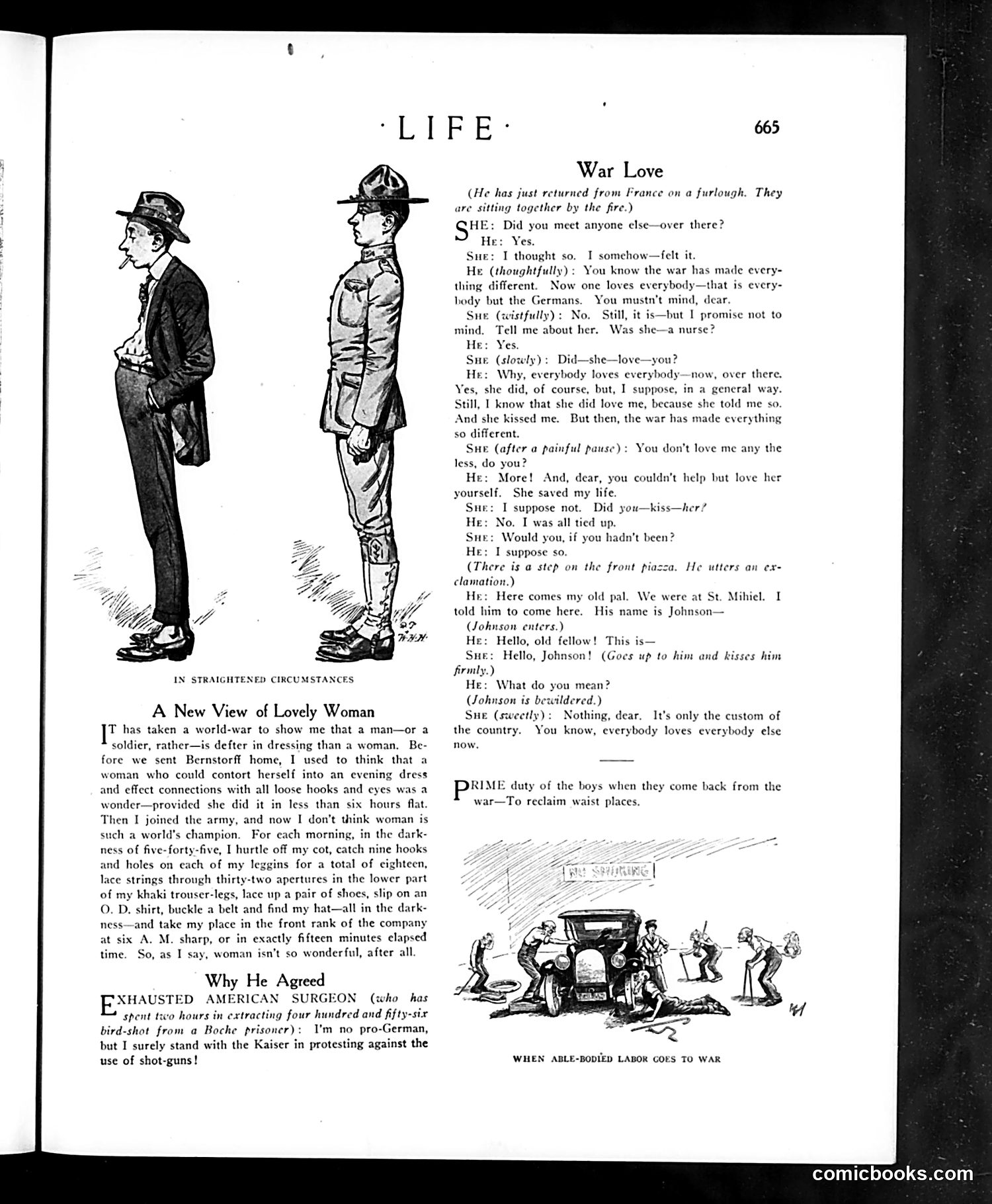
This page contains three satirical pieces about World War I and gender roles: **"War Love"** presents a dialogue between a soldier and woman discussing romance during wartime. The humor plays on how warfare supposedly changes social norms—she kisses him freely ("custom of the country"), which would have been scandalous pre-war behavior. **"A New View of Lovely Woman"** mocks the author's previous assumptions about women's delicacy. He describes the physical effort of military dressing (hooks, laces, equipment), suggesting women are now recognized as capable and hardy—equal to soldiers' demands. **"Why He Agreed"** shows an exhausted American surgeon refusing pro-German sympathies after extreme service, implying moral clarity through suffering. The illustrations depict soldiers in various states, emphasizing the physical transformation war demands of both men and women.
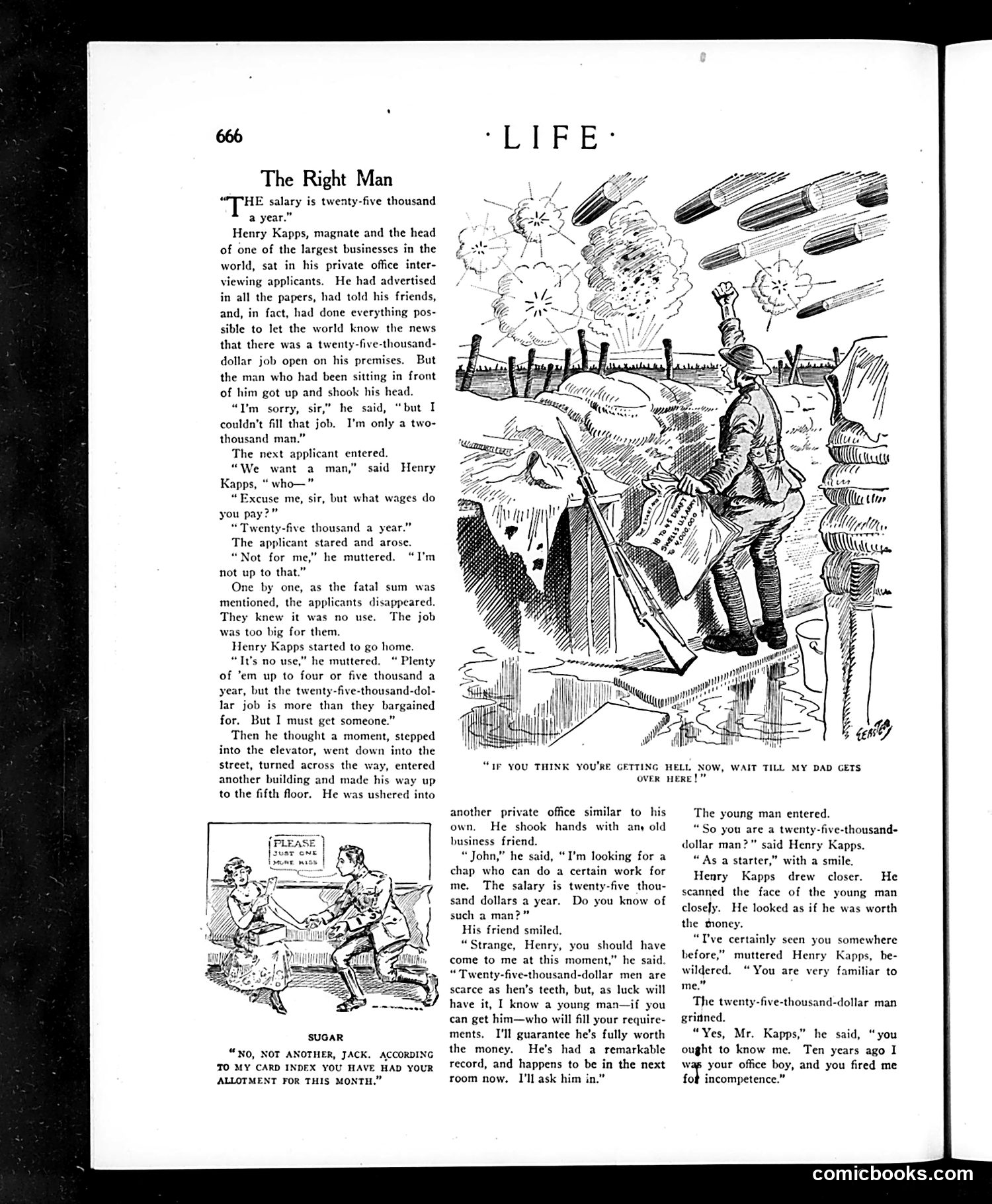
This story satirizes early 20th-century American business culture and class anxiety. Henry Kapps, a wealthy businessman, advertises a $25,000 annual salary position—an extraordinarily high wage for the era. Applicants eagerly apply, but when told the salary, each refuses, fearing the job is genuinely too demanding or dangerous to be worth it at any price. The punchline emerges when Kapps encounters a young man he previously fired for incompetence ten years earlier. This man accepts the position without hesitation, unaware of its true nature. The cartoon mocks both employer deception and working-class desperation: the "right man" is simply someone so financially desperate or naive he'll accept exploitative terms without question.
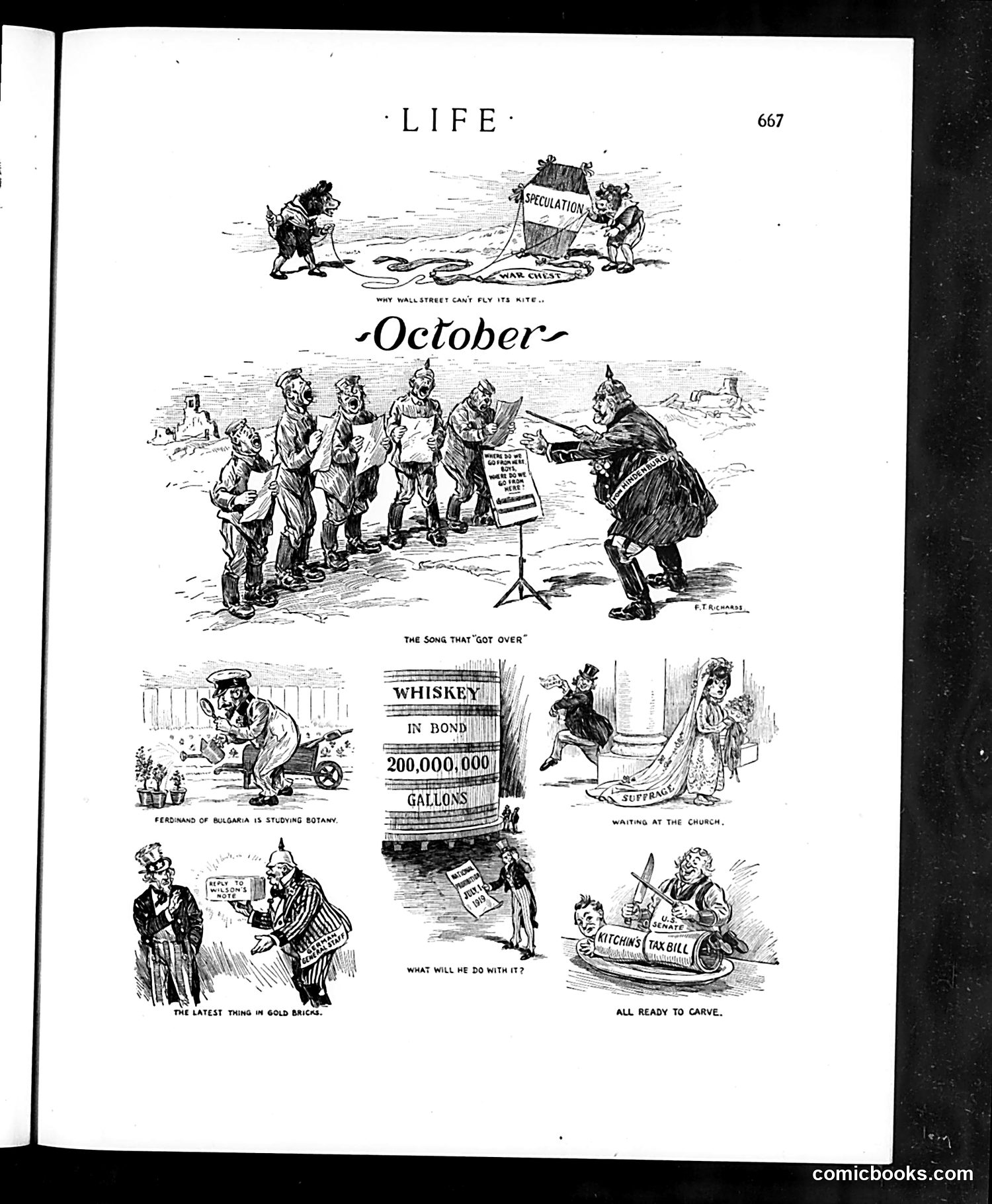
This page contains several interconnected satirical cartoons about early 20th-century American concerns: **Top cartoon** ("The Sons That Got Over"): Depicts military figures being instructed by a commanding officer, likely satirizing WWI soldiers returning home or war readiness. **Central image**: A large whiskey barrel labeled "200,000,000 Gallons" appears to address Prohibition debates—questioning what to do with alcohol stockpiles. **Surrounding vignettes** mock various topics: - Ferdinand of Bulgaria studying botany (political commentary on a foreign leader) - Gold prices and financial concerns ("Latest Thing in Gold Bricks") - Women's suffrage ("Waiting at the Church") - Food/kitchen taxation ("Kitchen's Tax Bill") The overall theme critiques contemporary political, military, and social anxieties of the era through satirical humor and caricature.
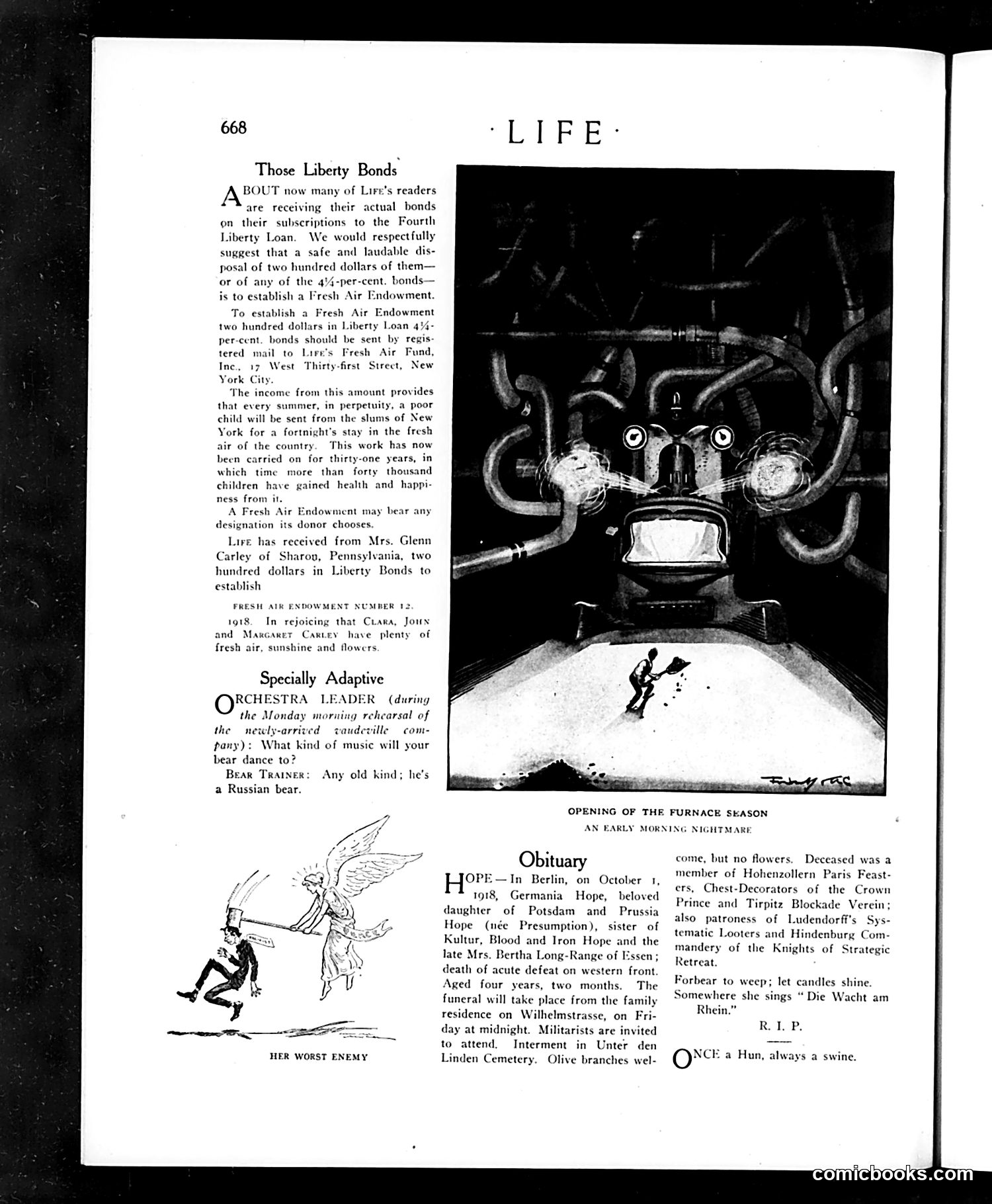
This page contains three distinct elements: 1. **"Those Liberty Bonds"** - An editorial encouraging readers to invest their Fourth Liberty Loan bond subscriptions in a Fresh Air Endowment, supporting poor children's summer stays in fresh air (a Progressive-era health initiative). 2. **"Opening of the Furnace Season"** - A cartoon showing a nightmarish figure operating industrial furnace controls. The caption "An Early Morning Nightmare" suggests anxiety about the approaching winter heating season, likely referencing fuel shortages or rationing during World War I. 3. **"Obituary"** - A death notice for a German noblewoman killed in WWI, followed by brief humorous quotes about hunts and swine, typical of Life's satirical section. The page reflects 1918 wartime concerns: Liberty Bonds, social welfare programs, and anti-German sentiment.
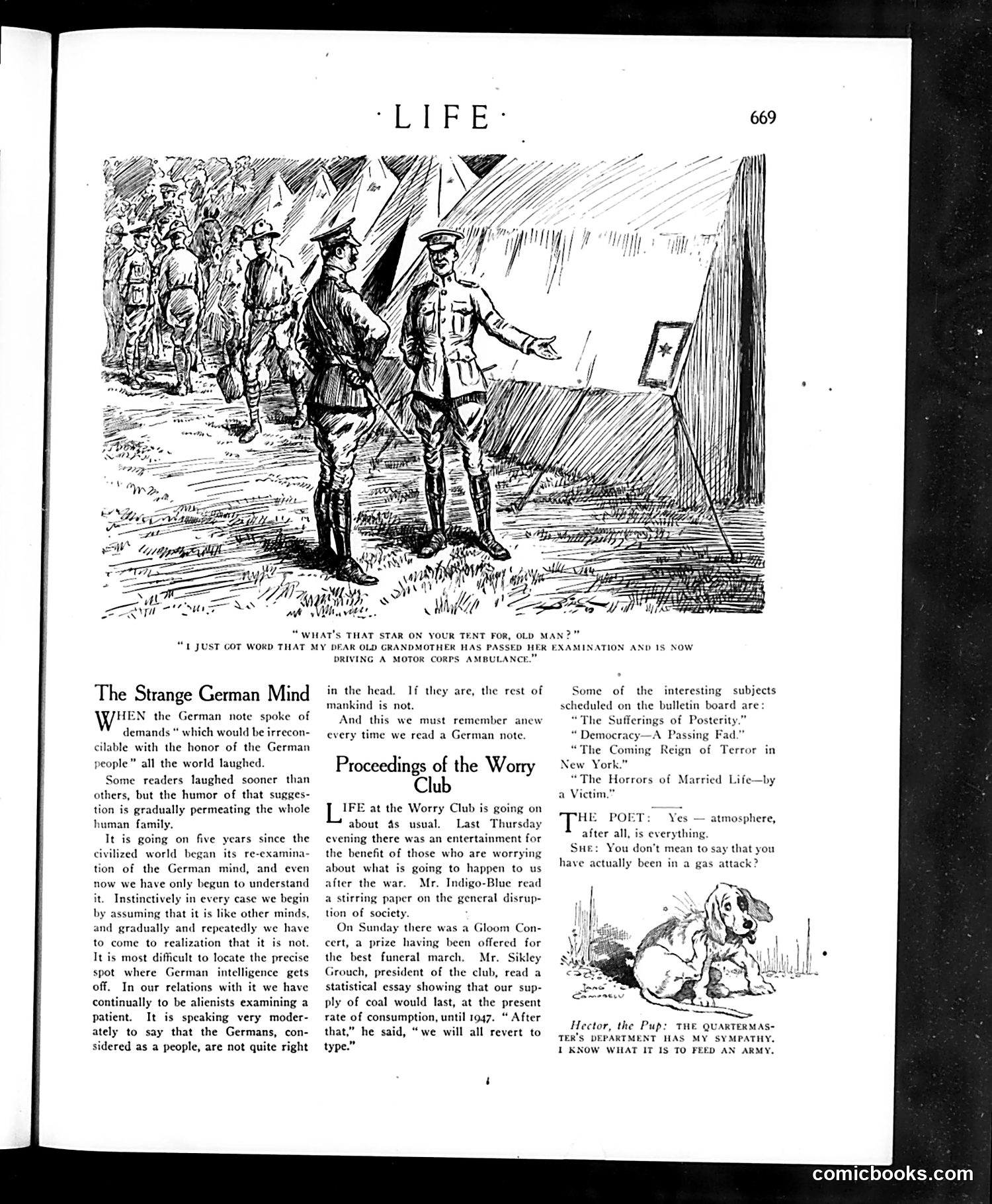
The main cartoon depicts military officers at a tent, with one officer pointing to a star on the tent while speaking to another. The caption reads: "What's that star on your tent for, old man?" The response: "I just got word that my dear old grandmother has passed her examination and is now driving a motor corps ambulance." This is WWI-era satire about the home front. The joke relies on the incongruity of an elderly grandmother becoming a military ambulance driver—suggesting that wartime mobilization has reached absurd levels, pulling even the elderly into service roles. The "star" likely indicates official military status or authorization. The accompanying article "The Strange German Mind" discusses German military philosophy, while "Proceedings of the Worry Club" presents satirical commentary on post-war anxieties, including coal shortages and social disruption.
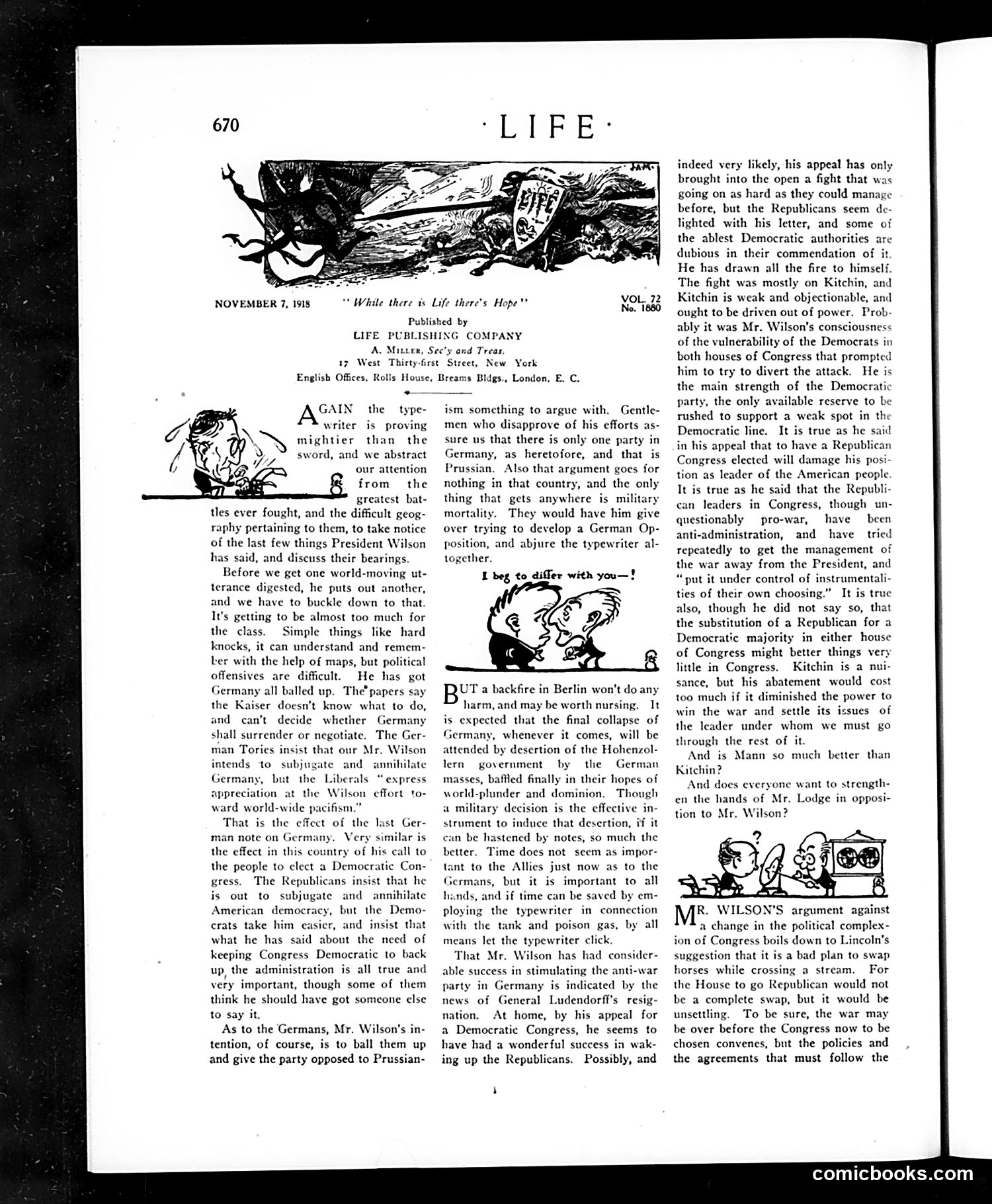
This Life magazine piece satirizes President Wilson's recent diplomatic and political communications during World War I's final weeks. The cartoons and text mock how Wilson's typewriter (his written appeals) affects different audiences unpredictably. The satire targets Wilson's dual strategy: his notes to Germany attempting to foment internal opposition to the Kaiser, and his appeal for Americans to elect a Democratic Congress to support his administration. The author argues both efforts confuse their intended audiences—Germans and Republicans respectively—though perhaps productively. Key figures referenced include **Kitchin** (likely Claude Kitchin, a Democratic congressman facing criticism) and **Ludendorff** (the German general whose resignation the author credits partly to Wilson's anti-war messaging). The joke: Wilson's typewriter proves as powerful as military weapons, inadvertently energizing Republican opposition while potentially weakening German morale—proving unpredictability can serve useful wartime purposes.
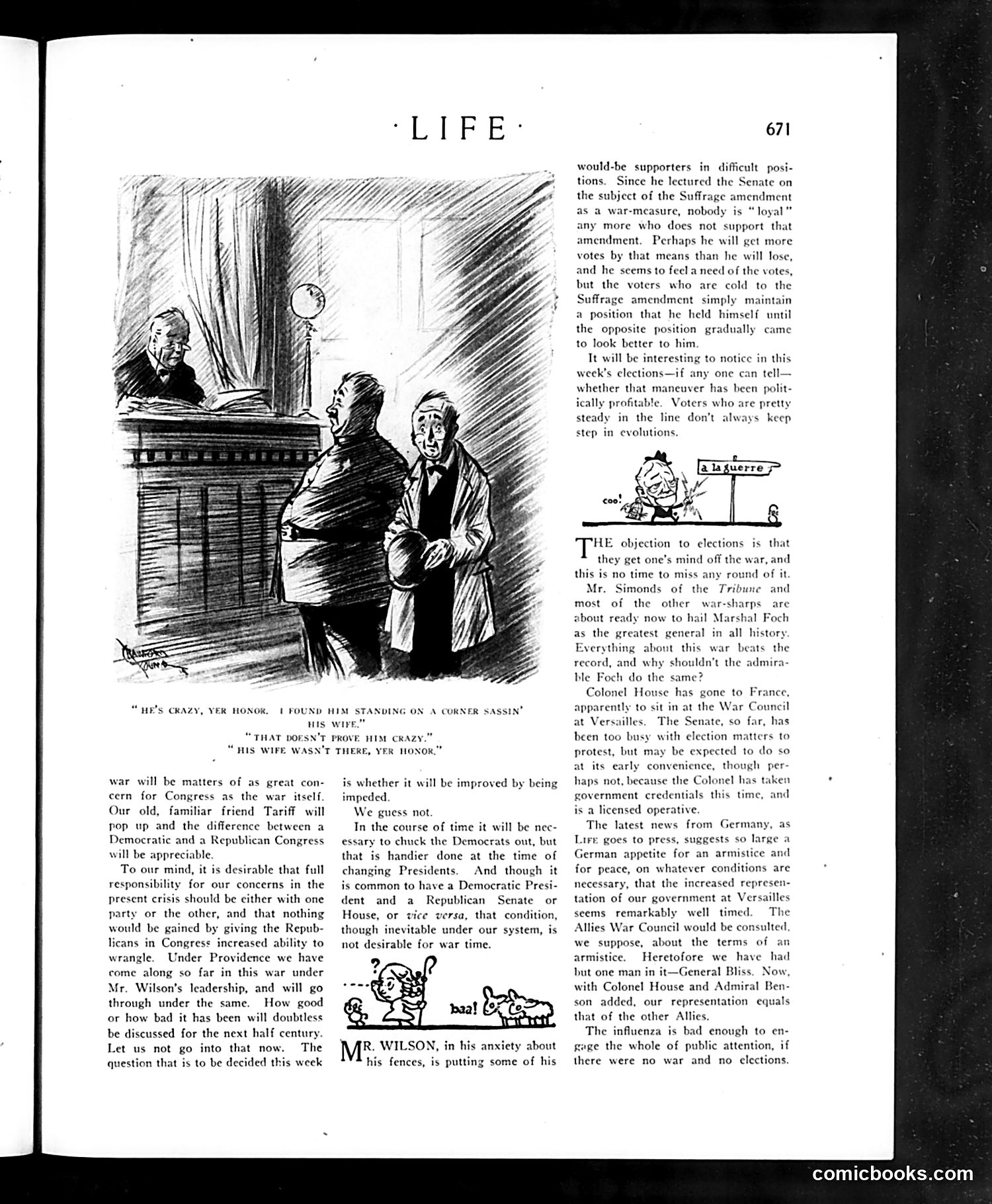
The main cartoon depicts a judge hearing a case where a man was found "standing on a corner sassin' his wife." The humor lies in the judge's response: finding a man arguing with his absent wife doesn't prove he's crazy—it's normal behavior. This is domestic satire mocking marital disputes. The accompanying text discusses upcoming elections during World War I, criticizing their timing as a distraction from the war effort. The author argues for unified government control rather than split Democratic-Republican leadership during wartime. The piece specifically references President Wilson's recent push for women's suffrage as a "war-measure," noting this has alienated voters previously neutral on the issue. The commentary questions whether Wilson's political maneuvering will gain or lose votes. The article also mentions Colonel House attending the War Council at Versailles and discusses Marshal Foch's military reputation, placing this during late-stage WWI negotiations (likely 1918).
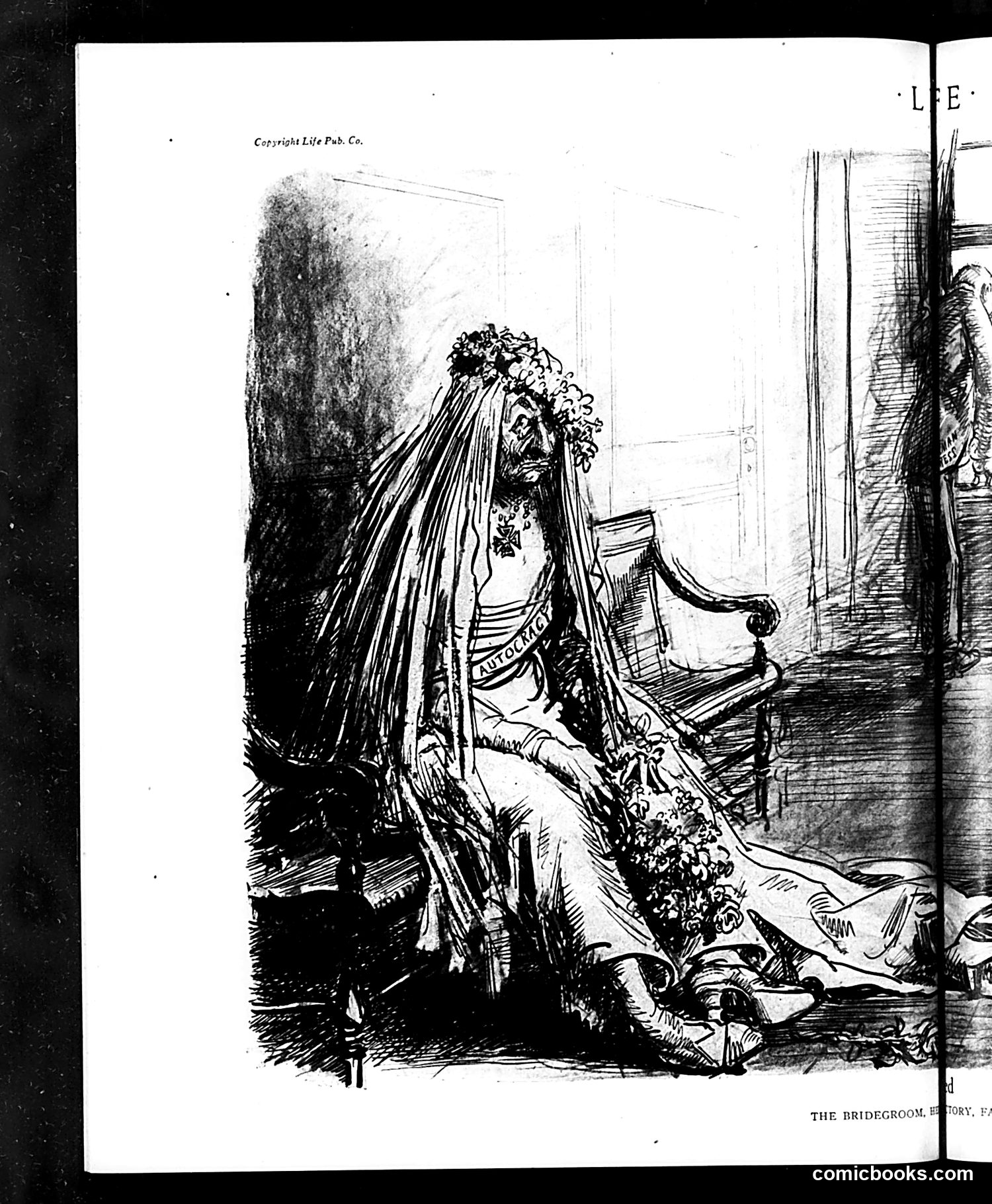
This appears to be a satirical illustration titled "The Bridegroom," published by Life magazine (copyright visible). The sketch depicts a richly dressed figure in ornate clothing with an elaborate veil and flowers, seated in an interior setting. The drawing style and composition suggest social satire, likely mocking either: - A wealthy or aristocratic marriage arrangement - Excessive extravagance in wedding pageantry - Possibly gender or class commentary However, without a legible date, artist signature, or complete caption text, I cannot definitively identify the specific political figure, historical event, or satirical target this references. The illustration's meaning would depend on contemporary context from the issue—who "the bridegroom" represents and what contemporary event or person is being lampooned remains unclear from the visible information.
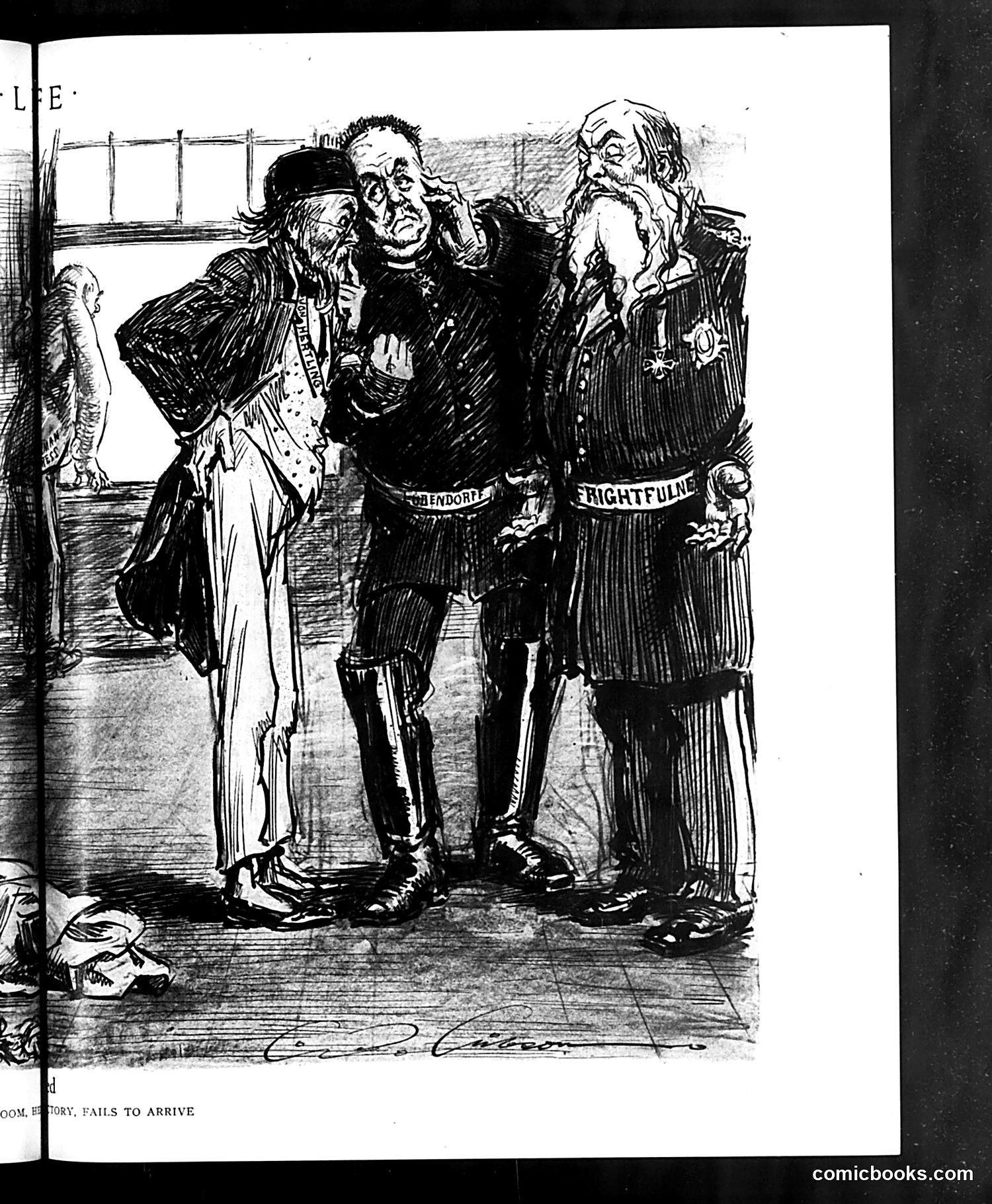
This appears to be a satirical cartoon from *Life* magazine depicting three military or political figures in formal uniforms with decorative medals and sashes. Two figures are labeled "MENDORF" and "RIGHTFULAE" on their belts. A fourth, civilian figure in white clothing stands to the left, appearing distressed or excluded from the group. The cartoon likely satirizes European political or military leadership, possibly during a period of diplomatic tension or conflict. The exaggerated facial features and caricatured drawing style are typical of *Life*'s satirical approach. The caption fragment "OOM...ITORY, FAILS TO ARRIVE" suggests someone important failed to attend a meeting or gathering, possibly critiquing diplomatic failures or political absurdity. Without the complete caption or publication date, specific identification remains unclear.
This page contains theater reviews and commentary. Key elements: **"Another Apology"** (top left): Life apologizes for quality issues due to WWI paper shortages and publishing delays caused by union strikes in the printing industry—framed as "money madness" sweeping labor unions. **Theater Reviews**: The bulk discusses three plays: - **"The Better 'Ole"**: Adapts cartoonist Bruce Bairnsfather's WWI trench humor into theater, featuring characters "Old Bill, Alf and Bert." The reviewer notes its "Tommy Atkins" (British soldier) humor may be too sophisticated for mainstream Broadway audiences but suits Greenwich Village tastes. - **"The Riddle: Woman"**: A blackmail drama adapted from Danish playwright C. Jacobi, featuring actresses Chrystal Herne and Mme. Kalich. The reviewer criticizes the performances as overly artificial despite dramatic moments. - **"Perkins"**: A comedy starring Ruth Chatterton and Henry Miller involving a will with matrimonial conditions. The satire is gentle—critiquing theatrical pretension and audience sophistication rather than politics directly.
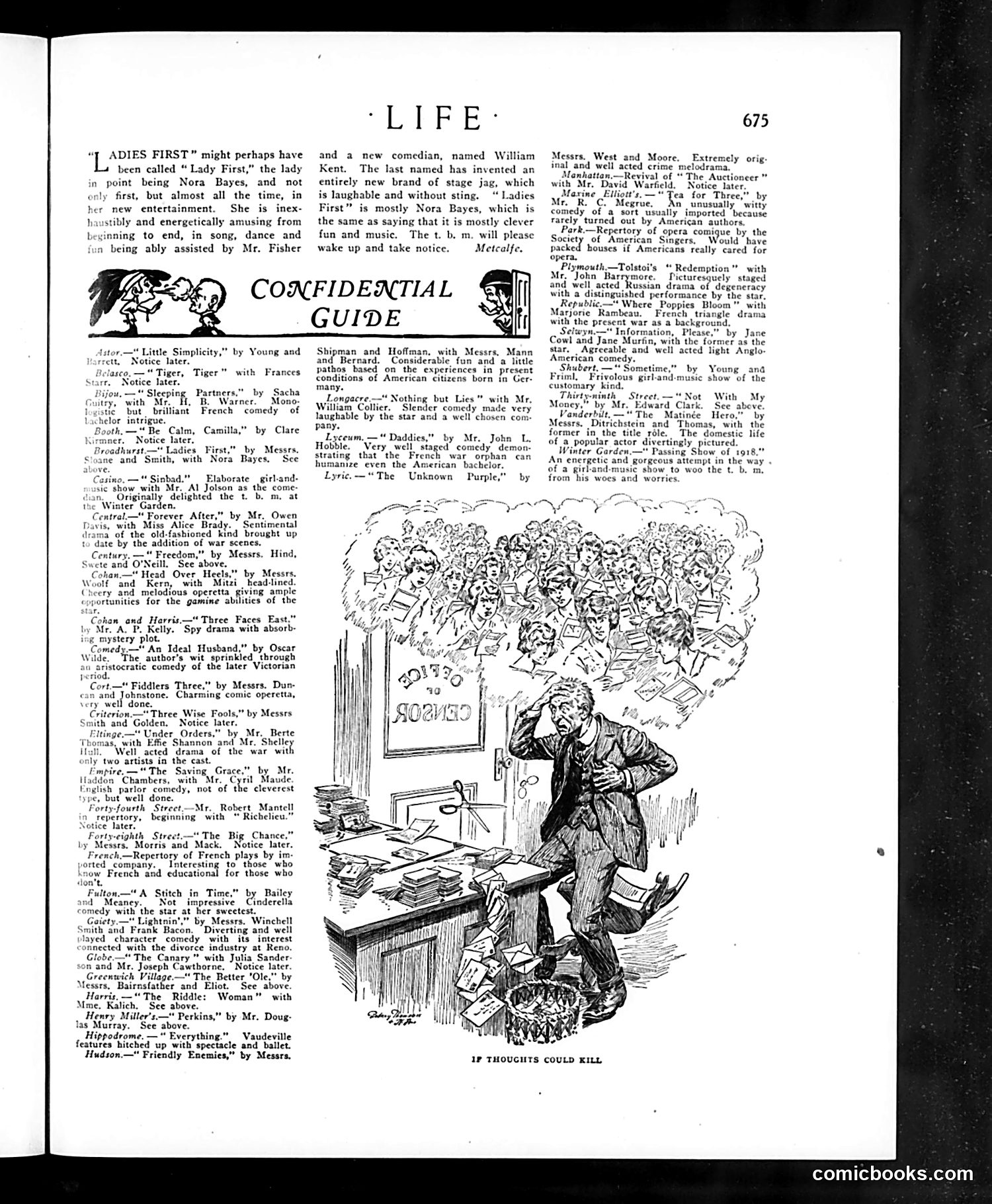
This page from *Life* magazine presents theater reviews alongside a single cartoon titled "If Thoughts Could Kill." The cartoon depicts a woman sitting at a desk surrounded by stacks of papers, appearing deeply frustrated or angry, with an explosive thought-cloud above her head containing what appears to be a chaotic crowd of figures. The cartoon satirizes the cognitive overload and mental stress of administrative or clerical work—likely referencing the growing female workforce in office settings during the early 20th century. The title's dark humor suggests that if her frustrated thoughts could materialize as violence, the consequences would be catastrophic. It's a commentary on workplace frustration and the psychological toll of tedious, paper-heavy labor, presented through the era's somewhat cynical comedic lens. The surrounding theater reviews are standard entertainment criticism unrelated to the cartoon.
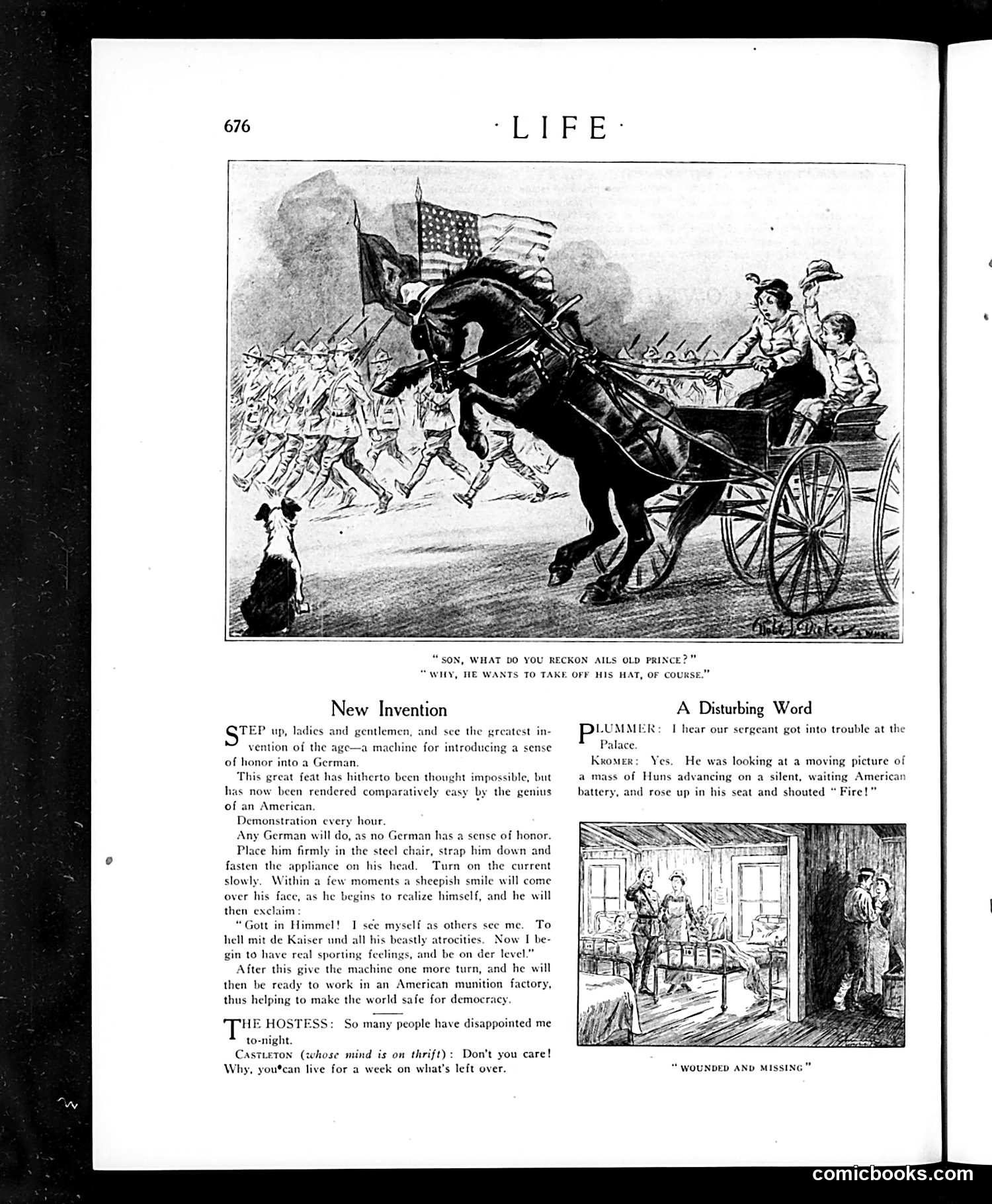
This page contains WWI-era American anti-German propaganda disguised as humor. **"New Invention"**: A satirical piece mocking Germans as inherently lacking honor. It presents a fictional "machine" that electrocutes Germans into developing morality and patriotism—implying Germans are so fundamentally deficient they require mechanical intervention. The dark joke: any German will do since "no German has a sense of honor." The punchline is that after treatment, Germans can work in American munitions factories, "making the world safe for democracy"—referencing President Wilson's WWI justification. **"A Disturbing Word"**: A brief anecdote where a sergeant watching propaganda footage of "Huns advancing" becomes so emotionally inflamed he shouts "Fire!" at the screen, unable to distinguish fiction from reality. Both segments deploy dehumanization of Germans as wartime rhetoric. The humor depends on readers accepting grotesque stereotypes about German national character as factual premises worthy of mockery.
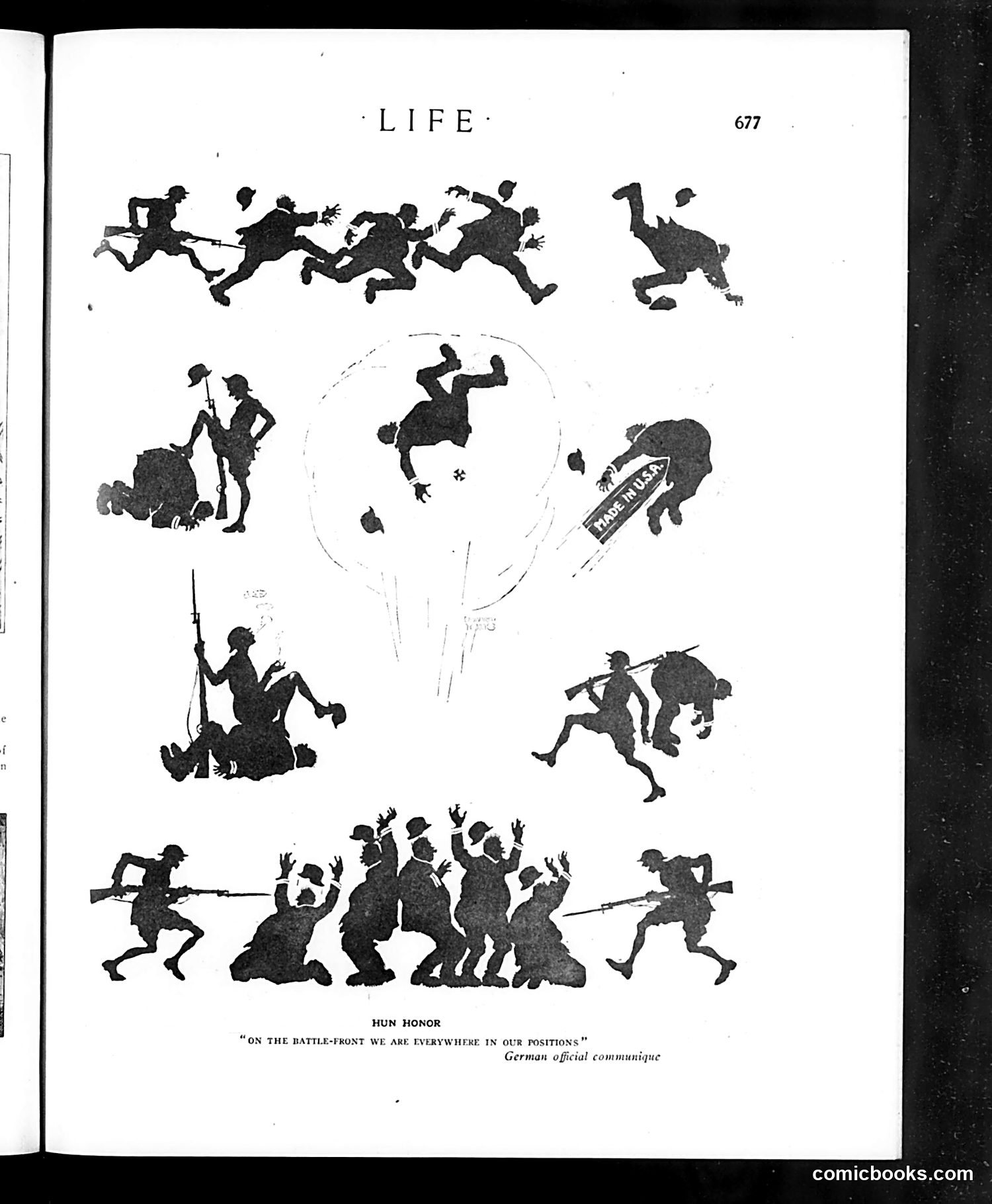
This WWI-era satirical cartoon mocks a German military communiqué claiming omnipresent battlefield strength. The silhouettes depict German soldiers engaged in various brutal activities—charging with bayonets, executing prisoners, plundering ("MADE IN GERMANY" box visible), cavalry combat, and group violence. The large skull-shaped composition frames these scenes, suggesting death and destruction as the true meaning of German military presence. The joke is bitter irony: the Germans claim to be "everywhere in our positions," but what Life's cartoonists actually show everywhere is murder, theft, and cruelty—characterizing German warfare as inherently dishonorable. This reflects American anti-German propaganda from WWI, equating German military conduct with atrocities and war crimes.
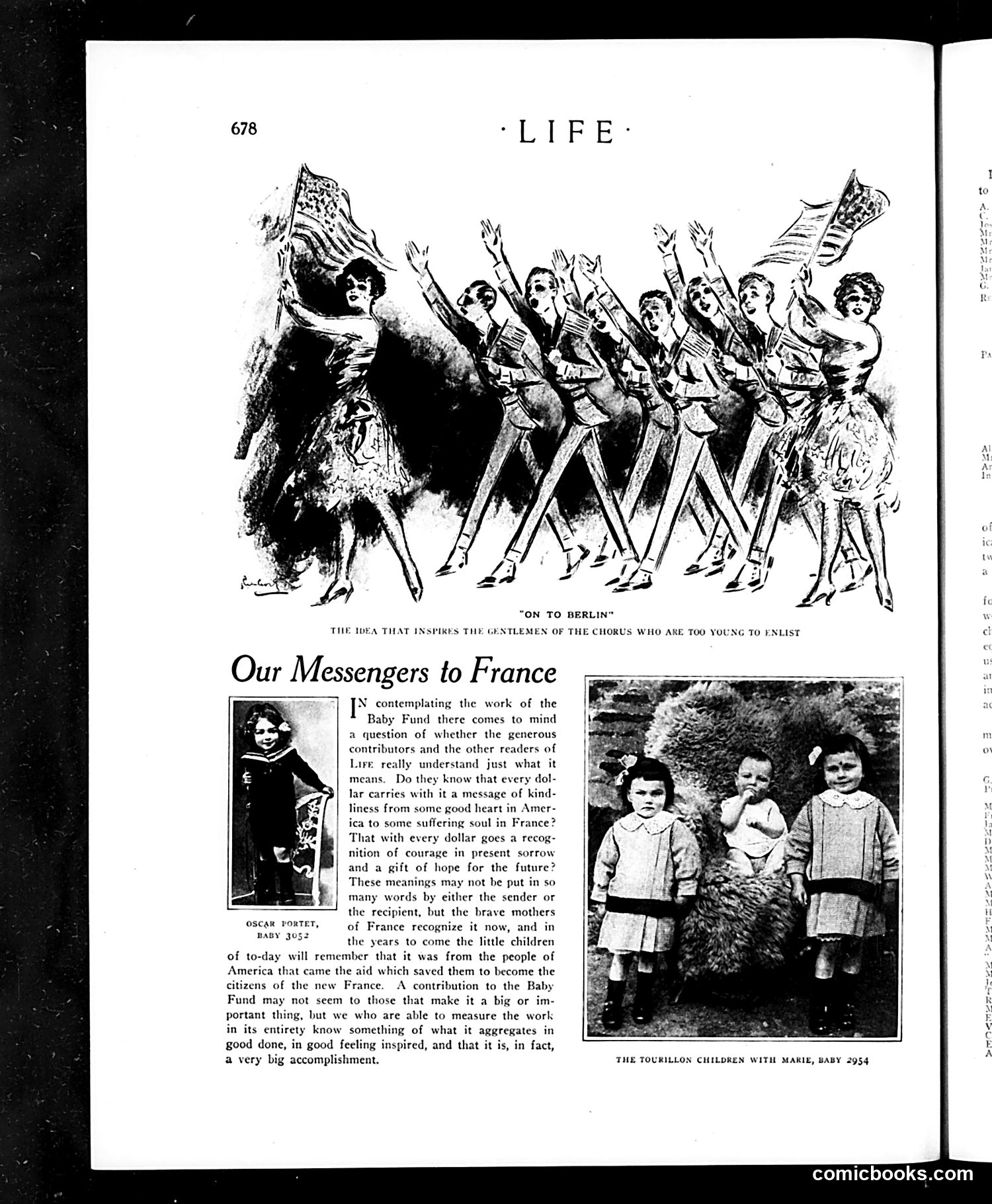
The top cartoon satirizes young men who enthusiastically embrace the slogan "On to Berlin" (attacking Germany) but are themselves too young to enlist in World War I. The chorus line of eager, dancing figures represents this disconnect—they advocate for aggressive war aims while avoiding actual military service, likely mocking their patriotic posturing as performative rather than genuine commitment. Below, "Our Messengers to France" promotes Life magazine's Baby Fund, a charitable effort supporting French children during WWI. The article argues that American donations carry symbolic meaning beyond money—each dollar represents American compassion and hope for France's future citizens. Photos of specific French children (including "Baby 2952" and "Baby 2954") personalize the appeal, making abstract charity concrete by showing actual beneficiaries of American generosity. The juxtaposition critiques empty wartime rhetoric while promoting genuine humanitarian action.
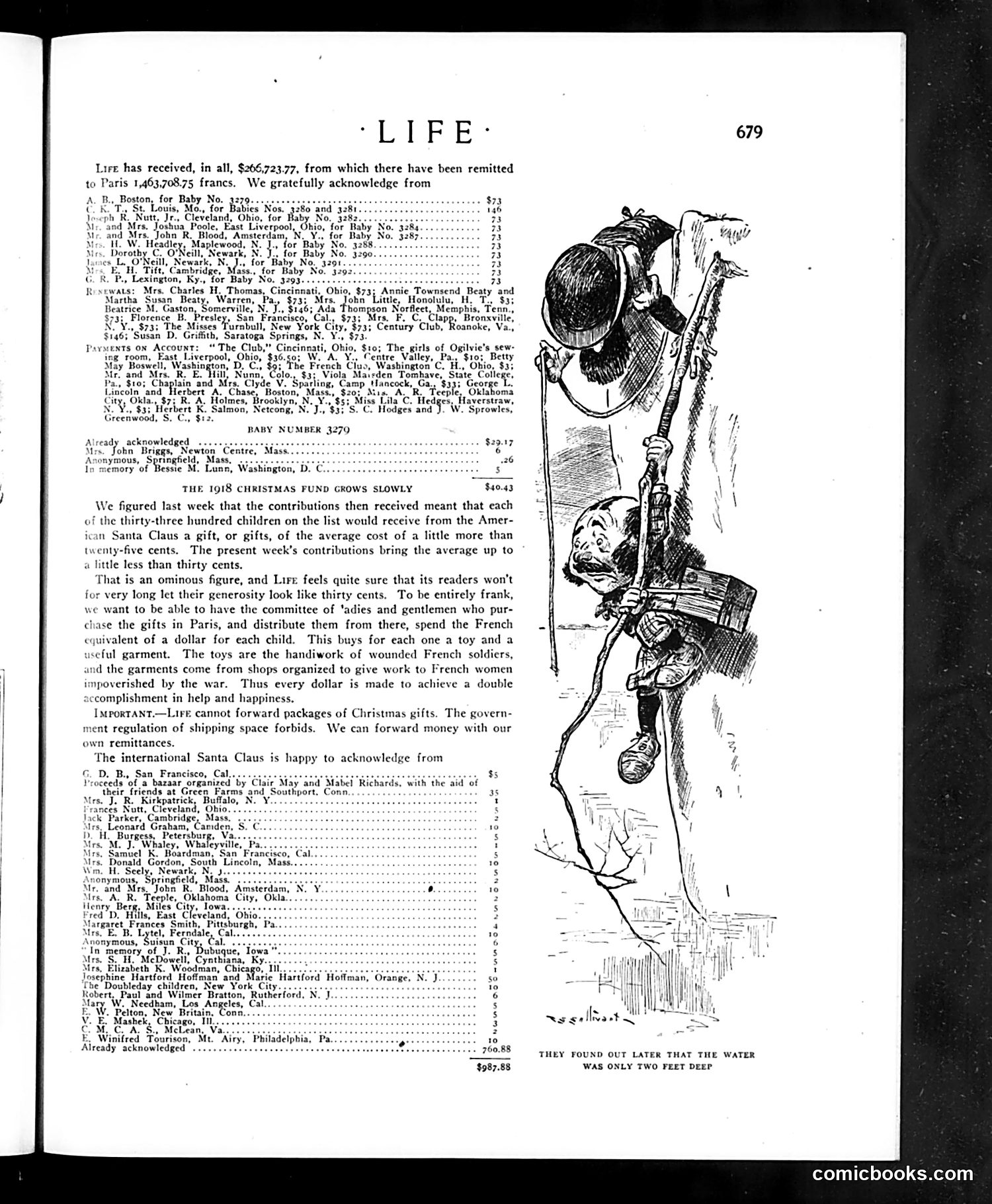
This page documents **Life magazine's charitable fundraising campaign** to send Christmas gifts to French children affected by World War I. The bulk of the page lists monetary donations received from American readers. The accompanying illustration shows **two children discovering that a well they've been drinking from is dangerously shallow**—presumably a visual metaphor for inadequate charitable efforts. The caption reads "THEY FOUND OUT LATER THAT THE WATER WAS ONLY TWO FEET DEEP." The satire critiques the insufficiency of current donations: Life notes contributions average only thirty cents per child (an "ominous figure"), when organizers hoped to spend a full dollar per child. The illustration suggests that like the shallow well, current generosity provides only surface relief to deep wartime suffering. The campaign specifically emphasized purchasing toys made by wounded French soldiers and garments from shops employing impoverished French women—maximizing humanitarian impact through strategic purchasing in Paris.
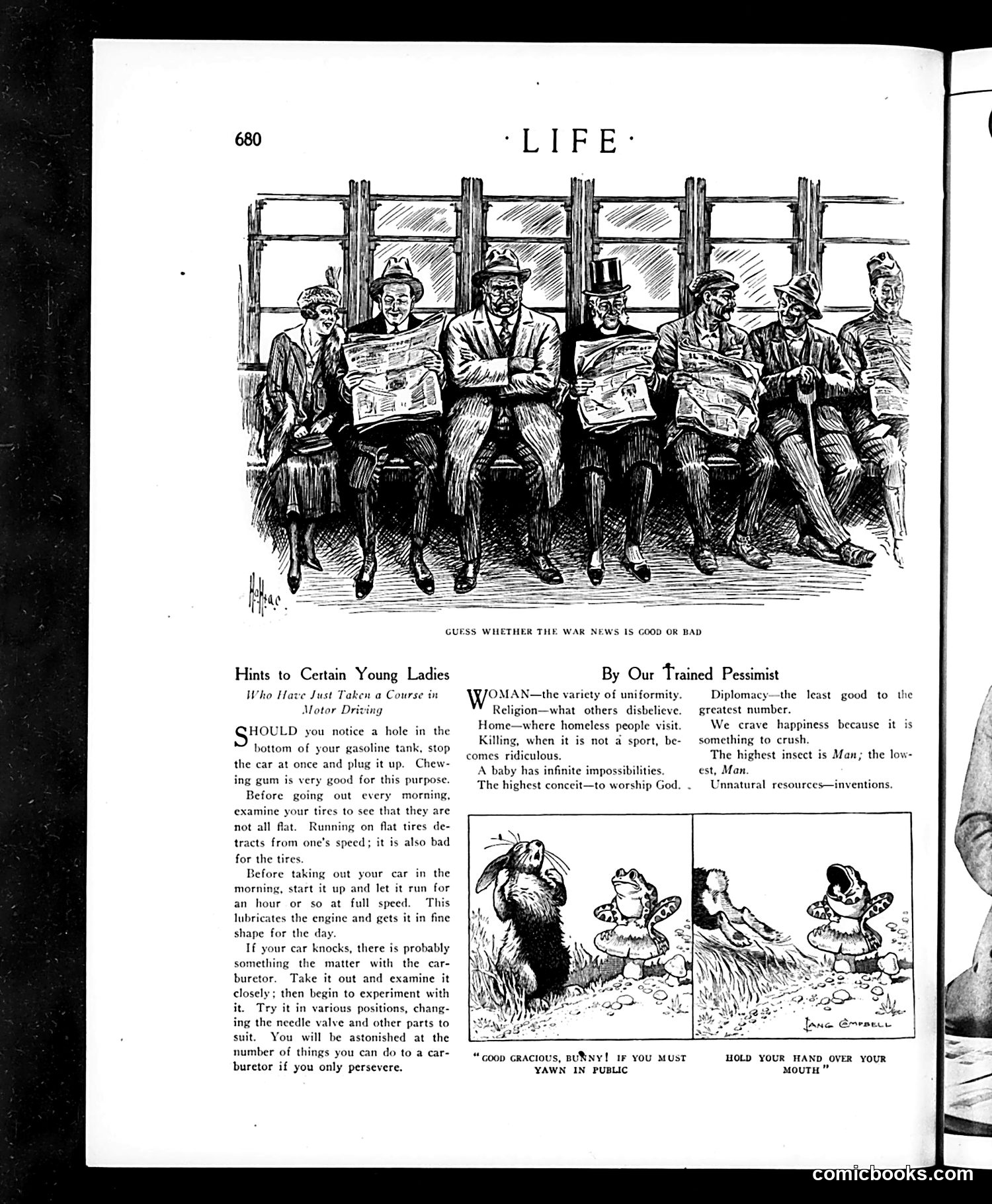
The top cartoon shows seven men on public transit reading newspapers, captioned "GUESS WHETHER THE WAR NEWS IS GOOD OR BAD." This satirizes how readers' facial expressions and body language reveal their emotional reactions to war coverage—their worried or anxious postures betray whether the news is actually favorable or grim, regardless of official claims. The "Hints to Certain Young Ladies" section humorously mocks newly licensed female drivers through deliberately terrible automotive advice: using chewing gum to plug gas leaks, running engines at full speed daily, and tinkering with carburetors without knowledge. This reflects contemporary skepticism about women's mechanical competence and suitability for driving. The "Trained Pessimist" aphorisms offer darkly cynical observations on human nature (worship as conceit, happiness as something to destroy). The bottom cartoons illustrate basic etiquette for public behavior, depicting a yawning rabbit/animal character—suggesting even animals should know civilized conduct. Overall, the page lampoons wartime anxiety, gender stereotypes about women drivers, and social pretension.
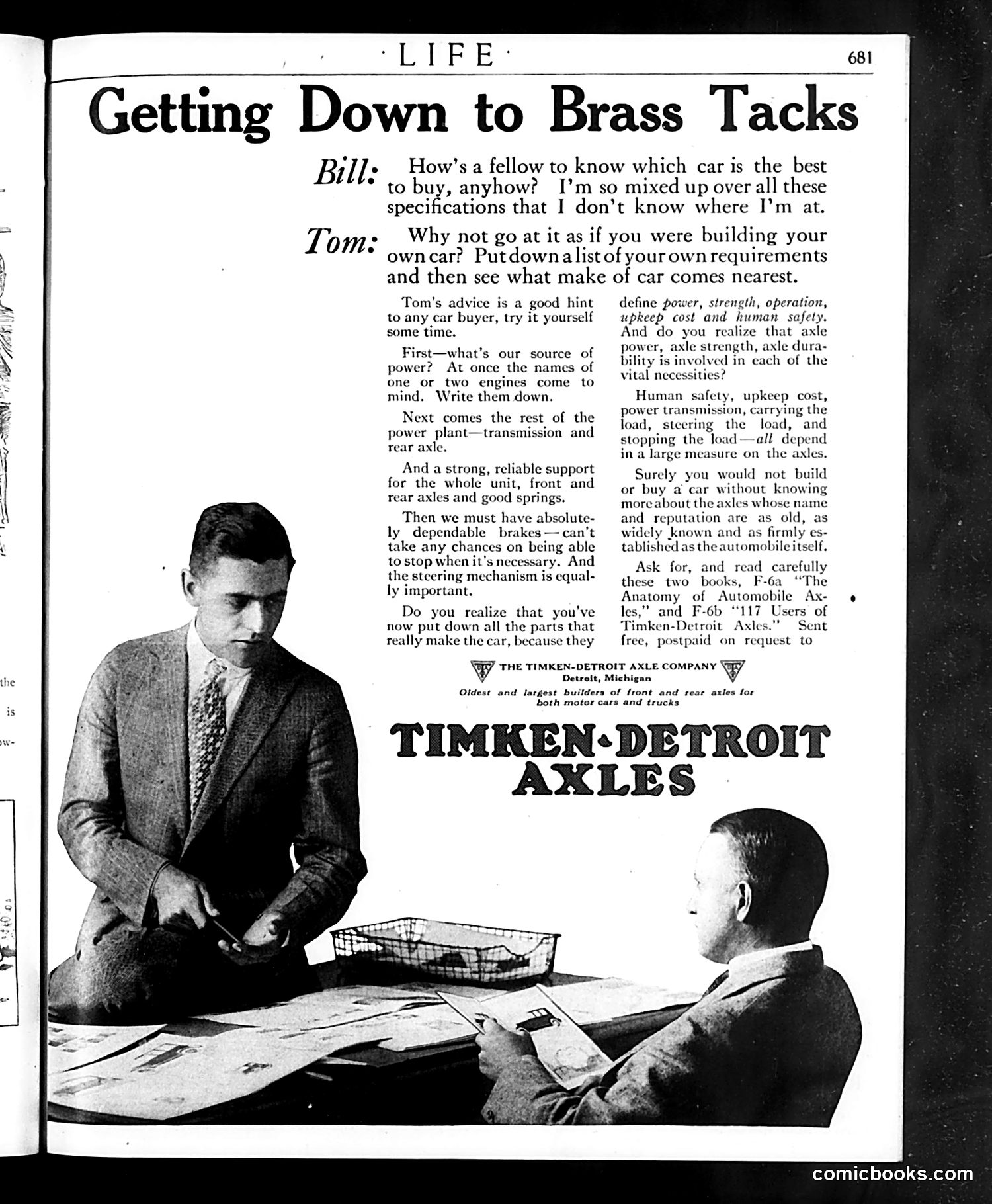
This page is primarily a **Timken-Detroit Axles advertisement** disguised as consumer advice, a common early 20th-century marketing technique. Two men ("Bill" and "Tom") discuss car-buying confusion. Tom suggests a rational approach: list your requirements, then match them to available cars. The dialogue then pivots to emphasizing that **axles are the most crucial component**—they affect safety, cost, steering, and braking. The satire is subtle: the "helpful consumer guidance" is actually a **sales pitch arguing that axle quality should dominate your car-purchasing decision**. By framing axles as foundational to all vital car functions, the ad creates urgency around what most buyers would consider a technical detail. The accompanying photograph shows two businessmen discussing specifications, reinforcing the appeal to rational, serious-minded consumers. This reflects a time when component manufacturers (not just carmakers) heavily advertised directly to consumers to influence brand preference.
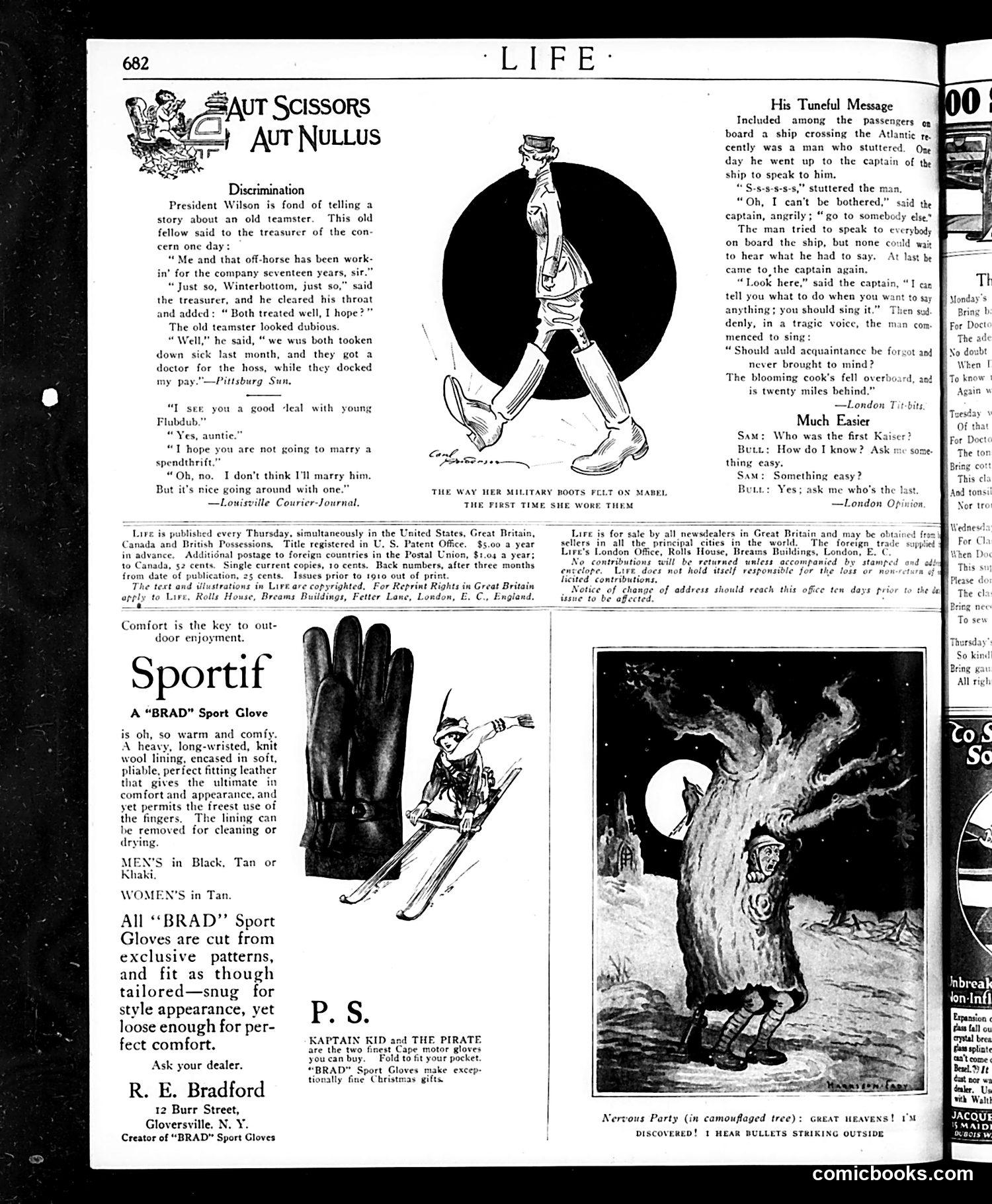
This page contains several satirical pieces typical of Life's style: **"Aut Scissors Aut Nullus" (Discrimination):** A brief anecdote mocking labor inequality—President Wilson tells a story about an old teamster and his horse who both got sick, but only the horse received a doctor while the man's pay was docked. The satire targets unfair treatment of workers compared to animals. **The Military Boots Cartoon:** A humorous illustration showing a woman's military boots felt "on Mabel the first time she wore them"—likely poking fun at women in military service or new military fashions, with the exaggerated pose suggesting the boots were uncomfortably stiff or ill-fitting. **"His Tuneful Message":** A joke about a stuttering ship passenger who tries unsuccessfully to speak to crew members, but finally communicates by singing—a pun on overcoming speech difficulties through song. The page also contains advertisements for "Sportif" gloves and other products. The humor throughout relies on observational comedy about everyday social situations rather than political commentary.
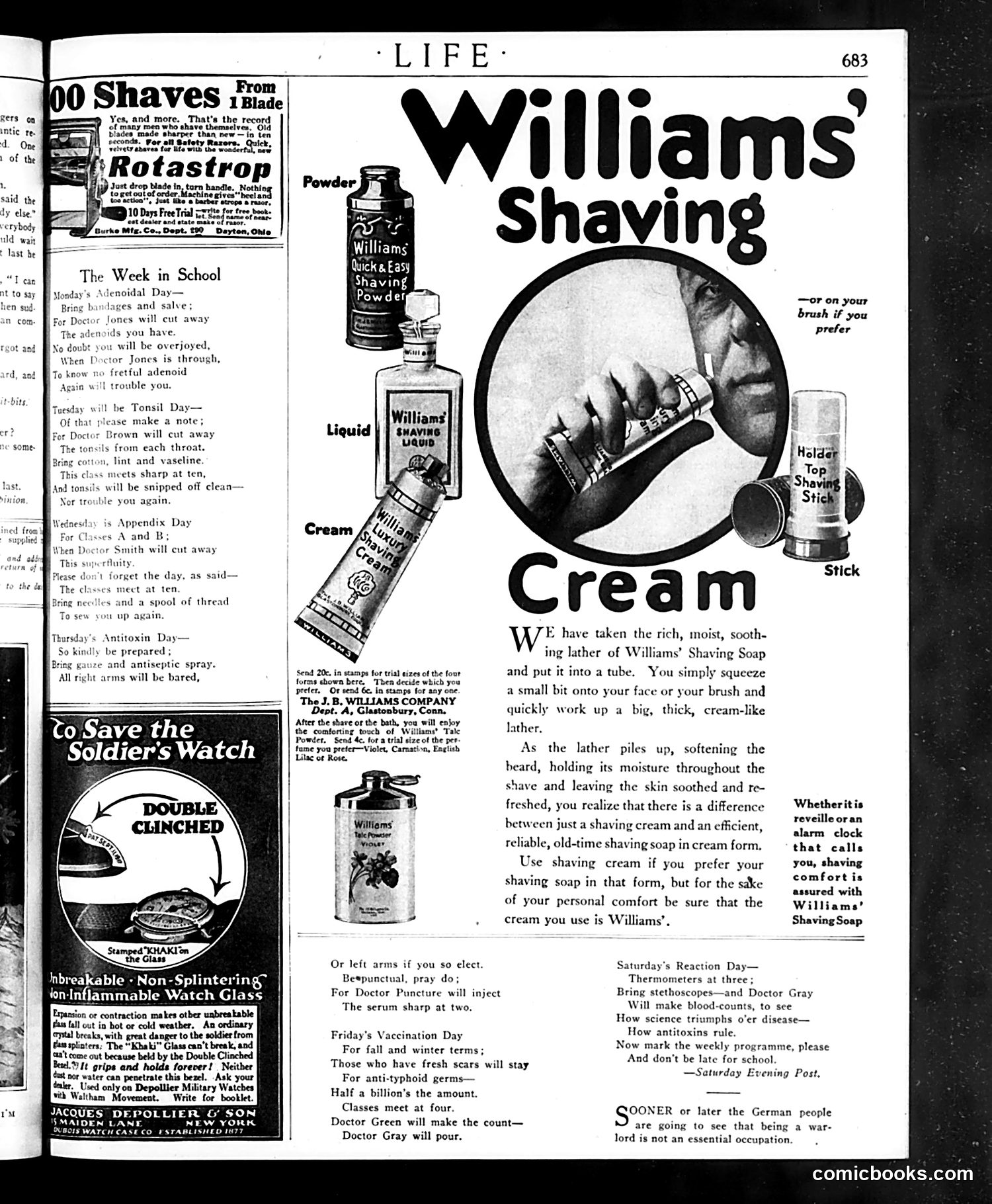
This page is primarily **advertising**, not political satire. The dominant content is a Williams' Shaving Cream advertisement featuring product shots and testimonial copy about the superiority of their cream-based shaving soap. The left column contains a humorous poem titled "The Week in School" (credited to *Saturday Evening Post*) that satirizes **mandatory medical procedures for schoolchildren**—likely during World War I era. The poem lists each weekday with a different invasive procedure: tonsil removal, appendix surgery, vaccination, and blood tests. The satire mocks the industrial, regimented approach to public health measures and military preparation, presented as inevitable school routines students must endure without complaint. The bottom advertisement promotes "Kaki" watch glass—unbreakable safety equipment apparently designed for soldiers. The page's only explicitly political line appears at the very bottom: a caption suggesting Germans will eventually recognize that militarism isn't essential—a reference to contemporary WWI attitudes.
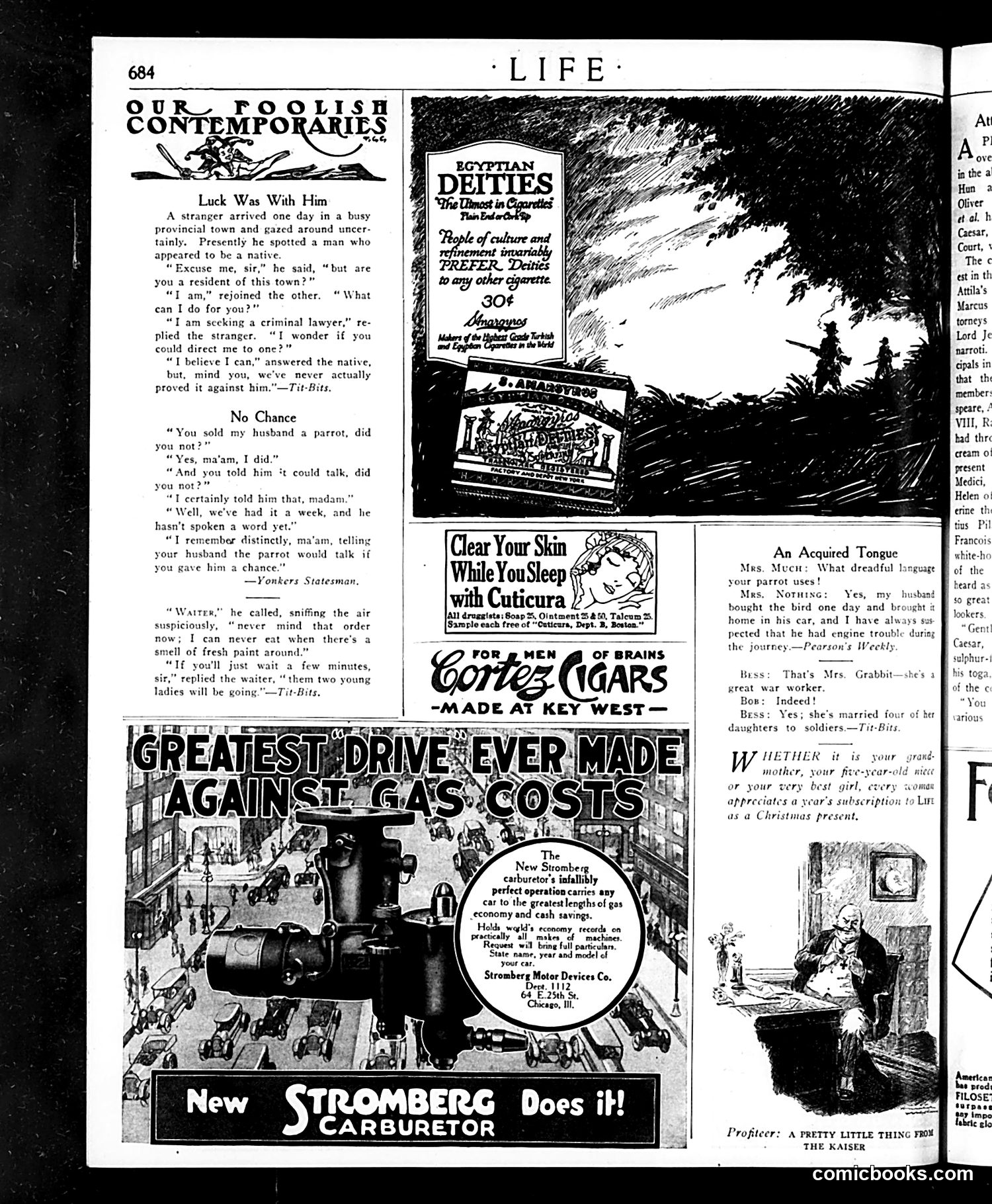
This page contains several brief satirical humor pieces typical of Life magazine's "Our Foolish Contemporaries" section, plus period advertisements. **The humor pieces** are short jokes about everyday situations: a stranger seeking a criminal lawyer in a small town (where the locals can't prove guilt against their own lawyer); a customer complaining a purchased parrot won't talk; a diner bothered by fresh paint smell; and a woman whose parrot uses "dreadful language" acquired from her husband's car troubles. **The advertisements** include vintage products (Cuticura skin cream, Cortez cigars, Stromberg carburetors) positioned as solutions to modern life's inconveniences. **The "Profiteer" cartoon** (bottom right) appears to reference wartime profiteering—a "pretty little thing from the Kaiser," likely satirizing merchants who exploited patriotic sentiment or war conditions for profit. The page reflects early-20th-century middle-class anxieties: social embarrassment, consumer purchases, and wartime opportunism. The humor relies on wordplay and situational irony rather than visual caricature.
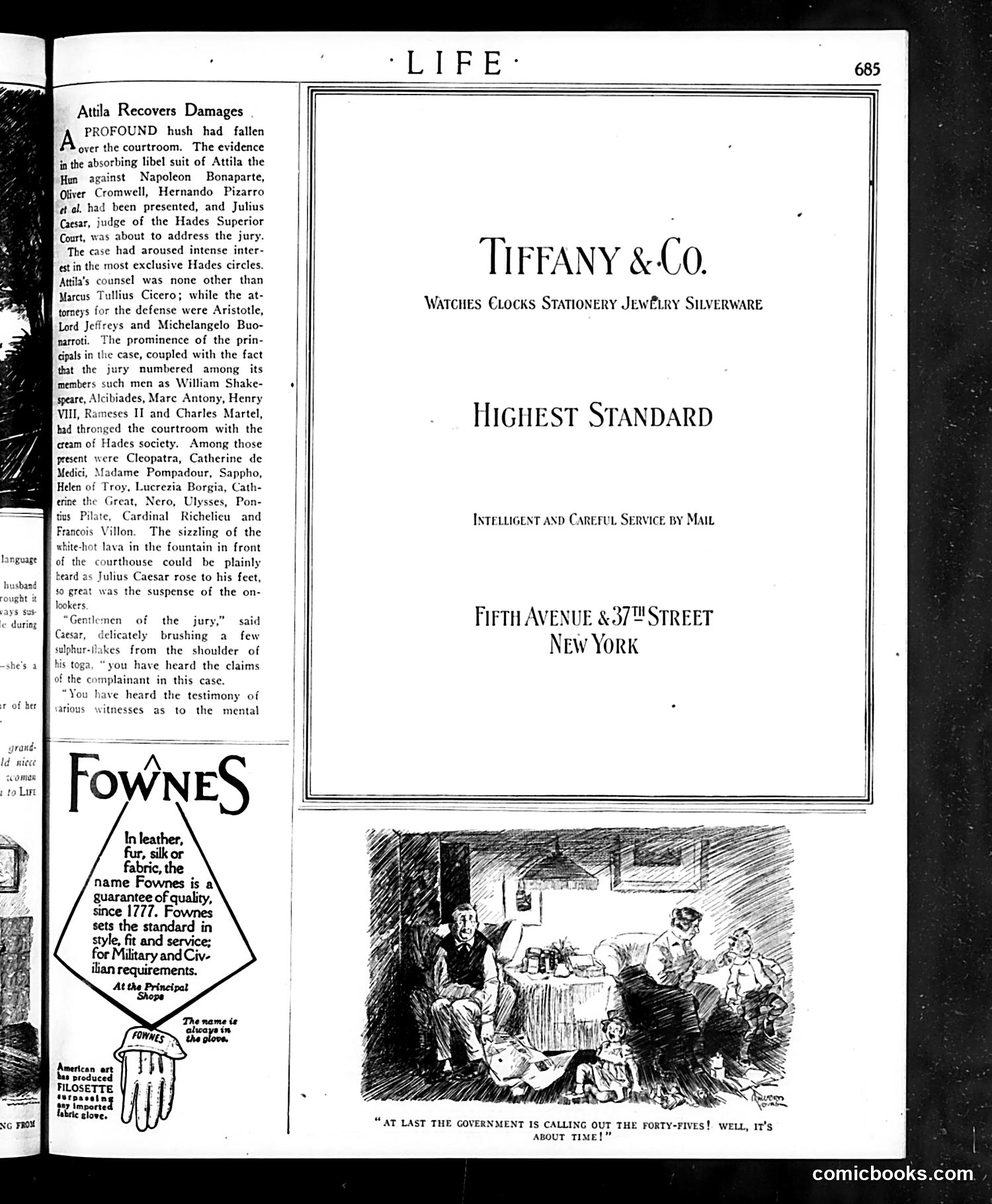
This page combines satirical fiction with period advertising. The main content is "Attila Recovers Damages," a humorous story imagining a libel trial in the underworld, presided over by Julius Caesar. The "jury" and "witnesses" consist entirely of famous historical figures known for violence or moral transgression—from Attila the Hun to Nero to Lucrezia Borgia—creating absurdist comedy through incongruity. The satire appears to mock legal proceedings by populating them with history's most disreputable figures as if they were upstanding citizens. The cartoon at bottom, captioned about "calling out the forty-fives," likely references military mobilization, possibly during World War I era (when Life was actively satirizing military matters). The page also features luxury advertisements (Tiffany & Co., Fownes gloves), typical of Life's upscale readership. The precise satirical target of the main story remains somewhat unclear without full context.
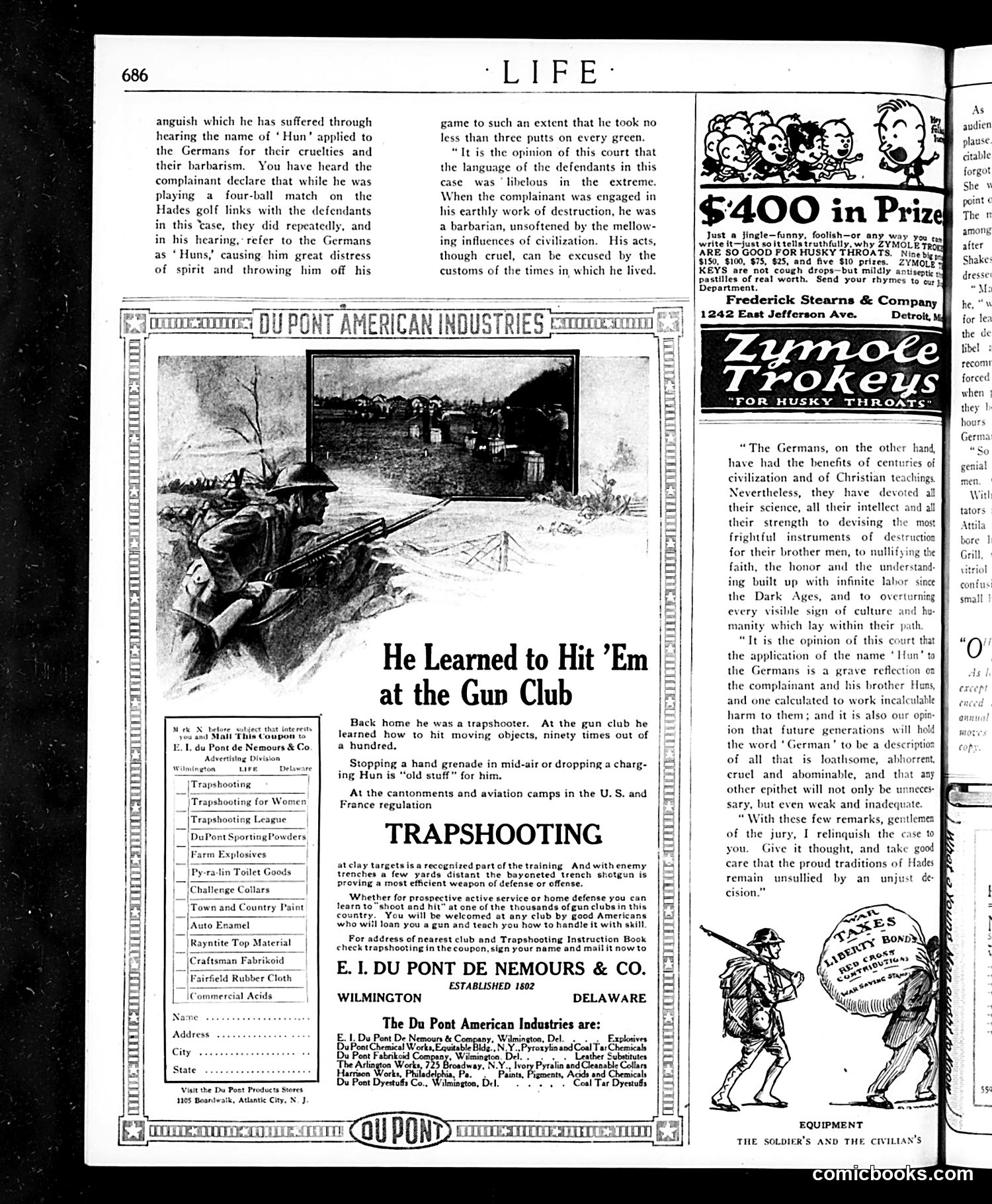
This page mixes satirical content with WWI-era propaganda advertising. The main cartoon titled "He Learned to Hit 'Em at the Gun Club" uses dark humor: it depicts a man who learned to trap-shoot becoming skilled at hitting moving targets—the implicit reference being that these "skills" now apply to killing enemy soldiers. The text column to the left contains a faux legal proceeding mocking German complaints about being called "Huns" during wartime. The court "opinion" sarcastically argues that calling Germans "Huns" is actually *justified* given their conduct—a rhetorical device defending anti-German wartime rhetoric. The adjacent Du Pont advertisement for trapshooting promotes their ammunition while framing recreational shooting as patriotic preparation for military service or home defense. **Context**: This reflects 1917-1918 America's wartime hostility toward Germany and German-Americans, when calling the enemy "Huns" was standard propaganda language. The page weaponizes satire to reinforce national sentiment and normalize violence.
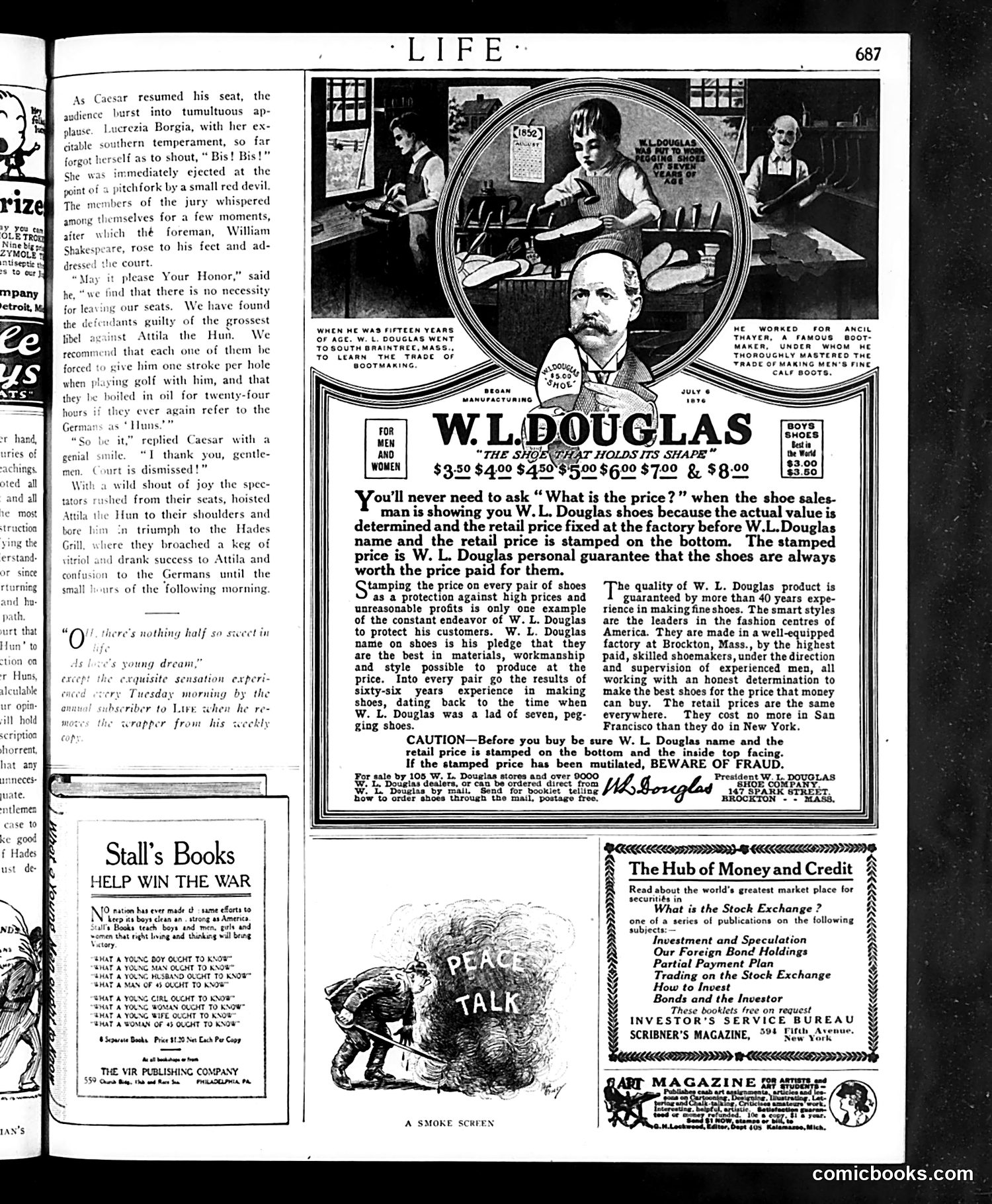
This page contains a satirical story about a mock trial of Attila the Hun, featuring famous historical and literary figures (Caesar, Lucrezia Borgia, William Shakespeare) as jury members and judges. The narrative—visible in the left column—describes their verdict that Attila is guilty and should be punished. The story's absurdist humor relies on anachronistically placing these historical figures in a modern courtroom. However, **the page is dominated by a full-page W.L. Douglas shoe advertisement**—not political satire. The ad emphasizes the brand's quality guarantee: the retail price is stamped on every shoe's bottom, protecting consumers against fraud and price-gouging. The advertisement includes testimonials about Douglas's 60+ years of shoemaking expertise and reassures readers that prices are uniform nationwide. The small advertisements below (Stall's Books, "The Hub of Money and Credit," Art Magazine) are secondary. This appears to be primarily a **commercial page** with embedded entertainment content.
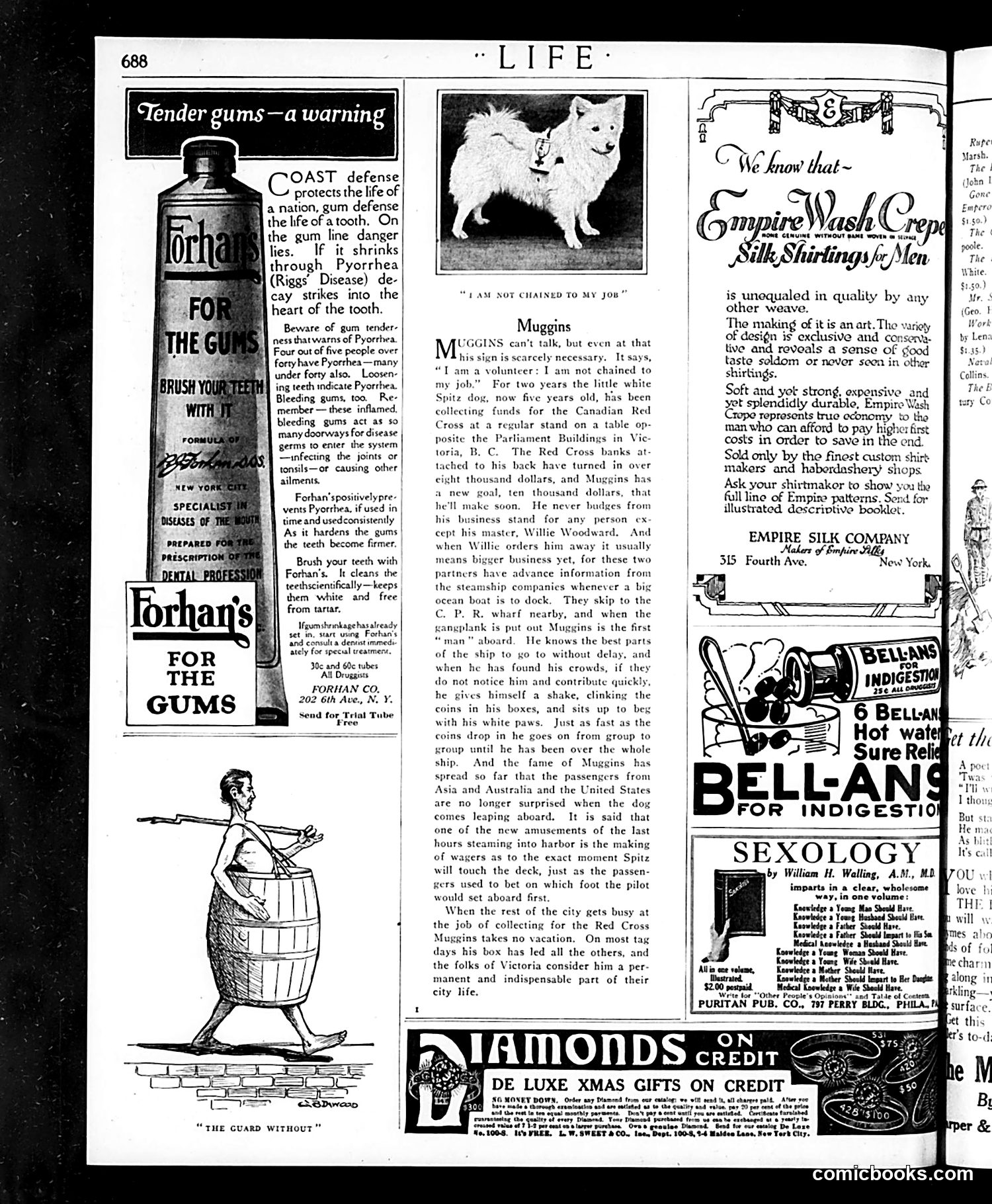
This page features a heartwarming human-interest story about **Muggins, a small white Spitz dog** who fundraises for the Canadian Red Cross in Victoria, B.C. The dog collects donations from passersby and notably boards steamships to solicit from passengers, having raised thousands of dollars over two years. The caption "I Am Not Chained to My Job" is Muggins's humorous self-description—emphasizing his volunteer status and dedication. The piece celebrates the dog's reliability and work ethic, noting he never abandons his post except on orders from his master, Willie Woodward. This reflects early-20th-century sentimentality about animal loyalty while promoting charitable giving during economically uncertain times. The story humanizes fundraising and suggests even a dog can contribute meaningfully to society—a message resonating with readers during the period. The remainder of the page contains advertisements for dental care, silk products, and other consumer goods typical of Life magazine's advertising model.
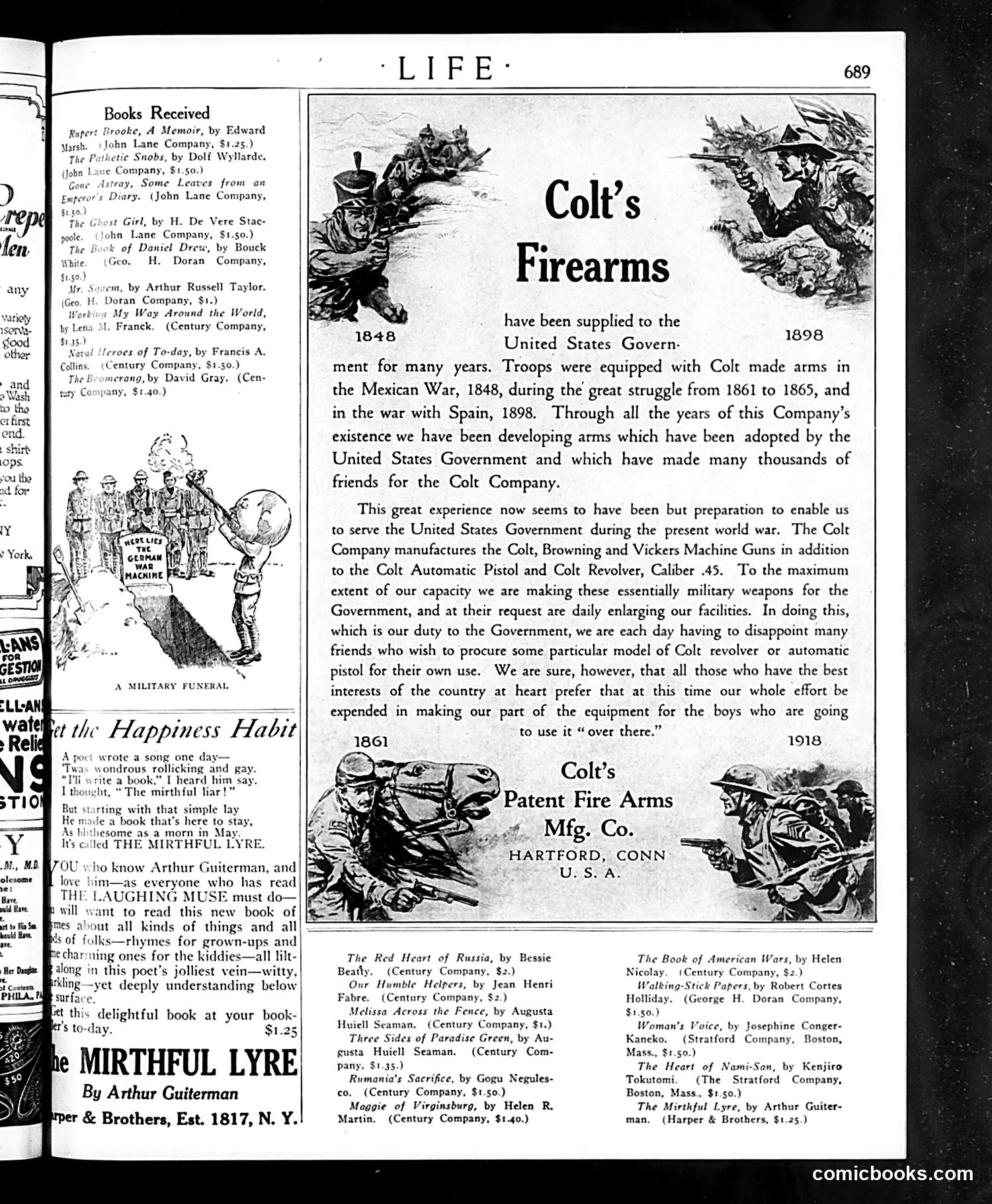
This page is primarily a **Colt Firearms advertisement**, not satire. The main content is a corporate statement from Colt's Patent Fire Arms Mfg. Co. (Hartford, Connecticut) explaining their wartime production efforts during World War I (referenced as "the present world war"). The advertisement emphasizes Colt's history supplying weapons to the U.S. Government since the Mexican War (1848) through the Spanish-American War (1898), positioning the company as a patriotic defense contractor. The text explicitly states they're now manufacturing machine guns and pistols at "maximum capacity" for the Government, and apologizes to civilian customers for being unable to fulfill private orders—framing this patriotic sacrifice as a duty. The small cartoon labeled "A MILITARY FUNERAL" appears unrelated satirical content, but the page is predominantly commercial messaging dressed in patriotic language aimed at readers during WWI.
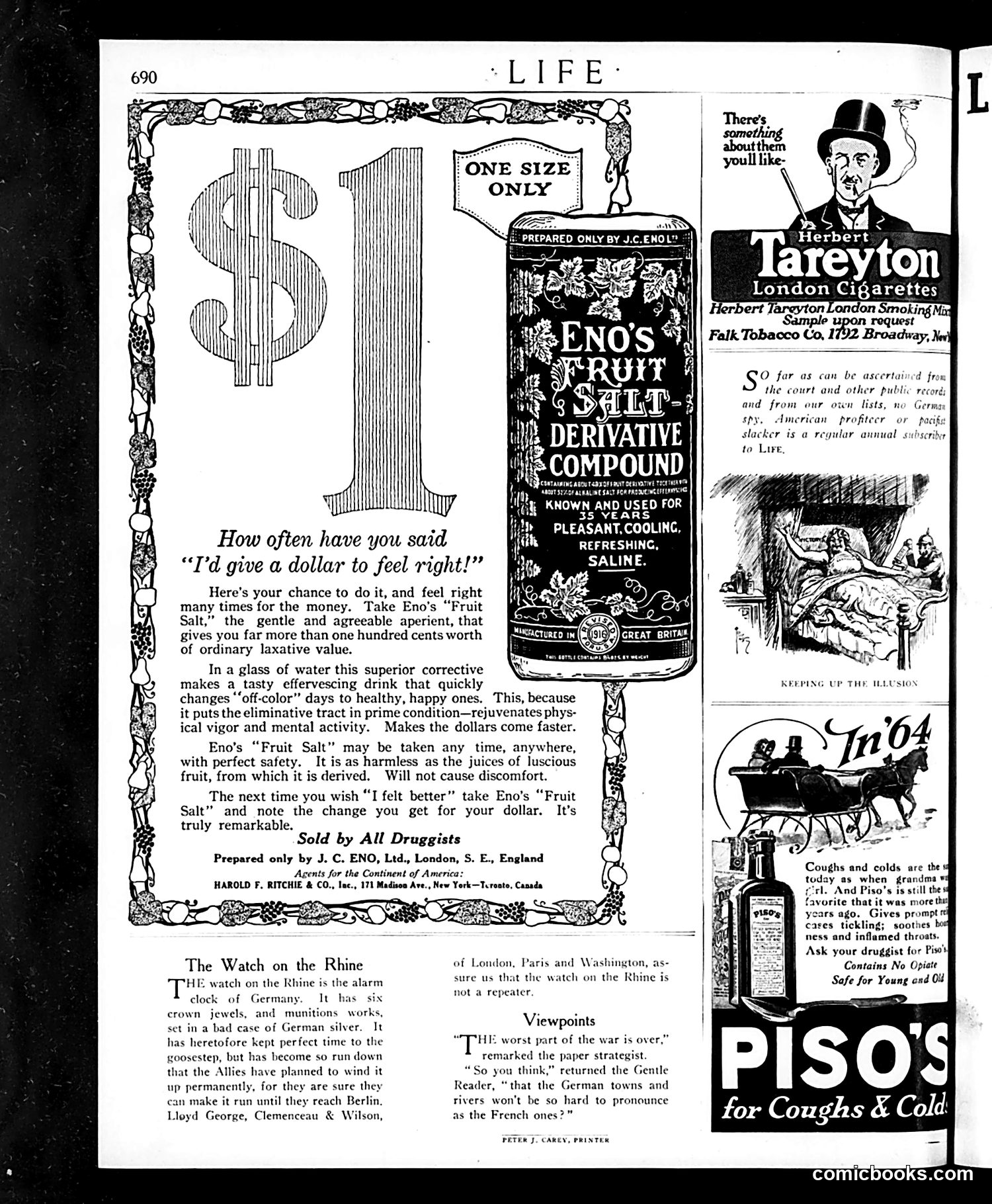
This page mixes advertisements with satirical commentary on World War I. The main cartoon, "The Watch on the Rhine," uses a clock metaphor to mock Germany's military infrastructure. A "watch" with "crown jewels" and "munitions works" in a "bad case of German silver" represents Germany itself—now "run down" and destined to be wound up permanently by the Allies (Lloyd George, Clemenceau, and Wilson). The punchline jokes that it's "not a repeater," meaning Germany won't rise again after defeat. The "Viewpoints" section offers tongue-in-cheek commentary: a strategist claims "the worst part of the war is over," but a reader sarcastically counters that pronouncing German town and river names will prove easier than French ones—mocking both the ongoing conflict and linguistic difficulty. The advertisements for Eno's Fruit Salt and Piso's cough medicine are period-typical medicinal pitches, unrelated to the satire. The Herbert Tareyton cigarette ad features a well-dressed gentleman.