
Life, 1918-11-07 · page 10 of 36
Life — November 7, 1918 — page 10: what you’re looking at
What you’re looking at
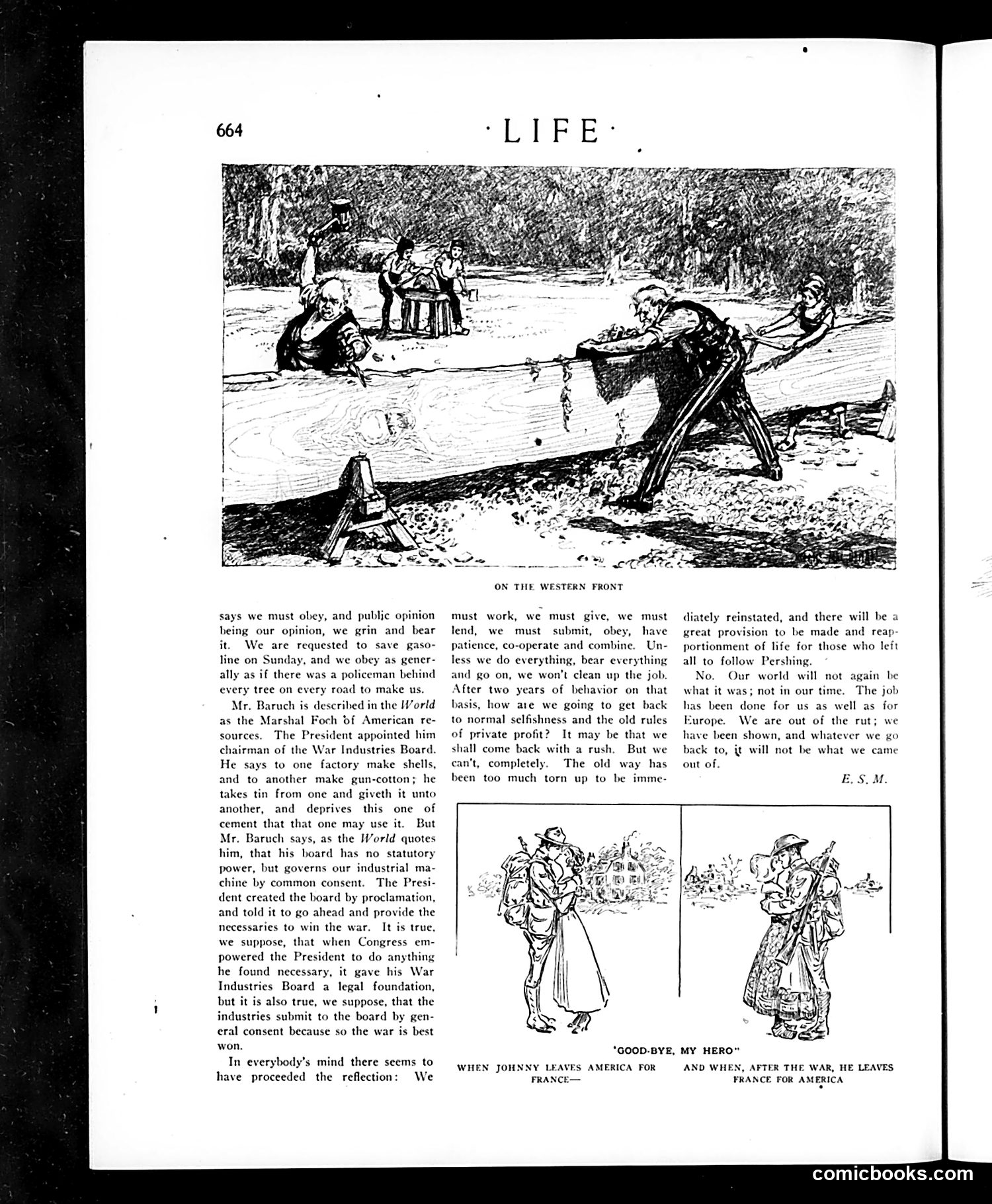
This page features a WWI-era cartoon titled "On the Western Front" depicting soldiers in a trench scene. The accompanying text discusses industrial mobilization for war, referencing Mr. Baruch (likely Bernard Baruch, head of the War Industries Board) and debates over governmental control versus private profit in wartime production. The two smaller illustrations at bottom show a soldier departing for France ("Good-bye, My Hero") and his return after the war. These contrast the enthusiastic send-off with the soldier's reintegration home, likely satirizing changing attitudes toward returning veterans or the gap between wartime patriotism and peacetime treatment. The overall message critiques the tension between collective sacrifice ("we must work, we must give") and preserving private interests during wartime mobilization.
📄 Transcribed text from this page (OCR, searchable)
Machine-transcribed from the original scan — historical spelling and the odd misread are preserved.
being our opinion, we grin and bear it. We are requested to save gaso- line on Sunday, and we obey as gener- ally as if there a policeman behind every tree on eve Mr. Baruch is described in the World as the Marshal Foch of American re- sources. The President appointed him chairman of the War Industries Board. He says to one factory make shells, and to another make gun-cotton; he takes tin from one and giveth it unto another, and deprives this one of cement that that one may use it. But Mr. Baruch says, as the World quotes him, that his board has no statutory power, but governs our industrial ma- chine by common consent. The Presi- dent created the board by proclamation, and told it to go ahead and provide the necessaries to win the war. It is true, we suppose, that when Congress em- powered the President to do anything he found necessary, it gave his War Industries Board a legal foundation, but it is also true, we suppose, that the industries submit to the board by gen- eral consent because so the war is best ly’s mind there seems to have proceeded the reflection: We ON THE WESTERN FRONT must work, we must give, we must lend, we must submit, obey, have nce, co-operate and combine. Un- less we do everything, bear everything and go on, we won't clean up the job. After two years of behavior on that basis, how are we going to get back to normal selfishness and the old rules of private profit? It may be that we shall come back with a rush, But we can't, completely. The old way has been too much torn up to be imme- diately reinstated, and there will be a great provision to be made and reap portionment of life for those who left all to follow Pershing. No. Our world will not a what it was; not in our time. The job has been done for us as well as for Europe. We are out of the rut; we have been shown, and whatever we go back to, it will not be what we came out of. ain be E,S.M. ‘GOOD-BYE, MY HERO” ES AMERICA FOR FRANCE— WHEN JOHN AND WHEN, AFTER THE WAR, HE LEAVES FRANCE FOR AMERICA comicbooks.com