
Life, 1918-11-07 · page 9 of 36
Life — November 7, 1918 — page 9: what you’re looking at
What you’re looking at
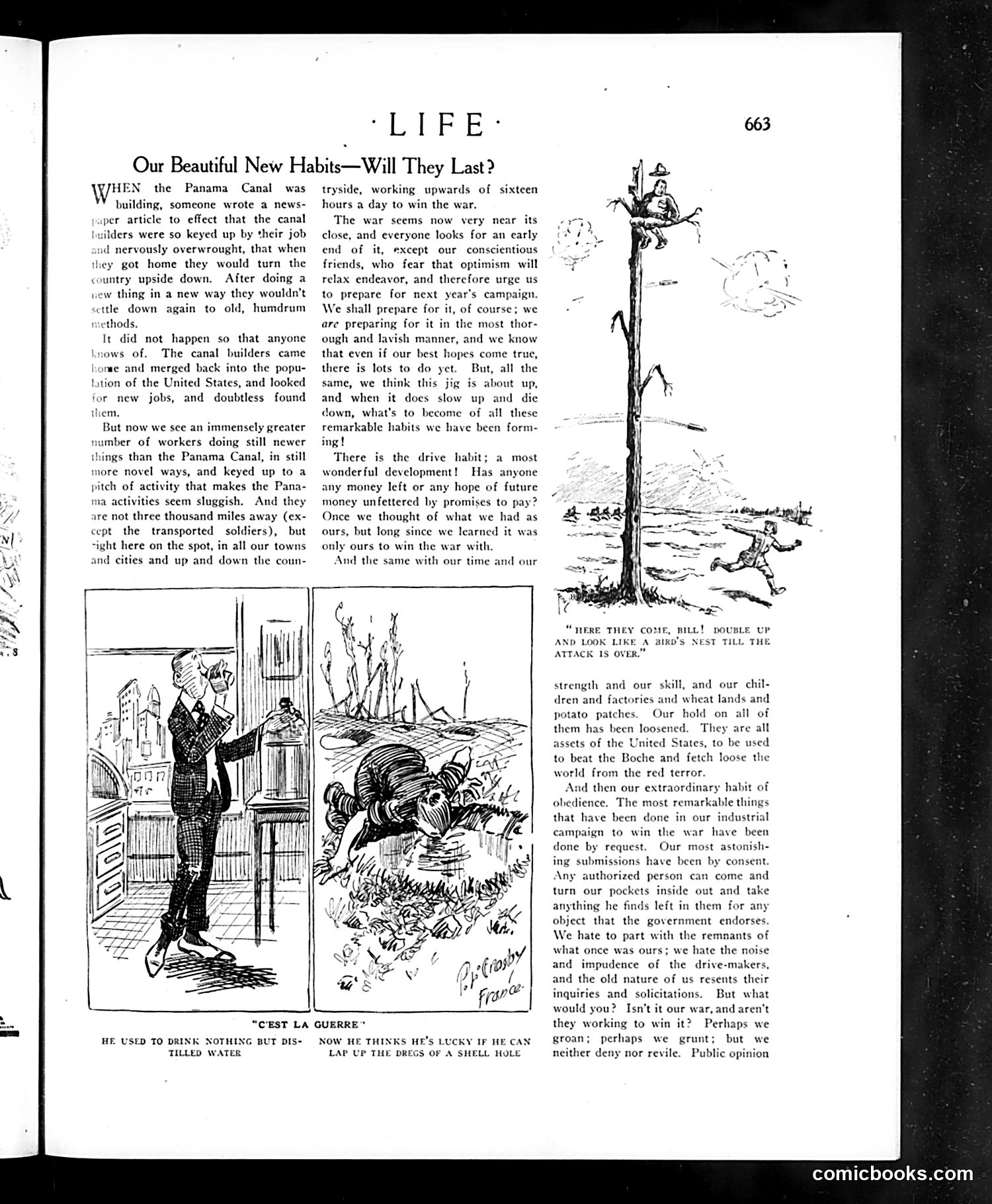
This 1918 Life magazine page satirizes American wartime habits and attitudes during World War I. The title "Our Beautiful New Habits—Will They Last?" questions whether wartime behavioral changes will persist after the conflict ends. The cartoons illustrate specific wartime adaptations: one shows someone drinking distilled water instead of other beverages (likely referencing Prohibition efforts), while another depicts military discipline becoming normalized in civilian life. The main text argues that extraordinary habits—like industrial efficiency, obedience to authority, and sacrifice—were adopted to "win the war." The author expresses doubt these habits will survive peacetime, musing whether Americans will return to pre-war complacency or maintain their newfound discipline and unity. The satire critiques American inconsistency and questions whether wartime unity can translate into lasting social improvement.
📄 Transcribed text from this page (OCR, searchable)
Machine-transcribed from the original scan — historical spelling and the odd misread are preserved.
‘LIFE* Our Beautiful New Habits—Will They Last? s\ HEN the Panama Canal was building, someone wrote a news- per article to effect that the canal ders were so keyed up by their job nd nervously overwrought, that when they got home they would turn the country upside down, After doing a thing in a new way they wouldn't ttle down again to old, humdrum methods. It did not happen so that anyone nows of. The canal builders came hore and merged back into the popu- lation of the United States, and looked for new jobs, and doubtless found m. But now we sce an immensely greater number of workers doing still newer things than the Panama Canal, in still more novel ways, and keyed up to a pitch of activity that makes the Pan: ma activities seem sluggish. And they ire not three thousand miles away (ex- cept the transported soldiers), but sight here on the spot, in all our towns and cities and up and down the coun- tryside, working upwards of sixteen hours a day to win the war. The war seems now very near its close, and everyone looks for an early end of it, except our conscientious friends, who fear that optimism will relax endeavor, and therefore urge us to prepare for next year’s campaign. We shall prepare for it, of course; we are preparing for it in the most thor- ough and lavish manner, and we know that even if our best hopes come true, there is lots to do yet. But, all the same, we think this jig is about up, and when it docs slow up and die down, what's to become of all these remarkable habits we have been form- ing! There is the drive habit; a most wonderful development! Has anyone any money left or any hope of future money unfettered by promises to pay? Once we thought of what we had as ours, but long since we learned it was only ours to win the war with. And the same with our time and our “C'EST LA GUERRE” HE USED TO DRINK NOTHING BUT DIS- TILLED WATER NOW HE THINKS HE'S LUCKY IF HE CAN LAP UP THE DREGS OF A SHELL HOLE “WERE THEY COME, BILL! DOUBLE UP AND LOOK LIKE A BIRD'S NEST TILL THE ATTACK 1S OVER.” strength and our skill, and our chil- dren and factories and wheat lands and potato patches. Our hold on all of them has been loosened. They are all assets of the United States, to be used to beat the Boche and fetch loose the world from the red terror. And then our extraordinary habit of obedience, The most remarkable things that have been done in our industrial campaign to win the war have been done by request. Our most astonish- ing submissions have been by consent. Any authorized person can come and turn our pockets inside out and take anything he finds left in them for any object that the government endorses. We hate to part with the remnants of what once was ours; we hate the noise and impudence of the drive-makers, and the old nature of us resents their inquiries and solicitations. But what would you? Isn't it our war, and aren't they working to win it? Perhaps we groan; perhaps we grunt; but we neither deny nor revile. Public opinion comicbooks.com